Monday, May 21, 2012

Galaxies in the Young Cosmos

Now you don't see it; now you do - the image of a galaxy from a time when the universe was only a billion years old. The left image, from Hubble, sees nothing in the sky, but the longer wavelength infrared image from Spitzer (right) sees a bright source. The intense star formation activity in the galaxy, its distance, and the expansion of the universe combine to make it appear in the infrared. Credit: K. Caputi. Low Resolution Image (jpg)

Cambridge, MA - The universe was born about 13.7 billion years ago in the big bang. The Sun and its system of planets formed about five billion years ago. What happened, then, during that long, intervening stretch of nearly nine billion years? This is one of the key questions in modern science. Astronomers think that the very first stars and galaxies appeared only a few hundreds of millions of years after the big bang, and have been evolving ever since. They must have been quite different from the stars and galaxies of today, however, in part because the young universe lacked most of the chemical elements present today - those elements were made gradually in the nuclear furnaces of those stars.

Modern telescopes and infrared and submillimeter techniques have recently enabled astronomers to spot significant numbers of very distant galaxies and begin to piece together a picture of cosmic evolution. Galaxies often undergo bursts of star formation that make their dust glow in the infrared. In fact, recent results suggest that at some cosmic epochs star formation was as much as ten times more active than it is today. The power of infrared is twofold: It can measure the luminous dust, and, because cosmic expansion shifts starlight into the infrared, it can also see spectral features in that starlight that allow an estimate of the cosmic distance.

Sensitive infrared cameras staring over large fields of view are the best way to find large numbers of very distant objects for analyses SAO astronomers Jia-Sheng Huang, Giovanni Fazio, and Matt Ashby, together with a team of colleagues, used the infrared camera on the Spitzer Space Telescope to undertake a very deep and sensitive search for distant infrared galaxies in an area of the sky one twentieth the size of the full moon. They coordinated their study with infrared images from Hubble.

The scientists discovered twenty five peculiar infrared objects in their field. Follow-up analyses revealed that between eleven and nineteen of them date to cosmic epochs from 1.5 to 3 billion years after the big bang. These galaxies seem to be very massive and to contain significant amounts of warm dust. Two other sources just as massive seem to be even older, dating from a period only one billion years after the big bang. The latter present a serious challenge to current theories about galaxy evolution, which predict very few such objects should exist at such an early time. The new survey is significant not only because it has discovered such distant galaxies, but also because it points to a previously unrecognized galaxy population whose properties are significantly different from those of known galaxies at similar epochs.

Saturday, May 19, 2012

NASA’s Kepler Detects Potential Evaporating Planet Candidate

The artist's concept depicts a comet-like tail of a possible disintegrating super Mercury-size planet candidate as it transits its parent star named KIC 12557548. At an orbital distance of only twice the diameter of its star, the surface temperature of the potential planet is estimated to be a sweltering 3,300 degrees Fahrenheit. At such a high temperature, the surface would melt and evaporate. The energy from the resulting wind would be enough to allow dust and gas to escape into space creating a trailing dusty effluence that intermittently blocks the starlight. Image credit: NASA/JPL-Caltech. Click here for full resolution.


A Curious Signature of a Potential Tiny World

The artist's animation depicts a possible disintegrating planet candidate as it orbits its star. Dust and gas ejected from the possible planet’s sweltering surface is theorized to form a comet-like tail of trailing material. The density of the tail can change dramatically, even over a single 15-hour orbit. Kepler finds planets by searching for the slight drop in brightness seen as they pass in front of their stars. Usually that drop is constant, but in this system, the variation seen from orbit to orbit hints at a dusty tail trailing a doomed world. Credit: NASA/JPL-Caltech

Astronomers may have detected evidence of a possible planet disintegrating under the searing heat of its host star located 1,500 light-years from Earth. Similar to a debris-trailing comet, the super Mercury-size planet candidate is theorized to fashion a dusty tail. But the tail won't last for long. Scientists calculate that, at the current rate of evaporation, the dusty world could be completely vaporized within 200 million years.

A research team led by Saul Rappaport, professor emeritus of physics at MIT, Boston, Mass., has identified an unusual light pattern emanating from a star named KIC 12557548 in the Kepler space telescope's field-of-view.

NASA's Kepler space telescope detects planets and planet candidates by measuring dips in the brightness of more than 150,000 stars to search for planets crossing in front, or transiting, their stars.

"The bizarre nature of the light output from this star with its precisely periodic transit-like features and highly variable depths exemplifies how Kepler is expanding the frontiers of science in unexpected ways," said Jon Jenkins, Kepler co-investigator at the SETI Institute in Mountain View, Calif. "This discovery pulls back the curtain of how science works in the face of surprising data."

Orbiting a star smaller and cooler than our sun, the planet candidate completes its orbit in less than 16 hours-- making it one of the shortest orbits ever detected. At an orbital distance of only twice the diameter of its star, the surface temperature of the planet is estimated to be a smoldering 3,300 degrees Fahrenheit.

Scientists hypothesize that the star-facing side of the potentially rocky inferno is an ocean of seething magma. The surface melts and evaporates at such high temperatures that the energy from the resulting wind is enough to allow dust and gas to escape into space. This dusty effluence trails behind the doomed companion as it disintegrates around the star.

Additional follow-up observations are needed to confirm the candidate as a planet. The finding is published in The Astrophysical Journal and is available for download at: http://arxiv.org/abs/1201.2662

For more details on the finding visit: http://web.mit.edu/newsoffice/2012/dusty-exoplanet-0517.html

For more information about the Kepler mission, visit: http://www.nasa.gov/kepler

Michele Johnson
Phone Number: (650) 604-6982
Ames Research Center, Moffett Field, Calif.

Friday, May 18, 2012

Herschel Sees Intergalactic Bridge Aglow With Stars

The Herschel Space Observatory has discovered a giant, galaxy-packed filament ablaze with billions of new stars. The filament connects two clusters of galaxies that, along with a third cluster, will smash together in several billion years and give rise to one of the largest galaxy superclusters in the universe. Image credit: ESA/NASA/JPL-Caltech/CXC/McGill Univ. Full image and caption

The Herschel Space Observatory has discovered a giant, galaxy-packed filament ablaze with billions of new stars. The filament connects two clusters of galaxies that, along with a third cluster, will smash together and give rise to one of the largest galaxy superclusters in the universe.

Herschel is a European Space Agency mission with important NASA contributions.

The filament is the first structure of its kind spied in a critical era of cosmic buildup when colossal collections of galaxies called superclusters began to take shape. The glowing galactic bridge offers astronomers a unique opportunity to explore how galaxies evolve and merge to form superclusters.

"We are excited about this filament, because we think the intense star formation we see in its galaxies is related to the consolidation of the surrounding supercluster," says Kristen Coppin, an astrophysicist at McGill University in Canada, and lead author of a new paper in Astrophysical Journal Letters.

"This luminous bridge of star formation gives us a snapshot of how the evolution of cosmic structure on very large scales affects the evolution of the individual galaxies trapped within it," says Jim Geach, a co-author who is also based at McGill.

The intergalactic filament, containing hundreds of galaxies, spans 8 million light-years and links two of the three clusters that make up a supercluster known as RCS2319. This emerging supercluster is an exceptionally rare, distant object whose light has taken more than seven billion years to reach us.

RCS2319 is the subject of a huge observational study, led by Tracy Webb and her group at McGill. Previous observations in visible and X-ray light had found the cluster cores and hinted at the presence of a filament. It was not until astronomers trained Herschel on the region, however, that the intense star-forming activity in the filament became clear. Dust obscures much of the star-formation activity in the early universe, but telescopes like Herschel can detect the infrared glow of this dust as it is heated by nascent stars.

The amount of infrared light suggests that the galaxies in the filament are cranking out the equivalent of about 1,000 solar masses (the mass of our sun) of new stars per year. For comparison's sake, our Milky Way galaxy is producing about one solar-mass worth of new stars per year.

Researchers chalk up the blistering pace of star formation in the filament to the fact that galaxies within it are being crunched into a relatively small cosmic volume under the force of gravity. "A high rate of interactions and mergers between galaxies could be disturbing the galaxies' gas reservoirs, igniting bursts of star formation," said Geach.

By studying the filament, astronomers will be able to explore the fundamental issue of whether "nature" versus "nurture" matters more in the life progression of a galaxy. "Is the evolution of a galaxy dominated by intrinsic properties such as total mass, or do wider-scale cosmic environments largely determine how galaxies grow and change?" Geach asked. "The role of the environment in influencing galactic evolution is one of the key questions of modern astrophysics."

The galaxies in the RCS2319 filament will eventually migrate toward the center of the emerging supercluster. Over the next seven to eight billion years, astronomers think RCS2319 will come to look like gargantuan superclusters in the local universe, like the nearby Coma cluster. These advanced clusters are chock-full of "red and dead" elliptical galaxies that contain aged, reddish stars instead of young ones.

"The galaxies we are seeing as starbursts in RCS2319 are destined to become dead galaxies in the gravitational grip of one of the most massive structures in the universe," said Geach. "We're catching them at the most important stage of their evolution."

Herschel is a European Space Agency cornerstone mission, with science instruments provided by consortia of European institutes and with important participation by NASA. NASA's Herschel Project Office is based at NASA's Jet Propulsion Laboratory, Pasadena, Calif. JPL contributed mission-enabling technology for two of Herschel's three science instruments. The NASA Herschel Science Center, part of the Infrared Processing and Analysis Center at the California Institute of Technology in Pasadena, supports the United States astronomical community. Caltech manages JPL for NASA.

More information is online at http://www.herschel.caltech.edu , http://www.nasa.gov/herschel and http://www.esa.int/SPECIALS/Herschel .

Written by Adam Hadhazy
Whitney Clavin 818-354-4673
Jet Propulsion Laboratory, Pasadena, Calif.
whitney.clavin@jpl.nasa.gov

Thursday, May 17, 2012

What is FINESSE?


FINESSE
EXPLORING NEW WORLDS AROUND OTHER NEWS STARS


Proposed for launch in 2016 as part of NASA's Explorers Program, FINESSE would take the first "family portrait" of extrasolar planets, or exoplanets. FINESSE is the first mission dedicated to finding out what exoplanet atmospheres are made of, what conditions or processes are responsible for their composition, and how our own solar system fits into the larger family of planets.

The last 15 years have witnessed extraordinary success in finding exoplanets; ground-based surveys and robotic space missions have collectively indentified hundreds of planets outside of our solar system. The number of candidate planets detected is now in the thousands.

FINESSE is designed to take the next step - probing the atmospheres of these far off worlds.

Source: FINESSE

NASA Survey Counts Potentially Hazardous Asteroids

New results from NASA's NEOWISE survey find that more potentially hazardous asteroids, or PHAs, are closely aligned with the plane of our solar system than previous models suggested. PHAs are the subset of near-Earth asteroids (NEAs) with the closest orbits to Earth's orbit, coming within 5 million miles (about 8 million kilometers). They are also defined as being large enough to survive passage through Earth's atmosphere and cause damage on a regional, or greater, scale. Image credit: NASA/JPL-Caltech. Full image and caption

This diagram illustrates the differences between orbits of a typical near-Earth asteroid (blue) and a potentially hazardous asteroid, or PHA (orange). PHAs are a subset of the near-Earth asteroids (NEAs). They have the closest orbits to Earth's orbit, coming within 5 million miles (about 8 million kilometers), and they are large enough to survive passage through Earth's atmosphere and cause damage on a greater, scale. Image credit: NASA/JPL-Caltech. Full image and caption - enlarge image

PASADENA, Calif. -- Observations from NASA's Wide-field Infrared Survey Explorer (WISE) have led to the best assessment yet of our solar system's population of potentially hazardous asteroids. The results reveal new information about their total numbers, origins and the possible dangers they may pose.

Potentially hazardous asteroids, or PHAs, are a subset of the larger group of near-Earth asteroids. The PHAs have the closest orbits to Earth's, coming within five million miles (about eight million kilometers), and they are big enough to survive passing through Earth's atmosphere and cause damage on a regional, or greater, scale.

The new results come from the asteroid-hunting portion of the WISE mission, called NEOWISE. The project sampled 107 PHAs to make predictions about the entire population as a whole. Findings indicate there are roughly 4,700 PHAs, plus or minus 1,500, with diameters larger than 330 feet (about 100 meters). So far, an estimated 20 to 30 percent of these objects have been found.

While previous estimates of PHAs predicted similar numbers, they were rough approximations. NEOWISE has generated a more credible estimate of the objects' total numbers and sizes.

"The NEOWISE analysis shows us we've made a good start at finding those objects that truly represent an impact hazard to Earth," said Lindley Johnson, program executive for the Near-Earth Object Observation Program at NASA Headquarters in Washington. "But we've many more to find, and it will take a concerted effort during the next couple of decades to find all of them that could do serious damage or be a mission destination in the future."

The new analysis also suggests that about twice as many PHAs as previously thought are likely to reside in "lower-inclination" orbits, which are more aligned with the plane of Earth's orbit. In addition, these lower-inclination objects appear to be somewhat brighter and smaller than the other near-Earth asteroids that spend more time far away from Earth. A possible explanation is that many of the PHAs may have originated from a collision between two asteroids in the main belt lying between Mars and Jupiter. A larger body with a low-inclination orbit may have broken up in the main belt, causing some of the fragments to drift into orbits closer to Earth and eventually become PHAs.

Asteroids with lower-inclination orbits would be more likely to encounter Earth and would be easier to reach. The results therefore suggest more near-Earth objects might be available for future robotic or human missions.

"NASA's NEOWISE project, which wasn't originally planned as part of WISE, has turned out to be a huge bonus," said Amy Mainzer, NEOWISE principal investigator, at NASA's Jet Propulsion Laboratory in Pasadena, Calif. "Everything we can learn about these objects helps us understand their origins and fate. Our team was surprised to find the overabundance of low-inclination PHAs. Because they will tend to make more close approaches to Earth, these targets can provide the best opportunities for the next generation of human and robotic exploration."

The discovery that many PHAs tend to be bright says something about their composition; they are more likely to be either stony, like granite, or metallic. This type of information is important in assessing the space rocks' potential hazards to Earth. The composition of the bodies would affect how quickly they might burn up in our atmosphere if an encounter were to take place.

The NEOWISE results have been accepted for publication in the Astrophysical Journal.

The WISE spacecraft scanned the sky twice in infrared light before entering hibernation mode in early 2011. It catalogued hundreds of millions of objects, including super-luminous galaxies, stellar nurseries and closer-to-home asteroids. The NEOWISE project snapped images of about 600 near-Earth asteroids, about 135 of which were new discoveries. Because the telescope detected the infrared light, or heat, of asteroids, it was able to pick up both light and dark objects, resulting in a more representative look at the entire population. The infrared data allowed astronomers to make good measurements of the asteroids' diameters and, when combined with visible light observations, how much sunlight they reflect.

JPL manages, and operates the Wide-field Infrared Survey Explorer for NASA's Science Mission Directorate, Washington. The principal investigator, Edward Wright, is at UCLA. The mission was competitively selected under NASA's Explorers Program managed by the Goddard Space Flight Center, Greenbelt, Md. The science instrument was built by the Space Dynamics Laboratory, Logan, Utah, and the spacecraft was built by Ball Aerospace & Technologies Corp., Boulder, Colo. Science operations and data processing and archiving take place at the Infrared Processing and Analysis Center at the California Institute of Technology in Pasadena. Caltech manages JPL for NASA.

More information is online at http://www.nasa.gov/wise and http://jpl.nasa.gov/wise

Whitney Clavin 818-354-4673
Jet Propulsion Laboratory, Pasadena, Calif.
whitney.clavin@jpl.nasa.gov

J.D. Harrington 202-358-5241
Headquarters, Washington
j.d.harrington@nasa.gov

Wednesday, May 16, 2012

NASA Lends Galaxy Evolution Explorer to Caltech

Hot stars burn brightly in this new image from NASA's Galaxy Evolution Explorer, showing the ultraviolet side of a familiar face. Image credit: NASA/JPL-Caltech. Full image and caption - Image gallery

A speeding star can be seen leaving an enormous trail in this image from NASA’s Galaxy Evolution Explorer. Image credit: NASA/JPL-Caltech . Full image and caption

This image of the Cartwheel galaxy shows a rainbow of multi-wavelength observations from NASA missions. Image credit: NASA/JPL-Caltech . Full image and caption

Wispy tendrils of hot dust and gas glow brightly in this ultraviolet image of the Cygnus Loop nebula. Image credit: NASA/JPL-Caltech . Full image and caption

A galaxy sprouts stars far from its central hub, as seen here where the blue dots line the red, spindly, spiral arms. Image credit: NASA/JPL-Caltech/VLA/MPIA . Full image and caption

WASHINGTON -- NASA is lending the Galaxy Evolution Explorer (GALEX) to the California Institute of Technology (Caltech) in Pasadena, where the spacecraft will continue its exploration of the cosmos. In a first-of-a-kind move for NASA, a Space Act Agreement was signed May 14 so the university soon can resume spacecraft operations and data management for the mission using private funds.

"NASA sees this as an opportunity to allow the public to continue reaping the benefits from this space asset that NASA developed using federal funding," said Paul Hertz, NASA's Astrophysics Division director at the agency's headquarters in Washington. "This is an excellent example of a public/private partnership that will help further astronomy in the United States."

The Galaxy Evolution Explorer spent about nine years as a NASA mission, probing the sky with its sharp ultraviolet eyes and cataloguing hundreds of millions of galaxies spanning 10 billion years of cosmic time.

"This mission was full of surprises, and now more surprises are sure to come," said Chris Martin, who will remain the mission's principal investigator at Caltech. "It already has scanned a large fraction of the sky, improving our understanding of how galaxies grow and evolve. The astronomy community will continue those studies, in addition to spending more time on stars closer to home in our own galaxy."

The spacecraft was placed in standby mode on Feb. 7 of this year. Soon, Caltech will begin to manage and operate the satellite, working with several international research groups to continue ultraviolet studies of the universe. Projects include cataloguing more galaxies across the entire sky; watching how stars and galaxies change over time; and making deep observations of the stars being surveyed for orbiting planets by NASA's Kepler mission. Data will continue to be made available to the public.

"We're thrilled that the mission will continue on its path of discovery," said Kerry Erickson, the mission's project manager at NASA's Jet Propulsion Laboratory in Pasadena, Calif. "The Galaxy Evolution Explorer is like the 'little engine that could,' forging ahead into unexplored territory."

During its time at NASA, the Galaxy Evolution Explorer made many discoveries involving various types of objects that light up our sky with ultraviolet light. Perhaps the most surprising of these was the discovery of a gargantuan comet-like tail behind a speeding star called Mira. Other finds included catching black holes "red-handed" as they munch away on stars, spying giant rings of new stars around old, presumed dead galaxies, and independently confirming the nature of dark energy.

For astronomers, the most profound shift in their understanding of galaxy evolution came from the mission's findings about a "missing link" population of galaxies. These missing members helped explain how the two major types of galaxies in our universe -- the "red and dead" ellipticals and the blue spirals -- transition from one type to another.

"We were able to trace the life of a galaxy," Martin said. "With the Galaxy Evolution Explorer's ultraviolet detectors, we were able to isolate the small amounts of star formation that are the signatures of galaxies undergoing an evolutionary change. We found that galaxies don't have a single personality, but may change types many times over their lifetime."

The mission also captured a dazzling collection of snapshots, showing everything from ghostly nebulas to a spiral galaxy with huge, spidery arms. A slideshow showing some of the top images can be seen here: http://www.nasa.gov/mission_pages/galex/gallery-index.html .

Under the new agreement, NASA maintains ownership and liability for the Galaxy Evolution Explorer spacecraft. When Caltech completes science activities, it will decommission the spacecraft for NASA. The mission's batteries and solar panels have an expected lifetime of 12 years or more, and the spacecraft will remain in orbit for at least 66 years, after which it will burn-up upon re-entry into Earth's atmosphere. The agreement can be renegotiated when it expires in three years.

Orbital Sciences Corporation in Dulles, Va., which built the spacecraft, will continue performing flight control functions for Caltech associated with monitoring and commanding GALEX and participating in mission planning. Universal Space Network will continue providing the ground stations for communicating with the spacecraft.

For graphics and additional information about the Galaxy Evolution Explorer, visit: http://www.nasa.gov/galex .


J.D. Harrington 202-358-5241
NASA Headquarters, Washington
j.d.harrington@nasa.gov

Lawren Markle 626-395-3226
California Institute of Technology, Pasadena, Calif.
lmarkle@caltech.edu

Fuel for the black hole

First investigations of a galactic nucleus with the AMBER instrument of the Very Large Telescope Interferometer in Chile


An international research team led by Gerd Weigelt from the Max-Planck-Institut für Radioastronomie in Bonn reports on high-resolution studies of an active galactic nucleus in the near-infrared. The observations were carried out with the Very Large Telescope Interferometer (VLTI) of the European Southern Observatory (ESO). The use of near-infrared interferometry allowed the team to resolve a ring-shaped dust distribution (generally called "dust torus") in the inner region of the nucleus of the active galaxy NGC 3783. This dust torus probably represents the reservoir of gaseous and dusty material that "feeds" the hot gas disk ("accretion disk") and the supermassive black hole in the center of this galaxy. The resolved dust torus has an angular radius of only 0.7 milli-arcseconds on the sky, an angle that is 5 million times smaller than one degree. This angular radius corresponds to a radius of approximately 0.5 light years for a distance of 150 million light years. Studies of the physical properties of these dust tori are very important to improve our understanding of their structure and interaction with the accretion disk. To obtain these measurements, the light from up to three telescopes of the Very Large Telescope Interferometer was interferometrically combined. This method is able to achieve an angular resolution equivalent to the resolution of a telescope with a diameter of 130 Meters.

Figure 1: Artist's view of a dust torus surrounding the accretion disk and the central black hole in active galactic nuclei. Credit: NASA E/PO - Sonoma State University, Aurore Simonnet (http://epo.sonoma.edu/). (Click here for higher resolution)

Extreme physical processes occur in the innermost regions of galactic nuclei. Supermassive black holes were discovered in many galaxies. The masses of these black holes are often a millionfold larger than the mass of our sun. These central black holes are surrounded by hot and bright gaseous disks, called "accretion disks". The emitted radiation from these accretion disks is probably generated by infalling material. To maintain the high luminosity of the accretion disk, fresh material has to be permanently supplied. The dust tori (see Fig. 1) surrounding the accretion disks are most likely the reservoir of the material that flows through the accretion disk and finally "feeds" the growing black hole.

Observations of these dust tori are very challenging since their sizes are very small. A giant telescope with a mirror diameter of more than 100 Meters would be able to provide the required angular resolution, but unfortunately telescopes of this size will not be available in the near future. This raises the question: Is there an alternative approach that provides the high resolution required?

The solution is to simultaneously combine ("interfere") the light from two or more telescopes since these multi-telescope images, which are called interferograms, contain high-resolution information. In the reported NGC 3783 observations, the AMBER interferometry instrument was used to combine the infrared light from two or three telescopes of ESO's Very Large Telescope Interferometer (VLTI, see Fig. 2). This interferometric method is able to achieve an extreme angular resolution that is proportional to the distance between the telescopes. Since the largest distance between the four telescopes of the VLTI is 130 Meters, an angular resolution is obtained that is as high as the theoretical resolution of a telescope with a mirror diameter of 130 Meters - a resolution that is 15 times higher than the resolution of one of the VLTI telescopes, which have a mirror diameter of 8 Meters.

"The ESO VLTI provides us with a unique opportunity to improve our understanding of active galactic nuclei,", says Gerd Weigelt from the Max-Planck-Institut für Radioastronomie in Bonn. "It allows us to study fascinating physical processes with unprecedented resolution over a wide range of infrared wavelengths. This is needed to derive physical properties of these sources."

And Makoto Kishimoto emphasizes: "We hope to obtain more detailed information in the next few years by additional observations at shorter wavelengths, with longer baselines, and with higher spectral resolution. Most importantly, in a few years, two further interferometric VLTI instruments will be available, which can provide complementary information."

To resolve the nucleus of the active galaxy NGC 3783, the research team recorded thousands of two- and three-telescope interferograms with the VLTI. The telescope distances were in the range of 45 to 114 Meters. The evaluation of these interferograms allowed the team to derive the radius of the compact dust torus in NGC 3783. A very small angular torus radius of 0.74 milli-arcsecond was measured, which corresponds to a radius of 0.52 light years. These near-infrared radius measurements, together with previously obtained mid-infrared measurements, allowed the team to derive important physical parameters of the torus of NGC 3783.

"The high resolution of the VLTI is also important for studying many other types of astrophysical key objects", underlines Karl-Heinz Hofmann. "It is clear that infrared interferometry will revolutionize infrared astronomy in a similar way as radio interferometry has revolutionized radio astronomy."

Fig. 2: The Very Large Telescope Interferometer of the European Southern Observatory.Photo: Gerd Weigelt/MPIfR. (Click here for higher resolution).

The research team comprises scientists from the Universities of Florence, Grenoble, Nice, Santa Barbara, and from the MPI für Radioastronomie.


Original Paper:

VLTI/AMBER observations of the Seyfert nucleus of NGC 3783, G. Weigelt, K.-H. Hofmann, M. Kishimoto, S. Hönig, D. Schertl, A. Marconi,, F. Millour, R. Petrov, D. Fraix-Burnet, F. Malbet, K. Tristram and M. Vannier, Astronomy & Astrophysics (Volume 541, L9, 2012). DOI: 10.1051/0004-6361/201219213.


Parallel Press Releases:

Buco nero in HD , Media INAF 16/05/2012 (in Italian)


Further Information:

Max-Planck-Institut für Radioastronomie (MPIfR)

Infrared Astronomy Group at MPIfR

European Southern Observatory (ESO)

AMBER - Astronomical Multi-BEam combineR, ESO Homepage

Astronomical Multi-BEam combineR, Grenoble Homepage

Institute for Planetology and Astrophysics (IPAG), Grenoble, France

Laboratoire Lagrange, Nice, France

Observatoire de la Côte d'Azur, Nice, France

Arcetri Astrophysical Observatory, Firenze, Italy

Department of Physics, UCSB, U.S.A.


Contact:

Prof. Dr. Gerd Weigelt,
Head of Research group "Infrared Astronomy",
Max-Planck-Institut für Radioastronomie, Bonn.
Fon: +49(0)228-525-243
E-mail: gweigelt@mpifr-bonn.mpg.de

Dr. Makoto Kishimoto,
Max-Planck-Institut für Radioastronomie:
Fon: +49(0)228-525-189
E-mail: mk@mpifr-bonn.mpg.de

Dr. Norbert Junkes,
Press and Public Outreach,
Max-Planck-Institut für Radioastronomie:
Fon: +49(0)228-525-399
E-mail: njunkes@mpifr-bonn.mpg.de

A Deeper Look at Centaurus A

PR Image eso1221a
A deep look at the strange galaxy Centaurus A

PR Image eso1221b
The strange galaxy Centaurus A in the constellation of Centaurus

Videos

Zooming in on the strange galaxy Centaurus A

Panning over a deep view at the strange galaxy Centaurus A

The strange galaxy Centaurus A is pictured in a new image from the European Southern Observatory. With a total exposure time of more than 50 hours this is probably the deepest view of this peculiar and spectacular object ever created. The image was produced by the Wide Field Imager of the MPG/ESO 2.2-metre telescope at ESO’s La Silla Observatory in Chile.


Centaurus A, also known as NGC 5128 [1], is a peculiar massive elliptical galaxy with a supermassive black hole at its heart. It lies about 12 million light-years away in the southern constellation of Centaurus (The Centaur) and has the distinction of being the most prominent radio galaxy in the sky. Astronomers think that the bright nucleus, strong radio emission and jet features of Centaurus A are produced by a central black hole with a mass of about 100 million times that of the Sun. Matter from the dense central parts of the galaxy releases vast amounts of energy as it falls towards the black hole.

This Wide Field Imager (WFI) picture allows us to appreciate the galaxy’s elliptical nature, which shows up as the elongated shape of the fainter outer parts. The glow that fills much of the picture comes from hundreds of billions of cooler and older stars. Unlike most elliptical galaxies, however, Centaurus A’s smooth shape is disturbed by a broad and patchy band of dark material that obscures the galaxy’s centre.

The dark band harbours large amounts of gas, dust and young stars. Bright young star clusters appear at the upper-right and lower-left edges of the band along with the red glow of star-forming clouds of hydrogen, whilst some isolated dust clouds are silhouetted against the stellar background. These features, and the prominent radio emission, are strong evidence that Centaurus A is the result of a merger between two galaxies. The dusty band is probably the mangled remains of a spiral galaxy in the process of being ripped apart by the gravitational pull of the giant elliptical galaxy.

The new set of images from WFI include long exposures through red, green and blue filters as well as filters specially designed to isolate the light from glowing hydrogen and oxygen. The latter help us to spot the known optical jet features around Centaurus A, which were barely visible in a previous image from the Wide Field Imager (eso0315a).

Extending from the galaxy to the upper left corner of the image are two groups of reddish filaments, which are roughly lined up with the huge jets that are prominent in radio images. Both sets of filaments are stellar nurseries, containing hot young stars [2]. Above the left side of the dusty band, we find the inner filaments, lying about 30 000 light-years away of the nucleus. Further out, around 65 000 light-years away from the galaxy’s nucleus and close to the upper left corner of the image, the outer filaments are visible. There is also possibly a very much fainter trace of a counter jet extending to the lower right.

Centaurus A has been extensively studied at wavelengths ranging from radio all the way to gamma-rays. In particular, radio and X-ray observations have been crucial for studying the interaction between the energetic output of the central supermassive black hole and its surroundings, see eso0903. Studies of Centaurus A with ALMA are just beginning.

Many of the observations of Centaurus A used to make this image were taken to see whether it was possible to use ground-based surveys to detect and study variable stars in galaxies like Centaurus A outside the local group [3]. More than 200 new variable stars in Centaurus A were discovered.

Notes

[1] The galaxy was first documented by British astronomer James Dunlop at the Parramatta observatory in Australia on August 4, 1826. This galaxy is often called Centaurus A because was the first major source of radio waves discovered in the constellation of Centaurus back in the 1950s.

[2] The origin of both filaments is not clear and astronomers still debate whether they are the result of the ionisation produced by radiation from the nucleus or the result of shocks within the gas clumps.

[3] More information is presented in the paper by J.T.A. de Jong et al. 2008.

More information

The year 2012 marks the 50th anniversary of the founding of the European Southern Observatory (ESO). ESO is the foremost intergovernmental astronomy organisation in Europe and the world’s most productive astronomical observatory. It is supported by 15 countries: Austria, Belgium, Brazil, the Czech Republic, Denmark, France, Finland, Germany, Italy, the Netherlands, Portugal, Spain, Sweden, Switzerland and the United Kingdom. ESO carries out an ambitious programme focused on the design, construction and operation of powerful ground-based observing facilities enabling astronomers to make important scientific discoveries. ESO also plays a leading role in promoting and organising cooperation in astronomical research. ESO operates three unique world-class observing sites in Chile: La Silla, Paranal and Chajnantor. At Paranal, ESO operates the Very Large Telescope, the world’s most advanced visible-light astronomical observatory and two survey telescopes. VISTA works in the infrared and is the world’s largest survey telescope and the VLT Survey Telescope is the largest telescope designed to exclusively survey the skies in visible light. ESO is the European partner of a revolutionary astronomical telescope ALMA, the largest astronomical project in existence. ESO is currently planning a 40-metre-class European Extremely Large optical/near-infrared Telescope, the E-ELT, which will become “the world’s biggest eye on the sky”.

Links
Photos of the MPG/ESO 2.2-metre Telescope
Other photos taken with the MPG/ESO 2.2-metre Telescope
Photos of La Silla

Contacts

Richard Hook
ESO, La Silla, Paranal, E-ELT and Survey Telescopes Public Information Officer
Garching bei München, Germany
Tel: +49 89 3200 6655
Cell: +49 151 15 37 35 91
Email: rhook@eso.org

Tuesday, May 15, 2012

SN 2010jl: A Supernova Cocoon Breakthrough

SN 2010jl
Credit X-ray: NASA/CXC/Royal Military College of Canada/P.Chandra et al); Optical: NASA/STScI
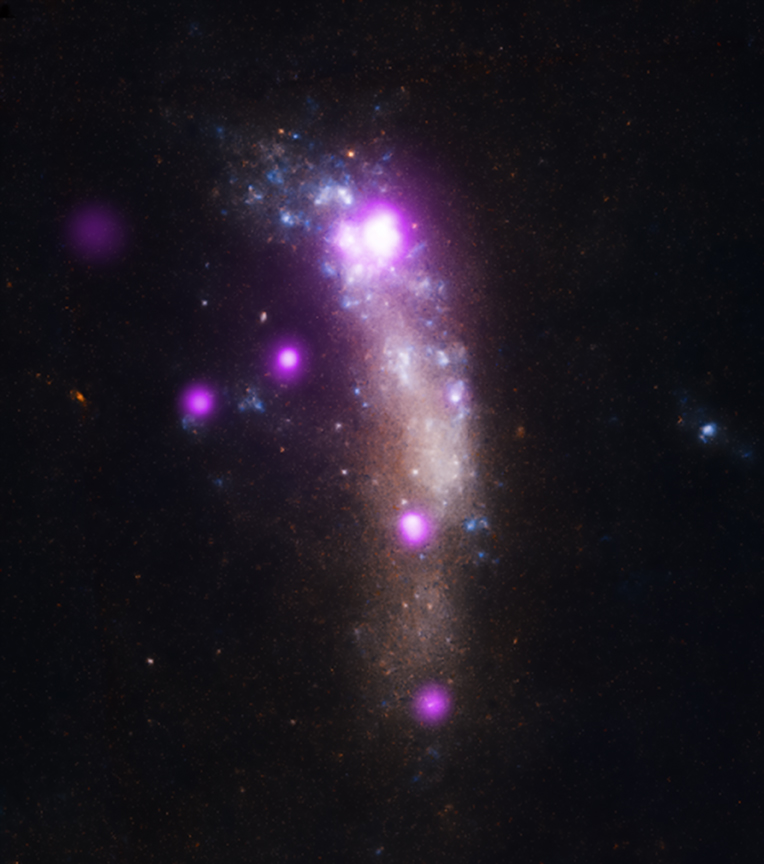
Observations with NASA's Chandra X-ray Observatory have provided the first X-ray evidence of a supernova shock wave breaking through a cocoon of gas surrounding the star that exploded. This discovery may help astronomers understand why some supernovas are much more powerful than others.

On November 3, 2010, a supernova was discovered in the galaxy UGC 5189A, located about 160 million light years away. Using data from the All Sky Automated Survey telescope in Hawaii taken earlier, astronomers determined this supernova exploded in early October 2010 (in Earth's time-frame).

This composite image of UGC 5189A shows X-ray data from Chandra in purple and optical data from Hubble Space Telescope in red, green and blue. SN 2010jl is the very bright X-ray source near the top of the galaxy.

A team of researchers used Chandra to observe this supernova in December 2010 and again in October 2011. The supernova was one of the most luminous that has ever been detected in X-rays.

In optical light, SN 2010jl was about ten times more luminous than a typical supernova resulting from the collapse of a massive star, adding to the class of very luminous supernovas that have been discovered recently with optical surveys. Different explanations have been proposed to explain these energetic supernovas including (1) the interaction of the supernova's blast wave with a dense shell of matter around the pre-supernova star, (2) radioactivity resulting from a pair-instability supernova (triggered by the conversion of gamma rays into particle and anti-particle pairs), and (3) emission powered by a neutron star with an unusually powerful magnetic field.

In the first Chandra observation of SN 2010jl, the X-rays from the explosion's blast wave were strongly absorbed by a cocoon of dense gas around the supernova. This cocoon was formed by gas blown away from the massive star before it exploded.

In the second observation taken almost a year later, there is much less absorption of X-ray emission, indicating that the blast wave from the explosion has broken out of the surrounding cocoon. The Chandra data show that the gas emitting the X-rays has a very high temperature -- greater than 100 million degrees Kelvin - strong evidence that it has been heated by the supernova blast wave.

The energy distribution, or spectrum, of SN 2010jl in optical light reveals features that the researchers think are explained by the following scenario: matter around the supernova has been heated and ionized (electrons stripped from atoms) by X-rays generated when the blast wave plows through this material. While this type of interaction has been proposed before, the new observations directly show, for the first time, that this is happening.

This discovery therefore supports the idea that some of the unusually luminous supernovas are caused by the blast wave from their explosion ramming into the material around it.

In a rare example of a cosmic coincidence, analysis of the X-rays from the supernova shows that there is a second unrelated source at almost the same location as the supernova. These two sources strongly overlap one another as seen on the sky. This second source is likely to be an ultraluminous X-ray source, possibly containing an unusually heavy stellar-mass black hole, or an intermediate mass black hole.

These results were published in a paper appearing in the May 1st, 2012 issue of The Astrophysical Journal Letters. The authors were Poonam Chandra (Royal Military College of Canada, Kingston, Canada), Roger Chevalier and Christopher Irwin (University of Virginia, Charlottsville, VA), Nikolai Chugai (Institute of Astronomy of Russian Academy of Sciences, Moscow, Russia), Claes Fransson (Stockholm University, Sweden), and Alicia Soderberg (Harvard-Smithsonian Center for Astrophysics, Cambridge, MA).

Fast Facts for SN 2010jl:

Scale: 46 arcsec across (36,000 light years)
Category: Supernovas & Supernova Remnants
Coordinates: (J2000) RA 09h 42m 53.33s | Dec +09° 29' 41.80"
Constellation: Leo
Observation Date: 3 pointings between 7 Dec 2010 and 17 Oct 2011
Observation Time: 22 hours 13 min.
Obs. ID: 11122, 13199, 13781
Color Code: X-ray (Purple); Optical (Red, Green, Blue)
Instrument: ACIS
References: Chandra, P. et al, 2012 ApJ 750:L2; arXiv:1203.1614
Distance Estimate: 163 million light years

Monday, May 14, 2012

Edge-on Beauty

Credit: ESA/Hubble & NASA
Acknowledgement: Nick Rose

Visible in the constellation of Andromeda, NGC 891 is located approximately 30 million light-years away from Earth. The NASA/ESA Hubble Space Telescope turned its powerful wide field Advanced Camera for Surveys towards this spiral galaxy and took this close-up of its northern half. The galaxy's central bulge is just out of the image on the bottom left.

The galaxy, spanning some 100 000 light-years, is seen exactly edge-on, and reveals its thick plane of dust and interstellar gas. While initially thought to look like our own Milky Way if seen from the side, more detailed surveys revealed the existence of filaments of dust and gas escaping the plane of the galaxy into the halo over hundreds of light-years. They can be clearly seen here against the bright background of the galaxy halo, expanding into space from the disc of the galaxy.

Astronomers believe these filaments to be the result of the ejection of material due to supernovae or intense stellar formation activity. By lighting up when they are born, or exploding when they die, stars cause powerful winds that can blow dust and gas over hundreds of light-years in space.

A few foreground stars from the Milky Way shine brightly in the image, while distant elliptical galaxies can be seen in the lower right of the image.

NGC 891 is part of a small group of galaxies bound together by gravity.

A version of this image was entered into the Hubble’s Hidden Treasures Image Processing Competition by contestant Nick Rose. Hidden Treasures is an initiative to invite astronomy enthusiasts to search the Hubble archive for stunning images that have never been seen by the general public.

Source:  ESA/Hubble - Space Telescope


Saturday, May 12, 2012

IBEX Reveals a Missing Boundary At the Edge Of the Solar System

IBEX studies the outer reaches of the solar system by observing neutral atoms that cross or bounce off of its boundaries. Credit: NASA/Goddard Space Flight Center. Download video


For the last few decades, space scientists have generally accepted that the bubble of gas and magnetic fields generated by the sun – known as the heliosphere – moves through space, creating three distinct boundary layers that culminate in an outermost bow shock. This shock is similar to the sonic boom created ahead of a supersonic jet. Earth itself certainly has one of these bow shocks on the sunward side of its magnetic environment, as do most other planets and many stars. A collection of new data from NASA's Interstellar Boundary Explorer (IBEX), however, now indicate that the sun does not have a bow shock.

In a paper appearing online in Science Express on May 10, 2012, scientists compile data from IBEX, NASA's twin Voyager spacecraft, and computer models to show that the heliosphere just isn't moving fast enough to create a bow shock in the tenuous and highly magnetized region in our local part of the galaxy.

"IBEX gives a global view. It shows the whole of this region," says Eric Christian who is the mission scientist for IBEX at NASA's Goddard Space Flight Center in Greenbelt, Md. and who was formerly the program scientist for Voyager. "At the same time the Voyager spacecraft are actually there, in situ, measuring its environment at two locations. The combination of IBEX and Voyager gives you great science and now the new IBEX results strongly indicate that there is no bow shock."

Since the 1980s, the boundaries of the heliosphere have largely been assumed to be a series of three. The first is a fairly spherical boundary called the termination shock -- the point where the solar wind streaming from the sun slows down below supersonic speeds. From there the wind continues more slowly until it collides with the material in the rest of the galaxy and is pushed back, deflecting around the outskirts of the heliosphere, streaming back toward the tail of the moving bubble. This second boundary is called the heliopause. The third boundary was thought to be the bow shock, formed as the heliosphere plowed its way through the local galactic cloud the same way a supersonic jet pushes aside the air as it moves.

The heliosphere surrounding our solar system is buffeted by strong magnetic fields, shown here as the black, diagonal, upward-pointing arrows. The heliosphere and the interstellar material of the local cloud pass by each other at a speed of 52,000 miles per hour, as shown by the blue arrow. The density of the material and the ramming pressures of the magnetic field coupled with the relatively slow speed of the heliosphere add up to indicate that there is no bow shock at the front of the heliosphere. Credit: SWRI. View larger

The two Voyager spacecraft have confirmed the existence of the first boundary, and have seen evidence for the second as they move toward it. However, each Voyager spacecraft has seen different things on their respective trips – one moving in a more northerly direction, one moving more to the south. They've encountered different regions at different distances from the sun, suggesting the very shape of the heliosphere is squashed and asymmetrical. Scientists believe this asymmetry is caused by the force and direction of magnetic fields ramming into the heliosphere from outside, the same way a hand pushing on a balloon will force it out of shape. This was the first clue that there's a strong magnetic field exerting pressure on the outskirts of the solar system. Independently, IBEX has seen a well-defined band, or ribbon, at the edge of the heliosphere, believed to be defined by this external magnetic field. Other studies from IBEX have helped quantify the magnitude of the magnetic field, showing that it is on the strong end of what was previously thought possible.

Stars travel through the galaxy surrounded by a bubble of charged gas and magnetic fields, rounded at the front and trailing into a long tail behind. The bubble is called an astrosphere, or -- in the case of the one around our sun -- a heliosphere. This image shows a few examples of astrospheres that are very strong and therefore visible. Credit: NASA/Goddard Space Flight Center. View larger

"We've seen one after another signature of a very strong magnetic field in the galactic environment," says Nathan Schwadron, a space scientist at the University of New Hampshire in Durham who is one of the authors on the paper. "That magnetic field influences the structure of the heliosphere and the boundaries themselves. That leads to a whole new paradigm."

Along with increased evidence for a strong external magnetic field, IBEX has also provided a new measurement for the speed of the heliosphere itself with respect to the local cloud.

"We recently analyzed two years worth of IBEX data, and they showed that the speed of the heliosphere – with respect to the local cloud of material – is only 52,000 miles per hour, instead of the previously believed 59,000," says David McComas at the Southwest Research Institute in San Antonio, Texas, who is first author on this paper and also the principal investigator for IBEX. "That might not seem like a huge difference, but it translates to a quarter less pressure exerted on the boundaries of the heliosphere. This means there's a very different interaction, a much weaker interaction, than previously thought."

In essence, it means that, like an airplane going too slowly to produce a sonic boom, the heliosphere isn't moving fast enough to create a bow shock, given the density and pressures of the material its moving through.

The heliosphere's boundaries lie roughly 10 billion miles away from Earth, but are nonetheless crucial for understanding our place in the universe. Indeed, the heliopause provides some protection for our solar system from the harsh, radiation environment surrounding it. By knowing the nature of these boundaries, scientists can start to better understand the propagation of particles that do have enough energy and speed to make it into our environment.

As scientists incorporate this substantive new understanding into their physical models, they will also be waiting for more evidence from both IBEX and the Voyagers, which they hope will continue to send back observations for many years to come.

"Imagine the point at which Voyager crosses the threshold of the heliopause and either does or does not see what IBEX is predicting," says Schwadron. "There will be enormous opportunities for scientific advancement."

For more information about the IBEX mission, go to:
http://www.nasa.gov/ibex


Karen C. Fox
NASA's Goddard Space Flight Center, Greenbelt, MD

Friday, May 11, 2012

NASA Dawn Mission Reveals Secrets of Large Asteroid

This image, made from data obtained by NASA's Dawn spacecraft, shows the mineral distribution in the southern hemisphere of the giant asteroid Vesta. Image credit: NASA/JPL-Caltech/UCLA/INAF/MPS/DLR/IDA. Full image and caption - Image gallery

This image, made from data obtained by NASA's Dawn spacecraft, shows the mineral distribution in the southern hemisphere of the giant asteroid Vesta. Image credit: NASA/JPL-Caltech/UCLA/INAF/MPS/DLR/IDA . Virtual flight video - Touring craters

This image shows three slices of a class of meteorites that fell to Earth that NASA's Dawn mission has confirmed as originating from the giant asteroid Vesta. Image credit: University of Tennessee. Full image and caption

The giant asteroid Vesta is shown here as the smallest body among other similar bodies in the solar system: Mars, Mercury, Earth's moon and the dwarf planet Ceres. Image credit: NASA/JPL-Caltech/UCLA . Full image and caption - Image gallery

PASADENA, Calif. – NASA's Dawn spacecraft has provided researchers with the first orbital analysis of the giant asteroid Vesta, yielding new insights into its creation and kinship with terrestrial planets and Earth's moon.

Vesta now has been revealed as a special fossil of the early solar system with a more varied, diverse surface than originally thought. Scientists have confirmed a variety of ways in which Vesta more closely resembles a small planet or Earth's moon than another asteroid. Results appear in today's edition of the journal Science.

"Dawn's visit to Vesta has confirmed our broad theories of this giant asteroid's history, while helping to fill in details it would have been impossible to know from afar," said Carol Raymond, deputy principal investigator at NASA's Jet Propulsion Laboratory in Pasadena, Calif. "Dawn's residence at Vesta of nearly a year has made the asteroid's planet-like qualities obvious and shown us our connection to that bright orb in our night sky."

Scientists now see Vesta as a layered, planetary building block with an iron core – the only one known to survive the earliest days of the solar system. The asteroid's geologic complexity can be attributed to a process that separated the asteroid into a crust, mantle and iron core with a radius of approximately 68 miles (110 kilometers) about 4.56 billion years ago. The terrestrial planets and Earth's moon formed in a similar way.

Dawn observed a pattern of minerals exposed by deep gashes created by space rock impacts, which may support the idea the asteroid once had a subsurface magma ocean. A magma ocean occurs when a body undergoes almost complete melting, leading to layered building blocks that can form planets. Other bodies with magma oceans ended up becoming parts of Earth and other planets.

Data also confirm a distinct group of meteorites found on Earth did, as theorized, originate from Vesta. The signatures of pyroxene, an iron- and magnesium-rich mineral, in those meteorites match those of rocks on Vesta's surface. These objects account for about 6 percent of all meteorites seen falling on Earth.

This makes the asteroid one of the largest single sources for Earth's meteorites. The finding also marks the first time a spacecraft has been able to visit the source of samples after they were identified on Earth.

Scientists now know Vesta's topography is quite steep and varied. Some craters on Vesta formed on very steep slopes and have nearly vertical sides, with landslides occurring more frequently than expected.

Another unexpected finding was that the asteroid's central peak in the Rheasilvia basin in the southern hemisphere is much higher and wider, relative to its crater size, than the central peaks of craters on bodies like our moon. Vesta also bears similarities to other low-gravity worlds like Saturn's small icy moons, and its surface has light and dark markings that don't match the predictable patterns on Earth's moon.

"We know a lot about the moon and we're only coming up to speed now on Vesta," said Vishnu Reddy, a framing camera team member at the Max Planck Institute for Solar System Research in Germany and the University of North Dakota in Grand Forks. "Comparing the two gives us two storylines for how these fraternal twins evolved in the early solar system."

Dawn has revealed details of ongoing collisions that battered Vesta throughout its history. Dawn scientists now can date the two giant impacts that pounded Vesta's southern hemisphere and created the basin Veneneia approximately 2 billion years ago and the Rheasilvia basin about 1 billion years ago. Rheasilvia is the largest impact basin on Vesta.

"The large impact basins on the moon are all quite old," said David O'Brien, a Dawn participating scientist from the Planetary Science Institute in Tucson, Ariz. "The fact that the largest impact on Vesta is so young was surprising."

Launched in 2007, Dawn began exploring Vesta in mid-2011. The spacecraft will depart Vesta on August 26 for its next study target, the dwarf planet Ceres, in 2015.

Dawn's mission to Vesta and Ceres is managed by JPL for NASA's Science Mission Directorate in Washington. Dawn is a project of the directorate's Discovery Program managed by NASA's Marshall Space Flight Center in Huntsville, Ala. UCLA is responsible for overall Dawn mission science. Orbital Sciences Corp. in Dulles, Va., designed and built the spacecraft. The German Aerospace Center, the Max Planck Institute for Solar System Research, the Italian Space Agency and the Italian National Astrophysical Institute are international partners on the mission team. The California Institute of Technology in Pasadena manages JPL for NASA.

This image, made from data obtained by NASA's Dawn spacecraft, shows the mineral distribution in the southern hemisphere of the giant asteroid Vesta. Image credit: NASA/JPL-Caltech/UCLA/INAF/MPS/DLR/IDA
Full image and caption - Image gallery

For more information about the Dawn mission, visit: http://www.nasa.gov/dawn and http://dawn.jpl.nasa.gov


Jia-Rui Cook
Jet Propulsion Laboratory, Pasadena, Calif.
818-354-0850
jccook@jpl.nasa.gov

Dwayne Brown 202-358-1726
NASA Headquarters, Washington
dwayne.c.brown@nasa.gov

Thursday, May 10, 2012

Cygnus-X: the cool swan glowing in flight

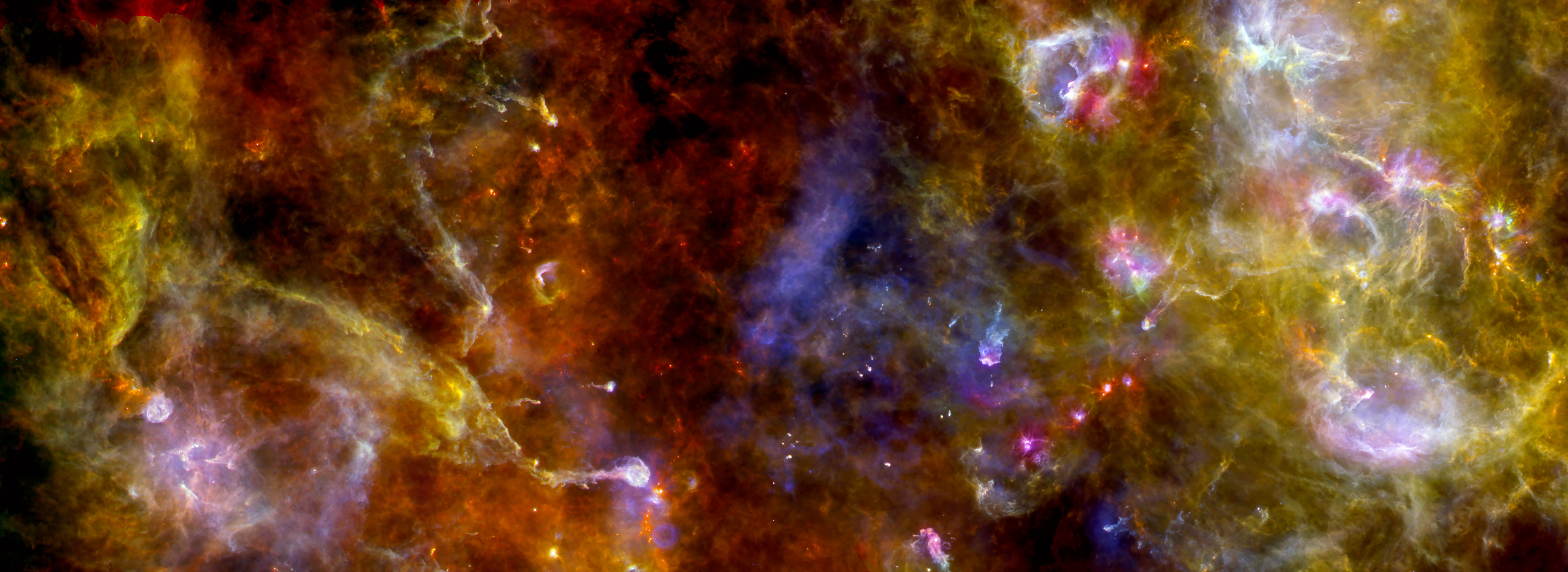
This new view of the Cygnus-X star-formation region by Herschel highlights chaotic networks of dust and gas that point to sites of massive star formation.

The image combines data acquired with the PACS instrument at 70 micron (corresponding to the blue channel) and 160 micron (corresponding to the green channel) and with the SPIRE instrument at 250 micron (corresponding to the red channel). The observations were made on 24 May 2010 and 18 December 2010. North is to the lower-right and east to the upper-right.

Credits: ESA/PACS/SPIRE/Martin Hennemann & Frédérique Motte, Laboratoire AIM Paris-Saclay, CEA/Irfu – CNRS/INSU – Univ. Paris Diderot, France. HI-RES JPEG (Size: 2381 kb)

An annotated version of Herschel’s view of Cygnus-X highlighting numerous dense sites of new star formation in the right-hand complex, and the swan-like structure in the left-hand portion of the scene. Powerful radiation and winds from thousands of stars in the OB2 complex undetected at Herschel’s long wavelengths have partly cleared and heated surrounding material, visible as the diffuse blue glow in the centre of the image. A supergiant star identified as G79.29+0.46 has likely ejected the ring of material seen at the bottom of the image.

Credits: ESA/PACS/SPIRE/Martin Hennemann & Frédérique Motte, Laboratoire AIM Paris-Saclay, CEA/Irfu – CNRS/INSU – Univ. Paris Diderot, France. HI-RES JPEG (Size:
7952 kb)

Chaotic networks of dust and gas signpost the next generations of massive stars in this stunning new image of the Cygnus-X star-nursery captured by ESA’s Herschel space observatory.

Cygnus-X is an extremely active region of massive-star birth some 4500 light-years from Earth in the constellation of Cygnus, the Swan.

Using Herschel’s far-infrared eyes, astronomers can seek out regions where dust has been gently heated by stars, pointing them to dense clumps of gas where new generations of stars are forming.

Bright white areas highlight zones where large stars have recently formed out of turbulent clouds, especially evident in the chaotic network of filaments seen in the right-hand portion of the image.

Here, dense knots of gas and dust mark intersections where filaments meet and collapse to form new stars, and where bubble-like structures are carved by their immense radiation.

In the centre of the image, fierce radiation and powerful stellar winds from stars undetected at Herschel’s wavelengths have partly cleared and heated interstellar material, which then glows blue in this representation.

The left-hand part of the scene is dominated by a pillar of gas whose shape resembles that of the neck of a swan.

Below and to the right, a shell of gas and dust has likely been ejected from a supergiant star at its centre, but which is not seen directly in this image.

Strings of compact red objects scattered throughout the scene map the cold seeds of future generations of stars.

The image highlights the unique capabilities of Herschel to probe the birth of large stars and their influence on the surrounding interstellar material with a level of detail at far-infrared wavelengths that has never before been available.

For further information, please contact:

Markus Bauer
ESA Science and Robotic Exploration Communication Officer
Tel: +31 71 565 6799
Mob: +31 61 594 3 954
Email: markus.bauer@esa.int

Göran Pilbratt
ESA Herschel Project Scientist
Research and Scientific Support Department
Science and Robotic Exploration Directorate
ESA, The Netherlands
Tel: +31 71 565 3621
Email: gpilbratt@rssd.esa.int