Showing posts with label supercluster. Show all posts

Friday, April 13, 2018

A colossal cluster

Credit: ESA/Hubble & NASA, RELICS


This NASA/ESA Hubble Space Telescope image shows a massive galaxy cluster glowing brightly in the darkness. Despite its beauty, this cluster bears the distinctly unpoetic name of PLCK_G308.3-20.2. 

Galaxy clusters can contain thousands of galaxies all held together by the glue of gravity. At one point in time they were believed to be the largest structures in the Universe — until they were usurped in the 1980s by the discovery of superclusters, which typically contain dozens of galaxy clusters and groups and span hundreds of millions of light-years. However, clusters do have one thing to cling on to; superclusters are not held together by gravity, so galaxy clusters still retain the title of the biggest structures in the Universe bound by gravity.

One of the most interesting features of galaxy clusters is the stuff that permeates the space between the constituent galaxies: the intracluster medium (ICM). High temperatures are created in these spaces by smaller structures forming within the cluster. This results in the ICM being made up of plasma — ordinary matter in a superheated state. Most luminous matter in the cluster resides in the ICM, which is very luminous X-rays. However, the majority of the mass in a galaxy cluster exists in the form of non-luminous dark matter. Unlike plasma, dark matter is not made from ordinary matter such as protons, neutrons and electrons. It is a hypothesised substance thought to make up 80 % of the Universe’s mass, yet it has never been directly observed.

This image was taken by Hubble’s Advanced Camera for Surveys and Wide-Field Camera 3 as part of an observing programme called RELICS (Reionization Lensing Cluster Survey). RELICS imaged 41 massive galaxy clusters with the aim of finding the brightest distant galaxies for the forthcoming NASA/ESA/CSA James Webb Space Telescope (JWST) to study.


Friday, November 03, 2017

Abell’s richest cluster

Abell 655
Credit: ESA/Hubble & NASA


The Universe contains some truly massive objects. Although we are still unsure how such gigantic things come to be, the current leading theory is known as hierarchical clustering, whereby small clumps of matter collide and merge to grow ever larger. The 14-billion-year history of the Universe has seen the formation of some enormous cosmic structures, including galaxy groupsclusters, and superclusters — the largest known structures in the cosmos!

This particular cluster is called Abell 665. It was named after its discoverer, George O. Abell, who included it in his seminal 1958 cluster catalogue. Abell 665 is located in the well-known northern constellation of Ursa Major (The Great Bear). This incredible image combines visible and infrared light gathered by the NASA/ESA Hubble Space Telescope using two of its cameras: the Advanced Camera for Surveys and the Wide Field Camera 3

Abell 665 is the only galaxy cluster in Abell’s entire catalogue to be given a richness class of 5, indicating that the cluster contains at least 300 individual galaxies. Because of this richness, the cluster has been studied extensively at all wavelengths, resulting in a number of fascinating discoveries — among other research, Abell 665 has been found to host a giant radio halo, powerful shockwaves, and has been used to calculate an updated value for the Hubble constant (a measure of how fast the Universe is expanding).


Friday, May 09, 2014

The scale of the Universe

 
Credit: ESA/Hubble & NASAAcknowledgement: D. Calzetti (University of Massachusetts) and the LEGUS Team

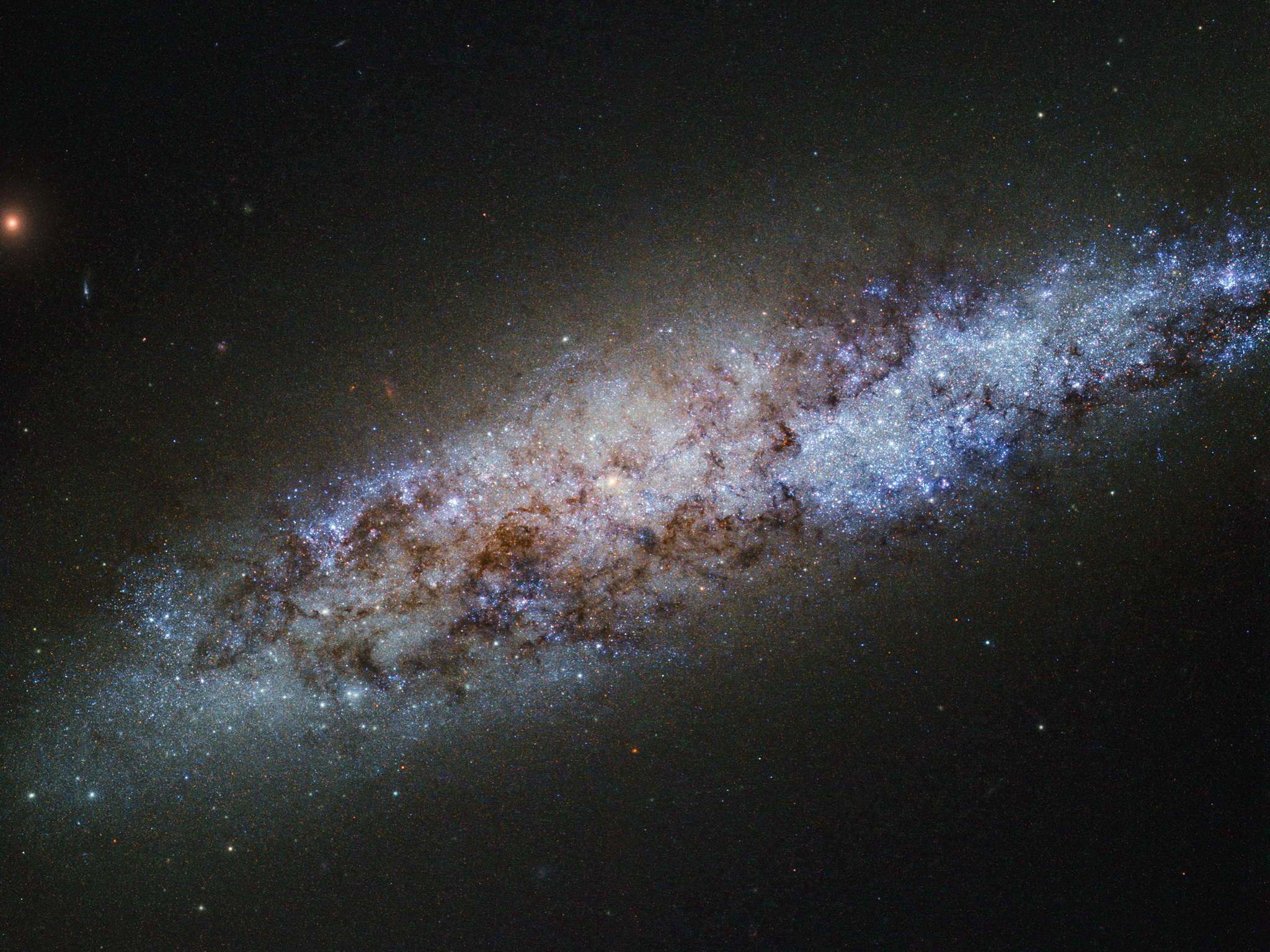
This bundle of bright stars and dark dust is a dwarf spiral galaxy known as NGC 4605, located around 16 million light-years away in the constellation of Ursa Major (The Great Bear). This galaxy’s spiral structure is not obvious from this image, but NGC 4605 is classified as an SBc type galaxy — meaning that it has sprawling, loosely wound arms and a bright bar of stars cutting through its centre.

NGC 4605 is a member of the Messier 81 group of galaxies, a gathering of bright galaxies including its namesake Messier 81 (heic0710), and the well-known Messier 82 (heic0604a). Galaxy groups like this usually contain around 50 galaxies, all loosely bound together by gravity. This group is famous for its unusual members, many of which formed from collisions between galaxies. With its somewhat unusual form, NGC 4605 fits in well with the family of perturbed galaxies in the M81 group, although the origin of its abnormal features is not yet clear.

The Messier 81 group is one of the nearest groups to our own, the Local Group, which houses the Milky Way and some of its well-known neighbours, including the Andromeda Galaxy and the Magellanic Clouds. Galaxy groups provide environments where galaxies can evolve through interactions like collisions and mergers. These galaxy groups are then lumped together into even larger gatherings of galaxies known as clusters and superclusters. The Local and Messier 81 groups both belong to the Virgo Supercluster, a large and massive collection of some 100 galaxy groups and clusters.

With so many galaxies swarming around, NGC 4605 may seem unremarkable. However, astronomers are using this galaxy to test our knowledge of stellar evolution. The newly-formed stars in NGC 4605 are being used to investigate how interactions between galaxies affect the formation, evolution, and behaviour of the stars within, how bright stellar nurseries come together to form stellar clusters and stellar associations, and how these stars evolve over time.

And that's not all — NGC 4605 is also proving to be a good testing ground for dark matter. Our theories on this hypothetical type of matter have had good success at describing how the Universe looks and behaves on a large scale — for example at the galaxy supercluster level — but when looking at individual galaxies, they have run into problems. Observations of NGC 4605 show that the way in which dark matter is spread throughout its halo is not quite as these models predict. While intriguing, observations in this area are still inconclusive, leaving astronomers to ponder over the contents of the Universe.

Source: ESA/Hubble - Space Telescope


Tuesday, January 29, 2013

An Intergalactic Heavyweight

 Abell 901/902
Credit: ESO

This deep-field image shows what is known as a supercluster of galaxies — a giant group of galaxy clusters which are themselves clustered together. This one, known as Abell 901/902, comprises three separate main clusters and a number of filaments of galaxies, typical of such super-structures. One cluster, Abell 901a, can be seen above and just to the right of the prominent red foreground star near the middle of the image. Another, Abell 901b, is further to the right of Abell 901a, and slightly lower. Finally, the cluster Abell 902 is directly below the red star, towards the bottom of the image.   

The Abell 901/902 supercluster is located a little over two billion light-years from Earth, and contains hundreds of galaxies in a region about 16 million light-years across. For comparison, the Local Group of galaxies — which contains our Milky Way among more than 50 others — measures roughly ten million light-years across.

This image was taken by the Wide Field Imager (WFI) camera on the MPG/ESO 2.2-metre telescope, located at the La Silla Observatory in Chile. Using data from the WFI and from the NASA/ESA Hubble Space Telescope, in 2008 astronomers were able to precisely map the distribution of dark matter in the supercluster, showing that the clusters and individual galaxies which comprise the super-structure reside within vast clumps of dark matter. To do this, astronomers looked at how the light from 60 000 faraway galaxies located behind the supercluster was being distorted by the gravitational influence of the dark matter it contains, thus revealing its distribution. The mass of the four main dark matter clumps of Abell 901/902 is thought to be around ten trillion times that of the Sun.

The observations shown here are part of the COMBO-17 survey, a survey of the sky undertaken in 17 different optical filters using the WFI camera. The COMBO-17 project has so far found over 25 000 galaxies.

Links

Source: ESO

Friday, May 18, 2012

Herschel Sees Intergalactic Bridge Aglow With Stars

The Herschel Space Observatory has discovered a giant, galaxy-packed filament ablaze with billions of new stars. The filament connects two clusters of galaxies that, along with a third cluster, will smash together in several billion years and give rise to one of the largest galaxy superclusters in the universe. Image credit: ESA/NASA/JPL-Caltech/CXC/McGill Univ. Full image and caption

The Herschel Space Observatory has discovered a giant, galaxy-packed filament ablaze with billions of new stars. The filament connects two clusters of galaxies that, along with a third cluster, will smash together and give rise to one of the largest galaxy superclusters in the universe.

Herschel is a European Space Agency mission with important NASA contributions.

The filament is the first structure of its kind spied in a critical era of cosmic buildup when colossal collections of galaxies called superclusters began to take shape. The glowing galactic bridge offers astronomers a unique opportunity to explore how galaxies evolve and merge to form superclusters.

"We are excited about this filament, because we think the intense star formation we see in its galaxies is related to the consolidation of the surrounding supercluster," says Kristen Coppin, an astrophysicist at McGill University in Canada, and lead author of a new paper in Astrophysical Journal Letters.

"This luminous bridge of star formation gives us a snapshot of how the evolution of cosmic structure on very large scales affects the evolution of the individual galaxies trapped within it," says Jim Geach, a co-author who is also based at McGill.

The intergalactic filament, containing hundreds of galaxies, spans 8 million light-years and links two of the three clusters that make up a supercluster known as RCS2319. This emerging supercluster is an exceptionally rare, distant object whose light has taken more than seven billion years to reach us.

RCS2319 is the subject of a huge observational study, led by Tracy Webb and her group at McGill. Previous observations in visible and X-ray light had found the cluster cores and hinted at the presence of a filament. It was not until astronomers trained Herschel on the region, however, that the intense star-forming activity in the filament became clear. Dust obscures much of the star-formation activity in the early universe, but telescopes like Herschel can detect the infrared glow of this dust as it is heated by nascent stars.

The amount of infrared light suggests that the galaxies in the filament are cranking out the equivalent of about 1,000 solar masses (the mass of our sun) of new stars per year. For comparison's sake, our Milky Way galaxy is producing about one solar-mass worth of new stars per year.

Researchers chalk up the blistering pace of star formation in the filament to the fact that galaxies within it are being crunched into a relatively small cosmic volume under the force of gravity. "A high rate of interactions and mergers between galaxies could be disturbing the galaxies' gas reservoirs, igniting bursts of star formation," said Geach.

By studying the filament, astronomers will be able to explore the fundamental issue of whether "nature" versus "nurture" matters more in the life progression of a galaxy. "Is the evolution of a galaxy dominated by intrinsic properties such as total mass, or do wider-scale cosmic environments largely determine how galaxies grow and change?" Geach asked. "The role of the environment in influencing galactic evolution is one of the key questions of modern astrophysics."

The galaxies in the RCS2319 filament will eventually migrate toward the center of the emerging supercluster. Over the next seven to eight billion years, astronomers think RCS2319 will come to look like gargantuan superclusters in the local universe, like the nearby Coma cluster. These advanced clusters are chock-full of "red and dead" elliptical galaxies that contain aged, reddish stars instead of young ones.

"The galaxies we are seeing as starbursts in RCS2319 are destined to become dead galaxies in the gravitational grip of one of the most massive structures in the universe," said Geach. "We're catching them at the most important stage of their evolution."

Herschel is a European Space Agency cornerstone mission, with science instruments provided by consortia of European institutes and with important participation by NASA. NASA's Herschel Project Office is based at NASA's Jet Propulsion Laboratory, Pasadena, Calif. JPL contributed mission-enabling technology for two of Herschel's three science instruments. The NASA Herschel Science Center, part of the Infrared Processing and Analysis Center at the California Institute of Technology in Pasadena, supports the United States astronomical community. Caltech manages JPL for NASA.

More information is online at http://www.herschel.caltech.edu , http://www.nasa.gov/herschel and http://www.esa.int/SPECIALS/Herschel .

Written by Adam Hadhazy
Whitney Clavin 818-354-4673
Jet Propulsion Laboratory, Pasadena, Calif.
whitney.clavin@jpl.nasa.gov

Thursday, January 10, 2008

Hubble Maps Dark Matter Web in a Large Galaxy Cluster

Credit for the Hubble Images: NASA, ESA, C. Heymans
(University of British Columbia, Vancouver),
M. Gray (University of Nottingham, U.K.), M. Barden (Innsbruck),
and the STAGES collaboration

These images reveal the distribution of dark matter in the supercluster Abell 901/902, composed of hundreds of galaxies.

The image in the center shows the entire supercluster. Astronomers assembled this photo by combining a visible-light image of the supercluster taken with the MPG/ESO 2.2-meter telescope in La Silla, Chile, with a dark matter map derived from observations with NASA's Hubble Space Telescope.

The magenta-tinted clumps represent a map of the dark matter in the cluster. Dark matter is an invisible form of matter that accounts for most of the universe's mass. The image shows that the supercluster galaxies lie within the clumps of dark matter.

Hubble cannot see the dark matter directly. Astronomers inferred its location by analyzing the effect of so-called weak gravitational lensing, where light from more than 60,000 galaxies behind Abell 901/902 is distorted by intervening matter within the cluster. Researchers used the observed, subtle distortion of the galaxies' shapes to reconstruct the dark matter distribution in the supercluster. The image was assembled by combining a visible-light image of the supercluster with a map of the dark matter distribution.

The Hubble study pinpointed four main areas in the supercluster where dark matter has pooled into dense clumps. These areas match the location of hundreds of galaxies that have experienced a violent history in their passage from the outskirts of the supercluster into these dense regions. The four close-up images flanking the central photo are Hubble views of the four dense clumps of matter. To make this image, astronomers superimposed the dark matter map over a Hubble visible-light image of the supercluster galaxies.

The images are part of the Space Telescope Abell 901/902 Galaxy Evolution Survey (STAGES), which covers one of the largest patches of sky ever observed by the Hubble telescope. The area surveyed is so wide that it took 80 Hubble images to cover the entire field.

Hubble's Advanced Camera for Surveys made the observations in June and July 2005 and in January 2006.

Source: HubbleSite