Artist’s impression of dust formation around a supernova explosion
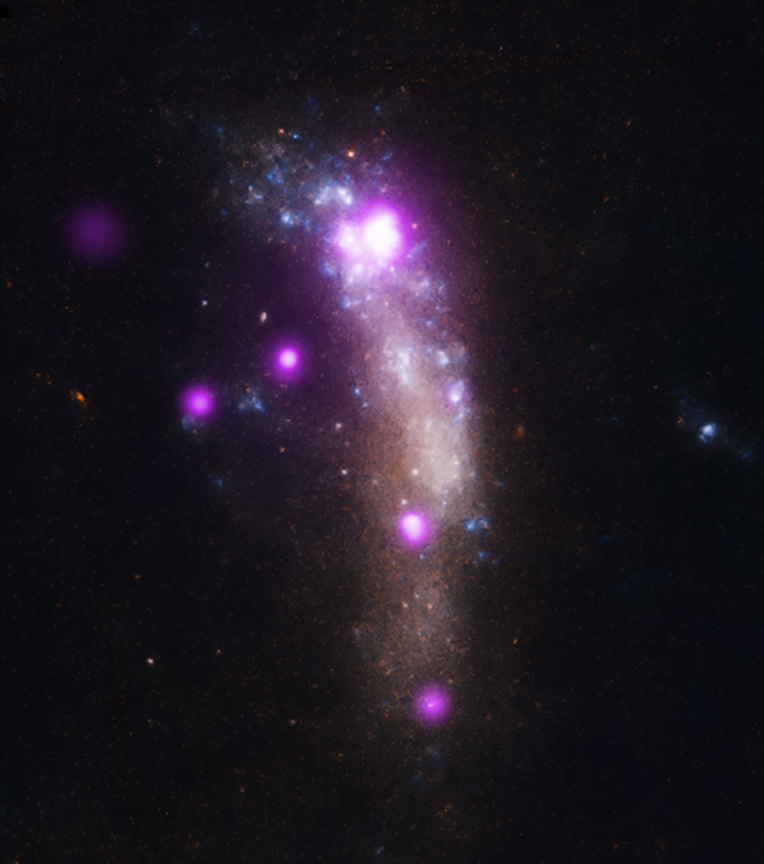
The dwarf galaxy UGC 5189A, site of the supernova SN 2010jl
The dwarf galaxy UGC 5189A, site of the supernova SN 2010jl (annotated)
New observations reveal how stardust forms around a supernova
A group of astronomers has been able to
follow stardust being made in real time — during the aftermath of a
supernova explosion. For the first time they show that these cosmic dust
factories make their grains in a two-stage process, starting soon after
the explosion, but continuing for years afterwards. The team used ESO's
Very Large Telescope (VLT) in northern Chile to analyse the light from
the supernova SN2010jl as it slowly faded. The new results are published
online in the journal Nature on 9 July 2014.
The origin of cosmic dust in galaxies is still a mystery
[1]. Astronomers know that
supernovae
may be the primary source of dust, especially in the early Universe,
but it is still unclear how and where dust grains condense and grow. It
is also unclear how they avoid destruction in the harsh environment of a
star-forming galaxy. But now, observations using ESO’s
VLT at the Paranal Observatory in northern Chile are lifting the veil for the first time.
An international team used the
X-shooter spectrograph to observe a supernova — known as
SN2010jl
— nine times in the months following the explosion, and for a tenth
time 2.5 years after the explosion, at both visible and near-infrared
wavelengths
[2]. This unusually bright supernova, the result of the death of a massive star, exploded in the small galaxy
UGC 5189A.
“By combining the data from the nine early sets of observations
we were able to make the first direct measurements of how the dust
around a supernova absorbs the different colours of light,” said lead author Christa Gall from Aarhus University, Denmark. “This allowed us to find out more about the dust than had been possible before.”
The team found that dust formation starts soon after the explosion
and continues over a long time period. The new measurements also
revealed how big the dust grains are and what they are made of. These
discoveries are a step beyond recent results obtained using the
Atacama Large Millimeter/submillimeter Array (ALMA),
which first detected the remains of a recent supernova brimming with
freshly formed dust from the famous supernova 1987A (SN 1987A;
eso1401).
The team found that dust grains larger than one thousandth of a
millimetre in diameter formed rapidly in the dense material surrounding
the star. Although still tiny by human standards, this is large for a
grain of cosmic dust and the surprisingly large size makes them
resistant to destructive processes. How dust grains could survive the
violent and destructive environment found in the remnants of supernovae
was one of the main open questions of the
ALMA paper, which this result has now answered — the grains are larger than expected.
“Our detection of large grains soon after the supernova explosion
means that there must be a fast and efficient way to create them,” said co-author Jens Hjorth from the Niels Bohr Institute of the University of Copenhagen, Denmark, and continued: “We really don’t know exactly how this happens.”
But the astronomers think they know where the new dust must have
formed: in material that the star shed out into space even before it
exploded. As the supernova's shockwave expanded outwards, it created a
cool, dense shell of gas — just the sort of environment where dust
grains could seed and grow.
Results from the observations indicate that in a second stage — after
several hundred days — an accelerated dust formation process occurs
involving ejected material from the supernova. If the dust production in
SN2010jl continues to follow the observed trend, by 25 years after the
supernova, the total mass of dust will be about half the mass of the
Sun; similar to the dust mass observed in other supernovae such as
SN 1987A.
“Previously astronomers have seen plenty of dust in supernova
remnants left over after the explosions. But they also only found
evidence for small amounts of dust actually being created in the
supernova explosions. These remarkable new observations explain how this
apparent contradiction can be resolved,” concludes Christa Gall.
Notes
[1] Cosmic dust consists of silicate
and amorphous carbon grains — minerals also abundant on Earth. The soot
from a candle is very similar to cosmic carbon dust, although the size
of the grains in the soot are ten or more times bigger than typical
grain sizes for cosmic grains.
[2] Light from this supernova was first seen in 2010,
as is reflected in the name, SN 2010jl. It is classed as a Type IIn
supernova. Supernovae classified as Type II result from the violent
explosion of a massive star with at least eight times the mass of the
Sun. The subtype of a Type IIn supernova — “n” denotes narrow — shows
narrow hydrogen lines in its spectra. These lines result from the
interaction between the material ejected by the supernova and the
material already surrounding the star.
More information
This research was presented in a
paper “Rapid formation of large dust grains in the luminous supernova SN
2010jl”, by C. Gall et al., to appear online in the journal Nature on 9 July 2014.
The team is composed of Christa Gall (Department of Physics
and Astronomy, Aarhus University, Denmark; Dark Cosmology Centre, Niels
Bohr Institute, University of Copenhagen, Denmark; Observational
Cosmology Lab, NASA Goddard Space Flight Center, USA), Jens Hjorth (Dark
Cosmology Centre, Niels Bohr Institute, University of Copenhagen,
Denmark), Darach Watson (Dark Cosmology Centre, Niels Bohr Institute,
University of Copenhagen, Denmark), Eli Dwek (Observational Cosmology
Lab, NASA Goddard Space Flight Center, USA), Justyn R. Maund
(Astrophysics Research Centre School of Mathematics and Physics Queen’s
University Belfast, UK; Dark Cosmology Centre, Niels Bohr Institute,
University of Copenhagen, Denmark; Department of Physics and Astronomy, University of Sheffield, UK),
Ori Fox (Department of Astronomy, University of California, Berkeley,
USA), Giorgos Leloudas (The Oskar Klein Centre, Department of Physics,
Stockholm University, Sweden; Dark Cosmology Centre, Niels Bohr
Institute, University of Copenhagen, Denmark), Daniele Malesani (Dark
Cosmology Centre, Niels Bohr Institute, University of Copenhagen,
Denmark) and Avril C. Day-Jones (Departamento de Astronomia, Universidad
de Chile, Chile).
ESO is the foremost intergovernmental astronomy organisation in
Europe and the world’s most productive ground-based astronomical
observatory by far. It is supported by 15 countries: Austria, Belgium,
Brazil, the Czech Republic, Denmark, France, Finland, Germany, Italy,
the Netherlands, Portugal, Spain, Sweden, Switzerland and the United
Kingdom. ESO carries out an ambitious programme focused on the design,
construction and operation of powerful ground-based observing facilities
enabling astronomers to make important scientific discoveries. ESO also
plays a leading role in promoting and organising cooperation in
astronomical research. ESO operates three unique world-class observing
sites in Chile: La Silla, Paranal and Chajnantor. At Paranal, ESO
operates the Very Large Telescope, the world’s most advanced
visible-light astronomical observatory and two survey telescopes. VISTA
works in the infrared and is the world’s largest survey telescope and
the VLT Survey Telescope is the largest telescope designed to
exclusively survey the skies in visible light. ESO is the European
partner of a revolutionary astronomical telescope ALMA, the largest
astronomical project in existence. ESO is currently planning the
39-metre European Extremely Large optical/near-infrared Telescope, the
E-ELT, which will become “the world’s biggest eye on the sky”.
Links
Contacts
Christa Gall
Aarhus University
Denmark
Cell: +45 53 66 20 18
Email: cgall@phys.au.dk
Jens Hjorth
Dark Cosmology Centre, Niels Bohr Institute, University of Copenhagen
Copenhagen, Denmark
Email: jens@dark-cosmology.dk
Richard Hook
ESO education and Public Outreach Department
Garching bei München, Germany
Tel: +49 89 3200 6655
Email: rhook@eso.org