Showing posts with label Vesta. Show all posts

Thursday, September 14, 2023

Minor Planet Vesta Gets a New Map

The final hybrid map, showing Vesta’s polar regions in the top two views and equatorial regions at the bottom.
Credit: Yingst et al. 2023

In 2011, the Dawn spacecraft began its 14-month survey of the minor planet Vesta, giving us the clearest look yet at Vesta’s surface. Dawn collected data on Vesta’s surface color, roughness, and composition, and mapped its large-scale surface features. While these observations presented an excellent opportunity to study one of the largest objects in the asteroid belt, it also presented a challenge: how do you combine different types of data to maximize the amount of information presented? Using data from the Dawn mission, Aileen Yingst (Planetary Science Institute) and collaborators first made two separate maps that divided Vesta’s surface into dozens of regions based on: 1) the color of the surface and 2) large-scale surface features like craters. To combine these maps into one hybrid map, shown above and to the right, the team used a decision tree to determine how to combine the different data sets to characterize each region. The resulting map includes 18 types of terrain, distinguished by both the type of landform (craters, highlands, and more) and the color. For more details about this mapping method and what it revealed about Vesta’s surface, be sure to read the full research article linked below.

By Kerry Hensley

Citation

“A Geologic Map of Vesta Produced Using a Hybrid Method for Incorporating Spectroscopic and Morphologic Data,” R. Aileen Yingst et al 2023 Planet. Sci. J. 4 157. doi:10.3847/PSJ/acebe9

Saturday, December 08, 2012

What is Creating Gullies on Vesta?

This image shows examples of long, narrow, sinuous gullies that scientists on NASA's Dawn mission have found on the giant asteroid Vesta. Image credit: NASA/JPL-Caltech/UCLA/MPS/DLR/IDA.  Full image and caption

This image shows a close-up of long, narrow, sinuous gullies that scientists on NASA's Dawn mission have found on the giant asteroid Vesta. Image credit: NASA/JPL-Caltech/UCLA/MPS/DLR/IDA.  Full image and caption  -  enlarge image
 
This image shows examples of straighter, shorter, wider gullies that scientists on NASA's Dawn mission have found on the giant asteroid Vesta. The crater shown here is called Fonteia. Image credit: NASA/JPL-Caltech/UCLA/MPS/DLR/IDA.   Full image and caption  -  enlarge image

In a preliminary analysis of images from NASA's Dawn mission, scientists have spotted intriguing gullies that sculpt the walls of geologically young craters on the giant asteroid Vesta. Led by Jennifer Scully, a Dawn team member at the University of California, Los Angeles, these scientists have found narrow channels of two types in images from Dawn's framing camera - some that look like straight chutes and others that carve more sinuous trails and end in lobe-shaped deposits. The mystery, however, is what is creating them?

 The presentation on gullies is one of several that Dawn team members are making at this year's American Geophysical Union conference in San Francisco. Other topics include craters on Vesta, the giant asteroid's mineralogy, and the distinctive dark and bright materials found on the surface.

 "The straight gullies we see on Vesta are textbook examples of flows of dry material, like sand, that we've seen on Earth's moon and we expected to see on Vesta," said Scully, who presented in-progress findings on these gullies today. "But these sinuous gullies are an exciting, unexpected find that we are still trying to understand."

 The sinuous gullies are longer, narrower, and curvier than the short, wide, straight gullies. They tend to start from V-shaped, collapsed regions described as "alcoves" and merge with other gullies. Scientists think different processes formed the two types of gullies and have been looking at images of Earth, Mars and other small bodies for clues.

 "On Earth, similar features - seen at places like Meteor Crater in Arizona -- are carved by liquid water," said Christopher Russell, Dawn's principal investigator, also based at UCLA. "On Mars, there is still a debate about what has caused them. We need to analyze the Vesta gullies very carefully before definitively specifying their source."

 Indeed, scientists have suggested various explanations for gullies on Mars since fresh-looking gullies were discovered in images from NASA's Mars Global Surveyor in 2000. Some of the proposed Martian mechanisms involve water, some carbon dioxide, and some neither. One study in 2010 suggested that carbon-dioxide frost was causing fresh flows of sand on the Red Planet.

 JPL manages the Dawn mission for NASA's Science Mission Directorate in Washington. Dawn is a project of the directorate's Discovery Program, managed by NASA's Marshall Space Flight Center in Huntsville, Ala. The University of California at Los Angeles (UCLA) is responsible for overall Dawn mission science. Orbital Sciences Corp. in Dulles, Va., designed and built the spacecraft. The German Aerospace Center, the Max Planck Institute for Solar System Research, the Italian Space Agency and the Italian National Astrophysical Institute are international partners on the mission team. The California Institute of Technology in Pasadena manages JPL for NASA. For more information about Dawn, visit: http://www.nasa.gov/dawn and http://dawn.jpl.nasa.gov .

Jia-Rui C. Cook/D.C. Agle 818-354-0850/393-9011
Jet Propulsion Laboratory, Pasadena, Calif.
jccook@jpl.nasa.gov / agle@jpl.nasa.gov

Friday, August 31, 2012

NASA's Dawn Prepares for Trek Toward Dwarf Planet

NASA's Dawn spacecraft arrived at the giant asteroid Vesta on July 15, 2011 PDT (July 16, 2011 EDT) and is set to depart on Sept. 4, 2012 PDT (Sept. 5 EDT). Image credit: NASA/JPL-Caltech.
Larger view

Dawn Spacecraft's Farewell Portrait of Giant Asteroid Vesta

PASADENA, Calif. - NASA's Dawn spacecraft is on track to become the first probe to orbit and study two distant solar system destinations, to help scientists answer questions about the formation of our solar system. The spacecraft is scheduled to leave the giant asteroid Vesta on Sept. 4 PDT (Sept. 5 EDT) to start its two-and-a-half-year journey to the dwarf planet Ceres.

Dawn began its 3-billion-mile (5-billion kilometer) odyssey to explore the two most massive objects in the main asteroid belt in 2007. Dawn arrived at Vesta in July 2011 and will reach Ceres in early 2015. Dawn's targets represent two icons of the asteroid belt that have been witness to much of our solar system's history.

To make its escape from Vesta, the spacecraft will spiral away as gently as it arrived, using a special, hyper-efficient system called ion propulsion. Dawn's ion propulsion system uses electricity to ionize xenon to generate thrust. The 12-inch-wide ion thrusters provide less power than conventional engines, but can maintain thrust for months at a time.

"Thrust is engaged, and we are now climbing away from Vesta atop a blue-green pillar of xenon ions," said Marc Rayman, Dawn's chief engineer and mission director, at NASA's Jet Propulsion Laboratory, Pasadena, Calif. "We are feeling somewhat wistful about concluding a fantastically productive and exciting exploration of Vesta, but now have our sights set on dwarf planet Ceres.

Dawn's orbit provided close-up views of Vesta, revealing unprecedented detail about the giant asteroid. The mission revealed that Vesta completely melted in the past, forming a layered body with an iron core. The spacecraft also revealed the scarring from titanic collisions Vesta suffered in its southern hemisphere, surviving not one but two colossal impacts in the last two billion years. Without Dawn, scientists would not have known about the dramatic troughs sculpted around Vesta, which are ripples from the two south polar impacts.

"We went to Vesta to fill in the blanks of our knowledge about the early history of our solar system," said Christopher Russell, Dawn's principal investigator, based at the University of California Los Angeles (UCLA). "Dawn has filled in those pages, and more, revealing to us how special Vesta is as a survivor from the earliest days of the solar system. We can now say with certainty that Vesta resembles a small planet more closely than a typical asteroid."

The mission to Vesta and Ceres is managed by NASA's Jet Propulsion Laboratory in Pasadena, Calif., for the agency's Science Mission Directorate in Washington. Dawn is a project of the directorate's Discovery Program, which is managed by NASA's Marshall Space Flight Center in Huntsville, Ala.

UCLA is responsible for the overall Dawn mission science. Orbital Sciences Corp. of Dulles, Va., designed and built the spacecraft. The German Aerospace Center, the Max Planck Institute for Solar System Research, the Italian Space Agency and the Italian National Astrophysical Institute are part of the mission's team. The California Institute of Technology in Pasadena manages JPL for NASA.

For information about the Dawn mission, visit: http://www.nasa.gov/dawn and http://dawn.jpl.nasa.gov .

Jia-Rui C. Cook 818-354-0850
Jet Propulsion Laboratory, Pasadena, Calif.

jccook@jpl.nasa.gov

Dwayne Brown 202-358-1726
NASA Headquarters, Washington

dwayne.c.brown@nasa.gov

Wednesday, June 06, 2012

Dawn Mission Video Shows Vesta's Coat of Many Colors

This animation of Vesta is made from images taken with Dawn's framing camera. Many of the images were taken at different viewing angles to provide stereo for use in determining the topography. Image credit: NASA/JPL-Caltech/UCLA/MPS/DLR/IDA/PSI. Full image and caption

PASADENA, Calif. - A new video from NASA's Dawn mission reveals the dappled, variegated surface of the giant asteroid Vesta. The animation drapes high-resolution false color images over a 3-D model of the Vesta terrain constructed from Dawn's observations. This visualization enables a detailed view of the variation in the material properties of Vesta in the context of its topography.

The video is available online at: http://www.jpl.nasa.gov/video/index.cfm?id=1085 .

The colors were chosen to highlight differences in surface composition that are too subtle for the human eye to see. Scientists are still analyzing what some of the colors mean for the composition of the surface. But it is clear that the orange material thrown out from some impact craters is different from the surrounding surface material. Green shows the relative abundance of iron. Parts of the huge impact basin known as Rheasilvia in Vesta's southern hemisphere, for instance, have areas with less iron than nearby areas.

Dawn has imaged the majority of the surface of Vesta with the framing camera to provide this 3-D map. While some areas in the north were in shadow at the time the images were obtained by the camera, Dawn expects to improve its coverage of Vesta's northern hemisphere with additional observations. Dawn's viewing geometry also prevented mapping of a portion of the mountain of the south pole.

The spacecraft is currently spiraling up from its lowest-altitude orbit into its final science orbit, where its average altitude will be about 420 miles (680 kilometers). Dawn is scheduled to leave Vesta around Aug. 26.

The Dawn mission is managed by NASA's Jet Propulsion Laboratory in Pasadena, Calif., for the agency's Science Mission Directorate in Washington. Dawn is a project of the directorate's Discovery Program, managed by NASA's Marshall Space Flight Center in Huntsville, Ala. UCLA is responsible for overall Dawn mission science. Orbital Sciences Corp. of Dulles, Va., designed and built the Dawn spacecraft. The framing cameras were developed and built under the leadership of the Max Planck Institute for Solar System Research in Katlenburg-Lindau, Germany. The German Aerospace Center (DLR) Institute of Planetary Research in Berlin made significant contributions in coordination with the Institute of Computer and Communication Network Engineering in Braunschweig. The framing camera project is funded by the Max Planck Society, DLR and NASA. JPL is a division of the California Institute of Technology in Pasadena.

For more information about Dawn, visit: http://www.nasa.gov/dawn and http://dawn.jpl.nasa.gov .

Priscilla Vega / Jia-Rui Cook 818-354-1357/0850
Jet Propulsion Laboratory, Pasadena, Calif.
Priscilla.r.vega@jpl.nasa.gov / jccook@jpl.nasa.gov

Friday, May 11, 2012

NASA Dawn Mission Reveals Secrets of Large Asteroid

This image, made from data obtained by NASA's Dawn spacecraft, shows the mineral distribution in the southern hemisphere of the giant asteroid Vesta. Image credit: NASA/JPL-Caltech/UCLA/INAF/MPS/DLR/IDA. Full image and caption - Image gallery

This image, made from data obtained by NASA's Dawn spacecraft, shows the mineral distribution in the southern hemisphere of the giant asteroid Vesta. Image credit: NASA/JPL-Caltech/UCLA/INAF/MPS/DLR/IDA . Virtual flight video - Touring craters

This image shows three slices of a class of meteorites that fell to Earth that NASA's Dawn mission has confirmed as originating from the giant asteroid Vesta. Image credit: University of Tennessee. Full image and caption

The giant asteroid Vesta is shown here as the smallest body among other similar bodies in the solar system: Mars, Mercury, Earth's moon and the dwarf planet Ceres. Image credit: NASA/JPL-Caltech/UCLA . Full image and caption - Image gallery

PASADENA, Calif. – NASA's Dawn spacecraft has provided researchers with the first orbital analysis of the giant asteroid Vesta, yielding new insights into its creation and kinship with terrestrial planets and Earth's moon.

Vesta now has been revealed as a special fossil of the early solar system with a more varied, diverse surface than originally thought. Scientists have confirmed a variety of ways in which Vesta more closely resembles a small planet or Earth's moon than another asteroid. Results appear in today's edition of the journal Science.

"Dawn's visit to Vesta has confirmed our broad theories of this giant asteroid's history, while helping to fill in details it would have been impossible to know from afar," said Carol Raymond, deputy principal investigator at NASA's Jet Propulsion Laboratory in Pasadena, Calif. "Dawn's residence at Vesta of nearly a year has made the asteroid's planet-like qualities obvious and shown us our connection to that bright orb in our night sky."

Scientists now see Vesta as a layered, planetary building block with an iron core – the only one known to survive the earliest days of the solar system. The asteroid's geologic complexity can be attributed to a process that separated the asteroid into a crust, mantle and iron core with a radius of approximately 68 miles (110 kilometers) about 4.56 billion years ago. The terrestrial planets and Earth's moon formed in a similar way.

Dawn observed a pattern of minerals exposed by deep gashes created by space rock impacts, which may support the idea the asteroid once had a subsurface magma ocean. A magma ocean occurs when a body undergoes almost complete melting, leading to layered building blocks that can form planets. Other bodies with magma oceans ended up becoming parts of Earth and other planets.

Data also confirm a distinct group of meteorites found on Earth did, as theorized, originate from Vesta. The signatures of pyroxene, an iron- and magnesium-rich mineral, in those meteorites match those of rocks on Vesta's surface. These objects account for about 6 percent of all meteorites seen falling on Earth.

This makes the asteroid one of the largest single sources for Earth's meteorites. The finding also marks the first time a spacecraft has been able to visit the source of samples after they were identified on Earth.

Scientists now know Vesta's topography is quite steep and varied. Some craters on Vesta formed on very steep slopes and have nearly vertical sides, with landslides occurring more frequently than expected.

Another unexpected finding was that the asteroid's central peak in the Rheasilvia basin in the southern hemisphere is much higher and wider, relative to its crater size, than the central peaks of craters on bodies like our moon. Vesta also bears similarities to other low-gravity worlds like Saturn's small icy moons, and its surface has light and dark markings that don't match the predictable patterns on Earth's moon.

"We know a lot about the moon and we're only coming up to speed now on Vesta," said Vishnu Reddy, a framing camera team member at the Max Planck Institute for Solar System Research in Germany and the University of North Dakota in Grand Forks. "Comparing the two gives us two storylines for how these fraternal twins evolved in the early solar system."

Dawn has revealed details of ongoing collisions that battered Vesta throughout its history. Dawn scientists now can date the two giant impacts that pounded Vesta's southern hemisphere and created the basin Veneneia approximately 2 billion years ago and the Rheasilvia basin about 1 billion years ago. Rheasilvia is the largest impact basin on Vesta.

"The large impact basins on the moon are all quite old," said David O'Brien, a Dawn participating scientist from the Planetary Science Institute in Tucson, Ariz. "The fact that the largest impact on Vesta is so young was surprising."

Launched in 2007, Dawn began exploring Vesta in mid-2011. The spacecraft will depart Vesta on August 26 for its next study target, the dwarf planet Ceres, in 2015.

Dawn's mission to Vesta and Ceres is managed by JPL for NASA's Science Mission Directorate in Washington. Dawn is a project of the directorate's Discovery Program managed by NASA's Marshall Space Flight Center in Huntsville, Ala. UCLA is responsible for overall Dawn mission science. Orbital Sciences Corp. in Dulles, Va., designed and built the spacecraft. The German Aerospace Center, the Max Planck Institute for Solar System Research, the Italian Space Agency and the Italian National Astrophysical Institute are international partners on the mission team. The California Institute of Technology in Pasadena manages JPL for NASA.

This image, made from data obtained by NASA's Dawn spacecraft, shows the mineral distribution in the southern hemisphere of the giant asteroid Vesta. Image credit: NASA/JPL-Caltech/UCLA/INAF/MPS/DLR/IDA
Full image and caption - Image gallery

For more information about the Dawn mission, visit: http://www.nasa.gov/dawn and http://dawn.jpl.nasa.gov


Jia-Rui Cook
Jet Propulsion Laboratory, Pasadena, Calif.
818-354-0850
jccook@jpl.nasa.gov

Dwayne Brown 202-358-1726
NASA Headquarters, Washington
dwayne.c.brown@nasa.gov

Wednesday, April 25, 2012

Dawn Reveals Secrets of Giant Asteroid Vesta

These composite images from the framing camera aboard NASA’s Dawn spacecraft show three views of a terrain with ridges and grooves near Aquilia crater in the southern hemisphere of the giant asteroid Vesta. Image credit: NASA/JPL-Caltech/UCLA/MPS/DLR/IDA. Full image and caption - View animation

These composite images from the framing camera aboard NASA’s Dawn spacecraft show three views of the comparatively fresh crater named Vibidia on the giant asteroid Vesta. Image credit: NASA/JPL-Caltech/UCLA/MPS/DLR/IDA. Full image and caption

These images of Tarpeia crater, near the south pole of the giant asteroid Vesta, were obtained by the visible and infrared mapping spectrometer on NASA’s Dawn spacecraft. Image credit: NASA/JPL-Caltech/UCLA/INAF. Full image and caption

This colorized image from NASA’s Dawn mission shows temperature variations at Tarpeia crater, near the south pole of the giant asteroid Vesta. Image credit: NASA/JPL-Caltech/UCLA/INAF. Full image and caption

This set of images from NASA's Dawn mission shows topography of the southern hemisphere of the giant asteroid Vesta and a map of Vesta’s gravity variations that have been adjusted to account for Vesta’s shape. Image credit: NASA/JPL-Caltech/UCLA/MPS/DLR/IDA. Full image and caption

PASADENA, Calif. – Findings from NASA's Dawn spacecraft reveal new details about the giant asteroid Vesta, including its varied surface composition, sharp temperature changes and clues to its internal structure. The findings were presented today at the European Geosciences Union meeting in Vienna, Austria, and will help scientists better understand the early solar system and processes that dominated its formation.

Images from Dawn's framing camera and visible and infrared mapping spectrometer, taken 420 miles (680 kilometers) and 130 miles (210 kilometers) above the surface of the asteroid, show a variety of surface mineral and rock patterns. Coded false-color images help scientists better understand Vesta's composition and enable them to identify material that was once molten below the asteroid's surface.

Researchers also see breccias, which are rocks fused during impacts from space debris. Many of the materials seen by Dawn are composed of iron- and magnesium-rich minerals, which often are found in Earth's volcanic rocks. Images also reveal smooth pond-like deposits, which might have formed as fine dust created during impacts settled into low regions.

"Dawn now enables us to study the variety of rock mixtures making up Vesta's surface in great detail," said Harald Hiesinger, a Dawn participating scientist at Münster University in Germany. "The images suggest an amazing variety of processes that paint Vesta's surface."

At the Tarpeia crater near the south pole of the asteroid, Dawn imagery revealed bands of minerals that appear as brilliant layers on the crater's steep slopes. The exposed layering allows scientists to see farther back into the geological history of the giant asteroid.

The layers closer to the asteroid's surface bear evidence of contamination from space rocks bombarding Vesta. Layers below preserve more of their original characteristics. Frequent landslides on the slopes of the craters also have revealed other hidden mineral patterns.

"These results from Dawn suggest Vesta's 'skin' is constantly renewing," said Maria Cristina De Sanctis, lead of the visible and infrared mapping spectrometer team based at Italy's National Institute for Astrophysics in Rome.

Dawn has given scientists a near 3-D view into Vesta's internal structure. By making ultra-sensitive measurements of the asteroid's gravitational tug on the spacecraft, Dawn can detect unusual densities within its outer layers. Data now show an anomalous area near Vesta's south pole, suggesting denser material from a lower layer of Vesta has been exposed by the impact that created a feature called the Rheasilvia basin. The lighter, younger layers coating other parts of Vesta's surface have been blasted away in the basin.

Dawn obtained the highest-resolution surface temperature maps of any asteroid visited by a spacecraft. Data reveal temperatures can vary from as warm as minus 10 degrees Fahrenheit (minus 23 degrees Celsius) in the sunniest spots to as cold as minus 150 degrees Fahrenheit (minus 100 degrees Celsius) in the shadows. This is the lowest temperature measurable by Dawn's visible and infrared mapping spectrometer. These findings show the surface responds quickly to illumination with no mitigating effect of an atmosphere.

"After more than nine months at Vesta, Dawn's suite of instruments has enabled us to peel back the layers of mystery that have surrounded this giant asteroid since humankind first saw it as just a bright spot in the night sky," said Carol Raymond, Dawn deputy principal investigator at NASA's Jet Propulsion Laboratory in Pasadena, Calif. "We are closing in on the giant asteroid's secrets."

Launched in 2007, Dawn began its exploration of the approximately 330-mile-wide (530-kilometers) asteroid in mid-2011. The spacecraft's next assignment will be to study the dwarf planet Ceres in 2015. These two icons of the asteroid belt have been witness to much of our solar system's history.

Dawn's mission is managed by JPL for NASA's Science Mission Directorate in Washington. Dawn is a project of the directorate's Discovery Program, managed by NASA's Marshall Space Flight Center in Huntsville, Ala. UCLA is responsible for overall Dawn mission science. Orbital Sciences Corp. in Dulles, Va., designed and built the spacecraft. The German Aerospace Center, the Max Planck Institute for Solar System Research, the Italian Space Agency and the Italian National Astrophysical Institute are international partners on the mission team. The California Institute of Technology in Pasadena manages JPL for NASA.

To view the new images and for more information about Dawn, visit: http://www.nasa.gov/dawn and http://dawn.jpl.nasa.gov .


Jia-Rui Cook
Jet Propulsion Laboratory, Pasadena, Calif.
818-354-0850
jccook@jpl.nasa.gov

Dwayne Brown 202-358-1726
NASA Headquarters, Washington
dwayne.c.brown@nasa.gov

Wednesday, March 21, 2012

Dawn Sees New Surface Features on Giant Asteroid

In this image from NASA's Dawn spacecraft, bright material extends out from the crater Canuleia on Vesta. The bright material appears to have been thrown out of the crater during the impact that created it. Image credit: NASA/JPL-Caltech/UCLA/MPS/DLR/IDA/UMD. Full image and caption | Image gallery

This image, made from data obtained by NASA's Dawn spacecraft, shows a perspective view of a layered young crater in the Rheasilvia basin at Vesta. Image credit: NASA/JPL-Caltech/UCLA/MPS/DLR/IDA/PSI. Full image and caption


The interplay of bright and dark material at the rim of Marcia crater on Vesta is visible in this image mosaic taken by NASA's Dawn spacecraft. Image credit: NASA/JPL-Caltech/UCLA/MPS/DLR/IDA/LPI/ASU. Full image and caption

This image from NASA's Dawn spacecraft shows a young crater on Vesta that is 9 miles (15 kilometers) in diameter. Image credit: NASA/JPL-Caltech/UCLA/MPS/DLR/IDA. Full image and caption

PASADENA, Calif. – NASA's Dawn spacecraft has revealed unexpected details on the surface of the giant asteroid Vesta. New images and data highlight the diversity of Vesta's surface and reveal unusual geologic features, some of which were never previously seen on asteroids.

These results were discussed today at the Lunar and Planetary Science Conference at The Woodlands, Texas.

Vesta is one of the brightest objects in the solar system and the only asteroid in the so-called main belt between Mars and Jupiter visible to the naked eye from Earth. Dawn has found that some areas on Vesta can be nearly twice as bright as others, revealing clues about the asteroid's history.

"Our analysis finds this bright material originates from Vesta and has undergone little change since the formation of Vesta over 4 billion years ago," said Jian-Yang Li, a Dawn participating scientist at the University of Maryland, College Park. "We're eager to learn more about what minerals make up this material and how the present Vesta surface came to be."

Bright areas appear everywhere on Vesta but are most predominant in and around craters. The areas vary from several hundred feet to around 10 miles (16 kilometers) across. Rocks crashing into the surface of Vesta seem to have exposed and spread this bright material. This impact process may have mixed the bright material with darker surface material.

While scientists had seen some brightness variations in previous images of Vesta from NASA's Hubble Space Telescope, Dawn scientists also did not expect such a wide variety of distinct dark deposits across its surface. The dark materials on Vesta can appear dark gray, brown and red. They sometimes appear as small, well-defined deposits around impact craters. They also can appear as larger regional deposits, like those surrounding the impact craters scientists have nicknamed the "snowman."

"One of the surprises was the dark material is not randomly distributed," said David Williams, a Dawn participating scientist at Arizona State University, Tempe. "This suggests underlying geology determines where it occurs."

The dark materials seem to be related to impacts and their aftermath. Scientists theorize carbon-rich asteroids could have hit Vesta at speeds low enough to produce some of the smaller deposits without blasting away the surface.

Higher-speed asteroids also could have hit Vesta's surface and melted the volcanic basaltic crust, darkening existing surface material. That melted conglomeration appears in the walls and floors of impact craters, on hills and ridges, and underneath brighter, more recent material called ejecta, which is material thrown out from a space rock impact.

Vesta's dark materials suggest the giant asteroid may preserve ancient materials from the asteroid belt and beyond, possibly from the birth of the solar system.

"Some of these past collisions were so intense they melted the surface," said Brett Denevi, a Dawn participating scientist at the Johns Hopkins University Applied Physics Laboratory in Laurel, Md. "Dawn's ability to image the melt marks a unique find. Melting events like these were suspected, but never before seen on an asteroid."

Dawn launched in September 2007. It will reach its second destination, Ceres, in February 2015.

"Dawn's ambitious exploration of Vesta has been going beautifully," said Marc Rayman, Dawn chief engineer at NASA's Jet Propulsion Laboratory in Pasadena, Calif. "As we continue to gather a bounty of data, it is thrilling to reveal fascinating alien landscapes."

To view the new images, visit: http://www.nasa.gov/dawn and http://dawn.jpl.nasa.gov .

Dawn's mission is managed by JPL for NASA's Science Mission Directorate in Washington. Dawn is a project of the directorate's Discovery Program, managed by NASA's Marshall Space Flight Center in Huntsville, Ala. UCLA is responsible for overall Dawn mission science. Orbital Sciences Corp. in Dulles, Va., designed and built the spacecraft. The German Aerospace Center, the Max Planck Institute for Solar System Research, the Italian Space Agency and the Italian National Astrophysical Institute are international partners on the mission team. JPL is managed for NASA by the California Institute of Technology in Pasadena.


Jia-Rui Cook
Jet Propulsion Laboratory, Pasadena, Calif.
818-354-0850
jccook@jpl.nasa.gov

Dwayne Brown 202-358-1726
NASA Headquarters, Washington
dwayne.c.brown@nasa.gov

Wednesday, December 21, 2011

Dawn Obtains First Low Altitude Images of Vesta

NASA's Dawn spacecraft has spiraled closer and closer to the surface of the giant asteroid Vesta. Image credit: NASA/JPL-Caltech/UCLA/MPS/DLR/IDA. Full image and caption

This image, one of the first obtained by NASA's Dawn spacecraft in its low altitude mapping orbit, shows an area within the Rheasilvia basin in the south polar area of the giant asteroid Vesta. Image credit: NASA/ JPL-Caltech/ UCLA/ MPS/ DLR/ IDA. Full image and caption

This image, one of the first obtained by NASA's Dawn spacecraft in its low altitude mapping orbit, shows a part of one of the troughs at the equator of the giant asteroid Vesta. Image credit: NASA/ JPL-Caltech/ UCLA/ MPS/ DLR/ IDA. Full image and caption

PASADENA, Calif. – NASA's Dawn spacecraft has sent back the first images of the giant asteroid Vesta from its low-altitude mapping orbit. The images, obtained by the framing camera, show the stippled and lumpy surface in detail never seen before, piquing the curiosity of scientists who are studying Vesta for clues about the solar system's early history.

At this detailed resolution, the surface shows abundant small craters, and textures such as small grooves and lineaments that are reminiscent of the structures seen in low-resolution data from the higher-altitude orbits. Also, this fine scale highlights small outcrops of bright and dark material.

A gallery of images can be found online at: http://www.nasa.gov/mission_pages/dawn/multimedia/gallery-index.html .

The images were returned to Earth on Dec. 13. Dawn scientists plan to acquire data in the low-altitude mapping orbit for at least 10 weeks. The primary science objectives in this orbit are to learn about the elemental composition of Vesta's surface with the gamma ray and neutron detector and to probe the interior structure of the asteroid by measuring the gravity field.

The Dawn mission to the asteroids Vesta and Ceres is managed by NASA's Jet Propulsion Laboratory, a division of the California Institute of Technology in Pasadena, for NASA's Science Mission Directorate, Washington. Dawn is a project of the directorate's Discovery Program, managed by NASA's Marshall Space Flight Center in Huntsville, Ala. UCLA is responsible for overall Dawn mission science. The Dawn Framing Cameras have been developed and built under the leadership of the Max Planck Institute for Solar System Research, Katlenburg-Lindau, Germany, with significant contributions by DLR German Aerospace Center, Institute of Planetary Research, Berlin, and in coordination with the Institute of Computer and Communication Network Engineering, Braunschweig. The framing camera project is funded by the Max Planck Society, DLR, and NASA/JPL.

More information about the Dawn mission is online at: http://www.nasa.gov/dawn and http://dawn.jpl.nasa.gov .


Jia-Rui Cook
Jet Propulsion Laboratory, Pasadena, Calif.
818-354-0850
jccook@jpl.nasa.gov

Monday, July 18, 2011

NASA Dawn Spacecraft Returns Close-Up Image of Vesta

Latest Image of Vesta captured by Dawn on July 17, 2011
This is the first image obtained by NASA's Dawn spacecraft after successfully entering orbit around Vesta. Image credit: NASA/JPL-Caltech/UCLA/MPS/DLR/IDA. Full image and caption


Anaglyph Image of Vesta's South Polar Region
This anaglyph image of the asteroid Vesta was taken on July 9, 2011 by the framing camera instrument aboard NASA's Dawn spacecraft. Image credit: NASA/JPL-Caltech/UCLA/MPS/DLR/IDA. Full image and caption

Vesta's South Polar Region
This enhanced image, taken by the framing camera instrument aboard NASA's Dawn spacecraft on July 9, 2011, views the south polar region of this giant asteroid. Image credit: NASA/JPL-Caltech/UCLA/MPS/DLR/IDA. Full image and caption

Vesta Sizes Up
Vesta is the largest asteroid visited by a spacecraft. It is currently being observed by NASA's Dawn spacecraft, which has entered orbit around Vesta. Image credit: NASA/JPL-Caltech/JAXA/ESA. Full image and caption

PASADENA, Calif. -- NASA's Dawn spacecraft has returned the first close-up image after beginning its orbit around the giant asteroid Vesta. On Friday, July 15, Dawn became the first probe to enter orbit around an object in the main asteroid belt between Mars and Jupiter.

The image taken for navigation purposes shows Vesta in greater detail than ever before. When Vesta captured Dawn into its orbit, there were approximately 9,900 miles (16,000 kilometers) between the spacecraft and asteroid. Engineers estimate the orbit capture took place at 10 p.m. PDT Friday, July 15 (1 a.m. EDT Saturday, July 16).

Vesta is 330 miles (530 kilometers) in diameter and the second most massive object in the asteroid belt. Ground- and space-based telescopes have obtained images of Vesta for about two centuries, but they have not been able to see much detail on its surface.

"We are beginning the study of arguably the oldest extant primordial surface in the solar system," said Dawn principal investigator Christopher Russell from the University of California, Los Angeles. "This region of space has been ignored for far too long. So far, the images received to date reveal a complex surface that seems to have preserved some of the earliest events in Vesta's history, as well as logging the onslaught that Vesta has suffered in the intervening eons."

Vesta is thought to be the source of a large number of meteorites that fall to Earth. Vesta and its new NASA neighbor, Dawn, are currently approximately 117 million miles (188 million kilometers) away from Earth. The Dawn team will begin gathering science data in August. Observations will provide unprecedented data to help scientists understand the earliest chapter of our solar system. The data also will help pave the way for future human space missions.

After traveling nearly four years and 1.7 billion miles (2.8 billion kilometers), Dawn also accomplished the largest propulsive acceleration of any spacecraft, with a change in velocity of more than 4.2 miles per second (6.7 kilometers per second), due to its ion engines. The engines expel ions to create thrust and provide higher spacecraft speeds than any other technology currently available.

"Dawn slipped gently into orbit with the same grace it has displayed during its years of ion thrusting through interplanetary space," said Marc Rayman, Dawn chief engineer and mission manager at NASA's Jet Propulsion Laboratory in Pasadena, Calif. "It is fantastically exciting that we will begin providing humankind its first detailed views of one of the last unexplored worlds in the inner solar system."

Although orbit capture is complete, the approach phase will continue for about three weeks. During approach, the Dawn team will continue a search for possible moons around the asteroid; obtain more images for navigation; observe Vesta's physical properties; and obtain calibration data.

In addition, navigators will measure the strength of Vesta's gravitational tug on the spacecraft to compute the asteroid's mass with much greater accuracy than has been previously available. That will allow them to refine the time of orbit insertion.

Dawn will spend one year orbiting Vesta, then travel to a second destination, the dwarf planet Ceres, arriving in February 2015. The mission to Vesta and Ceres is managed by JPL for the agency's Science Mission Directorate in Washington. Dawn is a project of the directorate's Discovery Program, which is managed by NASA's Marshall Space Flight Center in Huntsville, Ala.

UCLA is responsible for Dawn mission science. Orbital Sciences Corp. of Dulles, Va., designed and built the spacecraft. The German Aerospace Center, the Max Planck Institute for Solar System Research, the Italian Space Agency and the Italian National Astrophysical Institute are part of the mission's team.

To view the image and obtain more information about the Dawn mission, visit: http://www.nasa.gov/dawn and http://dawn.jpl.nasa.gov/

To follow the mission on Twitter, visit: http://www.twitter.com/NASA_Dawn .

Priscilla Vega 818-354-1357
Jet Propulsion Laboratory, Pasadena, Calif.
priscilla.r.vega@jpl.nasa.gov

Dwayne C. Brown 202-358-1726
NASA Headquarters, Washington
dwayne.c.brown@nasa.gov

Wednesday, May 11, 2011

NASA's Dawn Captures First Image of Nearing Asteroid

This image shows the first, unprocessed image obtained by NASA's Dawn spacecraft of the giant asteroid Vesta in front of a background of stars. Image credit: NASA/JPL-Caltech/UCLA/MPS/DLR/IDA. Full image and caption

This image, processed to show the true size of the giant asteroid Vesta, shows Vesta in front of a spectacular background of stars. Image credit: NASA/JPL-Caltech/UCLA/MPS/DLR/IDA. Full image and caption

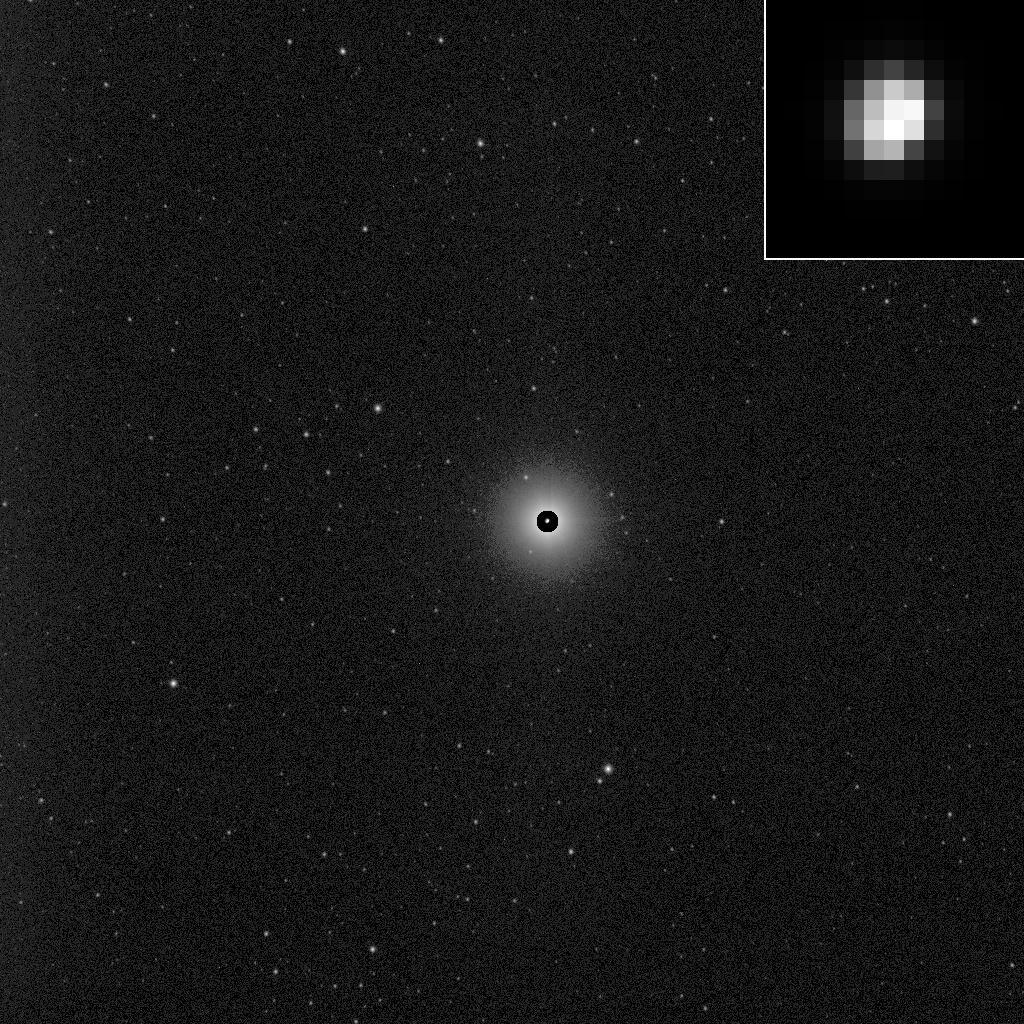
PASADENA, Calif. -- NASA's Dawn spacecraft has obtained its first image of the giant asteroid Vesta, which will help fine-tune navigation during its approach. Dawn is expected to achieve orbit around Vesta on July 16, when the asteroid is about 188 million kilometers (117 million miles) from Earth.

The image from Dawn's framing cameras was taken on May 3 when the spacecraft began its approach and was approximately 1.21 million kilometers (752,000 miles) from Vesta. The asteroid appears as a small, bright pearl against a background of stars. Vesta is also known as a protoplanet, because it is a large body that almost formed into a planet.

"After plying the seas of space for more than a billion miles, the Dawn team finally spotted its target," said Carol Raymond, Dawn's deputy principal investigator at NASA's Jet Propulsion Laboratory in Pasadena, Calif. "This first image hints of detailed portraits to come from Dawn's upcoming visit."

Vesta is 530 kilometers (330 miles) in diameter and the second most massive object in the asteroid belt. Ground- and space-based telescopes obtained images of the bright orb for about two centuries, but with little surface detail.

Mission managers expect Vesta's gravity to capture Dawn in orbit on July 16. To enter orbit, Dawn must match the asteroid's path around the sun, which requires very precise knowledge of the body's location and speed. By analyzing where Vesta appears relative to stars in framing camera images, navigators will pin down its location and enable engineers to refine the spacecraft's trajectory.

Dawn will start collecting science data in early August at an altitude of approximately 1,700 miles (2,700 kilometers) above the asteroid's surface. As the spacecraft gets closer, it will snap multi-angle images, allowing scientists to produce topographic maps. Dawn will later orbit at approximately 200 kilometers (120 miles) to perform other measurements and obtain closer shots of parts of the surface. Dawn will remain in orbit around Vesta for one year. After another long cruise phase, Dawn will arrive in 2015 at its second destination, Ceres, an even more massive body in the asteroid belt.

Gathering information about these two icons of the asteroid belt will help scientists unlock the secrets of our solar system's early history. The mission will compare and contrast the two giant bodies shaped by different forces. Dawn's science instruments will measure surface composition, topography and texture. Dawn will also measure the tug of gravity from Vesta and Ceres to learn more about their internal structures. The spacecraft's full odyssey will take it on a 5-billion-kilometer (3-billion-mile) journey, which began with its launch in September 2007.

Dawn's mission to Vesta and Ceres is managed by JPL for NASA's Science Mission Directorate in Washington. Dawn is a project of the directorate's Discovery Program, managed by NASA's Marshall Space Flight Center in Huntsville, Ala.

The University of California in Los Angeles is responsible for overall Dawn mission science. Orbital Sciences Corp. of Dulles, Va., designed and built the spacecraft. The framing cameras were developed and built under the leadership of the Max Planck Institute for Solar System Research in Katlenburg-Lindau in Germany, with significant contributions by the German Aerospace Center (DLR) Institute of Planetary Research in Berlin and in coordination with the Institute of Computer and Communication Network Engineering in Braunschweig. The framing camera project is funded by NASA, the Max Planck Society and DLR.

For more information about Dawn, visit: http://www.nasa.gov/dawn .

More information about JPL is online at: http://www.jpl.nasa.gov . Follow us via social media, including Facebook and Twitter. Details are at: http://www.jpl.nasa.gov/social .


Jia-Rui C. Cook 818-354-0850
Jet Propulsion Laboratory, Pasadena, Calif.
jia-rui.c.cook@jpl.nasa.gov

Dwayne C. Brown 202-358-1726
NASA Headquarters, Washington
dwayne.c.brown@nasa.gov

Tuesday, March 29, 2011

When is an Asteroid Not an Asteroid?

This image shows a model of the protoplanet Vesta, using scientists' best guess to date of what the surface of the protoplanet might look like. Image credit: NASA/JPL-Caltech/UCLA/PSI. Full image and caption

On March 29, 1807, German astronomer Heinrich Wilhelm Olbers spotted Vesta as a pinprick of light in the sky. Two hundred and four years later, as NASA's Dawn spacecraft prepares to begin orbiting this intriguing world, scientists now know how special this world is, even if there has been some debate on how to classify it.

Vesta is most commonly called an asteroid because it lies in the orbiting rubble patch known as the main asteroid belt between Mars and Jupiter. But the vast majority of objects in the main belt are lightweights, 100-kilometers-wide (about 60-miles wide) or smaller, compared with Vesta, which is about 530 kilometers (330 miles) across on average. In fact, numerous bits of Vesta ejected by collisions with other objects have been identified in the main belt.

"I don't think Vesta should be called an asteroid," said Tom McCord, a Dawn co-investigator based at the Bear Fight Institute, Winthrop, Wash. "Not only is Vesta so much larger, but it's an evolved object, unlike most things we call asteroids."

The layered structure of Vesta (core, mantle and crust) is the key trait that makes Vesta more like planets such as Earth, Venus and Mars than the other asteroids, McCord said. Like the planets, Vesta had sufficient radioactive material inside when it coalesced, releasing heat that melted rock and enabled lighter layers to float to the outside. Scientists call this process differentiation.

McCord and colleagues were the first to discover that Vesta was likely differentiated when special detectors on their telescopes in 1972 picked up the signature of basalt. That meant that the body had to have melted at one time.

Officially, Vesta is a "minor planet" -- a body that orbits the sun but is not a proper planet or comet. But there are more than 540,000 minor planets in our solar system, so the label doesn't give Vesta much distinction. Dwarf planets – which include Dawn's second destination, Ceres -- are another category, but Vesta doesn't qualify as one of those. For one thing, Vesta isn't quite large enough.

Dawn scientists prefer to think of Vesta as a protoplanet because it is a dense, layered body that orbits the sun and began in the same fashion as Mercury, Venus, Earth and Mars, but somehow never fully developed. In the swinging early history of the solar system, objects became planets by merging with other Vesta-sized objects. But Vesta never found a partner during the big dance, and the critical time passed. It may have had to do with the nearby presence of Jupiter, the neighborhood's gravitational superpower, disturbing the orbits of objects and hogging the dance partners.

Other space rocks have collided with Vesta and knocked off bits of it. Those became debris in the asteroid belt known as Vestoids, and even hundreds of meteorites that have ended up on Earth. But Vesta never collided with something of sufficient size to disrupt it, and it remained intact. As a result, Vesta is a time capsule from that earlier era.

"This gritty little protoplanet has survived bombardment in the asteroid belt for over 4.5 billion years, making its surface possibly the oldest planetary surface in the solar system," said Christopher Russell, Dawn's principal investigator, based at UCLA. "Studying Vesta will enable us to write a much better history of the solar system's turbulent youth."

Dawn's scientists and engineers have designed a master plan to investigate these special features of Vesta. When Dawn arrives at Vesta in July, the south pole will be in full sunlight, giving scientists a clear view of a huge crater at the south pole. That crater may reveal the layer cake of materials inside Vesta that will tell us how the body evolved after formation. The orbit design allows Dawn to map new terrain as the seasons progress over its 12-month visit. The spacecraft will make many measurements, including high-resolution data on surface composition, topography and texture. The spacecraft will also measure the tug of Vesta's gravity to learn more about its internal structure.

"Dawn's ion thrusters are gently carrying us toward Vesta, and the spacecraft is getting ready for its big year of exploration," said Marc Rayman, Dawn's chief engineer at NASA's Jet Propulsion Laboratory, Pasadena, Calif. "We have designed our mission to get the most out of this opportunity to reveal the exciting secrets of this uncharted, exotic world."

The Dawn mission to Vesta and Ceres is managed by the Jet Propulsion Laboratory, a division of the California Institute of Technology in Pasadena, for NASA's Science Mission Directorate, Washington. The Dawn mission is part of the Discovery Program managed by NASA's Marshall Space Flight Center in Huntsville, Ala. UCLA is responsible for overall Dawn mission science. Orbital Sciences Corporation of Dulles, Va., designed and built the Dawn spacecraft. The German Aerospace Center, the Max Planck Society, the Italian Space Agency and the Italian National Astrophysical Institute are part of the mission team.

For more information about Dawn, visit http://www.nasa.gov/dawn and http://dawn.jpl.nasa.gov .

Jia-Rui C. Cook 818-354-0850
Jet Propulsion Laboratory, Pasadena, Calif.
jccook@jpl.nasa.gov

Thursday, March 10, 2011

Dawn Gets Vesta Target Practice


This video shows the scientists' best guess to date of what the surface of the protoplanet Vesta might look like. It was created as part of an exercise for NASA's Dawn mission involving mission planners at NASA's Jet Propulsion Laboratory and science team members at the German Aerospace Center and the Planetary Science Institute. Image credit: NASA/JPL-Caltech/ESA/UCLA/DLR/PSI/STScI/UMd. Play video

This image shows the scientists' best guess to date of what the surface of the protoplanet Vesta might look like from the south pole, as projected onto a sphere 250 kilometers (160 miles) in radius. Image credit: NASA/JPL-Caltech/UCLA/PSI. Full image and caption - enlarge image

This anaglyph -- best viewed through red-blue glasses -- shows a 3-D model of the protoplanet Vesta, using scientists' best guess to date of what the surface of the protoplanet might look like. Image credit: NASA/JPL-Caltech/UCLA/PSI . Full image and caption - 2-D version - enlarge image

There is an old chestnut about a pedestrian who once asked a virtuoso violinist near Carnegie Hall how to get to the famed concert venue. The virtuoso's answer: practice!

The same applies to NASA's Dawn mission to the giant asteroid Vesta. In the lead-up to orbiting the second most massive body in the asteroid belt this coming July, Dawn mission planners and scientists have been practicing mapping Vesta's surface, producing still images and a rotating animation that includes the scientists' best guess to date of what the surface might look like.

The animation and images incorporate the best data on the dimples and bulges of Vesta from ground-based telescopes and NASA's Hubble Space Telescope. The The topography is color-coded by altitude. The cratering and small-scale surface variations are computer-generated, based on the patterns seen on Earth's moon, an inner solar system object with a surface appearance that may be similar to Vesta.

"We won't know what Vesta really looks like until Dawn gets there," said Carol Raymond, Dawn's deputy principal investigator, based at NASA's Jet Propulsion Laboratory, Pasadena, Calif., who helped orchestrate the activity. "But we needed a way to make sure our imaging plans would give us the best results possible. The products have proven that Dawn's mapping techniques will reveal a detailed view of this world that we've never seen up close before."

Vesta is one of the brightest asteroids in the night sky. Under the right conditions, Vesta can be seen with binoculars. But the best images so far from ground-based telescopes and Hubble still show Vesta as a bright, mottled orb. Once in orbit around Vesta, Dawn will pass about 650 kilometers (400 miles) above the asteroid's surface, snapping multi-angle images that will allow scientists to produce topographic maps. Later, Dawn will orbit at a lower altitude of about 200 kilometers (120 miles), getting closer shots of parts of the surface.

The Dawn mission will have the capability to map 80 percent of the asteroid's surface in the year the spacecraft is in orbit around Vesta. (The north pole will be dark when Dawn arrives in July 2011 and is expected to be only dimly lit when Dawn leaves in July 2012.) The mission will map Vesta at a spatial resolution on the order of the best global topography maps of Earth made by NASA's Shuttle Radar Topography mission.

Vesta formed very early in the history of the solar system and has one of the oldest surfaces in the system. Scientists are eager to get their first close-up look so they can better understand this early chapter.

Starting in August 2009, Dawn's optical navigation lead, Nick Mastrodemos, based at JPL, developed a computer simulation of the orbits and images to be taken by the spacecraft. He adapted software developed by Bob Gaskell of the Planetary Science Institute, Tuscon, Ariz. Mastrodemos created a model using scientists' best knowledge of Vesta and simulated the pictures that Dawn would take from the exact distances and geometries in the Dawn science plan.

He sent those images to two teams that use different techniques to derive topographical heights from imaging. One, led by Thomas Roatsch, was based at the Institute of Planetary Research of the German Aerospace Center (DLR) in Berlin. The other, led by Gaskell, was based at the Planetary Science Institute in Tuscon. (Like the Roatsch team, the Gaskell team did not have prior knowledge of the model from which the simulated data were created.) The groups sent their digital terrain models back to JPL, including the video produced by Frank Preusker from DLR that is based on his full stereo processing.

Mastrodemos compared their products to the original model he made. Both techniques reproduced the known data set well with only minor differences in spatial resolution and height accuracy. "Working through this exercise, the mission planners and the scientists learned that we could improve the overall accuracy of the topographic reconstruction, using a somewhat different observation geometry," Mastrodemos said. "Since then, Dawn science planners have worked to tweak the plans to implement the lessons of the exercise."

The exercise helped both teams get an early start on updating their software and planning the necessary computer resources. "In order to plan for proper stereo coverage of an unknown body like Vesta, practice is essential," said Roatsch, who is responsible for the framing camera team's stereo observation planning.

For now, the Virtual Vesta exercise gives the Dawn science team a fleshed-out model to consider. But to see whether their educated guesses were right, the team will have to wait until Dawn arrives at its target in four months.

The Dawn mission to Vesta and Ceres is managed for NASA's Science Mission Directorate in Washington by JPL, a division of the California Institute of Technology in Pasadena, and is a project of the Discovery Program managed at NASA's Marshall Space Flight Center, Huntsville, Ala. UCLA is home of the mission's principal investigator, Christopher Russell, and is responsible for overall Dawn mission science. The Dawn framing cameras have been developed and built under the leadership of the Max Planck Institute for Solar System Research, Katlenburg-Lindau, Germany, with significant contributions by the German Aerospace Center (DLR) Institute of Planetary Research, Berlin, and in coordination with the Institute of Computer and Communication Network Engineering, Braunschweig. The framing camera project is funded by the Max Planck Society, DLR and NASA.

To learn more about Dawn and its mission to the asteroid belt, and to see the new visuals, visit: http://www.nasa.gov/dawn or http://dawn.jpl.nasa.gov

Jia-Rui C. Cook 818-354-0850
Jet Propulsion Laboratory, Pasadena, Calif.
jia-rui.c.cook@jpl.nasa.gov

Saturday, October 09, 2010

NASA Mission to Asteroid Gets Help from Hubble Space Telescope

Asteroid Vesta Credit: NASA, ESA, and J.-Y. Li (University of Maryland,
College Park),
and L. McFadden (NASA GSFC)

WASHINGTON — NASA's Hubble Space Telescope has captured images of the large asteroid Vesta that will help scientists refine plans for the Dawn spacecraft's rendezvous with Vesta in July 2011.

Scientists have constructed a video from the images that will help improve pointing instructions for Dawn as it is placed in a polar orbit around Vesta. Analyses of Hubble images revealed a pole orientation, or tilt, of approximately four degrees more to the asteroid's east than scientists previously thought.

This means the change of seasons between the southern and northern hemispheres of Vesta may take place about a month later than previously expected while Dawn is orbiting the asteroid. The result is a change in the pattern of sunlight expected to illuminate the asteroid. Dawn needs solar illumination for imaging and some mapping activities.

"While Vesta is the brightest asteroid in the sky, its small size makes it difficult to image from Earth," said Jian-Yang Li, a scientist participating in the Dawn mission from the University of Maryland in College Park. "The new Hubble images give Dawn scientists a better sense of how Vesta is spinning because our new views are 90 degrees different from our previous images. It's like having a street-level view and adding a view from an airplane overhead."

The recent images were obtained by Hubble's Wide Field Camera 3 in February. The images complemented previous ones of Vesta taken from ground-based telescopes and Hubble's Wide Field and Planetary Camera 2 between 1983 and 2007. Li and his colleagues looked at 216 new images — and a total of 446 Hubble images overall — to clarify how Vesta was spinning. The journal Icarus recently published the report online.

"The new results give us food for thought as we make our way toward Vesta," said Christopher Russell, Dawn's principal investigator at the University of California, Los Angeles. "Because our goal is to take pictures of the entire surface and measure the elevation of features over most of the surface to an accuracy of about 33 feet, or the height of a three-story building, we need to pay close attention to the solar illumination. It looks as if Vesta is going to have a late northern spring next year, or at least later than we planned."

Launched in September 2007, Dawn will leave Vesta to encounter the dwarf planet Ceres in 2015. Vesta and Ceres are the most massive objects in the main asteroid belt between Mars and Jupiter. Scientists study these celestial bodies as examples of the building blocks of terrestrial planets like Earth. Dawn is approximately 134 million miles away from Vesta. Next summer, the spacecraft will make its own measurements of Vesta's rotating surface and allow mission managers to pin down its axis of spin.

"Vesta was discovered just over 200 years ago, and we are excited now to be on the threshold of exploring it from orbit," said Bob Mase, Dawn's project manager at NASA's Jet Propulsion Laboratory (JPL) in Pasadena, Calif. "We planned this mission to accommodate our imprecise knowledge of Vesta. Ours is a journey of discovery and, with our ability to adapt, we are looking forward to collecting excellent science data at our target."

The Dawn mission is managed by JPL for NASA's Science Mission Directorate at the agency's headquarters in Washington. Orbital Sciences Corporation of Dulles, Va., designed and built the spacecraft. Several international space organizations are part of the mission team.

To see the Vesta images and video, visit:

http://www.nasa.gov/mission_pages/dawn/multimedia/vestavid20101008.html
http://hubblesite.org/news/2010/33

To learn more about Dawn and its mission to the asteroid belt, visit:

http://www.nasa.gov/dawn

The Hubble Space Telescope is a project of international cooperation between NASA and the European Space Agency. NASA's Goddard Space Flight Center manages the telescope. The SpaceTelescope Science Institute (STScI) conducts Hubble science operations. STScI is operated for NASA by the Association of Universities for Research in Astronomy, Inc., in Washington, D.C.

Contact

Dwayne Brown
Headquarters, Washington
202-358-1726
dwayne.c.brown@nasa.gov

Jia-Rui Cook / D.C. Agle
Jet Propulsion Laboratory, Pasadena, Calif.
818-354-0850/393-9011
jia-rui.c.cook@jpl.nasa.gov / david.c.agle@jpl.nasa.gov

Ray Villard
Space Telescope Science Institute, Baltimore
410-338-4514
villard@stsci.edu