Showing posts with label supergiant star. Show all posts

Thursday, July 30, 2026

Astronomers find strongest evidence yet that Betelgeuse has a companion

PR Image eso2611a
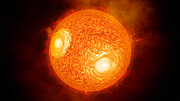
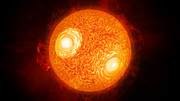
VLT images of Betelgeuse and its companion

PR Image eso2611b
VLT image of Betelgeuse’s companion

PR Image eso2611c
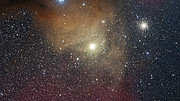
Digitized Sky Survey image of Betelgeuse

PR Image eso2611d
Wide-field view of the region of the sky where Betelgeuse is located

PR Image eso2611e
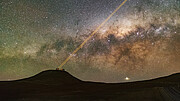
The star Betelgeuse in the constellation of Orion


Videos
Clearest image ever of Betelgeuse’s companion | ESO News

PR Video eso2611a
Clearest image ever of Betelgeuse’s companion | ESO News

Zooming in on Betelgeuse’s companion
PR Video eso2611b
Zooming in on Betelgeuse’s companion


“The conclusion of a century-long quest”

At long last, astronomers have firm evidence that Betelgeuse, one of the most famous stars in the night sky, is not alone. Using the European Southern Observatory’s Very Large Telescope (ESO's VLT), a team led by French researcher Miguel Montargès obtained the clearest image ever of what likely is Betelgeuse B, the star orbiting Betelgeuse. “This is the conclusion of a century-long quest,” says Montargès.

We have shown that Betelgeuse is not single, it is accompanied by a faint stellar companion,” says Montargès, astronomer at the Observatoire de Paris - PSL, France, and lead author of the study published today in Astronomy & Astrophysics. Betelgeuse — a reddish star in the Orion constellation that is easily visible with the naked eye and is known to change in brightness — has been observed for millennia. But it still surprises astronomers.

I jumped from my chair when I saw the processed images,” recalls Montargès. Astronomers have looked for the potential companion, originally proposed to explain Betelgeuse’s brightness changes, for about a century, but without success. Two studies published in 2024 robustly predicted that in December that year, the companion would be furthest from Betelgeuse and hence easier to spot. Montargès and his team got to work, observing the star with ESO’s VLT in December 2024 and spending several months processing the data.

Honestly, I thought we did not have the sensitivity to detect Betelgeuse B as it was predicted,” explains Montargès. “Because it is more massive than predicted, we see it!” Originally thought to be about as massive as the Sun, the new observations reveal that Betelgeuse B has instead around two to three times the mass of the Sun. “The fact that we can still discover a nearby companion, more massive and brighter than the Sun, around such a well-studied star is remarkable,” says Montargès. “These are among the best moments in science: seeing something new, unexpected.”

Betelgeuse B was directly imaged, meaning the light from the star itself was detected, using the SPHERE instrument on ESO’s VLT in Chile’s Atacama Desert. While there was evidence for the existence of this companion star, including a possible direct detection with the Gemini North Telescope in Hawaiʻi, USA, this is the strongest evidence for, and clearest image yet of, Betelgeuse B. “It is remarkable to see how SPHERE and advanced post-processing techniques, originally developed to find exoplanets, also excel at detecting a companion around a massive, evolved star like Betelgeuse," says co-author Anthony Boccaletti, also an astronomer at the Observatoire de Paris.

To be certain that the companion is really there, we still need to observe it in one year on the other side of the star, but there is very little space left for doubt,” adds Montargès.

A few years back, Betelgeuse was the subject of attention from astronomers and non-astronomers alike when it visibly started dimming. As an evolved supergiant star, Betelgeuse is expected to die in a supernova explosion, and the dimming led some to speculate it could be about to explode. A group of astronomers led by Montargès studied the star with ESO’s VLT, finding it was instead obscured by a cloud of dust.

The potential detection of Betelgeuse B will prompt astronomers to investigate how the companion could affect Betelgeuse's anticipated supernova explosion. “The question is truly opened whether this companion is going to have an impact on the evolution of the red supergiant,” concludes Montargès.

Source: ESO/News


More information

At long last, astronomers have firm evidence that Betelgeuse, one of the most famous stars in the night sky, is not This research was presented in a paper titled “VLT/SPHERE images the candidate companion of Betelgeuse” to appear in Astronomy & Astrophysics.

The team is composed of M. Montargès (Laboratoire d'Instrumentation et de Recherche en Astrophysique, Observatoire de Paris, Université PSL, Sorbonne Université, Université Paris Cité, CY Cergy Paris Université, CNRS, France [LIRA]), A. Boccaletti (LIRA), O. Flasseur (Universite Claude Bernard Lyon 1, Centre de Recherche Astrophysique de Lyon UMR5574, ENS de Lyon, CNRS, France), A. de Koter (University of Amsterdam, Anton Pannekoek Institute for Astronomy, The Netherlands), J. Milli (Univ. Grenoble Alpes, CNRS, IPAG, France), P. Kervella (French-Chilean Laboratory for Astronomy, IRL 3386, CNRS and U. de Chile, Chile and LIRA), S. Ridgway (National Optical Astronomy Observatory, USA), E. Bordier (I. Physikalisches Institut der Universität zu Köln, Germany), E. Lagadec (Université Côte dAzur, Observatoire de la Côte dAzur, CNRS, Laboratoire Lagrange, France), A. K. Dupree (Center for Astrophysics-Harvard & Smithsonian, USA), F. Backs (Institute of Astronomy, KU Leuven, Belgium), T. Calderwood (American Association of Variable Star Observers, USA [AAVSO]), and P. Morgan (AAVSO).

The European Southern Observatory (ESO) enables scientists worldwide to discover the secrets of the Universe for the benefit of all. We design, build and operate world-class observatories on the ground — which astronomers use to tackle exciting questions and spread the fascination of astronomy — and promote international collaboration for astronomy. Established as an intergovernmental organisation in 1962, today ESO is supported by 16 Member States (Austria, Belgium, Czechia, Denmark, France, Finland, Germany, Ireland, Italy, the Netherlands, Poland, Portugal, Spain, Sweden, Switzerland and the United Kingdom), along with the host state of Chile and with Australia as a Strategic Partner. ESO’s headquarters and its visitor centre and lanetarium, the ESO Supernova, are located close to Munich in Germany, while the Chilean Atacama Desert, a marvellous place with unique conditions to observe the sky, hosts our telescopes. ESO operates three observing sites: La Silla, Paranal and Chajnantor. At Paranal, ESO operates the Very Large Telescope and its Very Large Telescope Interferometer, as well as survey telescopes such as VISTA. Also at Paranal, ESO will host and operate the south array of the Cherenkov Telescope Array Observatory, the world’s largest and most sensitive gamma-ray observatory. Together with international partners, ESO operates ALMA on Chajnantor, a facility that observes the skies in the millimetre and submillimetre range. At Cerro Armazones, near Paranal, we are building “the world’s biggest eye on the sky” — ESO’s Extremely Large Telescope. From our offices in Santiago, Chile we support our operations in the country and engage with Chilean partners and society.


Links


Contacts:

Miguel Montargès
LIRA, Observatoire de Paris, PSL University
Paris, France
Tel: +33 (0)1 45 07 76 95
Email:
miguel.montarges@observatoiredeparis.psl.eu

Anthony Boccaletti
LIRA, Observatoire de Paris, PSL University
Paris, France
Email:
anthony.boccaletti@observatoiredeparis.psl.eu

Bárbara Ferreira
ESO Media Manager
Garching bei München, Germany
Tel: +49 89 3200 6670
Cell: +49 151 241 664 00
Email:
press@eso.org


Tuesday, January 06, 2026

NASA Hubble Helps Detect ‘Wake’ of Betelgeuse’s Elusive Companion Star

This artist’s concept shows the red supergiant star Betelgeuse and an orbiting companion star. The companion, which is orbiting clockwise from this point of view, generates a dusty wake that expands outward.

Scientists used NASA’s Hubble Space Telescope to look for evidence of a wake being generated by a companion star orbiting Betelgeuse. The team found a noticeable difference in light shown in the lefthand peak when the companion star was at different points in its orbit.


Using new observations from NASA’s Hubble Space Telescope and ground-based observatories, astronomers tracked the influence of a recently discovered companion star, Siwarha, on the gas around Betelgeuse. The research, from scientists at the Center for Astrophysics | Harvard & Smithsonian (CfA), reveals a trail of dense gas swirling through Betelgeuse’s vast, extended atmosphere, shedding light on why the giant star’s brightness and atmosphere have changed in strange and unusual ways.

The results of the new study were presented Monday at a news conference at the 247th meeting of the American Astronomical Society in Phoenix and are accepted for publication in The Astrophysical Journal.

The team detected Siwarha’s wake by carefully tracking changes in the star’s light over nearly eight years. These changes show the effects of the previously unconfirmed companion as it plows through the outer atmosphere of Betelgeuse. This discovery resolves one of the biggest mysteries about the giant star, helping scientists to explain how it behaves and evolves while opening new doors to understanding other massive stars nearing the end of their lives.

Located roughly 650 light-years away from Earth in the constellation Orion, Betelgeuse is a red supergiant star so large that more than 400 million Suns could fit inside. Because of its enormous size and proximity, Betelgeuse is one of the few stars whose surface and surrounding atmosphere can be directly observed by astronomers, making it an important and accessible laboratory for studying how giant stars age, lose mass, and eventually explode as supernovae.

Using NASA’s Hubble and ground-based telescopes at the Fred Lawrence Whipple Observatory and Roque de Los Muchachos Observatory, the team was able to see a pattern of changes in Betelgeuse, which provided clear evidence of a long-suspected companion star and its impact on the red supergiant’s outer atmosphere. Those include changes in the star’s spectrum, or the specific colors of light given off by different elements, and the speed and direction of gases in the outer atmosphere due to a trail of denser material, or wake. This trail appears just after the companion crosses in front of Betelgeuse every six years, or about 2,100 days, confirming theoretical models.

“It’s a bit like a boat moving through water. The companion star creates a ripple effect in Betelgeuse’s atmosphere that we can actually see in the data,” said Andrea Dupree, an astronomer at the CfA, and the lead study author. “For the first time, we’re seeing direct signs of this wake, or trail of gas, confirming that Betelgeuse really does have a hidden companion shaping its appearance and behavior.”

For decades, astronomers have tracked changes in Betelgeuse’s brightness and surface features in hopes of figuring out why the star behaves the way it does. Curiosity intensified after the giant star appeared to “sneeze” and became unexpectedly faint in 2020. Two distinct periods of variation in the star were especially puzzling for scientists: a short 400-day cycle, recently attributed to pulsations within the star itself, and the long, 2,100-day secondary period.

Until now, scientists have considered everything from large convection cells and clouds of dust to magnetic activity, and the possibility of a hidden companion star. Recent studies concluded that the long secondary period was best explained by the presence of a low-mass companion orbiting deep within Betelgeuse’s atmosphere, and another team of scientists reported a possible detection, but until now, astronomers lacked the evidence to prove what they believed was happening. Now, for the first time, they have firm evidence that a companion is disrupting the atmosphere of this supergiant star.

“The idea that Betelgeuse had an undetected companion has been gaining in popularity for the past several years, but without direct evidence, it was an unproven theory,” said Dupree. “With this new direct evidence, Betelgeuse gives us a front-row seat to watch how a giant star changes over time. Finding the wake from its companion means we can now understand how stars like this evolve, shed material, and eventually explode as supernovae.”

With Betelgeuse now eclipsing its companion from our point of view, astronomers are planning new observations for its next emergence in 2027. This breakthrough may also help explain similar mysteries in other giant and supergiant stars.

The Hubble Space Telescope has been operating for over three decades and continues to make ground-breaking discoveries that shape our fundamental understanding of the universe. Hubble is a project of international cooperation between NASA and ESA (European Space Agency). NASA’s Goddard Space Flight Center in Greenbelt, Maryland, manages the telescope and mission operations. Lockheed Martin Space, based in Denver, also supports mission operations at Goddard. The Space Telescope Science Institute in Baltimore, which is operated by the Association of Universities for Research in Astronomy, conducts Hubble science operations for NASA.


Monday, March 04, 2024

A new spin on Betelgeuse’s boiling surface

A direct comparison of a computer simulation of a nonrotating red supergiant with ALMA observations of Betelgeuse. If not sufficiently resolved in telescopes, the large-scale convection can result in a dipolar velocity map. The top row shows intensity maps, the bottom row shows maps of the radial velocity. The left-hand column shows the simulation of the star in full resolution; the middle column shows mock observations with reduced resolution. The right column shows the actual ALMA observation. © MPA, Ma, Jing-Ze et al, 2024


Betelgeuse is a well-known red supergiant star in the constellation Orion. Recently it has gained a lot of attention, not only because variations in its brightness led to speculations that an explosion might be imminent, but also because observations indicated that it’s rotating much faster than expected. This latter interpretation is now put into question by an international team led by astronomers at Max Planck Institute for Astrophysics, who propose that Betelgeuse’s boiling surface can be mistaken for rotation even in the most advanced telescopes. Other astronomers are actively analyzing new observational data to test such hypotheses.

As one of the brightest stars in the northern hemisphere, Betelgeuse can be easily found by naked-eye in the constellation of Orion. Betelgeuse is one of the biggest stars known. With a diameter larger than a billion kilometers, it is almost 1000 times larger than the Sun. If it had been in our solar system, it would have engulfed Earth with its atmosphere reaching Jupiter. A star that large is not supposed to rotate fast. In their evolution, most stars expand and spin down to conserve angular momentum. However, recent observations suggested that Betelgeuse is rotating quite fast (at 5 km/s), two orders of magnitude faster than a single evolved star should spin.

The most prominent evidence for Betelgeuse’s rotation came from the Atacama Large Millimeter/submillimeter Array (ALMA). The 66 antennas at ALMA work together as though they were a single giant telescope. They use a technique known as interferometry, where two or more antennas pick up a signal from the Universe and join forces to analyze the signal and obtain information on its source of emission. Using this technique, astronomers discovered a dipolar radial velocity map on the outer layer of Betelgeuse: Half of the star appears to be approaching us, and the other half seems to be receding. This observation, along with previous studies, led to the interpretation that Betelgeuse is rapidly rotating.

This interpretation would have been a clear case, if Betelgeuse was a perfectly round sphere. However, the surface of Betelgeuse is a vibrant world, governed by a physical process called convection. We can observe convection in our daily life when we boil water, but in Betelgeuse, this process is much more violent: The boiling bubbles can be as large as Earth’s orbit around the Sun, covering a large fraction of Betelgeuse’s surface. They rise and fall at a speed of up to 30 km/s, faster than any crewed spacecraft.

Based on this physical picture, an international team led by Jing-Ze Ma, PhD student at the Max Planck Institute for Astrophysics now offers an alternative explanation to Betelgeuse’s dipolar velocity map: Betelgeuse’s boiling surface mimics rotation. A cluster of boiling bubbles rise on one side of the star, and another group of bubbles sink on the other side. Due to the limited resolution of the ALMA telescope, such convective motions would be blurred in actual observations, which would result in the dipolar velocity map.

The team developed a new post-processing package to produce synthetic ALMA images and submillimeter spectra from their 3D radiation hydrodynamic simulations of nonrotating red supergiant stars. In 90% of the simulations, the star would be interpreted as rotating at several km/s simply because of the large-scale boiling motions on the surface that are not clearly seen in the ALMA telescope.

Further observations are needed to better assess the rapid rotation of Betelgeuse, and the team made predictions for future observations with higher spatial resolution. Fortunately, other astronomers have already made higher-resolution observations of Betelgeuse in 2022. The new data is being analyzed right now, which will put the predictions to the test and help unveil the mask of Betelgeuse.

“Most stars are just tiny points of light in the night sky. Betelgeuse is so incredibly large and nearby that, with the very best telescopes, it is one of the very few stars where we actually observe and study its boiling surface. It still feels a bit like a Science Fiction movie, as if we have traveled there to see it up close”, says coauthor Selma de Mink (director at the Max Planck Institute for astrophysics). “And the results are so exciting. If Betelgeuse is rapidly rotating after all, then we think it must have been spun up after eating a small companion star that was orbiting it.”

“There is so much we still don’t understand about gigantic boiling stars like Betelgeuse.”, says co-author Andrea Chiavassa, astronomer at CNRS. “How do they really work? How do they lose mass? What molecules can form in their outflows? Why did Betelgeuse suddenly get less bright? We are working very hard to make our computer simulations better and better, but we really need the incredible data from telescopes like ALMA.”

Simulation of Betelgeuse’s boiling surface
This animation shows a simulation of how convection dominates the surface of a Betelgeuse-like star. It then shows how this would look like in actual ALMA observations, demonstrating that the boiling surface could be mistaken as signature for a rotation.


Author:

Jing-Ze Ma
PhD student
tel:2261

jingze@mpa-garching.mpg.de

Selma E. de Mink
Director
tel:2041

sedemink@mpa-garching.mpg.de

Original publication

Jing-Ze Ma, Andrea Chiavassa, Selma E. de Mink, et al.
Is Betelgeuse Really Rotating? Synthetic ALMA Observations of Large-scale Convection in 3D Simulations of Red Supergiants
2024 ApJL 962 L36


Source | DOI


Thursday, February 04, 2021

Study of Supergiant Star Betelgeuse Unveils the Cause of its Pulsations; Recalibrated its Mass, Radius, and Distance

Fig 1: Recent brightness variations of Betelgeuse. Stellar pulsation causes the star’s brightness to vary, but the large dip in brightness in early 2020 is unprecedented. A comparison of direct images of the surface of Betelgeuse between January 2019 and December 2019 show that large portions of the star faded in December 2019, which could indicate a dust cloud appearing in front of it. The images were taken by the European Southern Observatory’s (ESO’s) Very Large Telescope. (Credit: ESO/M. Montargès et al.) For brightness data, see the caption of Fig 2.

Fig 2: Variation in brightness of Betelgeuse over the previous 15 years. Gaps in the data are periods when Betelgeuse is not visible in the night sky each year. The brightness data was collected by the observers of the American Association of Vari-able Star Observers (AAVSO) and the Solar Mass-Ejection Imager instrument in space. Data from the latter was processed by László Molnár from the Konkoly Observatory of CSFK in Budapest, Hungary. (Credit: L. Molnár, AAVSO, UCSD/SMEI, NA-SA/STEREO/HI)

Betelgeuse is normally one of the brightest, most recognizable stars of the winter sky, marking the left shoulder of the constellation Orion. But lately, it has been behaving strangely: an unprecedentedly large drop in its brightness has been observed in early 2020 (Figure 1), which has prompted speculation that Betelgeuse may be about to explode. 

To find out more, an international team of scientists, including Ken'ichi Nomoto at the Kavli Institute for the Physics and Mathematics of the Universe (Kavli IPMU), conducted a rigorous examination of Betelgeuse. They concluded that the star is in the early core helium-burning phase (which is more than 100,000 years before an explosion happens) and has smaller mass and radius—and is closer to Earth—than previously thought. They also showed that smaller brightness variations of Betelgeuse have been driven by stellar pulsations, and suggested that the recent large dimming event involved a dust cloud. 

The research team is led by Dr. Meridith Joyce from the Australian National University (ANU), who was an invited speaker at Kavli IPMU in January 2020, and includes Dr. Shing-Chi Leung, a former Kavli IPMU project researcher and a current postdoctoral scholar at the California Institute of Technology, and Dr. Chiaki Kobayashi, an associate professor at the University of Hertfordshire, who has been an affiliate member of Kavli IPMU. 

The team analyzed the brightness variation of Betelgeuse (Figure 2) by using evolutionary, hydrodynamic and seismic modelling. They achieved a clearer idea than before that Betelgeuse is currently burning helium in its core. They also showed that stellar pulsations driven by the so-called kappa-mechanism is causing the star to continuously brighten or fade with two periods of 185 (±13.5) days and approximately 400 days. But the large dip in brightness in early 2020 is unprecedented, and is likely due to a dust cloud in front of Betelgeuse, as seen in the image (Figure 1).

Their analysis reported a present-day mass of 16.5 to 19 solar mass—which is slightly lower than the most recent estimates. The study also revealed how big Betelgeuse is, as well as its distance from Earth. The star’s actual size has been a bit of a mystery: earlier studies, for instance, suggested it could be bigger than the orbit of Jupiter. However, the team’s results showed Betelgeuse only extends out to two-thirds of that, with a radius 750 times the radius of the sun. Once the physical size of the star is known, it will be possible to determine its distance from Earth. Thus far, the team's results show it is a mere 530 light years from us, or 25 percent closer than previously thought. 

Their results imply that Betelgeuse is not at all close to exploding, and that it is too far from Earth for the eventual explosion to have significant impact here, even though it is still a really big deal when a supernova goes off. And as Betelgeuse is the closest candidate for such an explosion, it gives us a rare opportunity to study what happens to stars like this before they explode.

 Source: Kavli Institute for the Physics and Mathematics of the Universe (Kavli IPMU)


Paper details 

Journal: The Astrophysical Journal
Title: Standing on the Shoulders of Giants: New Mass and Distance Estimates for Betelgeuse through Combined Evolutionary, Asteroseismic, and Hydrodynamic Simulations with MESA

Authors: Meridith Joyce (1,2), Shing-Chi Leung (3), László Molnár (4, 5, 6), Michael Ireland (1), Chiaki Kobayashi (2, 7, 8), Ken’ichi Nomoto (8)

Author affiliation:

1. Research School of Astronomy and Astrophysics, Australian National University (ANU), Canberra, ACT 2611, Australia
2. ARC Center of Excellence for All Sky Astrophysics in 3 Dimensions (ASTRO 3D), Australia
3. TAPIR, Walter Burke Institute for Theoretical Physics, Mailcode 350-17, Caltech, Pasadena, CA 91125, USA
4. Konkoly Observatory, Research Center for Astronomy and Earth Sciences (CSFK), Konkoly-Thege út 15-17, H-1121 Budapest, Hungary
5. MTA CSFK Lendulet Near-Field Cosmology Research Group, Konkoly-Thege út 15-17, H-1121 Budapest, Hungary
6. ELTE Eotvs Loránd University, Institute of Physics, Budapest, 1117, Páz mány Péter sétány 1 / A, Hungary
7. Center for Astrophysics Research, Department of Physics, Astronomy and Mathematics, University of Hertfordshire, College Lane, Hatfield AL10 9AB, UK
8. Kavli Institute for the Physics and Mathematics of the Universe (WPI), The University of Tokyo Institutes for Advanced Study, The University of Tokyo, Kashiwa, Chiba 277-8583, Japan

DOI: https://doi.org/10.3847/1538-4357/abb8db   (Posted on October 13, 2020)
Abstract of the paper: (The Astrophysical Journal)
Pre-print: (arXiv.org page)


Research contact :

Ken’ichi Nomoto
Senior Scientist
Kavli Institute for the Physics and Mathematics of the Universe, University of Tokyo
E-mail: nomoto@astron.s.u-tokyo.ac.jp
TEL: +81-4-7136-5940

Media contact:

John Amari
Press officer
Kavli Institute for the Physics and Mathematics of the Universe, The University of Tokyo
E-mail: press@ipmu.jp
TEL: 080-4056-2767


Related Links:

Click here to view the press release from ANU "Supergiant Betelgeuse smaller, closer than first thought

Click here to view the press release from Konkoly Observatory of the Research Centre for Astronomy and Earth Sciences (CSFK) / the web-page of Eötvös Loránd Research Network (ELKH)

"Supergiant star Betelgeuse smaller, closer than first thought"


Friday, February 14, 2020

ESO Telescope Sees Surface of Dim Betelgeuse

SPHERE’s view of Betelgeuse in December 2019

SPHERE’s view of Betelgeuse in January 2019

Betelgeuse before and after dimming

Betelgeuse’s dust plumes seen by VISIR image

A plume on Betelgeuse (artist’s impression with annotations)

The star Betelgeuse in the constellation of Orion


Videos

ESOcast 217 Light: ESO Telescope Sees Surface of Dim Betelgeuse

Zooming in on Betelgeuse

Betelgeuse before and after dimming (animated)

From Betelgeuse’s surroundings to its surface
PR Video eso2003d
From Betelgeuse’s surroundings to its surface


Using ESO’s Very Large Telescope (VLT), astronomers have captured the unprecedented dimming of Betelgeuse, a red supergiant star in the constellation of Orion. The stunning new images of the star’s surface show not only the fading red supergiant but also how its apparent shape is changing.

Betelgeuse has been a beacon in the night sky for stellar observers but it began to dim late last year. At the time of writing Betelgeuse is at about 36% of its normal brightness, a change noticeable even to the naked eye. Astronomy enthusiasts and scientists alike were excitedly hoping to find out more about this unprecedented dimming.

A team led by Miguel Montargès, an astronomer at KU Leuven in Belgium, has been observing the star with ESO's Very Large Telescope since December, aiming to understand why it’s becoming fainter. Among the first observations to come out of their campaign is a stunning new image of Betelgeuse’s surface, taken late last year with the SPHERE instrument.

The team also happened to observe the star with SPHERE in January 2019, before it began to dim, giving us a before-and-after picture of Betelgeuse. Taken in visible light, the images highlight the changes occurring to the star both in brightness and in apparent shape.

Many astronomy enthusiasts wondered if Betelgeuse’s dimming meant it was about to explode. Like all red supergiants, Betelgeuse will one day go supernova, but astronomers don’t think this is happening now. They have other hypotheses to explain what exactly is causing the shift in shape and brightness seen in the SPHERE images. “The two scenarios we are working on are a cooling of the surface due to exceptional stellar activity or dust ejection towards us,” says Montargès [1]. “Of course, our knowledge of red supergiants remains incomplete, and this is still a work in progress, so a surprise can still happen.”

Montargès and his team needed the VLT at Cerro Paranal in Chile to study the star, which is over 700 light-years away, and gather clues on its dimming. “ESO's Paranal Observatory is one of few facilities capable of imaging the surface of Betelgeuse,” he says. Instruments on ESO’s VLT allow observations from the visible to the mid-infrared, meaning astronomers can see both the surface of Betelgeuse and the material around it. “This is the only way we can understand what is happening to the star.”

Another new image, obtained with the VISIR instrument on the VLT, shows the infrared light being emitted by the dust surrounding Betelgeuse in December 2019. These observations were made by a team led by Pierre Kervella from the Observatory of Paris in France who explained that the wavelength of the image is similar to that detected by heat cameras. The clouds of dust, which resemble flames in the VISIR image, are formed when the star sheds its material back into space.

“The phrase ‘we are all made of stardust’ is one we hear a lot in popular astronomy, but where exactly does this dust come from?” says Emily Cannon, a PhD student at KU Leuven working with SPHERE images of red supergiants. “Over their lifetimes, red supergiants like Betelgeuse create and eject vast amounts of material even before they explode as supernovae. Modern technology has enabled us to study these objects, hundreds of light-years away, in unprecedented detail giving us the opportunity to unravel the mystery of what triggers their mass loss.”

Souce: ESO/News


Notes

[1] Betelgeuse's irregular surface is made up of giant convective cells that move, shrink and swell. The star also pulsates, like a beating heart, periodically changing in brightness. These convection and pulsation changes in Betelgeuse are referred to as stellar activity. 


More Information

The team is composed of Miguel Montargès (Institute of Astronomy, KU Leuven, Belgium), Emily Cannon (Institute of Astronomy, KU Leuven, Belgium), Pierre Kervella (LESIA, Observatoire de Paris - PSL, France), Eric Lagadec (Laboratoire Lagrange, Observatoire de la Côte d'Azur, France), Faustine Cantalloube (Max-Planck-Institut für Astronomie, Heidelberg, Germany), Joel Sánchez Bermúdez (Instituto de Astronomía, Universidad Nacional Autónoma de México, Mexico City, Mexico and Max-Planck-Institut für Astronomie, Heidelberg, Germany), Andrea Dupree (Center for Astrophysics | Harvard & Smithsonian, USA), Elsa Huby (LESIA, Observatoire de Paris - PSL, France), Ryan Norris (Georgia State University, USA), Benjamin Tessore (IPAG, France), Andrea Chiavassa (Laboratoire Lagrange, Observatoire de la Côte d'Azur, France), Claudia Paladini (ESO, Chile), Agnès Lèbre (Université de Montpellier, France), Leen Decin (Institute of Astronomy, KU Leuven, Belgium), Markus Wittkowski (ESO, Germany), Gioia Rau (NASA/GSFC, USA), Arturo López Ariste (IRAP, France), Stephen Ridgway (NSF’s National Optical-Infrared Astronomy Research Laboratory, USA), Guy Perrin (LESIA, Observatoire de Paris - PSL, France), Alex de Koter (Astronomical Institute Anton Pannekoek, Amsterdam University, The Netherlands & Institute of Astronomy, KU Leuven, Belgium), Xavier Haubois (ESO, Chile), Eric Pantin (CEA, France), Ralf Siebenmorgen (ESO, Germany).

The VISIR image was obtained as part of the NEAR science demonstration observations. NEAR (Near Earths in the AlphaCen Region) is an upgrade of VISIR, which was implemented as a time-limited experiment.

ESO is the foremost intergovernmental astronomy organisation in Europe and the world’s most productive ground-based astronomical observatory by far. It has 16 Member States: Austria, Belgium, the Czech Republic, Denmark, France, Finland, Germany, Ireland, Italy, the Netherlands, Poland, Portugal, Spain, Sweden, Switzerland and the United Kingdom, along with the host state of Chile and with Australia as a Strategic Partner. ESO carries out an ambitious programme focused on the design, construction and operation of powerful ground-based observing facilities enabling astronomers to make important scientific discoveries. ESO also plays a leading role in promoting and organising cooperation in astronomical research. ESO operates three unique world-class observing sites in Chile: La Silla, Paranal and Chajnantor. At Paranal, ESO operates the Very Large Telescope and its world-leading Very Large Telescope Interferometer as well as two survey telescopes, VISTA working in the infrared and the visible-light VLT Survey Telescope. Also at Paranal ESO will host and operate the Cherenkov Telescope Array South, the world’s largest and most sensitive gamma-ray observatory. ESO is also a major partner in two facilities on Chajnantor, APEX and ALMA, the largest astronomical project in existence. And on Cerro Armazones, close to Paranal, ESO is building the 39-metre Extremely Large Telescope, the ELT, which will become “the world’s biggest eye on the sky”.</ div>


Links


Contacts

Miguel Montargès
FWO [PEGASUS]² Marie Skłodowska-Curie Fellow / Institute of Astronomy, KU Leuven
Leuven, Belgium
Tel: +32 16 32 74 67
Email: miguel.montarges@kuleuven.be

Emily Cannon
Institute of Astronomy, KU Leuven
Leuven, Belgium
Tel: +32 16 32 88 92
Email: emily.cannon@kuleuven.be

Pierre Kervella
LESIA, Observatoire de Paris - PSL
Paris, France
Tel: +33 0145077966
Email: pierre.kervella@observatoiredeparis.psl.eu

Bárbara Ferreira
ESO Public Information Officer
Garching bei München, Germany
Tel: +49 89 3200 6670
Cell: +49 151 241 664 00
Email: pio@eso.org


Monday, October 30, 2017

BRITE space mission reveals the origins of fundamental structures in the wind of the supergiant star zeta Puppis

Artist’s impression of the hot massive supergiant Zeta Puppis. The rotation period of the star indicated by the new BRITE observations is 1.78 d, and its spin axis is inclined by (24 ± 9)° with respect to the line of sight. [Image credits: Tahina Ramiaramanantsoa] Hi-res image

Manifestations of bright spots at the surface of Zeta Puppis and corotating interaction regions (CIRs) in its wind. Bottom panels: Surface light variations of the star as observed by BRITE during one part of the observing campaign (Left), along with the surface map reconstructed from the light curve inversion algorithm (Right), revealing the locations of the dominant bright spots present during that part of the observing run. Top panels: Variations observed in the ionized Helium wind emission line (Left) compared to modelled line profile variations (Right) due to two arms of CIRs in the stellar wind driven by the two surface spots from the surface maps

Random variations at the surface of Zeta Puppis and clumps in its wind. Left panel: The random component of the surface light variations of star observed by BRITE during one night in February 2015 (Red = observations from the BRITE nanosats equipped with a red filter; Blue = observations from the BRITE nanosats equipped with a blue filter; Green = integrated residual intensity in the wind emission line). Main panel: The variations of the wind emission line due to the presence of wind clumps during that night. Right panel: Strong correlation between the amplitudes of the random surface variations and the clump-induced wind variations of Zeta Puppis.


ICRAR astronomer Paul Luckas has collaborated with a Canadian-led team of astronomers who have discovered observational evidence for how features at the surface of the massive southern supergiant star zeta Puppis induce the formation of fundamental structures in its wind.

We are the children of stars. But it is more precise to say that we are the children of massive stars. Indeed, in contrast to cool low-mass stars like the Sun, hot massive stars are scarce, possess extremely strong winds, and catastrophically end their lives as supernovae that stir up and enrich the interstellar medium with chemical elements involved in the creation of new stars and even planets like Earth. Thus, the research team’s breakthrough results on the hot massive supergiant star zeta Puppis are a significant step towards a better understanding of the true nature of hot massive stars which play a crucial role in the evolution of the Universe.

The research team used the network of nanosatellites of the BRIght Target Explorer (BRITE) space mission to monitor the visible brightness changes coming from the surface of zeta Puppis over about six months, and simultaneously monitored the behavior of the wind of the star from several ground-based professional and amateur observatories.

The observations revealed a 1.78-day periodicity both at the surface and in the wind of zeta Puppis. The behaviour of this periodic signal turns out to reflect the spinning of the star through the presence of slowly evolving bright spots tied to its surface, which are driving large-scale spiral-like structures dubbed corotating interaction regions (CIRs) in its wind. “Once we found that the variations in the brightness of zeta Puppis arise because bright spots on its surface are carried into and out of our view by the star’s rotation every 1.78 days, we employed an algorithm that used those brightness variations to make maps showing where the bright spots are on the star’s surface and how they change over time. Then by studying the light emitted at a specific wavelength by ionized helium from the star’s wind, we clearly saw some “S” patterns that are caused by arms of CIRs induced in the wind by the bright surface spots!”, explains Tahina Ramiaramanantsoa, PhD student at the Université de Montréal and member of the Centre de Recherche en Astrophysique du Québec (CRAQ), who led the investigation and the paper reporting on the results recently published in the Monthly Notices of the Royal Astronomical Society (MNRAS).

In addition to the 1.78-day periodicity, the research team also detected random changes on timescales of hours at the surface of zeta Puppis, strongly correlated with the behavior of small regions of higher density in the wind known as “clumps” that travel outward from the star. “These results are very exciting because we also find evidence, for the first time, of a direct link between surface variations and wind clumping, both random in nature”, comments investigating team member Anthony Moffat, professor emeritus at Université de Montréal, and Principal Investigator for the Canadian contribution to the BRITE mission.

The southern naked-eye bright star zeta Puppis is an evolved massive star currently at the stage of supergiant. It is often considered as the archetype of hot massive stars with strong stellar winds. Indeed, about sixty times more massive and seven times hotter than the Sun, zeta Puppis has a stellar wind about a billion times stronger than that of the Sun. In that sense, the solar wind that drives aurorae and shapes the tails of comets appears like a light breeze when compared to the gale-force wind from zeta Puppis.

Also, most massive stars occur in binary or multiple systems. However, zeta Puppis is particular because not only is it amongst the few massive stars known to be single, but also it is moving through space at a particularly fast velocity of about 60 km/s. Imagine an object about sixty times the mass of the Sun travelling about sixty times faster than a speeding bullet! “The existing theoretical scenarios that explain this high peculiar space velocity for zeta Puppis involve past interactions within a binary or a multiple system, and predicted a relatively short rotation period for the star. That prediction is now supported by these new observational results!”, exclaims investigating team member Dany Vanbeveren, professor at Vrije Universiteit Brussel.

The physical origins of the bright surface spots and the random brightness variations discovered in zeta Puppis remain unknown at this point, and will be the subject of further investigations, probably requiring other types of observations. Actually, an existing theory is that, within the huge radiative envelopes of massive stars, there is probably a thin convective layer close to the stellar surface. This sub-surface convection zone could be the site for the generation of small- scale magnetic fields, which could occasionally breach through the stellar surface and produce magnetic bright spots. The formation of clumps at the very base of the wind could also be induced by waves randomly excited from that sub-surface convection layer or even from the deep convective core.

After several decades of puzzling over the potential link between the surface variability of very hot massive stars and their wind variability, these results are a significant breakthrough in massive star research, essentially owing to the BRITE nanosats and the large contribution by both professional and amateur astronomers around the world. “It is really exciting to know that small dedicated telescopes are able to play a significant role at the scientific front!”, says investigating team member Paul Luckas from the International Centre for Radio Astronomy Research (ICRAR) at the University of Western Australia. Paul contributed a record breaking 257 high resolution spectra from his backyard observatory in Shenton Park over a 7 month period as part of a southern pro-am spectroscopy initiative.

Stay tuned!


Publication Detais 

BRITE-Constellation High-Precision Time-Dependent Photometry of the Early-O-Type Supergiant Z Puppies Unveils the Photospheric Drivers of its Small- and Large-Scale Wind Structures.’, to appear in Monthly Notices of the Royal Astronomical Society (MNRAS).
Click here for the research paper


More Information 

ICRAR 

The International Centre for Radio Astronomy Research, or ICRAR, is a joint venture between Curtin University and The University of Western Australia with support and funding from the State Government of Western Australia.

About the BRITE mission


BRITE (BRIght Target Explorer) Constellation is a network of five nanosatellites to investigate stellar structure and evolution of the brightest stars in the sky and their interaction with the local environment. Read more here and here


Contact Information


Tahina RAMIARAMANTSOA (Université de Montréal and Centre de Recherche en Astrophysique du Québec (CRAQ))
Email: tahina@astro.umontreal.ca


Thursday, August 24, 2017

Best Ever Image of a Star’s Surface and Atmosphere

 PR Image eso1726a
VLTI reconstructed view of the surface of Antares 

PR Image eso1726b
Artist’s impression of the red supergiant star Antares

PR Image eso1726c
VLTI velocity map of the surface of Antares

PR Image eso1726d
The bright red star Antares in the constellation of Scorpius 


Videos
 
ESOcast 123 Light: Best Ever Image of a Star’s Surface and Atmosphere (4K UHD)

Zooming in on the red supergiant star Antares

3D animation of Antares

Approaching Antares (artist's impression)


First map of motion of material on a star other than the Sun

Using ESO’s Very Large Telescope Interferometer astronomers have constructed the most detailed image ever of a star — the red supergiant star Antares. They have also made the first map of the velocities of material in the atmosphere of a star other than the Sun, revealing unexpected turbulence in Antares’s huge extended atmosphere. The results were published in the journal Nature.

To the unaided eye the famous, bright star Antares shines with a strong red tint in the heart of the constellation of Scorpius (The Scorpion). It is a huge and comparatively cool red supergiant star in the late stages of its life, on the way to becoming a supernova [1].

A team of astronomers, led by Keiichi Ohnaka, of the Universidad Católica del Norte in Chile, has now used ESO’s Very Large Telescope Interferometer (VLTI) at the Paranal Observatory in Chile to map Antares’s surface and to measure the motions of the surface material. This is the best image of the surface and atmosphere of any star other than the Sun.

The VLTI is a unique facility that can combine the light from up to four telescopes, either the 8.2-metre Unit Telescopes, or the smaller Auxiliary Telescopes, to create a virtual telescope equivalent to a single mirror up to 200 metres across. This allows it to resolve fine details far beyond what can be seen with a single telescope alone.

How stars like Antares lose mass so quickly in the final phase of their evolution has been a problem for over half a century,” said Keiichi Ohnaka, who is also the lead author of the paper. “The VLTI is the only facility that can directly measure the gas motions in the extended atmosphere of Antares — a crucial step towards clarifying this problem. The next challenge is to identify what’s driving the turbulent motions.”

Using the new results the team has created the first two-dimensional velocity map of the atmosphere of a star other than the Sun. They did this using the VLTI with three of the Auxiliary Telescopes and an instrument called AMBER to make separate images of the surface of Antares over a small range of infrared wavelengths. The team then used these data to calculate the difference between the speed of the atmospheric gas at different positions on the star and the average speed over the entire star [2]. This resulted in a map of the relative speed of the atmospheric gas across the entire disc of Antares — the first ever created for a star other than the Sun..

The astronomers found turbulent, low-density gas much further from the star than predicted, and concluded that the movement could not result from convection [3], that is, from large-scale movement of matter which transfers energy from the core to the outer atmosphere of many stars. They reason that a new, currently unknown, process may be needed to explain these movements in the extended atmospheres of red supergiants like Antares.

In the future, this observing technique can be applied to different types of stars to study their surfaces and atmospheres in unprecedented detail. This has been limited to just the Sun up to now,” concludes Ohnaka. “Our work brings stellar astrophysics to a new dimension and opens an entirely new window to observe stars.


Notes

[1] Antares is considered by astronomers to be a typical red supergiant. These huge dying stars are formed with between nine and 40 times the mass of the Sun. When a star becomes a red supergiant, its atmosphere extends outward so it becomes large and luminous, but low-density. Antares now has a mass about 12 times that of the Sun and a diameter about 700 times larger than the Sun’s. It is thought that it started life with a mass more like 15 times that of the Sun, and has shed three solar-masses of material during its life.

[2] The velocity of material towards or away from Earth can be measured by the Doppler Effect, which shifts spectral lines either towards the red or blue ends of the spectrum, depending on whether the material emitting or absorbing light is receding from or approaching the observer.

[3] Convection is the process whereby cold material moves downwards and hot material moves upwards in a circular pattern. The process occurs on Earth in the atmosphere and ocean currents, but it also moves gas around within stars.


More Information

This research was presented in a paper entitled “Vigorous atmospheric motion in the red supergiant star Antares”, by K. Ohnaka et al., published in the journal Nature.

The team is composed of K. Ohnaka (Universidad Católica del Norte, Antofagasta, Chile), G. Weigelt (Max- Planck-Institut für Radioastronomie, Bonn, Germany) and K. -H. Hofmann (Max- Planck-Institut für Radioastronomie, Bonn, Germany).

ESO is the foremost intergovernmental astronomy organisation in Europe and the world’s most productive ground-based astronomical observatory by far. It is supported by 16 countries: Austria, Belgium, Brazil, the Czech Republic, Denmark, France, Finland, Germany, Italy, the Netherlands, Poland, Portugal, Spain, Sweden, Switzerland and the United Kingdom, along with the host state of Chile. ESO carries out an ambitious programme focused on the design, construction and operation of powerful ground-based observing facilities enabling astronomers to make important scientific discoveries. ESO also plays a leading role in promoting and organising cooperation in astronomical research. ESO operates three unique world-class observing sites in Chile: La Silla, Paranal and Chajnantor. At Paranal, ESO operates the Very Large Telescope and its world-leading Very Large Telescope Interferometer as well as two survey telescopes, VISTA working in the infrared and the visible-light VLT Survey Telescope. ESO is also a major partner in two facilities on Chajnantor, APEX and ALMA, the largest astronomical project in existence. And on Cerro Armazones, close to Paranal, ESO is building the 39-metre Extremely Large Telescope, the ELT, which will become “the world’s biggest eye on the sky”.


Links


Contacts

Keiichi Ohnaka
Instituto de Astronomía — Universidad Católica del Norte
Antofagasta, Chile
Tel: +56 55 235 5493
Email: k1.ohnaka@gmail.com

Richard Hook
ESO Public Information Officer
Garching bei München, Germany
Tel: +49 89 3200 6655
Cell: +49 151 1537 3591
Email: rhook@eso.org
Source: ESO/News

Tuesday, January 22, 2013

Betelgeuse braces for a collision

 
Betelgeuse’s enigmatic environment
Copyright ESA/Herschel/PACS/L. Decin et al

Multiple arcs are revealed around Betelgeuse, the nearest red supergiant star to Earth, in this new image from ESA’s Herschel space observatory. The star and its arc-shaped shields could collide with an intriguing dusty ‘wall’ in 5000 years.

Betelgeuse rides on the shoulder of the constellation Orion the Hunter. It can easily be seen with the naked eye in the northern hemisphere winter night sky as the orange–red star above and to the left of Orion’s famous three-star belt.

Roughly 1000 times the diameter of our Sun and shining 100 000 times more brightly, Betelgeuse’s impressive statistics come with a cost. For this star is likely on its way to a spectacular supernova explosion, having already swelled into a red supergiant and shed a significant fraction of its outer layers.

The new far-infrared view from Herschel shows how the star’s winds are crashing against the surrounding interstellar medium, creating a bow shock as the star moves through space at speeds of around 30 km/s.

A series of broken, dusty arcs ahead of the star’s direction of motion testify to a turbulent history of mass loss.

Closer to the star itself, an inner envelope of material shows a pronounced asymmetric structure. Large convective cells in the star’s outer atmosphere have likely resulted in localised, clumpy ejections of dusty debris at different stages in the past.

An intriguing linear structure is also seen further away from the star, beyond the dusty arcs. While some earlier theories proposed that this bar was a result of material ejected during a previous stage of stellar evolution, analysis of the new image suggests that it is either a linear filament linked to the Galaxy’s magnetic field, or the edge of a nearby interstellar cloud that is being illuminated by Betelgeuse.

If the bar is a completely separate object, then taking into account the motion of Betelgeuse and its arcs and the separation between them and the bar, the outermost arc will collide with the bar in just 5000 years, with the red supergiant star itself hitting the bar roughly 12 500 years later.

Notes for editors:

“The enigmatic nature of the circumstellar envelope and bow shock surrounding Betelgeuse as revealed by Herschel,” by L. Decin et al, was published in Astronomy & Astrophysics, December 2012.

For further information, please contact:

Markus Bauer 
ESA Science and Robotic Exploration Communication Officer 
Tel: +31 71 565 6799 
Mob: +31 61 594 3 954
Email:
markus.bauer@esa.int

Leen Decin
Institute of Astronomy, KU Leuven, Belgium
Email:
Leen.Decin@ster.kuleuven.be

Göran Pilbratt
ESA Herschel Project Scientist 
Tel: +31 71 565 3621
Email:
gpilbratt@rssd.esa.int

Thursday, May 10, 2012

Cygnus-X: the cool swan glowing in flight

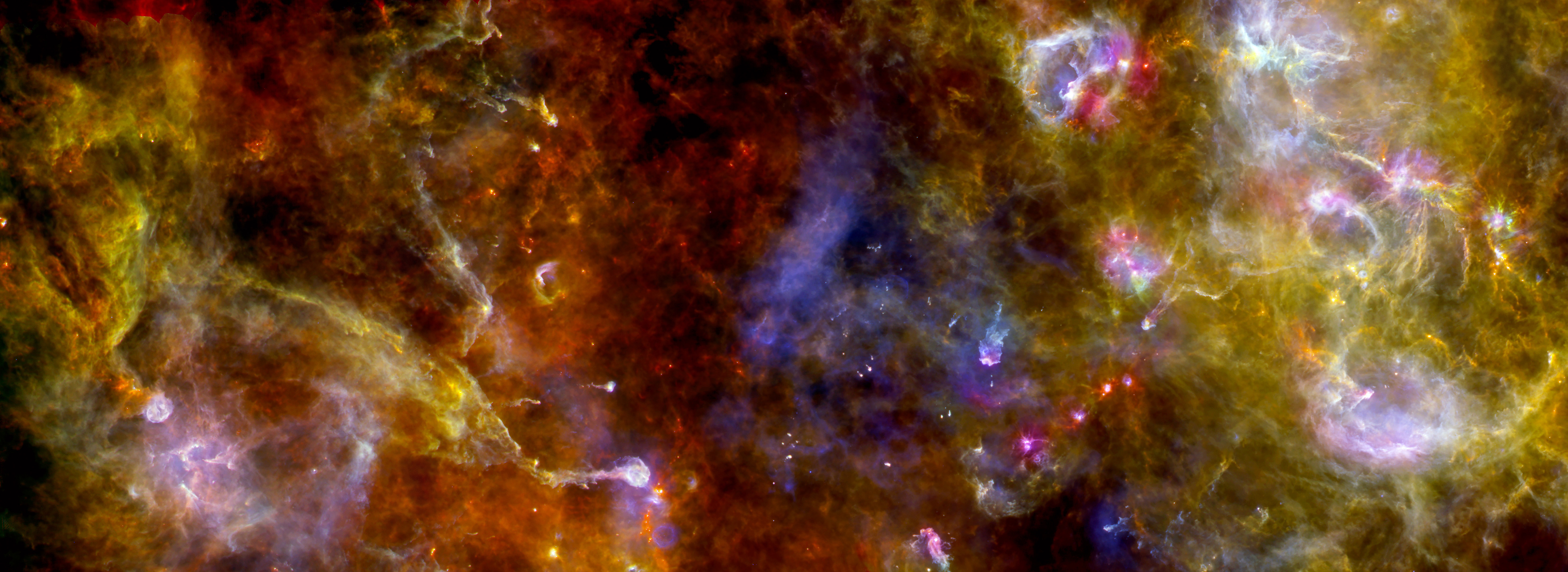
This new view of the Cygnus-X star-formation region by Herschel highlights chaotic networks of dust and gas that point to sites of massive star formation.

The image combines data acquired with the PACS instrument at 70 micron (corresponding to the blue channel) and 160 micron (corresponding to the green channel) and with the SPIRE instrument at 250 micron (corresponding to the red channel). The observations were made on 24 May 2010 and 18 December 2010. North is to the lower-right and east to the upper-right.

Credits: ESA/PACS/SPIRE/Martin Hennemann & Frédérique Motte, Laboratoire AIM Paris-Saclay, CEA/Irfu – CNRS/INSU – Univ. Paris Diderot, France. HI-RES JPEG (Size: 2381 kb)

An annotated version of Herschel’s view of Cygnus-X highlighting numerous dense sites of new star formation in the right-hand complex, and the swan-like structure in the left-hand portion of the scene. Powerful radiation and winds from thousands of stars in the OB2 complex undetected at Herschel’s long wavelengths have partly cleared and heated surrounding material, visible as the diffuse blue glow in the centre of the image. A supergiant star identified as G79.29+0.46 has likely ejected the ring of material seen at the bottom of the image.

Credits: ESA/PACS/SPIRE/Martin Hennemann & Frédérique Motte, Laboratoire AIM Paris-Saclay, CEA/Irfu – CNRS/INSU – Univ. Paris Diderot, France. HI-RES JPEG (Size:
7952 kb)

Chaotic networks of dust and gas signpost the next generations of massive stars in this stunning new image of the Cygnus-X star-nursery captured by ESA’s Herschel space observatory.

Cygnus-X is an extremely active region of massive-star birth some 4500 light-years from Earth in the constellation of Cygnus, the Swan.

Using Herschel’s far-infrared eyes, astronomers can seek out regions where dust has been gently heated by stars, pointing them to dense clumps of gas where new generations of stars are forming.

Bright white areas highlight zones where large stars have recently formed out of turbulent clouds, especially evident in the chaotic network of filaments seen in the right-hand portion of the image.

Here, dense knots of gas and dust mark intersections where filaments meet and collapse to form new stars, and where bubble-like structures are carved by their immense radiation.

In the centre of the image, fierce radiation and powerful stellar winds from stars undetected at Herschel’s wavelengths have partly cleared and heated interstellar material, which then glows blue in this representation.

The left-hand part of the scene is dominated by a pillar of gas whose shape resembles that of the neck of a swan.

Below and to the right, a shell of gas and dust has likely been ejected from a supergiant star at its centre, but which is not seen directly in this image.

Strings of compact red objects scattered throughout the scene map the cold seeds of future generations of stars.

The image highlights the unique capabilities of Herschel to probe the birth of large stars and their influence on the surrounding interstellar material with a level of detail at far-infrared wavelengths that has never before been available.

For further information, please contact:

Markus Bauer
ESA Science and Robotic Exploration Communication Officer
Tel: +31 71 565 6799
Mob: +31 61 594 3 954
Email: markus.bauer@esa.int

Göran Pilbratt
ESA Herschel Project Scientist
Research and Scientific Support Department
Science and Robotic Exploration Directorate
ESA, The Netherlands
Tel: +31 71 565 3621
Email: gpilbratt@rssd.esa.int