Monday, October 24, 2011

Hubble Sizes up a Dwarf Galaxy

Phoenix Dwarf Galaxy
Credit: ESA/Hubble & NASA
Fullsize Original 1,2 mb

The NASA/ESA Hubble Space Telescope has taken this image of the Phoenix Dwarf Galaxy, which is located 1.4 million light-years away from Earth. It is located in the constellation of Phoenix in the southern sky. The object, a dwarf irregular galaxy, features younger stars in its inner regions and older ones at its outskirts.

Dwarf galaxies are small galaxies composed of a few billion stars, compared to fully-fledged galaxies which can contain hundreds of billions of stars. In the Local Group, there are a number of such dwarf galaxies orbiting the larger galaxies such as the Milky Way or the Andromeda Galaxy. They are thought to have been created by tidal forces in the early stages of the creation of these galaxies, or as a result of collisions between galaxies, forming from ejected streams of material and dark matter from the parent galaxies. The Milky Way galaxy features at least 14 satellite dwarf galaxies orbiting it.

Because of their shape, dwarf irregulars have often been mistaken for globular clusters: they do not feature a bulge or spiral arms like larger galaxies. However, their importance in terms of cosmology is in stark contrast to their unspectacular shapes, as their chemical makeup and high levels of gas are believed to be similar to those of the earliest galaxies that populated the Universe. They are thought to be contemporary versions of some of the remote galaxies observed in deep field galaxy surveys, and can thus help to understand the early stages of galaxy and star formation in the young Universe.

The galaxy was discovered in 1976 by Hans-Emil Schuster and Richard Martin West. Hans-Emil Schuster was acting director of ESO’s La Silla Observatory in Chile and was involved in the selection and testing of the sites for the observatories of both La Silla and Paranal. His great contribution to astronomy and to ESO was recognised by the Chilean government last week when he was awarded the medal of the Order of Bernardo O’Higgins.

Thursday, October 20, 2011

Herschel detects abundant water in planet-forming disc

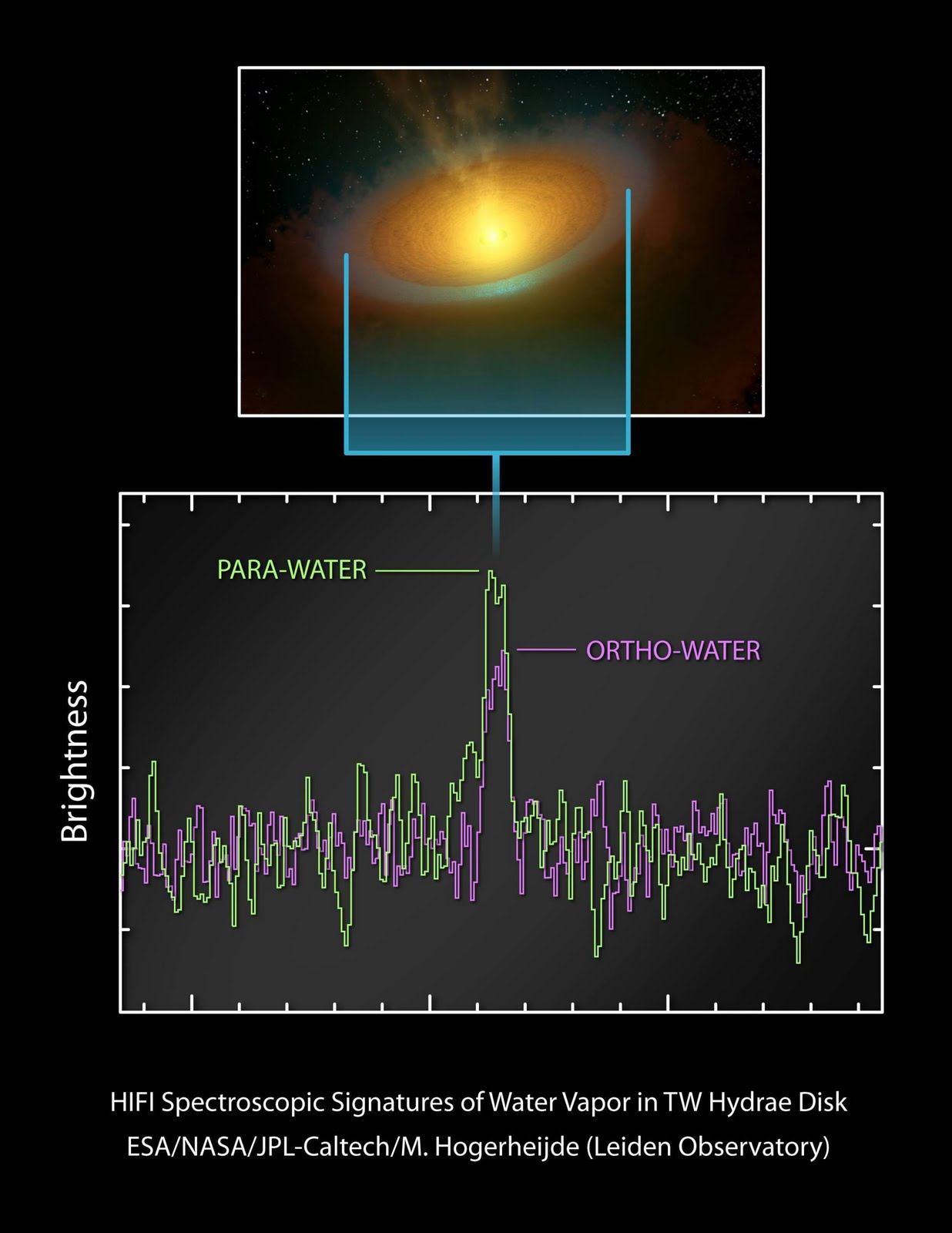
This image shows an artist's impression of the icy protoplanetary disc around the young star TW Hydrae (upper panel) and the spectrum of the disc as obtained using the HIFI spectrometer on ESA's Herschel Space Observatory (lower panel).

By analysing the spectrum, astronomers have detected the emission from cold water vapour in the planet-forming disc. The vapour arises when highly energetic radiation from the central star interacts with icy grains in the disc. The detection thus hints at a copious and otherwise undetectable supply of water ice hidden in the disc's deeper and colder layers.

The graph in the lower panel shows the spectral signature of water vapour in the disc. Water molecules come in two "spin" forms, called ortho and para, in which the two spins of the hydrogen nuclei have different orientations. By comparing the relative amounts of ortho and para water, astronomers can determine the temperatures under which the water formed. Lower ratios indicate cooler temperatures, though in practice the analysis is much more complicated. The ratio of ortho to para water observed in TW Hydrae's protoplanetary disc is low enough to point to the presence of cold water vapour.Credits: ESA/NASA/JPL-Caltech/M. Hogerheijde (Leiden Observatory) HI-RES JPEG (Size: 1196 kb)

This artist's impression illustrates an icy protoplanetary disc around the young star TW Hydrae, located about 175 light-years away in the Hydra, or Sea Serpent, constellation.

Astronomers using the HIFI spectrometer on ESA's Herschel Space Observatory detected copious amounts of cold water vapour, illustrated in blue, emanating from the star's planet-forming disc of dust and gas. The water vapour, corresponding to temperatures lower than 100 K, is distributed across the entire extent of the disc and is likely confined to a thin layer at an intermediate depth in the disc. The vapour arises when highly energetic radiation from the central star interacts with icy grains in the disc, the very same grains that should ultimately coalesce into icy planetesimals, such as comets. The detection thus hints at a copious and otherwise undetectable supply of water ice hidden in the disc's deeper and colder layers.

In our own Solar System, comets are thought to have carried water to Earth, creating our oceans. A similar process might be taking place around TW Hydrae, where comets could, over the next several millions of years, transport water to young worlds. The Herschel results demonstrate that vast reservoirs of water are available around stars for creating these hypothetical water worlds. Credits: ESA/NASA/JPL-Caltech. HI-RES JPEG (Size: 1934 kb)

ESA’s Herschel space observatory has found evidence of water vapour emanating from ice on dust grains in the disc around a young star, revealing a hidden ice reservoir the size of thousands of oceans.

TW Hydrae, a star between 5-10 million years old, and only 176 light-years away, is in the final stage of formation, and is surrounded by a disc of dust and gas that may condense to form a complete set of planets.

It is believed that a large proportion of Earth’s water may have come from ice-laden comets that bombarded our world during and after its formation. Recent studies of comet 103P/Hartley 2 with Herschel shed new light on how water may have come to Earth, with its findings of the first Earth-like water in a comet. Until now, however, almost nothing was known about reservoirs in planet-forming discs around other stars.

This new detection is the first of its kind and has been made possible by Herschel’s HIFI instrument.

The tell-tale water vapour signature, believed to be produced when the ice coated dust grains are warmed by interstellar UV radiation, has been detected throughout the disc around TW Hydrae, and, though weaker than expected, it hints at a substantial reservoir of ice. This could be a rich source of water for any planets that form around this young star.

"The detection of water sticking to dust grains throughout the disc would be similar to events in our own Solar System's evolution, where over millions of years, similar dust grains then coalesced to form comets," says Michiel Hogerheijde of Leiden University in the Netherlands, who led the study.

"These comets we believe became a contributing source of water for the planets."

The scientists ran detailed simulations, combining the new data with previous ground-based observations and some from NASA’s Spitzer telescope. From this they calculated the size of the ice reservoirs in the planet-forming regions.

Their results show that the total amount of water in the disc around TW Hydrae would fill several thousand Earth oceans.

"We already have approved time on Herschel to study more planet-forming regions around three other stars," says Dr Hogerheijde.

"We believe that will show similar results in terms of the water detections, but as our next observations will be of objects up to three times further in distance away, we'll need many more hours of observation time."

This research breaks new ground in understanding water’s role in planet-forming discs and gives scientists a new testing ground for looking at how water came to our own planet.

"With Herschel we can follow the trail of water through all the steps of star and planet formation," comments Göran Pilbratt, Herschel Project Scientist at ESA.

"Here we are studying the 'raw material' for planet formation, which is fundamental to an understanding of how planetary systems such as our own Solar System once formed."

Notes to editors

HIFI is the Heterodyne Instrument for the Far-Infrared spectrometer on the Herschel Space Observatory. It was designed to observe water in a wide variety of objects, and aims to study not only planet-forming discs and star formation, but also galactic evolution. Its capability for highly detailed chemical identification of individual atoms and molecules makes it the instrument of choice for studying chemistry throughout space, particularly around embryonic and dying stars.

Markus Bauer
ESA Science and Robotic Exploration Communication Officer
Email: markus.bauer@esa.int
Tel: +31 71 565 6799
Mob: +31 61 594 3 954

Michiel Hogerheijde
Leiden Observatory
Tel: +31 71 527 5590
Email: michiel@strw.leidenuniv.nl

Göran Pilbratt
ESA Herschel Project Scientist
Tel: +31 71 565 3621
Email: gpilbratt@rssd.esa.int

Wednesday, October 19, 2011

Record-Breaking Photo Reveals a Planet-sized Object as Cool as the Earth

These two infrared images were taken by the Spitzer Space Telescope in 2004 and 2009. They show a faint object moving through space together with a white dwarf. The brown dwarf, named WD 0806-661 B, is the coldest companion object to be directly imaged outside our solar system. Credit: Kevin Luhman, Penn State University, October 2011

An artist's impression of the coldest imaged companion, named WD 0806-661 B, (right foreground) orbiting at a large distance from a white dwarf --the collapsed-core remnant of a dying star. Credit: NASA Goddard Space Flight Center/Francis Reddy

A second artist's impression of the coldest imaged companion, named WD 0806-661 B, (left foreground) orbiting at a large distance from a white dwarf -- the collapsed-core remnant of a dying star. Credit: Janella Williams

The photo of a nearby star and its orbiting companion -- whose temperature is like a hot summer day in Arizona -- will be presented by Penn State Associate Professor of Astronomy and Astrophysics Kevin Luhman during the Signposts of Planets conference at NASA's Goddard Space Flight Center on 20 October 2011. A paper describing the discovery will be published in the Astrophysical Journal.

"This planet-like companion is the coldest object ever directly photographed outside our solar system," said Luhman, who led the discovery team. "Its mass is about the same as many of the known extra-solar planets -- about six to nine times the mass of Jupiter -- but in other ways it is more like a star. Essentially, what we have found is a very small star with an atmospheric temperature about cool as the Earth's."

Luhman classifies this object as a "brown dwarf," an object that formed just like a star out of a massive cloud of dust and gas. But the mass that a brown dwarf accumulates is not enough to ignite thermonuclear reactions in its core, resulting in a failed star that is very cool. In the case of the new brown dwarf, the scientists have gauged the temperature of its surface to be between 80 and 160 degrees Fahrenheit -- possibly as cool as a human.

Ever since brown dwarfs first were discovered in 1995, astronomers have been trying to find new record holders for the coldest brown dwarfs because these objects are valuable as laboratories for studying the atmospheres of planets with Earth-like temperatures outside our solar system.

Astronomers have named the brown dwarf "WD 0806-661 B" because it is the orbiting companion of an object named "WD 0806-661" -- the "white dwarf" core of a star that was like the Sun until its outer layers were expelled into space during the final phase of its evolution. "The distance of this white dwarf from the Sun is 63 light years, which is very near our solar system compared with most stars in our galaxy," Luhman said.

"The distance of this white dwarf from its brown-dwarf companion is 2500 astronomical units (AU) -- about 2500 times the distance between the Earth and the Sun, so its orbit is very large as compared with the orbits of planets, which form within a disk of dust swirling close around a newborn star," said Adam Burgasser at the University of California, San Diego, a member of the discovery team. Because it has such a large orbit, the astronomers say this companion most probably was born in the same manner as binary stars, which are known to be separated as far apart as this pair, while remaining gravitationally bound to each other.

Luhman and his colleagues presented this new candidate for the coldest known brown dwarf in a paper published in spring 2011, and they now have confirmed its record-setting cool temperature in a new paper that will be published in the Astrophysical Journal.

To make their discovery, Luhman and his colleagues searched through infrared images of over six hundred stars near our solar system. They compared images of nearby stars taken a few years apart, searching for any faint points of light that showed the same motion across the sky as the targeted star. "Objects with cool temperatures like the Earth are brightest at infrared wavelengths," Luhman said. "We used NASA's Spitzer Space Telescope because it is the most sensitive infrared telescope available."

Luhman and his team discovered the brown dwarf WD 0806-661 B moving in tandem with the white dwarf WD 0806-661 in two Spitzer images taken in 2004 and 2009. The images, which together show the movement of the objects, are available here. "This animation is a fun illustration of our technique because it resembles the method used to discovery Pluto in our own solar system," Luhman said.

In a related new discovery involving a different cool brown dwarf, Penn State Postdoctoral Scholar John Bochanski and his colleagues have made the most detailed measurement yet of ammonia in the atmosphere of an object outside our solar system. "These new data are much higher quality that previously achieved, making it possible to study, in much more detail than ever before, the atmospheres of the coldest brown dwarfs, which most closely resemble the atmospheres that are possible around planets," Bochanski said.

"Brown dwarfs that are far from their companion stars are much easier to study than are planets, which typically are difficult to observe because they get lost in the glare of the stars they orbit," Burgasser said. "Brown dwarfs with Earth-like temperatures allow us to refine theories about the atmospheres of objects outside our solar system that have comparatively cool atmospheres like that of our own planet."

This research was sponsored by grants from the National Science Foundation and the NASA Astrophysics Theory Program.


***

CONTACTS

Researchers Explain the Formation of Scheila's Unusual Triple Dust Tails

A research team of planetary scientists and astronomers, primarily from Seoul National University, the National Astronomical Observatory of Japan (NAOJ), the Institute of Space and Astronautical Science (ISAS), and Kobe University, has explained the formation of peculiar triple dust tails from the asteroid Scheila (asteroid #596). The researchers concluded that another asteroid about 20-50 meters in size impacted Scheila from behind on December 3, 2010 and accounted for its unusual brightness and form.

On December 11.4, 2010, Steve Larson of the Catalina Sky Survey noticed an odd brightness from Scheila, an asteroid on the outer region of the main belt of asteroids that orbit in an area between Mars and Jupiter. Three streams of dust appeared to trail from the asteroid. Data from NASA's Swift Satellite and the Hubble Space Telescope suggested that a smaller asteroid's impact was the likely trigger for the appearance of comet-like tails from Scheila. However, questions remained about the date when the dust emission occurred and how the triple dust tails formed. The current research team sought answers to these queries.

Soon after reports of Scheila's unusual brightness, the current research team used the Subaru Prime Focus Camera (Suprime-Cam) on the Subaru Telescope (8.2 m), the Ishigakijima Astronomical Observatory Murikabushi Telescope (1.05 m), and the University of Hawaii 2.2 m Telescope to make optical observations of these mysterious dust trails over a three-month period. The top of Figure 1 shows images of the development of the dust trails taken by the Murikabushi Telescope on the 12th and 19th of December 2010. Although asteroids generally look like points when observed from Earth, Scheila looked like a comet. As the three streaks of dust streamed from the asteroid, their surface brightness decreased. Eventually the dust clouds became undetectable, and then a faint linear structure appeared. The bottom of Figure 1 shows the image obtained by Subaru Telescope on March 2, 2011. Based on these images of the linear structure, the scientists determined a dust emission date of December 3.5+/-1, 2010. Steve Larson of the Catalina Sky Survey noticed that Scheila had a slightly diffuse appearance on December 3.4, 2010. Therefore, it is likely that the collision of the asteroids occurred within the short time between December 2 12:00 UT and December 3 10:00 UT.

To explain the formation of Scheila's triple dust tails, the research team conducted a computer simulation of Scheila's dust emission on December 3th. Their simulation was based on information gained through impact experiments in a laboratory at ISAS, a hypervelocity impact facility and division of the Japan Aerospace Exploration Agency (JAXA). Figure 2 shows the ejecta produced by an oblique impact, which was not a head-on collision. Two prominent features characterize oblique impacts and the shock waves generated by them. One feature, a downrange plume, occurs in a direction downrange from the impact site and results from the fragmentation or sometimes evaporation of the object that impacted another. A second feature occurs during the physical destruction of the impacted object; a shock wave spreads from the impact site, scoops out materials (conical impact ejecta), and forms an impact crater. The axis of the cone of ejecta is roughly perpendicular to the surface at the impact site. The team reasoned that these two processes caused the ejection of Scheila's dust particles and that sunlight pushed them away from the asteroid. After performing a tremendous number of computer simulations under different conditions, they could only duplicate their observed images when an object struck Scheila’s surface from behind (Figures 3 and 4).

Taking all of the evidence into account—their observations and simulations --the research team concluded that there is only one way to explain the mysterious brightness and triple trails of dust from Scheila. A smaller asteroid obliquely impacted Scheila from behind.

Notes:

The following papers will appear in the Astrophysical Journal:

Ishiguro et al. 2011, Astrophysical Journal Letters 740, L11, "Observational Evidences for Impact on the Main-Belt Asteroid (596) Scheila"
Ishiguro et al. 2011, Astrophysical Journal Letters, 741, L24, "Interpretation of (596) Scheila's Triple Dust Tails"

This research was supported by a Basic Research Grant from Seoul National University, by a fundamental research grant (type I) from the National Research Foundation of Korea and by a Grant-in-Aid for Scientific Research on Priority Areas from MEXT, Japan. NAOJ supported the use of the UH 2.2 m Telescope.

Figure 1: Top: Optical images of Scheila at three different epochs with different telescopes. Images of the triple dust tails were taken on the 12th and 19th of December 2010 using the Murikabushi Telescope.
Bottom: Suprime-Cam on the Subaru Telescope captured this image of the linear structure on the 2nd of March 2011.

Figure 2: Sequence of events after an oblique impact: (a) Object impacts another and generates a shock wave; (b) and (c) increased development of two prominent features, i.e., a downrange plume and conical impact ejecta. The downrange plume results from the fragmentation or sometimes the evaporation of the impacting object while the conical impact ejecta come from the physical destruction of the impacted object when the shock wave spreads from the site of impact and scoops up materials from it.

Figure 3: Image showing the result of a vast number of computer simulations to reproduce the shape of Scheila's triple dust tails observed on December 12, 2010. The researchers reasoned that the downrange plume and the conical impact ejecta produced the dust particles, which sunlight pushed away from the asteroid. The image on the right is the best-fit match for the observed image on the left. The downrange plume explains the appearance of the prominent northern feature (1) while the conical impact ejecta explain the remaining two structures (2)(3).

Figure 4: Orbits of the impacting asteroid and Scheila on December 3, 2010, assuming an impact angle of 45° relative to the surface normal vector.
Top: Face-on view, projected on the ecliptic plane.
Bottom: Edge-on view, projected on the X-Z plane.

Spiral Arms Point to Possible Planets in a Star's Dusty Disk

Two spiral arms emerge from the gas-rich disk around SAO 206462, a young star in the constellation Lupus. This image, acquired by the Subaru Telescope and its HiCIAO instrument, is the first to show spiral arms in a circumstellar disk. The disk itself is some 14 billion miles across, or about twice the size of Pluto's orbit in our own solar system. (Credit: NAOJ/Subaru)

"Detailed computer simulations have shown us that the gravitational pull of a planet inside a circumstellar disk can perturb gas and dust, creating spiral arms. Now, for the first time, we're seeing these dynamical features," said Carol Grady, an astronomer with Eureka Scientific, Inc., who is based at NASA's Goddard Space Flight Center in Greenbelt, Md. She revealed the image today at the Signposts of Planets meeting hosted this week at the center.


Simulations of young stellar systems suggest that planets embedded in a circumstellar disk can produce many distinctive structures, including rings, gaps and spiral arms. This video compares computer simulations of hypothetical systems to the Subaru image of SAO 206462. (Credit: NASA's Goddard Space Flight Center/NCSA)

Grady's research is part of the Strategic Exploration of Exoplanets and Disks with Subaru (SEEDS), a five-year-long near-infrared study of young stars and their surrounding dust disks using the Subaru Telescope atop Mauna Kea in Hawaii. The international consortium of researchers now includes more than 100 scientists at 25 institutions.

"What we're finding is that once these systems reach ages of a few million years, their disks begin to show a wealth of structure -- rings, divots, gaps and now spiral features," said John Wisniewski, a collaborator at the University of Washington in Seattle. "Many of these structures could be caused by planets within the disks."

The newly imaged disk surrounds SAO 206462, an 8.7-magnitude star located about 456 light-years away in the constellation Lupus. Astronomers estimate that the system is only about 9 million years old. The gas-rich disk spans some 14 billion miles, which is more than twice the size of Pluto's orbit in our own solar system.

The Subaru near-infrared image reveals a pair of spiral features arcing along the outer disk. Theoretical models show that a single embedded planet may produce a spiral arm on each side of a disk. The structures around SAO 206462 do not form a matched pair, suggesting the presence of two unseen worlds, one for each arm.

However, the research team cautions that processes unrelated to planets may give rise to these structures.

The view was made possible by the High Contrast Instrument for the Subaru Next Generation Adaptive Optics, or (HiCIAO, pronounced "HI-chow"), which is designed to block out harsh direct starlight.

"Together with improvements to Subaru's adaptive optics system, which counteracts the blurring effects of Earth's atmosphere, the telescope is operating near its theoretical performance limits," said SEEDS principle investigator Motohide Tamura at National Astronomical Observatory of Japan, which operates the telescope. "We are just beginning to see what it will do."

"The Signposts of Planets meeting is all about understanding these kinds of patterns,” said NASA Goddard’s Marc Kuchner, who organized the conference. “It’s a new kind of planet-hunting technique that is just now coming to fruition, and this new image from SEEDS is the perfect example of how it can work."

Francis Reddy
NASA's Goddard Space Flight Center, Greenbelt, Md.

Youngest Planet Seen As It’s Forming

Artist’s conception of the view at LkCa 15 b
Credit: Karen L. Teramura, UH IfA

Click here for enlarged version

Kamuela, HI – The first direct image of a planet in the process of forming around its star has been captured by astronomers who combined the power of the 10-meter Keck telescopes with a bit of optical sleight of hand.

What astronomers are calling LkCa 15 b, looks like a hot “protoplanet” surrounded by a swath of cooler dust and gas, which is falling into the still-forming planet. Images have revealed that the forming planet sits inside a wide gap between the young parent star and an outer disk of dust.

“LkCa 15 b is the youngest planet ever found, about 5 times younger than the previous record holder,” said astronomer Adam Kraus of the University of Hawaii’s Institute for Astronomy. “This young gas giant is being built out of the dust and gas. In the past, you couldn’t measure this kind of phenomenon because it’s happening so close to the star. But, for the first time, we’ve been able to directly measure the planet itself as well as the dusty matter around it.”

Kraus will be presenting the discovery at an Oct. 19 meeting at NASA’s Goddard Space Flight Center. The meeting follows the acceptance of a research paper on the discovery by Kraus and Michael Ireland (of Macquarie University and the Australian Astronomical Observatory), in The Astrophysical Journal (available at http://arxiv.org/abs/1110.3808)

Figure 1 Left: The transitional disk around the star LkCa 15. All of the light at this wavelength is emitted by cold dust in the disk. the hole in the center indicates an inner gap with radius of about 55 times the distance from the Earth to the Sun. Right: An expanded view of the central part of the cleared region, showing a composite of two reconstructed images (blue: 2.1 microns, from November 2010; red: 3.7 microns) for LkCa 15. The location of the central star is also marked. Credit: Kraus & Ireland 2011. Click here for enlarged version of Fig. 1

The optical sleight of hand used by the astronomers is to combine the power of Keck’s Adaptive Optics with a technique called aperture mask interferometry. The former is the use of a deformable mirror to rapidly correct for atmospheric distortions to starlight. The latter involves placing a small mask with several holes in the path of the light collected and concentrated by a giant telescope. With that, the scientists can manipulate the light waves.

“It’s like we have an array of small mirrors,” said Kraus. “We can manipulate the light and cancel out distortions.” The technique allows the astronomers to cancel out the bright light of stars. They can then resolve disks of dust around stars and see gaps in the dusty layers where protoplanets may be hiding.

“Interferometry has actually been around since the 1800’s, but through the use of adaptive optics has only been able to reach nearby young suns for about the last 7 years.” said Dr. Ireland. “Since then we’ve been trying to push the technique to its limits using the biggest telescopes in the world, especially Keck.”

The discovery of LkCa 15 b began as a survey of 150 young dusty stars in star forming regions. That led to the more concentrated study of a dozen stars.

“LkCa 15 was only our second target, and we immediately knew we were seeing something new,” said Kraus. “We could see a faint point source near the star, so thinking it might be a Jupiter-like planet we went back a year later to get more data.”

Figure 2: The location of LkCa 15 can be found using this chart.
Credit: Adam Kraus/IAU/Sky & Telescope
Click here for enlarged version of Fig. 2

In further investigations at varying wavelengths, the astronomers were intrigued to discover that the phenomenon was more complex than a single companion object.

“We realized we had uncovered a super Jupiter-sized gas planet, but that we could also measure the dust and gas surrounding it. We’d found a planet, perhaps even a future solar system at its very beginning” said Kraus.

Drs. Kraus and Ireland plan to continue their observations of LkCa 15 and other nearby young stars in their efforts to construct a clearer picture of how planets and solar systems form.

***

The W. M. Keck Observatory operates two 10-meter optical/infrared telescopes on the summit of Mauna Kea on the Big Island of Hawaii. The twin telescopes feature a suite of advanced instruments including imagers, multi-object spectrographs, high-resolution spectrographs, integral-field spectroscopy and a world-leading laser guide star adaptive optics system which cancels out much of the interference caused by Earth’s turbulent atmosphere. The Observatory is a private 501(c) 3 non-profit organization and a scientific partnership of the California Institute of Technology, the University of California and NASA.

NASA's Spitzer Detects Comet Storm in Nearby Solar System

This artist's conception illustrates a storm of comets around a star near our own, called Eta Corvi. Evidence for this barrage comes from NASA's Spitzer Space Telescope, whose infrared detectors picked up indications that one or more comets was recently torn to shreds after colliding with a rocky body. Image credit: NASA/JPL-Caltech . Full image and caption

PASADENA, Calif. -- NASA's Spitzer Space Telescope has detected signs of icy bodies raining down in an alien solar system. The downpour resembles our own solar system several billion years ago during a period known as the "Late Heavy Bombardment," which may have brought water and other life-forming ingredients to Earth.

During this epoch, comets and other frosty objects that were flung from the outer solar system pummeled the inner planets. The barrage scarred our moon and produced large amounts of dust.

Now Spitzer has spotted a band of dust around a nearby bright star in the northern sky called Eta Corvi that strongly matches the contents of an obliterated giant comet. This dust is located close enough to Eta Corvi that Earth-like worlds could exist, suggesting a collision took place between a planet and one or more comets. The Eta Corvi system is approximately one billion years old, which researchers think is about the right age for such a hailstorm.

"We believe we have direct evidence for an ongoing Late Heavy Bombardment in the nearby star system Eta Corvi, occurring about the same time as in our solar system," said Carey Lisse, senior research scientist at the Johns Hopkins University Applied Physics Laboratory in Laurel, Md., and lead author of a paper detailing the findings. The findings will be published in the Astrophysical Journal. Lisse presented the results at the Signposts of Planets meeting at NASA's Goddard Space Flight Center in Greenbelt, Md., today, Oct. 19.

Astronomers used Spitzer's infrared detectors to analyze the light coming from the dust around Eta Corvi. Certain chemical fingerprints were observed, including water ice, organics and rock, which indicate a giant comet source.

The light signature emitted by the dust around Eta Corvi also resembles the Almahata Sitta meteorite, which fell to Earth in fragments across Sudan in 2008. The similarities between the meteorite and the object obliterated in Eta Corvi imply a common birthplace in their respective solar systems.

A second, more massive ring of colder dust located at the far edge of the Eta Corvi system seems like the proper environment for a reservoir of cometary bodies. This bright ring, discovered in 2005, looms at about 150 times the distance from Eta Corvi as the Earth is from the sun. Our solar system has a similar region, known as the Kuiper Belt, where icy and rocky leftovers from planet formation linger. The new Spitzer data suggest that the Almahata Sitta meteorite may have originated in our own Kuiper Belt.

The Kuiper Belt was home to a vastly greater number of these frozen bodies, collectively dubbed Kuiper Belt objects. About 4 billion years ago, some 600 million years after our solar system formed, scientists think the Kuiper Belt was disturbed by a migration of the gas-giant planets Jupiter and Saturn. This jarring shift in the solar system's gravitational balance scattered the icy bodies in the Kuiper Belt, flinging the vast majority into interstellar space and producing cold dust in the belt. Some Kuiper Belt objects, however, were set on paths that crossed the orbits of the inner planets.

The resulting bombardment of comets lasted until 3.8 billion years ago. After comets impacted the side of the moon that faces Earth, magma seeped out of the lunar crust, eventually cooling into dark "seas," or maria. When viewed against the lighter surrounding areas of the lunar surface, those seas form the distinctive "Man in the Moon" visage. Comets also struck Earth or incinerated in the atmosphere, and are thought to have deposited water and carbon on our planet. This period of impacts might have helped life form by delivering its crucial ingredients.

"We think the Eta Corvi system should be studied in detail to learn more about the rain of impacting comets and other objects that may have started life on our own planet," Lisse said.

NASA's Jet Propulsion Laboratory in Pasadena, Calif., manages the Spitzer mission for the agency's Science Mission Directorate in Washington. Science operations are conducted at the Spitzer Science Center at the California Institute of Technology in Pasadena. Caltech manages JPL for NASA.

For more information about Spitzer, visit: http://spitzer.caltech.edu/ and http://www.nasa.gov/spitzer

Whitney Clavin 818-354-4673
Jet Propulsion Laboratory, Pasadena, Calif.
whitney.clavin@jpl.nasa.gov

Trent J. Perrotto 202-358-0321
Headquarters, Washington
trent.j.perrotto@nasa.gov

VISTA Finds New Globular Star Clusters

PR Image eso1141a
VISTA view of the newly discovered globular cluster VVV CL001 and its brighter companion

VISTA view of the newly discovered globular cluster VVV CL002
close to the centre of the Milky Way

PR Image eso1141c
VISTA view of the newly discovered open star cluster VVV CL003 beyond the galactic centre

PR Image eso1141d
Visible/infrared comparison views of the newly discovered globular cluster VVV CL001

PR Image eso1141e
Wide-field view of the newly discovered globular cluster VVV CL001

PR Video eso1141a
Zooming in on the newly discovered globular star cluster VVV CL001

PR Video eso1141b
Visible/infrared cross-fade of the newly discovered globular star cluster VVV CL001

VISTA Finds New Globular Star Clusters

and sees right through the heart of the Milky Way

Two newly discovered globular clusters have been added to the total of just 158 known globular clusters in our Milky Way. They were found in new images from ESO’s VISTA survey telescope as part of the Via Lactea (VVV) survey. This survey has also turned up the first star cluster that is far beyond the centre of the Milky Way and whose light has had to travel right through the dust and gas in the heart of our galaxy to get to us.

The dazzling globular cluster called UKS 1 dominates the right-hand side of the first of the new infrared images from ESO’s VISTA survey telescope at the Paranal Observatory in Chile. But if you can drag your gaze away, there is a surprise lurking in this very rich star field — a fainter globular cluster that was discovered in the data from one of VISTA’s surveys. You will have to look closely to see the other star cluster, which is called VVV CL001: it is a small collection of stars in the left half of the image.

But VVV CL001 is just the first of VISTA’s globular discoveries. The same team has found a second object, dubbed VVV CL002, which appears in image b [1]. This small and faint grouping may also be the globular cluster that is the closest known to the centre of the Milky Way. The discovery of a new globular cluster in our Milky Way is very rare. The last one was discovered in 2010, and only 158 globular clusters were known in our galaxy before the new discoveries.

These new clusters are early discoveries from the VISTA Variables in the Via Lactea (VVV) survey that is systematically studying the central parts of the Milky Way in infrared light. The VVV team is led by Dante Minniti (Pontificia Universidad Católica de Chile) and Philip Lucas (Centre for Astrophysics Research, University of Hertfordshire, UK).

As well as globular clusters, VISTA is finding many open, or galactic clusters, which generally contain fewer, younger, stars than globular clusters and are far more common (eso1128). Another newly announced cluster, VVV CL003, seems to be an open cluster that lies in the direction of the heart of the Milky Way, but much further away, about 15 000 light-years beyond the centre. This is the first such cluster to be discovered on the far side of the Milky Way.

Given the faintness of the newly found clusters, it is no wonder that they have remained hidden for so long; up until a few years ago, UKS 1 (seen in image a), which easily outshines the newcomers, was actually the dimmest known globular cluster in the Milky Way. Because of the absorption and reddening of starlight by interstellar dust, these objects can only be seen in infrared light and VISTA, the world’s largest survey telescope, is ideally suited to searching for new clusters hidden behind dust in the central parts of the Milky Way [2].

One intriguing possibility is that VVV CL001 is gravitationally bound to UKS 1 — making these two stellar groups the Milky Way’s first binary globular cluster pair. But this could just be a line-of-sight effect with the clusters actually separated by a vast distance.

These VISTA pictures were created from images taken though near-infrared filters J (shown in blue), H (shown in green), and Ks (shown in red). The size of the images show only a small fraction of the full VISTA field of view.

Notes

[1] The discovery of the additional new clusters was just announced in San Juan, Argentina, during the first bi-national meeting of the Argentinian and Chilean astronomical associations.

[2] The tiny dust grains that form huge clouds within galaxies scatter blue light much more strongly than red and infrared light. As a result astronomers can see through the dust much more effectively if they study infrared light rather than the usual visible radiation that our eyes are sensitive to.

More information

ESO, the European Southern Observatory, is the foremost intergovernmental astronomy organisation in Europe and the world’s most productive astronomical observatory. It is supported by 15 countries: Austria, Belgium, Brazil, the Czech Republic, Denmark, France, Finland, Germany, Italy, the Netherlands, Portugal, Spain, Sweden, Switzerland and the United Kingdom. ESO carries out an ambitious programme focused on the design, construction and operation of powerful ground-based observing facilities enabling astronomers to make important scientific discoveries. ESO also plays a leading role in promoting and organising cooperation in astronomical research. ESO operates three unique world-class observing sites in Chile: La Silla, Paranal and Chajnantor. At Paranal, ESO operates the Very Large Telescope, the world’s most advanced visible-light astronomical observatory and two survey telescopes. VISTA works in the infrared and is the world’s largest survey telescope and the VLT Survey Telescope is the largest telescope designed to exclusively survey the skies in visible light. ESO is the European partner of a revolutionary astronomical telescope ALMA, the largest astronomical project in existence. ESO is currently planning a 40-metre-class European Extremely Large optical/near-infrared Telescope, the E-ELT, which will become “the world’s biggest eye on the sky”.

Links
Associated research papers: A&A papers (Minniti et al A&A, 527, 81 & Moni Bidin et al. astro-ph:1109.1854)
Photos of VISTA

Contacts

Dante Minniti
Pontificia Universidad Católica de Chile
Santiago, Chile
Tel: +56 2 463 3267
Email: dante@astro.puc.cl

Maren Hempel
Pontificia Universidad Católica de Chile
Santiago, Chile
Tel: +56 2 354 4945
Email: mhempel@astro.puc.cl

Christian Moni Bidin
Universidad de Concepción
Concepción, Chile
Tel: +56 9 9210 3235
Email: cmbidin@astro-udec.cl

Richard Hook
ESO, La Silla, Paranal, E-ELT and Survey Telescopes Public Information Officer
Garching bei München, Germany
Tel: +49 89 3200 6655
Cell: +49 151 1537 3591
Email: rhook@eso.org

600 Mysteries in the Night Sky

NASA's Fermi team recently released the second catalog of gamma-ray sources detected by their satellite's Large Area Telescope (LAT). Of the 1873 sources found, nearly 600 are complete mysteries. No one knows what they are.

"Fermi sees gamma rays coming from directions in the sky where there are no obvious objects likely to produce gamma rays," says David Thompson, Fermi Deputy Project Scientist from Goddard Space Flight Center.

An all-sky map of gamma-ray emissions made by the Fermi Space Telescope. Hundreds of the sources in the map are complete mysteries. [larger image]


ScienceCasts: 600 Mysteries in the Night Sky

The Fermi Gamma-ray Space Telescope recently produced a map of the night sky. Out of 1873 new sources, nearly 600 were complete mysteries. In this week's ScienceCast, researchers speculate on the nature of the mystery objects - including the possibility that they are made of dark matter.

Gamma rays are by their very nature heralds of great energy and violence. They are a super-energetic form of light produced by sources such as black holes and massive exploding stars. Gamma-rays are so energetic that ordinary lenses and mirrors do not work. As a result, gamma-ray telescopes can't always get a sharp enough focus to determine exactly where the sources are.

For two thirds of the new catalog's sources the Fermi scientists can, with at least reasonable certainty, locate a known gamma ray-producing object*, such as a pulsar or blazar, in the vicinity the gamma-rays are coming from. But the remaining third – the "mystery sources" -- have the researchers stumped, at least for now. And they are the most tantalizing.
"Some of the mystery sources could be clouds of dark matter – something that's never been seen before," speculates Thompson.

About 85% of the gravitational mass of the universe is dark matter. The stuff we see makes up the rest. Dark matter is something that pulls on things with the force of its gravity but can't be detected in any other way. It doesn't shine – doesn't emit or scatter light – hence the adjective "dark."

Astronomers cannot detect dark matter directly using optical or radio telescopes. But dark matter just might shine in gamma rays.

"We've been using Fermi to search for dark matter for a long time," says the principal investigator for the Large Area Telescope, Peter Michelson of Stanford University.

Some researchers believe that when two dark matter antiparticles bump into each other, they will annihilate, producing gamma rays. Concentrated clouds of dark matter could form a gamma ray source at specific wavelengths detectable by Fermi.

"If we see a bump in the gamma-ray spectrum -- a narrow spectral line at high energies corresponding to the energy of the annihilating particles – we could be the first to 'apprehend' dark matter,” says Michelson.

Another, less-dark possibility for some of the mystery sources is colliding galaxy clusters. According to Michelson and Thompson, clashes of such magnitude would generate super large scale shock waves that would accelerate particles. Others of the sources, they say, might be some brand new phenomenon, perhaps something involving galactic black holes.

When all is said and done, many of the mystery sources could prove to be familiar. "[They] will probably turn out to be members of known source classes – things we know but haven't recognized yet, like undiscovered pulsars, binary systems, and supernova remnants," says Michelson.

"Of course we're hoping for something really exotic like dark matter, but we have to look first at all the other options," says Thompson. "Fermi is an ongoing mission. We'll continue to search for answers to these puzzles and perhaps turn up even more surprises."

Will notorious dark matter finally be nabbed? Stay tuned!

Author: Dauna Coulter | Editor: Dr. Tony Phillips | Credit: Science@NASA

More Information

Fermi Gamma-ray Space Telescope

Footnote: *Among the known classes in the second Fermi LAT catalog are almost 100 gamma-ray pulsars -- super dense neutron stars that are blinking in gamma rays. They are 1 ½ times the mass of our sun, but crushed to the size of a city."Pulsars rotate rapidly and the light from them sweeps past us like light from a light house," explains Thompson. "Some of them rotate as fast as a kitchen blender -- hundreds of times per second!" The LAT team has rock- solid identification on 83 pulsars in our own galaxy. But the largest single class of gamma-ray sources the LAT "sees" is blazars from active galactic nuclei. Blazars make up over 1000 of the 1873 sources. "They are of course extra-galactic," says Michelson. "Only about 25 of these are rock solid identifications, but we believe the others, because of their location, are likely associated with active galactic nuclei blazars too." Active galactic nuclei are the cores of galaxies. "The gamma rays are probably coming from the vicinity of black holes, which have 1 million to 1 billion times the mass of our sun," says Thompson. "A black hole pulls everything into itself by virtue of its unbelievable strong gravity. As it does so, enormous energy is released and squirted away from the black hole as a beam of particles and radiation moving at nearly the speed of light. It's called a blazar if the jet is aimed at us and we are looking down the barrel. But the jet of energy doesn't come out of the black hole itself; rather it is powered by material falling into the black hole." Binary systems constitute another known source class in the new catalog. They are made up of a neutron star or black hole orbiting a large normal star.

Credits: NASA's Fermi Gamma-Ray Space Telescope mission is an astrophysics and particle physics partnership, developed in collaboration with the U.S. Department of Energy, along with important contributions from academic institutions and partners in France, Germany, Italy, Japan, Sweden, and the United States. The mission's main instrument, the Large Area Telescope (LAT), is making pioneering observations of gamma-ray bursts at higher energies than ever before from space. Another instrument onboard, the Fermi Gamma-Ray Burst Monitor, is monitoring gamma-ray bursts at lower energies. The combination of the GBM and the LAT provides a powerful tool for studying GRBs over a very wide range of energies. The GBM is a collaboration among scientists at the Marshall Space Flight Center, the University of Alabama in Huntsville, the Max Planck Institute for Extraterrestrial Physics in Germany, and the Los Alamos National Laboratory.

Tuesday, October 18, 2011

Hubble Revisits an Old Friend

Supernova SN 1987A
Credit: ESA/Hubble & NASA

Supernova SN 1987A, one of the brightest stellar explosions since the invention of the telescope more than 400 years ago, is no stranger to the NASA/ESA Hubble Space Telescope. The observatory has been on the frontline of studies into this brilliant dying star since its launch in 1990, three years after the supernova exploded on 23 February 1987. This image of Hubble’s old friend, retreived from the telescope’s data archive, may be the best ever of this object, and reminds us of the many mysteries still surrounding it.

Dominating this picture are two glowing loops of stellar material and a very bright ring surrounding the dying star at the centre of the frame. Although Hubble has provided important clues on the nature of these structures, their origin is still largely unknown.

Another mystery is that of the missing neutron star. The violent death of a high-mass star, such as SN 1987A, leaves behind a stellar remnant — a neutron star or a black hole. Astronomers expect to find a neutron star in the remnants of this supernova, but they have not yet been able to peer through the dense dust to confirm it is there.

The supernova belongs to the Large Magellanic Cloud, a nearby galaxy about 168 000 light-years away. Even though the stellar explosion took place around 166 000 BC, its light arrived here less than 25 years ago.

This picture is based on observations done with the High Resolution Channel of Hubble’s Advanced Camera for Surveys. The field of view is approximately 25 by 25 arcseconds.

Monday, October 17, 2011

Dark Matter Mystery Deepens

This artist's conception shows a dwarf galaxy seen from the surface of a hypothetical exoplanet. A new study finds that the dark matter in dwarf galaxies is distributed smoothly rather than being clumped at their centers. This contradicts simulations using the standard cosmological model known as lambda-CDM. Credit: David A. Aguilar (CfA)

Cambridge, MA - Like all galaxies, our Milky Way is home to a strange substance called dark matter. Dark matter is invisible, betraying its presence only through its gravitational pull. Without dark matter holding them together, our galaxy's speedy stars would fly off in all directions. The nature of dark matter is a mystery -- a mystery that a new study has only deepened.

"After completing this study, we know less about dark matter than we did before," said lead author Matt Walker, a Hubble Fellow at the Harvard-Smithsonian Center for Astrophysics.

The standard cosmological model describes a universe dominated by dark energy and dark matter. Most astronomers assume that dark matter consists of "cold" (i.e. slow-moving) exotic particles that clump together gravitationally. Over time these dark matter clumps grow and attract normal matter, forming the galaxies we see today.

Cosmologists use powerful computers to simulate this process. Their simulations show that dark matter should be densely packed in the centers of galaxies. Instead, new measurements of two dwarf galaxies show that they contain a smooth distribution of dark matter. This suggests that the standard cosmological model may be wrong.

"Our measurements contradict a basic prediction about the structure of cold dark matter in dwarf galaxies. Unless or until theorists can modify that prediction, cold dark matter is inconsistent with our observational data," Walker stated.

Dwarf galaxies are composed of up to 99 percent dark matter and only one percent normal matter like stars. This disparity makes dwarf galaxies ideal targets for astronomers seeking to understand dark matter.

Walker and his co-author Jorge Peñarrubia (University of Cambridge, UK) analyzed the dark matter distribution in two Milky Way neighbors: the Fornax and Sculptor dwarf galaxies. These galaxies hold one million to 10 million stars, compared to about 400 billion in our galaxy. The team measured the locations, speeds and basic chemical compositions of 1500 to 2500 stars.

"Stars in a dwarf galaxy swarm like bees in a beehive instead of moving in nice, circular orbits like a spiral galaxy," explained Peñarrubia. "That makes it much more challenging to determine the distribution of dark matter."

Their data showed that in both cases, the dark matter is distributed uniformly over a relatively large region, several hundred light-years across. This contradicts the prediction that the density of dark matter should increase sharply toward the centers of these galaxies.

"If a dwarf galaxy were a peach, the standard cosmological model says we should find a dark matter 'pit' at the center. Instead, the first two dwarf galaxies we studied are like pitless peaches," said Peñarrubia.

Some have suggested that interactions between normal and dark matter could spread out the dark matter, but current simulations don't indicate that this happens in dwarf galaxies. The new measurements imply that either normal matter affects dark matter more than expected, or dark matter isn't "cold." The team hopes to determine which is true by studying more dwarf galaxies, particularly galaxies with an even higher percentage of dark matter.

The paper discussing this research was accepted for publication in The Astrophysical Journal and is available online.

Headquartered in Cambridge, Mass., the Harvard-Smithsonian Center for Astrophysics (CfA) is a joint collaboration between the Smithsonian Astrophysical Observatory and the Harvard College Observatory. CfA scientists, organized into six research divisions, study the origin, evolution and ultimate fate of the universe.

For more information, contact: David A. Aguilar Director of Public Affairs Harvard-Smithsonian Center for Astrophysics 617-495-7462
daguilar@cfa.harvard.edu

Christine Pulliam Public Affairs Specialist Harvard-Smithsonian Center for Astrophysics 617-495-7463
cpulliam@cfa.harvard.edu

Thursday, October 13, 2011

Ambitious Hubble Survey Obtaining New Dark Matter Census

MACS J1206.2-0847
Credit:
NASA, ESA, M. Postman (STScI), and the CLASH Team

This image of galaxy cluster MACS J1206.2-0847 (or MACS 1206 for short) is part of a broad survey with NASA's Hubble Space Telescope.

The distorted shapes in the cluster are distant galaxies from which the light is bent by the gravitational pull of an invisible material called dark matter within the cluster of galaxies. This cluster is an early target in a survey that will allow astronomers to construct the most detailed dark matter maps of more galaxy clusters than ever before.

These maps are being used to test previous, but surprising, results that suggest that dark matter is more densely packed inside clusters than some models predict. This might mean that galaxy cluster assembly began earlier than commonly thought.

The multiwavelength survey, called the Cluster Lensing And Supernova survey with Hubble (CLASH), probes, with unparalleled precision, the distribution of dark matter in 25 massive clusters of galaxies. So far, the CLASH team has completed observations of six of the 25 clusters.

Dark matter makes up the bulk of the universe's mass, yet it can only be detected by measuring how its gravity tugs on visible matter and warps space like a fun-house mirror so that the light from distant objects is distorted.

Galaxy clusters like MACS 1206 are perfect laboratories for studying dark matter's gravitational effects because they are the most massive structures in the universe. Because of their heft, the clusters act like giant cosmic lenses, magnifying, distorting and bending any light that passes through them — an effect known as gravitational lensing.

Lensing effects can also produce multiple images of the same distant object, as evident in this Hubble picture. In particular, the apparent numbers and shapes of distant galaxies far beyond a galaxy cluster become distorted as the light passes through, yielding a visible measurement of how much mass is in the intervening cluster and how it is distributed. The substantial lensing distortions seen are proof that the dominant component of clusters is dark matter. The distortions would be far weaker if the clusters' gravity came only from the visible galaxies in the clusters.

MACS 1206 lies 4.5 billion light-years from Earth. Hubble's keen vision helped CLASH astronomers uncover 47 multiple images of 12 newly identified faraway galaxies. Finding so many multiple images in a cluster is a unique capability of Hubble, and the CLASH survey is optimized to find them. The new observations build on earlier work by Hubble and ground-based telescopes.

Taking advantage of two of Hubble's powerful cameras, the Advanced Camera for Surveys and the Wide Field Camera 3, the CLASH survey covers a broad wavelength range, from ultraviolet to near infrared. Astronomers need the diverse colors to estimate the distances to lensed galaxies and study them in more detail. Hubble's unique capabilities allow astronomers to estimate distances to galaxies that are four times fainter than ground-based telescopes can see.

The era when the first clusters formed is not precisely known, but is estimated to be at least 9 billion years ago and possibly as far back as 12 billion years ago. If most of the clusters in the CLASH survey are found to have excessively high accumulations of dark matter in their central cores, then it may yield new clues to the early stages in the origin of structure in the universe.

Future telescopes like NASA's James Webb Space Telescope, a space-based infrared observatory now being built, will be able to study the fainter lensed galaxies in clusters like MACS 1206 in greater detail. Webb will be powerful enough to collect the spectra of some of the magnified galaxies to study their early chemical composition.

For additional information, contact:

Donna Weaver / Ray Villard
Space Telescope Science Institute, Baltimore, Md.
410-338-4493 / 410-338-4514
dweaver@stsci.edu / villard@stsci.edu

Marc Postman
Space Telescope Science Institute, Baltimore, Md.
410-338-4340
postman@stsci.edu


Wednesday, October 12, 2011

G299.2-2.9: A Middle-Aged Supernova Remnant

G299.2-2.9
Credit: X-ray: NASA/CXC/U.Texas/S.Park et al, ROSAT;
I
nfrared: 2MASS/UMass/IPAC-Caltech/NASA/NSF


JPEG (577.4 kb) - Tiff (8.7 MB) - PS (17.6 MB)

Download Desktop - Image with Scalebar - More Images

Zoom-In (flash) - View on the Sky (WWT)

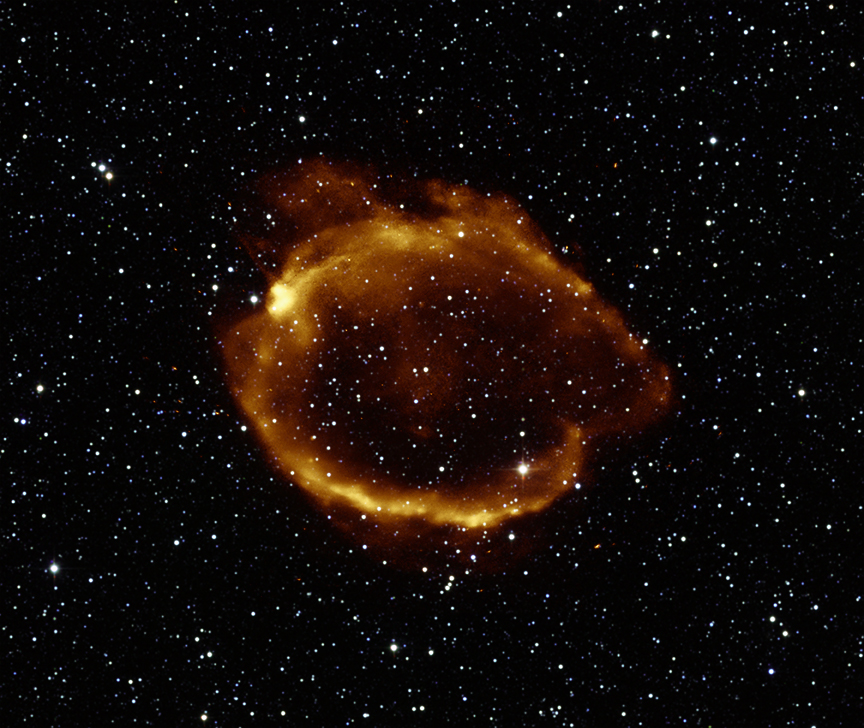
G299.2-2.9 is an intriguing supernova remnant found about 16,000 light years away in the Milky Way galaxy . Evidence points to G299.2-2.9 being the remains of a Type Ia supernova, where a white dwarf has grown sufficiently massive to cause a thermonuclear explosion. Because it is older than most supernova remnants caused by these explosions, at an age of about 4500 years, G299.2-2.9 provides astronomers with an excellent opportunity to study how these objects evolve over time. It also provides a probe of the Type Ia supernova explosion that produced this structure.

This composite image shows G299.2-2.9 in X-ray light from Chandra, along with data from the ROSAT satellite (orange), that has been overlaid on an infrared image from the Two Micron All-Sky Survey (2MASS). The faint X-ray emission from the inner region reveals relatively large amounts of iron and silicon, as expected for a remnant of a Type Ia supernova. The outer shell of the remnant is complex, with at least a double shell structure. Typically, such a complex outer shell is associated with a star that has exploded into space where gas and dust are not uniformly distributed.

Since most theories to explain Type Ia supernovas assume they go off in a uniform environment, detailed studies of this complicated outer shell should help astronomers improve their understanding of the environments where these explosions occur. It is very important to understand the details of Type Ia explosions because astronomers use them as cosmic mile markers to measure the accelerated expansion of the universe and study dark energy. The discovery of this accelerated expansion in the late 1990s led to the recent award of the Nobel Prize in Physics.

Fast Facts for G299.2-2.9:

Scale: Image is about 24 arcmin across (about 114 light years)
Category: Supernovas & Supernova Remnants
Coordinates (J2000): RA 12h 15m 33.80s | Dec -65° 26' 33.90"
Constellation: Musca
Observation Date: 10 pointings between April 9, 2005 and Nov 13, 2010
Observation Time: 186 hours 7 min (7 days 18 hours 7 min).
Obs. ID: 5517, 11098-11101, 13157-13160, 13187
Color Code: X-ray (Gold), Infrared (Red, Green, Blue)
Instrument: ACIS
Distance Estimate: 16,000 light years

Four-Galaxy Collision Creates Firestorm of Star Birth

IRAS 19297-0406
Image Credit: NASA, ESA, the NICMOS Group (STScI, ESA)
and the NICMOS Science Team (Univ. of Arizona)

This image, taken by the Advanced Camera for Surveys (ACS) shows a tumultuous collision between four galaxies located 1 billion light-years from Earth. The galactic wreckage is creating a torrent of new stars. The tangled-up galaxies, called IRAS 19297-0406, are crammed together in the center of the picture. IRAS 19297-0406 is part of a class of galaxies known as ultraluminous infrared galaxies (ULIRGs). ULIRGs are considered the progenitors of massive elliptical galaxies. ULIRGs glow fiercely in infrared light and appear 100 times brighter than our Milky Way Galaxy.

The large amount of dust in these galaxies is generated by a firestorm of star birth triggered by the collisions. IRAS 19297-0406 is producing about 200 new Sun-like stars every year - about 100 times more stars than our Milky Way creates. The hotbed of this star formation is the central region [the yellow objects]. This area is swamped in the dust created by the flurry of star formation. The bright blue material surrounding the central region corresponds to the ultraviolet glow of new stars. The ultraviolet light is not obscured by dust. Astronomers believe that this area is creating fewer new stars and therefore less dust. The colliding system [yellow and blue regions] has a diameter of about 30 000 light-years, or about half the size of the Milky Way. The tail [faint blue material at left] extends for another 20 000 light-years.

ACS captured the visible starlight of the colliding system's blue outer region. IRAS 19297-0406 may be similar to the so-called Hickson compact groups - clusters of at least four galaxies in a tight configuration that are isolated from other galaxies. The galaxies are so close together that they lose energy from the relentless pull of gravity. Eventually, they fall into each other and form one massive galaxy. The picture was taken through the V-band on the ACS wide-field camera; and the U-band on the ACS high-resolution camera. The images were taken on 13 and 14 May 2002.