Showing posts with label TW Hydrae. Show all posts

Thursday, June 16, 2016

First Detection of Methyl Alcohol in a Planet-forming Disc

Artist’s impression of the disc around the young star TW Hydrae

Artist’s impression of the disc around the young star TW Hydrae


Videos

Artist’s impression of the disc around the young star TW Hydrae

Methanol around the young star TW Hydrae


The organic molecule methyl alcohol (methanol) has been found by the Atacama Large Millimeter/Submillimeter Array (ALMA) in the TW Hydrae protoplanetary disc. This is the first such detection of the compound in a young planet-forming disc. Methanol is the only complex organic molecule as yet detected in discs that unambiguously derives from an icy form. Its detection helps astronomers understand the chemical processes that occur during the formation of planetary systems and that ultimately lead to the creation of the ingredients for life.

The protoplanetary disc around the young star TW Hydrae is the closest known example to Earth, at a distance of only about 170 light-years. As such it is an ideal target for astronomers to study discs. This system closely resembles what astronomers think the Solar System looked like during its formation more than four billion years ago.

The Atacama Large Millimeter/Submillimeter Array (ALMA) is the most powerful observatory in existence for mapping the chemical composition and the distribution of cold gas in nearby discs. These unique capabilities have now been exploited by a group of astronomers led by Catherine Walsh (Leiden Observatory, the Netherlands) to investigate the chemistry of the TW Hydrae protoplanetary disc.

The ALMA observations have revealed the fingerprint of gaseous methyl alcohol, or methanol (CH3OH), in a protoplanetary disc for the first time. Methanol, a derivative of methane, is one of the largest complex organic molecules detected in discs to date. Identifying its presence in pre-planetary objects represents a milestone for understanding how organic molecules are incorporated into nascent planets.

Furthermore, methanol is itself a building block for more complex species of fundamental prebiotic importance, like amino acid compounds. As a result, methanol plays a vital role in the creation of the rich organic chemistry needed for life.

Catherine Walsh, lead author of the study, explains: “Finding methanol in a protoplanetary disc shows the unique capability of ALMA to probe the complex organic ice reservoir in discs and so, for the first time, allows us to look back in time to the origin of chemical complexity in a planet nursery around a young Sun-like star.”

Gaseous methanol in a protoplanetary disc has a unique importance in astrochemistry. While other species detected in space are formed by gas-phase chemistry alone, or by a combination of both gas and solid-phase generation, methanol is a complex organic compound which is formed solely in the ice phase via surface reactions on dust grains.

The sharp vision of ALMA has also allowed astronomers to map the gaseous methanol across the TW Hydrae disc. They discovered a ring-like pattern in addition to significant emission from close to the central star [1].

The observation of methanol in the gas phase, combined with information about its distribution, implies that methanol formed on the disc’s icy grains, and was subsequently released in gaseous form. This first observation helps to clarify the puzzle of the methanol ice–gas transition [2], and more generally the chemical processes in astrophysical environments [3].

Ryan A. Loomis, a co-author of the study, adds: “Methanol in gaseous form in the disc is an unambiguous indicator of rich organic chemical processes at an early stage of star and planet formation. This result has an impact on our understanding of how organic matter accumulates in very young planetary systems.”

This successful first detection of cold gas-phase methanol in a protoplanetary disc means that the production of ice chemistry can now be explored in discs, paving the way to future studies of complex organic chemistry in planetary birthplaces. In the hunt for life-sustaining exoplanets, astronomers now have access to a powerful new tool.


Notes


[1] A ring of methanol between 30 and 100 astronomical units (au) reproduces the pattern of the observed methanol data from ALMA. The identified structure supports the hypothesis that the bulk of the disc ice reservoir is hosted primarily on the larger (up to millimetre-sized) dust grains, residing in the inner 50 au, which have become decoupled from the gas, and drifted radially inwards towards the star. 

[2] In this study, rather than thermal desorption (with methanol released at temperatures higher than its sublimation temperature), other mechanisms are supported and discussed by the team, including photodesorption by ultraviolet photons and reactive desorption. More detailed ALMA observations would help to definitely favour one scenario among the others.

[3] Radial variation of chemical species in the disc midplane composition, and specifically the locations of snowlines, are crucial for understanding the chemistry of nascent planets.The snowlines mark the boundary beyond which a particular volatile chemical species is frozen out onto dust grains. The detection of methanol also in the colder outer regions of the disc shows that it is able to escape off the grains at temperatures much lower than its sublimation temperature, necessary to trigger thermal desorption.


More Information

This research was presented in a paper entitled “First detection of gas-phase methanol in a protoplanetary disk”, by Catherine Walsh et al., published in Astrophysical Journal, Volume 823, Number 1.


The team is composed of Catherine Walsh (Leiden Observatory, Leiden University, Leiden, The Netherlands), Ryan A. Loomis (Harvard-Smithsonian Center for Astrophysics, Cambridge, Massachusetts, USA), Karin I. Öberg (Harvard-Smithsonian Center for Astrophysics, Cambridge, Massachusetts, USA), Mihkel Kama (Leiden Observatory, Leiden University, Leiden, The Netherlands), Merel L. R. van't Hoff (Leiden Observatory, Leiden University, Leiden, The Netherlands), Tom J. Millar (School of Mathematics and Physics, Queen’s University Belfast, Belfast, UK), Yuri Aikawa (Center for Computational Sciences, University of Tsukuba, Tsukuba, Japan), Eric Herbst (Departments of Chemistry and Astronomy, University of Virginia, Charlottesville, Virginia, USA), Susanna L. Widicus Weaver (Department of Chemistry, Emory University, Atlanta, Georgia, USA) and Hideko Nomura (Department of Earth and Planetary Science, Tokyo Institute of Technology, Tokyo, Japan).


The Atacama Large Millimeter/submillimeter Array (ALMA), an international astronomy facility, is a partnership of ESO, the U.S. National Science Foundation (NSF) and the National Institutes of Natural Sciences (NINS) of Japan in cooperation with the Republic of Chile. ALMA is funded by ESO on behalf of its Member States, by NSF in cooperation with the National Research Council of Canada (NRC) and the National Science Council of Taiwan (NSC) and by NINS in cooperation with the Academia Sinica (AS) in Taiwan and the Korea Astronomy and Space Science Institute (KASI).


ALMA construction and operations are led by ESO on behalf of its Member States; by the National Radio Astronomy Observatory (NRAO), managed by Associated Universities, Inc. (AUI), on behalf of North America; and by the National Astronomical Observatory of Japan (NAOJ) on behalf of East Asia. The Joint ALMA Observatory (JAO) provides the unified leadership and management of the construction, commissioning and operation of ALMA.

ESO is the foremost intergovernmental astronomy organisation in Europe and the world’s most productive ground-based astronomical observatory by far. It is supported by 16 countries: Austria, Belgium, Brazil, the Czech Republic, Denmark, France, Finland, Germany, Italy, the Netherlands, Poland, Portugal, Spain, Sweden, Switzerland and the United Kingdom, along with the host state of Chile. ESO carries out an ambitious programme focused on the design, construction and operation of powerful ground-based observing facilities enabling astronomers to make important scientific discoveries. ESO also plays a leading role in promoting and organising cooperation in astronomical research. ESO operates three unique world-class observing sites in Chile: La Silla, Paranal and Chajnantor. At Paranal, ESO operates the Very Large Telescope, the world’s most advanced visible-light astronomical observatory and two survey telescopes. VISTA works in the infrared and is the world’s largest survey telescope and the VLT Survey Telescope is the largest telescope designed to exclusively survey the skies in visible light. ESO is a major partner in ALMA, the largest astronomical project in existence. And on Cerro Armazones, close to Paranal, ESO is building the 39-metre European Extremely Large Telescope, the E-ELT, which will become “the world’s biggest eye on the sky”.


Links


Contacts 

Catherine Walsh
Leiden Observatory
Leiden University, The Netherlands
Tel: +31 71527 ext 6287
Email:
cwalsh@strw.leidenuniv.nl

Richard Hook
ESO Public Information Officer
Garching bei München, Germany
Tel: +49 89 3200 6655
Cell: +49 151 1537 3591
Email: rhook@eso.org


Source: ESO

Wednesday, November 04, 2015

Disk Gaps Don't Always Signal Planets

This artist's concept illustrates a solar system that is a much younger version of our own. Dusty disks, like the one shown here circling the star, are the breeding grounds of planets. When visible or near-infrared observations show a gap in a disk like this, it is often interpreted as evidence for an unseen planet. However, new research shows that a gap could be a sort of cosmic illusion and not the sign of a hidden planet after all.
NASA/JPL-Caltech/T. Pyle (SSC). High Resolution (jpg) - Low Resolution (jpg)


Cambridge, MA - When astronomers study protoplanetary disks of gas and dust that surround young stars, they sometimes spot a dark gap like the Cassini division in Saturn's rings. It has been suggested that any gap must be caused by an unseen planet that formed in the disk and carved out material from its surroundings. However, new research shows that a gap could be a sort of cosmic illusion and not the sign of a hidden planet after all.

"If we don't see light scattered from the disk, it doesn't necessarily mean that nothing is there," says lead author Til Birnstiel (Max Planck Institute for Astronomy), who conducted the research while at the Harvard-Smithsonian Center for Astrophysics (CfA).

The researchers studied disks that shine in visible or near-infrared wavelengths due to scattered, or reflected, light. (In contrast, radio or millimeter telescopes pick up emission directly from the disk itself.)

Scattered light comes from starlight that bounces off tiny particles about the size of cigarette smoke. Those particles initially suffuse the protoplanetary disk, but undergo changes over time.

Small particles can clump together to form larger and larger objects, eventually growing into full-fledged planets. However, when particles collide they sometimes break apart instead of sticking together. Particles can also move closer to or farther from the star in a process called migration. The team modeled these processes using the Smithsonian's Hydra supercomputer cluster.

"Growth, migration and destruction can have tangible, observable effects," explains co-author Sean Andrews of the CfA. "Specifically, these processes can create an apparent gap in the disk when the small particles that scatter light are cleared away, even though larger particles still remain."

Birnstiel offers the analogy, "Throwing a stone in the air doesn't obstruct my view, but throwing a handful of dust in the air does. Similarly, as small particles grow bigger in some areas of the disk, they don't obstruct our view any more and those regions appear empty."v So how can astronomers tell if a gap in a protoplanetary disk is real, or simply an area where pebbles reign and dust is gone? The key is to make observations at longer wavelengths of light that can pick up the pebbles.

To that end, the team will conduct observations of a well-known example of a disk with a gap, TW Hydrae, with the Atacama Large Millimeter/submillimeter Array (ALMA). If they find large grains within the apparent gap, that will suggest there is no planet. However, if the gap appears empty in these observations as well, then the evidence will be stronger for the existence of an unseen planet.

This work has been published in the Astrophysical Journal Letters.

Headquartered in Cambridge, Mass., the Harvard-Smithsonian Center for Astrophysics (CfA) is a joint collaboration between the Smithsonian Astrophysical Observatory and the Harvard College Observatory. CfA scientists, organized into six research divisions, study the origin, evolution and ultimate fate of the universe.

For more information, contact:

Christine Pulliam
Media Relations Manager
Harvard-Smithsonian Center for Astrophysics
617-495-7463
cpulliam@cfa.harvard.edu


Thursday, July 18, 2013

Snow in an Infant Planetary System

Artist’s impression of snow lines around TW Hydrae
ALMA image of the carbon monoxide snow line
Snow line distance compared to the Solar System

A frosty landmark for planet and comet formation

 
A snow line has been imaged in a far-off infant planetary system for the very first time. The snow line, located in the disc around the Sun-like star TW Hydrae, promises to tell us more about the formation of planets and comets, the factors that decide their composition, and the history of the Solar System. The results are published today in Science Express.

Astronomers using the Atacama Large Millimeter/submillimeter Array (ALMA) have taken the first ever image of the snow line in an infant planetary system. On Earth, snow lines form at high altitudes where falling temperatures turn the moisture in the air into snow. This line is clearly visible on a mountain, where the snow-capped summit ends and the rocky face begins.

The snow lines around young stars form in a similar way, in the distant, colder reaches of the dusty discs from which planetary systems form. Starting from the star and moving outwards, water (H2O) is the first to freeze, forming the first snow line. Further out from the star, as temperatures drop, more exotic molecules can freeze and turn to snow, such as carbon dioxide (CO2), methane (CH4), and carbon monoxide (CO). These different snows give the dust grains a sticky outer coating and play an essential role in helping the grains to overcome their usual tendency to break up in collisions, allowing them to become the crucial building blocks of planets and comets. The snow also increases how much solid matter is available and may dramatically speed up the planetary formation process.

Each of these different snow lines — for water, carbon dioxide, methane and carbon monoxide — may be linked to the formation of particular kinds of planets [1]. Around a Sun-like star in a planetary system like our own, the water snow line would correspond to a distance between the orbits of Mars and Jupiter, and the carbon monoxide snow line would correspond to the orbit of Neptune.

The snow line spotted by ALMA is the first glimpse of the carbon monoxide snow line, around TW Hydrae, a young star 175 light-years away from Earth. Astronomers believe this budding planetary system shares many of the same characteristics of the Solar System when it was just a few million years old.

“ALMA has given us the first real picture of a snow line around a young star, which is extremely exciting because of what it tells us about the very early period in the history of the Solar System,” said Chunhua “Charlie” Qi (Harvard-Smithsonian Center for Astrophysics, Cambridge, USA) one of the two lead authors of the paper. “We can now see previously hidden details about the frozen outer reaches of another planetary system similar to our own.”

But the presence of a carbon monoxide snow line could have greater consequences than just the formation of planets. Carbon monoxide ice is needed to form methanol, which is a building block of the more complex organic molecules that are essential for life. If comets ferried these molecules to newly forming Earth-like planets, these planets would then be equipped with the ingredients necessary for life.

Before now, snow lines had never been imaged directly because they always form in the relatively narrow central plane of a protoplanetary disc, so their precise location and extent could not be determined. Above and below the narrow region where snow lines exist, the star’s radiation prevents ice formation. The dust and gas concentration in the central plane is necessary to insulate the area from the radiation so that carbon monoxide and other gases can cool and freeze.

This team of astronomers succeeded in peering inside this disc to where the snow has formed with the help of a clever trick. Instead of looking for the snow — as it cannot be observed directly — they searched for a molecule known as diazenylium (N2H+), which shines brightly in the millimetre portion of the spectrum, and so is a perfect target for a telescope such as ALMA. The fragile molecule is easily destroyed in the presence of carbon monoxide gas, so would only appear in detectable amounts in regions where carbon monoxide had become snow and could no longer destroy it. In essence, the key to finding carbon monoxide snow lies in finding diazenylium.

ALMA's unique sensitivity and resolution has allowed the astronomers to trace the presence and distribution of diazenylium and find a clearly defined boundary approximately 30 astronomical units from the star (30 times the distance between the Earth and the Sun). This gives, in effect, a negative image of the carbon monoxide snow in the disc surrounding TW Hydrae, which can be used to see the carbon monoxide snow line precisely where theory predicts it should be — the inner rim of the diazenylium ring.

"For these observations we used only 26 of ALMA's eventual full complement of 66 antennas. Indications of snow lines around other stars are already showing up in other ALMA observations, and we are convinced that future observations with the full array will reveal many more of these and provide further, exciting insights into the formation and evolution of planets. Just wait and see,” concludes Michiel Hogerheijde from Leiden Observatory, the Netherlands.

Notes

[1] For instance dry rocky planets form on the inner side of the water snow line (nearest the star), where only dust can exist. At the other extreme are the icy giant planets which form beyond the carbon monoxide snow line.

More information

The Atacama Large Millimeter/submillimeter Array (ALMA), an international astronomy facility, is a partnership of Europe, North America and East Asia in cooperation with the Republic of Chile. ALMA is funded in Europe by the European Southern Observatory (ESO), in North America by the U.S. National Science Foundation (NSF) in cooperation with the National Research Council of Canada (NRC) and the National Science Council of Taiwan (NSC) and in East Asia by the National Institutes of Natural Sciences (NINS) of Japan in cooperation with the Academia Sinica (AS) in Taiwan. ALMA construction and operations are led on behalf of Europe by ESO, on behalf of North America by the National Radio Astronomy Observatory (NRAO), which is managed by Associated Universities, Inc. (AUI) and on behalf of East Asia by the National Astronomical Observatory of Japan (NAOJ). The Joint ALMA Observatory (JAO) provides the unified leadership and management of the construction, commissioning and operation of ALMA.

This research was presented in a paper appearing in the 18 July 2013 issue of Science Express.
The team is composed of C. Qi (Harvard-Smithsonian Center for Astrophysics, USA), K. I. Öberg (Departments of Chemistry and Astronomy, University of Virginia, USA), D. J. Wilner (Harvard-Smithsonian Center for Astrophysics, USA), P. d’Alessio (Centro de Radioastronomía y Astrofisica, Universidad Nacional Autónoma de Mexico, Mexico), E. Bergin (Department of Astronomy, University of Michigan, USA), S. M. Andrews (Harvard-Smithsonian Center for Astrophysics, USA), G. A. Blake (Division of Geological and Planetary Sciences, California Institute of Technology, USA), M. R. Hogerheijde (Leiden Observatory, Leiden University, Netherlands) and E. F. van Dishoeck (Max Planck Institute for Extraterrestrial Physics, Germany).

Qi and Öberg were joint lead authors of this work.

ESO is the foremost intergovernmental astronomy organisation in Europe and the world’s most productive ground-based astronomical observatory by far. It is supported by 15 countries: Austria, Belgium, Brazil, the Czech Republic, Denmark, France, Finland, Germany, Italy, the Netherlands, Portugal, Spain, Sweden, Switzerland and the United Kingdom. ESO carries out an ambitious programme focused on the design, construction and operation of powerful ground-based observing facilities enabling astronomers to make important scientific discoveries. ESO also plays a leading role in promoting and organising cooperation in astronomical research. ESO operates three unique world-class observing sites in Chile: La Silla, Paranal and Chajnantor. At Paranal, ESO operates the Very Large Telescope, the world’s most advanced visible-light astronomical observatory and two survey telescopes. VISTA works in the infrared and is the world’s largest survey telescope and the VLT Survey Telescope is the largest telescope designed to exclusively survey the skies in visible light. ESO is the European partner of a revolutionary astronomical telescope ALMA, the largest astronomical project in existence. ESO is currently planning the 39-metre European Extremely Large optical/near-infrared Telescope, the E-ELT, which will become “the world’s biggest eye on the sky”.

Links

Contacts

Chunhua Qi
Harvard-Smithsonian Center for Astrophysics
Cambridge, Mass., USA
Tel: +1 617 495 7087
Email:
cqi@cfa.harvard.edu

Michiel Hogerheijde
Leiden Observatory
Leiden, The Netherlands
Tel: +31 6 4308 3291
Email:
michiel@strw.leidenuniv.nl

Richard Hook
ESO, Public Information Officer
Garching bei München, Germany
Tel: +49 89 3200 6655
Cell: +49 151 1537 3591
Email:
rhook@eso.org


Thursday, June 27, 2013

Herschel sheds light on role of water

The location of Comet Hartley 2 and the Herschel image of it (inset). 
Click here for more information. Image Credit: ESA/NASA/Herschel/HSSO

Artist's impression of the disc of gas and dust around the star TW Hydrae. 
Click here for more information. Image credit: ESA/NASA/JPL-Caltech/WISH 

One of the most interesting molecules that astronomers like to study is water, which is so abundant on the Earth and though to be crucial for life. Water can form relatively easily, providing the temperature is not too high, and the outer regions of our own Solar system are full of icy bodies. Observations of water are very hard to observed from the Earth as the atmosphere interferes with the measurements, and so studying water requires spacecraft. Far from Earth, the HIFI instrument on board Herschel is studying the role of water in not just our own Solar System, but also in others.

In late 2010 the comet Hartley 2 passed relatively close to Earth, though it has not always ventured this close to the Sun. Hartley 2 originated in an outer region of the Solar System called the Kuiper Belt, but was put on an orbit that brings it in to the inner Solar System after encounters with planets and other large bodies. The HIFI instrument onboard Herschel measured the composition of the water in the comet, and found that it is very similar to that of the water in the Earth's oceans.

The idea that comets seeded the water on Earth has been a favourite among many astronomers for decades, as there are few other ways to explain where the water came from. However the composition of the water in most of the comets studied doesn't match that of the ocean water, and this has long been a thorn in the side of the proponents of the idea. Most of these comets formed relatively close to the Sun, around where Jupiter orbits, but Hartley 2 is the first comet to be investigated that formed much further out. The fact that the composition of the water in Hartley 2 is so similar lends further weight to the theory that comets seeded our oceans, though perhaps it was mainly this particular type of comet that did the seeding.

HIFI is sensitive enough to look at the material orbiting other stars, such as TW Hydrae in the constellation of Hydra. This star is a little less massive than the Sun but which is much, much younger. At only 10 million years old, TW Hydrae is still in its adolescent years, and has a disc of gas and dust around it. It is thought that our own Sun would have started out like this, with the planets forming after tens or hundreds of millions of years.

TW Hydrae is 175 light years away from the Sun, far too distant for any of Herschel's instruments to see in detail. The sensitivity of the HIFI instrument allows it to detect the faint signature of water vapour, and a careful study of the signature allows astronomers to work out the temperature of the water vapour and where it is in the disk. The water vapour is stripped from grains of ice by the light from the star, but is found at temperatures below 100 K (-170 Celsius). This is much colder than has been found previously around other stars, and indicates that the water vapour is present throughout the disc.

Water plays a crucial role in planetary systems, as it allows grains of dust to clump together and form asteroids, which later collect together to form the planets. Studying the presence of water, and the conditions in which it is found, is vital for understanding how Solar Systems such as our own formed.


Friday, June 14, 2013

Hubble Uncovers Evidence for Extrasolar Planet Under Construction

Credit: NASA, ESA, J. Debes (STScI), H. Jang-Condell (University of Wyoming), A. Weinberger (Carnegie Institution of Washington), A. Roberge (Goddard Space Flight Center), G. Schneider (University of Arizona/Steward Observatory), and A. Feild (STScI/AURA)

Nearly 900 extrasolar planets have been confirmed to date, but now for the first time astronomers think they are seeing compelling evidence for a planet under construction in an unlikely place, at a great distance from its diminutive red dwarf star.

The keen vision of NASA's Hubble Space Telescope has detected a mysterious gap in a vast protoplanetary disk of gas and dust swirling around the nearby star TW Hydrae, located 176 light-years away in the constellation Hydra (the Sea Serpent). The gap's presence is best explained as due to the effects of a growing, unseen planet that is gravitationally sweeping up material and carving out a lane in the disk, like a snow plow.

Researchers, led by John Debes of the Space Telescope Science Institute in Baltimore, Md., found the gap about 7.5 billion miles from the red dwarf star. If the putative planet orbited in our solar system, it would be roughly twice Pluto's distance from the Sun.

The suspected planet's wide orbit means that it is moving slowly around its host star. Finding the suspected planet in this orbit challenges current planet formation theories. The conventional planet-making recipe proposes that planets form over tens of millions of years from the slow but persistent buildup of dust, rocks, and gas as a budding planet picks up material from the surrounding disk. TW Hydrae, however, is only 8 million years old. There has not been enough time for a planet to grow through the slow accumulation of smaller debris. In fact, a planet at 7.5 billion miles from its star would take more than 200 times longer to form than Jupiter did at its distance from the Sun because of its much slower orbital speed and a deficiency of material in the disk.

An alternative planet-formation theory suggests that a piece of the disk becomes gravitationally unstable and collapses on itself. In this scenario, a planet could form more quickly, in just a few thousand years.

"If we can actually confirm that there's a planet there, we can connect its characteristics to measurements of the gap properties," Debes says. "That might add to planet formation theories as to how you can actually form a planet very far out. There's definitely a gap structure. We think it's probably a planet given the fact that the gap is sharp and circular."

What complicates the story is that the red dwarf star is only 55 percent the mass of our Sun. "It's so intriguing to see a system like this," Debes says. "This is the lowest-mass star for which we've observed a gap so far out."

The disk also lacks large dust grains in its outer regions. Observations from ALMA (the Atacama Large Millimeter Array) show that millimeter-sized (tenths-of-an-inch-sized) dust, roughly the size of a grain of sand, cuts off sharply at about 5.5 billion miles from the star, just short of the gap. The disk is 41 billion miles across.

"Typically, you need pebbles before you can have a planet. So, if there is a planet and there is no dust larger than a grain of sand farther out, that would be a huge challenge to traditional planet-formation models," Debes says.

The Hubble observations reveal that the gap, which is 1.9 billion miles wide, is not completely cleared out. The team suggests that if a planet exists, it is in the process of forming and not very massive. Based on the evidence, team member Hannah Jang-Condell at the University of Wyoming in Laramie estimates that the putative planet is 6 to 28 times more massive than Earth. Within this range lies a class of planets called super-Earths and ice giants. Such a small planet mass is also a challenge to direct-collapse planet-formation theories, which predict that clumps of material one to two times more massive than Jupiter can collapse to form a planet.

TW Hydrae has been a popular target with astronomers. The system is one of the closest examples of a face-on disk, giving astronomers an overhead view of the star's environment. Debes's team used Hubble's Near Infrared Camera and Multi-Object Spectrometer (NICMOS) to observe the star in near-infrared light. The team then re-analyzed archival Hubble data, using more NICMOS images as well as optical and spectroscopic observations from the Space Telescope Imaging Spectrograph (STIS). Armed with these observations, they composed the most comprehensive view of the system in scattered light over many wavelengths.

When Debes accounted for the rate at which the disk dims from reflected starlight, the gap was highlighted. It was a feature that two previous Hubble studies had suspected but could not definitively confirm. These earlier observations noted an uneven brightness in the disk but did not identify it as a gap.

"When I first saw the gap structure, it just popped out like that," Debes says. "The fact that we see the gap at every wavelength tells you that it's a structural feature rather than an instrumental artifact or a feature of how the dust scatters light.

The team plans to use ALMA and NASA's upcoming James Webb Space Telescope, an infrared observatory set to launch in 2018, to study the system in more detail.

The team's paper will appear online on June 14 in The Astrophysical Journal.

CONTACT

Donna Weaver / Ray Villard
Space Telescope Science Institute, Baltimore, Md.
410-338-4493 / 410-338-4514

dweaver@stsci.edu / villard@stsci.edu

John Debes
Space Telescope Science Institute, Baltimore, Md.
410-338-4782

debes@stsci.edu

Tuesday, June 11, 2013

Young Star Suggests our Sun Was a Feisty Toddler

This artist's conception illustrates what we would see if we could zoom in on the TW Hydrae system. We are viewing the star nearly pole-on, where streamers of gas from the surrounding protoplanetary disk funnel onto the star. Research shows that this growth process, also known as accretion, is clumpy and episodic. By studying TW Hydrae we can learn what our Sun was like when it was only 10 million years old. Credit: David A. Aguilar (CfA).  High Resolution Image (jpg) -  Low Resolution Image (jpg)

Indianapolis, IN - If you had a time machine that could take you anywhere in the past, what time would you choose? Most people would probably pick the era of the dinosaurs in hopes of spotting a T. rex. But many astronomers would choose the period, four and a half billion years ago, that our solar system formed. 

In lieu of a working time machine, we learn about the birth of our Sun and its planets by studying young stars in our galaxy. New work suggests that our Sun was both active and "feisty" in its infancy, growing in fits and starts while burping out bursts of X-rays. 

"By studying TW Hydrae, we can watch what happened to our Sun when it was a toddler," said Nancy Brickhouse of the Harvard-Smithsonian Center for Astrophysics (CfA). She presented the findings today in a press conference at a meeting of the American Astronomical Society. 

Brickhouse and her colleagues reached this conclusion by studying the young star TW Hydrae, located about 190 light-years from Earth in the southern constellation Hydra the Water Snake. TW Hydrae is an orange, type K star weighing about 80 percent as much as our Sun. It is about 10 million years old, and is still accreting gas from a surrounding disk of material. That same disk might contain newborn planets. 

In order to grow, the star "eats" gas from the disk. However, the disk doesn't extend all the way to the star's surface, so the star can't dine from it directly. Instead, infalling gas gets funneled along magnetic field lines to the star's poles. 

Fortunately, we are looking almost directly down on one of the star's poles. As a result, we can study the accretion process in detail. 

"We're looking right where the action is," said team member Andrea Dupree of the CfA. 

Infalling material smashes into the star, creating a shock wave and heating the accreting gas to temperatures greater than 5 million degrees Fahrenheit. The gas glows with high-energy X-rays. As it continues moving inward, the gas cools and its glow shifts to optical wavelengths of light. To study the process, Brickhouse and her team combined observations from NASA's Chandra X-ray Observatory with those from ground-based optical telescopes. 

"By gathering data in multiple wavelengths we followed the gas all the way down. We traced the whole accretion process for the first time," explained Brickhouse. 

They found that accretion was clumpy and episodic in building a star. At one point the amount of material landing on the star changed by a factor of five over the course of a few days. 

"The accretion process changes from night to night. Things are happening all the time," stated Dupree. 

Some of the infalling material is pushed away in a stellar wind much like the solar wind that fills our solar system. Some gets channeled into giant loops and stellar prominences. 

Astronomers have known that young stars are much more magnetically active than our middle-aged Sun, but now they can actually probe the interplay between the star's magnetic fields and the protoplanetary disk. 

"The very process of accretion is driving magnetic activity on TW Hydrae," added Brickhouse. 

Headquartered in Cambridge, Mass., the Harvard-Smithsonian Center for Astrophysics (CfA) is a joint collaboration between the Smithsonian Astrophysical Observatory and the Harvard College Observatory. CfA scientists, organized into six research divisions, study the origin, evolution and ultimate fate of the universe.

For more information, contact:

David A. Aguilar
Director of Public Affairs
Harvard-Smithsonian Center for Astrophysics
617-495-7462

daguilar@cfa.harvard.edu

 
Christine Pulliam
Public Affairs Specialist
Harvard-Smithsonian Center for Astrophysics
617-495-7463

cpulliam@cfa.harvard.edu


Thursday, January 31, 2013

Stars can be late parents

Weighing the planet-forming disc around a nearby star 

Using the unique capabilities of ESA’s Herschel space observatory, astronomers have accurately ‘weighed’ a star’s disc, finding it still has enough mass to spawn 50 Jupiter-sized planets, several million years after most other stars have already given birth.

Proto-planetary discs contain all the raw ingredients for building planets. They are composed mainly of cold molecular hydrogen gas, which is highly transparent and essentially invisible.

Usually, it is much easier to measure the emission from ‘contaminants’ such as the small fraction of dust mixed in the gas, or other gas constituents, to make estimates of the total disc mass.

In the past, this technique has caused significant uncertainties in the estimations of molecular hydrogen mass, but thanks to the far-infrared wavelength capabilities and sensitivity of Herschel, astronomers have used a new, more accurate method, using a close relative of molecular hydrogen called hydrogen deuteride, or ‘heavy’ molecular hydrogen.

Since the ratio of ‘normal’ and ‘heavy’ molecular hydrogen gas is extremely well known from measurements in our local solar neighbourhood, this approach provides a means to ‘weigh’ a star’s total disc mass with ten times higher accuracy than ever before.

Using this technique, a substantial mass of gas was detected in a disc encircling TW Hydrae, a young star just 176 light-years away in the constellation of Hydra.

“We did not expect to find so much gas around this 10-million-year-old star,” says Professor Edwin Bergin of the University of Michigan, lead author of the report published in Nature.

“This star has significantly more mass than required to make our own Solar System and could make a much more exotic system with planets more massive than Jupiter.”

Observing such a massive disc around TW Hydrae is unusual for stars of this age because, within a few million years, most material is typically incorporated into the central star or giant planets, or has been swept away by its strong stellar wind.

“With a more refined mass, we can learn more about this system in terms of its planet-bearing potential and the availability of ingredients that might be able to support a planet with life,” adds Professor Bergin.

Indeed, in a separate Herschel survey, scientists had already identified TW Hydrae as a star with a disc that contains enough water to fill the equivalent of several thousand Earth oceans.

The new method of ‘weighing’ a disc means that the volume of materials available – including water – could have been underestimated, in this system and in others.

A re-evaluation of the masses of discs around other stars of varying ages will provide more insight into the planet-building process. 

“There may be different outcomes regarding planet formation for systems of varying ages,” says co-author Professor Thomas Henning of the Max Planck Institute for Astronomy, Germany.

“Just as the ages at which people have children span a range, TW Hydrae seems to lie at the edge of that range for stars, showing that this particular system may have needed longer to form planets, and that it might be a late parent.”

“The detection of heavy molecular hydrogen was made possible thanks to the new observing capabilities offered by Herschel, providing this leap forward in weighing the disc around this star,” adds Göran Pilbratt, ESA’s Herschel project scientist.


“An old disk that can still form a planetary system,” by E. Bergin et al, is published in Nature, 31 January 2013. 
The survey was conducted as part of an open time Herschel Programme using the Photoconductor Array Camera and Spectrometer (PACS), which operates in the wavelength range 55–210 microns. 
Herschel is an ESA space observatory with science instruments provided by European-led Principal Investigator consortia and with important participation from NASA. PACS was designed and built by a nationally funded consortium led by the Max Planck Institute for Extraterrestrial Physics (Garching, Germany); the consortium includes institutes from Belgium, Austria, France, Italy and Spain. 

For further information, please contact:
 
Markus Bauer
ESA Science and Robotic Exploration Communication Officer
Tel: +31 71 565 6799
Mob: +31 61 594 3 954
Email: markus.bauer@esa.int

Edwin Bergin
University of Michigan, USA
Email: ebergin@umich.edu

Thomas Henning
Max-Planck-Institut für Astronomie, Germany
Email: henning@mpia.de

Göran Pilbratt
ESA Herschel Project Scientist
Tel: +31 71 565 3621

Email: gpilbratt@rssd.esa.int

Thursday, October 20, 2011

Herschel detects abundant water in planet-forming disc

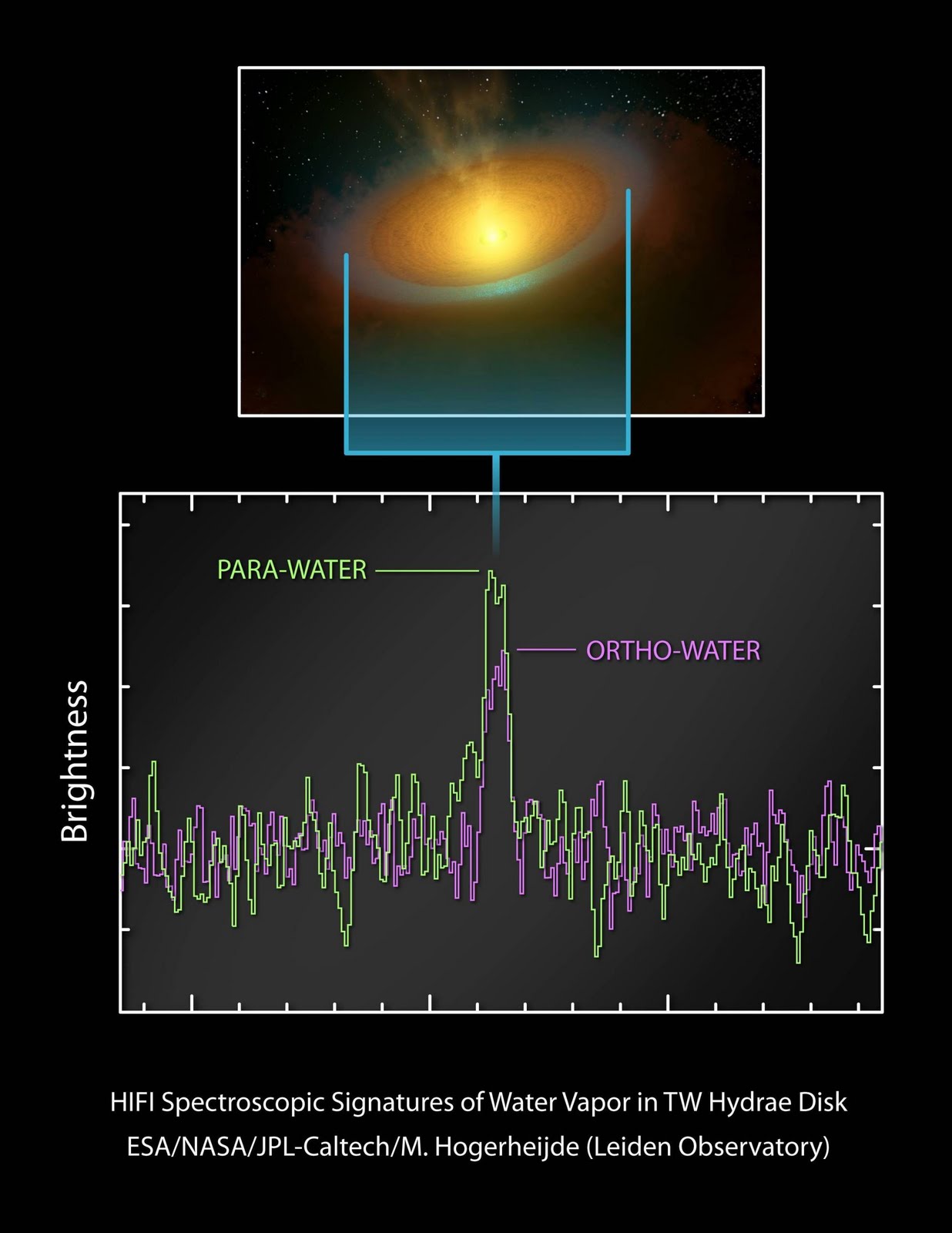
This image shows an artist's impression of the icy protoplanetary disc around the young star TW Hydrae (upper panel) and the spectrum of the disc as obtained using the HIFI spectrometer on ESA's Herschel Space Observatory (lower panel).

By analysing the spectrum, astronomers have detected the emission from cold water vapour in the planet-forming disc. The vapour arises when highly energetic radiation from the central star interacts with icy grains in the disc. The detection thus hints at a copious and otherwise undetectable supply of water ice hidden in the disc's deeper and colder layers.

The graph in the lower panel shows the spectral signature of water vapour in the disc. Water molecules come in two "spin" forms, called ortho and para, in which the two spins of the hydrogen nuclei have different orientations. By comparing the relative amounts of ortho and para water, astronomers can determine the temperatures under which the water formed. Lower ratios indicate cooler temperatures, though in practice the analysis is much more complicated. The ratio of ortho to para water observed in TW Hydrae's protoplanetary disc is low enough to point to the presence of cold water vapour.Credits: ESA/NASA/JPL-Caltech/M. Hogerheijde (Leiden Observatory) HI-RES JPEG (Size: 1196 kb)

This artist's impression illustrates an icy protoplanetary disc around the young star TW Hydrae, located about 175 light-years away in the Hydra, or Sea Serpent, constellation.

Astronomers using the HIFI spectrometer on ESA's Herschel Space Observatory detected copious amounts of cold water vapour, illustrated in blue, emanating from the star's planet-forming disc of dust and gas. The water vapour, corresponding to temperatures lower than 100 K, is distributed across the entire extent of the disc and is likely confined to a thin layer at an intermediate depth in the disc. The vapour arises when highly energetic radiation from the central star interacts with icy grains in the disc, the very same grains that should ultimately coalesce into icy planetesimals, such as comets. The detection thus hints at a copious and otherwise undetectable supply of water ice hidden in the disc's deeper and colder layers.

In our own Solar System, comets are thought to have carried water to Earth, creating our oceans. A similar process might be taking place around TW Hydrae, where comets could, over the next several millions of years, transport water to young worlds. The Herschel results demonstrate that vast reservoirs of water are available around stars for creating these hypothetical water worlds. Credits: ESA/NASA/JPL-Caltech. HI-RES JPEG (Size: 1934 kb)

ESA’s Herschel space observatory has found evidence of water vapour emanating from ice on dust grains in the disc around a young star, revealing a hidden ice reservoir the size of thousands of oceans.

TW Hydrae, a star between 5-10 million years old, and only 176 light-years away, is in the final stage of formation, and is surrounded by a disc of dust and gas that may condense to form a complete set of planets.

It is believed that a large proportion of Earth’s water may have come from ice-laden comets that bombarded our world during and after its formation. Recent studies of comet 103P/Hartley 2 with Herschel shed new light on how water may have come to Earth, with its findings of the first Earth-like water in a comet. Until now, however, almost nothing was known about reservoirs in planet-forming discs around other stars.

This new detection is the first of its kind and has been made possible by Herschel’s HIFI instrument.

The tell-tale water vapour signature, believed to be produced when the ice coated dust grains are warmed by interstellar UV radiation, has been detected throughout the disc around TW Hydrae, and, though weaker than expected, it hints at a substantial reservoir of ice. This could be a rich source of water for any planets that form around this young star.

"The detection of water sticking to dust grains throughout the disc would be similar to events in our own Solar System's evolution, where over millions of years, similar dust grains then coalesced to form comets," says Michiel Hogerheijde of Leiden University in the Netherlands, who led the study.

"These comets we believe became a contributing source of water for the planets."

The scientists ran detailed simulations, combining the new data with previous ground-based observations and some from NASA’s Spitzer telescope. From this they calculated the size of the ice reservoirs in the planet-forming regions.

Their results show that the total amount of water in the disc around TW Hydrae would fill several thousand Earth oceans.

"We already have approved time on Herschel to study more planet-forming regions around three other stars," says Dr Hogerheijde.

"We believe that will show similar results in terms of the water detections, but as our next observations will be of objects up to three times further in distance away, we'll need many more hours of observation time."

This research breaks new ground in understanding water’s role in planet-forming discs and gives scientists a new testing ground for looking at how water came to our own planet.

"With Herschel we can follow the trail of water through all the steps of star and planet formation," comments Göran Pilbratt, Herschel Project Scientist at ESA.

"Here we are studying the 'raw material' for planet formation, which is fundamental to an understanding of how planetary systems such as our own Solar System once formed."

Notes to editors

HIFI is the Heterodyne Instrument for the Far-Infrared spectrometer on the Herschel Space Observatory. It was designed to observe water in a wide variety of objects, and aims to study not only planet-forming discs and star formation, but also galactic evolution. Its capability for highly detailed chemical identification of individual atoms and molecules makes it the instrument of choice for studying chemistry throughout space, particularly around embryonic and dying stars.

Markus Bauer
ESA Science and Robotic Exploration Communication Officer
Email: markus.bauer@esa.int
Tel: +31 71 565 6799
Mob: +31 61 594 3 954

Michiel Hogerheijde
Leiden Observatory
Tel: +31 71 527 5590
Email: michiel@strw.leidenuniv.nl

Göran Pilbratt
ESA Herschel Project Scientist
Tel: +31 71 565 3621
Email: gpilbratt@rssd.esa.int