Monday, April 12, 2010

Young and getting cooler – the early life of a neutron star

Image of Cassiopeia A taken by the Chandra X-ray Observatory (Credit: NASA/CXC/MIT/UMass Amherst/M.D.Stage et al.): http://chandra.harvard.edu/photo/2006/casa/

Image of Cassiopeia A and an artist’s impression of the neutron star (Credit: NASA/CXC/Southampton/W. Ho et al.;
Illustration: NASA/CXC/M.Weiss): http://chandra.harvard.edu/photo/2009/cassio/

Observations of how the youngest-known neutron star has cooled over the past decade are giving astronomers new insights into the interior of these super-dense dead stars. Dr Wynn Ho will present the findings on Thursday April 15th at the RAS National Astronomy Meeting in Glasgow.

Dr Ho, of the University of Southampton, and Dr Craig Heinke, of the University of Alberta in Canada, measured the temperature of the neutron star in the Cassiopeia A supernova remnant using data obtained by NASA’s Chandra X-ray Observatory between 2000 and 2009.

“This is the first time that astronomers have been able to watch a young neutron star cool steadily over time. Chandra has given us a snapshot of the temperature roughly every two years for the past decade and we have seen the temperature drop during that time by about 3%,” said Dr Ho.

Neutron stars are composed mostly of neutrons crushed together by gravity, compressed to over a million million times the density of lead. They are the dense cores of massive stars that have run out of nuclear fuel and collapsed in supernova explosions. The Cassiopeia A supernova explosion, likely to have taken place around 1680, would have heated the neutron star to temperatures of billions of degrees, from which it has cooled down to a temperature of about two million degrees Celsius.

“Young neutron stars cool through the emission of high-energy neutrinos – particles similar to photons but which do not interact much with normal matter and therefore are very difficult to detect. Since most of the neutrinos are produced deep inside the star, we can use the observed temperature changes to probe what’s going on in the neutron star’s core. The structure of neutron stars determines how they cool, so this discovery will allow us to understand better what neutron stars are made of. Our observations of temperature variations already rule out some models for this cooling and has given us insights into the properties of matter that cannot be studied in laboratories on Earth,” said Dr Ho.

Initially, the core of the neutron star cools much more rapidly than the outer layers. After a few hundred years, equilibrium is reached and the whole interior cools at a uniform rate. At approximately 330 years old, the Cassiopeia A neutron star is near this cross-over age. If the cooling is only due to neutrino emission, there should be a steady decline in temperature. However, although Dr Ho and Dr Heinke observed an overall steady trend over the 10 year period, there was a larger change around 2006 that suggests other processes may be active.

“The neutron star may not yet have relaxed into the steady cooling phase, or we could be seeing other processes going on. We don’t know whether the interior of a neutron star contains more exotic particles, such as quarks, or other states of matter, such as superfluids and superconductors. We hope that with more observations, we will be able to explain what is happening in the interior in much more detail,” said Dr Ho. Dr Ho and Dr Heinke have submitted a paper on their discovery to the Astrophysical Journal.

CONTACTS

Dr Wynn Ho
School of Mathematics
University of Southampton
Southampton, SO17 1BJ, UK
E-mail:
wynn.ho@soton.ac.uk

Dr Craig Heinke
Department of Physics
University of Alberta
Room 238 CEB
Edmonton, AB, T6G 2G7, Canada
E-mail:
heinke@ualberta.ca

NAM 2010 Press Office (12th – 16th April only)
Room G358
Gilbert Scott Building
University of Glasgow.
Tel: +44 (0)141 330 7409, +44 (0)141 330 7410, +44 (0)141 330 7411

Anita Heward
Press Officer
Royal Astronomical Society
Mob: +44 (0)7756 034 243
E-mail:
anitaheward@btopenworld.com

Dr Robert Massey
Press and Policy Officer
Royal Astronomical Society
Mob: +44 (0)794 124 8035
E-mail:
rm@ras.org.uk

FURTHER INFORMATION

CHANDRA

NASA's Chandra X-ray Observatory, which was launched and deployed by Space Shuttle Columbia in 1999 is the most sophisticated X-ray observatory built to date. Chandra is designed to observe X-rays from high-energy regions of the universe, such as the remnants of exploded stars. For more details, see: http://chandra.harvard.edu/about/axaf_mission.html

NOTES FOR EDITORS

The RAS National Astronomy Meeting 2010 will take place from 12-16th April at the University of Glasgow. The conference is held in conjunction with the UK Solar Physics (UKSP) and Magnetosphere Ionosphere and Solar-Terrestrial Physics (MIST) meetings. NAM2010 (www.astro.gla.ac.uk/nam2010/) is principally sponsored by the Royal Astronomical Society (RAS) and the University of Glasgow.”

Mystery object in Starburst Galaxy M82 possible micro-quasar

M82 taken by the Spitzer Telescope. The hot plasma generated in supernova explosions has produced a hot wind which can be seen escaping from the nuclear region of M82 in the Spitzer telescope infra-red image of the galaxy where dust emission (coloured red) is detected. Credit: NASA/JPL-Caltech

MERLIN+VLA 5GHz combination image. The resolution of the image (the size of a pixel) is 100 miliarcseconds, the diameter of a 1p coin when viewed at a distance of 40 km. Credit: T.W.B. Muxlow JBCA

MERLIN 5GHz images April 25th and May 3rd 2009. The resolution of the images (size of a pixel) is 40 milliarcseconds, the diameter of a 1p coin when viewed at a distance of 100 km. Muxlow et al. arXiv:1003.0994

MERLIN 5GHz image at the position of the new radio source April 25th 2009 - nothing yet visible [resolution 40mas] (Credit Muxlow et al. arXiv:1003.0994

MERLIN 5GHz image at the position of the new radio source May 3rd 2009 - source now visible [resolution 40mas] (Credit Muxlow et al. arXiv:1003.0994)

Radio astronomers at the University of Manchester’s Jodrell Bank Observatory have discovered a strange new object in a nearby galaxy. The object, which appeared very suddenly in radio wavelengths and shows no signs of going away, does not appear to be like anything that has been seen in the Milky Way. Dr Tom Muxlow will present the discovery at the National Astronomy Meeting in Glasgow on Wednesday 14th April.

The galaxy, known as M82, is 10 million light years away and is a stellar production line churning out new stars at a prodigious rate. However, many of these stars die quickly in huge explosions, with a new supernova explosion occurring every 20 to 30 years.

“The new object, which appeared in May 2009, has left us scratching our heads – we’ve never seen anything quite like this before,” said Dr Muxlow. “The object turned on very rapidly within a few days and shows no sign of decaying in brightness over the first few months of its existence. The new young supernova explosions that we were expecting to see in M82 brighten at radio wavelengths over several weeks and then decay over several months, so that explanation seems unlikely.”

The plausibility of a supernova explanation was further undermined when very accurate positional monitoring by the UK network of radio telescopes, MERLIN, tentatively detected a change in position for the object over the first 50 days. This was equivalent to an apparent superluminal motion of over 4 times the speed of light. Such large apparent velocities are not seen in supernova remnants and are usually only found with relativistic jets ejected from accretion disks around massive black hole systems.

The nucleus of M82, like most major galaxies, is expected to contain a super-massive black hole. The new detection lies at a position close to, but several arcseconds from the dynamical centre of M82 – far enough away that it would seem unlikely that this object is associated with the central collapsed core of this galaxy.

The new source could be the first radio detection of an extragalactic ‘micro-quasar’. Examples of such systems within the Milky Way are found as X-ray binaries with relativistic jets ejected from an accretion disk around a collapsed star fuelled with material dragged from a close binary companion. However, this object would be brighter than any Galactic example yet detected, has lasted months longer than any known X-ray binary, and lies at a position in M82 where no variable X-ray source has been yet been detected.

If this object is an extragalactic micro-quasar, it would be the first that has been detected at radio wavelengths. The very high luminosity suggests that it is likely to be associated with a massive black hole system of some type; however this and its longevity imply that this type of object is extremely unusual and has not yet been seen within our Galaxy.

“We have just started processing data from an array of 20 radio telescopes across the Earth were taken for the central nuclear region of M82. These images will allow us to examine the structure of the new radio source in detail. However, processing such huge datasets takes significant amounts of computing effort and painstaking work. Only then will we be able to see if it is some rare form of micro-quasar. Watch this space…!” said Muxlow.

CONTACTS

Dr Tom Muxlow
Jodrell Bank Centre for Astrophysics
University of Manchester
Tel:
E-mail:
twbm@jb.man.ac.uk

NAM 2010 Press Office (12th – 16th April only)
Room G358
Gilbert Scott Building
University of Glasgow.
Tel: +44 (0)141 330 7409, +44 (0)141 330 7410, +44 (0)141 330 7411

Dr Robert Massey
Press and Policy Officer
Royal Astronomical Society
Mob: +44 (0)794 124 8035
E-mail:
rm@ras.org.uk

Anita Heward
Press Officer
Royal Astronomical Society
Mob: +44 (0)7756 034 243
E-mail:
anitaheward@btopenworld.com

IMAGES AND CAPTIONS

Source images can be found at:
http://www.jb.man.ac.uk/~twbm/NAM2010/

FURTHER INFORMATION

A paper on the discovery has been submitted to the Monthly Notices of the Royal Astronomical Society Letter is now accepted and on Astro-ph as arXiv:1003.0994.

M82


The nearby starburst galaxy M82 is a fascinating and spectacular example of a galaxy in which stars are being created. This burst of star-formation has been triggered by a near collision with its massive neighbouring spiral galaxy M81 and has been continuing for the past few millions of years. The central region of M82 is a very violent place with newly-formed high mass stars exploding in spectacular supernovae – a new explosion occurring every 20 to 30 years. For over 20 years astronomers at the University of Manchester observatory at Jodrell Bank have used the high-angular resolution imaging array MERLIN and the more widely-spaced European network of radio telescopes(EVN) to monitor the development and expansion of many recent supernova remnants in the nuclear region of M82. These were formed by supernova explosions within the last few hundreds of years. The ejected material is found to be expanding outward from the site of the explosion with velocities typically in excess of 10,000 km/s.

THE NEW OBJECT

As part of the monitoring programme, MERLIN observations detected a new faint point-like source of radio waves which appeared at the beginning of May 2009. The new object is 100 times fainter in the radio than the previous supernova explosions seen in M82 and, if it is a new supernova, it is clearly not of the same type. It is about the correct brightness to be a faint (type II) radio supernova, some nearby examples of which have been detected in the radio, however the very rapid turn on, its spectral characteristics, and lack of any significant decay in its flux density over the first 150 days of monitoring make this such a strange type II supernova, that this explanation is unlikely to be true.

NOTES FOR EDITORS

The RAS National Astronomy Meeting 2010 will take place from 12-16th April at the University of Glasgow. The conference is held in conjunction with the UK Solar Physics (UKSP) and Magnetosphere Ionosphere and Solar-Terrestrial Physics (MIST) meetings. NAM2010 (www.astro.gla.ac.uk/nam2010/) is principally sponsored by the Royal Astronomical Society (RAS) and the University of Glasgow.”

Have black holes been turning up the volume on the cosmic radio background?

The Hubble Deep Field, a very deep sky image taken by the Hubble Space Telescope, shows large numbers of very faint distant galaxies, seen in ordinary starlight. The new radio data seem to suggest that every one of these distant galaxies is also a faint radio source. Credit: NASA, ESA, S. Beckwith (STScI) and the HUDF Team.

Some nearby galaxies show high velocity jets which are believed to be emerging from a spinning black hole at the centre of the galaxy. This example is "active galaxy" M87, imaged by the Hubble Space Telescope. A possible explanation for the new results is that every galaxy has a fast spinning black hole, making jets which shine in radio emission. Credit: NASA and The Hubble Heritage Team (STScI/AURA).

Astronomers investigating why the cosmic background radiation is much brighter at radio wavelengths than expected have identified a potential culprit: fast spinning black holes early in the galaxy formation process. The results will be presented by Professor Andy Lawrence at the RAS National Astronomy Meeting in Glasgow on Wednesday 14th April.

Last July, US astronomers announced surprising results from a high-altitude balloon experiment called ARCADE-2, which had made careful measurements of the sky at radio wavelengths. The background radio emission, which is the component smoothly distributed across the whole sky, was several times brighter than anyone was expecting.

Now a team of astronomers from California and Scotland, including Jack Singal, Lukasz Stawarz, and Vahe Petrosian of Stanford University, and Andy Lawrence of the University of Edinburgh, believe that they have an explanation for this surprise.

“We looked at many different ways this could happen – a cosmic sea of relativistic particles, giant diffuse radio sources, distant exploding stars – and found them all to fail various tests. We then noticed that we could explain the emissions by adding up the very faint emission from every ordinary galaxy in the observable universe. This was a surprising result, because it implied that weak emission from a large population of ordinary, but distant, sources added up to more than the emission from rarer but more luminous sources, whereas we were expecting the opposite,” said Professor Lawrence, of the Institute for Astronomy at the University of Edinburgh.

The background appears to be the sum of radio emissions from all ordinary galaxies, both nearby and distant, but because there are so many more distant ones, they dominate. It would add up to an infinite amount were it not for the fact that the Universe is expanding and has a finite age.

Having found one solution, the team faced another difficult problem. In the local universe, most radio emission is associated with supernova remnants in regions of star formation. The radio emission seems to be tightly linked with the infrared emission which star formation regions also produce. The infrared sky background should, therefore, match the radio background. However measurements of the infrared background predict a radio background between three and ten times less than ARCADE-2’s observations.

“Somehow, in the distant universe, the tight connection we see locally between radio and infrared emission gets broken. Distant galaxies early in the history of the universe must produce extra radio emission. This may be because the process of star formation works differently in the early universe. However, we believe that there could be an early epoch of radio jet emission from fast-spinning black holes at the centre of many ordinary galaxies, which then fades away,” said Professor Lawrence. Astronomers believe that every galaxy probably contains a massive black hole. Fast-spinning black holes can give out energy in the form of radio jets.

"A possibility is that as these black holes were forming, they were usually spinning fast but over time, as accreted material tries to spin the black hole in many different directions, they ended up with no net spin on average and the source of the radio emission disappeared,” said Professor Lawrence.

CONTACTS

Andy Lawrence
Regius Professor of Astronomy, University of Edinburgh
Institute for Astronomy
Royal Observatory
Blackford Hill
Edinburgh, EH9 3HJ
E-mail:
al@roe.ac.uk
Tel: +44-(0)131-668-8346
Admin contact : Paula Wilkie 0131-668-8403
paw@roe.ac.uk

Professor Lawrence can be contacted through the NAM Press Office on Wednesday-Friday (April 14-16th).

NAM 2010 Press Office (12th – 16th April only)
Room G358
Gilbert Scott Building
University of Glasgow.
Tel: +44 (0)141 330 7409, +44 (0)141 330 7410, +44 (0)141 330 7411

Anita Heward
Press Officer
Royal Astronomical Society
Mob: +44 (0)7756 034 243
E-mail:
anitaheward@btopenworld.com

Dr Robert Massey
Press and Policy Officer
Royal Astronomical Society
Mob: +44 (0)794 124 8035
E-mail:
rm@ras.org.uk

NOTES FOR EDITORS

The RAS National Astronomy Meeting 2010 will take place from 12-16th April at the University of Glasgow. The conference is held in conjunction with the UK Solar Physics (UKSP) and Magnetosphere Ionosphere and Solar-Terrestrial Physics (MIST) meetings. NAM2010 (www.astro.gla.ac.uk/nam2010/) is principally sponsored by the Royal Astronomical Society (RAS) and the University of Glasgow.”

Watery, rocky planets may be common in the Milky Way

Image Caption: An artist’s impression of a massive asteroid belt in orbit around a star. The new work with SDSS data shows that similar rubble around many white dwarfs contaminates these stars with rocky material and water. Credit: NASA-JPL / Caltech / T. Pyle (SSC). Full size version

An international team of astronomers have discovered compelling evidence that rocky planets are commonplace in our Galaxy. Leicester University scientist and lead researcher Dr Jay Farihi surveyed white dwarfs, the compact remnants of stars that were once like our Sun, and found that many show signs of contamination by heavier elements and possibly even water, improving the prospects for extraterrestrial life. On Tuesday 13th April Dr Farihi will present his results at the RAS National Astronomy Meeting (NAM 2010) in Glasgow.

White dwarf stars are the endpoint of stellar evolution for the vast majority (>90%) of all stars in the Milky Way, including our Sun. Because they should have essentially pure hydrogen or pure helium atmospheres, if heavier elements (in astronomy described as ‘metals’, examples including calcium, magnesium and iron) are found then these must be external pollutants. For decades, it was believed that the interstellar medium, the tenuous gas between the stars, was the source of metals in these polluted white dwarfs.

Farihi and his team used data from the Sloan Digital Sky Survey (SDSS), a project that aims to survey the sky in infrared light, imaging more than 100 million objects and following up 1 million of these by obtaining their spectrum (dispersing the light by colour).

By examining the positions, motions and spectra of the white dwarfs identified in the SDSS, Farihi and his team show that this is no longer a viable theory. Instead, rocky planetary debris is almost certainly the culprit in most or all cases.

The new work indicates that at least 3% and perhaps as much as 20% of all white dwarfs are contaminated in this way, with the debris most likely in the form of rocky minor planets with a total mass of about that of a 140 km diameter asteroid.

This implies that a similar proportion of stars like our Sun, as well as stars that are a little more massive like Vega and Fomalhaut, build terrestrial planetary systems. Astronomers are thus playing the role of celestial archaeologists by studying the 'ruins' of rocky planets and or their building blocks.

The scientists also measured the composition of the contaminating planetary debris through its chemical signature which stands out in the otherwise pure atmosphere of the white dwarfs.

Excitingly, it appears a significant fraction of these stars are polluted with material that contained water, with important implications for the frequency of habitable planets around other stars. If internal water is present in a substantial fraction of asteroids around other stars, like those that contaminated the white dwarfs, it is conceivable that at least simple life may be common throughout the Galaxy.

Dr Farihi comments: “In our own Solar System with at least one watery, habitable planet, the asteroid belt - the leftover building blocks of the terrestrial planets - is several percent water by mass. From our study of white dwarfs, it appears there are basic similarities found among asteroid-like objects around other stars; hence it is likely a fraction of these white dwarfs once harbored watery planets, and possibly life.”

CONTACT

Dr Jay Farihi
University of Leicester
Tel: +44 (0)116 252 3577
Mob: +44 (0)779 449 2697
E-mail:
jf123@star.le.ac.uk

NAM 2010 Press Office (12th – 16th April only)
Room G358
Gilbert Scott Building
University of Glasgow.
Tel: +44 (0)141 330 7409, +44 (0)141 330 7410, +44 (0)141 330 7411

Dr Robert Massey
Press and Policy Officer
Royal Astronomical Society
Mob: +44 (0)794 124 8035
E-mail:
rm@ras.org.uk

Anita Heward
Press Officer
Royal Astronomical Society
Mob: +44 (0)7756 034 243
E-mail:
anitaheward@btopenworld.com

FURTHER INFORMATION

The results will appear in the journal Monthly Notices of the Royal Astronomical Society. A preprint of the paper can be seen at http://arxiv.org/abs/1001.5025

SDSS home page: http://www.sdss.org

NOTES FOR EDITORS

The RAS National Astronomy Meeting 2010 will take place from 12-16th April at the University of Glasgow. The conference is held in conjunction with the UK Solar Physics (UKSP) and Magnetosphere Ionosphere and Solar-Terrestrial Physics (MIST) meetings. NAM2010 (www.astro.gla.ac.uk/nam2010/) is principally sponsored by the Royal Astronomical Society (RAS) and the University of Glasgow.”

Baby stars in the Rosette cloud

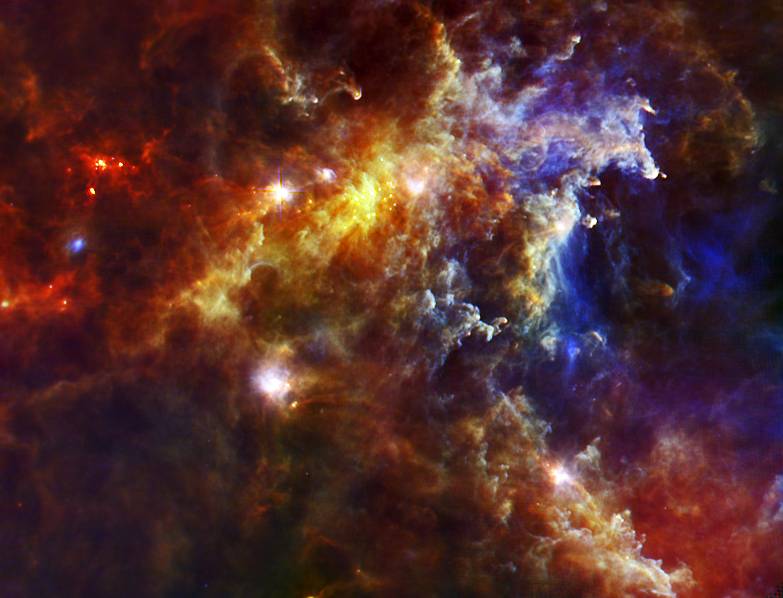
Infrared image of the Rosette molecular cloud. Herschel collects the infrared light given out by dust and this image is a three-colour composite made of wavelengths at 70 microns (blue), 160 microns (green) and 250 microns (red). It was made with observations from Herschel’s Photoconductor Array Camera and Spectrometer (PACS) and the Spectral and Photometric Imaging Receiver (SPIRE). The bright smudges are dusty cocoons containing massive protostars. The small spots near the centre of the image are lower mass protostars. Credits: ESA/PACS & SPIRE Consortium/HOBYS Key Programme Consortia

HI-RES JPEG (Size: 555 kb) - HI-RES TIFF (Size: 2779 kb)

Herschel’s latest image reveals the formation of previously unseen large stars, each one up to ten times the mass of our Sun. These are the stars that will influence where and how the next generation of stars are formed. The image is a new release of ‘OSHI’, ESA’s Online Showcase of Herschel Images.

The Rosette Nebula resides some 5,000 light years from Earth and is associated with a larger cloud that contains enough dust and gas to make the equivalent of 10,000 Sun-like stars. The Herschel image shows half of the nebula and most of the Rosette cloud. The massive stars powering the nebula lie to the right of the image but are invisible at these wavelengths. Each colour represents a different temperature of dust, from –263ºC (only 10ºC above absolute zero) in the red emission to –233ºC in the blue.

The bright smudges are dusty cocoons hiding massive protostars. These will eventually become stars containing around ten times the mass of the Sun. The small spots near the centre and in the redder regions of the image are lower mass protostars, similar in mass to the Sun.

ESA’s Herschel space observatory collects the infrared light given out by dust. This image is a combination of three infrared wavelengths, colour-coded blue, green and red in the image, though in reality the wavelengths are invisible to our eyes. It was created using observations from Herschel’s Photoconductor Array Camera and Spectrometer (PACS) and the Spectral and Photometric Imaging Receiver (SPIRE).

Herschel is showing astronomers such young, massive protostars for the first time, as part of the ‘Herschel imaging survey of OB Young Stellar objects’. Known as HOBYS, the survey targets young OB class stars, which will become the hottest and brightest stars.

“High-mass star-forming regions are rare and further away than low-mass ones,” says Frédérique Motte, Laboratoire AIM Paris-Saclay, France. So astronomers have had to wait for a space telescope like Herschel to reveal them.

It is important to understand the formation of high-mass stars in our Galaxy because they feed so much light and other forms of energy into their parent cloud they can often trigger the formation of the next generation of stars.

When astronomers look at distant galaxies, the star-forming regions they see are the bright, massive ones. Thus, if they want to compare our Galaxy to distant ones they must first understand high-mass star-formation here.

“Herschel will look at many other high-mass star-forming regions, some of them building stars up to a hundred times the mass of the Sun,” says Dr Motte, who plans to present the first scientific results from HOBYS at ESA’s annual ESLAB symposium to be held in the Netherlands, 4–7 May.

Tying down solar eruptions with magnetic ropes

Image Caption: The three images reveal gases trapped in the flux rope at different temperatures, from 1.5 million degrees Celsius in the image on the left through to 2.5 million degrees Celsius in the right hand image. These were made with data taken by the EIS telescope, an instrument built by a team led by UCL-MSSL and deployed on the Hinode spacecraft (a joint JAXA/UK/NASA mission). Credit: JAXA/ISAS/NASA/STFC. Full size version

Movie Caption: Link to quicktime movie. The movie is made using data taken by NASA's STEREO mission and shows the development of the S-shaped source region containing the flux rope and its subsequent eruption as a coronal mass ejection. Credit: NASA.
Full size version

Over the last century, astronomers have become very aware of how just dynamic the Sun really is. One of the most dramatic manifestations of this is a coronal mass ejection (CME) where billions of tons of matter is thrown into space. If a CME reaches the Earth it creates inclement ‘space weather’ that can disrupt communications, power grids and the delicate systems on orbiting satellites. This potential damage means there is a keen interest in understanding exactly what triggers a CME outburst.

Now a team of researchers from University College London (UCL) have used data from the Hinode spacecraft to reveal new details of the formation of an immense magnetic structure that erupted to produce a CME on the 7th December 2007. Lead researcher Dr Lucie Green will present their results on Monday 12th April at the RAS National Astronomy Meeting in Glasgow.

The Sun’s behaviour is shaped by the presence of magnetic fields that thread through the solar atmosphere. The magnetic fields may take on different shapes from uniform arches to coherent bundles of field lines known as ‘flux ropes’. Understanding the exact structure of magnetic fields is a crucial part of the effort to determine how the fields evolve and the role they play in solar eruptions. In particular, flux ropes are thought to play a vital role in the CME process, having been frequently detected in interplanetary space as CMEs reach the vicinity of the Earth.

Dr. Green says, “Magnetic flux ropes have been observed in interplanetary space for many years now and they are widely invoked in theoretical descriptions of how CMEs are produced. We now need observations to confirm or reject the existence of flux ropes in the solar atmosphere before an eruption takes place to see whether our theories are correct.”

The formation of the flux rope requires that significant energy is stored in the solar atmosphere. The rope is expected to remain stable whilst the solar magnetic field in the vicinity holds it down.

But at some point the structure becomes unstable and it erupts to produce a CME. Using data from the Hinode spacecraft Dr. Green has shown that a flux rope formed in the solar atmosphere over the 2.5 days that preceded the December 2007 event. Evidence for the flux rope takes the form of S shaped structures which are clearly seen by one of the Hinode instruments, the UK-led Extreme-Ultraviolet Imaging Telescope.

The key point to understanding and predicting the formation of CMEs is to know when the flux rope becomes unstable. Combining the observations of the S shaped structure with information on how the magnetic field in the region evolves has enabled Dr.Green to work out when this happened. The work shows that over 30% of the magnetic field of the region had been transformed into the flux rope before it became unstable, three times what has been suggested in theory.

Dr Green sees a better understanding of magnetic flux ropes and their role in emissions from the Sun and other stars as one of the most pressing questions not just for solar physics but astronomy as a whole.

She comments, “Flux ropes are thought to play a vital role in the evolution of the magnetic field of the Sun. However, the physics of flux ropes is applied across the Universe. For example, a solar physics model of flux rope ejection was recently used to explain the jets driven by the accretion disks around the supermassive black holes found in the centre of galaxies.”

CONTACTS

Dr Lucie Green
Mullard Space Science Laboratory
University College London
E-mail: lmg@mssl.ucl.ac.uk

NAM 2010 Press Office (12th – 16th April only)
Room G358
Gilbert Scott Building
University of Glasgow.
Tel: +44 (0)141 330 7409, +44 (0)141 330 7410, +44 (0)141 330 7411

Dr Robert Massey
Press and Policy Officer
Royal Astronomical Society
Mob: +44 (0)794 124 8035
E-mail: rm@ras.org.uk

Anita Heward
Press Officer
Royal Astronomical Society
Mob: +44 (0)7756 034 243
E-mail: anitaheward@btopenworld.com

IMAGE AND MOVIE

Image and movie available from the password-protected site http://www.astro.gla.ac.uk/~iain/nam_temp/press/ username: nam2010, password: 67$%nam

Image: The three images reveal gases trapped in the flux rope at different temperatures, from 1.5 million degrees Celsius in the image on the left through to 2.5 million degrees Celsius in the right hand image. These were made with data taken by the EIS telescope, an instrument built by a team led by UCL-MSSL and deployed on the Hinode spacecraft (a joint JAXA/UK/NASA mission). Credit: JAXA/ISAS/NASA/STFC

Movie: The movie is made using data taken by NASA's STEREO mission and shows the development of the S-shaped source region containing the flux rope and its subsequent eruption as a coronal mass ejection. Credit: NASA

NOTES FOR EDITORS

Dr Lucie Green is a Dorothy Hodgkin Research Fellow. This research work was funded by the Royal Society.

HINODE

The Hinode spacecraft is a joint JAXA, NASA and UK mission. UCL led the development of the Extreme-ultraviolet Imaging Spectrometer onboard this mission. For more information on these see http://msslxr.mssl.ucl.ac.uk:8080/SolarB/

NOTES FOR EDITORS

RAS NATIONAL ASTRONOMY MEETING (NAM 2010)

The RAS National Astronomy Meeting 2010 will take place from 12-16th April at the University of Glasgow. The conference is held in conjunction with the UK Solar Physics (UKSP) and Magnetosphere Ionosphere and Solar-Terrestrial Physics (MIST) meetings. NAM2010 (www.astro.gla.ac.uk/nam2010/) is principally sponsored by the Royal Astronomical Society (RAS) and the University of Glasgow.

THE ROYAL ASTRONOMICAL SOCIETY

The Royal Astronomical Society (RAS: www.ras.org.uk), founded in 1820, encourages and promotes the study of astronomy, solar-system science, geophysics and closely related branches of science. The RAS organises scientific meetings, publishes international research and review journals, recognises outstanding achievements by the award of medals and prizes, maintains an extensive library, supports education through grants and outreach activities and represents UK astronomy nationally and internationally. Its more than 3000 members (Fellows), a third based overseas, include scientific researchers in universities, observatories and laboratories as well as historians of astronomy and others.

THE UNIVERSITY OF GLASGOW

The University of Glasgow (founded 1451) is one of the world’s top 100 research universities with more than 70 per cent of its research rated as world-leading or internationally excellent. The Physics and Astronomy Department is one of the top four in the UK’s major research-intensive universities, the Russell Group.

The conference comes to Glasgow during the 250th anniversary year of the founding of the Regius Chair of Astronomy at the University of Glasgow, first held by astronomer and meteorologist Alexander Wilson in 1760. The present incumbent is Prof. John Brown, 10th Astronomer Royal for Scotland.

Thursday, April 08, 2010

Hubble snaps heavyweight of the Leo Triplet

Credit: NASA, ESA and the Hubble Heritage Team (STScI/AURA)-ESA/Hubble Collaboration. Acknowledgement: Davide De Martin and Robert Gendler


Hubble has snapped a spectacular view of the largest "player" in the Leo Triplet, a galaxy with an unusual anatomy: it displays asymmetric spiral arms and an apparently displaced core. The peculiar anatomy is most likely caused by the gravitational pull of the other two members of the trio.

The unusual spiral galaxy, Messier 66, is located at a distance of about 35 million light-years in the constellation of Leo. Together with Messier 65 and NGC 3628, Messier 66 is one third of the Leo Triplet, a trio of interacting spiral galaxies, part of the larger Messier 66 group. Messier 66 wins out in size over its fellow triplets — it is about 100 000 light-years across.

Messier 66 is the proud owner of exclusive asymmetric spiral arms which seem to climb above the galaxy's main disc and an apparently displaced nucleus. This asymmetry is unusual; most often, dense waves of gas, dust and newly born stars wind about the galaxy's centre in a symmetric way. Astronomers believe that Messier 66's once orderly shape has most likely been distorted by the gravitational pull of its two neighbours.

Hubble has imaged Messier 66's striking dust lanes and bright star clusters along the spiral arms in fine detail with the Advanced Camera for Surveys. Star clusters — pictured in the blue and pinkish regions of the image — are key tools for astronomers since they are used as indicators of how the parent galaxies assembled over time.

Messier 66 boasts a remarkable record of supernovae explosions. The spiral galaxy has hosted three supernovae since 1989, the latest one occurring in 2009. A supernova is a stellar explosion that may momentarily outshine its entire host galaxy. It then fades away over a period lasting several weeks or months. During its very short life the supernova radiates as much energy as the Sun would radiate over a period of about 10 billion years.

Links:

NASA's release

Contacts:

Colleen Sharkey
Hubble/ESA, Garching, Germany
Tel: +49 89 3200 6306
Cell: +49 151 153 73591
E-mail:
csharkey@eso.org

Wednesday, April 07, 2010

Astronomers take close-up pictures of mysterious dark object

Using an instrument created at the University of Michigan, astronomers have for the first time imaged a peculiar binary star eclipse that happens once every 27 years. Click here for more information.

ANN ARBOR, Mich.---For the first time, astronomers have directly observed the mysterious dark companion in a binary star system that has puzzled skywatchers since the 19th century.

Using an instrument developed at the University of Michigan, scientists have taken close-up pictures of Epsilon Aurigae during its eclipse, which happens every 27 years. "Close up" in this case is a relative term, but the images zoom in enough to show the shape of the dark object's shadow.

"Seeing is believing," said John Monnier, an associate professor in the U-M Department of Astronomy who is an author of a paper about the research findings published in the April 8 edition of Nature. Researchers from the University of Denver and Georgia State University were involved as well.

Epsilon Aurigae is the fifth brightest star in the northern constellation Auriga. For more than 175 years, astronomers have known it is dimmer than it should be, given its mass. They also noticed its brightness dip for more than a year every few decades. They surmised that it was a binary system in which one companion was invisible. But what type of object was the companion?

Because astronomers hadn't observed much light from it, the prevailing theory labeled it a smaller star orbited edge-on by a thick disk of dust. The theory held that the disk's orbit must be in precisely the same plane as the dark object's orbit around the brighter star, and all of this had to be occurring in the same plane as Earth's vantage point. This would be an unlikely alignment, but it explained observations.

The new images show that this is indeed the case. A geometrically thin, dark, dense, but partially translucent cloud can be seen passing in front of Epsilon Aurigae.

"This really shows that the basic paradigm was right, despite the slim probability," Monnier said. "It kind of blows my mind that we could capture this. There's no other system like this known. On top of that, it seems to be in a rare phase of stellar life. And it happens to be so close to us. It's extremely fortuitous."

The disk appears much flatter than recent modeling from the Spitzer Space Telescope suggests, Monnier said.

"It's really flat as a pancake," he said.

Monnier led the creation of the Michigan Infra-Red Combiner (MIRC) instrument that was used to produce these images. MIRC uses a process called "interferometry" to combine the light entering four telescopes at the CHARA array at Georgia State University and amplify it so that it seems to be coming through a device 100 times larger than the Hubble Space Telescope.

MIRC allowed astronomers to see the shape and surface characteristics of stars for the first time. Previously, stars were mere points of light even with the largest telescopes.

"Interferometry has made high resolution imaging of distant objects a reality," said Fabien Baron, a post-doctoral researcher in the Department of Astronomy who helped with the imaging in this study. "It most probably will solve many mysteries but also raise many new questions."

***

The paper is called "Infrared images of the transiting disk in the epsilon Aurigae System." Xiao Che, a graduate student in the U-M Department of Astronomy, contributed to the research. The lead authors are astrophysics graduate student Brian Kloppenborg and astronomy professor Bob Stencel at the University of Denver.

This research is funded by the National Science Foundation and the office of the dean of the College of Arts and Sciences at Georgia State University.

John Monnier: www.astro.lsa.umich.edu/~monnier

EDITORS: Watch and link to a video at www.ns.umich.edu/podcast/video.php?id=1211

Link: http://www.nsf.gov/news/news_summ.jsp?cntn_id=116731&org=NSF&from=news

Hiding Out Behind the Milky Way

A leggy cosmic creature comes out of hiding in this new infrared view from NASA's Wide-field Infrared Survey Explorer, or WISE. Image credit: NASA/JPL-Caltech/UCLA. Full image and caption

A leggy cosmic creature comes out of hiding in this new infrared view from NASA's Wide-field Infrared Survey Explorer, or WISE. The spiral beauty, called IC 342 and sometimes the "hidden galaxy," is shrouded behind our own galaxy, the Milky Way. Stargazers and professional astronomers have a hard time seeing the galaxy through the Milky Way's bright band of stars, dust and gas. WISE's infrared vision cuts through this veil, offering a crisp view.

In a spiral galaxy like IC 342, dust and gas are concentrated in the arms. The denser pockets of gas trigger the formation of new stars, as represented here in green and yellow. The core, shown in red, is also bursting with young stars, which are heating up dust. Stars that appear blue reside within our Milky Way, between us and IC 342.

This galaxy has been of great interest to astronomers because it is relatively close. However, determining its distance from Earth has proven difficult due to the intervening Milky Way. Astronomer Edwin Hubble first thought the galaxy might belong to our own Local Group of galaxies, but current estimates now place it farther away, at about 6.6 to 11 million light-years.

This image was made from observations by all four infrared detectors aboard WISE. Blue and cyan represent infrared light at wavelengths of 3.4 and 4.6 microns, which is primarily light from stars. Green and red represent light at 12 and 22 microns, which is primarily emission from warm dust.

Whitney Clavin (818) 354-4673
Whitney.clavin@jpl.nasa.gov

Tuesday, April 06, 2010

Fermi Maps an Active Galaxy's 'Smokestack Plumes'

Fermi's Large Area Telescope resolved high-energy gamma rays from an extended region around the active galaxy Centaurus A. The emission corresponds to million-light-year-wide radio-emitting gas thrown out by the galaxy's supersized black hole. This inset shows an optical/gamma-ray composite of the galaxy and its location on the Fermi one-year sky map. Credit: NASA/DOE/Fermi LAT Collaboration, Capella Observatory. Larger image

The giant elliptical galaxy NGC 5128, show here in visible light, hosts the radio source known as Centaurus A. Located 12 million light-years away, it is one of the closest active galaxies. Credit: Capella Observatory. Larger image

The gamma-ray output from Cen A's lobes exceeds their radio output by more than ten times. High-energy gamma rays detected by Fermi's Large Area Telescope are depicted as purple in this gamma ray/optical composite of the galaxy. Credit: NASA/DOE/Fermi LAT Collaboration, Capella Observatory. Larger image

It takes the addition of radio data (orange) to fully appreciate the scale of Cen A's giant radio-emitting lobes, which stretch more than 1.4 million light-years. Gamma-rays from Fermi's Large Area Telescope (purple) and an image of the galaxy in visible light are also included in this composite. Credit: NASA/DOE/Fermi LAT Collaboration, Capella Observatory, and Ilana Feain, Tim Cornwell, and Ron Ekers (CSIRO/ATNF), R. Morganti (ASTRON), and N. Junkes (MPIfR). Larger image

If our eyes could see radio waves, the nearby galaxy Centaurus A (Cen A) would be one of the biggest and brightest objects in the sky, nearly 20 times the apparent size of a full moon. What we can't see when looking at the galaxy in visible light is that it lies nestled between a pair of giant radio-emitting gas plumes ejected by its supersized black hole. Each plume is nearly a million light-years long.

NASA's Fermi Gamma-Ray Space Telescope maps gamma rays, radiation that typically packs 100 billion times the energy of radio waves. Nevertheless, and to the surprise of many astrophysicists, Cen A's plumes show up clearly in the satellite's first 10 months of data. The study appears in Thursday's edition of Science Express.

"This is something we've never seen before in gamma rays," said Teddy Cheung, a Fermi team member at the Naval Research Laboratory in Washington. "Not only do we see the extended radio lobes, but their gamma-ray output is more than ten times greater than their radio output." If gamma-ray telescopes had matured before their radio counterparts, astronomers would have instead classified Cen A as a "gamma-ray galaxy."

Also known as NGC 5128, Cen A is located about 12 million light-years away in the constellation Centaurus and is one of the first celestial radio sources identified with a galaxy. "A hallmark of radio galaxies is the presence of huge, double-lobed radio-emitting structures around otherwise normal-looking elliptical galaxies," said Jürgen Knödlseder, a Fermi collaborator at the Center for the Study of Space Radiation in Toulouse, France. "Cen A is a textbook example."

Astronomers classify Cen A as an "active galaxy," a term applied to any galaxy whose central region exhibits strong emissions at many different wavelengths. "What powers these emissions is a well-fed black hole millions of times more massive than our sun," said Yasushi Fukazawa, a co-author of the study at Hiroshima University in Japan. "The black hole somehow diverts some of the matter falling toward it into two oppositely directed jets that stream away from the center."

Fueled by a black hole estimated at hundreds of millions of times the sun's mass, Cen A ejects magnetized particle jets moving near the speed of light. Over the course of tens of millions of years, these jets puffed out two giant bubbles filled with magnetic fields and energetic particles -- the radio lobes we now see. The radio waves arise as high-speed electrons spiral through the lobes' tangled magnetic fields.

But where do gamma rays -- the highest-energy form of light -- come from?

The entire universe is filled with low-energy radiation -- radio photons from the all-pervasive cosmic microwave background, as well as infrared and visible light from stars and galaxies. The presence of this radiation is the key to understanding Cen A's gamma rays.

"When one of these photons collides with a super-fast particle in the radio lobes, the photon receives such an energy boost, it becomes a gamma ray," explained co-author Lukasz Stawarz at the Japan Aerospace Exploration Agency in Sagamihara, Japan.

Although it sounds more like billiards than astrophysics, this process, called inverse Compton scattering, is a common way of making cosmic gamma rays. For Cen A, an especially important aspect is the case where photons from the cosmic microwave background ricochet off of the highest-energy particles in the radio lobes.

In dozens of active galaxies, this process has been shown to produce X-rays. But the Cen A study marks the first case where astronomers have solid evidence that microwave photons can be kicked up to gamma-ray energies.

Fermi cataloged hundreds of blazars and other types of active galaxies in its first year. Before its mission ends, that number may reach several thousand. But because Cen A is so close, so large and so vigorous, it may be the only active galaxy Fermi will view this way.

With Centaurus A, Fermi hit the jackpot.

NASA’s Fermi Gamma-ray Space Telescope is an astrophysics and particle physics partnership, developed in collaboration with the U.S. Department of Energy, along with important contributions from academic institutions and partners in France, Germany, Italy, Japan, Sweden, and the U.S. The National Radio Astronomy Observatory is a facility of the National Science Foundation operated under cooperative agreement by Associated Universities, Inc.

Related Links:

CSIRO astronomers reveal a 'blue whale of space'
The Many Faces of Cen A
Continent-sized Radio Telescope Takes Close-ups of Fermi Active Galaxies
NASA's Fermi Finds Gamma-ray Galaxy Surprises


Francis Reddy
NASA's Goddard Space Flight Center

Small Companion to Brown Dwarf Challenges Simple Definition

This is an artist's conception of the binary system 2M J044144 showing the primary brown dwarf that is estimated to be approximately 20 times the mass of Jupiter (at left) and its companion that is estimated to be 7 times the mass of Jupiter (at right). The disk of the primary likely never had enough material to make a companion of this mass. As a result, this small companion probably formed like a binary star. In this illustration, both objects are presented at the same distance to show relative sizes. Not shown are two other nearby objects, a low-mass star and a brown dwarf that are probably both parts of this system. Science Credit: NASA, ESA, and K. Todorov and K. Luman (Penn State University). Artwork Credit: Gemini Observatory, courtesy of L. Cook.

This is a Hubble Space Telescope image of young brown dwarf 2M J044144. It has a companion object at the 8 o'clock position that is estimated to be 5-10 times the mass of Jupiter. In the right panel, the light from the brown dwarf has been subtracted to provide a clearer view of the companion object. The separation of the companion corresponds to 1.4 billion miles at the distance of the Taurus star-forming region, which is only about 1 million years old. The companion may be a very small brown dwarf or a large planet, depending on how it formed. Images were taken with Hubble's Wide Field Planetary Camera 2 to track the motion of the two objects to see if they actually do travel across space together. Additional observations were done with the Gemini North telescope on Mauna Kea, Hawaii. Credit: NASA, ESA, and K. Todorov and K. Luhman (Penn State University)

As our telescopes grow more powerful, astronomers are uncovering objects that defy conventional wisdom. The latest example is the discovery of a planet-like object circling a brown dwarf. It's the right size for a planet, estimated to be 5-10 times the mass of Jupiter. But the object formed in less than 1 million years — the approximate age of the brown dwarf — and much faster than the predicted time it takes to build planets according to some theories.

Kamen Todorov of Penn State University and co-investigators used the keen eyesight of the Hubble Space Telescope and the Gemini Observatory to directly image the companion of the brown dwarf, which was uncovered in a survey of 32 young brown dwarfs in the Taurus star-forming region. Brown dwarfs are objects that typically are tens of times the mass of Jupiter and are too small to sustain nuclear fusion to shine as stars do.

The mystery object orbits the nearby brown dwarf at a separation of approximately 2.25 billion miles (3.6 billion kilometers — which is between the distances of Saturn and Uranus from the Sun). The team's research is being published in an upcoming issue of The Astrophysical Journal.

There has been a lot of discussion in the context of the Pluto debate over how small an object can be and still be called a planet. This new observation addresses the question at the other end of the size spectrum: How small can an object be and still be a brown dwarf rather than a planet? This new companion is within the range of masses observed for planets around stars — less than 15 Jupiter masses. But should it be called a planet? The answer is strongly connected to the mechanism by which the companion most likely formed.

There are three possible formation scenarios: Dust in a circumstellar disk slowly agglomerates to form a rocky planet 10 times larger than Earth, which then accumulates a large gaseous envelope; a lump of gas in the disk quickly collapses to form an object the size of a gas giant planet; or, rather than forming in a disk, a companion forms directly from the collapse of the vast cloud of gas and dust in the same manner as a star (or brown dwarf).

If the last scenario is correct, then this discovery demonstrates that planetary-mass bodies can be made through the same mechanism that builds stars. This is the likely solution because the companion is too young to have formed by the first scenario, which is very slow. The second mechanism occurs rapidly, but the disk around the central brown dwarf probably did not contain enough material to make an object with a mass of 5-10 Jupiter masses.

"The most interesting implication of this result is that it shows that the process that makes binary stars extends all the way down to planetary masses. So it appears that nature is able to make planetary-mass companions through two very different mechanisms," says team member Kevin Luhman of the Center for Exoplanets and Habitable Worlds at Penn State University. If the mystery companion formed through cloud collapse and fragmentation, as stellar binary systems do, then it is not a planet by definition because planets build up inside disks.

The mass of the companion is estimated by comparing its brightness to the luminosities predicted by theoretical evolutionary models for objects at various masses for an age of 1 millon years.

Further supporting evidence comes from the presence of a very nearby binary system that contains a small red star and a brown dwarf. Luhman thinks that all four objects may have formed in the same cloud collapse, making this in actuality a quadruple system. "The configuration closely resembles quadruple star systems, suggesting that all of its components formed like stars," says Luhman.

CONTACT

Ray Villard
Space Telescope Science Institute, Baltimore, Md.
410-338-4514

villard@stsci.edu

Peter Michaud
Gemini Observatory, Hilo, Hawaii
808-974-2510

pmichaud@gemini.edu

Kevin Luhman
Penn State University, University Park, Pa.
814-863-4957

kluhman@astro.psu.edu

Thursday, April 01, 2010

Colony of Young Stars Shines in New Spitzer Image

About this image: A colony of hot, young stars is stirring up the cosmic scene in this new picture from NASA's Spitzer Space Telescope. The image shows the Orion nebula, a happening place where stars are born. The young stars dip and peak in brightness due to a variety of reasons. Shifting cold and hot spots on the stars' surfaces cause brightness levels to change, in addition to surrounding disks of lumpy planet-forming material, which can obstruct starlight. Spitzer is keeping tabs on the young stars, providing data on their changing ways.

The hottest stars in the region, called the Trapezium cluster, are bright spots at center right. Radiation and winds from those stars has sculpted and blown away surrounding dust. The densest parts of the cloud appear dark at center left.

This image was taken after Spitzer's liquid coolant ran dry in May 2009, marking the beginning of its "warm" mission. Light from the telescope's remaining infrared channels has been color-coded: 3.6-micron light is blue and 4.5-micron light is orange.

Astronomers have their eyes on a hot group of young stars, watching their every move like the paparazzi. A new infrared image from NASA's Spitzer Space Telescope shows the bustling star-making colony of the Orion nebula, situated in the hunter's sword of the famous constellation. Like Hollywood starlets, the cosmic orbs don't always shine their brightest, but vary over time. Spitzer is watching the stellar show, helping scientists learn more about why the stars change, and to what degree planet formation might play a role.

"This is an exploratory project. Nobody has done this before at a wavelength sensitive to the heat from dust circling around so many stars," said John Stauffer, the principal investigator of the research at NASA's Spitzer Science Center, located at the California Institute of Technology in Pasadena. "We are seeing a lot of variation, which may be a result of clumps or warped structures in the planet-forming disks."

The new image was taken after Spitzer ran out of its coolant in May 2009, beginning its extended "warm" mission. The coolant was needed to chill the instruments, but the two shortest-wavelength infrared channels still work normally at the new, warmer temperature of 30 Kelvin (minus 406 Fahrenheit). In this new phase of the mission, Spitzer is able to spend more time on projects that cover a lot of sky and require longer observation times.

One such project is the "Young Stellar Object Variability" program, in which Spitzer looks repeatedly at the same patch of the Orion nebula, monitoring the same set of about 1,500 variable stars over time. It has already taken about 80 pictures of the region over 40 days. A second set of observations will be made in fall 2010. The region's twinkling stars are about one million years old - this might invoke thoughts of wrinkle cream to a movie star, but in the cosmos, it is quite young. Our middle-aged sun is 4.6 billion years old.

Young stars are fickle, with brightness levels that change more than those of adult, sun-like stars. They also spin around faster. One reason for the ups and downs in brightness is the existence of cold spots on their surfaces. Cold spots are the opposite of "age spots" - the younger the star, the more it has. The cold spots come and go as a star whips around, changing the amount of light that reaches our telescopes.

Stellar brightness can also change due to hot spots, which are caused by gas accreting onto a young star from the material out of which it formed.

"In the 1950s and 60s, astronomers knew that younger stars varied, and they postulated this had something to do with the birthing process," said Stauffer. "Later, with improved technology, we could see a lot more and learned a great deal about the stars' spots."

Spitzer is particularly suited to study yet another reason why the stars are changing. The telescope's infrared sight can see the warm, dusty disks orbiting around them. These disks are where planets may eventually clump together and form. When the disks are young, they can have asymmetries, possibly caused by forming planets or gravitational disturbances from formed planets. As the skewed disks circle around a star, they block varying amounts of starlight.

By gathering more and more data on these varying disks, Stauffer and his team hope to learn more about how planets develop -- not exactly tabloid fodder, but an ongoing drama of one large, stellar family.

NASA's Jet Propulsion Laboratory in Pasadena, Calif., manages the Spitzer Space Telescope mission for NASA's Science Mission Directorate, Washington. Science operations are conducted at the Spitzer Science Center at the California Institute of Technology in Pasadena. Caltech manages JPL for NASA.

Astronomers See Historical Supernova From New Angle

Chandra X-ray Observatory image of the supernova remnant Cassiopeia A (Cas A). The red, green, and blue regions in this X-ray image of Cas A show where the intensity of low, medium, and high-energy X-rays, respectively, is greatest. While this photo shows the remains of the exploded star, light echoes show us reflected light from the explosion itself. Credit: NASA/CXC/MIT/UMass Amherst/M.D.Stage et al.

MAUNA KEA, HI— By observing visible “light echoes,” astronomers have assembled one of the first 3-D perspectives of a cosmic object. The new view of the supernova remnant Cassiopeia A confirms that it formed during a lopsided explosion.

“Light echoes allow us to conduct forensic studies of stars that exploded long ago, before modern astronomical instruments became available,” said astronomer Alex Filippenko of the University of California, Berkeley. “It’s kind of like getting photographs of a crime that was committed years ago, before cameras existed.”

Filippenko and his collaborators made the light-echo measurements of Cassiopeia A, which is located about 16,000 light years from Earth, based on the familiar concept of a sound echo. If a person yells “Echo!” in a cave, the sound waves bounce off the walls and reflect back to his ears, or the ears of other people, as echoes. A similar phenomenon occurs with light.

The supernova’s light, for example, reflects off interstellar clouds of dust, creating light echoes that come toward Earth from different directions, depending on where the clouds are located.

“Just like mirrors in a changing room show you a clothing outfit from all sides, interstellar dust clouds act like mirrors to show us different sides of the supernova,” said Armin Rest of Harvard University, the lead investigator of the project.

Most of Cassiopeia A’s light washed over the Earth about 330 years ago and is long gone. But light that took a longer path, reflecting off clouds of interstellar dust, is just now reaching the planet. This faint, reflected light is what the astronomers detected as light echoes using the Mayall 4-meter telescope at Kitt Peak National Observatory in Arizona.

They then used the 10-meter Keck I telescope on Mauna Kea to obtain high-quality spectra of the light echoes, which are several million times fainter than the faintest stars visible to the unaided eye in dark skies. Keck’s Low Resolution Imaging Spectrometer spread out the light from each echo into its component colors, or spectrum, and from this, the astronomers were able to measure the expansion speeds of the ejected gases.

“One of the big uncertainties in our understanding of how massive stars explode is whether the explosions are spherically symmetric, the same in all directions,” said Filippenko, who conducted the supernova echo project at the Keck Observatory. “Up until now, we have had some indirect evidence for asymmetries, but our new Keck observations of light echoes directly reveal them.”

Each echo comes from a spot with a different view of the explosion. The Keck spectra ultimately revealed that the gas was streaming away from the remnant in one direction at a speed of almost nine million miles per hour (or 2,500 miles per second) faster than gas moving in the other two observed directions.

Previous studies support the team’s findings. The neutron star, created when the core of the original star in Cassiopeia A collapsed, is zooming through space at nearly 800,000 miles per hour, in the opposite direction of the unique light echo. The explosion may have kicked gas one way and the neutron star out the other side, a consequence of Newton’s third law of motion, which states that every action has an equal and opposite reaction.

“Now we can connect the dots from the explosion itself, to the supernova’s light, to the supernova remnant,” said Ryan Foley of the Harvard-Smithsonian Center for Astrophysics and co-author of the new paper. Filippenko noted that theoretical astrophysicists will now definitely need to include asymmetries in their physical models of how massive, dying stars explode.

The results have been submitted for publication in the Astrophysical Journal.

Headquartered in Cambridge, Mass., the Harvard-Smithsonian Center for Astrophysics (CfA) is a joint collaboration between the Smithsonian Astrophysical Observatory and the Harvard College Observatory. CfA scientists, organized into six research divisions, study the origin, evolution and ultimate fate of the universe.

The W. M. Keck Observatory operates two 10-meter optical/infrared telescopes on the summit of Mauna Kea on the island of Hawai’i and is a scientific partnership of the California Institute of Technology, the University of California, and NASA. For more information please call 808.881.3827 or visit http://www.keckobservatory.org.