Showing posts with label Messier 66. Show all posts

Thursday, May 17, 2018

Hubble shows the local Universe in ultraviolet

The glowing spiral arms of NGC 6744

Dwarf galaxy UGCA 281

Messier 66 — member of the Leo Triplet
Pockets of star formation in DDO 68

PR Image heic1810e
Wave of star formation in Messier 96
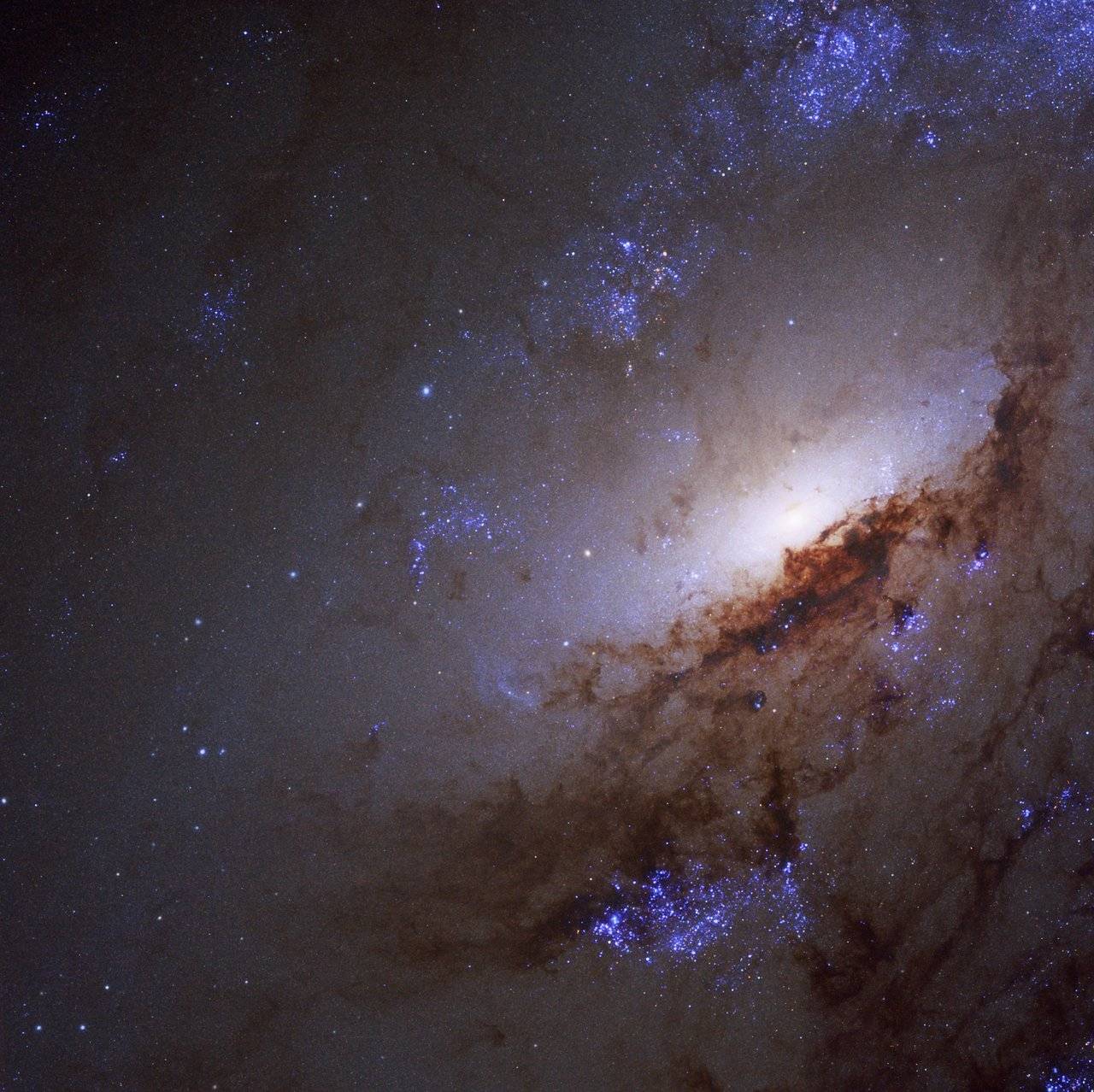
Parts of Messier 106


Using the unparalleled sharpness and ultraviolet observational capabilities of the NASA/ESA Hubble Space Telescope, an international team of astronomers has created the most comprehensive high-resolution ultraviolet-light survey of star-forming galaxies in the local Universe. The catalogue contains about 8000 clusters and 39 million hot blue stars.

Ultraviolet light is a major tracer of the youngest and hottest stars. These stars are short-lived and intensely bright. Astronomers have now finished a survey called LEGUS (Legacy ExtraGalactic UV Survey) that captured the details of 50 local galaxies within 60 million light-years of Earth in both visible and ultraviolet light.

The LEGUS team carefully selected its targets from among 500 candidate galaxies compiled from ground-based surveys. They chose the galaxies based on their mass, star-formation rate, and their abundances of elements heavier than hydrogen and helium. Because of the proximity of the selected galaxies, Hubble was able to resolve them into their main components: stars and star clusters. With the LEGUS data, the team created a catalogue with about 8000 young clusters and it also created a star catalogue comprising about 39 million stars that are at least five times more massive than our Sun.

The data, gathered with Hubble’s Wide Field Camera 3 and Advanced Camera for Surveys, provide detailed information on young, massive stars and star clusters, and how their environment affects their development. As such, the catalogue offers an extensive resource for understanding the complexities of star formation and galaxy evolution.

One of the key questions the survey may help astronomers answer is the connection between star formation and the major structures, such as spiral arms, that make up a galaxy. These structured distributions are particularly visible in the youngest stellar populations.

By resolving the fine details of the studied galaxies, while also studying the connection to larger galactic structures, the team aims to identify the physical mechanisms behind the observed distribution of stellar populations within galaxies.

Figuring out the final link between gas and star formation is key to fully understanding galaxy evolution. Astronomers are studying this link by looking at the effects of the environment on star clusters, and how their survival is linked to their surroundings.

LEGUS will not only allow astronomers to understand the local Universe. It will also help interpret views of distant galaxies, where the ultraviolet light from young stars is stretched to infrared wavelengths due to the expansion of space. The NASA/ESA/CSA James Webb Space Telescope and its ability to observe in the far infrared will complement the LEGUS views.


More Information

The Hubble Space Telescope is a project of international cooperation between ESA and NASA.
Image credit: NASA, ESA, LEGUS team


Links


Contacts

Linda Smith
European Space Agency
Baltimore, Maryland, USA
Tel: 001 4103384926
Email:
lsmith@stsci.edu

Mathias Jäger
ESA/Hubble, Public Information Officer
Garching bei München, Germany
Cell: +49 176 62397500
Email:
mjaeger@partner.eso.org


Wednesday, July 27, 2011

VST Looks at the Leo Triplet — and Beyond

PR Image eso1126a
VST’s view of the Leo Triplet and beyond

PR Image eso1126b
The triplet of galaxies Messier 65, Messier 66 and NGC 3628 in the constellation of Leo

PR Image eso1126c
Wide-field view of the sky around the Leo Triplet of galaxies

PR Video eso1126a
Zooming in on the Leo Triplet of galaxies

A huge image, from the new VLT Survey Telescope (VST) and its camera OmegaCAM at ESO's Paranal Observatory, shows a triplet of bright galaxies in the constellation of Leo (The Lion). But the faint objects in the background, rather than the foreground galaxies, are what may capture an astronomer’s attention. The VST’s sharp view of these dim objects hints at the power of the telescope and OmegaCAM for mapping the distant Universe.

The VST [1] is the newest addition to ESO’s Paranal Observatory (eso1119). It is a state-of-the-art 2.6-metre telescope, which is equipped with a giant 268-megapixel camera, OmegaCAM [2]. As the name indicates, the VST is dedicated to surveying the skies in visible light, and it is the largest telescope in the world designed exclusively for this purpose. This large view of the Leo Triplet demonstrates the excellent quality of images produced by the VST and its camera.

The Leo Triplet is a magnificent group of interacting galaxies about 35 million light-years from Earth. All three of them are spirals like our own Milky Way galaxy, even though this may not be immediately obvious in this image because their discs are tilted at different angles to our line of sight. NGC 3628, at the left of the frame, is seen edge-on, with thick dust lanes along the plane of the galaxy. The Messier objects M 65 (upper right) and M 66 (lower right), on the other hand, are inclined enough to make their spiral arms visible.

Large telescopes can normally study only one of these galaxies at a time (see for example potw1026a and eso0338c), but the VST field of view — twice as broad as the full Moon — is wide enough to frame all three members of the group in a single picture. The VST also brings to light large numbers of fainter and more distant galaxies, seen as smudges in the background of this image.

In the foreground of the new image many point-like stars of varied brightness, lying in our own galaxy, can also be seen. One of the science goals of the VST is to search for much fainter objects in the Milky Way, such as brown dwarf stars, planets, neutron stars and black holes. These are thought to permeate the halo of our galaxy but are often too dim to be detected directly even by large telescopes. The VST will look for subtle events, produced by a phenomenon called microlensing [3], to detect these very elusive objects indirectly and study the galactic halo.

Through these studies, the VST is expected to further our understanding of dark matter, which is thought to be the largest constituent of the galactic halo. Clues on the nature of this substance, as well as on the nature of dark energy, are also expected to be found through the VST’s surveys of the distant Universe. The telescope will discover distant galaxy clusters and high-redshift quasars that will help astronomers understand the early Universe and find answers to long-standing questions in cosmology.

Very much closer to home, this image also contains the tracks of several asteroids within the Solar System that have moved across the images during the exposures. These show up as short coloured lines [4] and at least ten can be seen in this picture. As Leo is a zodiacal constellation, lying in the plane of the Solar System, the number of asteroids is particularly high.

This image is a composite created by combining exposures taken through three different filters. Light that passed through a near-infrared filter was coloured red, light in the red part of the spectrum is coloured green, and green light is coloured magenta.

Notes

[1] The VST programme is a joint venture between the INAF–Osservatorio Astronomico di Capodimonte, Naples, Italy and ESO.

[2] OmegaCAM was designed and built by a consortium including institutes in the Netherlands, Germany and Italy with major contributions from ESO.

[3] Microlensing is a gravitational lensing phenomenon by which the presence of a dim but massive object can be inferred from the effect of its gravity on light coming from a more distant star. If, due to a chance alignment, the dim object passes sufficiently close to our line of sight to the more distant star, its gravitational field bends the light coming from the background star. This can lead to a measurable increase in the background star’s brightness. As microlensing events rely on rare chance alignments, they are usually found by large surveys that can observe great numbers of potential background stars.

[4] These are either green or pairs of magenta/red trails. This is because the exposures used to make the green channel of the final colour image were taken on a different night to those used for the red and magenta, which were taken in sequence on the same night.

More information

ESO, the European Southern Observatory, is the foremost intergovernmental astronomy organisation in Europe and the world’s most productive astronomical observatory. It is supported by 15 countries: Austria, Belgium, Brazil, the Czech Republic, Denmark, France, Finland, Germany, Italy, the Netherlands, Portugal, Spain, Sweden, Switzerland and the United Kingdom. ESO carries out an ambitious programme focused on the design, construction and operation of powerful ground-based observing facilities enabling astronomers to make important scientific discoveries. ESO also plays a leading role in promoting and organising cooperation in astronomical research. ESO operates three unique world-class observing sites in Chile: La Silla, Paranal and Chajnantor. At Paranal, ESO operates the Very Large Telescope, the world’s most advanced visible-light astronomical observatory and two survey telescopes. VISTA works in the infrared and is the world’s largest survey telescope and the VLT Survey Telescope is the largest telescope designed to exclusively survey the skies in visible light. ESO is the European partner of a revolutionary astronomical telescope ALMA, the largest astronomical project in existence. ESO is currently planning a 40-metre-class European Extremely Large optical/near-infrared Telescope, the E-ELT, which will become “the world’s biggest eye on the sky”.

Links
Photos of VST

Contacts

Douglas Pierce-Price
ESO, Public Information Officer
Garching bei München, Germany
Tel: +49 89 3200 6759
Email: dpiercep@eso.org

Thursday, April 08, 2010

Hubble snaps heavyweight of the Leo Triplet

Credit: NASA, ESA and the Hubble Heritage Team (STScI/AURA)-ESA/Hubble Collaboration. Acknowledgement: Davide De Martin and Robert Gendler


Hubble has snapped a spectacular view of the largest "player" in the Leo Triplet, a galaxy with an unusual anatomy: it displays asymmetric spiral arms and an apparently displaced core. The peculiar anatomy is most likely caused by the gravitational pull of the other two members of the trio.

The unusual spiral galaxy, Messier 66, is located at a distance of about 35 million light-years in the constellation of Leo. Together with Messier 65 and NGC 3628, Messier 66 is one third of the Leo Triplet, a trio of interacting spiral galaxies, part of the larger Messier 66 group. Messier 66 wins out in size over its fellow triplets — it is about 100 000 light-years across.

Messier 66 is the proud owner of exclusive asymmetric spiral arms which seem to climb above the galaxy's main disc and an apparently displaced nucleus. This asymmetry is unusual; most often, dense waves of gas, dust and newly born stars wind about the galaxy's centre in a symmetric way. Astronomers believe that Messier 66's once orderly shape has most likely been distorted by the gravitational pull of its two neighbours.

Hubble has imaged Messier 66's striking dust lanes and bright star clusters along the spiral arms in fine detail with the Advanced Camera for Surveys. Star clusters — pictured in the blue and pinkish regions of the image — are key tools for astronomers since they are used as indicators of how the parent galaxies assembled over time.

Messier 66 boasts a remarkable record of supernovae explosions. The spiral galaxy has hosted three supernovae since 1989, the latest one occurring in 2009. A supernova is a stellar explosion that may momentarily outshine its entire host galaxy. It then fades away over a period lasting several weeks or months. During its very short life the supernova radiates as much energy as the Sun would radiate over a period of about 10 billion years.

Links:

NASA's release

Contacts:

Colleen Sharkey
Hubble/ESA, Garching, Germany
Tel: +49 89 3200 6306
Cell: +49 151 153 73591
E-mail:
csharkey@eso.org