Showing posts with label Rosette Nebula. Show all posts

Thursday, April 24, 2025

Eye on Infinity: NASA Celebrates Hubble’s 35th Year in Orbit

A selection of photogenic space targets to celebrate the 35th anniversary of NASA's Hubble Space Telescope. Upper left: Mars. Upper right: planetary nebula NGC 2899. Lower left: a small portion of the Rosette Nebula. Lower right: barred spiral galaxy NGC 5 planetary nebula335. Image: NASA, ESA, STScI; Image Processing: Joseph DePasquale (STScI), Alyssa Pagan (STScI)


In celebration of the Hubble Space Telescope’s 35 years in Earth orbit, NASA is releasing an assortment of compelling images recently taken by Hubble, stretching from the planet Mars to star-forming regions, and a neighboring galaxy.

After more than three decades of perusing the universe, Hubble remains a household name — the most well-recognized and scientifically productive telescope in history. The Hubble mission is a glowing success story of America’s technological prowess, unyielding scientific curiosity, and a reiteration of our nation’s pioneering spirit.

“Hubble opened a new window to the universe when it launched 35 years ago. Its stunning imagery inspired people across the globe, and the data behind those images revealed surprises about everything from early galaxies to planets in our own solar system,” said Shawn Domagal-Goldman, acting director of the Astrophysics Division at NASA Headquarters in Washington. “The fact that it is still operating today is a testament to the value of our flagship observatories, and provides critical lessons for the Habitable Worlds Observatory, which we plan to be serviceable in the spirit of Hubble.”

Perched above Earth’s blurry atmosphere, Hubble’s crystal-clear views have been nothing less than transformative for the public’s perception of the cosmos. Through its evocative imagery, Hubble has made astronomy very relevant, engaging, and accessible for people of all ages. Hubble snapshots can portray the universe as awesome, mysterious, and beautiful — and at the same time chaotic, overwhelming, and foreboding.

A selection of photogenic space targets to celebrate the 35th anniversary of NASA's Hubble Space Telescope. Upper left: Mars. Upper right: planetary nebula NGC 2899. Lower left: a small portion of the Rosette Nebula. Lower right: barred spiral galaxy NGC 5335. Image: NASA, ESA, STScI; Image Processing: Joseph DePasquale (STScI), Alyssa Pagan (STScI)

The 24,000-pound observatory was tucked away inside the space shuttle Discovery’s cargo bay and lofted into low Earth orbit on April 24, 1990. As the shuttle Discovery thundered skyward, the NASA commentator described Hubble as a “new window on the universe.” The telescope turned out to be exactly as promised, and more.

More scientific papers than ever are based on Hubble data, thanks to the dedication, perseverance, and skills of engineers, scientists, and mission operators. Astronauts chased and rendezvoused with Hubble on five servicing missions in which they upgraded Hubble’s cameras, computers, and other support systems. The servicing missions took place from 1993 to 2009.

The telescope’s mission got off to a shaky start in 1990 when an unexpected flaw was found in the observatory’s nearly eight-foot diameter primary mirror. Astronauts gallantly came to the rescue on the first shuttle servicing mission in December 1993 to improve Hubble’s sharpness with corrective optics.

To date, Hubble has made nearly 1.7 million observations, looking at approximately 55,000 astronomical targets. Hubble discoveries have resulted in over 22,000 papers and over 1.3 million citations as of February 2025. All the data collected by Hubble is archived and currently adds up to over 400 terabytes, representing the biggest dataset for a NASA astrophysics mission besides the James Webb Space Telescope.

Hubble’s long operational life has allowed astronomers to return to the same cosmic scenes multiple times to observe changes that happened during more than three decades: seasonal variability on the planets in our solar system, black hole jets travelling at nearly the speed of light, stellar convulsions, asteroid collisions, expanding supernova bubbles, and much more.

Hubble’s Senior Project Scientist, Dr. Jennifer Wiseman, takes you on a tour of all four Hubble 35th anniversary images. Credit: NASA's Goddard Space Flight Center; Lead Producer: Paul Morris; Narrator: Dr. Jennifer Wiseman

Before 1990, powerful optical telescopes on Earth could see only halfway across the cosmos. Estimates for the age of the universe disagreed by a big margin. Supermassive black holes were only suspected to be the powerhouses behind a rare zoo of energetic phenomena. Not a single planet had been seen around another star.

Among its long list of breakthroughs: Hubble’s deep field images unveiled myriad galaxies dating back to the early universe. The telescope also allowed scientists to precisely measure the universe’s expansion, find that supermassive black holes are common among galaxies, and make the first measurement of the atmospheres of exoplanets. Hubble also contributed to the discovery of dark energy, the mysterious phenomenon accelerating the expansion of universe, leading to the 2011 Nobel Prize in Physics. 

The relentless pace of Hubble’s trailblazing discoveries kick-started a new generation of space telescopes for the 21st century. Hubble provided the first observational evidence that there were myriad distant galaxies for Webb to pursue in infrared wavelengths that reach even farther beyond Hubble’s gaze. Now, Hubble and Webb are often being used in complement to study everything from exoplanets to galaxy evolution.

Hubble’s planned successor, the Habitable Worlds Observatory, will have a significantly larger mirror than Hubble’s to study the universe in visible and ultraviolet light. It will be significantly sharper than Hubble and up to 100 times more sensitive to starlight. The Habitable Worlds Observatory will advance science across all of astrophysics, as Hubble has done for over three decades. A major goal of the future mission is to identify terrestrial planets around neighboring stars that might be habitable.

The Hubble Space Telescope continues to make ground-breaking discoveries that shape our fundamental understanding of the universe. Hubble is a project of international cooperation between NASA and ESA (European Space Agency). NASA’s Goddard Space Flight Center in Greenbelt, Maryland, manages the telescope and mission operations. Lockheed Martin Space, based in Denver, also supports mission operations at Goddard. The Space Telescope Science Institute in Baltimore, which is operated by the Association of Universities for Research in Astronomy, conducts Hubble science operations for NASA.


Saturday, October 19, 2024

Dark Energy Camera captures most detailed image of the resplendent Rosette Nebula and the star cluster fueling its glow

PR Image noirlab2424a
Rosette Nebula Captured with DECam

PR Image noirlab2424b
Excerpts From Rosette Nebula


Videos

Cosmoview Episode 87: Radiant Stars at the Heart of a Cosmic Rose
PR Video noirlab2424a
Cosmoview Episode 87: Radiant Stars at the Heart of a Cosmic Rose

Zooming into the Rosette Nebula
PR Video noirlab2424b
Zooming into the Rosette Nebula

Pan on the Rosette Nebula
PR Video noirlab2424c
Pan on the Rosette Nebula

Cosmoview Episodio 87: Estrellas radiantes en el corazón de una rosa cósmica
PR Video noirlab2424d
Cosmoview Episodio 87: Estrellas radiantes en el corazón de una rosa cósmica


Cradled within the fiery petals of the Rosette Nebula is NGC 2244, the young star cluster which it nurtured. The cluster’s stars light up the nebula in vibrant hues of red, gold and purple, and opaque towers of dust rise from the billowing clouds around its excavated core. This image, captured by the 570-megapixel Dark Energy Camera, is being released in celebration of NOIRLab’s fifth anniversary.

Around 5000 light-years away, the Rosette Nebula appears to be blooming right out the interstellar medium. Every detail of this cosmic flower, from its glowing central cavity to its shadowy filaments and globulettes, is captured in this image by the 570-megapixel Department of Energy-fabricated Dark Energy Camera (DECam), mounted on the U.S. National Science Foundation Víctor M. Blanco 4-meter Telescope at Cerro Tololo Inter-American Observatory in Chile, a Program of NSF NOIRLab.

Located in the constellation Monoceros (the Unicorn), the Rosette Nebula spans 1.3 degrees of sky, roughly the width of an index finger held out at arm’s length. For comparison, the well-known Orion Nebula, located in the constellation Orion just below the hunter’s belt, spans one degree of sky. Although the Rosette Nebula has a diameter of 130 light-years — more than five times as large as the Orion Nebula — their apparent sizes are similar because the former is four times as distant.

As prominent as the nebula’s ‘petals’ is the conspicuous absence of gas at its center. The culprits responsible for excavating this hollow core are the most massive stars of NGC 2244 — the open star cluster nurtured by the nebula. This cluster was born around two million years ago after the nebula’s gasses coalesced into clumps brought together by their mutual gravity. Eventually, some clumps grew to be massive stars that produce stellar winds powerful enough to bore a hole in the nebula’s heart.

NGC 2244’s massive stars also emit ultraviolet radiation, which ionizes the surrounding hydrogen gas and lights up the nebula in an array of brilliant colors. The billowing red clouds are regions of H-alpha emission, resulting from highly energized hydrogen atoms emitting red light. Along the walls of the central cavity, closer to the massive central stars, the radiation is energetic enough to ionize a heavier atom like oxygen, which glows in shades of gold and yellow. Finally, along the edges of the flower’s petals are wispy tendrils of deep pink glowing from the light emitted by ionized silicon.

The Rosette Nebula’s bright and glowing features are certainly striking; but its dark and shadowy features also command attention. Around the nebula’s excavated nucleus is a string of dark clouds dubbed ‘elephant trunks,’ so-named because of their trunk-like pillars. These structures are opaque because they contain obscuring dust, and they line the border between the hot shell of ionized hydrogen and the surrounding environment of cooler hydrogen. As the shell expands outwards it encounters cold and clumpy gas that resists its push. This creates the long and extended trunks whose lengths point like fingers towards the central cluster.

One of these dark features is the Wrench Trunk, its claw-like head seen towards the upper right of the central cluster. Unlike the prototypical Pillars of Creation trunks which stand like straight columns, the Wrench’s ‘handle’ has an unusual spiral shape which traces the magnetic field of the nebula.

Less obvious but equally interesting are the dark globulettes. Sometimes round and sometimes teardrop-shaped, these diminutive blobs of dust are smaller than the better known globules at only a few times more massive than Jupiter. A string of them can be seen near the Wrench Trunk, but hundreds more dot the entire Rosette Nebula. These globulettes may host brown dwarfs and planets within them.

Like all roses, the Rosette Nebula will not last forever, for the same stars it birthed will also bring about its death. In roughly 10 million years the radiation from the hot, young stars of the NGC 2244 cluster will have dissipated the nebula. By then the rosette will no longer be, and its massive stars will be left without their parent cloud.

This huge 377-megapixel image is being released in celebration of NOIRLab’s fifth anniversary. On 1 October 2019 NOIRLab’s five programs — Cerro Tololo Inter-American Observatory, the Community Science and Data Center, the International Gemini Observatory, Kitt Peak National Observatory and Vera C. Rubin Observatory — were brought together under one organization. In the years since, NOIRLab’s world-class telescopes have contributed to many discoveries and countless press releases, and produced an impressive collection of stunning astronomical images showcasing our diverse and colorful Universe.


More information

NSF NOIRLab (U.S. National Science Foundation National Optical-Infrared Astronomy Research Laboratory), the U.S. center for ground-based optical-infrared astronomy, operates the International Gemini Observatory (a facility of NSF, NRC–Canada, ANID–Chile, MCTIC–Brazil, MINCyT–Argentina, and KASI–Republic of Korea), Kitt Peak National Observatory (KPNO), Cerro Tololo Inter-American Observatory (CTIO), the Community Science and Data Center (CSDC), and Vera C. Rubin Observatory (operated in cooperation with the Department of Energy’s SLAC National Accelerator Laboratory). It is managed by the Association of Universities for Research in Astronomy (AURA) under a cooperative agreement with NSF and is headquartered in Tucson, Arizona. The astronomical community is honored to have the opportunity to conduct astronomical research on I’oligam Du’ag (Kitt Peak) in Arizona, on Maunakea in Hawai‘i, and on Cerro Tololo and Cerro Pachón in Chile. We recognize and acknowledge the very significant cultural role and reverence that these sites have to the Tohono O’odham Nation, to the Native Hawaiian community, and to the local communities in Chile, respectively.


Links


Contacts

Josie Fenske
Jr. Public Information Officer
NSF NOIRLab
Email:
josie.fenske@noirlab.edu


Wednesday, September 08, 2010

Rosette Nebula: The Heart of a Rose

Credit: X-ray (NASA/CXC/SAO/J. Wang et al),
Optical (DSS & NOAO/AURA/NSF/KPNO 0.9-m/T. Rector et al)


This composite image shows the Rosette star formation region, located about 5,000 light years from Earth. Data from the Chandra X-ray Observatory are colored red and outlined by a white line (roll your mouse over the image above). The X-rays reveal hundreds of young stars in the central cluster and fainter clusters on either side. Optical data from the Digitized Sky Survey and the Kitt Peak National Observatory (purple, orange, green and blue) show large areas of gas and dust, including giant pillars that remain behind after intense radiation from massive stars has eroded the more diffuse gas.

A recent Chandra study of the cluster on the right side of the image, named NGC 2237, provides the first probe of the low-mass stars in this satellite cluster. Previously only 36 young stars had been discovered in NGC 2237, but the Chandra work has increased this sample to about 160 stars. The presence of several X-ray emitting stars around the pillars and the detection of an outflow -- commonly associated with very young stars -- originating from a dark area of the optical image indicates that star formation is continuing in NGC 2237. By combining these results with earlier studies, the scientists conclude that the central cluster formed first, followed by expansion of the nebula, which triggered the formation of the two neighboring clusters, including NGC 2237.

This work was led by Junfeng Wang of the Harvard-Smithsonian Center for Astrophysics. The co-authors were Eric Feigelson, Leisa Townsley, Pat Broos and Gordon Garmire from Penn State University, Carlos Roman-Zuniga from the German-Spanish Astronomical Center in Spain, and Elizabeth Lada from the University of Florida.

Fast Facts for Rosette Nebula:


Scale: Image is 1 degree across (about 87 light years).
Category:
Normal Stars & Star Clusters
Coordinates (J2000) RA 06h 31m 52.00s Dec +04° 55' 57.00"
Constellation:
Monoceros
Observation Date: 4 pointings on 5-6 Jan 2001, 1 Jan 2004, 9 Feb 2007
Observation Time: 50 hours (2 days 2 hours)
Obs. ID: 1874-1877, 3750, 8454
Color Code: Optical (Purple, Orange, Green, Blue); X-ray (Red)
Instrument:
ACIS
References: Wang et al, 2010 ApJ 716:474-489
Distance Estimate: About 5,000 light years

Monday, April 12, 2010

Baby stars in the Rosette cloud

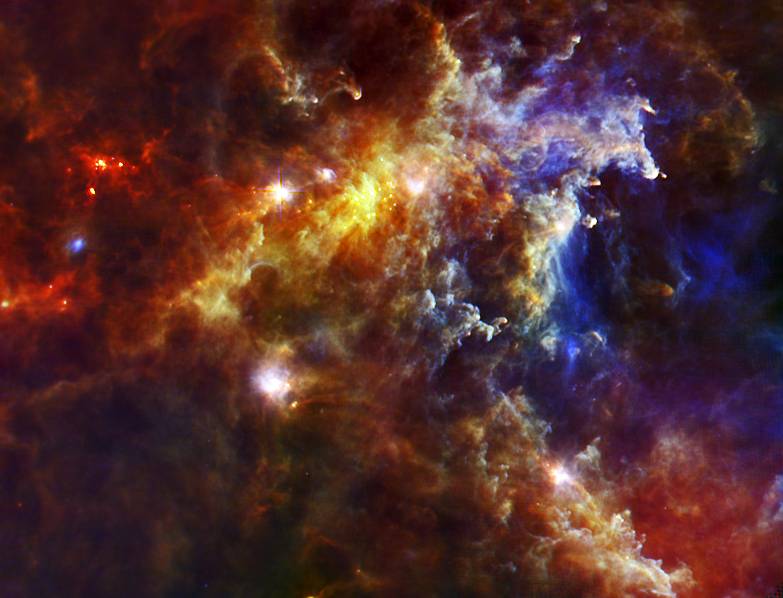
Infrared image of the Rosette molecular cloud. Herschel collects the infrared light given out by dust and this image is a three-colour composite made of wavelengths at 70 microns (blue), 160 microns (green) and 250 microns (red). It was made with observations from Herschel’s Photoconductor Array Camera and Spectrometer (PACS) and the Spectral and Photometric Imaging Receiver (SPIRE). The bright smudges are dusty cocoons containing massive protostars. The small spots near the centre of the image are lower mass protostars. Credits: ESA/PACS & SPIRE Consortium/HOBYS Key Programme Consortia

HI-RES JPEG (Size: 555 kb) - HI-RES TIFF (Size: 2779 kb)

Herschel’s latest image reveals the formation of previously unseen large stars, each one up to ten times the mass of our Sun. These are the stars that will influence where and how the next generation of stars are formed. The image is a new release of ‘OSHI’, ESA’s Online Showcase of Herschel Images.

The Rosette Nebula resides some 5,000 light years from Earth and is associated with a larger cloud that contains enough dust and gas to make the equivalent of 10,000 Sun-like stars. The Herschel image shows half of the nebula and most of the Rosette cloud. The massive stars powering the nebula lie to the right of the image but are invisible at these wavelengths. Each colour represents a different temperature of dust, from –263ºC (only 10ºC above absolute zero) in the red emission to –233ºC in the blue.

The bright smudges are dusty cocoons hiding massive protostars. These will eventually become stars containing around ten times the mass of the Sun. The small spots near the centre and in the redder regions of the image are lower mass protostars, similar in mass to the Sun.

ESA’s Herschel space observatory collects the infrared light given out by dust. This image is a combination of three infrared wavelengths, colour-coded blue, green and red in the image, though in reality the wavelengths are invisible to our eyes. It was created using observations from Herschel’s Photoconductor Array Camera and Spectrometer (PACS) and the Spectral and Photometric Imaging Receiver (SPIRE).

Herschel is showing astronomers such young, massive protostars for the first time, as part of the ‘Herschel imaging survey of OB Young Stellar objects’. Known as HOBYS, the survey targets young OB class stars, which will become the hottest and brightest stars.

“High-mass star-forming regions are rare and further away than low-mass ones,” says Frédérique Motte, Laboratoire AIM Paris-Saclay, France. So astronomers have had to wait for a space telescope like Herschel to reveal them.

It is important to understand the formation of high-mass stars in our Galaxy because they feed so much light and other forms of energy into their parent cloud they can often trigger the formation of the next generation of stars.

When astronomers look at distant galaxies, the star-forming regions they see are the bright, massive ones. Thus, if they want to compare our Galaxy to distant ones they must first understand high-mass star-formation here.

“Herschel will look at many other high-mass star-forming regions, some of them building stars up to a hundred times the mass of the Sun,” says Dr Motte, who plans to present the first scientific results from HOBYS at ESA’s annual ESLAB symposium to be held in the Netherlands, 4–7 May.