Showing posts with label NGC 2100. Show all posts

Wednesday, May 30, 2018

A Crowded Neighbourhood

The rich region around the Tarantula Nebula in the Large Magellanic Cloud

Tarantula Nebula region in the constellation of Doradus

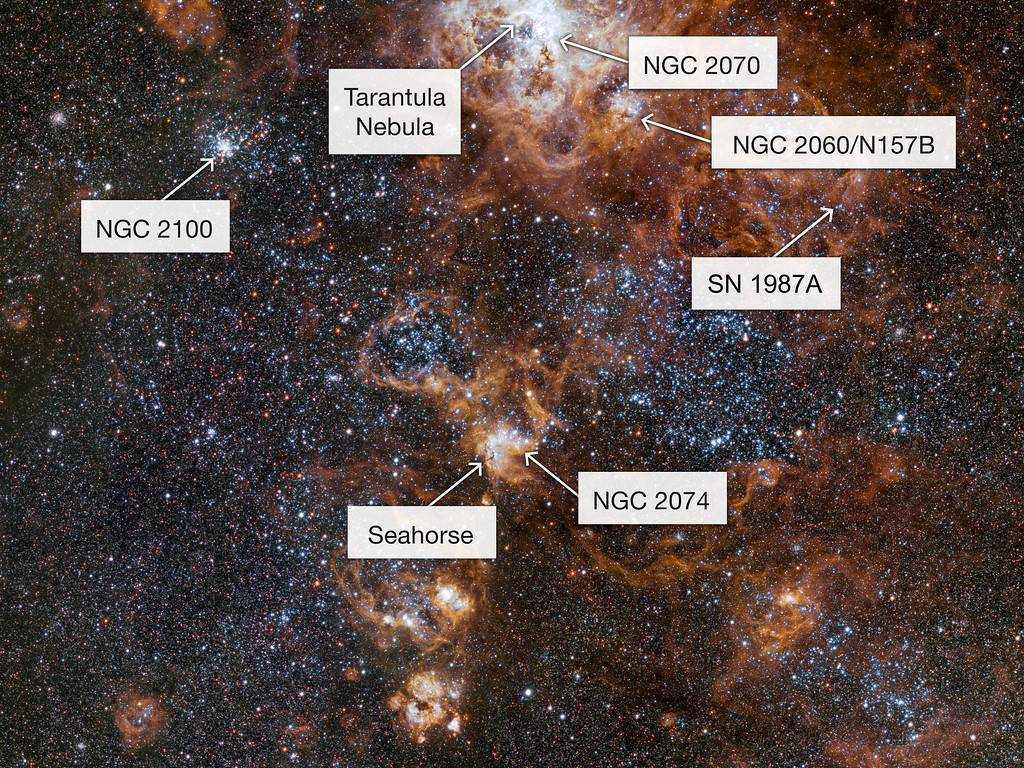
The rich region around the Tarantula Nebula in the Large Magellanic Cloud (annotated)


Videos
ESOcast 162 Light: A Crowded Neighbourhood (4K UHD)

Zooming in on the Tarantula Nebula


Glowing brightly about 160 000 light-years away, the Tarantula Nebula is the most spectacular feature of the Large Magellanic Cloud, a satellite galaxy to our Milky Way. The VLT Survey Telescope at ESO’s Paranal Observatory in Chile has imaged this region and its rich surroundings in exquisite detail. It reveals a cosmic landscape of star clusters, glowing gas clouds and the scattered remains of supernova explosions. This is the sharpest image ever of this entire field.

Taking advantage of the capacities of the VLT Survey Telescope (VST) at ESO’s Paranal Observatory in Chile, astronomers captured this very detailed new image of the Tarantula Nebula and its numerous neighbouring nebulae and star clusters. The Tarantula, which is also known as 30 Doradus, is the brightest and most energetic star-forming region in the Local Group of galaxies.

The Tarantula Nebula, at the top of this image, spans more than 1000 light-years and is located in the constellation of Dorado (The Dolphinfish) in the far southern sky. This stunning nebula is part of the Large Magellanic Cloud, a dwarf galaxy that measures about 14 000 light-years across. The Large Magellanic Cloud is one of the closest galaxies to the Milky Way.

At the core of the Tarantula Nebula lies a young, giant star cluster called NGC 2070, a starburst region whose dense core, R136, contains some of the most massive and luminous stars known. The bright glow of the Tarantula Nebula itself was first recorded by French astronomer Nicolas-Louis de Lacaille in 1751.

Another star cluster in the Tarantula Nebula is the much older Hodge 301, in which at least 40 stars are estimated to have exploded as supernovae, spreading gas throughout the region. One example of a supernova remnant is the superbubble SNR N157B, which encloses the open star cluster NGC 2060. This cluster was first observed by British astronomer John Herschel in 1836, using an 18.6-inch reflector telescope at the Cape of Good Hope in South Africa. On the outskirts of the Tarantula Nebula, on the lower right-hand side, it is possible to identify the location of the famous supernova SN 1987A [1].

Moving to the left-hand side of the Tarantula Nebula, one can see a bright open star cluster called NGC 2100, which displays a brilliant concentration of blue stars surrounded by red stars. This cluster was discovered by Scottish astronomer James Dunlop in 1826 while working in Australia, using his self-built 9-inch (23-cm) reflecting telescope.

At the centre of the image is the star cluster and emission nebula NGC 2074, another massive star-forming region discovered by John Herschel. Taking a closer look one can spot a dark seahorse-shaped dust structure — the “Seahorse of the Large Magellanic Cloud”. This is a gigantic pillar structure roughly 20 light-years long — almost five times the distance between the Sun and the nearest star, Alpha Centauri. The structure is condemned to disappear over the next million years; as more stars in the cluster form, their light and winds will slowly blow away the dust pillars.

Obtaining this image was only possible thanks to the VST’s specially designed 256-megapixel camera called OmegaCAM. The image was created from OmegaCAM images through four different coloured filters, including one designed to isolate the red glow of ionised hydrogen [2].


Notes

[1] SN 1987A was the first supernova to be observed with modern telescopes and the brightest since Kepler’s Star in 1604. SN 1987A was so intense that it blazed with the power of 100 million suns for several months following its discovery on 23 February 1987.

[2] The H-alpha emission line is a red spectral line created when the electron inside a hydrogen atom loses energy. This happens in hydrogen around hot young stars when the gas becomes ionised by the intense ultraviolet radiation and electrons subsequently recombine with protons to form atoms again. The ability of OmegaCAM to detect this line allows astronomers to characterise the physics of giant molecular clouds where new stars and planets form.


More Information

ESO is the foremost intergovernmental astronomy organisation in Europe and the world’s most productive ground-based astronomical observatory by far. It has 15 Member States: Austria, Belgium, the Czech Republic, Denmark, France, Finland, Germany, Italy, the Netherlands, Poland, Portugal, Spain, Sweden, Switzerland and the United Kingdom, along with the host state of Chile and with Australia as a strategic partner. ESO carries out an ambitious programme focused on the design, construction and operation of powerful ground-based observing facilities enabling astronomers to make important scientific discoveries. ESO also plays a leading role in promoting and organising cooperation in astronomical research. ESO operates three unique world-class observing sites in Chile: La Silla, Paranal and Chajnantor. At Paranal, ESO operates the Very Large Telescope and its world-leading Very Large Telescope Interferometer as well as two survey telescopes, VISTA working in the infrared and the visible-light VLT Survey Telescope. ESO is also a major partner in two facilities on Chajnantor, APEX and ALMA, the largest astronomical project in existence. And on Cerro Armazones, close to Paranal, ESO is building the 39-metre Extremely Large Telescope, the ELT, which will become “the world’s biggest eye on the sky”.


Links


Contacts


Richard Hook
ESO Public Information Officer
Garching bei München, Germany
Tel: +49 89 3200 6655
Cell: +49 151 1537 3591
Email:
rhook@eso.org


Source: ESO/News

Wednesday, September 07, 2011

Young Stars Take a Turn in the Spotlight

The star cluster NGC 2100 in the Large Magellanic Cloud

PR Image eso1133b
The star cluster NGC 2100 in the constellation of Dorado

PR Image eso1133c
The star cluster NGC 2100 in context

PR Video eso1133a
Zooming in on the star cluster NGC 2100 in the Large Magellanic Cloud

ESO’s New Technology Telescope (NTT) has captured a striking image of the open cluster NGC 2100. This brilliant star cluster is around 15 million years old, and located in the Large Magellanic Cloud, a nearby satellite galaxy of the Milky Way. The cluster is surrounded by glowing gas from the nearby Tarantula Nebula.

Observers often overlook NGC 2100 because of its close proximity to the impressive Tarantula Nebula (eso0650) and the super star cluster RMC 136 (eso1030). The glowing gas of the Tarantula Nebula even tries to steal the limelight in this image — the bright colours here are the nebula’s outskirts. This new picture was created from exposures through several different colour filters using the EMMI instrument [1] on the New Technology Telescope at ESO’s La Silla Observatory in Chile. The stars are shown in their natural colours, while light from glowing ionised hydrogen (shown here in red) and oxygen (shown in blue) is overlaid.

The colours that appear in nebulae depend on the temperatures of the stars lighting them up. The hot young stars in the Tarantula Nebula, which lie in the super star cluster RMC 136, are above and to the right of this image, and are powerful enough to cause oxygen to glow [2] showing up as blue nebulosity in this picture. Below NGC 2100 the red glow indicates either that the outer reaches of the influence of the hot stars of RMC 136 has been reached, or that cooler, and older, stars, that are only able to excite hydrogen are the dominant influence in this region. The stars that make up NGC 2100 are older and less energetic, and hence have little or no nebulosity associated with them.

Star clusters are groups of stars that formed around the same time from a single cloud of gas and dust. The stars with the most mass tend to form in the centre of the cluster, while those with less mass dominate the outer regions. This, along with the greater number of stars concentrated in the centre, makes the middle of the cluster brighter than the outer regions.

NGC 2100 is an open cluster, which means its stars are relatively loosely bound by gravity. These clusters have a lifespan measured in tens or hundreds of millions of years, as they eventually disperse through gravitational interaction with other bodies. Globular clusters, which look similar to the untrained eye, contain many more older stars and are much more tightly bound, and so have far longer lifespans: many globular clusters have been measured to be almost as old as the Universe itself. So while NGC 2100 might be older than its neighbours in the Large Magellanic Cloud, it is still a youngster by the standards of star clusters.

Data for this image of the under-appreciated young cluster were selected from the depths of ESO’s data archives by Hidden Treasures entrant David Roma as part of the astrophotography competition held by ESO in 2010 [3].

Notes

[1] EMMI stands for ESO Multi Mode Instrument. It is both a camera for imaging and a spectrograph.

[2] Most of the glow from oxygen comes from oxygen atoms that have lost two electrons. This strong emission is very common in nebulae but was mysterious to early astronomical spectroscopists and was initially thought to be coming from a new element given the name Nebulium.

[3] ESO’s Hidden Treasures 2010 competition gave amateur astronomers the opportunity to search through ESO’s vast archives of astronomical data, hoping to find a well-hidden gem that needed polishing by the entrants. To find out more about Hidden Treasures, visit http://www.eso.org/public/outreach/hiddentreasures/.

More information

ESO, the European Southern Observatory, is the foremost intergovernmental astronomy organisation in Europe and the world’s most productive astronomical observatory. It is supported by 15 countries: Austria, Belgium, Brazil, the Czech Republic, Denmark, France, Finland, Germany, Italy, the Netherlands, Portugal, Spain, Sweden, Switzerland and the United Kingdom. ESO carries out an ambitious programme focused on the design, construction and operation of powerful ground-based observing facilities enabling astronomers to make important scientific discoveries. ESO also plays a leading role in promoting and organising cooperation in astronomical research. ESO operates three unique world-class observing sites in Chile: La Silla, Paranal and Chajnantor. At Paranal, ESO operates the Very Large Telescope, the world’s most advanced visible-light astronomical observatory and two survey telescopes. VISTA works in the infrared and is the world’s largest survey telescope and the VLT Survey Telescope is the largest telescope designed to exclusively survey the skies in visible light. ESO is the European partner of a revolutionary astronomical telescope ALMA, the largest astronomical project in existence. ESO is currently planning a 40-metre-class European Extremely Large optical/near-infrared Telescope, the E-ELT, which will become “the world’s biggest eye on the sky”.

Links
Photos of the NTT and La Silla Observatory
David Roma’s Hidden Treasures image

Contacts

Richard Hook
ESO, La Silla, Paranal, E-ELT and Survey Telescopes Public Information Officer
Garching bei München, Germany
Tel: +49 89 3200 6655
Cell: +49 151 1537 3591
Email: rhook@eso.org