Wide-field image of the Spiderweb galaxy (ground-based image)
Videos


Artist’s impression of a protocluster forming in the early Universe
Using the Atacama Large
Millimeter/submillimeter Array (ALMA), of which ESO is a partner,
astronomers have discovered a large reservoir of hot gas in the
still-forming galaxy cluster around the Spiderweb galaxy — the most
distant detection of such hot gas yet. Galaxy clusters are some of the
largest objects known in the Universe and this result, published today
in Nature, further reveals just how early these structures begin to
form.
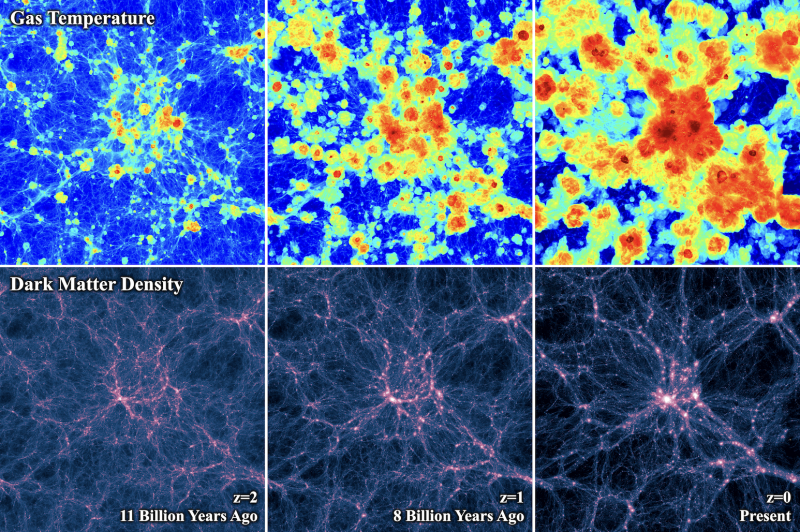
Galaxy clusters, as the name suggests, host a large number of galaxies — sometimes even thousands. They also contain a vast “intracluster medium” (ICM) of gas that permeates the space between the galaxies in the cluster. This gas in fact considerably outweighs the galaxies themselves. Much of the physics of galaxy clusters is well understood; however, observations of the earliest phases of formation of the ICM remain scarce.
Previously, the ICM had only been studied in fully-formed nearby galaxy clusters. Detecting the ICM in distant protoclusters — that is, still-forming galaxy clusters – would allow astronomers to catch these clusters in the early stages of formation. A team led by Luca Di Mascolo, first author of the study and researcher at the University of Trieste, Italy, were keen to detect the ICM in a protocluster from the early stages of the Universe.
Galaxy clusters are so massive that they can bring together gas that heats up as it falls towards the cluster. “Cosmological simulations have predicted the presence of hot gas in protoclusters for over a decade, but observational confirmations has been missing,” explains Elena Rasia, researcher at the Italian National Institute for Astrophysics (INAF) in Trieste, Italy, and co-author of the study. “Pursuing such key observational confirmation led us to carefully select one of the most promising candidate protoclusters.”
That was the Spiderweb protocluster, located at an epoch when the Universe was only 3 billion years old. Despite being the most intensively studied protocluster, the presence of the ICM has remained elusive. Finding a large reservoir of hot gas in the Spiderweb protocluster would indicate that the system is on its way to becoming a proper, long-lasting galaxy cluster rather than dispersing.
Di Mascolo’s team detected the ICM of the Spiderweb protocluster through what’s known as the thermal Sunyaev-Zeldovich (SZ) effect. This effect happens when light from the cosmic microwave background — the relic radiation from the Big Bang — passes through the ICM. When this light interacts with the fast-moving electrons in the hot gas it gains a bit of energy and its colour, or wavelength, changes slightly. “At the right wavelengths, the SZ effect thus appears as a shadowing effect of a galaxy cluster on the cosmic microwave background,” explains Di Mascolo.
By measuring these shadows on the cosmic microwave background, astronomers can therefore infer the existence of the hot gas, estimate its mass and map its shape. “Thanks to its unparalleled resolution and sensitivity, ALMA is the only facility currently capable of performing such a measurement for the distant progenitors of massive clusters,” says Di Mascolo.
They determined that the Spiderweb protocluster contains a vast reservoir of hot gas at a temperature of a few tens of millions of degrees Celsius. Previously, cold gas had been detected in this protocluster, but the mass of the hot gas found in this new study outweighs it by thousands of times. This finding shows that the Spiderweb protocluster is indeed expected to turn into a massive galaxy cluster in around 10 billion years, growing its mass by at least a factor of ten.
Tony Mroczkowski, co-author of the paper and researcher at ESO, explains that “this system exhibits huge contrasts. The hot thermal component will destroy much of the cold component as the system evolves, and we are witnessing a delicate transition." He concludes that "it provides observational confirmation of long-standing theoretical predictions about the formation of the largest gravitationally bound objects in the Universe.”
These results help to set the groundwork for synergies between ALMA and ESO’s upcoming Extremely Large Telescope (ELT), which “will revolutionise the study of structures like the Spiderweb,” says Mario Nonino, a co-author of the study and researcher at the Astronomical Observatory of Trieste. The ELT and its state-of-the-art instruments, such as HARMONI and MICADO, will be able to peer into protoclusters and tell us about the galaxies in them in great detail. Together with ALMA’s capabilities to trace the forming ICM, this will provide a crucial glimpse into the assembly of some of the largest structures in the early Universe.
Galaxy clusters, as the name suggests, host a large number of galaxies — sometimes even thousands. They also contain a vast “intracluster medium” (ICM) of gas that permeates the space between the galaxies in the cluster. This gas in fact considerably outweighs the galaxies themselves. Much of the physics of galaxy clusters is well understood; however, observations of the earliest phases of formation of the ICM remain scarce.
Previously, the ICM had only been studied in fully-formed nearby galaxy clusters. Detecting the ICM in distant protoclusters — that is, still-forming galaxy clusters – would allow astronomers to catch these clusters in the early stages of formation. A team led by Luca Di Mascolo, first author of the study and researcher at the University of Trieste, Italy, were keen to detect the ICM in a protocluster from the early stages of the Universe.
Galaxy clusters are so massive that they can bring together gas that heats up as it falls towards the cluster. “Cosmological simulations have predicted the presence of hot gas in protoclusters for over a decade, but observational confirmations has been missing,” explains Elena Rasia, researcher at the Italian National Institute for Astrophysics (INAF) in Trieste, Italy, and co-author of the study. “Pursuing such key observational confirmation led us to carefully select one of the most promising candidate protoclusters.”
That was the Spiderweb protocluster, located at an epoch when the Universe was only 3 billion years old. Despite being the most intensively studied protocluster, the presence of the ICM has remained elusive. Finding a large reservoir of hot gas in the Spiderweb protocluster would indicate that the system is on its way to becoming a proper, long-lasting galaxy cluster rather than dispersing.
Di Mascolo’s team detected the ICM of the Spiderweb protocluster through what’s known as the thermal Sunyaev-Zeldovich (SZ) effect. This effect happens when light from the cosmic microwave background — the relic radiation from the Big Bang — passes through the ICM. When this light interacts with the fast-moving electrons in the hot gas it gains a bit of energy and its colour, or wavelength, changes slightly. “At the right wavelengths, the SZ effect thus appears as a shadowing effect of a galaxy cluster on the cosmic microwave background,” explains Di Mascolo.
By measuring these shadows on the cosmic microwave background, astronomers can therefore infer the existence of the hot gas, estimate its mass and map its shape. “Thanks to its unparalleled resolution and sensitivity, ALMA is the only facility currently capable of performing such a measurement for the distant progenitors of massive clusters,” says Di Mascolo.
They determined that the Spiderweb protocluster contains a vast reservoir of hot gas at a temperature of a few tens of millions of degrees Celsius. Previously, cold gas had been detected in this protocluster, but the mass of the hot gas found in this new study outweighs it by thousands of times. This finding shows that the Spiderweb protocluster is indeed expected to turn into a massive galaxy cluster in around 10 billion years, growing its mass by at least a factor of ten.
Tony Mroczkowski, co-author of the paper and researcher at ESO, explains that “this system exhibits huge contrasts. The hot thermal component will destroy much of the cold component as the system evolves, and we are witnessing a delicate transition." He concludes that "it provides observational confirmation of long-standing theoretical predictions about the formation of the largest gravitationally bound objects in the Universe.”
These results help to set the groundwork for synergies between ALMA and ESO’s upcoming Extremely Large Telescope (ELT), which “will revolutionise the study of structures like the Spiderweb,” says Mario Nonino, a co-author of the study and researcher at the Astronomical Observatory of Trieste. The ELT and its state-of-the-art instruments, such as HARMONI and MICADO, will be able to peer into protoclusters and tell us about the galaxies in them in great detail. Together with ALMA’s capabilities to trace the forming ICM, this will provide a crucial glimpse into the assembly of some of the largest structures in the early Universe.
More Information
This research was presented in the paper “Forming intracluster gas in a galaxy protocluster at a redshift of 2.16” to appear in Nature (doi: 10.1038/s41586-023-05761-x)
The team is composed of Luca Di Mascolo (Astronomy Unit, University of Trieste, Italy [UT]; INAF – Osservatorio Astrofisico di Trieste, Italy [INAF Trieste]; IFPU – Institute for Fundamental Physics of the Universe, Italy [IFPU]), Alexandro Saro (UT; INAF Trieste; IFPU; INFN – Sezione di Trieste, Italy [INFN]), Tony Mroczkowski (European Southern Observatory, Germany [ESO]), Stefano Borgani (UT; INAF Trieste; IFPU; INFN), Eugene Churazov (Max-Planck-Institute für Astrophysik, Germany; Space Research Institute, Russia), Elena Rasia (INAF Trieste; IFPU), Paolo Tozzi (INAF – Osservatorio Astrofisico di Arcetri, Italy), Helmut Dannerbauer (Instituto de Astrofísica de Canarias, Spain; Universidad de La Laguna, Spain), Kaustuv Basu (Argel ander Institute for Astronomy, University of Bonn, Germany), Christopher L. Carilli (National Radio Astronomy Observatory, USA), Michele Ginolfi (ESO; Dipartimento di Fisica e Astronomia, University of Florence, Italy), George Miley (Leiden Observatory, Leiden University, Netherlands), Mario Nonino (UT), Maurilio Pannella (UT; INAF Trieste; IFPU), Laura Pentericci (INAF – Osservatorio Astronomico di Roma, Italy), Francesca Rizzo (Cosmic Dawn Center, Denmark; Niels Bohr Institute, Denmark)
The Atacama Large Millimeter/submillimeter Array (ALMA), an international astronomy facility, is a partnership of ESO, the U.S. National Science Foundation (NSF) and the National Institutes of Natural Sciences (NINS) of Japan in cooperation with the Republic of Chile. ALMA is funded by ESO on behalf of its Member States, by NSF in cooperation with the National Research Council of Canada (NRC) and the National Science and Technology Council (NSTC) in Taiwan and by NINS in cooperation with the Academia Sinica (AS) in Taiwan and the Korea Astronomy and Space Science Institute (KASI). ALMA construction and operations are led by ESO on behalf of its Member States; by the National Radio Astronomy Observatory (NRAO), managed by Associated Universities, Inc. (AUI), on behalf of North America; and by the National Astronomical Observatory of Japan (NAOJ) on behalf of East Asia. The Joint ALMA Observatory (JAO) provides the unified leadership and management of the construction, commissioning and operation of ALMA.
The team is composed of Luca Di Mascolo (Astronomy Unit, University of Trieste, Italy [UT]; INAF – Osservatorio Astrofisico di Trieste, Italy [INAF Trieste]; IFPU – Institute for Fundamental Physics of the Universe, Italy [IFPU]), Alexandro Saro (UT; INAF Trieste; IFPU; INFN – Sezione di Trieste, Italy [INFN]), Tony Mroczkowski (European Southern Observatory, Germany [ESO]), Stefano Borgani (UT; INAF Trieste; IFPU; INFN), Eugene Churazov (Max-Planck-Institute für Astrophysik, Germany; Space Research Institute, Russia), Elena Rasia (INAF Trieste; IFPU), Paolo Tozzi (INAF – Osservatorio Astrofisico di Arcetri, Italy), Helmut Dannerbauer (Instituto de Astrofísica de Canarias, Spain; Universidad de La Laguna, Spain), Kaustuv Basu (Argel ander Institute for Astronomy, University of Bonn, Germany), Christopher L. Carilli (National Radio Astronomy Observatory, USA), Michele Ginolfi (ESO; Dipartimento di Fisica e Astronomia, University of Florence, Italy), George Miley (Leiden Observatory, Leiden University, Netherlands), Mario Nonino (UT), Maurilio Pannella (UT; INAF Trieste; IFPU), Laura Pentericci (INAF – Osservatorio Astronomico di Roma, Italy), Francesca Rizzo (Cosmic Dawn Center, Denmark; Niels Bohr Institute, Denmark)
The Atacama Large Millimeter/submillimeter Array (ALMA), an international astronomy facility, is a partnership of ESO, the U.S. National Science Foundation (NSF) and the National Institutes of Natural Sciences (NINS) of Japan in cooperation with the Republic of Chile. ALMA is funded by ESO on behalf of its Member States, by NSF in cooperation with the National Research Council of Canada (NRC) and the National Science and Technology Council (NSTC) in Taiwan and by NINS in cooperation with the Academia Sinica (AS) in Taiwan and the Korea Astronomy and Space Science Institute (KASI). ALMA construction and operations are led by ESO on behalf of its Member States; by the National Radio Astronomy Observatory (NRAO), managed by Associated Universities, Inc. (AUI), on behalf of North America; and by the National Astronomical Observatory of Japan (NAOJ) on behalf of East Asia. The Joint ALMA Observatory (JAO) provides the unified leadership and management of the construction, commissioning and operation of ALMA.
Links