Showing posts with label Kavli Institute for Cosmology. Show all posts

Tuesday, February 25, 2020

LIGO-Virgo Network Catches Another Neutron Star Collision

GW190425 : Artist's impression of the binary neutron star merger observed by LIGO Livingston on April 25, 2019. Image credit: National Science FounGW190425 : Artist's impression of the binary neutron star merger observed by LIGO Livingston on April 25, 2019. Image credit: National Science Foundation/LIGO/Sonoma State University/A. Simonnet. dation/LIGO/Sonoma State University/A. Simonnet.

On April 25, 2019, the LIGO Livingston Observatory picked up what appeared to be gravitational ripples from a collision of two neutron stars. LIGO Livingston is part of a gravitational-wave network that includes LIGO (the Laser Interferometer Gravitational-wave Observatory), funded by the National Science Foundation (NSF), and the European Virgo detector. Now, a new study confirms that this event was indeed likely the result of a merger of two neutron stars. This would be only the second time this type of event has ever been observed in gravitational waves.

The first such observation, which took place in August of 2017, made history as the first joint observation of the same cosmic event in both gravitational waves and light. The April 25 merger, by contrast, did not result in any light being detected. However, through an analysis of the gravitational-wave data alone, researchers have learned that the objects involved in this collision were unusually massive given the expectations for neutron star binaries.

"From conventional observations with light, we already knew of 17 binary neutron star systems in our own galaxy and we have estimated the masses of these stars", says Ben Farr, a LIGO team member based at the University of Oregon. "What's surprising is that the combined mass of this binary is much higher than what was expected."

"We have detected a second event consistent with a binary neutron star system and this is an important confirmation of the August 2017 event that marked an exciting new beginning for multi-messenger astronomy two years ago", says Jo van den Brand, Virgo Spokesperson and professor at Maastricht University, and Nikhef and VU University Amsterdam in the Netherlands. Multi-messenger astronomy occurs when different types of signals are witnessed simultaneously, such as those based on gravitational waves and light.

The study, accepted for publication in The Astrophysical Journal Letters, is authored by an international team comprised of the LIGO Scientific Collaboration and the Virgo Collaboration, the latter of which is associated with the Virgo gravitational-wave detector in Italy.

Neutron stars are the remnants of dying stars that undergo catastrophic explosions as they collapse at the end of their lives. When two neutron stars spiral together, they undergo a violent merger that sends gravitational shudders through the fabric of space and time.

LIGO became the first observatory to directly detect gravitational waves in 2015; in that instance, the waves were generated by the violent collision of two black holes. Since then, LIGO and Virgo have registered dozens of additional candidate black hole mergers.

“Just as the first gravitational wave detection revealed a binary of unexpectedly massive black holes, this detection again reveals an unexpected member of the ‘cosmological ecosystem’ ”, says Nathan Johnson-McDaniel from the Department of Applied Mathematics and Theoretical Physics (DAMTP) at the University of Cambridge. “It is yet another illustration of the great discovery potential of gravitational wave observations.”


GW190425 FactSheet

The April 2019 event was first identified in data from the LIGO Livingston detector alone. The LIGO Hanford detector was temporarily offline at the time, and, at a distance of more than 500 million light-years, the event was extremely faint in Virgo's data. Using the Livingston data, combined with information derived from Virgo’s data, the team narrowed the location of the event to a patch of sky more than 8,200 square degrees in size, or about 20 percent of the sky. For comparison, the August 2017 event was narrowed to a region of just 16 square degrees, or 0.04 percent of the sky.

“But what was the fate of this merger, what type of remnant did it leave behind?”, wonders Michalis Agathos, researcher at DAMTP and the Kavli Institute for Cosmology in Cambridge. “To answer this we can make use of information on the properties of neutron-star matter, that we had gained from the first event back in 2017. And we infer that the binary of this second event seems to be massive enough to immediately collapse upon merger, forming a black hole. Hence we should not expect a strong electromagnetic afterglow.”

The LIGO data reveal that the combined mass of the merged bodies is about 3.4 times the mass of our Sun. In our galaxy, known binary neutron star systems have combined masses up to only 2.9 times that of the Sun. One possibility for the unusually high mass is that the collision took place not between two neutron stars, but a neutron star and a black hole (black holes can be heavier than neutron stars). In this case, however, the black hole would be too light to match astrophysical observations and theoretical expectations. Therefore, the scientists believe it is much more likely that LIGO witnessed a merger of two neutron stars.

“When you look at the black holes and neutron stars observed so far, however, there is a gap in their mass distributions”, says Ulrich Sperhake head of the Cambridge LIGO group at DAMTP. “You have the black holes on the heavy end, the neutron stars on the light end and seemingly no objects in between with about 2.5 to 5 solar masses. This detection may give us the first clues whether and how this gap is filled.”

“This second event was consistent with matter properties extracted from the first binary neutron star observation, GW170817, but was not as loud”, said Charalampos Markakis from the University of Cambridge. “Future events and detector upgrades will allow us to measure properties of matter at extreme densities, beyond the reach of terrestrial laboratories, expanding our understanding of high-energy physics.”

Neutron star pairs are thought to form in two possible ways. They might form from binary systems of massive stars that each end their lives as neutron stars, or they might arise when two separately formed neutron stars come together within a dense stellar environment. The LIGO data for the April 25 event do not indicate which of these scenarios is more likely, but they do suggest that more data and new models are needed to explain the merger’s unexpectedly high mass.


Additional information about the gravitational-wave observatories:

LIGO is funded by the NSF and operated by Caltech and MIT, which conceived of LIGO and lead the project. Financial support for the Advanced LIGO project was led by the NSF with Germany (Max Planck Society), the U.K. (Science and Technology Facilities Council) and Australia (Australian Research Council-OzGrav) making significant commitments and contributions to the project. Approximately 1,300 scientists from around the world participate in the effort through the LIGO Scientific Collaboration, which includes the GEO Collaboration. A list of additional partners is available at https://my.ligo.org/census.php.

The Virgo Collaboration is currently composed of approximately 520 members from 99 institutes in 11 different countries including Belgium, France, Germany, Hungary, Italy, the Netherlands, Poland, and Spain. The European Gravitational Observatory (EGO) hosts the Virgo detector near Pisa in Italy, and is funded by Centre National de la Recherche Scientifique (CNRS) in France, the Istituto Nazionale di Fisica Nucleare (INFN) in Italy, and Nikhef in the Netherlands. A list of the Virgo Collaboration groups can be found at http://public.virgo-gw.eu/the-virgo-collaboration/. More information is available on the Virgo website at http://www.virgo-gw.eu.


Wednesday, December 18, 2019

The Detection of a Molecular Outflow in a Primeval Starburst Galaxy

Figure 1: Absorption profile of the two water transitions observed towards the far-infrared continuum emission of the distant starburst galaxy (SPT 0346-52).

Figure 2. Molecular outflow rate (Ṁ) as a function of star formation rate (SFR) for galaxies with detected molecular outflows. Outflows driven by AGNs are shown by diamonds, while those driven by starbursts are shown by star symbols. Each object is coloured according to its redshift. The range and average of best-fit outflow rates of our object (SPT 0346-52) are shown. The molecular outflow detected in this work is in the most powerful starburst. Additional data include both low-redshift (z~1.5-5.3) sources. A representative uncertainty for all low-redshift sources (±0.3 dex) is shown for one such source.

Using the Atacama Large Millimeter/submillimeter Array, a team led by scientists from the Kavli Institute have observed two water absorption lines towards a starburst galaxy (i.e., forming stars at a rate ~4000x faster than the Milky Way) in the early Universe, or about one billion years after the Big Bang, finding evidence for outflowing gas (Figure 1).

The distinct shape of these blueshifted water lines, in addition to the extremely hot and dense environments required for their detection, indicates that they originate from a massive nuclear outflow.

When the outflow rate and star formation rate of this object are compared to those of local galaxies and other high-redshift objects (see Figure 2), it is apparent that the outflow detected here is at the highest redshift and originates from the object with the highest star formation rate. However, the outflow rate is much less than the star formation rate, suggesting that this outflow does not represent a dominant form of mass loss in this system. Thus, the galaxy is likely undergoing a period of runaway star formation.

This work was led by Gareth Jones, a postdoctoral research associate at the Kavli Institute and the results has been published in Astronomy & Astrophysics Letters:


Saturday, November 23, 2019

Gas content and quenching of local galaxies

Top panel: gas fraction (fgas) and bottom panel: star formation efficiency (SFE) plotted as functions of distance from the MS in four bins of total stellar mass. Each point corresponds to a median value with a bootstrapped error estimate. The grey shaded area covers the range in ∆SFMS with 10% completeness in each bin.

During galactic transition towards quiescence 'it is not only the gas reservoir of a galaxy which decreases but also the efficiency with which the gas is turned into stars' - suggests a new study led by KICC researchers.

Galaxies in the observable Universe divide into two broad categories: blue, star-forming and red, quiescent. When observed across cosmic, time the distribution of galaxies shifts from the star-formation dominated to passive (quiescent) and hence these two states are interpreted as an evolutionary sequence.

Understanding the physical processes responsible for ceasing star formation is one of the long-standing questions in the area of galaxy evolution. Ultimately, galaxies may quench either due to a lack of fuel or a decrease in star formation efficiency (i.e. an increase in thedepletion time). In order to differentiate between the two possibilities one needs to measure the dense neutral gas within galaxies. However, observing the faint gas emission typically requires long exposure times on premier facilities, thus limiting the sample sizes to only a few hundred detections.

In this work led by Joanna Piotrowska, a PhD student at the Kavli, the KICC researchers use an indirect method to obtain gas mass estimates for ~62 000 local galaxies in the Sloan Digital Sky Survey which allows them to investigate the variation of gas fraction and star formation efficiency of objects on their path towards quiescence. They show that as galaxies deviate from the star-forming Main Sequence (a tight relation between the galaxy stellar mass and star formation rate) it is not only the gas reservoir of a galaxy which decreases but also the efficiency with which the gas is turned into stars as shown in the figure at the above of the page.

These results call for a better understanding of the physical processes driving the decrease in star formation efficiency, which has received relatively little attention in the theory of quenching until now.

You can freely access the article at this link  or with a subscription in the MNRAS Letters here.


Monday, October 28, 2019

Scientists at the Kavli Institute have identified hot gas around the most luminous quasar at an epoch when the universe was less than 4 billion years old.

Left panel: Residual visibilities showing the signal present only on very large scales. This indicates the presence of very extended hot gas. Right panel: Map of the quasar field showing the detection of a negative SZ 'bowl' (on smaller scales) to the southwest of the quasar. Hi-res image

Scientists at the Kavli Institute have identified hot gas around a galaxy which hosts one of the most luminous quasars in the Universe, seen at an epoch when the Universe was less than 4 billion years old (a redshift of 1.7). Quasars are supermassive black holes which are accreting matter at a high rate.

Models of galaxy evolution invoke negative feedback from quasars onto their host galaxies to explain the so-called 'quenching' of star formation in galaxies, which turns blue, star forming galaxies into red, passive ones. In one such feedback scenario, it is thought that the black hole at the centre of the galaxy injects thermal energy into the galaxy’s halo, reducing the accretion of fresh gas into the galaxy and eventually suppressing star formation (due to a lack of gas available inside the galaxy to form stars).

The newly-detected hot gas is distributed on very large scales (hundreds of kilo-parsecs) and can be distinguished from the galaxy's normal emission using interferometers such as the Atacama Large Millimetre Array (ALMA) which are sensitive to a large range of spatial scales.

The hot gas has a low density and is therefore difficult to detect using standard techniques. A second approach, using the so-called Sunyaev-Zeldovich effect, looks for imprints in the Cosmic Microwave Background (CMB) caused by the hot gas. The team found indications of these imprints in the CMB around HE0515-4414, which is the most luminous quasar at redshift 1.7 (when the universe was less than 4 billion years old).

Refining the observational setup of ALMA in forthcoming observations will allow astronomers to probe the very extended hot gas with higher sensitivity. With these measurements, we will be able to carry out detailed tests of the effectiveness of halo heating in quenching star formation inside galaxies, and test different models of galaxy evolution.

This investigation was led by Simcha Brownson, a PhD student at the Kavli Institute, and the results were published in this week's issue of Monthly Notices of the Royal Astronomical Society - https://academic.oup.com/mnras/advance-article/doi/10.1093/mnras/stz2945/5602606?guestAccessKey=a3ceea43-506b-4eeb-84f8-6e30ed8fda4f or https://arxiv.org/abs/1910.02088


Friday, October 18, 2019

Stormy cluster weather could unleash black hole power and explain lack of cosmic cooling

Figure 1. The left hand panel shows an actual observation of the galaxy cluster MS 0735.6+7421, while on the right the background Hubble image has instead been overlaid with a mock observation of the jet (pink) and X-ray emission (blue) made from the simulation. Both images show cavities excavated by the lobe inflation surround by X-ray bright rims of dense gas (blue), which are filled by distorted jet material (pink). Image credit: Hubble and Chandra Image: NASA, ESA, CXC, STScI, and B. McNamara (University of Waterloo); Very Large Array Telescope Image: NRAO, and L. Birzan and team (Ohio University); Simulated Data: M. A. Bourne (University of Cambridge).

Figure 2. An artist’s impression of the jet launched by a supermassive black hole, which inflates lobes of very hot gas that are distorted by the cluster weather. Image credit: Institute of Astronomy, University of Cambridge.


“Weather” in clusters of galaxies may explain a longstanding puzzle, according to a team of researchers at the University of Cambridge. The scientists used sophisticated simulations to show how powerful jets from supermassive black holes are disrupted by the motion of hot gas and galaxies, preventing gas from cooling, which could otherwise form stars. The team publish their work in the journal Monthly Notices of the Royal Astronomical Society.

 Typical clusters of galaxies have several thousand member galaxies, which can be very different to our own Milky Way and vary in size and shape. These systems are embedded in very hot gas known as the intracluster medium (ICM), all of which live in an unseen halo of so-called ‘dark matter’.

A large number of galaxies have supermassive black holes in their centres, and these often have high speed jets of material stretching over thousands of light years that can inflate very hot lobes in the ICM.

 The researchers, based at the Kavli Institute for Cosmology and Institute of Astronomy performed state-of-the-art simulations looking at the jet lobes in fine detail and the X-rays emitted as a result. The model captures the birth and cosmological evolution of the galaxy cluster, and allowed the scientists to investigate with unprecedented realism how the jets and lobes they inflate interact with a dynamic ICM.

They found that the mock X-ray observations of the simulated cluster revealed the so-called “X-ray cavities” and “X-ray bright rims” generated by supermassive black hole-driven jets, which itself is distorted by motions in the cluster remarkably resemble those found in observations of real galaxy clusters.

 Dr Martin Bourne of the Institute of Astronomy in Cambridge led the team. He commented: “We have developed new computational techniques, which harness the latest high-performance computing technology, to model for the first time the jet lobes with more than a million elements in fully realistic clusters. This allows us to place the physical processes that drive the liberation of the jet energy under the microscope.”

 As galaxies move around in the cluster, the simulation shows they create a kind of ‘weather’, moving, deforming and destroying the hot lobes of gas found at the end of the black hole jets. The jet lobes are enormously powerful and if disrupted, deliver vast amounts of energy to the ICM.

The Cambridge team believe that this cluster weather disruption mechanism may solve an enduring problem: understanding why ICM gas does not cool and form stars in the cluster centre. This so-called “cooling flow” puzzle has plagued astrophysicists for more than 25 years.

 The simulations performed provide a tantalizing new solution that could solve this problem. Dr Bourne commented: “The combination of the huge energies pumped into the jet lobes by the supermassive black hole and the ability of cluster weather to disrupt the lobes and redistribute this energy to the ICM provides a simple and yet elegant mechanism to solve the cooling flow problem.”

A series of next generation X-ray space telescopes will launch into orbit over the next decade. These advanced instruments should help settle the debate – and if intergalactic weather really does stop the birth of stars.


Notes

The simulations have been performed on the STFC DiRAC HPC facilities which are part of the National e-Infrastructure. The research was funded by European Research Council, STFC and the Kavli Foundation. This work has been accepted by Monthly Notices of the Royal Astronomical Society: “AGN jet feedback on a moving mesh: lobe energetics and X-ray properties in a realistic cluster environment” by Martin A. Bourne, Debora Sijacki and Ewald Puchwein.


Science Contact

Dr Martin Bourne
Kavli Institute for Cosmology, Cambridge
Institute of Astronomy
Cambridge

Mob: +44 (0)7557380858
mabourne@ast.cam.ac.uk


Monday, October 14, 2019

A triple merger in the early Universe

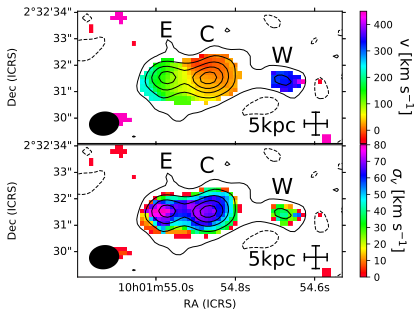
The total brightness (contours), velocity along our line of sight (colors of top panel), and speed of random motions (colors of bottom panel) of  DEIMOS COSMOS 818760.

As part of the multinational ALPINE collaboration, scientists at the Kavli Institute have discovered a system of three galaxies merging together when the universe was only 1.3 billion years old.

The ALPINE program (ALMA Large Program to INvestigate CII at Early times) is an extensive project using the Atacama Large Millimetre Array (ALMA) to look at the ionized carbon emission (tracing regions that are actively forming stars) from 118 galaxies as they were ~1-1.5 billion years after the Big Bang. One of the primary goals is to characterize the dynamics of each galaxy in the sample, including how many are merging with other galaxies and how many feature regular rotating disks.

One of the galaxies in this sample (named DEIMOS COSMOS 818760), features three clumps of emission. From the way the clumps are distributed, how they are moving, and by comparing them with simulations, they are interpreted as three galaxies that are merging together in the early Universe. The two brightest sources are close together and show signs of interaction, while the third source is slightly weaker and more distant. The discovery of such complex interactions between galaxies in the early Universe provides previous information for understanding the early formation of galaxies and of their subsequent evolution.

Only a handful of triple mergers have been detected in the early universe, and further analysis of the ALPINE data is sure to reveal more.

The investigation of this galaxy was led by Gareth Jones, a postdoctoral research associate at the Kavli Institute, and the results were published in this week's issue of Monthly Notices of the Royal Astronomical Society: Letters - https://academic.oup.com/mnrasl/advance-article-abstract/doi/10.1093/mnrasl/slz154/5582601. This is the very first paper published by the ALPINE collaboration and it is opening a sequel of several other papers that will be published in the coming months presenting various other important results that provide new important information on the primeval stages of galaxy evolution.

The ALPINE project is led by Olivier Le Févre.


Tuesday, April 16, 2019

Variations in the ‘fogginess’ of the universe identify a milestone in cosmic history

 
New study suggests that reionisation occurred 1.1 billion years after the big bang 
Credit: Kavli Institute for Cosmology
Hi-res image


Large differences in the ‘fogginess’ of the early universe were caused by islands of cold gas left behind when the universe heated up after the big bang, according to an international team of astronomers.

The results, reported in the Monthly Notices of the Royal Astronomical Society, have enabled astronomers to zero in on the time when reionisation ended and the universe emerged from a cold and dark state to become what it is today: full of hot and ionised hydrogen gas permeating the space between luminous galaxies.

Hydrogen gas dims light from distant galaxies much like streetlights are dimmed by fog on a winter morning. By observing this dimming in the spectra of a special type of bright galaxies, called quasars, astronomers can study conditions in the early universe.

“We expected the light from quasars to vary from place to place at most by factor of two at this time, but it is seen to vary by factor of about 500,” said lead author Girish Kulkarni, who completed the research while a postdoctoral researcher at the Kavli Institute, University of Cambridge. “Some hypotheses were put forward for why this is so, but none were satisfactory.”

The new study concludes that these variations result from large regions full of cold hydrogen gas present in the universe when it was just one billion years old, a result which enables researchers to pinpoint when reionisation ended.

During reionisation, when the universe transitioned out of the cosmic ‘dark ages’, the space between galaxies was filled with a plasma of ionised hydrogen with a temperature of about 10,000˚C. This is puzzling because fifty million years after the big bang, the universe was cold and dark. It contained gas with temperature only a few degrees above absolute zero, and no luminous stars and galaxies. How is it then that today, about 13.6 billion years later, the universe is bathed in light from stars in a variety of galaxies, and the gas is a thousand times hotter?

Answering this question has been an important goal of cosmological research over the last two decades. The conclusions of the new study suggests that reionisation occurred 1.1 billion years after the big bang (or 12.7 billion years ago), quite a bit later than previously thought.

The team of researchers from India, the UK, Canada, Germany, and France drew their conclusions with the help of state-of-the-art computer simulations performed on supercomputers based at the Universities of Cambridge, Durham, and Paris, funded by the UK Science and Technology Facilities Council (STFC) and the Partnership for Advanced Computing in Europe (PRACE).

“When the universe was 1.1 billion years old there were still large pockets of the cosmos where the gas between galaxies was still cold and it is these neutral islands of cold gas that explain the puzzling observations,” said Martin Haehnelt of the Kavli Institute, University of Cambridge, who led the group that conducted this research, supported by funding from the European Research Council (ERC).

“This finally allows us to pinpoint the end of reionisation much more accurately than before,” said Laura Keating of the Canadian Institute of Theoretical Astrophysics.

The new study suggests that the universe was reionised by light from young stars in the first galaxies to form.

“Late reionisation is also good news for future experiments that aim to detect the neutral hydrogen from the early universe,” said Kulkarni, who is now based at the Tata Institute of Fundamental Research in India. “The later the reionisation, the easier it will be for these experiments to succeed.”


Reference:

Girish Kulkarni et al. ‘Large Ly α opacity fluctuations and low CMB τ in models of late reionisation with large islands of neutral hydrogen extending to z < 5:5.’ Monthly Notices of the Royal  Astronomical Society (2019). DOI: 10.1093/mnrasl/slz025

Adapted from a press release by Girish Kulkarni (Tata Institute of Fundamental Research)