Monday, February 15, 2016

Planet Formation around Binary Star

A composite image of the HD 142527 binary star system from data captured by the Atacama Large Millimeter/submillimeter Array shows a distinctive arc of dust (red) and a ring of carbon monoxide (blue and green). The red arc is free of gas, suggesting the carbon monoxide has "frozen out," forming a layer of frost on the dust grains in that region. Astronomers speculate this frost provides a boost to planet formation. Credit: Andrea Isella/Rice University; B. Saxton (NRAO/AUI/NSF); ALMA (NRAO/ESO/NAOJ)

A composite image of the HD 142527 binary star system from data captured by the Atacama Large Millimeter/submillimeter Array shows a distinctive arc of dust (red) and a ring of carbon monoxide (blue and green). The red arc is free of gas, suggesting the carbon monoxide has "frozen out," forming a layer of frost on the dust grains in that region. Astronomers speculate this frost provides a boost to planet formation. The two dots in the center represent the two stars in the system. Credit: Andrea Isella/Rice University; B. Saxton (NRAO/AUI/NSF); ALMA (NRAO/ESO/NAOJ)

Artist impression of the HD 142527 binary star system based on data from the Atacama Large Millimeter/submillimeter Array (ALMA). The rendition shows a distinctive arc of dust (red) embedded in the protoplanetary disk. The red arc is free of gas, suggesting the carbon monoxide has "frozen out," forming a layer of frost on the dust grains in that region. Astronomers speculate this frost provides a boost to planet formation. The two dots in the center represent the two stars in the system. Credit: B. Saxton (NRAO/AUI/NSF)


ALMA reveals planet-forming potential of protoplanetary disk

Using ALMA, astronomers have taken a new, detailed look at the very early stages of planet formation around a binary star. Embedded in the outer reaches of a double star's protoplanetary disk, the researchers discovered a striking crescent-shape region of dust that is conspicuously devoid of gas. This result, presented at the AAAS meeting in Washington, D.C., provides fresh insights into the planet-forming potential of a binary system.

Astronomers struggle to understand how planets form in binary star systems. Early models suggested that the gravitational tug-of-war between two stellar bodies would send young planets into eccentric orbits, possibly ejecting them completely from their home system or sending them crashing into their stars. Observational evidence, however, reveals that planets do indeed form and maintain surprisingly stable orbits around double stars.

To better understand how such systems form and evolve, astronomers using the Atacama Large Millimeter/submillimeter Array (ALMA) took a new, detailed look at the planet-forming disk around HD 142527, a binary star about 450 light-years from Earth in a cluster of young stars known as the Scorpius-Centaurus Association.

The HD 142527 system includes a main star a little more than twice the mass of our Sun and a smaller companion star only about a third the mass of our Sun. They are separated by approximately one billion miles: a little more than the distance from the Sun to Saturn. Previous ALMA studies of this system revealed surprising details about the structure of the system's inner and outer disks.

"This binary system has long been known to harbor a planet-forming corona of dust and gas," said Andrea Isella, an astronomer at Rice University in Houston, Texas. "The new ALMA images reveal previously unseen details about the physical processes that regulate the formation of planets around this and perhaps many other binary systems."

Planets form out of the expansive disks of dust and gas that surround young stars. Small dust grains and pockets of gas come together under gravity, forming larger and larger agglomerations and eventually asteroids and planets. The fine points of this process are not well understood, however. By studying a wide range of protoplanetary disks with ALMA, astronomers hope to better understand the conditions that set the stage for planet formation across the Universe.

ALMA's new, high-resolution images of HD 142527 show a broad elliptical ring around the double star. The disk begins incredibly far from the central star -- about 50 times the Sun-Earth distance. Most of it consists of gases, including two forms of carbon monoxide (13CO and C180), but there is a noticeable dearth of these gases within a huge arc of dust that extends nearly a third of the way around the star system.

This crescent-shaped dust cloud may be the result of gravitational forces unique to binary stars and may also be the key to the formation of planets, Isella speculates. Its lack of free-floating gases is likely the result of them freezing out and forming a thin layer of ice on the dust grains.

"The temperature is so low that the gas turns into ice and sticks to the grains," Isella said. "This process is thought to increase the capacity for dust grains to stick together, making it a strong catalyst for the formation of planetesimals, and, down the line, of planets."

"We've been studying protoplanetary disks for at least 20 years," Isella said. "There are between a few hundred and a few thousand we can look at again with ALMA to find new and surprising details. That's the beauty of ALMA. Every time you get new data, it's like opening a present. You don't know what's inside."

HD 142527 will be the subject of an upcoming paper led by Rice postdoctoral fellow Yann Boehler, who is working in Isella’s group.

The National Radio Astronomy Observatory is a facility of the National Science Foundation, operated under cooperative agreement by Associated Universities, Inc.
 
Contact:

Charles Blue, NRAO Public Information Officer
(434) 296-0314; 
Email:  cblue@nrao.edu


Friday, February 12, 2016

Gravitational waves detected 100 years after Einstein’s prediction

The LIGO observatory has provided scientists with the first-ever direct detection of gravitational waves, ripples in the fabric of spacetime predicted in 1915 by physicist Albert Einstein. The waves originated from the merger of distant black holes, envisioned here in a computer simulation. Image: SXS


LIGO opens a new window on the universe with the observation of gravitational waves from colliding black holes


February 11, 2016 -  The following is adapted from a press release issued today by MIT and Caltech, which jointly operate the Laser Interferometer Gravitational-Wave Observatory (LIGO) with funding from the National Science Foundation.

For the first time, scientists have observed ripples in the fabric of spacetime called gravitational waves, arriving at the Earth from a cataclysmic event in the distant universe. This confirms a major prediction of Albert Einstein’s 1915 general theory of relativity and opens an unprecedented new window onto the cosmos.

Gravitational waves carry information about their dramatic origins and about the nature of gravity that cannot otherwise be obtained. Physicists have concluded that the detected gravitational waves were produced during the final fraction of a second of the merger of two black holes to produce a single, more massive spinning black hole. This collision of two black holes had been predicted but never observed.

The gravitational waves were detected on Sept. 14, 2015 at 5:51 a.m. Eastern Daylight Time (09:51 UTC) by both of the twin Laser Interferometer Gravitational-Wave Observatory (LIGO) detectors, located in Livingston, Louisiana, and Hanford, Washington, USA. The LIGO Observatories are funded by the National Science Foundation (NSF), and were conceived, built, and are operated by Caltech and MIT. The discovery, accepted for publication in the journal Physical Review Letters, was made by the LIGO Scientific Collaboration (which includes the GEO Collaboration and the Australian Consortium for Interferometric Gravitational Astronomy) and the Virgo Collaboration using data from the two LIGO detectors.

Based on the observed signals, LIGO scientists estimate that the black holes for this event were about 29 and 36 times the mass of the sun, and the event took place 1.3 billion years ago. About three times the mass of the sun was converted into gravitational waves in a fraction of a second — with a peak power output about 50 times that of the whole visible universe. By looking at the time of arrival of the signals — the detector in Livingston recorded the event 7 milliseconds before the detector in Hanford — scientists can say that the source was located in the Southern Hemisphere.

According to general relativity, a pair of black holes orbiting around each other lose energy through the emission of gravitational waves, causing them to gradually approach each other over billions of years, and then much more quickly in the final minutes. During the final fraction of a second, the two black holes collide into each other at nearly one-half the speed of light and form a single more massive black hole, converting a portion of the combined black holes’ mass to energy, according to Einstein’s formula E=mc2. This energy is emitted as a final strong burst of gravitational waves. It is these gravitational waves that LIGO has observed.

LIGO was originally proposed as a means of detecting these gravitational waves in the 1980s by Rainer Weiss, emeritus professor of physics, from MIT; Kip Thorne, Caltech’s Richard P. Feynman Professor of Theoretical Physics, emeritus; and Ronald Drever, emeritus professor of physics, also from Caltech.
“With this discovery, we humans are embarking on a marvelous new quest: the quest to explore the warped side of the universe — objects and phenomena that are made from warped spacetime. Colliding black holes and gravitational waves are our first beautiful examples,” Thorne says.

“The description of this observation is beautifully described in the Einstein theory of general relativity formulated 100 years ago and comprises the first test of the theory in strong gravitation. It would have been wonderful to watch Einstein’s face had we been able to tell him,” Weiss says.
“Caltech thrives on posing fundamental questions and inventing new instruments to answer them,” says Caltech president Thomas Rosenbaum, the Sonja and William Davidow Presidential Chair and professor of physics. “LIGO represents an exhilarating example of how this approach can transform our knowledge of the universe. We are proud to partner with NSF and MIT and our other scientific collaborators to lead this decades-long effort.”

“The LIGO team has uncovered fresh news about the building blocks of the universe, and they have opened a whole new field of inquiry,” adds MIT president L. Rafael Reif. “The discovery we celebrate today embodies the paradox of fundamental science: that it is painstaking, rigorous, and slow — and electrifying, revolutionary, and catalytic. Without basic science, our best guess never gets any better, and ‘innovation’ is tinkering around the edges. With the advance of basic science, society advances, too. We are tremendously proud of the thousands of researchers, across three generations, who made this impossible dream come true.”

“Our observation of gravitational waves accomplishes an ambitious goal set out over five decades ago to directly detect this elusive phenomenon and better understand the universe, and, fittingly, fulfills Einstein’s legacy on the 100th anniversary of his general theory of relativity,” says Caltech’s David H. Reitze, executive director of the LIGO Laboratory.
“This discovery is just the beginning,” says Fiona Harrison, the Benjamin M. Rosen Professor of Physics and holder of the Kent and Joyce Kresa Leadership Chair of the Division of Physics, Mathematics and Astronomy at Caltech. “Over the next years, LIGO will be putting general relativity to its most stringent tests ever, it will be discovering new sources of gravitational waves, and we will be using telescopes on the ground and in space to search for light emitted by these catastrophic events.”

The existence of gravitational waves was first demonstrated in the 1970s and 80s by Joseph Taylor, Jr., and colleagues. Taylor and Russell Hulse discovered in 1974 a binary system composed of a pulsar in orbit around a neutron star. Taylor and Joel M. Weisberg in 1982 found that the orbit of the pulsar was slowly shrinking over time because of the release of energy in the form of gravitational waves. For discovering the pulsar and showing that it would make possible this particular gravitational wave measurement, Hulse and Taylor were awarded the Nobel Prize in Physics in 1993.

The new LIGO discovery is the first observation of gravitational waves themselves, made by measuring the tiny disturbances the waves make to space and time as they pass through the Earth.

LIGO research is carried out by the LIGO Scientific Collaboration (LSC), a group of more than 1,000 scientists from universities around the United States and in 14 other countries. More than 90 universities and research institutes in the LSC develop detector technology and analyze data; approximately 250 students are strong contributing members of the collaboration. The LSC detector network includes the LIGO interferometers and the GEO600 detector. The GEO team includes scientists at the Max Planck Institute for Gravitational Physics (Albert Einstein Institute, AEI), Leibniz Universität Hannover, along with partners at the University of Glasgow, Cardiff University, the University of Birmingham, other universities in the United Kingdom, and the University of the Balearic Islands in Spain.

“This detection is the beginning of a new era: The field of gravitational wave astronomy is now a reality,” says Gabriela González, LSC spokesperson and professor of physics and astronomy at Louisiana State University.
The discovery was made possible by the enhanced capabilities of Advanced LIGO, a major upgrade that increases the sensitivity of the instruments compared with the first generation LIGO detectors, enabling a large increase in the volume of the universe probed — and the discovery of gravitational waves during its first observation run. The U.S. National Science Foundation leads in financial support for Advanced LIGO. 

Funding organizations in Germany (Max Planck Society), the U.K. (Science and Technology Facilities Council, STFC), and Australia (Australian Research Council) also have made significant commitments to the project. Several of the key technologies that made Advanced LIGO so much more sensitive have been developed and tested by the German UK GEO collaboration. Significant computer resources have been contributed by the AEI Hannover Atlas Cluster, the LIGO Laboratory, Syracuse University, and the University of Wisconsin at Milwaukee. Several universities designed, built, and tested key components for Advanced LIGO: The Australian National University, the University of Adelaide, the University of Florida, Stanford University, Columbia University of New York, and Louisiana State University.

“In 1992, when LIGO’s initial funding was approved, it represented the biggest investment the NSF had ever made,” says France Córdova, NSF director. “It was a big risk. But the National Science Foundation is the agency that takes these kinds of risks. We support fundamental science and engineering at a point in the road to discovery where that path is anything but clear. We fund trailblazers. It’s why the U.S. continues to be a global leader in advancing knowledge.”

“The Advanced LIGO detectors are a tour de force of science and technology, made possible by a truly exceptional international team of technicians, engineers, and scientists,” says David Shoemaker of MIT, the project leader for Advanced LIGO. “We are very proud that we finished this NSF-funded project on time and on budget, and delighted Advanced LIGO delivered its groundbreaking detection so quickly.”

At each observatory, the 2.5-mile-long L-shaped LIGO interferometer uses laser light split into two beams that travel back and forth down the arms (4-foot diameter tubes kept under a near-perfect vacuum). The beams are used to monitor the distance between mirrors precisely positioned at the ends of the arms. 

According to Einstein’s theory, the distance between the mirrors will change by an infinitesimal amount when a gravitational wave passes by the detector. A change in the lengths of the arms smaller than one-ten-thousandth the diameter of a proton (10-19 meter) can be detected.

Independent and widely separated observatories are necessary to determine the direction of the event causing the gravitational waves, and also to verify that the signals come from space and are not from some other local phenomenon.

A network of detectors will significantly help to localize the sources. The Virgo detector will be the first to join later this year.

The LIGO Laboratory also is working closely with scientists in India at the Inter-University Centre for Astronomy and Astrophysics, the Raja Ramanna Centre for Advanced Technology, and the Institute for Plasma to establish a third Advanced LIGO detector on the Indian subcontinent. Awaiting approval by the government of India, it could be operational early in the next decade. The additional detector will greatly improve the ability of the global detector network to localize gravitational-wave sources.

Virgo research is carried out by the Virgo Collaboration, consisting of more than 250 physicists and engineers belonging to 19 different European research groups: six from Centre National de la Recherche Scientifique (CNRS) in France; eight from the Istituto Nazionale di Fisica Nucleare (INFN) in Italy; two in the Netherlands with Nikhef; the Wigner RCP in Hungary; the POLGRAW group in Poland, and the European Gravitational Observatory (EGO), the laboratory hosting the Virgo detector near Pisa in Italy.


The icy blue wings of Hen 2-437

Credit: ESA/Hubble & NASA
Acknowledgement: Judy Schmidt (
Geckzilla)


In this cosmic snapshot, the spectacularly symmetrical wings of Hen 2-437 show up in a magnificent icy blue hue. Hen 2-437 is a planetary nebula, one of around 3000 such objects known to reside within the Milky Way.

Located within the faint northern constellation of Vulpecula (The Fox), Hen 2-437 was first identified in 1946 by Rudolph Minkowski, who later also discovered the famous and equally beautiful M2-9 (otherwise known as the Twin Jet Nebula). Hen 2-437 was added to a catalogue of planetary nebula over two decades later by astronomer and NASA astronaut Karl Gordon Henize.

Planetary nebulae such as Hen 2-437 form when an aging low-mass star — such as the Sun — reaches the final stages of life. The star swells to become a red giant, before casting off its gaseous outer layers into space. The star itself then slowly shrinks to form a white dwarf, while the expelled gas is slowly compressed and pushed outwards by stellar winds. As shown by its remarkably beautiful appearance, Hen 2-437 is a bipolar nebula — the material ejected by the dying star has streamed out into space to create the two icy blue lobes pictured here.


Thursday, February 11, 2016

The sleeping giant

The sleeping giant NGC 4889
 
Wide-field view of NGC 4889 (ground-based view)


Videos

Zooming onto the galaxy NGC 4889

Panning across the elliptical galaxy NGC 4889


The placid appearance of NGC 4889 can fool the unsuspecting observer. But the elliptical galaxy, pictured in this new image from the NASA/ESA Hubble Space Telescope, harbours a dark secret. At its heart lurks one of the most massive black holes ever discovered.

Located about 300 million light-years away in the Coma Cluster, the giant elliptical galaxy NGC 4889, the brightest and largest galaxy in this image, is home to a record-breaking supermassive black hole. Twenty-one billion times the mass of the Sun, this black hole has an event horizon — the surface at which even light cannot escape its gravitational grasp — with a diameter of approximately 130 billion kilometres. This is about 15 times the diameter of Neptune’s orbit from the Sun. By comparison, the supermassive black hole at the centre of our galaxy, the Milky Way, is believed to have a mass about four million times that of the Sun and an event horizon just one fifth the orbit of Mercury.

But the time when NGC 4889’s black hole was swallowing stars and devouring dust is past. Astronomers believe that the gigantic black hole has stopped feeding, and is currently resting after feasting on NGC 4889’s cosmic cuisine. The environment within the galaxy is now so peaceful that stars are forming from its remaining gas and orbiting undisturbed around the black hole.

When it was active, NGC 4889’s supermassive black hole was fuelled by the process of hot accretion. 

When galactic material — such as gas, dust and other debris — slowly fell inwards towards the black hole, it accumulated and formed an accretion disc. Orbiting the black hole, this spinning disc of material was accelerated by the black hole’s immense gravitational pull and heated to millions of degrees. This heated material also expelled gigantic and very energetic jets. During its active period, astronomers would have classified NGC 4889 as a quasar and the disc around the supermassive black hole would have emitted up to a thousand times the energy output of the Milky Way.

The accretion disc sustained the supermassive black hole’s appetite until the nearby supply of galactic material was exhausted. Now, napping quietly as it waits for its next celestial snack, the supermassive black hole is dormant. However its existence allows astronomers to further their knowledge of how and where quasars, these still mysterious and elusive objects, formed in the early days of the Universe.

Although it is impossible to directly observe a black hole — as light cannot escape its gravitational pull — its mass can be indirectly determined. Using instruments on the Keck II Observatory and Gemini North Telescope, astronomers measured the velocity of the stars moving around NGC 4889’s centre. These velocities — which depend on the mass of the object they orbit — revealed the immense mass of the supermassive black hole.


More Information

The Hubble Space Telescope is a project of international cooperation between ESA and NASA.
Image credit: NASA & ESA

Links

Contacts:

Mathias Jäger
ESA/Hubble, Public Information Officer
Garching bei München, Germany
Tel: +49 176 62397500
Email:
mjaeger@partner.eso.org

Source: ESA/HUBBLE /News 

Scientists discover hidden galaxies behind the Milky Way

An annotated artist's impression showing radio waves travelling from the new galaxies, then passing through the Milky Way and arriving at the Parkes radio telescope on Earth (not to scale). Credit: ICRAR  

An artist’s impression of the galaxies found in the ‘Zone of Avoidance’ behind the Milky Way. This scene has been created using the actual positional data of the new galaxies and randomly populating the region with galaxies of different sizes, types and colours. Credit: ICRAR


An animation showing the location of the galaxies discovered in the 'Zone of Avoidance'. Until now this region of space has remained hidden from view because of the gas and dust of the Milky Way which blocks light at optical wavelengths from reaching telescopes on Earth. By using CSIRO's Parkes radio telescope to detect radio waves that can travel through our galaxy's gas and dust, hundreds of new galaxies have been found in the region of space known to astronomers as the 'Zone of Avoidance'. This animation has been created using the actual positional data of the new galaxies and randomly populating the region with galaxies of different sizes, types and colours. Credit: ICRAR. Music by Holly Broadbent.


An annotated animation showing the location of the galaxies discovered in the 'Zone of Avoidance'. Until now this region of space has remained hidden from view because of the gas and dust of the Milky Way which blocks light at optical wavelengths from reaching telescopes on Earth. By using CSIRO's Parkes radio telescope to detect radio waves that can travel through our galaxy's gas and dust, hundreds of new galaxies have been found in the region of space known to astronomers as the 'Zone of Avoidance'. This animation has been created using the actual positional data of the new galaxies and randomly populating the region with galaxies of different sizes, types and colours. Credit: ICRAR. Music by Holly Broadbent.

 
A visualisation showing the coordinates of the new 'hidden galaxies'. At the centre is Earth. Blue represents galaxies found in other surveys and other colours show the locations of the new galaxies. Credit: ICRAR

Hidden Galaxies Animation    
Download link


Hundreds of hidden nearby galaxies have been studied for the first time, shedding light on a mysterious gravitational anomaly dubbed the Great Attractor.

Despite being just 250 million light years from Earth—very close in astronomical terms—the new galaxies had been hidden from view until now by our own galaxy, the Milky Way.

Using CSIRO’s Parkes radio telescope equipped with an innovative receiver, an international team of scientists were able to see through the stars and dust of the Milky Way, into a previously unexplored region of space.

The discovery may help to explain the Great Attractor region, which appears to be drawing the Milky Way and hundreds of thousands of other galaxies towards it with a gravitational force equivalent to a million billion Suns.

Lead author Professor Lister Staveley-Smith, from The University of Western Australia node of the International Centre for Radio Astronomy Research (ICRAR), said the team found 883 galaxies, a third of which had never been seen before.

“The Milky Way is very beautiful of course and it’s very interesting to study our own galaxy but it completely blocks out the view of the more distant galaxies behind it,” he said.

Professor Staveley-Smith said scientists have been trying to get to the bottom of the mysterious Great Attractor since major deviations from universal expansion were first discovered in the 1970s and 1980s.

“We don’t actually understand what’s causing this gravitational acceleration on the Milky Way or where it’s coming from,” he said.

“We know that in this region there are a few very large collections of galaxies we call clusters or superclusters, and our whole Milky Way is moving towards them at more than two million kilometres per hour.”

The research identified several new structures that could help to explain the movement of the Milky Way, including three galaxy concentrations (named NW1, NW2 and NW3) and two new clusters (named CW1 and CW2).

University of Cape Town astronomer Professor Renée Kraan-Korteweg said astronomers have been trying to map the galaxy distribution hidden behind the Milky Way for decades.

“We’ve used a range of techniques but only radio observations have really succeeded in allowing us to see through the thickest foreground layer of dust and stars,” she said.

“An average galaxy contains 100 billion stars, so finding hundreds of new galaxies hidden behind the Milky Way points to a lot of mass we didn't know about until now.”

Dr. Bärbel Koribalski from CSIRO Astronomy and Space Science said innovative technologies on the Parkes Radio telescope had made it possible to survey large areas of the sky very quickly.

“With the 21-cm multibeam receiver on Parkes we’re able to map the sky 13 times faster than we could before and make new discoveries at a much greater rate,” she said.

The study involved researchers from Australia, South Africa, the US and the Netherlands, and was published today in the Astronomical Journal.


More Information

The International Centre for Radio Astronomy Research (ICRAR) is a joint venture between Curtin University and The University of Western Australia with support and funding from the State Government of Western Australia.

Professor Lister Staveley-Smith is ICRAR’s Director of Science at UWA and the Deputy Director of the ARC Centre of Excellence for All-sky Astrophysics (CAASTRO).

Dr Bärbel S. Koribalski is a CSIRO Science Leader, leading the HI group at CSIRO Astronomy and Space Science. Dr Koribalski and Prof Staveley-Smith are the principal investigators of WALLABY, the ASKAP HI All-Sky Survey.

The ‘Great Attractor’ is a diffuse concentration of mass 250 million light-years away, that’s pulling our galaxy, the Milky Way, and hundreds of thousands of other galaxies towards it.

CSIRO’s Parkes telescope, or “the Dish”, is a 64-metre radio telescope located in New South Wales, Australia. The telescope has been in operation since 1961 and continues to be at the forefront of astronomical discovery.


Original publication details:

‘The Parkes HI Zone of Avoidance Survey’, published in the Astronomical Journal February 9th, 2016. Available at this link.


Contacts:

Prof. Lister Staveley-SmithUniversity of Western Australia, ICRAR, CAASTRO
Ph: +61 425 212 592
E:
Lister.Staveley-Smith@icrar.org

Prof. Renée C. Kraan-KortewegUniversity of Cape Town
M: +27 21 650 5830
E:
kraan@ast.uct.ac.za

Dr Bärbel Koribalski CSIRO Astronomy and Space Science
M: +61 450 624 954
E:
Baerbel.Koribalski@csiro.au

Pete WheelerMedia Contact, ICRAR
M: +61 423 982 018
E:
Pete.Wheeler@icrar.org

Source: International Centre for Radio Astronomy Research (ICRAR)

Wednesday, February 10, 2016

A Star’s Moment in the Spotlight

Young star lights up reflection nebula IC 2631

PR Image eso1605b
The location of the reflection nebula IC 2631 in the constellation of Chameleon

The sky around reflection nebula IC 2631


Videos
 
Zooming in on the young star in the reflection nebula IC 2631

Close-up of the reflection nebula IC 2631


A newly formed star lights up the surrounding cosmic clouds in this new image from ESO’s La Silla Observatory in Chile. Dust particles in the vast clouds that surround the star HD 97300 diffuse its light, like a car headlight in enveloping fog, and create the reflection nebula IC 2631. Although HD 97300 is in the spotlight for now, the very dust that makes it so hard to miss heralds the birth of additional, potentially scene-stealing, future stars.

The glowing region in this new image from the MPG/ESO 2.2-metre telescope is a reflection nebula known as IC 2631. These objects are clouds of cosmic dust that reflect light from a nearby star into space, creating a stunning light show like the one captured here. IC 2631 is the brightest nebula in the Chamaeleon Complex, a large region of gas and dust clouds that harbours numerous newborn and still-forming stars. The complex lies about 500 light-years away in the southern constellation of Chamaeleon.

IC 2631 is illuminated by the star HD 97300, one of the youngest — as well as most massive and brightest — stars in its neighbourhood. This region is full of star-making material, which is made evident by the presence of dark nebulae noticeable above and below IC 2631 in this picture. Dark nebulae are so dense with gas and dust that they prevent the passage of background starlight.

Despite its dominating presence, the heft of HD 97300 should be kept in perspective. It is a T Tauri star, the youngest visible stage for relatively small stars. As these stars mature and reach adulthood they will lose mass and shrink. But during the T Tauri phase these stars have not yet contracted to the more modest size that they will maintain for billions of years as main sequence stars.

These fledging stars already have surface temperatures similar to their main sequence phase and accordingly, because T Tauri-phase objects are essentially jumbo versions of their later selves, they look brighter in their oversized youth than in maturity. They have not yet started to fuse hydrogen into helium in their cores, like normal main sequence stars, but are just starting to flex their thermal muscles by generating heat from contraction.

Reflection nebula, like the one spawned by HD 97300, merely scatter starlight back out into space. Starlight that is more energetic, such as the ultraviolet radiation pouring forth from very hot new stars, can ionise nearby gas, making it emit light of its own. These emission nebulae indicate the presence of hotter and more powerful stars, which in their maturity can be observed across thousands of light-years. HD 97300 is not so powerful, and its moment in the spotlight is destined not to last.


More Information

ESO is the foremost intergovernmental astronomy organisation in Europe and the world’s most productive ground-based astronomical observatory by far. It is supported by 16 countries: Austria, Belgium, Brazil, the Czech Republic, Denmark, France, Finland, Germany, Italy, the Netherlands, Poland, Portugal, Spain, Sweden, Switzerland and the United Kingdom, along with the host state of Chile. ESO carries out an ambitious programme focused on the design, construction and operation of powerful ground-based observing facilities enabling astronomers to make important scientific discoveries. ESO also plays a leading role in promoting and organising cooperation in astronomical research. ESO operates three unique world-class observing sites in Chile: La Silla, Paranal and Chajnantor. At Paranal, ESO operates the Very Large Telescope, the world’s most advanced visible-light astronomical observatory and two survey telescopes. VISTA works in the infrared and is the world’s largest survey telescope and the VLT Survey Telescope is the largest telescope designed to exclusively survey the skies in visible light. ESO is a major partner in ALMA, the largest astronomical project in existence. And on Cerro Armazones, close to Paranal, ESO is building the 39-metre European Extremely Large Telescope, the E-ELT, which will become “the world’s biggest eye on the sky”.

Links


Contacts

Richard Hook
ESO Public Information Officer
Garching bei München, Germany
Tel: +49 89 3200 6655
Cell: +49 151 1537 3591
Email:
rhook@eso.org


Source: ESO

Tuesday, February 09, 2016

A galaxy in distress: the spectacular tails of ionized gas in NGC 4569, the most massive spiral galaxy in the Virgo cluster

The colour image of the galaxy NGC 4569 in the Virgo cluster, obtained with MegaCam at the CFHT. The red filaments at the right of the galaxy show the ionised gas removed by ram pressure. This is about 95% of the gas reservoir of the galaxy needed to feed the formation of new stars (image ©2015 CFHT/Coelum).


An international team led by researchers from the Laboratoire d'Astrophysique de Marseille (LAM) has used MegaCam on CFHT to observe NGC 4569, the most massive spiral galaxy in the Virgo cluster. They observed, for the first time, spectacular tails of ionized gas that extend for over 300,000 light years, five times larger than NGC 4569 itself! This observation confirms that ram pressure stripping due to the intracluster medium is depriving NGC 4569 of its gas reservoir. This important constraint must be taken into account in any cosmological model striving to incorporate the effect of environment on the evolution of galaxies. The result also shows that MegaCam at CFHT is now a second-to-none world-class facility to study gas stripping and opens up a promising new avenue for understanding the role of environment in the evolution of galaxies.

Galaxies are not distributed uniformly throughout the universe. Some are found in dense clusters that can contain hundred to thousands of galaxies. Astrophysicists suspect that living in a cluster environment can have a strong influence in the way galaxies evolve. The tell-tail signs have long been recognized: for instance, compared to less dense regions, clusters contain proportionally more elliptical galaxies (spheroidal systems with little to no gas and dust) and fewer spirals (gas rich disky systems in which new stars are continuously formed from the gas in the interstellar medium). And even the few spiral galaxies found in clusters generally contain less gas and have an older population of stars than isolated spiral galaxies.

Several mechanisms have been proposed to explain the difference observed between galaxies in different environments. First, when two galaxies interact, tidal forces tend to rip apart and disrupt the outermost, less gravitationally bound and most diffuse parts. A second mechanism is the "dynamical pressure" exerted on the interstellar medium of a galaxy as it travels through the hot, diffuse medium that permeates the space in between galaxies, a process known as `ram pressure stripping’ (a biker travelling at high speed would experience a similar kind of pressure from the ambient air!). These two processes are able to lift gas from the disks of spiral galaxies, and therefore inhibit the formation of new stars. There is also a third mechanism that is thought to affect mostly the most massive galaxies: these galaxies host very massive black holes at their centres, and the energy liberated by the accretion onto these black holes, injected into the surrounding medium, can unbind the gas.

Identifying which of these processes is dominant is critical to constrain cosmological simulations that follow the evolution of galaxies. Observationally, however, observing the low density gas as it is being stripped is a tremendous challenge. The MegaCam Camera on the Canada France Hawaii Telescope (CFHT) has recently been equipped with a new, high efficient narrow-band filter that isolates the H-alpha emission line from the ionized gas, allowing it to be detected with high efficiency.

An international team led by researchers from the Laboratoire d'Astrophysique de Marseille (LAM) has used this instrument to observe NGC 4569, the most massive spiral galaxy in the Virgo cluster (at 45 million light years, the massive cluster of galaxies closest to the Milky Way). The Virgo cluster is still evolving, and therefore offers the opportunity to observe the transformation of galaxies as it takes place. NGC 4569 is moving through the cluster at a staggering 1200 km/s. The H-alpha image obtained with MegaCam at CFHT shows for the first time spectacular tails of ionized gas that extend for over 300,000 light years, five times larger than NGC 4569 itself ! This observation confirms that ram pressure stripping due to the intracluster medium is depriving NGC 4569 of its gas reservoir. An estimate of the mass of gas in these tails shows that 95% of the interstellar medium has already been removed from the disk of the galaxy, greatly limiting its ability to form new stars.

For a galaxy as massive as NGC 4569, it is perhaps surprising that internal gravitational forces are not strong enough to hold the gas together, counteracting the action of ram pressure stripping. Indeed, in cosmological models, it is hypothesised that in such massive galaxies, it is the activity related to the central supermassive black hole to cause the gas to be lost. The new observations show instead that the dominant effect is ram pressure: this important constraint must be taken into account in any cosmological model striving to incorporate the effect of environment on the evolution of galaxies.

The result also shows that MegaCam at CFHT is now a second-to-none world-class facility to study gas stripping and opens up a promising new avenue for understanding the role of environment in the evolution of galaxies.


Additional information: Scientific article

Information/Maiin contact:

Alessandro Boselli
Laboratoire d'Astrophysique de Marseille
38, rue Joliot-Curie
F-13388 Marseille cedex 13 -  France
alessandro.boselli@lam.fr


Monday, February 08, 2016

Earth-like Planets Have Earth-like Interiors


"We wanted to see how Earth-like these rocky planets are. It turns out they are very Earth-like," says lead author Li Zeng of the Harvard-Smithsonian Center for Astrophysics (CfA).

To reach this conclusion Zeng and his co-authors applied a computer model known as the Preliminary Reference Earth Model (PREM), which is the standard model for Earth's interior. They adjusted it to accommodate different masses and compositions, and applied it to six known rocky exoplanets with well-measured masses and physical sizes.

They found that the other planets, despite their differences from Earth, all should have a nickel/iron core containing about 30 percent of the planet's mass. In comparison, about a third of the Earth's mass is in its core. The remainder of each planet would be mantle and crust, just as with Earth.

"We've only understood the Earth's structure for the past hundred years. Now we can calculate the structures of planets orbiting other stars, even though we can't visit them," adds Zeng.

The new code also can be applied to smaller, icier worlds like the moons and dwarf planets in the outer solar system. For example, by plugging in the mass and size of Pluto, the team finds that Pluto is about one-third ice (mostly water ice but also ammonia and methane ices).

The model assumes that distant exoplanets have chemical compositions similar to Earth. This is reasonable based on the relevant abundances of key chemical elements like iron, magnesium, silicon, and oxygen in nearby systems. However, planets forming in more or less metal-rich regions of the galaxy could show different interior structures. The team expects to explore these questions in future research.

The paper detailing this work, authored by Li Zeng, Dimitar Sasselov, and Stein Jacobsen (Harvard University), has been accepted for publication in The Astrophysical Journal and is available online.

Headquartered in Cambridge, Mass., the Harvard-Smithsonian Center for Astrophysics (CfA) is a joint collaboration between the Smithsonian Astrophysical Observatory and the Harvard College Observatory. CfA scientists, organized into six research divisions, study the origin, evolution and ultimate fate of the universe.


For more information, contact:

Christine Pulliam
Media Relations Manager
Harvard-Smithsonian Center for Astrophysics
617-495-7463
cpulliam@cfa.harvard.edu


Friday, February 05, 2016

One from many

Credit:ESA/Hubble & NASA
Acknowledgement: Judy Schmidt (
Geckzilla)


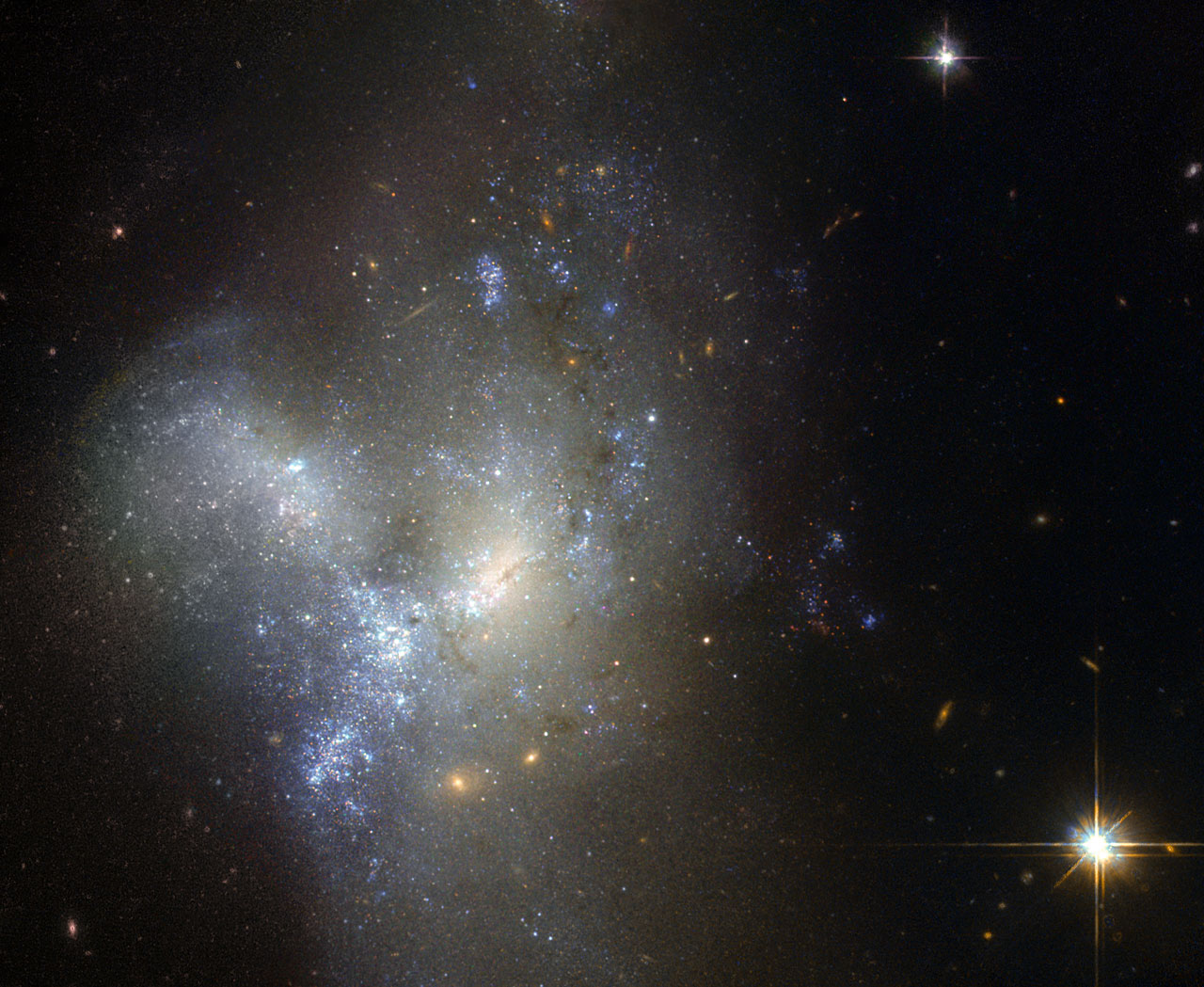
This image, taken by the NASA/ESA Hubble Space Telescope, shows a peculiar galaxy known as NGC 1487, lying about 30 million light-years away in the southern constellation of Eridanus.

Rather than viewing a celestial object, it is actually better to think of this as an event. Here, we are witnessing two or more galaxies in the act of merging together to form a single new galaxy. Each progenitor has lost almost all traces of its original appearance, as stars and gas have been thrown hither and thither by gravity in an elaborate cosmic whirl.

Unless one is very much bigger than the other, galaxies are always disrupted by the violence of the merging process. As a result, it is very difficult to determine precisely what the original galaxies looked like and, indeed, how many of them there were. In this case, it is possible that we are seeing the merger of several dwarf galaxies that were previously clumped together in a small group.

Although older yellow and red stars can be seen in the outer regions of the new galaxy, its appearance is dominated by large areas of bright blue stars, illuminating the patches of gas that gave them life. This burst of star formation may well have been triggered by the merger.


Thursday, February 04, 2016

Moon was produced by a head-on collision between Earth and a forming planet

The extremely similar chemical composition of rocks on the Earth and moon helped scientists determine that a head-on collision, not a glancing blow, took place between Earth and Theia. Copyright William K. Hartmann

Paul Warren, Edward Young (holding a sample of a rock from the moon) and Issaku Kohl
Credit: Christelle Snow/UCLA


UCLA-led research reconstructs massive crash, which took place 4.5 billion years ago


The moon was formed by a violent, head-on collision between the early Earth and a “planetary embryo” called Theia approximately 100 million years after the Earth formed, UCLA geochemists and colleagues report.

Scientists had already known about this high-speed crash, which occurred almost 4.5 billion years ago, but many thought the Earth collided with Theia (pronounced THAY-eh) at an angle of 45 degrees or more — a powerful side-swipe (simulated in this 2012 YouTube video). New evidence reported Jan. 29 in the journal Science substantially strengthens the case for a head-on assault.

The researchers analyzed seven rocks brought to the Earth from the moon by the Apollo 12, 15 and 17 missions, as well as six volcanic rocks from the Earth’s mantle — five from Hawaii and one from Arizona.

The key to reconstructing the giant impact was a chemical signature revealed in the rocks’ oxygen atoms. (Oxygen makes up 90 percent of rocks’ volume and 50 percent of their weight.) More than 99.9 percent of Earth’s oxygen is O-16, so called because each atom contains eight protons and eight neutrons. But there also are small quantities of heavier oxygen isotopes: O-17, which have one extra neutron, and O-18, which have two extra neutrons. Earth, Mars and other planetary bodies in our solar system each has a unique ratio of O-17 to O-16 — each one a distinctive “fingerprint.”

In 2014, a team of German scientists reported in Science that the moon also has its own unique ratio of oxygen isotopes, different from Earth’s. The new research finds that is not the case.

“We don’t see any difference between the Earth’s and the moon’s oxygen isotopes; they’re indistinguishable,” said Edward Young, lead author of the new study and a UCLA professor of geochemistry and cosmochemistry.

Young’s research team used state-of-the-art technology and techniques to make extraordinarily precise and careful measurements, and verified them with UCLA’s new mass spectrometer.

The fact that oxygen in rocks on the Earth and our moon share chemical signatures was very telling, Young said. Had Earth and Theia collided in a glancing side blow, the vast majority of the moon would have been made mainly of Theia, and the Earth and moon should have different oxygen isotopes. A head-on collision, however, likely would have resulted in similar chemical composition of both Earth and the moon.

“Theia was thoroughly mixed into both the Earth and the moon, and evenly dispersed between them,” Young said. “This explains why we don’t see a different signature of Theia in the moon versus the Earth.”

Theia, which did not survive the collision (except that it now makes up large parts of Earth and the moon) was growing and probably would have become a planet if the crash had not occurred, Young said. Young and some other scientists believe the planet was approximately the same size as the Earth; others believe it was smaller, perhaps more similar in size to Mars.

Another interesting question is whether the collision with Theia removed any water that the early Earth may have contained. After the collision — perhaps tens of millions of year later — small asteroids likely hit the Earth, including ones that may have been rich in water, Young said. Collisions of growing bodies occurred very frequently back then, he said, although Mars avoided large collisions.

A head-on collision was initially proposed in 2012 by Matija Ćuk, now a research scientist with the SETI Institute, and Sarah Stewart, now a professor at UC Davis; and, separately during the same year by Robin Canup of the Southwest Research Institute.

Co-authors of the Science paper are Issaku Kohl, a researcher in Young’s laboratory; Paul Warren, a researcher in the UCLA department of Earth, planetary, and space sciences; David Rubie, a research professor at Germany’s Bayerisches Geoinstitut, University of Bayreuth; and Seth Jacobson and Alessandro Morbidelli, planetary scientists at France’s Laboratoire Lagrange, Université de Nice.

The research was funded by NASA, the Deep Carbon Observatory and a European Research Council advanced grant (ACCRETE).


Media Contact

Stuart Wolpert
310-206-0511
swolpert@support.ucla.edu


Wednesday, February 03, 2016

The Deep-Frozen Flying Saucer

PR Image eso1604a 
The Flying Saucer protoplanetary disc around 2MASS J16281370-2431391
The Rho Ophiuchi star formation region in the constellation of Ophiuchus

The Rho Ophiuchi star formation region in the constellation of Ophiuchus

Zooming in on the Flying Saucer protoplanetary disc


ALMA finds unexpectedly cold grains in planet-forming disc

Astronomers have used the ALMA and IRAM telescopes to make the first direct measurement of the temperature of the large dust grains in the outer parts of a planet-forming disc around a young star. By applying a novel technique to observations of an object nicknamed the Flying Saucer they find that the grains are much colder than expected: −266 degrees Celsius. This surprising result suggests that models of these discs may need to be revised.

The international team, led by Stephane Guilloteau at the Laboratoire d'Astrophysique de Bordeaux, France, measured the temperature of large dust grains around the young star 2MASS J16281370-2431391 in the spectacular Rho Ophiuchi star formation region, about 400 light-years from Earth.

This star is surrounded by a disc of gas and dust — such discs are called protoplanetary discs as they are the early stages in the creation of planetary systems. This particular disc is seen nearly edge-on, and its appearance in visible light pictures has led to its being nicknamed the Flying Saucer.

The astronomers used the Atacama Large Millimeter/submillimeter Array (ALMA) to observe the glow coming from carbon monoxide molecules in the 2MASS J16281370-2431391 disc. They were able to create very sharp images and found something strange — in some cases they saw a negative signal! Normally a negative signal is physically impossible, but in this case there is an explanation, which leads to a surprising conclusion.

Lead author Stephane Guilloteau takes up the story: “This disc is not observed against a black and empty night sky. Instead it’s seen in silhouette in front of the glow of the Rho Ophiuchi Nebula. This diffuse glow is too extended to be detected by ALMA, but the disc absorbs it. The resulting negative signal means that parts of the disc are colder than the background. The Earth is quite literally in the shadow of the Flying Saucer!

The team combined the ALMA measurements of the disc with observations of the background glow made with the IRAM 30-metre telescope in Spain [1]. They derived a disc dust grain temperature of only −266 degrees Celsius (only 7 degrees above absolute zero, or 7 Kelvin) at a distance of about 15 billion kilometres from the central star [2]. This is the first direct measurement of the temperature of large grains (with sizes of about one millimetre) in such objects.

This temperature is much lower than the −258 to −253 degrees Celsius (15 to 20 Kelvin) that most current models predict. To resolve the discrepancy, the large dust grains must have different properties than those currently assumed, to allow them to cool down to such low temperatures.

To work out the impact of this discovery on disc structure, we have to find what plausible dust properties can result in such low temperatures. We have a few ideas — for example the temperature may depend on grain size, with the bigger grains cooler than the smaller ones. But it is too early to be sure,” adds co-author Emmanuel di Folco (Laboratoire d'Astrophysique de Bordeaux).

If these low dust temperatures are found to be a normal feature of protoplanetary discs this may have many consequences for understanding how they form and evolve.

For example, different dust properties will affect what happens when these particles collide, and thus their role in providing the seeds for planet formation. Whether the required change in dust properties is significant or not in this respect cannot yet be assessed.

Low dust temperatures can also have a major impact for the smaller dusty discs that are known to exist. If these discs are composed of mostly larger, but cooler, grains than is currently supposed, this would mean that these compact discs can be arbitrarily massive, so could still form giant planets comparatively close to the central star.

Further observations are needed, but it seems that the cooler dust found by ALMA may have significant consequences for the understanding of protoplanetary discs.


Notes:

[1] The IRAM measurements were needed as ALMA itself was not sensitive to the extended signal from the background.

 [2] This corresponds to one hundred times the distance from the Earth to the Sun. This region is now occupied by the Kuiper Belt within the Solar System.


More information

This research was presented in a paper entitled “The shadow of the Flying Saucer: A very low temperature for large dust grains”, by S. Guilloteau et al., published in Astronomy & Astrophysics Letters.

The team is composed of S. Guilloteau (University of Bordeaux/CNRS, Floirac, France), V. Piétu (IRAM, Saint Martin d’Hères, France), E. Chapillon (University of Bordeaux/CNRS; IRAM), E. Di Folco (University of Bordeaux/CNRS), A. Dutrey (University of Bordeaux/CNRS), T.Henning (Max Planck Institute für Astronomie, Heidelberg, Germany [MPIA]), D.Semenov (MPIA), T.Birnstiel (MPIA) and N. Grosso (Observatoire Astronomique de Strasbourg, Strasbourg, France).

The Atacama Large Millimeter/submillimeter Array (ALMA), an international astronomy facility, is a partnership of ESO, the US National Science Foundation (NSF) and the National Institutes of Natural Sciences (NINS) of Japan in cooperation with the Republic of Chile. ALMA is funded by ESO on behalf of its Member States, by NSF in cooperation with the National Research Council of Canada (NRC) and the National Science Council of Taiwan (NSC) and by NINS in cooperation with the Academia Sinica (AS) in Taiwan and the Korea Astronomy and Space Science Institute (KASI).

ALMA construction and operations are led by ESO on behalf of its Member States; by the National Radio Astronomy Observatory (NRAO), managed by Associated Universities, Inc. (AUI), on behalf of North America; and by the National Astronomical Observatory of Japan (NAOJ) on behalf of East Asia. The Joint ALMA Observatory (JAO) provides the unified leadership and management of the construction, commissioning and operation of ALMA.

The Institut de Radio Astronomie Millimétrique (IRAM) is supported by INSU/CNRS (France), MPG (Germany), and IGN (Spain).

ESO is the foremost intergovernmental astronomy organisation in Europe and the world’s most productive ground-based astronomical observatory by far. It is supported by 16 countries: Austria, Belgium, Brazil, the Czech Republic, Denmark, France, Finland, Germany, Italy, the Netherlands, Poland, Portugal, Spain, Sweden, Switzerland and the United Kingdom, along with the host state of Chile. ESO carries out an ambitious programme focused on the design, construction and operation of powerful ground-based observing facilities enabling astronomers to make important scientific discoveries. ESO also plays a leading role in promoting and organising cooperation in astronomical research. ESO operates three unique world-class observing sites in Chile: La Silla, Paranal and Chajnantor. At Paranal, ESO operates the Very Large Telescope, the world’s most advanced visible-light astronomical observatory and two survey telescopes. VISTA works in the infrared and is the world’s largest survey telescope and the VLT Survey Telescope is the largest telescope designed to exclusively survey the skies in visible light. ESO is a major partner in ALMA, the largest astronomical project in existence. And on Cerro Armazones, close to Paranal, ESO is building the 39-metre European Extremely Large Telescope, the E-ELT, which will become “the world’s biggest eye on the sky”.


Links


Contacts

Stephane Guilloteau
Laboratoire d'Astrophysique de Bordeaux
Floirac, France
Email: stephane.guilloteau@u-bordeaux.fr

Emmanuel di Folco
Laboratoire d'Astrophysique de Bordeaux
Floirac, France
Email: emmanuel.di-folco@u-bordeaux.fr

Vincent Pietu
IRAM
Grenoble, France
Email: pietu@iram.fr

Richard Hook
ESO Public Information Officer
Garching bei München, Germany
Tel: +49 89 3200 6655
Cell: +49 151 1537 3591
Email: rhook@eso.org


Source: ESO