Tuesday, June 24, 2014

Hunt for extraterrestrial life gets massive methane boost

 Extrasolar planet HD189733b rises from behind its star. Is there methane on this planet? 
Credit: ESA

A powerful new model to detect life on planets outside of our solar system, more accurately than ever before, has been developed by UCL researchers.

The new model focuses on methane, the simplest organic molecule, widely acknowledged to be a sign of potential life. 

Researchers from UCL and the University of New South Wales have developed a new spectrum for ‘hot’ methane which can be used to detect the molecule at temperatures above that of Earth, up to 1,500K/1220°C – something which was not possible before. 

To find out what remote planets orbiting other stars are made of, astronomers analyse the way in which their atmospheres absorb starlight of different colours and compare it to a model, or ‘spectrum’, to identify different molecules.

Professor Jonathan Tennyson, (UCL Department of Physics and Astronomy) co-author of the study said: “Current models of methane are incomplete, leading to a severe underestimation of methane levels on planets.We anticipate our new model will have a big impact on the future study of planets and ‘cool’ stars external to our solar system, potentially helping scientists identify signs of extraterrestrial life.”

Lead author of the study, Dr Sergei Yurchenko, (UCL Department of Physics and Astronomy) added: “The comprehensive spectrum we have created has only been possible with the astonishing power of modern supercomputers which are needed for the billions of lines required for the modelling. We limited the temperature threshold to 1,500K to fit the capacity available, so more research could be done to expand the model to higher temperatures still. Our calculations required about 3 million CPU (central processing unit) hours alone; processing power only accessible to us through the DiRAC project.

“We are thrilled to have used this technology to significantly advance beyond previous models available for researchers studying potential life on astronomical objects, and we are eager to see what our new spectrum helps them discover.” he added. 

The new model has been tested and verified by successfully reproducing in detail the way in which the methane in failed stars, called brown dwarfs, absorbs light.

Links


Media contact

Bex Caygill  
Tel: +44 (0)20 3108 3846

3D map shows dusty structure of the Milky Way

Detail from map at 9000 light years (3 kiloparsec). The map is coloured according to how much dust lies in each direction in the northern Milky Way. The red/brown areas are dustiest directions. Credit: Sale et al/IPHAS

A team of international astronomers has created a detailed three-dimensional map of the dusty structure of the Milky Way – the star-studded bright disc of our own galaxy – as seen from Earth’s northern hemisphere. The map will be presented by Prof Janet Drew of the University of Hertfordshire at the National Astronomy Meeting (NAM) 2014 in Portsmouth on Monday 23 June.

Dust and gas, which make up the interstellar medium (ISM), fill the space between stars in galaxies. The dust in the ISM is shaped by turbulent flows that form intricate fractal structures on scales ranging from thousands of light years down to hundreds of kilometres. Rather than measuring the dust itself to create the map, the team has used observations of more than 38 million stars to estimate how much starlight has been obscured by the ISM and thus how much dust lies in our line of sight to each star. This ‘extinction’ map derives from the newly released catalogue of the Isaac Newton Telescope Photometric H-alpha Survey of the Northern Galactic Plane (IPHAS), the first digital survey to cover the entire northern Milky Way.

"Because the Solar System is embedded in the disc of the Milky Way, our view of it is choked with dust, with the result we know less about its internal structure than we do about some external galaxies, such as M31 in Andromeda." said Drew, the Principal Investigator for the IPHAS survey. "In this Northern survey, we are mainly looking at the parts of the Galactic disc that lie outside the Sun's orbit around the Galactic Centre. This 3-D map demonstrates with greater force than existing 2-D maps that dust in the outer disc does not trace the Perseus spiral arm and other expected structures in a simple way."

The map shows how extinction builds with distance away from the Sun (typically out to 12,000 light years or more) in any part of the surveyed northern Milky Way. Detail on an angular scales 7 times finer than the angular size of the moon is captured. The fractal nature of the ISM is visible in the map, as are large-scale features, such as star-forming molecular clouds and bubbles of ionized gas around clusters of hot stars.

"We can see a number of specific features, including the Rosette Nebula and the star-forming belt in the Perseus Arm of the Milky Way," said Dr Stuart Sale, who led the team that created the map. "Our location within the Milky Way means that we can study the ISM in far greater detail than for any other galaxy. The knowledge that we gain from studying our own galaxy can subsequently be applied to others."

"IPHAS has been a major part of the Isaac Newton Telescope's programme of observation over the last decade. It is one of several ground-based surveys beginning to provide important new and very large collections of data, complementing ESA's Gaia mission as it starts its work, that are being discussed at NAM 2014. The common goal is to properly unravel the full 3-D spatial organisation of our own Galaxy" said Drew.

MEDIA CONTACTS

NAM 2014 press office landlines: +44 (0) 02392 845176, +44 (0)2392 845177, +44 (0)2392 845178

Robert Massey

Royal Astronomical Society

Mob: +44 (0)794 124 8035

Anita Heward

Royal Astronomical Society

Mob: +44 (0)7756 034 243

Keith Smith

Royal Astronomical Society

SCIENCE CONTACTS


Prof Janet Drew

IPHAS Survey PI

Centre for Astrophysics Research

University of Hertfordshire

Dr Geert Barentsen

Centre for Astrophysics Research

University of Hertfordshire

Dr Stuart Sale

Rudolf Peierls Centre for Theoretical Physics

University of Oxford

IMAGES

1. Each panel is a map coloured according to how much dust lies in each direction in the northern Milky Way, out to a fixed distance.  Maps for 3 distances (1, 2 and 3 kiloparsecs or ~3000, ~6000 and ~9000 light years) are shown, using a colour scale that trends to red/brown for the dustiest directions. Credit: Sale et al/IPHAS

2. Detail from map at 9000 light years (3 kiloparsec).  The map is coloured according to how much dust lies in each direction in the northern Milky Way. The red/brown areas are dustiest directions. Credit: Sale et al/IPHAS
https://www.ras.org.uk/images/stories/NAM/2014/Drew_3kpc_small.jpg

FURTHER INFORMATION

A 3D extinction map of the Northern Galactic Plane based on IPHAS photometry. Sale et al, MNRAS, 2014, http://arxiv.org/abs/1406.0009

Barentsen et al, MNRAS, 2014, see www.iphas.org/data.shtml
The map can be explored interactively on the IPHAS website (http://www.iphas.org/extinction/)

About IPHAS

The INT Photometric Hα Survey of the Northern Galactic Plane (IPHAS, www.iphas.org) was carried out at the Isaac Newton Telescope (INT).  IPHAS is a digital survey of the northern Milky Way in two optical/red colours and narrow-band H-alpha - a filter that picks out the most prominent line of hydrogen, the most abundant element in the Universe.  The work on this survey began in 2003 in La Palma, and only now is close enough to completion that most of the ~45000 exposures making up the survey have been uniformly calibrated.  These data are now being made available to the astronomical community as source catalogues that measure the brightness of over 200 million objects (nearly all stars) brighter than ~20th magnitude

The INT is operated on the island of La Palma by the Isaac Newton Group in the Spanish Observatorio del Roque de los Muchachos of the Instituto de Astrofisica de Canarias. All IPHAS data are processed by the Cambridge Astronomical Survey Unit, at the Institute of Astronomy in Cambridge. The bandmerged DR2 catalogue was assembled at the Centre for Astrophysics Research, University of Hertfordshire, supported by STFC grant ST/J001333/1.

NOTES FOR EDITORS

The RAS National Astronomy Meeting (NAM 2014) will bring together more than 600 astronomers, space scientists and solar physicists for a conference running from 23 to 26 June in Portsmouth. NAM 2014, the largest regular professional astronomy event in the UK, will be held in conjunction with the UK Solar Physics (UKSP), Magnetosphere Ionosphere Solar-Terrestrial physics (MIST) and UK Cosmology (UKCosmo) meetings. The conference is principally sponsored by the Royal Astronomical Society (RAS), the Science and Technology Facilities Council (STFC) and the University of Portsmouth. Meeting arrangements and a full and up to date schedule of the scientific programme can be found on the official website at http://www.nam2014.org and via Twitter @RASNAM2014

The University of Portsmouth (http://www.port.ac.uk, Twitter: @portsmouthuni ) is a top-ranking university in a student-friendly waterfront city. It’s in the top 50 universities in the UK, in The Guardian University Guide League Table 2014 and is ranked in the top 400 universities in the world, in the most recent Times Higher Education World University Rankings 2013. Research at the University of Portsmouth is varied and wide ranging, from pure science – such as the evolution of galaxies and the study of stem cells – to the most technologically applied subjects – such as computer games design. Our researchers collaborate with colleagues worldwide, and with the public, to develop new insights and make a difference to people’s lives.

The Royal Astronomical Society (RAS: http://www.ras.org.uk, Twitter: @royalastrosoc), founded in 1820, encourages and promotes the study of astronomy, solar-system science, geophysics and closely related branches of science. The RAS organises scientific meetings, publishes international research and review journals, recognizes outstanding achievements by the award of medals and prizes, maintains an extensive library, supports education through grants and outreach activities and represents UK astronomy nationally and internationally. Its more than 3800 members (Fellows), a third based overseas, include scientific researchers in universities, observatories and laboratories as well as historians of astronomy and others.

The Science and Technology Facilities Council (STFC: http://www.stfc.ac.uk, Twitter: @stfc_matters) is keeping the UK at the forefront of international science and tackling some of the most significant challenges facing society such as meeting our future energy needs, monitoring and understanding climate change, and global security. The Council has a broad science portfolio and works with the academic and industrial communities to share its expertise in materials science, space and ground-based astronomy technologies, laser science, microelectronics, wafer scale manufacturing, particle and nuclear physics, alternative energy production, radio communications and radar. It enables UK researchers to access leading international science facilities for example in the area of astronomy, the European Southern Observatory.

The University of Hertfordshire (http://www.herts.ac.uk) is the UK’s leading business-facing university and an exemplar in the sector.  It is innovative and enterprising and challenges individuals and organisations to excel. The University of Hertfordshire is one of the region’s largest employers with over 2,425 staff and a turnover of over £234 million. With a student community of over 25,100 including more than 2,900 overseas students from 120 different countries, the University has a global network of over 175,000 alumni. It is also one of the top 100 universities in the world under 50 years old, according to the new Times Higher Education 100 under 50 rankings 2014.


Monday, June 23, 2014

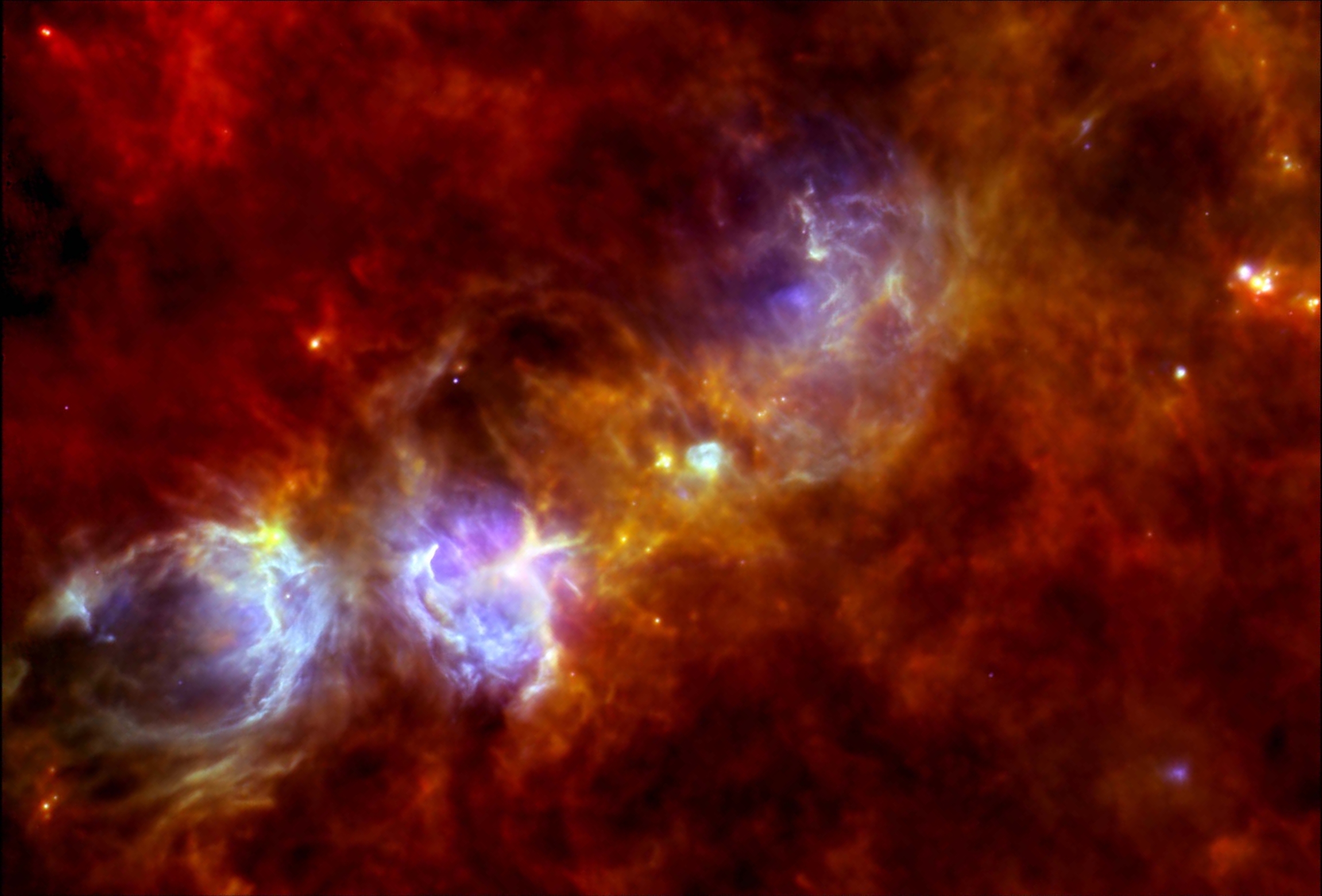
From oldest to youngest: a line of star nurseries

From oldest to youngest: a line of star nurseries
Copyright: ESA/Herschel/PACS/SPIRE/HOBYS Key Programme consortium

Just as children are sorted into age groups at school, so the seeds of new stars can also be found in ‘classes’ of others of similar ages. This is especially true when the birth of stars in a cloud of gas and dust is triggered by an external event, like the explosion of a nearby supernova.

This image from ESA’s Herschel space observatory shows a sequence of star-forming regions in the molecular cloud W48, some 10 000 light-years away in the constellation Aquila (the Eagle).

The blue, jellyfish-shaped cloud at the lower left is the oldest stellar nursery in the image. Young and massive stars embedded within it have shaped it into a bubble and heated the diffuse gas, making it shine at the longest wavelengths probed by Herschel.

To its right, another glowing cloud conceals clumps that will evolve into massive stars. These clumps, some of which are visible as bright blotches of light, are also lined up by their age: the older ones at the lower-left and the younger ones to the upper-right. The youngest in this sequence is the small cyan lump at the centre of the image, harbouring the seeds of future massive stars.

Astronomers believe that this sequence of stellar birth is the result of dozens of supernovas that exploded over 10 million years ago in a region called Aquila Supershell, beyond the left edge of this image. 

Compressing the surrounding material, these supernovas may have initiated a wave of star formation that sparked, one by one, these stellar cribs.

The image is a composite of the wavelengths of 70 microns (blue), 160 microns (green) and 250 microns (red) and spans about one degree on the long side. North is to the upper-left and east is to the lower left. 

The data were acquired with Herschel’s PACS and SPIRE instruments in September 2010, as part of a larger map of the W48 molecular complex in the HOBYS Key Programme. This was first published in a paper by Q. Nguyen Luong, et al. 2011. A more detailed study of the star-forming regions shown in this image is presented in a paper by K.L.J. Rygl, et al. 2014.


Source: ESA

Swiftly moving gas streamer eclipses supermassive black hole

 
Supermassive black hole at the heart of NGC 5548
 
Artist’s impression of gas filament eclipsing a black hole

Astronomers have discovered strange and unexpected behaviour around the supermassive black hole at the heart of the galaxy NGC 5548. The international team of researchers detected a clumpy gas stream flowing quickly outwards and blocking 90 percent of the X-rays emitted by the black hole. This activity could provide insights into how supermassive black holes interact with their host galaxies.

The discovery of the unusual behaviour in NGC 5548 is the result of an intensive observing campaign using major ESA and NASA space observatories, including the NASA/ESA Hubble Space Telescope [1]. In 2013 and 2014 the international team carried out the most extensive monitoring campaign of an active galaxy [2] ever conducted.

There are other galaxies that show gas streams near a black hole, but this is the first time that a stream like this has been seen to move into the line of sight.

The researchers say that this is the first direct evidence for the long-predicted shielding process that is needed to accelerate powerful gas streams, or winds, to high speeds. “This is a milestone in understanding how supermassive black holes interact with their host galaxies,” says Jelle Kaastra of the SRON Netherlands Institute for Space Research, who led the research team [3]. “We were very lucky. 

You don’t normally see this kind of event with objects like this. It tells us more about the powerful ionised winds that allow supermassive black holes in the nuclei of active galaxies to expel large amounts of matter. In larger quasars than NGC 5548, these winds can regulate the growth of both the black hole and its host galaxy.”

As matter spirals down into a black hole it forms a flat disc, known as an accretion disc. The disc is heated so much that it emits X-rays, near to the black hole, and less energetic ultraviolet radiation further out. The ultraviolet radiation can create winds strong enough to blow gas away from the black hole, which otherwise would have fallen into it. But, the winds only come into existence if their starting point is shielded from X-rays.

Earlier observations had seen the effects of both X-rays and ultraviolet radiation on a region of warm gas for away from the black hole, but these most recent observations have shown the presence of a new gas stream between the disc and the original cloud. The newly discovered gas stream in the archetypal Seyfert galaxy NGC 5548 — one of the best-studied sources of this type over the past half-century — absorbs most of the X-ray radiation before it reaches the original cloud, shielding it from X-rays and leaving only the ultraviolet radiation. The same stream shields gas closer to the accretion disc. This makes the strong winds possible, and it appears that the shielding has been going on for at least three years.

Directly after Hubble had observed NGC 5548 on 22 June 2013, the team discovered unexpected features in the data. “There were dramatic changes since the last observation with Hubble in 2011. We saw signatures of much colder gas than was present before, indicating that the wind had cooled down, due to a strong decrease in the ionising X-ray radiation from the nucleus,” said team member Gerard Kriss of the Space Telescope Science Institute in Baltimore, USA.

After combining and analysing data from the six observatories involved, the team was able to put the pieces of the puzzle together. NGC 5548’s persistent wind, which has been known about for two decades, reaches velocities exceeding 3.5 million kilometres per hour. But, a new wind has arisen which is much stronger and faster than the persistent wind.

“The new wind reaches speeds of up to 18 million kilometres per hour, but is much closer to the nucleus than the persistent wind,” says Kaastra. “The new gas outflow blocks 90 percent of the low-energy X-rays that come from very close to the black hole, and it obscures up to a third of the region that emits the ultraviolet radiation at a distance of a few light-days from the black hole.”

Strong X-ray absorption by ionised gas has been seen in several other sources, and it has been attributed for instance to passing clouds. “However, in our case, thanks to the combined XMM-Newton and Hubble data, we know this is a fast stream of outflowing gas very close to the nucleus,” said team member Massimo Cappi, of INAF-IASF Bologna. “It may even originate from the accretion disc,” added team member Pierre-Olivier Petrucci, of CNRS, IPAG Grenoble.

These results are being published online in the 19 June issue of Science Express.

Notes

[1] The observatories include ESA’s X-ray Multi-Mirror Mission (XMM-Newton), the NASA/ESA Hubble Space Telescope, NASA’s Swift, NASA’s Nuclear Spectroscopic Telescope Array (NuSTAR), NASA’s Chandra X-ray Observatory, and ESA's International Gamma-Ray Astrophysics Laboratory (INTEGRAL).

[2] An active galaxy is a galaxy which hosts an active galactic nucleus (AGN). An AGN is a compact region at the centre of a galaxy that has a much higher than normal luminosity. The high level of radiation, sometimes across the whole of the electromagnetic spectrum, is thought to be a result the supermassive black hole at the centre pulling in mass from the surroundings.

[3] The interactions between black holes and their host galaxies are believed to have a fundamental importance on the way galaxies evolve.


Notes for editors

The Hubble Space Telescope is a project of international cooperation between ESA and NASA.

More information

ESA/Hubble and NASA. Acknowledgement: Davide de Martin.

 Links

Images of Hubble

Contacts

Jelle Kaastra
SRON Netherlands Institute for Space Research
Utrecht, Netherlands
Tel: +31 88 7775870
Email:
J.Kaastra@sron.nl

Gerard A. Kriss
Space Telescope Science Institute
Baltimore, USA
Tel: +1 4103384353
Email:
gak@stsci.edu

Georgia Bladon
ESA/Hubble, Public Information Officer
Garching bei München, Germany
Tel: +44 7816291261
Email:
gbladon@partner.eso.org


Friday, June 20, 2014

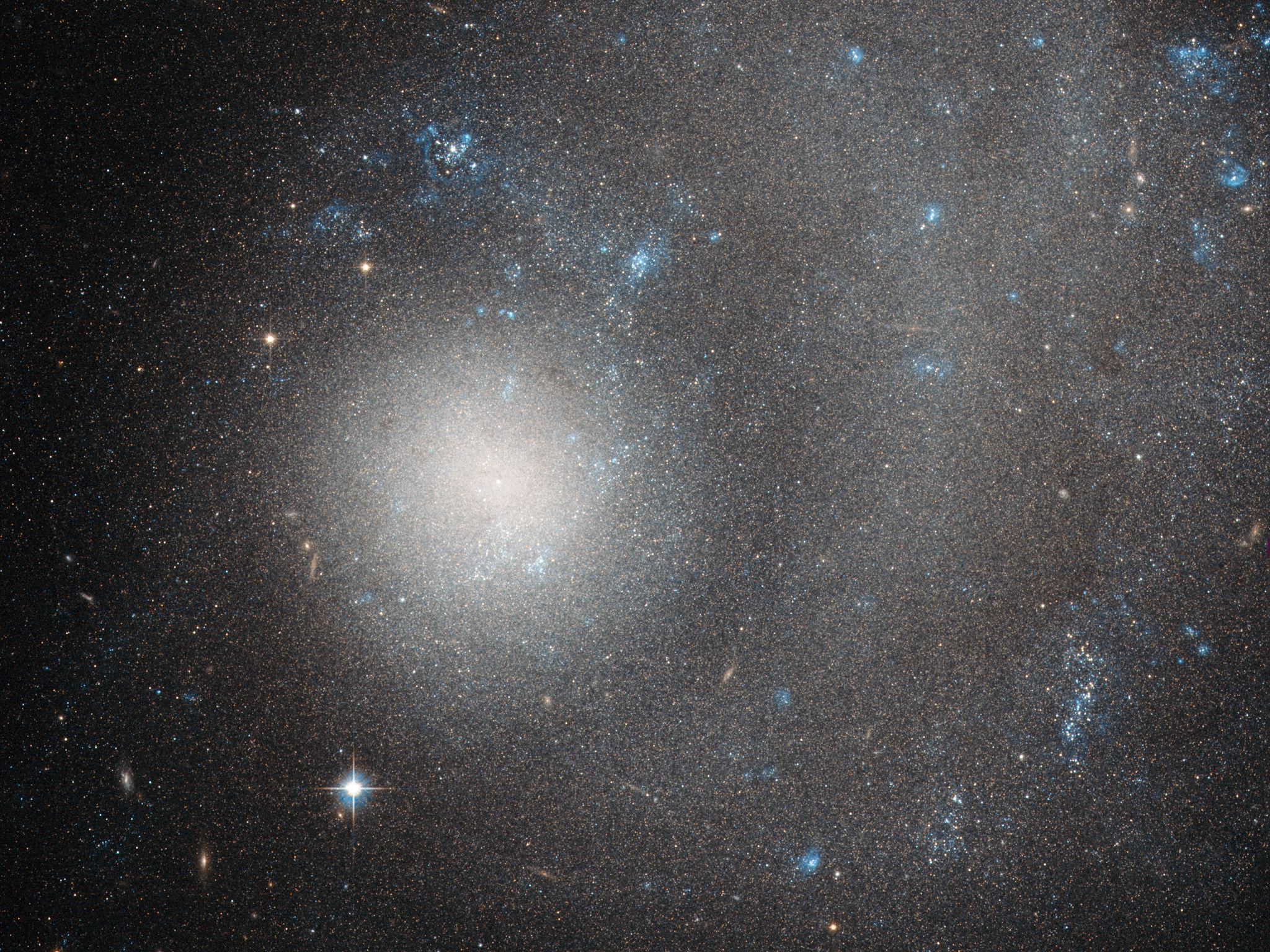
A dwarf galaxy ravaged by grand design

Credit:  ESA/Hubble & NASA

The subject of this new Hubble image is NGC 5474, a dwarf galaxy located 21 million light-years away in the constellation of Ursa Major (The Great Bear). This beautiful image was taken with Hubble's Advanced Camera for Surveys (ACS).

The term "dwarf galaxy" may sound diminutive, but don't let that fool you — NGC 5474 contains several billion stars! However, when compared to the Milky Way with its hundreds of billions of stars, NGC 5474 does indeed seem relatively small.

NGC 5474 itself is part of the Messier 101 Group. The brightest galaxy within this group is the well-known spiral Pinwheel Galaxy (also known as Messier 101, heic0602). This galaxy's prominent, well-defined arms classify it as a "grand design galaxy", along with other spirals Messier 81 (heic0710) and Messier 74 (heic0719).

Also within this group are Messier 101's galactic neighbours. It is possible that gravitational interactions with these companion galaxies have had some influence on providing Messier 101 with its striking shape. Similar interactions with Messier 101 may have caused the distortions visible in NGC 5474.

Both the Messier 101 Group and our own Local Group reside within the Virgo Supercluster, making NGC 5474 something of a neighbour in galactic terms.

Source: ESA/Hubble - Space Telescope


Thursday, June 19, 2014

Hubble Finds That Dwarf Galaxies Formed More Than Their Fair Share of the Universe's Stars

GOODS Field Containing Distant Dwarf Galaxies Forming Stars at an Incredible Rate 
Photo Credit: NASA, ESA, the GOODS Team, and M. Giavalisco (University of Massachusetts, Amherst)
Science Credit: NASA, ESA, and H. Atek and J.-P. Kneib (EPFL, Switzerland)

They may be little, but they pack a big star-forming punch. New observations from NASA's Hubble Space Telescope show that small galaxies, also known as dwarf galaxies, are responsible for forming a large proportion of the universe's stars.

Studying this early epoch of the universe's history is critical to fully understanding how these stars formed and how galaxies have grown and evolved 2 billion to 6 billion years after the beginning of the universe. This result supports a decade-long investigation into whether there is a link between a galaxy's mass and its star-forming activity, and helps paint a consistent picture of events in the early universe.

"We already suspected these kinds of galaxies would contribute to the early wave of star formation, but this is the first time we've been able to measure the effect they actually had," said Hakim Atek of the École Polytechnique Fédérale de Lausanne (EPFL) in Switzerland, lead author of the study published in the June 19 online issue of The Astrophysical Journal. "They appear to have had a surprisingly huge role to play."

Previous studies of star-forming galaxies were restricted to the analysis of mid- or high-mass galaxies, leaving out the numerous dwarf galaxies that existed in this era of prolific star formation. Astronomers conducted a recent study using data from Hubble's Wide Field Camera 3 (WFC3) to take a further and significant step forward in understanding this formative era by examining a sample of starburst galaxies in the young universe. Starburst galaxies form stars at a furiously fast rate, far above what is considered by experts to be a normal rate of star formation.

The infrared capabilities of WFC3 have allowed astronomers to finally calculate how much these low-mass dwarf galaxies contributed to the star population in our universe.

"These galaxies are forming stars so quickly that they could actually double their entire mass of stars in only 150 million years — an incredibly short astronomical timescale," added co-author Jean-Paul Kneib, also of EPFL.

Researchers say such a mass gain would take most normal galaxies 1 billion to 3 billion years to accomplish.

In addition to adding new insight to how and where the stars in our universe formed, this finding may also help to unravel the secrets of galactic evolution. Galaxies evolve through a jumble of complex processes. As galaxies merge, they are consumed by newly formed stars that feed on their combined gases, and exploding stars and supermassive black holes emit galactic material — a process that depletes the mass of a galaxy.

It is unusual to find a galaxy in a state of starburst, which suggests to researchers that starburst galaxies are the result of an unusual incident in the past, such as a violent merger.

CONTACT

Ray Villard
Space Telescope Science Institute, Baltimore, Maryland
410-338-4514

villard@stsci.edu

J.D. Harrington
NASA Headquarters, Washington, D.C.
202-358-5241

j.d.harrington@nasa.gov

Source: HubbleSite

Gemini Reveals a Gravitational Wave Source in Hiding

Figure 1. Artist's rendition of the future evolution of the WD 0931+444 system. Credit: David A. Aguilar (Harvard-Smithsonian Center for Astrophysics)

Figure 2. Gemini time-resolved spectroscopy of H-gamma (top) and H-beta lines (bottom) over 45 minutes. Both lines clearly show a 20 minute periodicity. 

Figure 3. The radial velocities of the Balmer lines in WD 0931+444. The bottom panel shows all of these data points phased with the best-fit period. The dotted line represents the best-fit model for a circular orbit with a period of 19.8 minutes.  

Figure 4. Gemini time-resolved spectroscopy of the Na I doublet (top) and the H-alpha line (bottom) over 90 minutes. The Na I lines and the H-alpha line from the M dwarf are stationary, whereas the H-alpha line from the WD clearly shows a 20 minute periodicity.

Einstein's Theory of General Relativity predicts that accelerated masses emit gravitational waves, or ripples in space-time. Even though gravitational waves have yet to be detected directly, we expect that there are more than hundred million gravitational wave sources in our own galaxy. However, as of today, we know of only a few such sources. 

A team of researchers, led by Dr. Mukremin Kilic of the University of Oklahoma and Dr. Warren Brown of the Smithsonian Astrophysical Observatory, have recently identified one of the best (and perhaps the most powerful) gravitational wave sources currently known using the Gemini Multi-Object Spectrograph (GMOS) on the Gemini North telescope and the Blue Channel spectrograph on the 6.5-meter MMT Telescope. Known as WD 0931+444, the object was first identified in 1982, and classified as a white dwarf with a low-mass M-dwarf stellar companion. 

This new data from Gemini and MMT reveal that the white dwarf in this system is not in a binary with the M dwarf. Instead, it is orbiting another invisible white dwarf every 20 minutes. Thanks to the large collecting area of the Gemini and MMT telescopes, the team was able to obtain high quality optical spectroscopy of this system every 2 minutes and resolve the 20 minute orbital period. 

The orbital separation of the two stars is only 20 percent of the size of the Sun. These two stars will lose angular momentum through gravitational wave radiation and merge in less than nine Million years. Depending on the inclination angle (which is currently unknown) the pair may merge even faster, in only a few million years. This previously unknown source is believed to be stretching everything around us (due to gravity waves) by a factor of 10-22 (or more) every 10 minutes! 

The discovery of the true nature of WD 0931+444 indicates that there are likely many other strong gravitational wave sources hiding in plain sight. Some of these hidden sources can be identified through further optical follow-up observations as in this work. However, the direct detection of gravitational waves from these sources has to wait for a space-based gravitational wave mission like the evolved Laser Interferometer Space Antenna, which will likely not be operational until 2034 as currently envisioned.”
The paper can be accessed at: http://arxiv.org/abs/1406.3346


Wednesday, June 18, 2014

Hersche New molecules around old stars


This image presents the Helix Nebula first at optical wavelengths, as seen by the Hubble Space Telescope, then by Herschel’s SPIRE instrument at wavelengths around 250 micrometres. A spectrum is shown for the region identified on the image, showing the clear signature of CO and OH+ emission in the clumpy outer regions of the planetary nebula.

The molecular ion OH+ is needed for the formation of water, and ESA’s Herschel space observatory is the first to detect it in planetary nebulas – the product of dying Sun-like stars.

Copyright: Hubble image: NASA/ESA/C.R. O’Dell (Vanderbilt University), M. Meixner & P. McCullough (STScI); Herschel data: ESA/Herschel/SPIRE/MESS Consortium/M. Etxaluze et al.

Using ESA’s Herschel space observatory, astronomers have discovered that a molecule vital for creating water exists in the burning embers of dying Sun-like stars.

When low- to middleweight stars like our Sun approach the end of their lives, they eventually become dense, white dwarf stars. In doing so, they cast off their outer layers of dust and gas into space, creating a kaleidoscope of intricate patterns known as planetary nebulas.

These actually have nothing to do with planets, but were named in the late 18th century by astronomer William Herschel, because they appeared as fuzzy circular objects through his telescope, somewhat like the planets in our Solar System.

Over two centuries later, planetary nebulas studied with William Herschel’s namesake, the Herschel space observatory, have yielded a surprising discovery.

Like the dramatic supernova explosions of weightier stars, the death cries of the stars responsible for planetary nebulas also enrich the local interstellar environment with elements from which the next generations of stars are born.

While supernovas are capable of forging the heaviest elements, planetary nebulas contain a large proportion of the lighter ‘elements of life’ such as carbon, nitrogen, and oxygen, made by nuclear fusion in the parent star.

The Ring Nebula at optical wavelengths as seen by the Hubble Space Telescope, with Herschel data acquired with SPIRE and PACS over a wavelength range of 51–672 micrometres for the region identified. 

The spectra have been cropped and the scales stretched in order to show the OH+ emission, a molecular ion important for the formation of water. ESA’s Herschel space observatory is the first to detect this molecule in planetary nebulas – the product of dying Sun-like stars.
Copyright: Hubble image: NASA/ESA/C. Robert O’Dell (Vanderbilt University) Herschel data: ESA/Herschel/PACS & SPIRE/ HerPlaNS survey/I. Aleman et al.

A star like the Sun steadily burns hydrogen in its core for billions of years. But once the fuel begins to run out, the central star swells into a red giant, becoming unstable and shedding its outer layers to form a planetary nebula. 

The remaining core of the star eventually becomes a hot white dwarf pouring out ultraviolet radiation into its surroundings. 

This intense radiation may destroy molecules that had previously been ejected by the star and that are bound up in the clumps or rings of material seen in the periphery of planetary nebulas. 

The harsh radiation was also assumed to restrict the formation of new molecules in those regions. 

But in two separate studies using Herschel astronomers have discovered that a molecule vital to the formation of water seems to rather like this harsh environment, and perhaps even depends upon it to form. The molecule, known as OH+, is a positively charged combination of single oxygen and hydrogen atoms.


 What links the three is that they host the hottest stars, with temperatures exceeding 100 000ºC.

“We think that a critical clue is in the presence of the dense clumps of gas and dust, which are illuminated by UV and X-ray radiation emitted by the hot central star,” says Dr Aleman. 

“This high-energy radiation interacts with the clumps to trigger chemical reactions that leads to the formation of the molecules.”
Copyright: Hubble image: NASA/ESA/C.R. O’Dell (Vanderbilt University), M. Meixner & P. McCullough (STScI); Herschel image: ESA/Herschel/SPIRE/MESS Consortium/M. Etxaluze et al.

Meanwhile, another study, led by Dr Mireya Etxaluze of the Instituto de Ciencia de los Materiales de Madrid, Spain, focused on the Helix Nebula, one of the nearest planetary nebulas to our Solar System, at a distance of 700 light years. 

The central star is about half the mass of our Sun, but has a far higher temperature of about 120 000ºC. The expelled shells of the star, which in optical images appear reminiscent of a human eye, are known to contain a rich variety of molecules. 

Herschel mapped the presence of the crucial molecule across the Helix Nebula, and found it to be most abundant in locations where carbon monoxide molecules, previously ejected by the star, are most likely to be destroyed by the strong UV radiation. 

Once oxygen atoms have been liberated from the carbon monoxide, they are available to make the oxygen–hydrogen molecules, further bolstering the hypothesis that the UV radiation may be promoting their creation.
The two studies are the first to identify in planetary nebulas this critical molecule needed for the formation of water, although it remains to be seen if the conditions would actually allow water formation to proceed. 

“The proximity of the Helix Nebula means we have a natural laboratory on our cosmic doorstep to study in more detail the chemistry of these objects and their role in recycling molecules through the interstellar medium,” says Dr Etxaluze. 

“Herschel has traced water across the Universe, from star-forming clouds to the asteroid belt in our own Solar System,” says Göran Pilbratt, ESA’s Herschel project scientist.  

“Now we have even found that stars like our Sun could contribute to the formation of water in the Universe, even as they are in their death throes.” 

 
HerPlaNS (The Herschel Planetary Nebulae Survey) is a survey of 11 planetary nebulas aiming the study the formation and evolution of the circumstellar material by tracing the dust and gas components. The HerPlaNS team is led by Toshiya Ueta from the University of Denver. 

The MESS (Mass loss of Evolved StarS) consortium studies a wide variety of evolved stars (including planetary nebulas) to better understand the mass loss in these objects, the dust and gas chemistry in the ejected material, and the processes shaping the nebulae. The MESS consortium is led by Martin Groenewegen (Royal Observatory of Belgium) and the study of planetary nebulas within the group is led by Peter van Hoof (Royal Observatory of Belgium). 

For further information, please contact:
 
Markus Bauer


ESA Science and Robotic Exploration Communication Officer


Tel: +31 71 565 6799


Mob: +31 61 594 3954


Email:
markus.bauer@esa.int

Isabel Aleman
Leiden Observatory, University of Leiden, the Netherlands
Email:
aleman@strw.leidenuniv.nl

Mireya Etxaluze
Group of Molecular Astrophysics, Instituto de Ciencias de los Materiales de Madrid, CSIC, Spain
Email:
m.etxaluze@icmm.csic.es

Göran Pilbratt

ESA Herschel Project Scientist

Tel: +31 71 565 3621


Email:
gpilbratt@rssd.esa.int

 Source: ESA


Tuesday, June 17, 2014

NASA's Messenger Spots Giant Space Weather Effects at Mercury

The yellow color shows the standing bow shock in front of Mercury. The signature of material flowing in a vastly different direction than the solar wind -- an HFA – can be seen in red at the lower left. Image Credit: NASA/Duberstein.

The solar wind of particles streaming off the sun helps drive flows and swirls in space as complicated as any terrestrial weather pattern. Scientists have now spotted at planet Mercury, for the first time, a classic space weather event called a hot flow anomaly, or HFA, which has previously been spotted at Earth, Venus, Saturn and Mars.

"Planets have a bow shock the same way a supersonic jet does," said Vadim Uritsky at NASA's Goddard Space Flight Center in Greenbelt, Maryland. "These hot flow anomalies are made of very hot solar wind deflected off the bow shock."

The results were published in the Journal of Geophysical Research: Space Physics on Jan. 15, 2014. To identify the presence of HFAs at Mercury, the team used observations from NASA's Messenger (short for Mercury Surface, Space Environment, Geochemistry, and Ranging) to detect the presence of two HFA signatures. The first measurement was of magnetic fields that can be used to detect giant electric current sheets that lead to HFAs. The second was of the heating of the charged particles. The scientists then analyzed this information to quantify what kind of turbulence exists in the region, which provided the final smoking gun of an HFA.

Not only is this the first sighting of HFAs at Mercury, but the observations help round out a picture of this type of space weather in general.  HFAs come in a variety of scale sizes – from around 600 miles across at Venus to closer to 60,000 miles across at Saturn. This study suggests that the most important factor for determining HFA size is the geometry and size of the planet's bow shock.

Related Link


NASA's Hubble to Begin Search Beyond Pluto for a New Horizons Mission Target

This is an artist's rendering of the New Horizons spacecraft encountering a Kuiper Belt object — a city-sized icy relic left over from the birth of our solar system. The Sun, more than 4.1 billion miles (6.7 billion kilometers) away, shines as a bright star embedded in the glow of the zodiacal dust cloud. Jupiter and Neptune are visible as orange and blue "stars" to the right of the Sun.  Credit: Johns Hopkins University Applied Physics Laboratory/Southwest Research Institute (JHUAPL/SwRI). Release Images
 
After careful consideration and analysis, the Hubble Space Telescope Time Allocation Committee has recommended using Hubble to search for an object the Pluto-bound NASA New Horizons mission could visit after its flyby of Pluto in July 2015.

The planned search will involve targeting a small area of sky in search of a Kuiper Belt object (KBO) for the outbound spacecraft to visit. The Kuiper Belt is a vast debris field of icy bodies left over from the solar system's formation 4.6 billion years ago. A KBO has never been seen up close because the belt is so far from the Sun, stretching out to a distance of 5 billion miles into a never-before-visited frontier of the solar system.

"I am pleased that our science peer-review process arrived at a consensus as to how to effectively use Hubble's unique capabilities to support the science goals of the New Horizons mission," said Matt Mountain, director of the Space Telescope Science Institute (STScI) in Baltimore, Maryland.

The full execution of the KBO search is contingent upon the results from a pilot observation using Hubble observations provided by Mountain's director's discretionary time.

The space telescope will scan an area of sky in the direction of the constellation Sagittarius to try and identify any objects orbiting within the Kuiper Belt. To discriminate between a foreground KBO and the clutter of background stars in Sagittarius, the telescope will turn at the predicted rate that KBOs are moving against the background stars. In the resulting images, the stars will be streaked, but any KBOs should appear as pinpoint objects.

If the test observation identifies at least two KBOs of a specified brightness, it will demonstrate statistically that Hubble has a chance of finding an appropriate KBO for New Horizons to visit. At that point, an additional allotment of observing time will continue the search across a field of view roughly the angular size of the full Moon.

Astronomers around the world apply for observing time on the Hubble Space Telescope. Competition for time on the telescope is extremely intense and the requested observing time significantly exceeds the observing time available in a given year. Proposals must address significant astronomical questions that can only be addressed with Hubble's unique capabilities and are beyond the capabilities of ground-based telescopes. The proposals are peer reviewed annually by an expert committee, which looks for the best possible science that can be conducted by Hubble and recommends to the STScI director a balanced program of small, medium, and large investigations.

Though Hubble is powerful enough to see galaxies near the horizon of the universe, finding a KBO is a challenging needle-in-haystack search. A typical KBO along the New Horizons' trajectory may be no larger than Manhattan Island and as black as charcoal.

Even before the launch of New Horizons in 2006, Hubble has provided consistent support for this edge-of-the-solar system mission. Hubble was used to discover four small moons orbiting Pluto and its binary companion object Charon, providing new targets to enhance the mission's scientific return. And Hubble has provided the most sensitive search yet for potentially hazardous dust rings around Pluto. Hubble also has made a detailed map of the dwarf planet's surface, which astronomers are using to plan New Horizons' close-up reconnaissance photos.

In addition to Pluto exploration, recent Hubble solar system observations have discovered a new satellite around Neptune, probed the magnetospheres of the gas-giant planets, found circumstantial evidence for oceans on Europa, and uncovered several bizarre cases of asteroids disintegrating before our eyes. Hubble has supported numerous NASA Mars missions by monitoring the Red Planet's seasonal atmospheric changes. Hubble has made complementary observations in support of the Dawn asteroid mission, and comet flybys. Nearly 20 years ago, in July 1994, Hubble documented the never-before-seen string of comet collisions with Jupiter that resulted from the tidal breakup of comet Shoemaker-Levy 9.

"The planned search for a suitable target for New Horizons further demonstrates how Hubble is effectively being used to support humankind's initial reconnaissance of the solar system," said Mountain. "Likewise, it is also a preview of how the powerful capabilities of the upcoming James Webb Space Telescope will further bolster planetary science. We are excited by the potential of both observatories for ongoing solar system exploration and discovery."

CONTACT

Ray Villard
Space Telescope Science Institute, Baltimore, Maryland
410-338-4514

villard@stsci.edu

J.D. Harrington
NASA Headquarters, Washington, D.C.
202-358-5241

j.d.harrington@nasa.gov

 Source: HubbleSite


Monday, June 16, 2014

Herschel Sees Budding Stars and a Giant, Strange Ring

The Herschel Space Observatory has uncovered a weird ring of dusty material while obtaining one of the sharpest scans to date of a huge cloud of gas and dust, called NGC 7538. Image credit: ESA/NASA/JPL-Caltech/Whitman College.  ›Full image and caption

The Herschel Space Observatory has uncovered a weird ring of dusty material while obtaining one of the sharpest scans to date of a huge cloud of gas and dust, called NGC 7538. The observations have revealed numerous clumps of material, a baker's dozen of which may evolve into the most powerful kinds of stars in the universe. Herschel is a European Space Agency mission with important NASA contributions.

"We have looked at NGC 7538 with Herschel and identified 13 massive, dense clumps where colossal stars could form in the future," said paper lead author Cassandra Fallscheer, a visiting assistant professor of astronomy at Whitman College in Walla Walla, Washington, and lead author of the paper published in The Astrophysical Journal. "In addition, we have found a gigantic ring structure and the weird thing is, we're not at all sure what created it."

NGC 7538 is relatively nearby, at a distance of about 8,800 light-years and located in the constellation Cepheus. The cloud, which has a mass on the order of 400,000 suns, is undergoing an intense bout of star formation. Astronomers study stellar nurseries such as NGC 7538 to better learn how stars come into being. Finding the mysterious ring, in this case, came as an unexpected bonus. 

The cool, dusty ring has an oval shape, with its long axis spanning about 35 light-years and its short axis about 25 light-years. Fallscheer and her colleagues estimate that the ring possesses the mass of 500 suns. Additional data from the James Clerk Maxwell Telescope, located at the Mauna Kea Observatory in Hawaii, further helped characterize the odd ovoid. Astronomers often see ring and bubble-like structures in cosmic dust clouds. The strong winds cast out by the most massive stars, called O-type stars, can generate these expanding puffs, as can their explosive deaths as supernovas. 

But no energetic source or remnant of a deceased O-type star, such as a neutron star, is apparent within the center of this ring. It is possible that a big star blew the bubble and, because stars are all in motion, subsequently left the scene, escaping detection. 

The observations were taken as part of the Herschel OB Young Stellar objects (HOBYS) Key Programme. The "OB" refers to the two most massive kinds of stars, O-type and B-type. These bright blue, superhot, short-lived stars end up exploding as supernovas, leaving behind either incredibly dense neutron stars or even denser black holes. 

Stars of this caliber form from gassy, dusty clumps with initial masses dozens of times greater than the sun's; the 13 clumps spotted in NGC 7358, some of which lie along the edge of the mystery ring, all are more than 40 times more massive than the sun. The clumps gravitationally collapse in on themselves, growing denser and hotter in their cores until nuclear fusion ignites and a star is born. For now, early in the star-formation process, the clumps remain quite cold, just a few tens of degrees above absolute zero. At these temperatures, the clumps emit the bulk of their radiation in the low-energy, submillimeter and infrared light that Herschel was specifically designed to detect.

As astronomers continue probing these budding O-type giants in NGC 7358, the follow-up observations with other telescopes should also help in solving the puzzle of the humongous, dusty ring. "Further research to determine the mechanism responsible for creating the ring structure is necessary," said Fallscheer. 

Herschel is a European Space Agency mission, with science instruments provided by consortia of European institutes and with important participation by NASA. While the observatory stopped making science observations in April 2013, after running out of liquid coolant as expected, scientists continue to analyze its data. NASA's Herschel Project Office is based at the Jet Propulsion Laboratory in Pasadena, California. JPL contributed mission-enabling technology for two of Herschel's three science instruments. The NASA Herschel Science Center, part of the Infrared Processing and Analysis Center at the California Institute of Technology in Pasadena, supports the U.S. astronomical community.

More information is online at:

Whitney Clavin 818-354-4673
Jet Propulsion Laboratory, Pasadena, Calif.

whitney.clavin@jpl.nasa.gov


Galaxy-wide Outflows, Powered by Supermassive Black Holes, Common Among Quasars

Figure 1. Artist’s impression of a galaxy with a large-scale outflow. 
Credit: ESA/ATG medialab.

Figure 2. An example object from the GMOS observations. The background image is from the Sloan Digital Sky Survey. The cyan rectangle shows the GMOS field of view. The red/yellow contours show the distribution of high-­‐velocity ionized gas. The inset shows an example oxygen emission-­‐line profile ([O III]5007) that was used to trace the velocity of the gas. 

Figure 3. Left: Distribution of the emission-line widths (a proxy for gas velocity) of both the overall population of luminous quasars (yellow histogram) and the sample studied here (red histogram). Around half the luminous quasars in the parent population show very high gas velocities (> 700 kilometers per second). The 16 objects studied here were selected from this population. Right: Similar histograms show that the radio luminosities of the quasars studied here are representative of the parent population. 

Observations using the Gemini Multi-Object Spectrograph on Gemini South reveal that galaxy-wide high-velocity outflows are extremely common among galaxies that host luminous quasars. These outflows may represent a crucial stage in a galaxy’s evolution when the supermassive black hole at its center begins injecting vast amounts of mass and energy into the galaxy. 
 
Supermassive black holes reside at the center of all massive galaxies and they grow through mass accretion, taking on material from their surroundings. During the most active periods they become luminous quasars. The most successful models of galaxy evolution predict that quasars play an integral role in the formation and evolution of massive galaxies by injecting mass and energy into their host galaxies. Without such feedback mechanisms, models are unable to accurately reproduce the properties of local massive galaxies such as the distributions of colors, star formation rates and stellar masses. 

A popular idea for a feedback mechanism is that extremely powerful and high-velocity outflows of gas are launched by quasars and consequently propagate throughout the galaxy (see Figure 1). These outflows could sweep up and heat material, reducing the star formation rates of the host galaxies and add material to the larger scale environment. While earlier observations have shown that high-velocity outflows exist in some quasars, it has remained unclear what the spatial extent of these outflows are and how often they occur. 

Using the Gemini Multi-Object Spectrograph (GMOS) on Gemini South, astronomers at Durham University, led by Chris Harrison, have begun to answer these questions and show the properties and frequency of outflows in quasars. Using GMOS’s integral field spectrograph, they traced the properties of the gas across the host galaxies of 16 quasars. Critically, GMOS on Gemini South enabled the astronomers to trace the velocity of the gas over the full spatial extent of the quasars’ host galaxies. By using emission lines produced by ionized hydrogen and oxygen to trace the gas velocities the observations revealed that outflows, reaching velocities of >1000 kilometers/second, were found over the full spatial extent of the host galaxies of all of the quasars observed (e.g., see Figure 2). Estimates of the masses involved in these outflows indicate that they are removing significant amounts of gas from the galaxies and their overall properties are in line with model predictions. 

A key aspect of this work is the quasars that were observed with GMOS were initially selected from a parent sample of several thousand objects with optical spectra (Figure 3). These observations can thus be placed in the context of the overall population and reveal properties of quasars generally. For example, these observations imply that at least 70% of the most luminous quasars (those predicted by models to drive the feedback mechanisms) exhibit galaxy-wide outflows of this type. Further work now needs to be done to pin-down exactly how the central black holes are able to launch such large-scale outflows. Furthermore, while models predict that outflows, such as those observed here, have a dramatic impact upon the star formation in their host galaxies the current observational evidence for these effects remains only indirect. Astronomers continue to search for direct observational proof that these outflows can have a profound influence the evolution of massive galaxies. 

This research is presented in the paper: Kiloparsec-scale outflows are prevalent among luminous AGN: outflows and feedback in the context of the overall AGN population by C. M. Harrison, D. M. Alexander, J. R. Mullaney and A. M. Swinbank. The paper is published in the Monthly Notices of the Royal Astronomical Society (2014 441 3306) and is available on astro-ph.