Showing posts with label New Horizons spacecraft. Show all posts

Saturday, August 31, 2024

New Horizons Measurements Shed New Light on the Darkness of the Universe

An artist's impression of NASA's New Horizons spacecraft against the backdrop of deep space. More than 5.4 billion miles (7.3 billion kilometers) from Earth, New Horizons is traversing a region of the solar system far enough from the Sun to offer the darkest skies available to any existing telescope – and to provide a unique vantage point from which to measure the overall brightness of the distant universe. The lane of our Milky Way galaxy is in the background. Credits: Artwork: NASA, APL, SwRI, Serge Brunier (ESO), Marc Postman (STScI), Dan Durda

Just how dark is deep space? Astronomers may have finally answered this long-standing question by tapping into the capabilities and distant position of NASA's New Horizons spacecraft, by making the most precise, direct measurements ever of the total amount of light the universe generates.

More than 18 years after launch and nine years after its historic exploration of Pluto, New Horizons is more than 5.4 billion miles (7.3 billion kilometers) from Earth, in a region of the solar system far enough from the Sun to offer the darkest skies available to any existing telescope – and to provide a unique vantage point from which to measure the overall brightness of the distant universe.

"If you hold up your hand in deep space, how much light does the universe shine on it?" asked Marc Postman, an astronomer at the Space Telescope Science Institute in Baltimore and lead author of a new paper detailing the research, which published today in The Astrophysical Journal . "We now have a good idea of just how dark space really is. The results show that the great majority of visible light we receive from the universe was generated in galaxies. Importantly, we also found that there is no evidence for significant levels of light produced by sources not presently known to astronomers."

The findings solve a puzzle that has perplexed scientists since the 1960s, when astronomers Arno Penzias and Robert Wilson discovered that space is pervaded by strong microwave radiation, which had been predicted to be left over from the creation of the universe itself. This result led to their being awarded the Nobel Prize. Subsequently, astronomers also found evidence of backgrounds of X-rays, gamma rays and infrared radiation that also fill the sky.

Detecting the background of "ordinary" (or visible) light – more formally called the cosmic optical background, or COB – provided a way to add up all the light generated by galaxies over the lifetime of the universe before NASA's Hubble Space Telescope and James Webb Space Telescope could see the faint background galaxies directly.

In the Hubble and James Webb telescope era, astronomers measure the COB to detect light that might come from sources other than these known galaxies. But measuring the total light output of the universe is extremely difficult from Earth or anywhere in the inner solar system.

"People have tried over and over to measure it directly, but in our part of the solar system, there's just too much sunlight and reflected interplanetary dust that scatters the light around into a hazy fog that obscures the faint light from the distant universe," said Tod Lauer, a New Horizons co-investigator, astronomer from the National Science Foundation NOIRLab in Tucson, Arizona, and a co-author of the new paper. "All attempts to measure the strength of the COB from the inner solar system suffer from large uncertainties."

Enter New Horizons, billions of miles along its trek beyond the planets, now deep in the Kuiper Belt and headed toward interstellar space. Late last summer, from a distance 57 times farther from the Sun than Earth, New Horizons scanned the universe with its Long Range Reconnaissance Imager (LORRI), collecting two-dozen separate imaging fields. LORRI itself was intentionally shielded from the Sun by the main body of the spacecraft – keeping even the dimmest sunlight from directly entering the sensitive camera – and the target fields were positioned away from the bright disk and core of the Milky Way and nearby bright stars.

The New Horizons observers used other data, taken in the far-infrared by the European Space Agency's Planck mission, of fields with a range in dust density to calibrate the level of those far-infrared emissions to the level of ordinary visible light. This allowed them to accurately predict and correct for the presence of dust-scattered Milky Way light in the COB images – a technique that was not available to them during a 2021 test COB observation run with New Horizons in which they underestimated the amount of dust-scattered light and overestimated excess light from the universe itself.

But this time around, after accounting for all known sources of light, such as background stars and light scattered by thin clouds of dust within the Milky Way galaxy, the researchers found the remaining level of visible light was entirely consistent with the intensity of light generated by all galaxies over the past 12.6 billion years.

"The simplest interpretation is that the COB is completely due to galaxies," Lauer said. "Looking outside the galaxies, we find darkness there and nothing more."

"This newly published work is an important contribution to fundamental cosmology, and really something that could only be done with a far-away spacecraft like New Horizons," said New Horizons Principal Investigator Alan Stern, of the Southwest Research Institute in Boulder, Colorado. "And it shows that our current extended mission is making important scientific contributions far beyond the original intent of this planetary mission designed to make the first close spacecraft explorations of Pluto and Kuiper Belt objects."

Launched in January 2006, New Horizons made the historic reconnaissance of Pluto and its moons in July 2015, before giving humankind its first close-up look at a planetary building block and Kuiper Belt object, Arrokoth, in January 2019. New Horizons is now in its second extended mission, imaging distant Kuiper Belt objects, characterizing the outer heliosphere of the Sun, and making important astrophysical observations from its unmatched vantage point in the farthest regions of the solar system.

The Johns Hopkins Applied Physics Laboratory (APL) in Laurel, Maryland, built and operates the New Horizons spacecraft and manages the mission for NASA's Science Mission Directorate. Southwest Research Institute, based in San Antonio and Boulder, Colorado, directs the mission via Principal Investigator Alan Stern and leads the science team, payload operations and encounter science planning. New Horizons is part of NASA's New Frontiers program, managed by NASA's Marshall Space Flight Center in Huntsville, Alabama.


About This Release

Credits:

Media Contact:

Michael Buckley
Johns Hopkins University Applied Physics Laboratory, Laurel, Maryland

Ray Villard
Space Telescope Science Institute, Baltimore, Maryland

Science Contact:

Marc Postman
Space Telescope Science Institute, Baltimore, Maryland

Permissions: Content Use Policy

Contact Us: Direct inquiries to the News Team.

Related Links and Documents


Saturday, February 23, 2019

New Horizons Spacecraft Returns Its Sharpest Views of Ultima Thule

The most detailed images of Ultima Thule -- obtained just minutes before the spacecraft's closest approach at 12:33 a.m. EST on Jan. 1 -- have a resolution of about 110 feet (33 meters) per pixel. Their combination of higher spatial resolution and a favorable viewing geometry offer an unprecedented opportunity to investigate the surface of Ultima Thule, believed to be the most primitive object ever encountered by a spacecraft.  This processed, composite picture combines nine individual images taken with the Long Range Reconnaissance Imager (LORRI), each with an exposure time of 0.025 seconds, just 6 ½ minutes before the spacecraft's closest approach to Ultima Thule (officially named 2014 MU69). The image was taken at 5:26 UT (12:26 a.m. EST) on Jan. 1, 2019, when the spacecraft was 4,109 miles (6,628 kilometers) from Ultima Thule and 4.1 billion miles (6.6 billion kilometers) from Earth. The angle between the spacecraft, Ultima Thule and the Sun – known as the "phase angle" – was 33 degrees. Credit: NASA/Johns Hopkins Applied Physics Laboratory/Southwest Research Institute, National Optical Astronomy Observatory

This processed, composite picture combines seven individual images taken with the New Horizons Long Range Reconnaissance Imager (LORRI), each with an exposure time of 0.025 seconds, just 19 minutes before the spacecraft’s closest approach to Ultima Thule (officially named 2014 MU69).The image was taken at 5:14 UT (12:14 a.m. EST) on Jan. 1, 2019, when the spacecraft was 10,350 miles (16,694 kilometers) from Ultima Thule, yielding a resolution of 273 feet (83 meters) per pixel. The spacecraft was 4.1 billion miles (6.6 billion kilometers) from Earth. The angle between the spacecraft, Ultima Thule and the Sun – known as the “phase angle” – was 16 degrees.  Credit: NASA/Johns Hopkins Applied Physics Laboratory/Southwest Research Institute, National Optical Astronomy Observatory

New Horizons scientists created this movie from 14 different images taken by the New Horizons Long Range Reconnaissance Imager (LORRI) shortly before the spacecraft flew past the Kuiper Belt object nicknamed Ultima Thule (officially named 2014 MU69) on Jan. 1, 2019. The central frame of this sequence was taken on Jan. 1 at 5:26:54 UT (12:26 a.m. EST), when New Horizons was 4,117 miles (6,640 kilometers) from Ultima Thule, some 4.1 billion miles (6.6 billion kilometers) from Earth. Ultima Thule nearly completely fills the LORRI image and is perfectly captured in the frames, an astounding technical feat given the uncertain location of Ultima Thule and the New Horizons spacecraft flying past it at over 32,000 miles per hour. Credit: NASA/Johns Hopkins University Applied Physics Laboratory/Southwest Research Institute.  Credit: NASA/Johns Hopkins University Applied Physics Laboratory/Southwest Research Institute.  View MP4


The mission team called it a "stretch goal" – just before closest approach, precisely point the cameras on NASA's New Horizons spacecraft to snap the sharpest possible pics of the Kuiper Belt object nicknamed Ultima Thule, its New Year's flyby target and the farthest object ever explored.

Now that New Horizons has sent those stored flyby images back to Earth, the team can enthusiastically confirm that its ambitious goal was met.

These new images of Ultima Thule – obtained by the telephoto Long-Range Reconnaissance Imager (LORRI) just 6½ minutes before New Horizons' closest approach to the object (officially named 2014 MU69) at 12:33 a.m. EST on Jan. 1 – offer a resolution of about 110 feet (33 meters) per pixel. Their combination of high spatial resolution and a favorable viewing angle gives the team an unprecedented opportunity to investigate the surface, as well as the origin and evolution, of Ultima Thule – thought to be the most primitive object ever encountered by a spacecraft.

"Bullseye!" said New Horizons Principal Investigator Alan Stern, of the Southwest Research Institute (SwRI). "Getting these images required us to know precisely where both tiny Ultima and New Horizons were — moment by moment – as they passed one another at over 32,000 miles per hour in the dim light of the Kuiper Belt, a billion miles beyond Pluto. This was a much tougher observation than anything we had attempted in our 2015 Pluto flyby.

"These 'stretch goal' observations were risky, because there was a real chance we'd only get part or even none of Ultima in the camera's narrow field of view," he continued. "But the science, operations and navigation teams nailed it, and the result is a field day for our science team! Some of the details we now see on Ultima Thule's surface are unlike any object ever explored before."

The higher resolution brings out a many surface features that weren't readily apparent in earlier images. Among them are several bright, enigmatic, roughly circular patches of terrain. In addition, many small, dark pits near the terminator (the boundary between the sunlit and dark sides of the body) are better resolved. "Whether these features are craters produced by impactors, sublimation pits, collapse pits, or something entirely different, is being debated in our science team," said John Spencer, deputy project scientist from SwRI.

Project Scientist Hal Weaver, of the Johns Hopkins Applied Physics Laboratory, noted that the latest images have the highest spatial resolution of any New Horizons has taken – or may ever take – during its entire mission. Swooping within just 2,200 miles (3,500 kilometers), New Horizons flew approximately three times closer to Ultima than it zipped past its primary mission target, Pluto, in July 2015.

Ultima Thule is smaller than Pluto, but the Ultima flyby was done with the highest navigation precision ever achieved by any spacecraft. This unprecedented precision was achieved thanks to the ground-based occultation campaigns from 2017 and 2018 conducted in Argentina, Senegal, South Africa and Colombia, as well as the European Space Agency's Gaia mission, which provided the locations of the stars that were used during the occultation campaigns.

Look for these and other LORRI images on the New Horizons LORRI website this week. Raw images from the camera are posted to the site each Friday.

Mission operations manager Alice Bowman, of APL, reports that the spacecraft continues to operate flawlessly. New Horizons is nearly 4.13 billion miles (6.64 billion kilometers) from Earth; at that distance, radio signals, traveling at light speed, reach the large antennas of NASA's Deep Space Network six hours and nine minutes after New Horizons sends them. Follow New Horizons on its trek through the Kuiper Belt.


Source:  New Horizons - NASA's Mission to Pluto and the Kuiper Belt


Thursday, January 17, 2019

New Movie Shows Ultima Thule from an Approaching New Horizons


Image credits: NASA/Johns Hopkins Applied Physics Laboratory/Southwest Research Institute/National Optical Astronomy Observatory

NASA Spacecraft Begins Returning New Images, Other Data from Historic New Year's Flyby

This movie shows the propeller-like rotation of Ultima Thule in the seven hours between 20:00 UT (3 p.m. ET) on Dec. 31, 2018, and 05:01 UT (12:01 a.m.) on Jan. 1, 2019, as seen by the Long Range Reconnaissance Imager (LORRI) aboard NASA's New Horizons as the spacecraft sped toward its close encounter with the Kuiper Belt object at 05:33 UT (12:33 a.m. ET) on Jan. 1.

During this deep-space photo shoot – part of the farthest planetary flyby in history – New Horizons' range to Ultima Thule decreased from 310,000 miles (500,000 kilometers, farther than the distance from the Earth to the Moon) to just 17,100 miles (28,000 kilometers), during which the images became steadily larger and more detailed. The team processed two different image sequences; the bottom sequence shows the images at their original relative sizes, while the top corrects for the changing distance, so that Ultima Thule (officially named 2014 MU69) appears at constant size but becomes more detailed as the approach progresses.

All the images have been sharpened using scientific techniques that enhance detail. The original image scale is 1.5 miles (2.5 kilometers) per pixel in the first frame, and 0.08 miles (0.14 kilometers) per pixel in the last frame. The rotation period of Ultima Thule is about 16 hours, so the movie covers a little under half a rotation. Among other things, the New Horizons science team will use these images to help determine the three-dimensional shape of Ultima Thule, in order to better understand its nature and origin.

The raw images included in the movie are available on the New Horizons LORRI website. New Horizons downlinked the two highest-resolution images in this movie immediately after the Jan. 1 flyby, but the more distant images were sent home on Jan. 12-14, after a week when New Horizons was too close to the Sun (from Earth's point of view) for reliable communications. New Horizons will continue to transmit images – including its closest views of Ultima Thule – and data for the next many months.


Wednesday, January 02, 2019

New Horizons Successfully Explores Ultima Thule

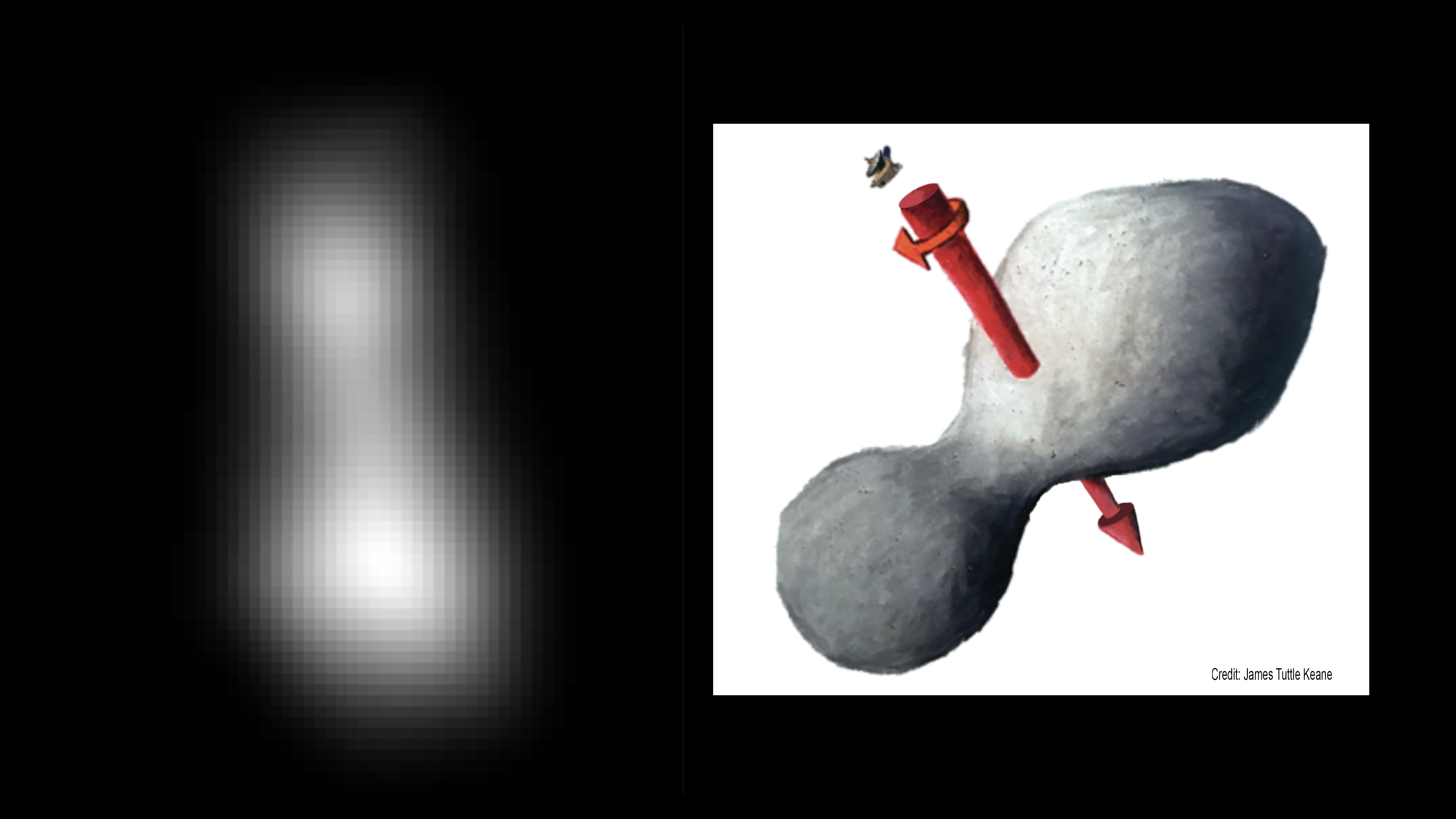
At left is a composite of two images taken by New Horizons' high-resolution Long-Range Reconnaissance Imager (LORRI), which provides the best indication of Ultima Thule's size and shape so far. Preliminary measurements of this Kuiper Belt object suggest it is approximately 20 miles long by 10 miles wide (32 kilometers by 16 kilometers). An artist's impression at right illustrates one possible appearance of Ultima Thule, based on the actual image at left. The direction of Ultima's spin axis is indicated by the arrows. Credits: NASA/JHUAPL/SwRI; sketch courtesy of James Tuttle Keane. Hi-res image

This sequence of three images, received on Dec. 31, 2018, and taken by the LORRI camera onboard New Horizons at 70 and 85 minutes apart illustrates the rotation of Ultima Thule. Credits: NASA/JHUAPL/SwRI

NASA Spacecraft Reaches Most Distant Target in History

NASA's New Horizons spacecraft flew past Ultima Thule in the early hours of New Year's Day, ushering in the era of exploration from the enigmatic Kuiper Belt, a region of primordial objects that holds keys to understanding the origins of the solar system.

"Congratulations to NASA's New Horizons team, Johns Hopkins Applied Physics Laboratory and the Southwest Research Institute for making history yet again. In addition to being the first to explore Pluto, today New Horizons flew by the most distant object ever visited by a spacecraft and became the first to directly explore an object that holds remnants from the birth of our solar system," said NASA Administrator Jim Bridenstine. "This is what leadership in space exploration is all about."

Signals confirming the spacecraft is healthy and had filled its digital recorders with science data on Ultima Thule reached the mission operations center at the Johns Hopkins Applied Physics Laboratory (APL) today at 10:29 a.m. EST, almost exactly 10 hours after New Horizons' closest approach to the object.

"New Horizons performed as planned today, conducting the farthest exploration of any world in history — 4 billion miles from the Sun," said Principal Investigator Alan Stern, of the Southwest Research Institute in Boulder, Colorado. "The data we have look fantastic and we're already learning about Ultima from up close. From here out the data will just get better and better!"

Images taken during the spacecraft's approach — which brought New Horizons to within just 2,200 miles (3,500 kilometers) of Ultima at 12:33 a.m. EST — revealed that the Kuiper Belt object may have a shape similar to a bowling pin, spinning end over end, with dimensions of approximately 20 by 10 miles (32 by 16 kilometers). Another possibility is Ultima could be two objects orbiting each other. Flyby data have already solved one of Ultima's mysteries, showing that the Kuiper Belt object is spinning like a propeller with the axis pointing approximately toward New Horizons. This explains why, in earlier images taken before Ultima was resolved, its brightness didn't appear to vary as it rotated. The team has still not determined the rotation period.

As the science data began its initial return to Earth, mission team members and leadership reveled in the excitement of the first exploration of this distant region of space.

"New Horizons holds a dear place in our hearts as an intrepid and persistent little explorer, as well as a great photographer," said Johns Hopkins Applied Physics Laboratory Director Ralph Semmel. "This flyby marks a first for all of us — APL, NASA, the nation and the world — and it is a great credit to the bold team of scientists and engineers who brought us to this point."

"Reaching Ultima Thule from 4 billion miles away is an incredible achievement. This is exploration at its finest," said Adam L. Hamilton, president and CEO of the Southwest Research Institute in San Antonio. "Kudos to the science team and mission partners for starting the textbooks on Pluto and the Kuiper Belt. We're looking forward to seeing the next chapter."

The New Horizons spacecraft will continue downloading images and other data in the days and months ahead, completing the return of all science data over the next 20 months. When New Horizons launched in January 2006, George W. Bush was in the White House, Twitter had just been launched and Time Magazine's Person of the Year was "you — all the worldwide web users." Nine years into its journey, the spacecraft began its exploration of the Kuiper Belt with a flyby of Pluto and its moons. Almost 13 years after the launch, the spacecraft will continue its exploration of the Kuiper Belt until at least 2021. Team members plan to propose more Kuiper Belt exploration.

The Johns Hopkins Applied Physics Laboratory in Laurel, Maryland, designed, built and operates the New Horizons spacecraft, and manages the mission for NASA's Science Mission Directorate. The Southwest Research Institute, based in San Antonio, leads the science team, payload operations and encounter science planning. New Horizons is part of the New Frontiers Program managed by NASA's Marshall Space Flight Center in Huntsville, Alabama. Follow the New Horizons mission on Twitter and use the hashtags #UltimaThule, #UltimaFlyby and #askNewHorizons to join the conversation. Live updates and links to mission information are also available on http://pluto.jhuapl.edu and www.nasa.gov.


Sunday, September 18, 2016

Pluto 'Paints' its Largest Moon Red

NASA's New Horizons spacecraft captured this high-resolution, enhanced color view of Pluto’s largest moon, Charon, just before closest approach on July 14, 2015. The image combines blue, red and infrared images taken by the spacecraft's Ralph/Multispectral Visual Imaging Camera (MVIC); the colors are processed to best highlight the variation of surface properties across Charon. Scientists have learned that reddish material in the north (top) polar region – informally named Mordor Macula – is chemically processed methane that escaped from Pluto’s atmosphere onto Charon. Charon is 754 miles (1,214 kilometers) across; this image resolves details as small as 1.8 miles (2.9 kilometers). Credits: NASA/Johns Hopkins University Applied Physics Laboratory/Southwest Research Institute . Hi-res image


In June 2015, when the cameras on NASA's approaching New Horizons spacecraft first spotted the large reddish polar region on Pluto's largest moon, Charon, mission scientists knew two things: they'd never seen anything like it elsewhere in our solar system, and they couldn't wait to get the story behind it.

Over the past year, after analyzing the images and other data that New Horizons has sent back from its historic July 2015 flight through the Pluto system, the scientists think they've solved the mystery. 

As they detail this week in the international scientific journal Nature, Charon's polar coloring comes from Pluto itself - as methane gas that escapes from Pluto's atmosphere and becomes "trapped" by the moon's gravity and freezes to the cold, icy surface at Charon's pole. This is followed by chemical processing by ultraviolet light from the sun that transforms the methane into heavier hydrocarbons and eventually into reddish organic materials called tholins.

"Who would have thought that Pluto is a graffiti artist, spray-painting its companion with a reddish stain that covers an area the size of New Mexico?" asked Will Grundy, a New Horizons co-investigator from Lowell Observatory in Flagstaff, Arizona, and lead author of the paper. "Every time we explore, we find surprises. Nature is amazingly inventive in using the basic laws of physics and chemistry to create spectacular landscapes."

The team combined analyses from detailed Charon images obtained by New Horizons with computer models of how ice evolves on Charon's poles. Mission scientists had previously speculated that methane from Pluto's atmosphere was trapped in Charon's north pole and slowly converted into the reddish material, but had no models to support that theory.

The New Horizons team dug into the data to determine whether conditions on the Texas-sized moon (with a diameter of 753 miles or 1,212 kilometers) could allow the capture and processing of methane gas. The models using Pluto and Charon's 248-year orbit around the sun show some extreme weather at Charon's poles, where 100 years of continuous sunlight alternate with another century of continuous darkness. Surface temperatures during these long winters dip to -430 Fahrenheit (-257 Celsius), cold enough to freeze methane gas into a solid.

"The methane molecules bounce around on Charon's surface until they either escape back into space or land on the cold pole, where they freeze solid, forming a thin coating of methane ice that lasts until sunlight comes back in the spring," Grundy said. But while the methane ice quickly sublimates away, the heavier hydrocarbons created from it remain on the surface.

The models also suggested that in Charon's springtime the returning sunlight triggers conversion of the frozen methane back into gas. But while the methane ice quickly sublimates away, the heavier hydrocarbons created from this evaporative process remain on the surface.

Sunlight further irradiates those leftovers into reddish material - called tholins - that has slowly accumulated on Charon's poles over millions of years. New Horizons' observations of Charon's other pole, currently in winter darkness - and seen by New Horizons only by light reflecting from Pluto, or "Pluto-shine" - confirmed that the same activity was occurring at both poles.

"This study solves one of the greatest mysteries we found on Charon, Pluto's giant moon," said Alan Stern, New Horizons principal investigator from the Southwest Research Institute, and a study co-author. "And it opens up the possibility that other small planets in the Kuiper Belt with moons may create similar, or even more extensive 'atmospheric transfer' features on their moons." 


Thursday, July 23, 2015

WHT Observes Pluto in Support of NASA's New Horizons Mission

The William Herschel Telescope (WHT) has participated in 2014 and 2015 in a worldwide campaign to spectroscopically follow up Pluto from the ground in support of the encounter of NASA's New Horizons spacecraft with Pluto.

Constant monitoring of the surface of Pluto is necessary because it is known to be spectrally and photometrically variable from season to season, and probably during the whole secular calendar. By gathering data at different wavelengths astronomers are able to characterize the distribution of the materials which make up the surface and atmosphere in different ways, from the layers of volatile ices (bright, whitish areas made up of methane, nitrogen, and carbon monoxide) to the more complex organic residues, which are reddish.

Last year Pluto was already observed for six nights using the WHT. The spectra, obtained using ACAM and planned as a series of overrides, showed two principal characteristics of the surface of Pluto, the clearest being the absorption bands due to methane ice. The second characteristic is the continuum slope of the spectrum which is an indicator of the colour of the surface. This colouring agent is not uniformly distributed over Pluto's surface, but changes significantly during its rotation period, which is 6.4 Earth days. 

Images of Pluto taken from the New Horizons probe. Below, spectra from the observing campaign at the WHT in 2014. The difference between the two spectra indicates differences in the composition of the surface of the planet. The spectrum printed in yellow (dark zone) has a larger slope, which is associated with the presence of very dark complexes of organic materials, which seem to be abundant in the dark region to the left of the map. The spectrum printed in red (bright zone) has somewhat deeper absorption bands, which indicate that there is more methane ice in the bright heart-shaped zone. Credits: NASA-JHUAPL-SWRI & ORM team [ JPG ].

This year, the observations were planned in a similar way and for a period of 11 nights, from 3rd to 14th July, coinciding with the closest approach of New Horizons spacecraft with Pluto. The new spectra will provide an important independent calibration of the MVIC (Multispectral Visible Imaging Camera on board New Horizons).


More information:


Monday, July 20, 2015

Pluto Wags its Tail: New Horizons Discovers a Cold, Dense Region of Atmospheric Ions Behind Pluto

Artist’s concept of the interaction of the solar wind (the supersonic outflow of electrically charged particles from the Sun) with Pluto’s predominantly nitrogen atmosphere. Some of the molecules that form the atmosphere have enough energy to overcome Pluto’s weak gravity and escape into space, where they are ionized by solar ultraviolet radiation. As the solar wind encounters the obstacle formed by the ions, it is slowed and diverted (depicted in the red region), possibly forming a shock wave upstream of Pluto. The ions are “picked up” by the solar wind and carried in its flow past the dwarf planet to form an ion or plasma tail (blue region). The Solar Wind around Pluto (SWAP) instrument on the New Horizons spacecraft made the first measurements of this region of low-energy atmospheric ions shortly after closest approach on July 14. Such measurements will enable the SWAP team to determine the rate at which Pluto loses its atmosphere and, in turn, will yield insight into the evolution of the Pluto’s atmosphere and surface. Also illustrated are the orbits of Pluto’s five moons and the trajectory of the spacecraft. Credit: NASA/Johns Hopkins University Applied Physics Laboratory/Southwest Research Institute


New Horizons has discovered a region of cold, dense ionized gas tens of thousands of miles beyond Pluto — the planet’s atmosphere being stripped away by the solar wind and lost to space. Beginning an hour and half after closest approach, the Solar Wind Around Pluto (SWAP) instrument observed a cavity in the solar wind — the outflow of electrically charged particles from the Sun — between 48,000 miles (77,000 km) and 68,000 miles (109,000 km) downstream of Pluto. SWAP data revealed this cavity to be populated with nitrogen ions forming a “plasma tail” of undetermined structure and length extending behind the planet.

Similar plasma tails are observed at planets like Venus and Mars. In the case of Pluto’s predominantly nitrogen atmosphere, escaping molecules are ionized by solar ultraviolet light, “picked up” by the solar wind, and carried past Pluto to form the plasma tail discovered by New Horizons. Prior to closest approach, nitrogen ions were detected far upstream of Pluto by the Pluto Energetic Particle Spectrometer Science Investigation (PEPSSI) instrument, providing a foretaste of Pluto’s escaping atmosphere.

Plasma tail formation is but one fundamental aspect of Pluto’s solar wind interaction, the nature of which is determined by several yet poorly constrained factors. Of these, perhaps the most important is the atmospheric loss rate. “This is just a first tantalizing look at Pluto’s plasma environment,” says co-investigator Fran Bagenal, University of Colorado, Boulder, who leads the New Horizons Particles and Plasma team. “We’ll be getting more data in August, which we can combine with the Alice and Rex atmospheric measurements to pin down the rate at which Pluto is losing its atmosphere. Once we know that, we’ll be able to answer outstanding questions about the evolution of Pluto’s atmosphere and surface and determine to what extent Pluto’s solar wind interaction is like that of Mars.”


Saturday, July 18, 2015

Animated Flyover of Pluto’s Icy Mountain and Plains


This simulated flyover of Pluto’s Norgay Montes (Norgay Mountains) and Sputnik Planum (Sputnik Plain) was created from New Horizons closest-approach images. Norgay Montes have been informally named for Tenzing Norgay, one of the first two humans to reach the summit of Mount Everest. Sputnik Planum is informally named for Earth’s first artificial satellite. The images were acquired by the Long Range Reconnaissance Imager (LORRI) on July 14 from a distance of 48,000 miles (77,000 kilometers). Features as small as a half-mile (1 kilometer) across are visible. Credit: NASA/JHUAPL/SWRI. Youtube


Thursday, July 16, 2015

Views of Pluto Through the Years

This animation combines various observations of Pluto over the course of several decades. The first frame is a digital zoom-in on Pluto as it appeared upon its discovery by Clyde Tombaugh in 1930 (image courtesy Lowell Observatory Archives). The other images show various views of Pluto as seen by NASA's Hubble Space Telescope beginning in the 1990s and NASA's New Horizons spacecraft in 2015. The final sequence zooms in to a close-up frame of Pluto released on July 15, 2015.


Complete source list in order with image credits:

Clyde Tombaugh, Lowell Observatory, 1930: http://solarsystem.nasa.gov/multimedia/display.cfm?IM_ID=19989
Note: This image is property of the Lowell Observatory Archives. 
Any public use requires written permission of the Lowell Observatory Archives.


New Horizons, July 15, 2015: https://www.youtube.com/watch?v=7iyd-gh2rhM


Thursday, June 04, 2015

Hubble Finds Two Chaotically Tumbling Pluto Moons

Artist's Illustration of the Chaotic Spin of Pluto's Moon Nix
This set of artist's illustrations of Pluto's moon Nix shows how the orientation of the moon changes unpredictably as it orbits the "double planet" Pluto-Charon. This illustration is based on dynamical models of spinning bodies in complex gravitational fields — like the field produced by Pluto and Charon's motion about each other. Astronomers used this simulation to try to understand the unpredictable changes in reflected light from Nix as it orbits Pluto-Charon. They also found that Pluto's moon Hydra also undergoes chaotic spin. The football shape of both moons contributes to their wild motion. The consequences are that if you lived on either moon, you could not predict the time or direction the sun would rise the next day. (The moon is too small for Hubble to resolve surface features, and so the surface textures used here are purely for illustration purposes.)   Credit: NASA, ESA, M. Showalter (SETI Institute), and G. Bacon (STScI)

Nix, Hydra, Kerberos, Styx and Charon
This artist's illustration shows the scale and comparative brightness of Pluto's small satellites, as discovered by the Hubble Space Telescope over the past several years. Pluto's binary companion, Charon (discovered in 1978), is placed at the bottom for scale. Two of the moons are highly oblate. The reflectivity among the moons varies from dark charcoal to the brightness of white sand. Hubble cannot resolve surface features on the moons and so the cratered textures seen here are purely for illustration purposes. Credit: NASA, ESA, M. Showalter (SETI Institute), and A. Feild (STScI)


If you lived on one of Pluto's moons Nix or Hydra, you'd have a hard time setting your alarm clock. That's because you could not know for sure when, or even in which direction, the sun would rise.

A comprehensive analysis of all available Hubble Space Telescope data shows that two of Pluto's moons, Nix and Hydra, are wobbling unpredictably. Scientists believe the other two small moons, Kerberos and Styx, are likely in a similar situation, pending further study.

"Hubble has provided a new view of Pluto and its moons revealing a cosmic dance with a chaotic rhythm," said John Grunsfeld, associate administrator of NASA's Science Mission Directorate in Washington, D.C. "When the New Horizons spacecraft flies through the Pluto system in July we'll get a chance to see what these moons look like up close and personal."

Why the chaos? Because the moons are embedded inside a dynamically shifting gravitational field caused by the system's two central bodies, Pluto and Charon, whirling about each other. The variable gravitational field induces torques that send the smaller moons tumbling in unpredictable ways. This torque is strengthened by the fact the moons are football shaped rather than spherical.

The surprising results of the Hubble research, conducted by Mark Showalter of the SETI Institute in Mountain View, California, and Doug Hamilton of the University of Maryland at College Park, are appearing in the June 4 issue of the British science journal Nature.

"Prior to the Hubble observations nobody appreciated the intricate dynamics of the Pluto system," Showalter said. "Our report provides important new constraints on the sequence of events that led to the formation of the system."

Hubble's monitoring of Pluto's four outer moons has also revealed that three of them, Nix, Styx, and Hydra, are presently locked together in resonance where there is a precise ratio among their orbital periods. "This ties together their motion in a way similar to that of three of Jupiter's large moons," noted Hamilton. "If you were sitting on Nix you would see that Styx orbits Pluto twice for every three orbits made by Hydra."

Hubble provides observational evidence that the satellites are also orbiting chaotically. "However, that does not necessarily mean that the system is on the brink of flying apart," Showalter added. "We need to know a lot more about the system before we can determine its long-term fate."

To the surprise of astronomers, Hubble also found that the moon Kerberos is as dark as a charcoal briquette, while the other satellites are as bright as white sand. It was predicted that pollution by dust blasted off the satellites by meteorite impacts should overcoat all the moons, giving their surfaces a homogeneous look. "This is a very provocative result," Showalter said.

NASA's New Horizons probe, which will fly by the Pluto-Charon system in July 2015, may help settle the question of the asphalt-black moon as well as the other oddities uncovered by Hubble. These new discoveries are being used in the science planning for New Horizons's observations.

The chaos in the Pluto-Charon system offers insights into how planets orbiting a double-star might behave. "We are learning that chaos may be a common trait of binary systems," Hamilton said. "It might even have consequences for life on planets in such systems." NASA's Kepler space observatory has found several planetary systems orbiting double stars.

Clues to the Pluto chaos first came when astronomers measured variations in the light reflected off of the two moons Nix and Hydra. Their brightness changed unpredictably. "The data were confusing; they made no sense at all. We had an inkling something was fishy," Showalter said. His team analyzed Hubble images of Pluto taken during 2005-2012. They compared the unpredictable changes in the moons' reflectivity to dynamical models of spinning bodies in complex gravitational fields.

Virtually all large moons, as well as small moons in close-in orbits, keep one hemisphere facing their parent planet. This means that the satellite's rotation is perfectly matched to the orbital period. This is not coincidental, but the consequence of gravitational tides between moon and planet. (Hyperion, which orbits Saturn, is the only other solar-system example of chaotic rotation; it is due to the combined gravitational tugs of the planet and it largest moon, Titan).

Pluto's moons are hypothesized to have formed by a collision between the dwarf planet and another similar-sized body early in the history of the solar system. The smashup flung material that coalesced into the family of satellites observed around Pluto today. Its large binary companion, Charon, was discovered in 1978. The object is almost half the size of Pluto. Hubble discovered Nix and Hydra in 2005, Kerberos in 2011, and Styx in 2012. These little moons, measuring just tens of miles across, were found as part of a Hubble search for potential hazards to the New Horizons spacecraft flyby.

Pluto and Charon are called a double planet because they orbit about a common center of gravity that is located in the space between the bodies. Some regard the Earth-moon system as a double planet, too, although the center of gravity falls beneath Earth's surface. (Our moon has 1/80th of Earth's mass, whereas Charon has 1/8th of Pluto's mass.)

Researchers say that a combination of monitoring data from Hubble, New Horizons's brief close-up look, and eventually, observations with the James Webb Space Telescope will help settle many mysteries of the Pluto-Charon system. No ground-based telescopes have yet been able to detect the smallest moons.

"Pluto will continue to surprise us when New Horizons flies past it in July," Showalter said. "Our work with the Hubble telescope just gives us a foretaste of what's in store."

Contacts:

Ray Villard
Space Telescope Science Institute, Baltimore, Maryland
410-338-4514

villard@stsci.edu

Felicia Chou
NASA Headquarters, Washington, D.C.
202-358-0257

felicia.chou@nasa.gov

Mark Showalter
SETI Institute, Mountain View, California
605-810-0234

mshowalter@seti.org

Doug Hamilton
University of Maryland, College Park, Maryland
301-405-1548

dhamil@astro.umd.edu


Source: HubbleSite

Thursday, May 14, 2015

New Horizons Spots Pluto’s Faintest Known Moons

New Horizons Spots Pluto’s Faintest Known Moons
Download the .mov file


For the first time, NASA's New Horizons spacecraft has photographed Kerberos and Styx – the smallest and faintest of Pluto's five known moons. Following the spacecraft's detection of Pluto's giant moon Charon in July 2013, and Pluto's smaller moons Hydra and Nix in July 2014 and January 2015, respectively, New Horizons is now within sight of all the known members of the Pluto system. 

"New Horizons is now on the threshold of discovery," said mission science team member John Spencer, of the Southwest Research Institute in Boulder, Colorado. "If the spacecraft observes any additional moons as we get closer to Pluto, they will be worlds that no one has ever seen before." 

Drawing even closer to Pluto in mid-May, New Horizons will begin its first search for new moons or rings that might threaten the spacecraft on its passage through the Pluto system. The images of faint Styx and Kerberos shown here are allowing the search team to refine the techniques they will use to analyze those data, which will push the sensitivity limits even deeper. 

Kerberos and Styx were discovered in 2011 and 2012, respectively, by New Horizons team members using the Hubble Space Telescope. Styx, circling Pluto every 20 days between the orbits of Charon and Nix, is likely just 4 to 13 miles (approximately 7 to 21 kilometers) in diameter, and Kerberos, orbiting between Nix and Hydra with a 32-day period, is just 6 to 20 miles (approximately 10 to 30 kilometers) in diameter. Each is 20 to 30 times fainter than Nix and Hydra. 

The images detecting Kerberos and Styx shown here were taken with New Horizons' most sensitive camera, the Long Range Reconnaissance Imager (LORRI), from April 25-May 1. Each observation consists of five 10-second exposures that have been added together to make the image in the left panel, and extensively processed to reduce the bright glare of Pluto and Charon and largely remove the dense field of background stars (center and right panels), in order to reveal the faint satellites, whose positions and orbits, along with those of the brighter moons Nix and Hydra, are given in the right panel. 

"Detecting these tiny moons from distance of over 55 million miles is amazing, and a credit to the team that built our LORRI long-range camera and John Spencer's team of moon and ring hunters," added New Horizons Principal Investigator Alan Stern, of the Southwest Research Institute. 

Kerberos is visible in all of the images, though is partially obscured in the second image. Styx is not visible in the first image, only in subsequent ones; on April 25 it was obscured by electronic artifacts in the camera – the black and white streaks extending to the right of the extremely overexposed images of Pluto and Charon in the center of the frame. These artifacts point in different directions in different images due to the varying orientation of the spacecraft. Other unlabeled features in the processed images include the imperfectly removed images of background stars and other residual artifacts. 

Although Styx and Kerberos are more visible in some frames than others, perhaps due to brightness fluctuations as they rotate on their axes, their identity is confirmed by their positions being exactly where they are predicted to be (in the center of the circles in the right panel). 

The Johns Hopkins University Applied Physics Laboratory (APL) designed, built, and operates the New Horizons spacecraft, and manages the mission for NASA's Science Mission Directorate. SwRI leads the science team, payload operations and encounter science planning. New Horizons is part of the New Frontiers Program managed by NASA's Marshall Space Flight Center in Huntsville, Alabama. 


Thursday, October 16, 2014

NASA's Hubble Telescope Finds Potential Kuiper Belt Targets for New Horizons

Artist's Impression of Kuiper Belt Object (Annotated)

This is an artist's impression of a Kuiper Belt object (KBO), located on the outer rim of our solar system at a staggering distance of 4 billion miles from the Sun. Unlike asteroids, KBOs have not been significantly heated by the Sun, and so are thought to represent a pristine, well preserved, deep-freeze sample of what the outer solar system was like following its birth 4.6 billion years ago. A Hubble survey uncovered three KBOs, ranging from 27 to 35 miles across, that are potentially reachable by NASA's New Horizons spacecraft after it passes by Pluto in mid-2015.


The Sun appears as a bright star at image center in this graphic, which represents the view from the KBO. The Earth and other inner planets are too close to the Sun to be seen in this illustration. The bright "star" to the left of the Sun is the planet Jupiter, and the bright object below the Sun is the planet Saturn. Two bright pinpoints of light to the right of the Sun, midway to the edge of the frame, are the planets Uranus and Neptune, respectively. The planet positions are plotted for late 2018 when the New Horizons probe reaches a distance of 4 billion miles from the Sun. The Milky Way appears in the background. .  Illustration Credit: NASA, ESA, and G. Bacon (STScI)

Kuiper Belt Object 1110113Y

A Kuiper Belt object (KBO) that is potentially reachable by NASA's Pluto-bound New Horizons probe is visible in multiple exposures taken with the Hubble Space Telescope. Hubble tracked the KBO (named 1110113Y or "PT1") moving against the crowded background field of stars in the constellation Sagittarius. The object is no bigger than 19 to 28 miles across, and it is a deep-freeze relic of what the outer solar system was like 4.6 billion years ago, during the period when the Sun formed. As the KBO orbits the Sun, its position noticeably shifts between exposures taken approximately 10 minutes apart. Following an initial proof of concept of the Hubble pilot observing program in June, the New Horizons team was awarded telescope time by the Space Telescope Science Institute for a wider survey in July. When the search was completed in early September, the team identified this KBO as "definitely reachable" by the New Horizons spacecraft. Credit: NASA, ESA, SwRI, JHU/APL, and the New Horizons KBO Search Team

Hubble's Search for Kuiper Belt Objects

A Kuiper Belt object (KBO) that is potentially reachable by NASA's Pluto-bound New Horizons probe is visible in multiple exposures taken with the Hubble Space Telescope. Hubble tracked the KBO (labeled PT1) moving against the crowded background field of stars in the summer constellation Sagittarius. The object is no bigger than 19 to 28 miles across, and it is a deep-freeze relic of what the outer solar system was like 4.6 billion years ago, during the period when the Sun formed. The image at right shows the KBO at an estimated distance of approximately 4 billion miles from Earth. As the KBO orbits the Sun, its position noticeably shifts between exposures taken approximately 10 minutes apart. Following an initial proof of concept of the Hubble pilot observing program in June, the New Horizons team was awarded telescope time by the Space Telescope Science Institute for a wider survey in July. When the search was completed in early September, the team identified this KBO as "definitely reachable" by the New Horizons spacecraft. Credit: NASA, ESA SwRI, JHU/APL, and the New Horizons KBO Search Team


Peering out to the dim, outer reaches of our solar system, NASA's Hubble Space Telescope has uncovered three Kuiper Belt objects (KBOs) the agency's New Horizons spacecraft could potentially visit after it flies by Pluto in July 2015.

The KBOs were detected through a dedicated Hubble observing program by a New Horizons search team that was awarded telescope time for this purpose.

"This has been a very challenging search, and it's great that in the end Hubble could accomplish a detection — one NASA mission helping another," said Alan Stern of the Southwest Research Institute (SwRI) in Boulder, Colorado, principal investigator of the New Horizons mission.

The Kuiper Belt is a vast rim of primordial debris encircling our solar system. KBOs belong to a unique class of solar system objects that has never been visited by spacecraft and which contain clues to the origin of our solar system.

The KBOs that Hubble found are each about 10 times larger than typical comets, but only about 1-2 percent of the size of Pluto. Unlike asteroids, KBOs have not been heated by the Sun, and are thought to represent a pristine, well preserved, deep-freeze sample of what the outer solar system was like following its birth 4.6 billion years ago. The KBOs found in the Hubble data are thought to be the building blocks of dwarf planets such as Pluto.

The New Horizons team started to look for suitable KBOs in 2011 using some of the largest ground-based telescopes on Earth. They found several dozen KBOs, but none were reachable within the fuel supply available aboard the New Horizons spacecraft.

"We started to get worried that we could not find anything suitable, even with Hubble, but in the end the space telescope came to the rescue," said New Horizons science team member John Spencer of SwRI. "There was a huge sigh of relief when we found suitable KBOs; we are 'over the moon' about this detection."
Following an initial proof of concept of the Hubble pilot observing program in June, the New Horizons team was awarded telescope time by the Space Telescope Science Institute for a wider survey in July. When the search was completed in early September, the team identified one KBO that is "definitely reachable" and two other potentially accessible KBOs that will require more tracking over several months to know whether they too are accessible by the New Horizons spacecraft.

This was a needle-in-a-haystack search for the New Horizons team because the elusive KBOs are extremely small, faint, and difficult to pick out against myriad background stars in the constellation Sagittarius, which is in the present direction of Pluto. The three KBOs identified are each a whopping 1 billion miles beyond Pluto. Two of the KBOs are estimated to be as large as 34 miles (55 kilometers) across, and the third is perhaps as small as 15 miles (25 kilometers).

The New Horizons spacecraft, launched in 2006 from Florida, is the first mission in NASA's New Frontiers Program. Once a NASA mission completes its prime mission, the agency conducts an extensive science and technical review to determine whether extended operations are warranted.

The New Horizons team expects to submit such a proposal to NASA in late 2016 for an extended mission to fly by one of the newly identified KBOs. Hurtling across the solar system, the New Horizons spacecraft would reach the distance of 4 billion miles from the Sun at its farthest point roughly three to four years after its July 2015 Pluto encounter. Accomplishing such a KBO flyby would substantially increase the science return from the New Horizons mission as laid out by the 2003 Planetary Science Decadal Survey.

CONTACT

Dwayne Brown
Headquarters, Washington, D.C.
202-358-0257
dwayne.c.brown@nasa.gov

Ray Villard
Space Telescope Science Institute, Baltimore, Md.
410-338-4514
villard@stsci.edu

Source: HubbleSite

Tuesday, June 17, 2014

NASA's Hubble to Begin Search Beyond Pluto for a New Horizons Mission Target

This is an artist's rendering of the New Horizons spacecraft encountering a Kuiper Belt object — a city-sized icy relic left over from the birth of our solar system. The Sun, more than 4.1 billion miles (6.7 billion kilometers) away, shines as a bright star embedded in the glow of the zodiacal dust cloud. Jupiter and Neptune are visible as orange and blue "stars" to the right of the Sun.  Credit: Johns Hopkins University Applied Physics Laboratory/Southwest Research Institute (JHUAPL/SwRI). Release Images
 
After careful consideration and analysis, the Hubble Space Telescope Time Allocation Committee has recommended using Hubble to search for an object the Pluto-bound NASA New Horizons mission could visit after its flyby of Pluto in July 2015.

The planned search will involve targeting a small area of sky in search of a Kuiper Belt object (KBO) for the outbound spacecraft to visit. The Kuiper Belt is a vast debris field of icy bodies left over from the solar system's formation 4.6 billion years ago. A KBO has never been seen up close because the belt is so far from the Sun, stretching out to a distance of 5 billion miles into a never-before-visited frontier of the solar system.

"I am pleased that our science peer-review process arrived at a consensus as to how to effectively use Hubble's unique capabilities to support the science goals of the New Horizons mission," said Matt Mountain, director of the Space Telescope Science Institute (STScI) in Baltimore, Maryland.

The full execution of the KBO search is contingent upon the results from a pilot observation using Hubble observations provided by Mountain's director's discretionary time.

The space telescope will scan an area of sky in the direction of the constellation Sagittarius to try and identify any objects orbiting within the Kuiper Belt. To discriminate between a foreground KBO and the clutter of background stars in Sagittarius, the telescope will turn at the predicted rate that KBOs are moving against the background stars. In the resulting images, the stars will be streaked, but any KBOs should appear as pinpoint objects.

If the test observation identifies at least two KBOs of a specified brightness, it will demonstrate statistically that Hubble has a chance of finding an appropriate KBO for New Horizons to visit. At that point, an additional allotment of observing time will continue the search across a field of view roughly the angular size of the full Moon.

Astronomers around the world apply for observing time on the Hubble Space Telescope. Competition for time on the telescope is extremely intense and the requested observing time significantly exceeds the observing time available in a given year. Proposals must address significant astronomical questions that can only be addressed with Hubble's unique capabilities and are beyond the capabilities of ground-based telescopes. The proposals are peer reviewed annually by an expert committee, which looks for the best possible science that can be conducted by Hubble and recommends to the STScI director a balanced program of small, medium, and large investigations.

Though Hubble is powerful enough to see galaxies near the horizon of the universe, finding a KBO is a challenging needle-in-haystack search. A typical KBO along the New Horizons' trajectory may be no larger than Manhattan Island and as black as charcoal.

Even before the launch of New Horizons in 2006, Hubble has provided consistent support for this edge-of-the-solar system mission. Hubble was used to discover four small moons orbiting Pluto and its binary companion object Charon, providing new targets to enhance the mission's scientific return. And Hubble has provided the most sensitive search yet for potentially hazardous dust rings around Pluto. Hubble also has made a detailed map of the dwarf planet's surface, which astronomers are using to plan New Horizons' close-up reconnaissance photos.

In addition to Pluto exploration, recent Hubble solar system observations have discovered a new satellite around Neptune, probed the magnetospheres of the gas-giant planets, found circumstantial evidence for oceans on Europa, and uncovered several bizarre cases of asteroids disintegrating before our eyes. Hubble has supported numerous NASA Mars missions by monitoring the Red Planet's seasonal atmospheric changes. Hubble has made complementary observations in support of the Dawn asteroid mission, and comet flybys. Nearly 20 years ago, in July 1994, Hubble documented the never-before-seen string of comet collisions with Jupiter that resulted from the tidal breakup of comet Shoemaker-Levy 9.

"The planned search for a suitable target for New Horizons further demonstrates how Hubble is effectively being used to support humankind's initial reconnaissance of the solar system," said Mountain. "Likewise, it is also a preview of how the powerful capabilities of the upcoming James Webb Space Telescope will further bolster planetary science. We are excited by the potential of both observatories for ongoing solar system exploration and discovery."

CONTACT

Ray Villard
Space Telescope Science Institute, Baltimore, Maryland
410-338-4514

villard@stsci.edu

J.D. Harrington
NASA Headquarters, Washington, D.C.
202-358-5241

j.d.harrington@nasa.gov

 Source: HubbleSite