Tuesday, July 23, 2013

Pale Blue Dot: Distant Spacecraft Photograph Earth

Color and black-and-white images of Earth taken by two NASA interplanetary spacecraft on July 19 show our planet and its moon as bright beacons from millions of miles away in space.

NASA's Cassini spacecraft captured the color images of Earth and the moon from its perch in the Saturn system nearly 900 million miles (1.5 billion kilometers) away. MESSENGER, the first probe to orbit Mercury, took a black-and-white image from a distance of 61 million miles (98 million kilometers) as part of a campaign to search for natural satellites of the planet.

In this rare image taken on July 19, 2013, the wide-angle camera on NASA's Cassini spacecraft has captured Saturn's rings and Earth in the same frame. Image Credit: NASA/JPL-Caltech/Space Science Institute. Larger image

Cameras on NASA's Cassini spacecraft photographed Earth and its moon from Saturn orbit on July 19, 2013. Larger image

In the Cassini images Earth and the moon appear as mere dots -- Earth a pale blue and the moon a stark white, visible between Saturn's rings. It was the first time Cassini's highest-resolution camera captured Earth and its moon as two distinct objects.

It also marked the first time people on Earth had advance notice their planet's portrait was being taken from interplanetary distances. NASA invited the public to celebrate by finding Saturn in their part of the sky, waving at the ringed planet and sharing pictures over the Internet. More than 20,000 people around the world participated. 

"We can't see individual continents or people in this portrait of Earth, but this pale blue dot is a succinct summary of who we were on July 19," said Linda Spilker, Cassini project scientist, at NASA's Jet Propulsion Laboratory in Pasadena, Calif. "Cassini's picture reminds us how tiny our home planet is in the vastness of space, and also testifies to the ingenuity of the citizens of this tiny planet to send a robotic spacecraft so far away from home to study Saturn and take a look-back photo of Earth."

Pictures of Earth from the outer solar system are rare because from that distance, Earth appears very close to our sun. A camera's sensitive detectors can be damaged by looking directly at the sun, just as a human being can damage his or her retina by doing the same. Cassini was able to take this image because the sun had temporarily moved behind Saturn from the spacecraft's point of view and most of the light was blocked. 

A wide-angle image of Earth will become part of a multi-image picture, or mosaic, of Saturn's rings, which scientists are assembling. This image is not expected to be available for several weeks because of the time-consuming challenges involved in blending images taken in changing geometry and at vastly different light levels, with faint and extraordinarily bright targets side by side. 

It thrills me to no end that people all over the world took a break from their normal activities to go outside and celebrate the interplanetary salute between robot and maker that these images represent," said Carolyn Porco, Cassini imaging team lead at the Space Science Institute in Boulder, Colo. "The whole event underscores for me our 'coming of age' as planetary explorers."

In the MESSENGER image, Earth and the moon are less than a pixel, but appear very large because they are overexposed. Long exposures are required to capture as much light as possible from potentially dim objects. Consequently, bright objects in the field of view become saturated and appear artificially large. (To view the MESSENGER images, visit: http://go.nasa.gov/16Vnt5G)

"That images of our planet have been acquired on a single day from two distant solar system outposts reminds us of this nation's stunning technical accomplishments in planetary exploration," said MESSENGER Principal Investigator Sean Solomon of Columbia University's Lamont-Doherty Earth Observatory in Palisades, N.Y. "And because Mercury and Saturn are such different outcomes of planetary formation and evolution, these two images also highlight what is special about Earth. There's no place like home."  Source: NASA - Science News


Credits:

Production editor: Dr. Tony Phillips | Credit: Science@NASA


More information:

The Cassini-Huygens mission is a cooperative project of NASA, the European Space Agency and the Italian Space Agency. JPL designed, developed and assembled the Cassini orbiter and its two onboard cameras. The Johns Hopkins University Applied Physics Laboratory in Laurel, Md., designed and built MESSENGER, a spacecraft developed under NASA's Discovery Program. NASA's Marshall Space Flight Center in Huntsville, Ala., manages the program for the agency's Science Mission Directorate in Washington. JPL and APL manage their respective missions for NASA. The California Institute of Technology in Pasadena manages JPL for NASA. 


Source: NASA - Science News  


Monday, July 22, 2013

In the Zone: How Scientists Search for Habitable Planets

This artist's concept shows a Super Venus planet on the left, and a Super Earth on the right. Researchers use a concept known as the habitable zone to distinguish between these two types of planets, which exist beyond our solar system. Image credit: NASA/JPL-Caltech/Ames. › Full image and caption

There is only one planet we know of, so far, that is drenched with life. That planet is Earth, as you may have guessed, and it has all the right conditions for critters to thrive on its surface. Do other planets beyond our solar system, called exoplanets, also host life forms?

Astronomers still don't know the answer, but they search for potentially habitable planets using a handful of criteria. Ideally, they want to find planets just like Earth, since we know without a doubt that life took root here. The hunt is on for planets about the size of Earth that orbit at just the right distance from their star - in a region termed the habitable zone.

NASA's Kepler mission is helping scientists in the quest to find these worlds, sometimes called Goldilocks planets after the fairy tale because they orbit where conditions are "just right" for life. Kepler and other telescopes have confirmed a handful so far, all of which are a bit larger than Earth -- the Super Earths. The search for Earth's twin, a habitable-zone planet as small as Earth, is ongoing.

An important part of this research is the continuing investigation into exactly where a star's habitable zone starts and stops.

The habitable zone is the belt around a star where temperatures are ideal for liquid water -- an essential ingredient for life as we know it -- to pool on a planet's surface. Earth lies within the habitable zone of our star, the sun. Beyond this zone, a planet would probably be too cold and frozen for life (though it's possible life could be buried underneath a moon's surface). A planet lying between a star and the habitable zone would likely be too hot and steamy.

That perfect Goldilocks planet within the zone wouldn't necessarily be home to any furry creatures. But it would have the potential for some type of life to abound, if even microbes.

In one new study, researchers based at NASA's Exoplanet Science Institute at the California Institute of Technology, in Pasadena, Calif., carefully analyzed the location of both a planet called Kepler-69c and its habitable zone. Their analysis shows that this planet, which is 1.7 times the size of Earth, lies just outside the inner edge of the zone, making it more of a Super Venus than a Super Earth, as previous estimates indicated.

"On the way to finding Earths, Kepler is telling us a lot about the frequency of Venus-like planets in our galaxy," said Stephen Kane, lead author of the new paper on Kepler-69c appearing in the Astrophysical Journal Letters.

To determine the location of a star's habitable zone, one must first learn how much total radiation it emits. Stars more massive than our sun are hotter, and blaze with radiation, so their habitable zones are farther out. Similarly, stars that are smaller and cooler sport tighter belts of habitability than our sun. For example, the Super Earth planet called Kepler-62f, discovered by Kepler to orbit in the middle of a habitable zone around a cool star, orbits closer to its star than Earth. The planet takes just 267 days to complete an orbit, as compared to 365 days for Earth.

Knowing precisely how far away a habitable zone needs to be from a star also depends on chemistry. For example, molecules in a planet's atmosphere will absorb a certain amount of energy from starlight and radiate the rest back out. How much of this energy is trapped can mean the difference between a turquoise sea and erupting volcanoes.

Researchers led by Ravi kumar Kopparapu of Penn State University, University Park, Pa., used this type of chemical information to nudge the habitable zone out a bit farther than previously thought. The team's 2013 Astrophysical Journal study is the current gold standard in determining how a star's total radiation output relates to the location of its habitable zone. Kane and his colleagues used this information to fine-tune the boundaries of Kepler-69c's habitable zone, in addition to careful measurements of the star's total energy output and the orbit of the planet.

"Understanding the properties of the star is critical to determining planetary properties and calculating the extent of the habitable zone in that system," said Kane.

But before you purchase real estate in a habitable zone, keep in mind there are other factors that dictate whether a world develops lush greenery and beaches. Eruptions from the surfaces of stars called flares, for example, can wreak havoc on planets.

"There are a lot of unanswered questions about habitability," said Lucianne Walkowicz, a Kepler science team member based at Princeton University, N.J., who studies flaring stars. "If the planet gets zapped with radiation all the time by flares from its parent star, the surface might not be a very pleasant place to live. But on the other hand, if there's liquid water around, that makes a really good shield from high-energy radiation, so maybe life could thrive in the oceans."

Flares can also scrape off the atmospheres of planets, complicating the picture further. This is particularly true for the smaller, cooler stars, which tend to be more hyperactive than stars like our sun.

Ideally, astronomers would like to know more about the atmosphere of potentially habitable planets. That way they could look at the planet's molecular makeup for signs of runaway greenhouse gases that could indicate an inhospitable Venus-like planet. Or, future space telescopes might even be able to pick up signatures of oxygen, water, carbon dioxide and methane -- indicators that the planet might be somebody's home.

NASA's upcoming James Webb Space Telescope will bring us closer to this goal, by probing the atmospheres of planets, some of which may lie in habitable zones. The mission won't be able to examine the atmospheres of planets as small as Earth, so we'll have to wait for another future telescope to separate out the Venuses from the Earths.

NASA Ames manages Kepler's ground system development, mission operations and science data analysis. NASA's Jet Propulsion Laboratory in Pasadena, Calif., managed Kepler mission development. Ball Aerospace & Technologies Corp. in Boulder, Colo., developed the Kepler flight system and supports mission operations with JPL at the Laboratory for Atmospheric and Space Physics at the University of Colorado in Boulder. The Space Telescope Science Institute in Baltimore archives, hosts and distributes the Kepler science data. Kepler is NASA's 10th Discovery Mission and is funded by NASA's Science Mission Directorate at the agency's headquarters in Washington. More information about the Kepler mission is at http://www.nasa.gov/kepler .

More information about exoplanets and NASA's planet-finding program is at http://planetquest.jpl.nasa.gov .

Whitney Clavin 818-354-4673
Jet Propulsion Laboratory, Pasadena, Calif.
whitney.clavin@jpl.nasa.gov

Friday, July 19, 2013

A stranger in the crowd

Credit: ESA/Hubble & NASA
Acknowledgement: Gilles Chapdelaine   

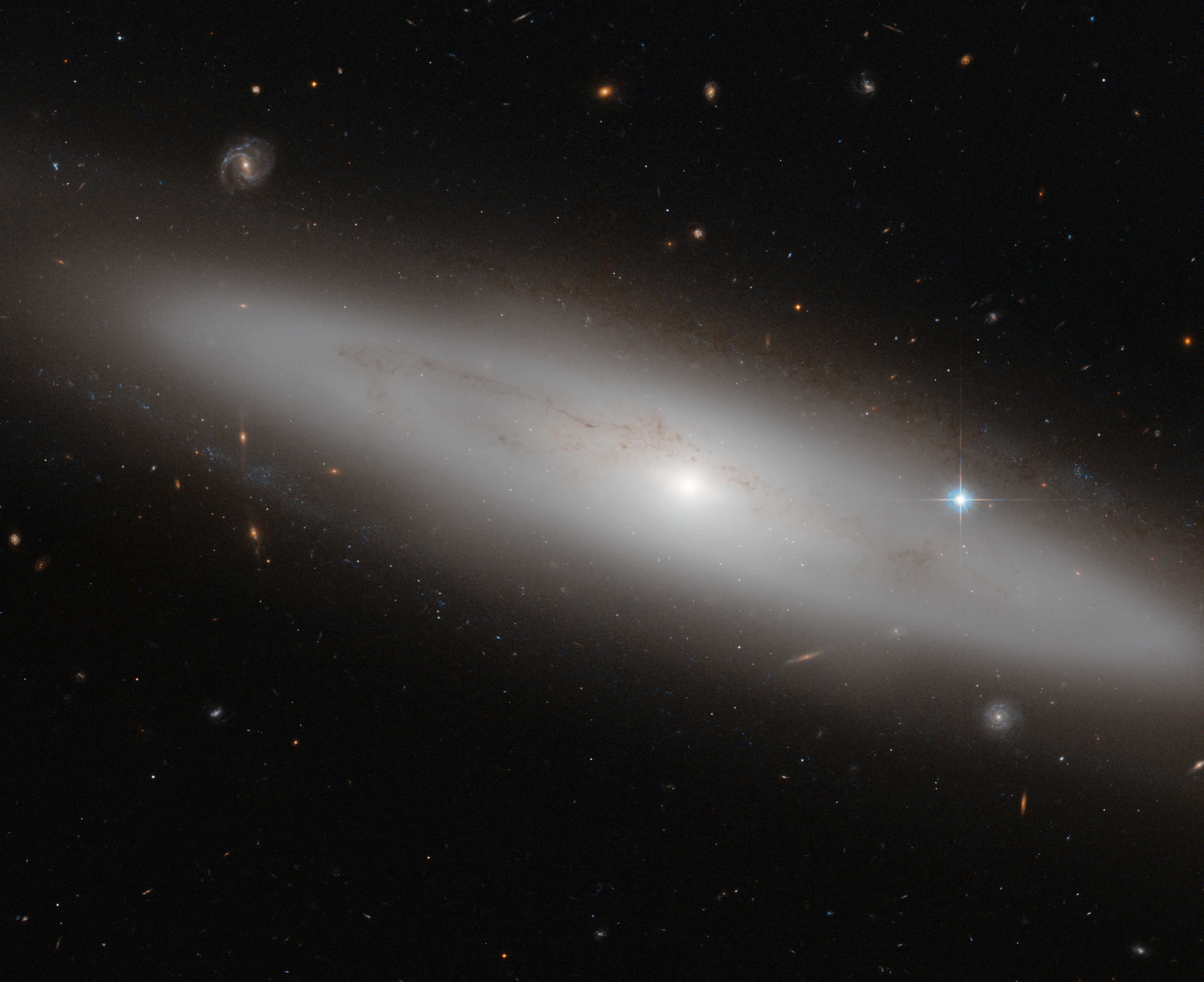
The constellation of Virgo (The Virgin) is the largest of the Zodiac constellations, and the second largest overall after Hydra (The Water Snake). Its most appealing feature, however, is the sheer number of galaxies that lie within it. In this picture, among a crowd of face- and edge-on spiral, elliptical, and irregular galaxies, lies NGC 4866, a lenticular galaxy situated about 80 million light-years from Earth.

Lenticular galaxies are somewhere between spirals and ellipticals in terms of shape and properties. From the picture, we can appreciate the bright central bulge of NGC 4886, which contains primarily old stars, but no spiral arms are visible. The galaxy is seen from Earth as almost edge-on, meaning that the disc structure — a feature not present in elliptical galaxies — is clearly visible. Faint dust lanes trace across NGC 4866 in this image, obscuring part of the galaxy’s light.

To the right of the galaxy is a very bright star that appears to lie within NGC 4886’s halo. However, this star actually lies much closer to us; in front of the galaxy, along our line of sight. These kinds of perspective tricks are common when observing, and can initially deceive astronomers as to the true nature and position of objects such as galaxies, stars, and clusters.

This sharp image of NGC 4866 was captured by the Advanced Camera for Surveys, an instrument on the NASA/ESA Hubble Space Telescope. A version was entered into the Hubble’s Hidden Treasures image processing competition by contestant Gilles Chapdelaine.


Source: ESA/HUBBLE - Space Telescope


Hubble Shows Link Between Stars' Ages and Their Orbits in Dense Cluster


Globular Cluster 47 Tucanae  
Credit: NASA, ESA, Digitized Sky Survey (DSS; STScI/AURA/UKSTU/AAO), H. Richer and J. Heyl (University of British Columbia), and J. Anderson and J. Kalirai (STScI). More Images

Astronomers using NASA's Hubble Space Telescope have for the first time linked two distinct populations of stars in an ancient globular star cluster to their unique orbital dynamics, offering proof that the stars do not share the same birth date.

The analysis of the globular cluster 47 Tucanae shows that the two populations differ in age by less than 100 million years. The cluster resides roughly 16,700 light-years away in the southern constellation Tucana.

Researchers, led by Harvey Richer of the University of British Columbia in Vancouver, combined recent Hubble observations with eight years' worth of data from the telescope's archive to determine the motions of the stars in this cluster.

Previous spectroscopic studies revealed that many globular clusters contain stars of varying chemical compositions, suggesting multiple episodes of star birth. This Hubble analysis, however, goes a step further, adding the stars' orbital motion to the analysis.

"When analyzing the motions of stars, the longer the time baseline for observations, the more accurately we can measure their motion," Richer explained. "These data are so good, we can actually see for the first time the individual motions of the stars in the cluster. The data offer detailed evidence to help us understand how various stellar populations formed in such clusters."

The Milky Way's globular clusters are the surviving relics from our galaxy's formation. They offer insights into the early history of our galaxy. 47 Tucanae is 10.5 billion years old and one of the brightest of our galaxy's more than 150 globular clusters. The cluster measures about 120 light-years wide.

Richer and his team used Hubble's Advanced Camera for Surveys in 2010 to observe the cluster. They combined those observations with 754 archival images to accurately measure the changes in positions of more than 30,000 stars. Using these data, they could discern how fast the stars are moving. The team also measured the stellar luminosities as well as temperatures.

This stellar archaeology identified the two distinct populations of stars. The first consists of redder stars, which are older, less chemically enriched, and in random, circularized orbits. The second population comprises bluer stars, which are younger, more chemically enhanced, and in more elliptical orbits.

"The redder generation, which is deficient in heavier elements, reflects the initial motion of the gas that formed the cluster," Richer said. "These stars have retained a memory of their original motion."

After the most massive of these stars completed their stellar evolution, they expelled gas enriched with heavier elements back into the cluster. This gas collided with other gas and formed a second, more chemically enriched generation of stars that was concentrated towards the cluster center. Slowly over time these stars have been moving outwards, putting them on more radial orbits.

This discovery is not the first for Hubble in revealing multiple generations of stars in globular clusters. In 2007 Hubble researchers found three generations of stars in the massive globular cluster NGC 2808. Richer's team, however, linked stellar dynamics to separate populations for the first time. Finding multiple stellar populations in globular clusters has deep cosmological implications. Astronomers need to solve future enigmas of these multiple generations to better understand how stars formed in distant galaxies in the early universe.

The team's results are published in the July 1 issue of The Astrophysical Journal Letters.

CONTACT

Donna Weaver / Ray Villard
Space Telescope Science Institute, Baltimore, Md.
410-338-4493 / 410-338-4514

dweaver@stsci.edu / villard@stsci.edu

Harvey Richer
University of British Columbia, Vancouver, BC, Canada
604-822-4134

richer@astro.ubc.ca


Thursday, July 18, 2013

Snow in an Infant Planetary System

Artist’s impression of snow lines around TW Hydrae
ALMA image of the carbon monoxide snow line
Snow line distance compared to the Solar System

A frosty landmark for planet and comet formation

 
A snow line has been imaged in a far-off infant planetary system for the very first time. The snow line, located in the disc around the Sun-like star TW Hydrae, promises to tell us more about the formation of planets and comets, the factors that decide their composition, and the history of the Solar System. The results are published today in Science Express.

Astronomers using the Atacama Large Millimeter/submillimeter Array (ALMA) have taken the first ever image of the snow line in an infant planetary system. On Earth, snow lines form at high altitudes where falling temperatures turn the moisture in the air into snow. This line is clearly visible on a mountain, where the snow-capped summit ends and the rocky face begins.

The snow lines around young stars form in a similar way, in the distant, colder reaches of the dusty discs from which planetary systems form. Starting from the star and moving outwards, water (H2O) is the first to freeze, forming the first snow line. Further out from the star, as temperatures drop, more exotic molecules can freeze and turn to snow, such as carbon dioxide (CO2), methane (CH4), and carbon monoxide (CO). These different snows give the dust grains a sticky outer coating and play an essential role in helping the grains to overcome their usual tendency to break up in collisions, allowing them to become the crucial building blocks of planets and comets. The snow also increases how much solid matter is available and may dramatically speed up the planetary formation process.

Each of these different snow lines — for water, carbon dioxide, methane and carbon monoxide — may be linked to the formation of particular kinds of planets [1]. Around a Sun-like star in a planetary system like our own, the water snow line would correspond to a distance between the orbits of Mars and Jupiter, and the carbon monoxide snow line would correspond to the orbit of Neptune.

The snow line spotted by ALMA is the first glimpse of the carbon monoxide snow line, around TW Hydrae, a young star 175 light-years away from Earth. Astronomers believe this budding planetary system shares many of the same characteristics of the Solar System when it was just a few million years old.

ALMA has given us the first real picture of a snow line around a young star, which is extremely exciting because of what it tells us about the very early period in the history of the Solar System,” said Chunhua “Charlie” Qi (Harvard-Smithsonian Center for Astrophysics, Cambridge, USA) one of the two lead authors of the paper. “We can now see previously hidden details about the frozen outer reaches of another planetary system similar to our own.”

But the presence of a carbon monoxide snow line could have greater consequences than just the formation of planets. Carbon monoxide ice is needed to form methanol, which is a building block of the more complex organic molecules that are essential for life. If comets ferried these molecules to newly forming Earth-like planets, these planets would then be equipped with the ingredients necessary for life.

Before now, snow lines had never been imaged directly because they always form in the relatively narrow central plane of a protoplanetary disc, so their precise location and extent could not be determined. Above and below the narrow region where snow lines exist, the star’s radiation prevents ice formation. The dust and gas concentration in the central plane is necessary to insulate the area from the radiation so that carbon monoxide and other gases can cool and freeze.

This team of astronomers succeeded in peering inside this disc to where the snow has formed with the help of a clever trick. Instead of looking for the snow — as it cannot be observed directly — they searched for a molecule known as diazenylium (N2H+), which shines brightly in the millimetre portion of the spectrum, and so is a perfect target for a telescope such as ALMA. The fragile molecule is easily destroyed in the presence of carbon monoxide gas, so would only appear in detectable amounts in regions where carbon monoxide had become snow and could no longer destroy it. In essence, the key to finding carbon monoxide snow lies in finding diazenylium.

ALMA's unique sensitivity and resolution has allowed the astronomers to trace the presence and distribution of diazenylium and find a clearly defined boundary approximately 30 astronomical units from the star (30 times the distance between the Earth and the Sun). This gives, in effect, a negative image of the carbon monoxide snow in the disc surrounding TW Hydrae, which can be used to see the carbon monoxide snow line precisely where theory predicts it should be — the inner rim of the diazenylium ring.

"For these observations we used only 26 of ALMA's eventual full complement of 66 antennas. Indications of snow lines around other stars are already showing up in other ALMA observations, and we are convinced that future observations with the full array will reveal many more of these and provide further, exciting insights into the formation and evolution of planets. Just wait and see,” concludes Michiel Hogerheijde from Leiden Observatory, the Netherlands.

Notes

[1] For instance dry rocky planets form on the inner side of the water snow line (nearest the star), where only dust can exist. At the other extreme are the icy giant planets which form beyond the carbon monoxide snow line.

More information

The Atacama Large Millimeter/submillimeter Array (ALMA), an international astronomy facility, is a partnership of Europe, North America and East Asia in cooperation with the Republic of Chile. ALMA is funded in Europe by the European Southern Observatory (ESO), in North America by the U.S. National Science Foundation (NSF) in cooperation with the National Research Council of Canada (NRC) and the National Science Council of Taiwan (NSC) and in East Asia by the National Institutes of Natural Sciences (NINS) of Japan in cooperation with the Academia Sinica (AS) in Taiwan. ALMA construction and operations are led on behalf of Europe by ESO, on behalf of North America by the National Radio Astronomy Observatory (NRAO), which is managed by Associated Universities, Inc. (AUI) and on behalf of East Asia by the National Astronomical Observatory of Japan (NAOJ). The Joint ALMA Observatory (JAO) provides the unified leadership and management of the construction, commissioning and operation of ALMA.

This research was presented in a paper appearing in the 18 July 2013 issue of Science Express.
The team is composed of C. Qi (Harvard-Smithsonian Center for Astrophysics, USA), K. I. Öberg (Departments of Chemistry and Astronomy, University of Virginia, USA), D. J. Wilner (Harvard-Smithsonian Center for Astrophysics, USA), P. d’Alessio (Centro de Radioastronomía y Astrofisica, Universidad Nacional Autónoma de Mexico, Mexico), E. Bergin (Department of Astronomy, University of Michigan, USA), S. M. Andrews (Harvard-Smithsonian Center for Astrophysics, USA), G. A. Blake (Division of Geological and Planetary Sciences, California Institute of Technology, USA), M. R. Hogerheijde (Leiden Observatory, Leiden University, Netherlands) and E. F. van Dishoeck (Max Planck Institute for Extraterrestrial Physics, Germany).

Qi and Öberg were joint lead authors of this work.

ESO is the foremost intergovernmental astronomy organisation in Europe and the world’s most productive ground-based astronomical observatory by far. It is supported by 15 countries: Austria, Belgium, Brazil, the Czech Republic, Denmark, France, Finland, Germany, Italy, the Netherlands, Portugal, Spain, Sweden, Switzerland and the United Kingdom. ESO carries out an ambitious programme focused on the design, construction and operation of powerful ground-based observing facilities enabling astronomers to make important scientific discoveries. ESO also plays a leading role in promoting and organising cooperation in astronomical research. ESO operates three unique world-class observing sites in Chile: La Silla, Paranal and Chajnantor. At Paranal, ESO operates the Very Large Telescope, the world’s most advanced visible-light astronomical observatory and two survey telescopes. VISTA works in the infrared and is the world’s largest survey telescope and the VLT Survey Telescope is the largest telescope designed to exclusively survey the skies in visible light. ESO is the European partner of a revolutionary astronomical telescope ALMA, the largest astronomical project in existence. ESO is currently planning the 39-metre European Extremely Large optical/near-infrared Telescope, the E-ELT, which will become “the world’s biggest eye on the sky”.

Links

Contacts

Chunhua Qi
Harvard-Smithsonian Center for Astrophysics
Cambridge, Mass., USA
Tel: +1 617 495 7087
Email:
cqi@cfa.harvard.edu

Michiel Hogerheijde
Leiden Observatory
Leiden, The Netherlands
Tel: +31 6 4308 3291
Email:
michiel@strw.leidenuniv.nl

Richard Hook
ESO, Public Information Officer
Garching bei München, Germany
Tel: +49 89 3200 6655
Cell: +49 151 1537 3591
Email:
rhook@eso.org


Earth's Gold Came from Colliding Dead Stars

 
This artist's conception portrays two neutron stars at the moment of collision. New observations confirm that colliding neutron stars produce short gamma-ray bursts. Such collisions produce rare heavy elements, including gold. All Earth's gold likely came from colliding neutron stars.  Credit: Dana Berry, SkyWorks Digital, Inc.  High Resolution Image (jpg) - Low Resolution Image (jpg) - More images

This animation shows the collision and merger of two neutron stars. Merging neutron stars can create an event known as a short gamma-ray burst.Credit: Dana Berry, SkyWorks Digital, Inc. Low Resolution Image (jpg) - Animation (mov)

Cambridge, MA - We value gold for many reasons: its beauty, its usefulness as jewelry, and its rarity. Gold is rare on Earth in part because it's also rare in the universe. Unlike elements like carbon or iron, it cannot be created within a star. Instead, it must be born in a more cataclysmic event - like one that occurred last month known as a short gamma-ray burst (GRB). Observations of this GRB provide evidence that it resulted from the collision of two neutron stars - the dead cores of stars that previously exploded as supernovae. Moreover, a unique glow that persisted for days at the GRB location potentially signifies the creation of substantial amounts of heavy elements - including gold. 

"We estimate that the amount of gold produced and ejected during the merger of the two neutron stars may be as large as 10 moon masses - quite a lot of bling!" says lead author Edo Berger of the Harvard-Smithsonian Center for Astrophysics (CfA). 

Berger presented the finding today in a press conference at the CfA in Cambridge, Mass. 

A gamma-ray burst is a flash of high-energy light (gamma rays) from an extremely energetic explosion. Most are found in the distant universe. Berger and his colleagues studied GRB 130603B which, at a distance of 3.9 billion light-years from Earth, is one of the nearest bursts seen to date.
Gamma-ray bursts come in two varieties - long and short - depending on how long the flash of gamma rays lasts. GRB 130603B, detected by NASA's Swift satellite on June 3rd, lasted for less than two-tenths of a second.
Although the gamma rays disappeared quickly, GRB 130603B also displayed a slowly fading glow dominated by infrared light. Its brightness and behavior didn't match a typical "afterglow," which is created when a high-speed jet of particles slams into the surrounding environment. 

Instead, the glow behaved like it came from exotic radioactive elements. The neutron-rich material ejected by colliding neutron stars can generate such elements, which then undergo radioactive decay, emitting a glow that's dominated by infrared light - exactly what the team observed. 

"We've been looking for a 'smoking gun' to link a short gamma-ray burst with a neutron star collision. The radioactive glow from GRB 130603B may be that smoking gun," explains Wen-fai Fong, a graduate student at the CfA and a co-author of the paper. 

The team calculates that about one-hundredth of a solar mass of material was ejected by the gamma-ray burst, some of which was gold. By combining the estimated gold produced by a single short GRB with the number of such explosions that have occurred over the age of the universe, all the gold in the cosmos might have come from gamma-ray bursts. 

"To paraphrase Carl Sagan, we are all star stuff, and our jewelry is colliding-star stuff," says Berger. 

The team's results have been submitted for publication in The Astrophysical Journal Letters and are available online. Berger's co-authors are Wen-fai Fong and Ryan Chornock, both of the CfA. 

Headquartered in Cambridge, Mass., the Harvard-Smithsonian Center for Astrophysics (CfA) is a joint collaboration between the Smithsonian Astrophysical Observatory and the Harvard College Observatory. CfA scientists, organized into six research divisions, study the origin, evolution and ultimate fate of the universe.

For more information, contact:

David A. Aguilar
Director of Public Affairs
Harvard-Smithsonian Center for Astrophysics
617-495-7462

daguilar@cfa.harvard.edu

 
Christine Pulliam
Public Affairs Specialist
Harvard-Smithsonian Center for Astrophysics
617-495-7463

cpulliam@cfa.harvard.edu

Wednesday, July 17, 2013

Ripped Apart by a Black Hole

 
Images of gas cloud being ripped apart by the black hole 
at the centre of the Milky Way
 
Simulation of gas cloud being ripped apart by the black hole 
at the centre of the Milky Way
 
Gas cloud being ripped apart by the black hole 
at the centre of the Milky Way
 
Gas cloud being ripped apart by the black hole 
at the centre of the Milky Way (annotated)
 
Images of gas cloud being ripped apart by the black hole 
at the centre of the galaxy 


Videos

Simulation of gas cloud being ripped apart by the black hole at the centre of the Milky Way
Simulation of gas cloud being ripped apart by the black hole 
at the centre of the Milky Way

Gas cloud being ripped apart by the black hole at the centre of the Milky Way
Gas cloud being ripped apart by the black hole 
at the centre of the Milky Way

Gas cloud falling in towards the black hole at the centre of the Milky Way
Gas cloud falling in towards the black hole 
at the centre of the Milky Way


LT watches in real time as gas cloud makes closest approach to the monster at the centre of the Milky Way

 
New observations from ESO’s Very Large Telescope show for the first time a gas cloud being ripped apart by the supermassive black hole at the centre of the galaxy. The cloud is now so stretched that its front part has passed the closest point and is travelling away from the black hole at more than 10 million km/h, whilst the tail is still falling towards it.

In 2011 ESO's Very Large Telescope (VLT) discovered a gas cloud with several times the mass of the Earth accelerating towards the black hole at the centre of the Milky Way (eso1151) [1]. This cloud is now making its closest approach and new VLT observations show that it is being grossly stretched by the black hole’s extreme gravitational field.

"The gas at the head of the cloud is now stretched over more than 160 billion kilometres around the closest point of the orbit to the black hole. And the closest approach is only a bit more than 25 billion kilometres from the black hole itself — barely escaping falling right in," explains Stefan Gillessen (Max Planck Institute for Extraterrestrial Physics, Garching, Germany) who led the observing team [2]. "The cloud is so stretched that the close approach is not a single event but rather a process that extends over a period of at least one year."

As the gas cloud is stretched its light gets harder to see. But by staring at the region close to the black hole for more than 20 hours of total exposure time with the SINFONI instrument on the VLT — the deepest exposure of this region ever with an integral field spectrometer [3] — the team was able to measure the velocities of different parts of the cloud as it streaks past the central black hole [4].

"The most exciting thing we now see in the new observations is the head of the cloud coming back towards us at more than 10 million km/h along the orbit — about 1% of the speed of light," adds Reinhard Genzel, leader of the research group that has been studied this region for nearly twenty years. "This means that the front end of the cloud has already made its closest approach to the black hole."
The origin of the gas cloud remains mysterious, although there is no shortage of ideas [5]. The new observations narrow down the possibilities.

"Like an unfortunate astronaut in a science fiction film, we see that the cloud is now being stretched so much that it resembles spaghetti. This means that it probably doesn’t have a star in it," concludes Gillessen. "At the moment we think that the gas probably came from the stars we see orbiting the black hole."

The climax of this unique event at the centre of the galaxy is now unfolding and being closely watched by astronomers around the world. This intense observing campaign will provide a wealth of data, not only revealing more about the gas cloud [6], but also probing the regions close to the black hole that have not been previously studied and the effects of super-strong gravity.

Notes

[1] The black hole at the centre of the Milky Way is estimated to have a mass of about four million times that of the Sun and is formally known as Sgr A* (pronounced Sagittarius A star). It is the closest supermassive black hole known by far and hence is the best place to study black holes in detail. The study of the supermassive black hole at the centre of the galaxy and its environment is rated number one in the list of ESO's top ten astronomical discoveries.

[2] The distance of closest approach is about five times the distance of the planet Neptune from the Sun. This is much too close for comfort to a black hole with a mass four million times that of the Sun!

[3] In an integral field spectrometer the light recorded in each pixel is separately spread out into its component colours and so spectra are recorded for each pixel. The spectra can then be analysed individually and used to create maps of the velocities and the chemical properties of each part of the object, for example.

[4] The team is also hoping to see evidence of how the rapidly moving cloud interacts with any ambient gas around the black hole. So far nothing has been found, but further observations are planned to look for such effects.

[5] Astronomers thought that the gas cloud might have been created by stellar winds from the stars orbiting the black hole. Or possibly even be the result of a jet from the galactic centre. Another option was that a star was at the centre of the cloud. In this case the gas would come either from a wind from the star, or from a planet-forming disc of gas and dust around the star.

[6] As this event at the centre of the galaxy unfolds, astronomers expect to see that the evolution of the cloud switches from purely gravitational and tidal to complex, turbulent hydrodynamics.

More information

This research was presented in a paper "Pericenter passage of the gas cloud G2 in the Galactic Center", by S. Gillessen et al, to appear in the Astrophysical Journal.


The team is composed of S. Gillessen (Max Planck Institute for Extraterrestrial Physics, Garching, Germany [MPE]), R. Genzel (MPE; Departments of Physics and Astronomy, University of California, Berkeley, USA), T. K. Fritz (MPE), F. Eisenhauer (MPE), O. Pfuhl (MPE), T. Ott (MPE), M. Schartmann (Universitätssternwarte der Ludwig-Maximilians-Universität, Munich, Germany [USM]; MPE), A. Ballone (USM; MPE) and A. Burkert (USM; MPE).


ESO is the foremost intergovernmental astronomy organisation in Europe and the world’s most productive ground-based astronomical observatory by far. It is supported by 15 countries: Austria, Belgium, Brazil, the Czech Republic, Denmark, France, Finland, Germany, Italy, the Netherlands, Portugal, Spain, Sweden, Switzerland and the United Kingdom. ESO carries out an ambitious programme focused on the design, construction and operation of powerful ground-based observing facilities enabling astronomers to make important scientific discoveries. ESO also plays a leading role in promoting and organising cooperation in astronomical research. ESO operates three unique world-class observing sites in Chile: La Silla, Paranal and Chajnantor. At Paranal, ESO operates the Very Large Telescope, the world’s most advanced visible-light astronomical observatory and two survey telescopes. VISTA works in the infrared and is the world's largest survey telescope and the VLT Survey Telescope is the largest telescope designed to exclusively survey the skies in visible light. ESO is the European partner of a revolutionary astronomical telescope ALMA, the largest astronomical project in existence. ESO is currently planning the 39-metre European Extremely Large optical/near-infrared Telescope, the E-ELT, which will become "the world's biggest eye on the sky".

Links

Contacts

Stefan Gillessen
Max Planck Institute for Extraterrestrial Physics
Garching bei München, Germany
Tel: +49 89 30000 3839
Email:
ste@mpe.mpg.de

Reinhard Genzel
Max Planck Institute for Extraterrestrial Physics
Garching bei München, Germany
Tel: +49 89 30000 3281
Email:
genzel@mpe.mpg.de

Richard Hook
ESO, La Silla, Paranal, E-ELT & Survey Telescopes Press Officer
Garching bei München, Germany
Tel: +49 89 3200 6655
Email:
rhook@eso.org

Tuesday, July 16, 2013

Hubble Finds New Neptune Moon

S/2004 N 1
Credit: NASA, ESA, and M. Showalter (SETI Institute)

NASA's Hubble Space Telescope has discovered a new moon orbiting the distant blue-green planet Neptune. This brings the number of known satellites circling the giant planet to 14.

The body is estimated to be no more than 12 miles across, making it the smallest known moon in the Neptunian system. It's so small that it escaped detection by NASA's Voyager 2 spacecraft, which flew by Neptune in 1989 and surveyed the planet's system of moons and rings.

Mark Showalter of the SETI Institute in Mountain View, Calif., discovered the moon on July 1, while studying the faint ring-arcs of Neptune. "The moons and arcs orbit very quickly, so we had to devise a way to follow their motion in order to bring out the details of the system," he said. "It's the same reason a sports photographer tracks a running athlete — the athlete stays in focus, but the background blurs."

On a whim, Showalter extended his analysis outward to regions well beyond the ring system, and noticed an extra white dot about 65,400 miles from Neptune, located between the orbits of the moons Larissa and Proteus.

Showalter next analyzed over 150 archival Neptune photographs taken by Hubble from 2004 to 2009. The same white dot appeared over and over again. He then plotted a circular orbit for the moon, which completes one revolution around Neptune every 23 hours.

The moon, designated S/2004 N 1, is so small and dim that it is roughly one hundred million times fainter than the faintest star that can be seen with the naked eye.

Neptune's largest moon, Triton, which is nearly the size of Earth's moon, may be a captured icy dwarf planet from the Kuiper Belt at the outer rim of our solar system. This capture would have gravitationally torn up any original satellite system Neptune possessed. Many of the moons now seen orbiting the planet probably formed after Triton settled into its unusual retrograde orbit about Neptune.

CONTACT

Donna Weaver / Ray Villard
Space Telescope Science Institute, Baltimore, Md.
410-338-4493 / 410-338-4514

dweaver@stsci.edu / villard@stsci.edu
 
Karen Randall
SETI Institute, Mountain View, Calif.
650-960-4537

krandall@seti.org

Monday, July 15, 2013

Disks Don't Need Planets to Make Patterns

Debris disks around stars naturally form complex structures without the presence of a planet. This image shows the dust density and the growth of structure in a simulated disk, which extends about 100 times farther from its star than Earth's orbit around the sun. At left, the disk is seen from 24-degree angle; at right, it's face-on. Lighter colors show greater dust concentrations. Image credit: NASA Goddard/JPL-Caltech.  › Larger image

Many young stars known to host planets also possess disks containing dust and icy grains, particles produced by collisions among asteroids and comets also orbiting the star. These debris disks often show sharply defined rings or spiral patterns, features that could signal the presence of orbiting planets. Astronomers study the disk features as a way to better understand the physical properties of known planets and possibly uncover new ones. 

But a new study by NASA scientists sounds a cautionary note in interpreting rings and spiral arms as signposts for new planets. Thanks to interactions between gas and dust, a debris disk may, under the right conditions, produce narrow rings on its own -- no planets needed. 

"When the mass of gas is roughly equal to the mass of dust, the two interact in a way that leads to clumping in the dust and the formation of patterns," said lead researcher Wladimir Lyra, a Sagan Fellow at NASA's Jet Propulsion Laboratory in Pasadena, Calif. "In essence, the gas shepherds the dust into the kinds of structures we would expect to be see if a planet were present." 

A paper describing the findings was published in the July 11 issue of Nature. 

The warm dust in debris disks is easy to detect at infrared wavelengths, but estimating the gas content of disks is a much greater challenge. As a result, theoretical studies tend to focus on the role of dust and ice particles, paying relatively little attention to the gas component. Yet icy grains evaporate and collisions produce both gas and dust, so at some level all debris disks must contain some amount of gas. 

"All we need to produce narrow rings and other structures in our models of debris disks is a bit of gas, too little for us to detect today in most actual systems," said co-author Marc Kuchner, an astrophysicist at NASA's Goddard Space Flight Center in Greenbelt, Md. 

Here's how it works. When high-energy ultraviolet light from the central star strikes a clump of dust and ice grains, it drives electrons off the particles. These high-speed electrons then collide with and heat nearby gas.
The rising gas pressure changes the drag force on the orbiting dust, causing the clump to grow and better heat the gas. This interaction, which the astronomers refer to as the photoelectric instability, continues to cascade. Clumps grow into arcs, rings and oval features in tens of thousands of years, a relatively short time compared to other forces at work in a young solar system. 

A model developed by Lyra and Kuchner shows the process at work. 

"We were fascinated to watch this structure form in the simulations," Lyra said. "Some of the rings begin to oscillate, and at any moment they have the offset appearance of dust rings we see around many stars, such as Fomalhaut." 

In addition, dense clumps with many times the dust density elsewhere in the disk also form during the simulation. When a clump in a ring grows too dense, the ring breaks into arcs and the arcs gradually shrink until only a single compact clump remains. In actual debris disks, some of these dense clumps could reflect enough light to be directly observable. 

"We would detect these clumps as bright moving sources of light, which is just what we're looking for when we search for planets," adds Kuchner.
The researchers conclude that the photoelectric instability provides a simple and plausible explanation for many of the features found in debris disks, making the job of planet-hunting astronomers just a little bit harder. 

An abstract for the Nature paper, titled "Sharp Eccentric Rings in Planetless Hydrodynamical Models of Debris Disks," is online at http://dx.doi.org/10.1038/nature12281

The Sagan Fellowship Program is administered by the NASA Exoplanet Science Institute at the California Institute of Technology in Pasadena. Its purpose is to advance the scientific and technical goals of NASA's Exoplanet Exploration Program, managed for NASA by JPL. Caltech manages JPL for NASA. 


Whitney Clavin 818-354-4673
Jet Propulsion Laboratory, Pasadena, Calif.

whitney.clavin@jpl.nasa.gov


Saturday, July 13, 2013

New insights concerning the early bombardment history on Mercury

Mercury image courtesy of John Hopkins APL. Download Image


The figure shows an image of Mercury's surface (left; obtained using publicly available mosaic of Mercury from the MESSENGER spacecraft found at http://messenger.jhuapl.edu/) and a color-coded view of the global crater areal density (right), obtained by measuring craters greater than 25 km. The region within the white line corresponds to the heavily cratered terrains analyzed to calculate the age of the oldest surfaces on Mercury.

Boulder, Colo. —  The surface of Mercury is rather different from those of well-known rocky bodies like the Moon and Mars. Early images from the Mariner 10 spacecraft unveiled a planet covered by smooth plains and cratered plains of unclear origin. A team led by Dr. Simone Marchi, a Fellow of the NASA Lunar Science Institute located at the Southwest Research Institute (SwRI) Boulder, Colo., office, collaborating with the MESSENGER team, including Dr. Clark Chapman of the SwRI Planetary Science Directorate, studied the surface to better understand if the plains were formed by volcanic flows or composed of material ejected from the planet's giant impact basins.

Recent images from NASA's MESSENGER (MErcury Surface, Space ENvironment, GEochemistry, and Ranging) spacecraft provided new insights showing that at least the younger plains resulted from vigorous volcanic activity. Yet scientists were unable to establish limits on how far into the past this volcanic activity may have occurred, or how much of the planet's surface may have been resurfaced by very old volcanic plains.

Now, a team of scientists has concluded that the oldest visible terrains on Mercury have an age of 4 billion to 4.1 billion years, and that the first 400 to 500 million years of the planet's evolution are not recorded on its surface. To reach its conclusion, the team measured the sizes and numbers of craters on the most heavily cratered terrains using images obtained by the MESSENGER spacecraft during its first year in orbit around Mercury. Team members then extrapolated to Mercury a model that was originally developed for comparing the Moon's crater distribution to a chronology based on the ages of rock samples gathered during the Apollo missions.

The study, "Global Resurfacing of Mercury 4.0-4.1 Billion Years Ago by Heavy Bombardment and Volcanism" by Marchi, Chapman, Caleb I. Fassett, James W. Head, William F. Bottke and Robert G. Strom, is in the July 4 issue of the journal Nature.

"By comparing the measured craters to the number and spatial distribution of large impact basins on Mercury, we found that they started to accumulate at about the same time, suggesting that the resetting of Mercury's surface was global and likely due to volcanism," said lead author Dr. Simone Marchi, who has a joint appointment between two of NASA's Lunar Science Institutes, one at the SwRI in Boulder and another at the Lunar and Planetary Institute in Houston.

Those results set the age boundary for the oldest terrains on Mercury to be contemporary with the so-called Late Heavy Bombardment (LHB), a period of intense asteroid and comet impacts recorded in lunar and asteroidal rocks and by the numerous craters on the Moon, Earth, and Mars, as well as Mercury.

"Meanwhile, the age of the youngest and broadest volcanic provinces visible on Mercury was determined to be about 3.6 billion to 3.8 billion years ago, just after the end of the Late Heavy Bombardment," Marchi said.

Altogether, the results indicate that the time agreement between the onset of the LHB and the global resurfacing of Mercury implies not only that the resurfacing was due to volcanism, but also, according to Chapman, that "the impact of large projectiles hitting Mercury's thin solid crust during the LHB may have enhanced the observed global resurfacing."

MESSENGER is a NASA-sponsored scientific investigation of the planet Mercury and the first space mission designed to orbit the planet closest to the Sun. The MESSENGER spacecraft launched on August 3, 2004, and entered orbit about Mercury on March 17, 2011. The Johns Hopkins University Applied Physics Laboratory built and operates the MESSENGER spacecraft and manages this Discovery-class mission for NASA.

The figure shows an image of Mercury's surface (left; obtained using publicly available mosaic of Mercury from the MESSENGER spacecraft found at http://messenger.jhuapl.edu/) and a color-coded view of the global crater areal density (right), obtained by measuring craters greater than 25 km. The region within the white line corresponds to the heavily cratered terrains analyzed to calculate the age of the oldest surfaces on Mercury.

Editors: An image is available at http://www.swri.org/press/2013/mercury-crater.htm.

For more information, contact Joe Fohn, (210) 522-4630, Communications Department, Southwest Research Institute, PO Drawer 28510, San Antonio, TX 78228-0510.

Friday, July 12, 2013

NGC 2392: A Beautiful End to a Star's Life

Credit  X-ray: NASA/CXC/IAA-CSIC/N.Ruiz et al, 
Optical: NASA/STScI


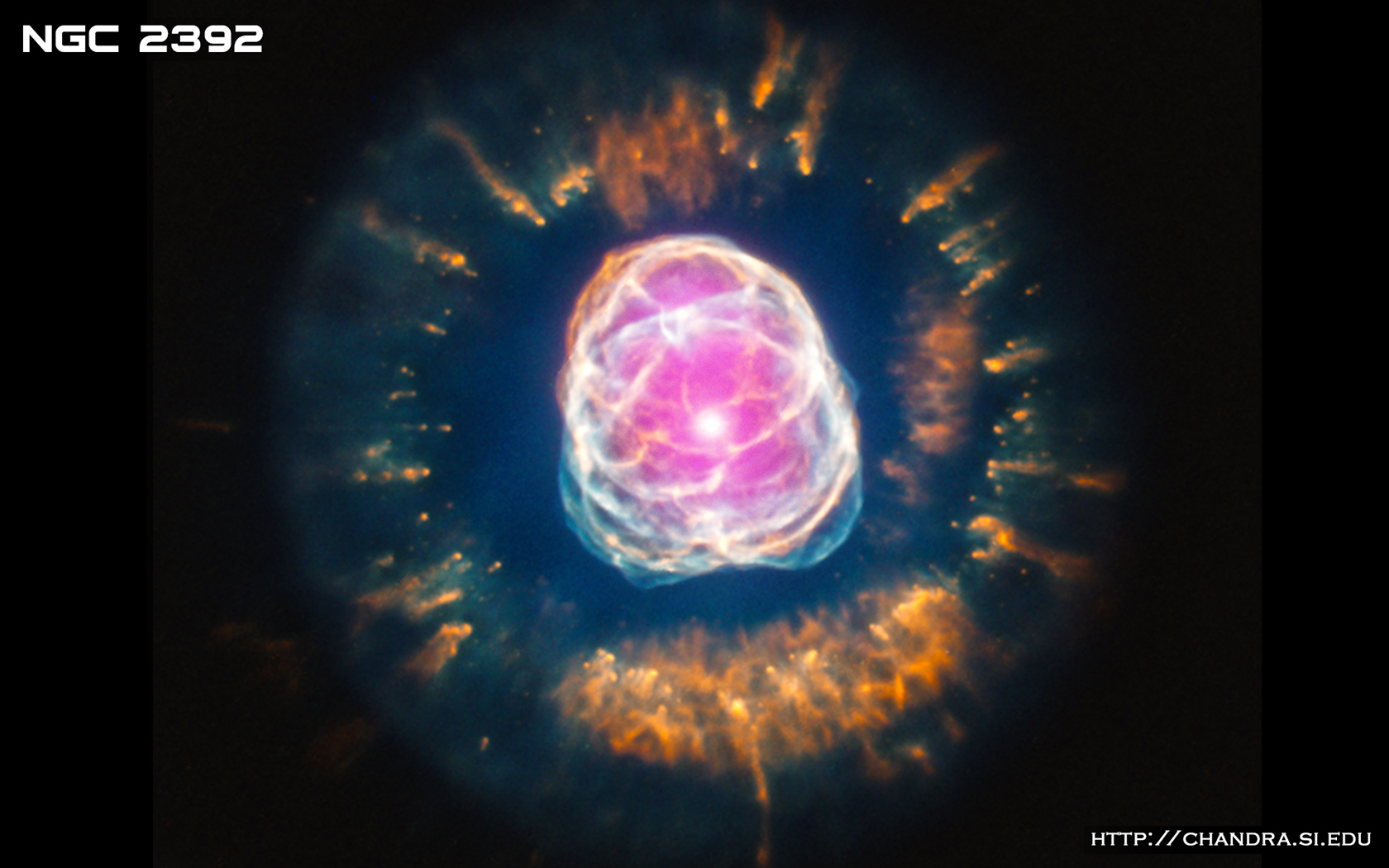
Stars like the Sun can become remarkably photogenic at the end of their life. A good example is NGC 2392, which is located about 4,200 light years from Earth. NGC 2392, (nicknamed the "Eskimo Nebula") is what astronomers call a planetary nebula. This designation, however, is deceiving because planetary nebulas actually have nothing to do with planets. The term is simply a historic relic since these objects looked like planetary disks to astronomers in earlier times looking through small optical telescopes.

Instead, planetary nebulas form when a star uses up all of the hydrogen in its core -- an event our Sun will go through in about five billion years. When this happens, the star begins to cool and expand, increasing its radius by tens to hundreds of times its original size. Eventually, the outer layers of the star are carried away by a 50,000 kilometer per hour wind, leaving behind a hot core. This hot core has a surface temperature of about 50,000 degrees Celsius, and is ejecting its outer layers in a much faster wind traveling six million kilometers per hour. The radiation from the hot star and the interaction of its fast wind with the slower wind creates the complex and filamentary shell of a planetary nebula. Eventually the remnant star will collapse to form a white dwarf star.

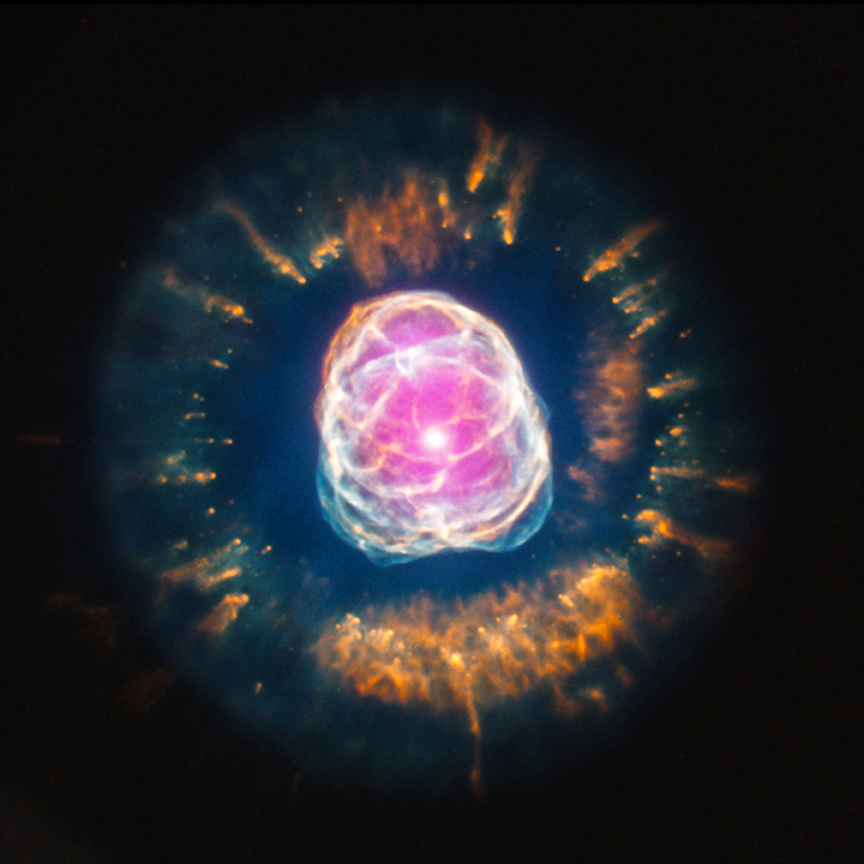
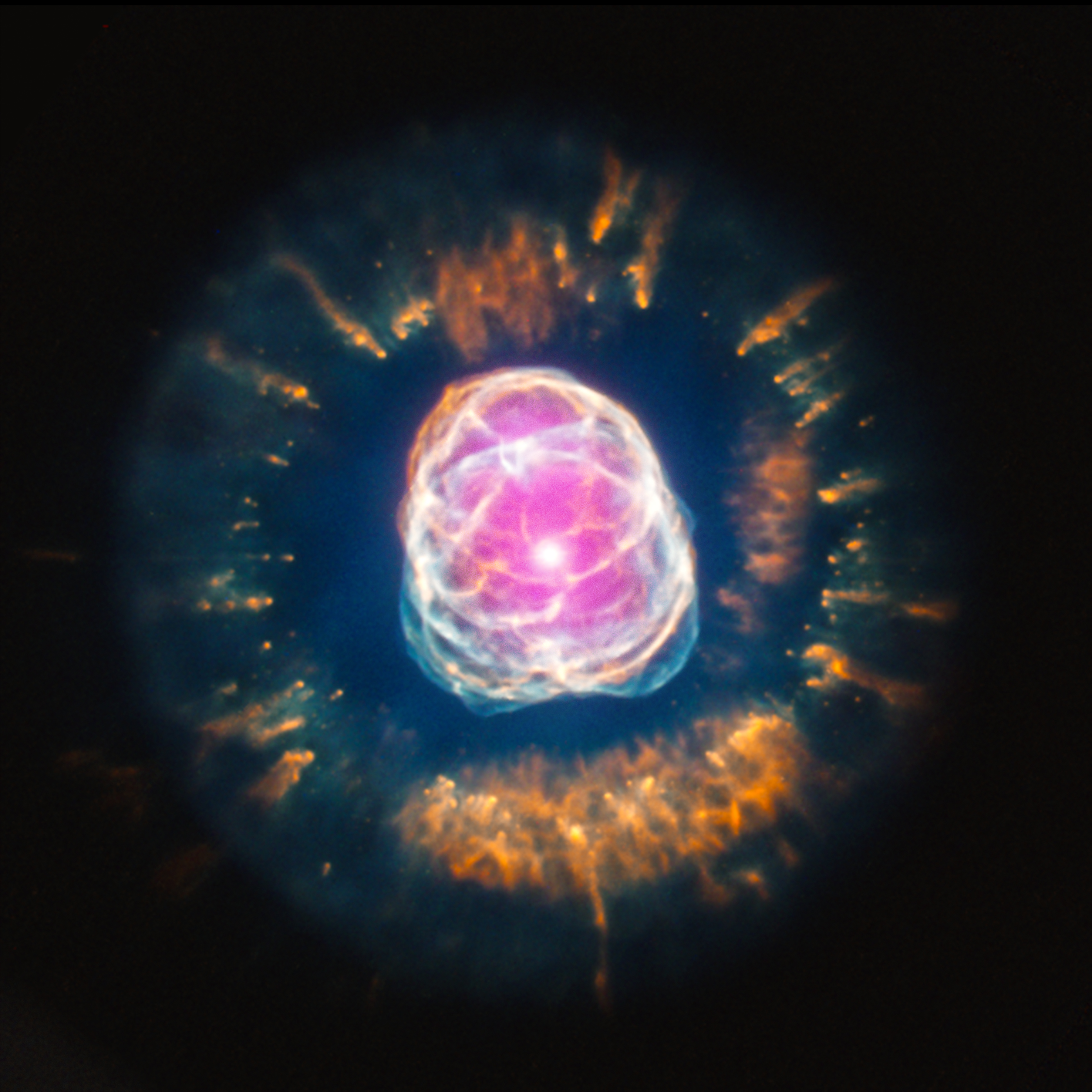
Now days, astronomers using space-based telescopes are able to observe planetary nebulas such as NGC 2392 in ways their scientific ancestors probably could never imagine. This composite image of NGC 2392 contains X-ray data from NASA's Chandra X-ray Observatory in purple showing the location of million-degree gas near the center of the planetary nebula. Data from the Hubble Space Telescope show — colored red, green, and blue — the intricate pattern of the outer layers of the star that have been ejected. The comet-shaped filaments form when the faster wind and radiation from the central star interact with cooler shells of dust and gas that were already ejected by the star.

The observations of NGC 2392 were part of a study of three planetary nebulas with hot gas in their center. The Chandra data show that NGC 2392 has unusually high levels of X-ray emission compared to the other two. This leads researchers to deduce that there is an unseen companion to the hot central star in NGC 2392. The interaction between a pair of binary stars could explain the elevated X-ray emission found there. Meanwhile, the fainter X-ray emission observed in the two other planetary nebulas in the sample — IC 418 and NGC 6826 — is likely produced by shock fronts (like sonic booms) in the wind from the central star. A composite image of NGC 6826 was included in a gallery of planetary nebulas released in 2012.

A paper describing these results is available online and was published in the April 10th, 2013 issue of The Astrophysical Journal. The first author is Nieves Ruiz of the Instituto de Astrofísica de Andalucía (IAA-CSIC) in Granada, Spain, and the other authors are You-Hua Chu, and Robert Gruendl from the University of Illinois, Urbana; Martín Guerrero from the Instituto de Astrofísica de Andalucía (IAA-CSIC) in Granada, Spain, and Ralf Jacob,Detlef Schönberner and Matthias Steffen from the Leibniz-Institut Für Astrophysik in Potsdam (AIP), Germany.

NASA's Marshall Space Flight Center in Huntsville, Ala., manages the Chandra program for NASA's Science Mission Directorate in Washington. The Smithsonian Astrophysical Observatory controls Chandra's science and flight operations from Cambridge, Mass.


Fast Facts for NGC 2392:

Scale: Image is 1 arcmin across (about 1.2 light years)
Category:  White Dwarfs & Planetary Nebulas
Coordinates (J2000): RA 07h 29m 10.80s | Dec +20 54 42.50
Constellation: Gemini
Observation Date: 09 Sep 2007
Observation Time: 15 hours 57 min
Obs. ID: 7421
Instrument: ACIS
Also Known As: Eskimo Nebula
References: Ruiz, N. et al, 2013, ApJ, 767, 35; arXiv:1302.3886
Color Code: X-ray (Pink), Optical (Red, Green, Blue)
Distance Estimate:  About 4,200 light years


Stars that go out with a whimper

Credit: ESA/Hubble & NASA
Acknowledgement: Serge Meunier 

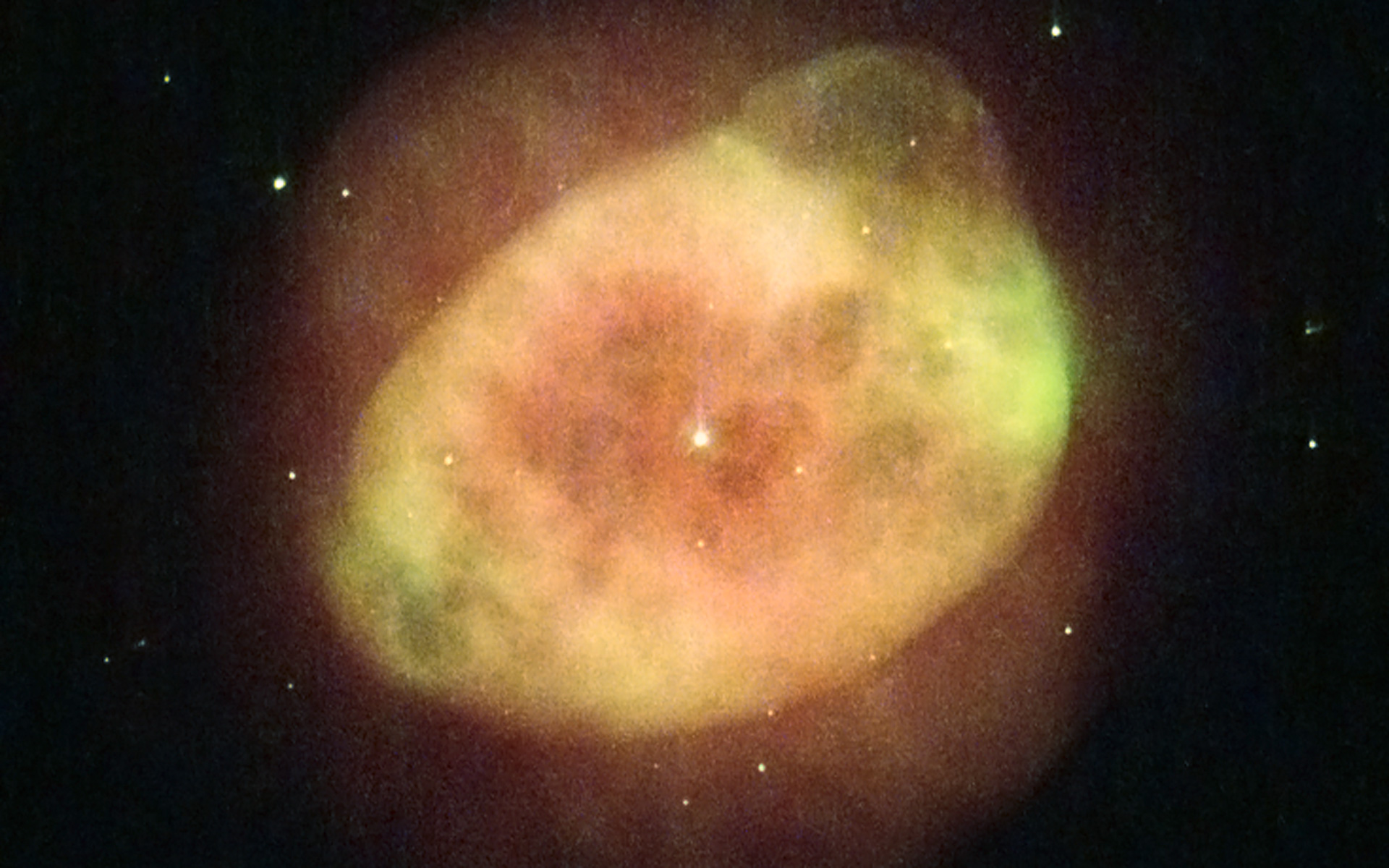
This NASA/ESA Hubble Space Telescope image shows the planetary nebula IC 289, located in the northern constellation of Cassiopeia. Formerly a star like our Sun, it is now just a cloud of ionised gas being pushed out into space by the remnants of the star’s core, visible as a small bright dot in the middle of the cloud.

Weirdly enough, planetary nebulae have nothing to do with planets. Early observers, when looking through small telescopes, could only see undefined, smoky forms that looked like gaseous planets — hence the name. The term has stuck even though modern telescopes like Hubble have made it clear that these objects are not planets at all, but the outer layers of dying stars being thrown off into space.

Stars shine as a result of nuclear fusion reactions in their cores, converting hydrogen to helium. All stars are stable, balancing the inward push caused by their gravity with the outwards thrust from the inner fusion reactions in their cores. When all the hydrogen is consumed the equilibrium is broken; the gravitational forces become more powerful than the outward pressure from the fusion process and the core starts to collapse, heating up as it does so.

When the hot, shrinking core gets hot enough, the helium nuclei begin to fuse into carbon and oxygen and the collapse stops. However, this helium-burning phase is highly unstable and huge pulsations build up, eventually becoming large enough to blow the whole star’s atmosphere away.

A version of this image was entered into the Hubble’s Hidden Treasures image processing competition by contestant Serge Meunier.