Wednesday, March 17, 2010

NASA's Spitzer Unearths Primitive Black Holes


Credit: NASA/JPL-Caltech/R. Hurt (SSC)

Astronomers have come across what appear to be two of the earliest and most primitive supermassive black holes known. The discovery, based largely on observations from NASA's Spitzer Space Telescope, will provide a better understanding of the roots of our universe, and how the very first black holes, galaxies and stars came to be.

"We have found what are likely first-generation quasars, born in a dust-free medium and at the earliest stages of evolution," said Linhua Jiang of the University of Arizona, Tucson. Jiang is the lead author of a paper announcing the findings in the March 18 issue of Nature.

Black holes are beastly distortions of space and time. The most massive and active ones lurk at the cores of galaxies, and are usually surrounded by doughnut-shaped structures of dust and gas that feed and sustain the growing black holes. These hungry, supermassive black holes are called quasars.

As grimy and unkempt as our present-day universe is today, scientists believe the very early universe didn't have any dust -- which tells them that the most primitive quasars should also be dust-free. But nobody had seen such immaculate quasars -- until now. Spitzer has identified two -- the smallest on record -- about 13 billion light-years away from Earth.

The quasars, called J0005-0006 and J0303-0019, were first unveiled in visible light using data from the Sloan Digital Sky Survey. That discovery team, which included Jiang, was led by Xiaohui Fan, a coauthor of the recent paper at the University of Arizona. NASA's Chandra X-ray Observatory had also observed X-rays from one of the objects. X-rays, ultraviolet and optical light stream out from quasars as the gas surrounding them is swallowed.

"Quasars emit an enormous amount of light, making them detectable literally at the edge of the observable universe," said Fan.

When Jiang and his colleagues set out to observe J0005-0006 and J0303-0019 with Spitzer between 2006 and 2009, their targets didn't stand out much from the usual quasar bunch. Spitzer measured infrared light from the objects along with 19 others, all belonging to a class of the most distant quasars known. Each quasar is anchored by a supermassive black hole weighing more than 100 million suns.

Of the 21 quasars, J0005-0006 and J0303-0019 lacked characteristic signatures of hot dust, the Spitzer data showed. Spitzer's infrared sight makes the space telescope ideally suited to detect the warm glow of dust that has been heated by feeding black holes.

"We think these early black holes are forming around the time when the dust was first forming in the universe, less than one billion years after the Big Bang," said Fan. "The primordial universe did not contain any molecules that could coagulate to form dust. The elements necessary for this process were produced and pumped into the universe later by stars."

The astronomers also observed that the amount of hot dust in a quasar goes up with the mass of its black hole. As a black hole grows, dust has more time to materialize around it. The black holes at the cores of J0005-0006 and J0303-0019 have the smallest measured masses known in the early universe, indicating they are particularly young, and at a stage when dust has not yet formed around them.

Other authors include W.N. Brandt of Pennsylvania State University, University Park; Chris L. Carilli of the National Radio Astronomy Observatory, Socorro, N.M.; Eiichi Egami of the University of Arizona; Dean C. Hines of the Space Science Institute, Boulder, Colo.; Jaron D. Kurk of the Max Planck Institute for Extraterrestrial Physics, Germany; Gordon T. Richards of Drexel University, Philadephia, Pa.; Yue Shen of the Harvard Smithsonian Center for Astrophysics, Cambridge, Mass.; Michael A. Strauss of Princeton, N.J.; Marianne Vestergaard of the University of Arizona and Niels Bohr Institute in Denmark; and Fabian Walter of the Max Planck Institute for Astronomy, Germany. Fan and Kurk were based in part at the Max Planck Institute for Astronomy when this research was conducted.

The Spitzer observations were made before the telescope ran out of its liquid coolant in May 2009, beginning its "warm" mission.

NASA's Jet Propulsion Laboratory, Pasadena, Calif., manages the Spitzer Space Telescope mission for NASA's Science Mission Directorate, Washington. Science operations are conducted at the Spitzer Science Center at the California Institute of Technology in Pasadena. Caltech manages JPL for NASA.

Whitney Clavin 818-354-4673
Jet Propulsion Laboratory, Pasadena, Calif
.
whitney.clavin@jpl.nasa.gov

Planck sees tapestry of cold dust

Dust structures within 500 light-years of the Sun
Credits: ESA/HFI Consortium/IRAS

The red box shows the region of sky seen in the new Planck image; it covers a portion of the sky about 55°. The background image is a globe representing half the sky as imaged by the IRAS satellite at 100 micrometres. Credits: ESA/IRAS

Filamentary structures on large and small scales in the Milky Way
Credits: ESA/HFI Consortium. Credits for inset: ESA/SPIRE & PACS consortia/P. André (CEA Saclay) for Gould’s Belt Key Programme Consortia

Planck will scan the entire sky to build the most accurate map ever of the Cosmic Microwave Background (CMB), the relic radiation from the Big Bang. The spacecraft will spin at 1 rotation per minute around an axis offset by about 85° so that the observed sky region will trace a large circle on the sky. As the spin axis follows the Sun the circle observed by the instruments sweeps through the sky at a rate of 1° per day. Planck will take about 6 months to complete a full scan of the sky, allowing the creation of two complete sky maps during the nominal mission lifetime (about 15 months). Credits: ESA (animation by C. Carreau) - HI-RES MOV (Size: 13 600 Kb)

Giant filaments of cold dust stretching through our Galaxy are revealed in a new image from ESA’s Planck satellite. Analysing these structures could help to determine the forces that shape our Galaxy and trigger star formation.

Planck is principally designed to study the biggest mysteries of cosmology. How did the Universe form? How did the galaxies form? This new image extends the range of its investigations into the cold dust structures of our own Galaxy.

The image shows the filamentary structure of dust in the solar neighbourhood – within about 500 light-years of the Sun. The local filaments are connected to the Milky Way, which is the pink horizontal feature near the bottom of the image. Here, the emission is coming from much further away, across the disc of our Galaxy.

The image has been colour coded to discern different temperatures of dust. White-pink tones show dust of a few tens of degrees above absolute zero, whereas the deeper colours are dust at around –261°C, only about 12 degrees above absolute zero. The warmer dust is concentrated into the plane of the Galaxy whereas the dust suspended above and below is cooler.

“What makes these structures have these particular shapes is not well understood,” says Jan Tauber, ESA Project Scientist for Planck. The denser parts are called molecular clouds while the more diffuse parts are ‘cirrus’. They consist of both dust and gas, although the gas does not show up directly in this image.

There are many forces at work in the Galaxy to help shape the molecular clouds and cirrus into these filamentary patterns. For example, on large scales the Galaxy rotates, creating spiral patterns of stars, dust, and gas. Gravity exerts an important influence, pulling on the dust and gas. Radiation and particle jets from stars push the dust and gas around, and magnetic fields also play a role, although to what extent is presently unclear.

Bright spots in the image are dense clumps of matter where star formation may take place. As the clumps shrink, they become denser and better at shielding their interiors from light and other radiation. This allows them to cool more easily and collapse faster.

ESA’s Herschel space telescope can be used to study such regions in detail, but only Planck can find them all over the sky. Launched together in May 2009, Planck and Herschel are both studying the coolest components of the Universe. Planck looks at large structures, while Herschel can make detailed observations of smaller structures, such as nearby star-forming regions.

One puzzle to be solved is why there is similar filamentary structure on both the large and the small scale. “That’s a big question,” says Tauber.

The new image is a combination of data taken with Planck’s High Frequency Instrument (HFI), at wavelengths of 540 micrometres and 350 micrometres, and a 100-micrometre image taken in 1983 with the IRAS satellite.

The HFI data were recorded as part of Planck’s first all-sky survey at microwave wavelengths. As the spacecraft rotates, its instruments sweep across the sky. During every rotation, they cross the Milky Way twice. Thus, in the course of Planck’s mission to precisely map the afterglow of the big bang, it is also producing exquisite maps of the Galaxy.

For more information

Jan Tauber, Planck Project Scientist
European Space Agency

Tuesday, March 16, 2010

Jupiter’s Spot Seen Glowing

PR Image eso1010a
Jupiter’s Storms: Temperatures and Cloud Colours
Credit:ESO/NASA/JPL/ESA/L. Fletcher

Scientists Get First Look at Weather
Inside the Solar System’s Biggest Storm


New ground-breaking thermal images obtained with ESO’s Very Large Telescope and other powerful ground-based telescopes show swirls of warmer air and cooler regions never seen before within Jupiter’s Great Red Spot, enabling scientists to make the first detailed interior weather map of the giant storm system linking its temperature, winds, pressure and composition with its colour.

“This is our first detailed look inside the biggest storm of the Solar System,” says Glenn Orton, who led the team of astronomers that made the study. “We once thought the Great Red Spot was a plain old oval without much structure, but these new results show that it is, in fact, extremely complicated.”

The observations reveal that the reddest colour of the Great Red Spot corresponds to a warm core within the otherwise cold storm system, and images show dark lanes at the edge of the storm where gases are descending into the deeper regions of the planet. The observations, detailed in a paper appearing in the journal Icarus, give scientists a sense of the circulation patterns within the solar system’s best-known storm system.

Sky gazers have been observing the Great Red Spot in one form or another for hundreds of years, with continuous observations of its current shape dating back to the 19th century. The spot, which is a cold region averaging about -160 degrees Celsius, is so wide that about three Earths could fit inside its boundaries.

The thermal images were mostly obtained with the VISIR [1] instrument attached to ESO’s Very Large Telescope in Chile, with additional data coming from the Gemini South telescope in Chile and the National Astronomical Observatory of Japan’s Subaru Telescope in Hawaii. The images have provided an unprecedented level of resolution and extended the coverage provided by NASA’s Galileo spacecraft in the late 1990s. Together with observations of the deep cloud structure by the 3-metre NASA Infrared Telescope Facility in Hawaii, the level of thermal detail observed from these giant observatories is for the first time comparable to visible-light images from the NASA/ESA Hubble Space Telescope.

VISIR allows the astronomers to map the temperature, aerosols and ammonia within and surrounding the storm. Each of these parameters tells us how the weather and circulation patterns change within the storm, both spatially (in 3D) and with time. The years of VISIR observations, coupled with those from the other observatories, reveals how the storm is incredibly stable despite turbulence, upheavals and close encounters with other anticyclones that affect the edge of the storm system.

“One of the most intriguing findings shows the most intense orange-red central part of the spot is about 3 to 4 degrees warmer than the environment around it,” says lead author Leigh Fletcher. This temperature difference might not seem like a lot, but it is enough to allow the storm circulation, usually counter-clockwise, to shift to a weak clockwise circulation in the very middle of the storm. Not only that, but on other parts of Jupiter, the temperature change is enough to alter wind velocities and affect cloud patterns in the belts and zones.

“This is the first time we can say that there’s an intimate link between environmental conditions — temperature, winds, pressure and composition — and the actual colour of the Great Red Spot,” says Fletcher. “Although we can speculate, we still don’t know for sure which chemicals or processes are causing that deep red colour, but we do know now that it is related to changes in the environmental conditions right in the heart of the storm.”

Notes

[1] VISIR stands for VLT Imager and Spectrometer for mid Infrared (eso0417). It is a complex multi-mode instrument designed to operate in the 10 and 20 micron atmospheric windows, i.e. at wavelengths up to about 40 times longer than visible light, and to provide images as well as spectra.

More information

This research was presented in a paper to appear in Icarus (“Thermal Structure and Composition of Jupiter’s Great Red Spot from High-Resolution Thermal Imaging”, by L. Fletcher et al.).

The team is composed of Leigh N. Fletcher and P. G. J. Irwin (University of Oxford, UK), G. S. Orton, P. Yanamandra-Fisher, and B. M. Fisher (Jet Propulsion Laboratory, California Institute of Technology, USA), O. Mousis (Observatoire de Besançon, France, and University of Arizona, Tucson, USA), P. D. Parrish (University of Edinburgh, UK), L. Vanzi (Pontificia Universidad Catolica de Chile, Santiago, Chile), T. Fujiyoshi and T. Fuse (Subaru Telescope, National Astronomical Observatory of Japan, Hawaii, USA), A.A. Simon-Miller (NASA/Goddard Spaceflight Center, Greenbelt, Maryland, USA), E. Edkins (University of California, Santa Barbara, USA), T.L. Hayward (Gemini Observatory, La Serena, Chile), and J. De Buizer (SOFIA - USRA, NASA Ames Research Center, Moffet Field, CA 94035, USA). Leigh Fletcher was working at JPL during the study.

ESO, the European Southern Observatory, is the foremost intergovernmental astronomy organisation in Europe and the world’s most productive astronomical observatory. It is supported by 14 countries: Austria, Belgium, the Czech Republic, Denmark, France, Finland, Germany, Italy, the Netherlands, Portugal, Spain, Sweden, Switzerland and the United Kingdom. ESO carries out an ambitious programme focused on the design, construction and operation of powerful ground-based observing facilities enabling astronomers to make important scientific discoveries. ESO also plays a leading role in promoting and organising cooperation in astronomical research. ESO operates three unique world-class observing sites in Chile: La Silla, Paranal and Chajnantor. At Paranal, ESO operates the Very Large Telescope, the world’s most advanced visible-light astronomical observatory and VISTA, the world’s largest survey telescope. ESO is the European partner of a revolutionary astronomical telescope ALMA, the largest astronomical project in existence. ESO is currently planning a 42-metre European Extremely Large optical/near-infrared Telescope, the E-ELT, which will become “the world’s biggest eye on the sky”.

Links

Research paper

Contacts

Leigh N. Fletcher
University of Oxford, UK
Tel: +44 18 65 27 20 89
Email: fletcher@atm.ox.ac.uk

Glenn Orton
Jet Propulsion Laboratory
Pasadena, USA
Tel: +1 818 354 2460
Email: go@orton.jpl.nasa.gov

Henri Boffin
ESO
Garching, Germany
Tel: +49 89 3200 6222
Cell: +49 174 515 43 24
Email: hboffin@eso.org

Jia-Rui C. Cook
Jet Propulsion Laboratory
Pasadena, USA
Tel: +1 818 354 0850
Email: jia-rui.c.cook@jpl.nasa.gov

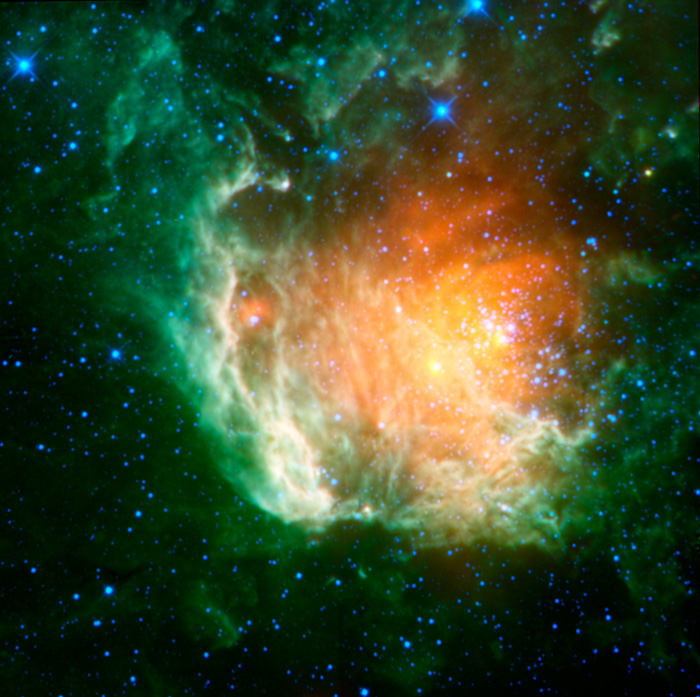
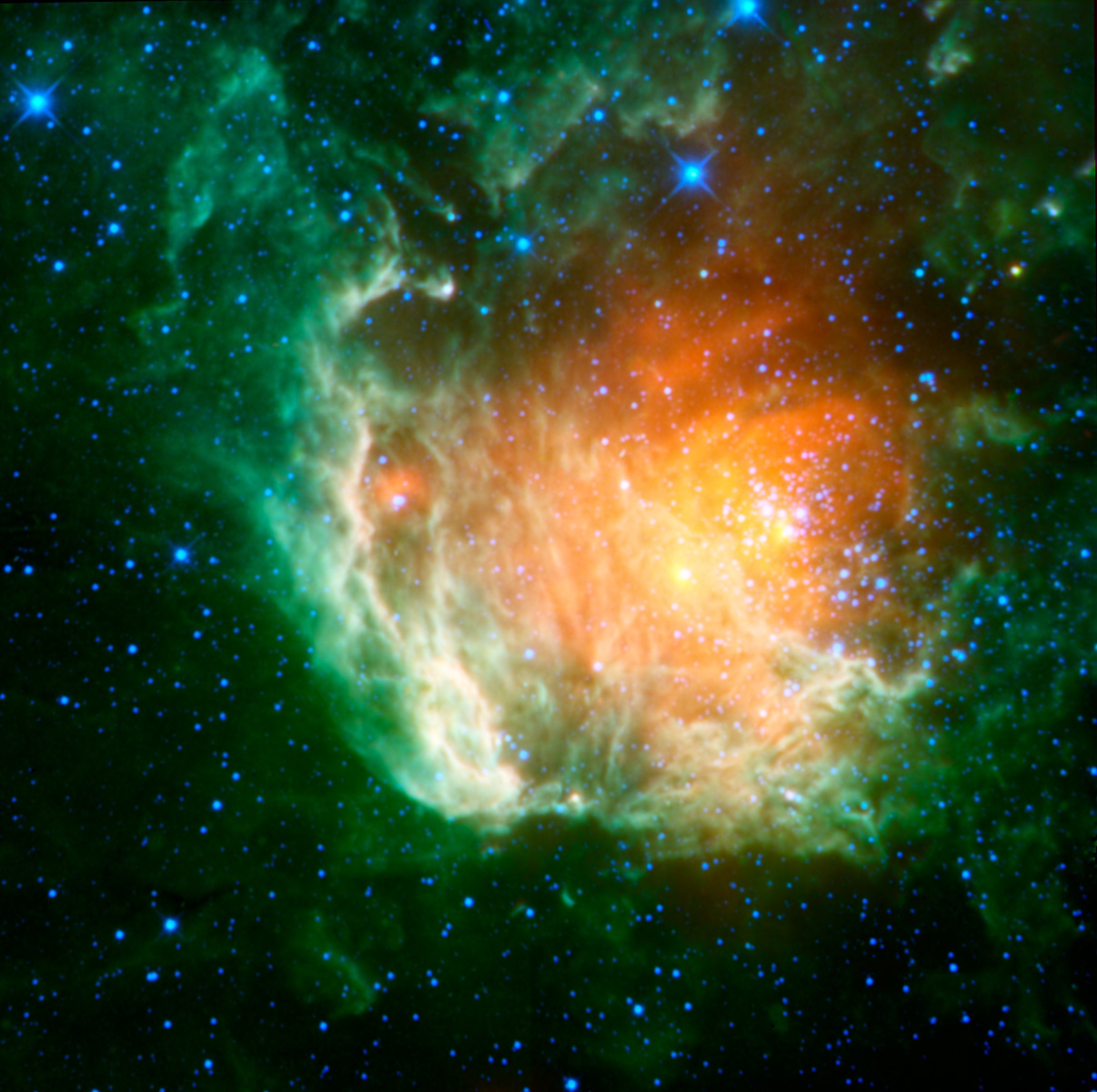
Cosmic Rosebud

Image Credit: NASA/JPL-Caltech/WISE Team

A new infrared image from NASA's Wide-field Infrared Survey Explorer, or WISE, shows a cosmic rosebud blossoming with new stars. The stars, called the Berkeley 59 cluster, are the blue dots to the right of the image center. They are ripening out of the dust cloud from which they formed, and at just a few million years old, are young on stellar time scales.

The rosebud-like red glow surrounding the hot, young stars is warm dust heated by the stars. Green "leafy" nebulosity enfolds the cluster, showing the edges of the dense, dusty cloud. This green material is from heated polycyclic aromatic hydrocarbons, molecules that can be found on Earth in barbecue pits, exhaust pipes and other places where combustion has occurred.

Red sources within the green nebula indicate a second generation of stars forming at the surface of the natal cloud, possibly as a consequence of heating and compression from the younger stars. A supernova remnant associated with this region, called NGC 7822, indicates that a massive star has already exploded, blowing the cloud open in a "champagne flow" and leaving behind this floral remnant. Blue dots sprinkled throughout are foreground stars in our Milky Way galaxy.

Berkeley 59 and NGC 7822 are located in the constellation Cepheus at a distance of about 3,300 light-years from Earth.

Infrared light is color coded in this picture as follows: blue shows 3.4-micron light; cyan, 4.6-micron light; green, 12-micron light; and red, 22-micron light.

Sizes:
JPEG:
small (43K) 240 x 240 JPEG
medium (192K) 700 x 700 JPEG
large (417K) 1200 x 1200 JPEG

original (4876K) 1960 x 1950 TIF

Packaged image (4330K) 2400 x 3000 JPG
Packaged image (7.27MB) 8 x 10 in. PDF

More information is online at http://www.nasa.gov/wise

Friday, March 12, 2010

Study validates general relativity on cosmic scale, existence of dark matter

A collection of galaxies from the Sloan Digital Sky Survey (missing slices are obscured by the Milky Way). Red galaxies composed of older stars are more luminous; a sample of 70,000 red luminous galaxies were used to compare galaxy clustering, weak gravitational lensing, and redshift to test various theories of gravity. (Image by Michael Blanton for SDSS

A partial map of the distribution of galaxies in the Sloan Digital Sky Survey, going out to a distance of 7 billion light years. The amount of galaxy clustering that we observe today is a signature of how gravity acted over cosmic time, and allows as to test whether general relativity holds over these scales. (M. Blanton, Sloan Digital Sky Survey)

An image of a galaxy cluster in the Sloan Digital Sky Survey, showing some of the 70,000 bright elliptical galaxies that were analyzed to test general relativity on cosmic scales. (Sloan Digital Sky Survey)

BERKELEY — An analysis of more than 70,000 galaxies by University of California, Berkeley, University of Zurich and Princeton University physicists demonstrates that the universe – at least up to a distance of 3.5 billion light years from Earth – plays by the rules set out 95 years ago by Albert Einstein in his General Theory of Relativity.

By calculating the clustering of these galaxies, which stretch nearly one-third of the way to the edge of the universe, and analyzing their velocities and distortion from intervening material, the researchers have shown that Einstein's theory explains the nearby universe better than alternative theories of gravity.

One major implication of the new study is that the existence of dark matter is the most likely explanation for the observation that galaxies and galaxy clusters move as if under the influence of some unseen mass, in addition to the stars astronomers observe.

"The nice thing about going to the cosmological scale is that we can test any full, alternative theory of gravity, because it should predict the things we observe," said co-author Uros Seljak, a professor of physics and of astronomy at UC Berkeley and a faculty scientist at Lawrence Berkeley National Laboratory who is currently on leave at the Institute of Theoretical Physics at the University of Zurich. "Those alternative theories that do not require dark matter fail these tests."

In particular, the tensor-vector-scalar gravity (TeVeS) theory, which tweaks general relativity to avoid resorting to the existence of dark matter, fails the test.

The result conflicts with a report late last year that the very early universe, between 8 and 11 billion years ago, did deviate from the general relativistic description of gravity.

Seljak and his current and former students, including first authors Reinabelle Reyes, a Princeton University graduate student, and Rachel Mandelbaum, a recent Princeton Ph.D. recipient, report their findings in the March 11 issue of the journal Nature. The other co-authors are Tobias Baldauf, Lucas Lombriser and Robert E. Smith of the University of Zurich, and James E. Gunn, professor of physics at Princeton and father of the Sloan Digital Sky Survey.

Einstein's General Theory of Relativity holds that gravity warps space and time, which means that light bends as it passes near a massive object, such as the core of a galaxy. The theory has been validated numerous times on the scale of the solar system, but tests on a galactic or cosmic scale have been inconclusive.

"There are some crude and imprecise tests of general relativity at galaxy scales, but we don't have good predictions for those tests from competing theories," Seljak said.

Such tests have become important in recent decades because the idea that some unseen mass permeates the universe disturbs some theorists and has spurred them to tweak general relativity to get rid of dark matter. TeVeS, for example, says that acceleration caused by the gravitational force from a body depends not only on the mass of that body, but also on the value of the acceleration caused by gravity.

The discovery of dark energy, an enigmatic force that is causing the expansion of the universe to accelerate, has led to other theories, such as one dubbed f(R), to explain the expansion without resorting to dark energy.

Tests to distinguish between competing theories are not easy, Seljak said. A theoretical cosmologist, he noted that cosmological experiments, such as detections of the cosmic microwave background, typically involve measurements of fluctuations in space, while gravity theories predict relationships between density and velocity, or between density and gravitational potential.

"The problem is that the size of the fluctuation, by itself, is not telling us anything about underlying cosmological theories. It is essentially a nuisance we would like to get rid of," Seljak said. "The novelty of this technique is that it looks at a particular combination of observations that does not depend on the magnitude of the fluctuations. The quantity is a smoking gun for deviations from general relativity."

Three years ago, a team of astrophysicists led by Pengjie Zhang of Shanghai Observatory suggested using a quantity dubbed EG to test cosmological models. EG reflects the amount of clustering in observed galaxies and the amount of distortion of galaxies caused by light bending as it passes through intervening matter, a process known as weak lensing. Weak lensing can make a round galaxy look elliptical, for example.

"Put simply, EG is proportional to the mean density of the universe and inversely proportional to the rate of growth of structure in the universe," he said. "This particular combination gets rid of the amplitude fluctuations and therefore focuses directly on the particular combination that is sensitive to modifications of general relativity."

Using data on more than 70,000 bright, and therefore distant, red galaxies from the Sloan Digital Sky Survey, Seljak and his colleagues calculated EG and compared it to the predictions of TeVeS, f(R) and the cold dark matter model of general relativity enhanced with a cosmological constant to account for dark energy.

The predictions of TeVeS were outside the observational error limits, while general relativity fit nicely within the experimental error. The EG predicted by f(R) was somewhat lower than that observed, but within the margin of error.

In an effort to reduce the error and thus test theories that obviate dark energy, Seljak hopes to expand his analysis to perhaps a million galaxies when SDSS-III's Baryon Oscillation Spectroscopic Survey (BOSS), led by a team at LBNL and UC Berkeley, is completed in about five years. To reduce the error even further, by perhaps as much as a factor of 10, requires an even more ambitious survey called BigBOSS, which has been proposed by physicists at LBNL and UC Berkeley, among other places.

Future space missions, such as NASA's Joint Dark Energy Mission (JDEM) and the European Space Agency's Euclid mission, will also provide data for a better analysis, though perhaps 10-15 years from now.

Seljak noted that these tests do not tell astronomers the actual identity of dark matter or dark energy. That can only be determined by other types of observations, such as direct detection experiments.

By Robert Sanders, Media Relations
UC Berkeley

Underweight or Blinded by Youth? Finding the True Mass of Galaxy Mergers

Fig. 1: Optical (left) and near-infrared (right) comparison between mass (M) and mass-to-light ratio (M/L). The vector shows the evolution of M/L over time. LIRGs (open circles) appear very different in both panels, while non-LIRGs and ellipticals remain the same.

Fig. 2: For luminous infrared galaxy (LIRG) mergers (left), velocity dispersion measured with CO (CO σ0) is significantly lower than that measured with the Calcium II Triplet (CaT σ0). For non-LIRG mergers and normal elliptical galaxies (middle and right), there is no meaningful difference between the two techniques.

Fig. 3: Astronomers have different perspectives on the centers of galaxies at optical (left) and near-infrared (right) wavelengths. Dust prevents optical measurement of the rotating disk of stars that is located at the galaxy's center. Although the dust is still present, it does not obscure near-infrared views

Galaxies are the building blocks of the universe, so accounting for their formation is an essential problem in astronomy. Most galaxies are either spiral or elliptical, with the latter tending to be larger and more massive. One suggestion that is grounded in fundamental measurements of the universe as a whole is that merging spiral galaxies form elliptical galaxies. A way to test the predictions of this merger hypothesis is to observe examples of galaxy merging in process. Barry Rothberg and Jacqueline Fischer of the Naval Research Laboratory (US) have done that, drawing important conclusions about the objects they observed and the techniques astronomers use to measure them.

One critical property of a galaxy is its mass. The motion of stars is sensitive to the gravitational effect of the mass, so measuring the stellar motion can yield a galaxy's mass. Observations of characteristic features in the spectra of stars are sensitive to this motion. Specifically, measurement of CO at near-infrared wavelengths is a common diagnostic, especially in dusty luminous and ultraluminous infrared galaxies (LIRGs and ULIRGs). A surprising aspect of past near-IR studies of merging galaxies is that the resulting elliptical galaxies would have relatively low mass, while previous optical studies by Rothberg using the calcium II triplet at 0.85µm show that they would have large masses. Is there a fundamental problem with using the CO measurements for all galaxies, or is something strange happening only in the LIRGs and ULIRGs that had been studied? As Rothberg says, "Either possibility would have a significant impact on galaxy dynamical studies. The only instrument that could answer this question definitively was GNIRS (Gemini Near-Infrared Spectrograph), because of the unique combination of spectral and spatial resolution and the need for an 8-meter mirror to gather enough light."

In the new work, Rothberg and Fischer find that IR-luminous mergers appear younger and less massive in the near-IR but indistinguishable from old, massive ellipticals at optical wavelengths (Figure 1). The fundamental measurement of these two diagnostics (the velocity dispersion) is different in the LIRGs, where CO shows smaller velocity dispersion and therefore indicates smaller mass. Normal elliptical galaxies and merger remnants that are not IR-luminous, however, do not show any significant difference between the optical and near-IR measurements (Figure 2). GNIRS provided the critical observations to show that CO measurements cannot be used to determine the mass of LIRGs and ULIRGs.

Why are these IR-luminous merging galaxies different, and what do their CO measurements mean? The strong infrared emission from these systems arises in the dusty environments of recent bursts of star formation. The CO measurements are sensitive to these younger stars, and they even show a rotating disk of young stars in rotation curves. Thus, in these luminous IR galaxies, the CO does not probe the total mass of the merger remnant but traces the rotating young central stellar disk instead. Optical light cannot penetrate the dusty centers of these systems, so these central stellar disks do not affect the calcium II triplet diagnostic, and it measures the mass of the entire merger (Figure 3). After the merging systems have settled to become regular elliptical galaxies, however, they no longer exhibit the confusion of recent star formation and obscuring dust, so optical and infrared measurements are consistent with each other.

The complete results (published in the Astrophysical Journal 2010, Vol. 712, page 318) use data from the University of Hawaii 2.2 meter, Keck, and Hubble Space telescopes in addition to Gemini. GNIRS is currently being repaired, and it will be deployed on the Gemini North telescope later this year.

Thursday, March 11, 2010

Spitzer Detects the 'Heartbeat' of Star Formation in the Milky Way Galaxy

This image is roughly 1/34 of the entire GLIMPSE Survey. This small section is riddled with young stellar objects, counted by Robitaille and his team.
Credit :NASA / JPL-Caltech / T. Robitaille (Harvard-Smithsonian Center for Astrophysics), GLIMPSE Team

Astronomers have used NASA's Spitzer Space Telescope rather like a doctor's stethoscope to listen in on the "heartbeat" of star formation in our galaxy, a finding that will help trace the "life" of the Milky Way and other galaxies.

A key vital sign in people is our heart rate, or the number of beats the heart muscle makes in a given time. Galaxies, too, have a sort of heartbeat, which is their pace of forming new stars. This rate indicates a galaxy's activity level and gives clues about its "lifetime," or how long the celestial body might keep making new stars and planets before growing old and quiet.

Now astronomers have felt the pulse of star formation in the Milky Way more directly than ever before by using observations from Spitzer to count up baby stars in our galaxy. This information was then plugged into a computer simulation of galactic star formation, a novel technique which revealed that our home galaxy beats to a rhythm of creating about one star like our sun every year.

"Measuring the rate of star formation inside the Milky Way with this method is important not just for understanding our galaxy, but also has implications for measuring star formation rates for all galaxies," says Thomas Robitaille of the Harvard-Smithsonian Center for Astrophysics and lead author of a new study describing the results.

Previous measurements have suggested a slightly faster Milky Way star formation rate - as high as five times the mass of the Sun annually - but have relied on indirect methods. One technique required measuring the radio waves emanating from hydrogen gas clouds energized by the biggest, brightest and hottest stars. Scientists have made estimates of how many smaller, more common stars like our sun form per every one of these rare, yet easily detected behemoths. Such an extrapolation, however, is somewhat imprecise.

Because we cannot see individual stars and young stellar objects (YSOs) in distant galaxies, and therefore have to indirectly take their pulse, it's important to gauge these other methods' accuracy. Accordingly, the new YSO-counting technique, which will only get sharper in the future, will help calibrate ways of measuring star formation rates in other galaxies.

Forming and Counting Stars

Stars form from the gravitational collapse of gas that is scattered throughout space. As budding stars rotate and their cores heat up, leftover material gets spun into a surrounding dusty disk that can clump together in places to make planets. These YSOs, though extremely faint in the visible light we see, shine brightly in the infrared light that Spitzer sees.

To take the Milky Way's star formation vital sign, Robitaille first counted up thousands of these YSOs spotted by Spitzer's Infrared Array Camera for a survey called the Galactic Legacy Infrared Mid-Plane Survey Extraordinaire (GLIMPSE). This survey looked at a slice of sky about two degrees high by 130 degrees long, large enough to fit over 330 times the full moon. Other infrared surveys had previously captured fuzzy light from tens of thousands of stars, but GLIMPSE saw 100 million stars clearly and as many as 20,000 YSOs.

"We are seeing forming stars all the way through the galaxy for the first time," says paper co-author Barbara Whitney, a Senior Research Scientist at the Space Science Institute in Boulder, Colorado.

Whitney and Robitaille designed a realistic computer model of overall galactic star birth. By tweaking the model's star formation rate to correspond with the number of YSOs that Spitzer saw, the research duo came up with a directly measured, annual star formation rate of two-thirds to one and a half times the mass of the Sun.

A middle-aged heartbeat

This current star formation rate may seem low when considering that the galaxy contains 100 billion stars. To make all the stars we see now, the rate must have been far greater in the past, the researchers agree, and that the present figure is indeed reasonable for a mature galaxy like the Milky Way. As our galaxy has calmed since a wild youth over its 11 billion year history, the Milky Way's star formation rate has slowed to a more sedate, middle-aged pace.

The galaxy has settled into near equilibrium in generating stars from some of the gas that older stars expel back into the cosmic environment. In this cyclical way, Whitney says that star formation rates are like "the heartbeat of a galaxy": if a galaxy is making stars very quickly, it may deplete the amount of gas available, stalling the genesis of new stars - not unlike someone having to take a rest after exercising and getting their heart rate up. Similarly, galaxies with low star formation rates may be winding down their youthful eons of star-producing activity.

The new Spitzer results were published in the February 10, 2010 issue of The Astrophysical Journal Letters. The observations as part of GLIMPSE were made before Spitzer began its "warm" mission in May 2009 upon exhausting its liquid coolant.

Written by Adam Hadhazy

Wednesday, March 10, 2010

“Catastrophic event” behind the halt of star birth in early galaxy formation

Artists’ representation showing outflow from a supermassive black hole inside the middle of a galaxy. Credit: NASA/CXC/M.Weiss. http://astro.dur.ac.uk/~dma/galaxy_growth_blast.jpg

Observation showing gas in the galaxy SMM J1237+6203 seen using the Gemini Observatory’s Near-Infrared Integral Field Spectrometer (NIFS). The contours show how the blast of energy is travelling through the galaxy. Credit: Dave Alexander/Mark Swinbank (Durham University) & Gemini Observatory. http://astro.dur.ac.uk/~dma/galaxy_growth.jpg

Scientists have found evidence of a catastrophic event they believe was responsible for halting the birth of stars in a galaxy in the early Universe. They report their results in the journal Monthly Notices of the Royal Astronomical Society.

The researchers, led by Durham University’s Department of Physics and funded by the Royal Society and Royal Astronomical Society say the massive galaxy, SMM J1237+6203, underwent a series of blasts trillions of times more powerful than any caused by an atomic bomb. The blasts happened every second for millions of years, according to the scientists.

The explosions scattered the gas needed to form new stars by helping it escape the gravitational pull of the galaxy, effectively regulating its development. The Durham-led team believes the huge surge of energy was caused by either the outflow of debris from the galaxy’s black hole or from powerful winds generated by dying stars exploding as supernovae.

SMM J1237+6203 lies in the direction of the constellation Ursa Major and is so far away that we see it as it appeared 10 billion years ago, or three billion years after the Big Bang, when the Universe was only one quarter of its present age.

Properties seen in massive galaxies nearer to our own galaxy, the Milky Way, suggest that a major event rapidly turned off star formation in galaxies early in the history of the Universe and stopped them from expanding. Theorists, including scientists at Durham University, have argued that this could be due to outflows of energy blowing galaxies apart and preventing further new stars from forming, but until now evidence for this has been lacking.

Using the Gemini Near-Infrared Integral Field Spectrometer (NIFS) to measure the speed of material in the galaxy, they found huge outflows powerful enough to help star-forming debris escape the galaxy’s gravitational pull. They believe the colossal energies generated by these outflows of energy were enough to suppress any further star formation in the galaxy.

Dr Dave Alexander, of Durham University’s Department of Physics, said: “We are looking into the past and seeing a catastrophic event that essentially switched off star formation and halted the growth of a typical massive galaxy in the early Universe.

‘Effectively the galaxy is regulating its growth by preventing new stars from being born. Theorists had predicted that huge outflows of energy were behind this activity, but it’s only now that we have seen it in action.

‘We believe that similar huge outflows are likely to have stopped the growth of other galaxies in the early Universe by blowing away the materials needed for star formation.”

The Durham-led team now plans to study other massive forming galaxies in the early Universe to see if they display similar characteristics.

Durham University is part of a team building the K-Band Multi-Object Spectrometer (KMOS) for the European Southern Observatory’s (ESO) Very Large Telescope. KMOS will be used to investigate the physical and environmental processes that shape the formation and evolution of galaxies.

CONTACTS

Dr Dave Alexander
Department of Physics
Durham University
Tel: +44 (0)191 334 3594
E-mail:
d.m.alexander@durham.ac.uk
[Dr Alexander is available for interview from 0900 to 1700 GMT on Tuesday the 9th and Wednesday the 10th of March]

Leighton Kitson
Media Relations Officer
Durham University
Tel: +44 (0)191 334 6074
E-mail:
leighton.kitson@durham.ac.uk

Dr Robert Massey
Press and Policy Officer
Royal Astronomical Society
Tel: +44 (0)20 7734 3307
Mob: +44 (0)794 124 8035
E-mail:
rm@ras.org.uk

FURTHER INFORMATION

“Searching for evidence of energetic feedback in distant galaxies: a galaxy wide outflow in a z ≈ 2 ultraluminous infrared galaxy”, by David M. Alexander, A. Mark Swinbank (Durham University, UK), Ian Smail (Durham University, UK), Richard McDermid (Gemini Observatory), and Nicole P. H. Nesvadba (Université Paris). Published online in the Monthly Notices of the Royal Astronomical Society, DOI:10.1111/j.1365-2966.2009.16046.x (A preprint is available at http://arxiv.org/abs/0911.0014)

Durham University Department of Physics: www.dur.ac.uk/physics/
Monthly Notices of the Royal Astronomical Society: http://www3.interscience.wiley.com/journal/117974593/home?CRETRY=1&SRETRY=0
Royal Astronomical Society: www.ras.org.uk
Royal Society: www.royalsociety.org/
Gemini: www.gemini.edu/
KMOS: www.eso.org/sci/facilities/develop/instruments/kmos/

NOTES FOR EDITORS

Durham University is a member of the 1994 Group of 19 leading research-intensive universities. The Group was established in 1994 to promote excellence in university research and teaching. Each member undertakes diverse and high-quality research, while ensuring excellent levels of teaching and student experience. www.1994group.ac.uk

The Royal Astronomical Society

The Royal Astronomical Society (RAS), founded in 1820, encourages and promotes the study of astronomy, solar-system science, geophysics and closely related branches of science. The RAS organizes scientific meetings, publishes international research and review journals, recognizes outstanding achievements by the award of medals and prizes, maintains an extensive library, supports education through grants and outreach activities and represents UK astronomy nationally and internationally. Its more than 3000 members (Fellows), a third based overseas, include scientific researchers in universities, observatories and laboratories as well as historians of astronomy and others.

Tuesday, March 09, 2010

Keck telescope confirms smallest known star duo

This artist’s conception made with the BinSim software reflects the geometry of HM Cancri and shows the mass overflow and an accretion disk around the star at the left. This depiction closely matches what is seen in the spectral data taken at Keck. Credit: Rob Hynes and Paul Groot, Radboud University

About 1,600 light-years away, in a binary star system known as HM Cancri, two dense white dwarf stars orbit each other once every 5.4 minutes, based on data from the Keck Observatory. This artist’s rendition shows the dance of these dead stars and the resulting gravitational waves. HM Cancri is possibly one of the brightest sources of such gravity waves. Credit: NASA/Tod Strohmayer (GSFC)/Dana Berry (Chandra X-Ray Observatory)

The twin Keck telescopes take their final look at the cosmos as the sun begins to rise over Mauna Kea. Credit: Rick Peterson/WMKO

Astronomers using the W. M. Keck Observatory have identified the smallest known binary system to date. The system, called HM Cancri, consists of two dead stars that revolve around each other in 5.4 minutes, by far the shortest known orbital period of any pair of stars.

The team, led by Gijs Roelofs of the Harvard-Smithsonian Center of Astrophysics, used the 10-meter Keck I telescope with its Low Resolution Imaging Spectrograph to study the velocity changes in the spectral lines in the light of HM Cancri. They observed that as the stars orbited each other, the system’s spectral lines shifted periodically from blue to red and back following the Doppler Effect. With the velocity information, the astronomers were able to confirm the binary’s 5.4-minute period. The results appear in the March 10 Astrophysical Journal Letters.

“When the first data from the Keck telescope arrived, and our quick analysis showed the periodic shift of the spectral lines, we knew that we had succeeded. More than ten years after its discovery, we finally had deciphered the nature of HM Cancri,” said Arne Rau of the Max Planck Institute for Extraterrestrial Physics in Garching, Germany, who led the observations at Keck.

The group of international astronomers proposed several years ago that HM Cancri was indeed an interacting binary consisting of two dead stars and that the 5.4 minute period observed was the orbital period. “It is very gratifying to see this model confirmed by our observations, especially since earlier attempts had been thwarted by bad weather,” said Daniel Steeghs of the University of Warwick, UK. The team had been trying to make precise velocity measurements to confirm the period since 2005.

HM Cancri was discovered in 1999 as a weak X-ray source in data from the German ROSAT satellite. It consists of two white dwarfs, burnt-out cinders of stars that were once similar to the Sun and contain a highly condensed form of helium, carbon and oxygen. In 2001, the X-ray, and also optical, data suggested that the two stars orbited each other in 5.4 minutes.

But this information suggested that the binary system was roughly eight times the diameter of the Earth—equivalent to a quarter of the distance between the Earth and the Moon—or smaller. Astronomers were reluctant to accept this physical description of HM Cancri without additional evidence. But even at a distance of 16,000 light years from Earth, the binary system shines only one millionth as bright as the faintest stars visible to the naked eye.

To determine with certainty the period of such a system, astronomers needed to use world’s largest telescopes to collect the additional evidence. “This type of observation is really at the limit of what is currently possible. Not only does one need the biggest telescopes in the world, but they also have to be equipped with the best instruments available,” said team member Paul Groot of the Radboud University Nijmegen in the Netherlands.

As a result of the successful observations with Keck, astronomers now have a new cosmic laboratory to study the evolution of stars as well as general relativity. “We know the system must have come from two normal stars that somehow spiraled together in two earlier episodes of mass transfer, but the physics of this process is very poorly understood,” said Gijs Nelemans of the Radboud University who was also part of the team.

He added that the system must be one of the most copious emitters of gravitational waves. “We hope to detect these distortions of space-time directly with the future LISA satellite. HM Cancri will now be a cornerstone system for the mission,” he said.
The W. M. Keck Observatory operates two 10-meter optical/infrared telescopes on the summit of Mauna Kea on the island of Hawai’i and is a scientific partnership of the California Institute of Technology, the University of California and NASA. For more information please call 808.881.3827 or visit http://www.keckobservatory.org.

Thursday, March 04, 2010

NASA's Kepler Mission Celebrates One Year in Space

Kepler Space Telescope
Image credit: NASA/JPL

An image of the Milky Way region of the sky showing where the Kepler photometer is pointing. Image Credit: Eastbay Astronomical Society/Carter Roberts. Full Resolution Image

One year ago this week, NASA's Kepler mission soared into the dark night sky, leaving a bright glow in its wake as it began to search for other worlds like Earth.

"It was a stunning launch," recalled former Kepler Project Manager James Fanson of NASA's Jet Propulsion Laboratory, Pasadena, Calif.

Following Kepler's spectacular nocturnal launch from Cape Canaveral Air Force Station, Fla., aboard a United Launch Alliance Delta II rocket at 7:49 p.m. Pacific Time (10:49 p.m. Eastern Time on Friday, March 6, 2009, science team members whooped with joy.

"Now the fun begins," quipped an ecstatic William Borucki, Kepler's science principal investigator of NASA's Ames Research Center, Moffett Field, Calif.

Since the search began, NASA's plucky exoplanet hunter has achieved significant success in its quest to answer the timeless question: "Are we alone in our galaxy?" Two months ago today, Kepler scientists jubilantly announced the discovery of five large exoplanets (planets located beyond our solar system) named Kepler 4b, 5b, 6b, 7b and 8b.

The Kepler Mission is designed to observe more than 150,000 stars continuously and simultaneously for signs of Earth-size planets until at least November 2012. Some of the planets are expected to orbit in a star's "habitable zone," a warm region where liquid water could pool on the surface.

Kepler is a NASA Discovery mission. Kepler is managed and operated by NASA Ames, and Ames is the home organization of the Science Principal Investigator. Kepler development was managed by NASA's Jet Propulsion Laboratory, Pasadena, Calif. Ball Aerospace & Technologies Corp., Boulder, Colo., developed the Kepler flight system. Ball Aerospace and the Laboratory for Atmospheric and Space Physics at the University of Colorado in Boulder, support mission operations. The final data archive is located at the Space Telescope Science Institute in Baltimore, Md.

More information is online at:

Read more at http://www.nasa.gov/mission_pages/kepler/news/one_year_anniv.html

Whitney Clavin 818-354-4673
Whitney.clavin@jpl.nasa.gov

Herschel Finds Possible Life-Enabling Molecules in Space

Data, called a spectrum, showing water and organics in the Orion nebula. The data were taken by the heterodyne instrument for the far infrared, or HIFI, onboard the Herschel Space Observatory, a European Space Agency-led mission with important participation from NASA. Image credit: ESA/NASA/JPL-Caltech. Larger view

The Herschel Space Observatory has revealed the chemical fingerprints of potentially life-enabling organic molecules in the Orion nebula, a nearby stellar nursery in our Milky Way galaxy. Herschel is led by the European Space Agency with important participation from NASA.

The new data, obtained with the telescope's heterodyne instrument for the far infrared -- one of Herschel's three innovative instruments -- demonstrates the gold mine of information that Herschel will provide on how organic molecules form in space.

The Orion nebula is known to be one of the most prolific chemical factories in space, although the full extent of its chemistry and the pathways for molecule formation are not well understood. By sifting through the pattern of spikes in the new data, called a spectrum, astronomers have identified a few common molecules that are precursors to life-enabling molecules, including water, carbon monoxide, formaldehyde, methanol, dimethyl ether, hydrogen cyanide, sulfur oxide and sulfur dioxide.

Herschel is a European Space Agency cornerstone mission, with science instruments provided by a consortia of European institutes and with important participation by NASA. NASA's Herschel Project Office is based at NASA's Jet Propulsion Laboratory, Pasadena, Calif. JPL contributed mission-enabling technology for two of Herschel's three science instruments. The NASA Herschel Science Center, part of the Infrared Processing and Analysis Center at the California Institute of Technology in Pasadena, supports the United States astronomical community. Caltech manages JPL for NASA.

More information is online at:

Bully galaxy rules the neighbourhood

Credit: NASA, ESA and Michael West (ESO)

In general, galaxies can be thought of as "social" — hanging out in groups and frequently interacting. However, this recent NASA/ESA Hubble Space Telescope image highlights how some galaxies appear to be hungry loners. These cosmic oddities have set astronomers on the "case of the missing neighbour galaxies".

Located half a billion light-years from Earth, ESO 306-17, is a large, bright elliptical galaxy in the southern sky of a type known as a fossil group. Astronomers use this term to emphasise the isolated nature of these galaxies. However, are they like fossils — the last remnants of a once active community — or is it more sinister than that? Did ESO 306-17 gobble up its next-door neighbours?

Gravity brings galaxies together and bigger ones swallow smaller ones. There is evidence that our own Milky Way galaxy has "snacked" on numerous smaller galaxies that strayed too close. ESO 306-17 and other fossil groups may be the most extreme examples of galaxy cannibalism, ravenous systems that don't stop until they've devoured all of their neighbours.

In this image, taken by the Advanced Camera for Surveys aboard Hubble in November 2008, it appears that ESO 306-17 is surrounded by other galaxies, but the bright galaxies at bottom left are thought to be in the foreground, not at the same distance in the sky. In reality, ESO 306-17 lies fairly abandoned in an enormous sea of dark matter and hot gas [1]. When zooming in closely on ESO 306-17, one can see faint clusters of stars through the bright shine of the galaxy's large halo. These are globular clusters — tightly bound groups of stars that can often fend off cannibalism from larger, "bully" galaxies. Studying these surrounding clusters will prove helpful to astronomers in their pursuit to put the pieces of ESO 306-17's history together.

Researchers are also using this image to search for nearby ultra-compact dwarf galaxies. Ultra-compact dwarfs are mini versions of dwarf galaxies that have been left with only their core due to interaction with larger, more powerful galaxies. Most ultra-compact dwarfs discovered to date are located near giant elliptical galaxies in large clusters of galaxies, so it will be interesting to see if researchers find similar objects in fossil groups.

Notes for editors:

[1] Studies conducted by both ESA's XMM-Newton mission and NASA's Chandra X-ray Observatory have confirmed the existence of hot gas surrounding ESO 306-17.

The Hubble Space Telescope is a project of international cooperation between ESA and NASA.

Contacts:

Michael West
European Southern Observatory (ESO), Chile
Tel: +56-2-463-3254
E-mail:
mwest@eso.org

Colleen Sharkey
Hubble/ESA, Garching, Germany
Tel: +49 89 3200 6306
Cell: +49 151 153 73591
E-mail:
csharkey@eso.org

Wednesday, March 03, 2010

NGC 1068: Winds of Change: How Black Holes May Shape Galaxies

Credit X-ray (NASA/CXC/MIT/C.Canizares, D.Evans et al),
Optical (NASA/STScI), Radio (NSF/NRAO/VLA)


This is a composite image of NGC 1068, one of the nearest and brightest galaxies containing a rapidly growing supermassive black hole. X-ray data from the Chandra X-ray Observatory are shown in red, optical data from the Hubble Space Telescope in green and radio data from the Very Large Array in blue. The spiral structure of NGC 1068 is shown by the X-ray and optical data, and a jet powered by the central supermassive black hole is shown by the radio data.

The X-ray images and spectra obtained using Chandra's High Energy Transmission Grating Spectrometer show that a strong wind is being driven away from the center of NGC 1068 at a rate of about a million miles per hour. This wind is likely generated as surrounding gas is accelerated and heated as it swirls toward the black hole. A portion of the gas is pulled into the black hole, but some of it is blown away. High energy X-rays produced by the gas near the black hole heat the ouflowing gas, causing it to glow at lower X-ray energies.

This Chandra study is much deeper than previous X-ray observations. It allowed scientists to make a high-definition map of the cone-shaped volume lit up by the black hole and its winds, and make precision measurements of how the wind speed varies along the cone. Using this data it is shown that each year several times the mass of the Sun is being deposited out to large distances, about 3,000 light years from the black hole. The wind likely carries enough energy to heat the surrounding gas and suppress extra star formation.

These results help explain how a supermassive black hole can alter the evolution of its host galaxy. It has long been suspected that material blown away from a black hole can affect its environment, but a key question has been whether such "black hole blowback" typically delivers enough power to have a significant impact.

NGC 1068 is located about 50 million light years from Earth and contains a supermassive black hole about twice as massive as the one in the middle of the Milky Way Galaxy.

Fast Facts for NGC 1068:

Scale: Image is 1.0 arcmin across (about 15,000 light years across)
Category: Quasars & Active Galaxies
Coordinates: (J2000) RA 02h 42m 40.70s | Dec -00° 00' 47.60"
Constellation: Cetus
Observation Date: 1 pointing on Dec 4, 2000 and 9 pointings between Nov 18 and Dec 5, 2008
Observation Time: 122 hours (5 days 2 hours)
Obs. ID: 332, 9148-9150, 10815-10817, 10823, 10829-10830
Color Code: X-ray (Red), Optical (Green), Radio (Blue)
Instrument: ACIS
Also Known As: M77
References: D.Evans et al., 2010, HEAD meeting.
Distance Estimate: About 50 million light years away

First of Missing Primitive Stars Discovered

The newly discovered red giant star S1020549 dominates this artist's conception. The primitive star contains 6,000 times less heavy elements than our Sun, indicating that it formed very early in the Universe's history. Located in the dwarf galaxy Sculptor some 290,000 light-years away, the star's presence supports the theory that our galaxy underwent a "cannibal" phase, growing to its current size by swallowing dwarf galaxies and other galactic building blocks. Credit: David A. Aguilar (CfA)

Cambridge, MA - Astronomers have discovered a relic from the early universe - a star that may have been among the second generation of stars to form after the Big Bang. Located in the dwarf galaxy Sculptor some 290,000 light-years away, the star has a remarkably similar chemical make-up to the Milky Way's oldest stars. Its presence supports the theory that our galaxy underwent a "cannibal" phase, growing to its current size by swallowing dwarf galaxies and other galactic building blocks.

"This star likely is almost as old as the universe itself," said astronomer Anna Frebel of the Harvard-Smithsonian Center for Astrophysics, lead author of the Nature paper reporting the finding.

Dwarf galaxies are small galaxies with just a few billion stars, compared to hundreds of billions in the Milky Way. In the "bottom-up model" of galaxy formation, large galaxies attained their size over billions of years by absorbing their smaller neighbors.

"If you watched a time-lapse movie of our galaxy, you would see a swarm of dwarf galaxies buzzing around it like bees around a beehive," explained Frebel. "Over time, those galaxies smashed together and mingled their stars to make one large galaxy - the Milky Way."

If dwarf galaxies are indeed the building blocks of larger galaxies, then the same kinds of stars should be found in both kinds of galaxies, especially in the case of old, "metal-poor" stars. To astronomers, "metals" are chemical elements heavier than hydrogen or helium. Because they are products of stellar evolution, metals were rare in the early Universe, and so old stars tend to be metal-poor.

Old stars in the Milky Way's halo can be extremely metal-poor, with metal abundances 100,000 times poorer than in the Sun, which is a typical younger, metal-rich star. Surveys over the past decade have failed to turn up any such extremely metal-poor stars in dwarf galaxies, however.

"The Milky Way seemed to have stars that were much more primitive than any of the stars in any of the dwarf galaxies," says co-author Josh Simon of the Observatories of the Carnegie Institution. "If dwarf galaxies were the original components of the Milky Way, then it's hard to understand why they wouldn't have similar stars."

The team suspected that the methods used to find metal-poor stars in dwarf galaxies were biased in a way that caused the surveys to miss the most metal-poor stars. Team member Evan Kirby, a Caltech astronomer, developed a method to estimate the metal abundances of large numbers of stars at a time, making it possible to efficiently search for the most metal-poor stars in dwarf galaxies.

"This was harder than finding a needle in a haystack. We needed to find a needle in a stack of needles," said Kirby. "We sorted through hundreds of candidates to find our target."

Among stars he found in the Sculptor dwarf galaxy was one faint, 18th-magnitude speck designated S1020549. Spectroscopic measurements of the star's light with Carnegie's Magellan-Clay telescope in Las Campanas, Chile, determined it to have a metal abundance 6,000 times lower than that of the Sun; this is five times lower than any other star found so far in a dwarf galaxy.

The researchers measured S1020549's total metal abundance from elements such as magnesium, calcium, titanium, and iron. The overall abundance pattern resembles those of old Milky Way stars, lending the first observational support to the idea that these galactic stars originally formed in dwarf galaxies.

The researchers expect that further searches will discover additional metal-poor stars in dwarf galaxies, although the distance and faintness of the stars pose a challenge for current optical telescopes. The next generation of extremely large optical telescopes, such as the proposed 24.5-meter Giant Magellan Telescope, equipped with high-resolution spectrographs, will open up a new window for studying the growth of galaxies through the chemistries of their stars.

In the meantime, says Simon, the extremely low metal abundance in S1020549 study marks a significant step towards understanding how our galaxy was assembled. "The original idea that the halo of the Milky Way was formed by destroying a lot of dwarf galaxies does indeed appear to be correct."

This release is being issued jointly with the Observatories of the Carnegie Institution.

Headquartered in Cambridge, Mass., the Harvard-Smithsonian Center for Astrophysics (CfA) is a joint collaboration between the Smithsonian Astrophysical Observatory and the Harvard College Observatory. CfA scientists, organized into six research divisions, study the origin, evolution and ultimate fate of the universe.

For more information, contact:

David A. Aguilar
Director of Public Affairs
Harvard-Smithsonian Center for Astrophysics
617-495-7462
daguilar@cfa.harvard.edu

Christine Pulliam
Public Affairs Specialist
Harvard-Smithsonian Center for Astrophysics
617-495-7463
cpulliam@cfa.harvard.edu