Thursday, December 15, 2022

NGC 3293: Chandra Sees Stellar X-rays Exceeding Safety Limits

NGC 3293
Credit: X-ray: NASA/CXC/Penn State Univ./K. Getman et al.;
Infrared: ESA/NASA JPL-Caltech/Herschel Space Observatory/JPL/IPAC; NASA JPL-Caltech/SSC/Spitzer Space Telescope;


Astronomers have made the most extensive study yet of how magnetically active stars are when they are young. This gives scientists a window into how X-rays from stars like the Sun, but billions of years younger, could partially or completely evaporate the atmospheres of planets orbiting them.

Many stars begin their lives in “open clusters,” loosely packed groups of stars with up to a few thousand members, all formed roughly at the same time. This makes open clusters valuable for astronomers investigating the evolution of stars and planets, because they allow the study of many stars of similar ages forged in the same environment.

A team of astronomers led by Konstantin Getman of Penn State University studied a sample of over 6,000 stars in 10 different open clusters with ages between 7 million and 25 million years. One of the goals of this study was to learn how the magnetic activity levels of stars like our Sun change during the first tens of millions of years after they form. Getman and his colleagues used NASA’s Chandra X-ray Observatory for this study because stars that have more activity linked to magnetic fields are brighter in X-rays.

This composite image shows one of those clusters, NGC 3293, which is 11 million years old and is located about 8,300 light-years from Earth in the Milky Way galaxy. The image contains X-rays from Chandra (purple) as well as infrared data from ESA’s Herschel Space Observatory (red), longer-wavelength infrared data from NASA’s retired Spitzer Space Telescope (blue and white), and optical data from the MPG/ESO 2.2-meter telescope at ESO’s La Silla Observatory in Chile appearing as red, white and blue.

The researchers combined the Chandra data of the stars’ activity with data from ESA’s Gaia satellite — not shown in the new composite image — to determine which stars are in the open clusters and which ones are in the foreground or background. The team identified nearly a thousand members of the cluster.

They combined their results for the open clusters with previously published Chandra studies of stars as young as 500,000 years old. The team found that the X-ray brightness of young, Sun-like stars is roughly constant for the first few million years, and then fades from 7 to 25 million years of age. This decrease happens more quickly for heftier stars.

To explain this decline in activity, Getman’s team used astronomers’ understanding of the interior of the Sun and Sun-like stars. Magnetic fields in such stars are generated by a dynamo, a process involving the rotation of the star as well as convection, the rising and falling of hot gas in the star's interior.

Around the age of NGC 3293, the dynamos of Sun-like stars become much less efficient because their convection zones become smaller as they age. For stars with masses smaller than that of the Sun, this is a relatively gradual process. For more massive stars, a dynamo dies away because the convection zone of the stars disappears.

How active a star is directly affects the formation processes of planets in the disk of gas and dust that surrounds all nascent stars. The most boisterous, magnetically active young stars quickly clear away their disks, halting the growth of planets.

This activity, measured in X-rays, also affects the potential habitability of the planets that emerge after the disk has disappeared. If a star is extremely active, as with many NGC 3293 stars in the Chandra data, then scientists predict it will blast planets in its system with energetic X-rays and ultraviolet light. In some cases, this high-energy barrage could cause an Earth-sized rocky planet to lose much of its original, hydrogen-rich atmosphere through evaporation within a few million years. It might also strip away a carbon dioxide-rich atmosphere that forms later, unless it is protected by a magnetic field. Our planet possesses its own magnetic field that prevented such an outcome for Earth.

A paper describing these results was published in the August issue of The Astrophysical Journal and is available online. Coauthors of the paper are Eric D. Feigelson and Patrick S. Broos from Penn State University, Gordon P. Garmire from the Huntingdon Institute for X-ray Astronomy, Michael A. Kuhn from the University of Hertsfordshire, Thomas Preibisch from Ludwig-Maximilians-Universitat, and Vladimir S. Airapetian from NASA’s Goddard Space Flight Center.

NASA's Marshall Space Flight Center manages the Chandra program. The Smithsonian Astrophysical Observatory's Chandra X-ray Center controls science operations from Cambridge, Massachusetts, and flight operations from Burlington, Massachusetts.


Tour: Chandra Sees Stellar X-rays Exceeding Safety Limits


Fast Facts for NGC 3293:

Scale: Image is about 22 arcmin (53 light-years) across.
Category:
Normal Stars & Star Clusters
Coordinates (J2000): RA 10h 35m 52.8 | Dec -58° 13´ 52"
Constellation:
Carina
Observation Date: October 7, 2015
Observation Time: 19 hours 41 minutes
Obs. ID:
16648
Instrument:
ACIS
References: Getman, K.V., et al., 2022, ApJ, 935, 43; arXiv:2203.02047
Color Code: X-ray: purple; Infrared: red, blue, white; Optical: red, green, blue;
Distance Estimate: About 8,300 light-years


Wednesday, December 14, 2022

Finding Ways to Catch Collapsars Making Heavy Metals

An artist's impression of a collapsar and an associated gamma-ray burst
Credit: NASA/SkyWorks Digital

Researchers are still working out where heavy metals are made in the universe. A recent publication explores ways to tell if elements heavier than iron can be created when extremely massive stars collapse to form black holes.

An illustration of two neutron stars approaching a merger
Credit:
ESO/L. Calçada


Making Heavy Metals

In the cores of stars, nuclear fusion combines light elements into heavier ones, with the largest stars generating elements up to iron. But elements bulkier than iron must arise elsewhere, since a star that attempts to create anything heavier is doomed to collapse in a supernova explosion.

About half of the elements beyond iron on the periodic table are thought to form through something called the r-process, in which atoms rapidly capture multiple neutrons in a dense, hot environment. Core-collapse supernovae were early contenders for r-process production, but simultaneous observations of light and gravitational waves from colliding neutron stars cemented mergers as an important source of heavy elements. Now, researchers are searching for ways to determine if certain supernovae could be sites of r-process element creation after all.

An illustration of the authors’ model, in which r-process-enriched material is surrounded by an r-process-poor shell

Credits: Barnes & Metzger 2022

Collapsars as Candidates

Collapsars are rapidly rotating massive stars that explode as supernovae when they can no longer sustain nuclear fusion, ultimately creating a black hole. As the star’s core collapses, material in the outer layers forms an accretion disk, in which conditions for r-process element formation may exist. To probe the possible role that collapsars play in generating r-process elements, Jennifer Barnes (University of California, Santa Barbara) and Brian Metzger (Columbia University and Flatiron Institute) modeled the effects of r-process nucleosythesis on the light curves of collapsars exploding as supernovae.

Barnes and Metzger first used an analytical model to predict when the presence of r-process products might be observable as the supernova’s emission rises and falls, as well as how best to observe these effects. The team found that it may be possible to discern whether a collapsar explosion contains r-process material by making long-wavelength observations several months after the explosion, depending on how the material is distributed, but early in the explosion might offer a better chance of identifying these events.


Demonstration of how the degree of mixing (ψmix) affects the resultant light curve. As the degree of mixing increases (higher ψmix), the emission shifts toward the near-infrared. Credit: Barnes & Metzger 2022


Light Curve Modeling


As a follow-on to their initial investigation, the team modeled the evolution of light curves from collapsar explosions that produce varying amounts of r-process material. These models explore how supernova light curves change as a function of the mass ejected in the explosion, the velocity of the ejected mass, the amount of nickel-56 (a radioactive form of nickel that decays into cobalt-56, creating the characteristic shape of many supernova light curves), and the amount and distribution of r-process material.

Citation

“Signatures of r-process Enrichment in Supernovae from Collapsars,” Jennifer Barnes and Brian D. Metzger 2022 ApJL 939 L29. doi:10.3847/2041-8213/ac9b41

Tuesday, December 13, 2022

Cosmic Smokescreen

NGC 6530/Lagoon Nebula
Credit: ESA/Hubble & NASA, ESO, O. De Marco
Acknowledgement: M. H. Özsaraç


A portion of the open cluster NGC 6530 appears as a roiling wall of smoke studded with stars in this image from the NASA/ESA Hubble Space Telescope. NGC 6530 is a collection of several thousand stars lying around 4350 light-years from Earth in the constellation Sagittarius. The cluster is set within the larger Lagoon Nebula, a gigantic interstellar cloud of gas and dust. It is the nebula that gives this image its distinctly smokey appearance; clouds of interstellar gas and dust stretch from one side of this image to the other.

Astronomers investigated NGC 6530 using Hubble’s Advanced Camera for Surveys and Wide Field Planetary Camera 2. They scoured the region in the hope of finding new examples of proplyds, a particular class of illuminated protoplanetary discs surrounding newborn stars. The vast majority of proplyds have been found in only one region, the nearby Orion Nebula. This makes understanding their origin and lifetimes in other astronomical environments challenging.

Hubble’s ability to observe at infrared wavelengths — particularly with Wide Field Camera 3— have made it an indispensable tool for understanding starbirth and the origin of exoplanetary systems. In particular, Hubble was crucial to investigations of the proplyds around newly born stars in the Orion Nebula. The new NASA/ESA/CSA James Webb Space Telescope’s unprecedented observational capabilities at infrared wavelengths will complement Hubble observations by allowing astronomers to peer through the dusty envelopes around newly born stars and investigate the faintest, earliest stages of starbirth.

Monday, December 12, 2022

NASA’s Webb Indicates Several Stars ‘Stirred Up’ Southern Ring Nebula

Two Views of the Gas in the Southern Ring Nebula (NIRCam and MIRI Composite Images)
Credits Science: NASA, ESA, CSA, STScI, Orsola De Marco (Macquarie University)
Image Processing: Joseph DePasquale (STScI)

Southern Ring Nebula’s Spokes (NIRCam and MIRI Composite Image)
Credits: Science: NASA, ESA, CSA, STScI, Orsola De Marco (Macquarie University)
Image Processing: Joseph DePasquale (STScI)

Illustration of Star Interactions in the Southern Ring Nebula
Credits: Illustration: NASA, ESA, CSA, STScI, Elizabeth Wheatley (STScI)

Southern Ring Nebula’s Gas (NIRCam and MIRI Composite Compass Image)
Credits: Science: NASA, ESA, CSA, STScI, Orsola De Marco (Macquarie University)
Image Processing: Joseph DePasquale (STScI)

Release Images


Some of the first data from NASA’s James Webb Space Telescope has shown there were at least two, and possibly three, more unseen stars that crafted the oblong, curvy shapes of the Southern Ring Nebula. Plus, for the first time, by pairing Webb’s infrared images with existing data from ESA’s (European Space Agency’s) Gaia observatory, researchers were able to precisely pinpoint the mass of the central star before it created the nebula. A team of almost 70 researchers led by Orsola De Marco of Macquarie University in Sydney, Australia, analyzed Webb’s 10 highly detailed exposures of this dying star to produce these results.

Their calculations show the central star was nearly three times the mass of the Sun before it ejected its layers of gas and dust. After those ejections, it now measures about 60 percent of the mass of the Sun. Knowing the initial mass is a critical piece of evidence that helped the team reconstruct the scene and project how the shapes in this nebula may have been created.

Let’s start with the top-tier celebrity of this particular “party,” the star that sloughed off its layers of gas and dust over thousands of years. It appears red in the image on the left because it is surrounded by an orbiting, dusty disk similar in size to our solar system’s Kuiper Belt. While some stars expel their layers as solo acts “on stage,” researchers propose that there were a few companions with front row seats – and at least one that may have joined the central star before it began to create the Southern Ring Nebula. “With Webb, it’s like we were handed a microscope to examine the universe,” De Marco said. “There is so much detail in its images. We approached our analysis much like forensic scientists to rebuild the scene.”

It’s common for small groups of stars, spanning a range of masses, to form together and continue to orbit one another as they age. The team used this principle to step back in time, by thousands of years, to determine what might explain the shapes of the colorful clouds of gas and dust.

First, they focused on the aging star that cast off its layers and is still surrounded by a dusty red “cloak” of dust. Extensive research about these types of aging stars shows that dusty cloaks like these must take the form of dusty disks that orbit the star. A quick dive into the data revealed the disk. “This star is now smaller and hotter, but is surrounded by cool dust,” said Joel Kastner, another team member, from the Rochester Institute of Technology in New York. “We think all that gas and dust we see thrown all over the place must have come from that one star, but it was tossed in very specific directions by the companion stars.”

Before the dying star shed its layers, the team proposes that it interacted with one or even two smaller companion stars. During this intimate “dance,” the interacting stars may have launched two-sided jets, which appeared later as roughly paired projections that are now observed at the edges of the nebula. “This is much more hypothetical, but if two companions were interacting with the dying star, they would launch toppling jets that could explain these opposing bumps,” De Marco explained. The dusty cloak around the dying star points to these interactions.

Where are those companions now? They are either dim enough to hide, camouflaged by the bright lights of the two central stars, or have merged with the dying star.

The complex shapes of the Southern Ring Nebula are more evidence of additional unseen companions – its ejections are thinner in some areas and thicker in others. A third closely interacting star may have agitated the jets, skewing the evenly balanced ejections like spin art. In addition, a fourth star with a slightly wider orbit might have also “stirred the pot” of ejections, like a spatula running through batter in the same direction each time, generating the enormous set of rings in the outer reaches of the nebula.

What about the very bright blue-white star in Webb’s images? Think of the fifth star like the most responsible party guest that continues to orbit the dying star slowly, predictably, and calmly.

The two images shown here each combine near-infrared and mid-infrared data to isolate different components of the nebula. The image at left highlights the very hot gas that surrounds the central stars. The image at right traces the star’s scattered molecular outflows that have reached farther into the cosmos.

The team's paper, entitled " The messy death of a multiple star system and the resulting planetary nebula as observed by JWST," will be published in Nature Astronomy on December 8.

The James Webb Space Telescope is the world’s premier space science observatory. Webb will solve mysteries in our solar system, look beyond to distant worlds around other stars, and probe the mysterious structures and origins of our universe and our place in it. Webb is an international program led by NASA with its partners, ESA (European Space Agency) and CSA (Canadian Space Agency).


About This Release:

Credits:

Media Contact:

Claire Blome
Space Telescope Science Institute, Baltimore, Maryland

Christine Pulliam
Space Telescope Science Institute, Baltimore, Maryland


Permissions: Content Use Policy

Contact Us: Direct inquiries to the News Team.

Related Links and Documents


Friday, December 09, 2022

Head in the Clouds

A large number of bright stars, each with a cross-shape extending from its centre. In the centre there is a dense collection of foreground stars. Five are orange and the rest are blue. The black background is filled with small stars — most of them, however, larger than a single point. Credit: ESA/Hubble & NASA, A. Nota, G. De Marchi

A small portion of the Small Magellanic Cloud (SMC) is pictured in this image from the NASA/ESA Hubble Space Telescope. The SMC is a dwarf galaxy and one of the Milky Way’s nearest neighbours, lying only about 200 000 light-years from Earth. It makes a pair with the Large Magellanic Cloud, and both objects can be seen from the southern hemisphere, as well as from some northern latitudes.

The Small Magellanic Cloud contains hundreds of millions of stars, but this image focuses on just a small fraction of them. These stars comprise the open cluster NGC 376, which has a total mass only about 3400 times that of the Sun. Open clusters, as the name suggests, are loosely bound and sparsely populated. This distinguishes open clusters from globular clusters, which are often so thronged with stars that they have a continuous blur of starlight at their centres. In the case of NGC 376, individual stars can be picked out clearly even in the most densely populated parts of this image.

The data in this image come from two different astronomical investigations which relied on two of Hubble’s instruments: the Wide Field Camera 3 (WFC3) and the Advanced Camera for Surveys (ACS). The first investigation used the ACS to explore a handful of star clusters in the Small Magellanic Cloud and help astronomers explore topics including the abundance of low- and high-mass stars in different environments. The second investigation used both the WFC3 and ACS, and aimed to answer fundamental questions about the lives of stars and help astronomers understand precisely where, when, why and how stars form.


Thursday, December 08, 2022

Hubble Detects Ghostly Glow Surrounding Our Solar System 

SKYSURF illustration
Credits: Artwork: NASA, ESA, Andi James (STScI)

Release Images


Aside from a tapestry of glittering stars, and the glow of the waxing and waning Moon, the nighttime sky looks inky black to the casual observer. But how dark is dark?

To find out, astronomers decided to sort through 200,000 images from NASA's Hubble Space Telescope and made tens of thousands of measurements on these images to look for any residual background glow in the sky, in an ambitious project called SKYSURF. This would be any leftover light after subtracting the glow from planets, stars, galaxies, and from dust in the plane of our solar system (called zodiacal light).

When researchers completed this inventory, they found an exceedingly tiny excess of light, equivalent to the steady glow of 10 fireflies spread across the entire sky. That's like turning out all the lights in a shuttered room and still finding an eerie glow coming from the walls, ceiling, and floor.

The researchers say that one possible explanation for this residual glow is that our inner solar system contains a tenuous sphere of dust from comets that are falling into the solar system from all directions, and that the glow is sunlight reflecting off this dust. If real, this dust shell could be a new addition to the known architecture of the solar system.

This idea is bolstered by the fact that in 2021 another team of astronomers used data from NASA's New Horizons spacecraft to also measure the sky background. New Horizons flew by Pluto in 2015, and a small Kuiper belt object in 2018, and is now heading into interstellar space. The New Horizons measurements were done at a distance of 4 billion to 5 billion miles from the Sun. This is well outside the realm of the planets and asteroids where there is no contamination from interplanetary dust.

New Horizons detected something a bit fainter that is apparently from a more distant source than Hubble detected. The source of the background light seen by New Horizons also remains unexplained. There are numerous theories ranging from the decay of dark matter to a huge unseen population of remote galaxies.

"If our analysis is correct there's another dust component between us and the distance where New Horizons made measurements. That means this is some kind of extra light coming from inside our solar system," said Tim Carleton, of Arizona State University (ASU).

"Because our measurement of residual light is higher than New Horizons we think it is a local phenomenon that is not from far outside the solar system. It may be a new element to the contents of the solar system that has been hypothesized but not quantitatively measured until now," said Carleton.

Hubble veteran astronomer Rogier Windhorst, also of ASU, first got the idea to assemble Hubble data to go looking for any "ghost light." "More than 95% of the photons in the images from Hubble's archive come from distances less than 3 billion miles from Earth. Since Hubble's very early days, most Hubble users have discarded these sky-photons, as they are interested in the faint discrete objects in Hubble's images such as stars and galaxies," said Windhorst. "But these sky-photons contain important information which can be extracted thanks to Hubble's unique ability to measure faint brightness levels to high precision over its three decades of lifetime."

A number of graduate and undergraduate students contributed to project SKYSURF, including Rosalia O'Brien, Delondrae Carter and Darby Kramer at ASU, Scott Tompkins at the University of Western Australia, Sarah Caddy at Macquarie University in Australia, and many others.

The team's research papers are published in The Astronomical Journal and The Astrophysical Journal Letters.

The Hubble Space Telescope is a project of international cooperation between NASA and ESA. NASA's Goddard Space Flight Center in Greenbelt, Maryland, manages the telescope. The Space Telescope Science Institute (STScI) in Baltimore, Maryland, conducts Hubble and Webb science operations. STScI is operated for NASA by the Association of Universities for Research in Astronomy, in Washington, D.C.


About This Release

Credits:

Release: NASA, ESA, STScI

Media Contact:

Ray Villard
Space Telescope Science Institute, Baltimore, Maryland

Science Contact:

Timothy Carleton
Arizona State University, Tempe, Arizona

Rogier Windhorst
Arizona State University, Tempe, Arizona


Permissions: Content Use Policy

Contact Us: Direct inquiries to the News Team.

Related Links and Documents


Wednesday, December 07, 2022

Kilonova Discovery Challenges our Understanding of Gamma-Ray Bursts


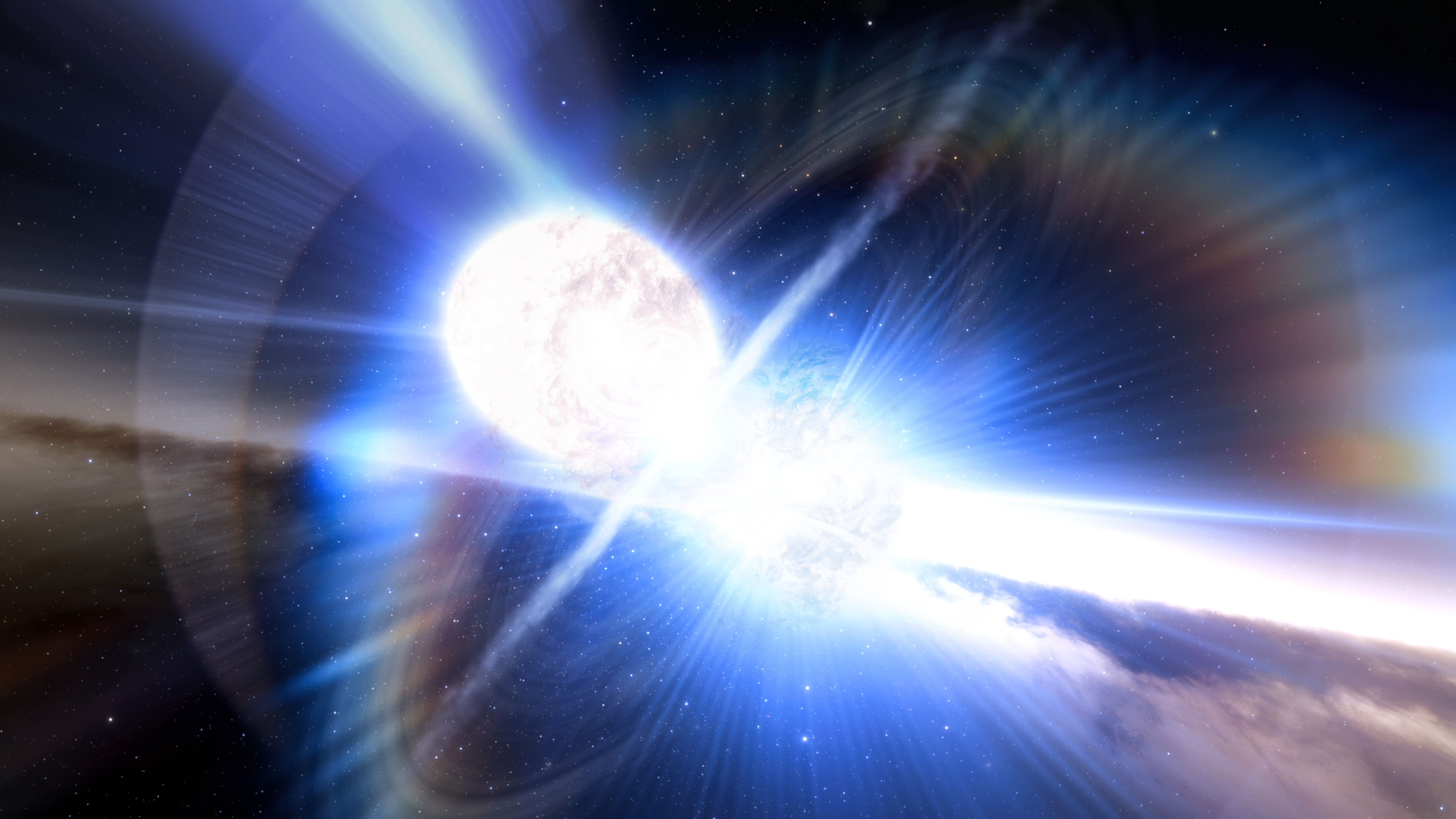
This artist's impression shows a kilonova produced by two colliding neutron stars. While studying the aftermath of a long gamma-ray burst (GRB), two independent teams of astronomers using a host of telescopes in space and on Earth, including the Gemini North telescope on Hawai‘i and the Gemini South telescope in Chile, have uncovered the unexpected hallmarks of a kilonova, the colossal explosion triggered by colliding neutron stars. Credit: NOIRLab/NSF/AURA/J. da Silva/Spaceengine. download Large JPEG


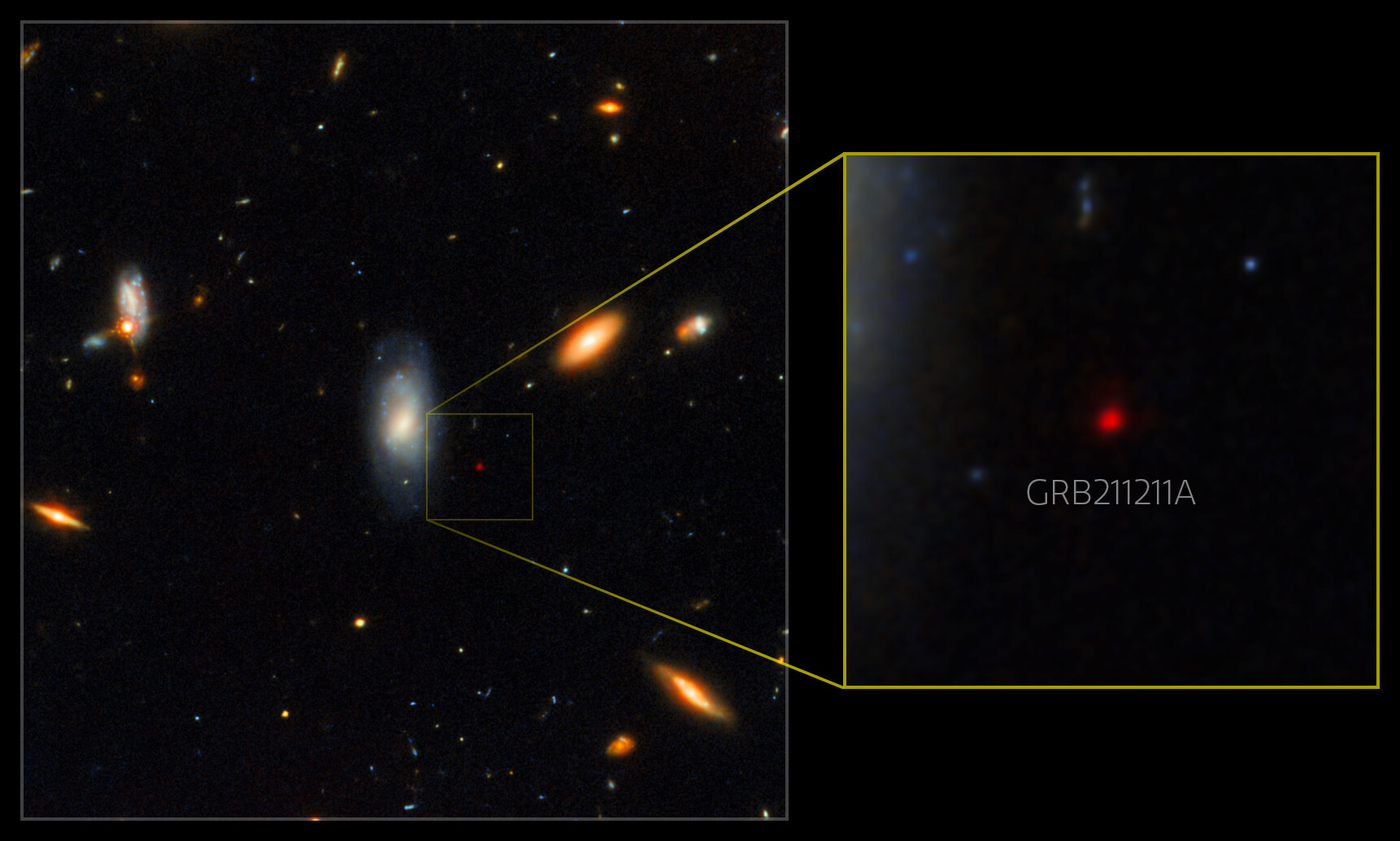
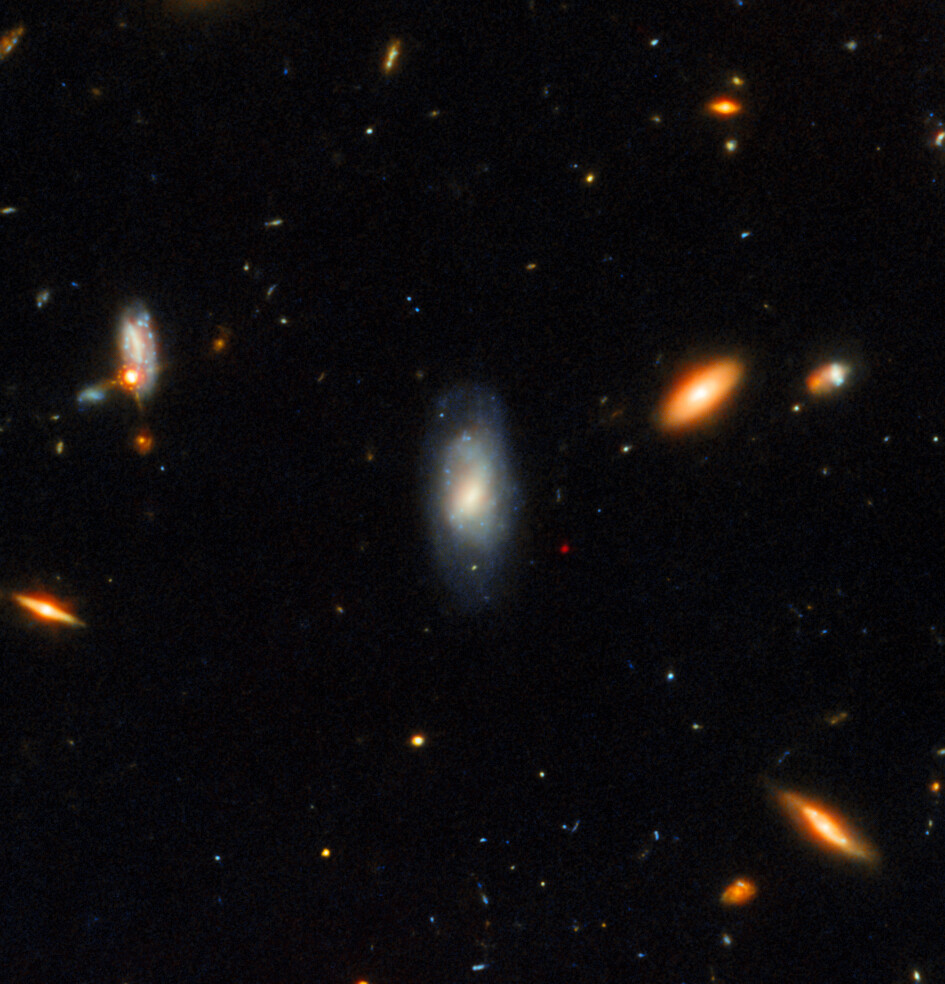
This Gemini North image, superimposed on an image taken with the Hubble Space Telescope, shows the telltale near-infrared afterglow of a kilonova produced by a long GRB (GRB 211211A). This discovery challenges the prevailing theory that long GRBs exclusively come from supernovae, the end-of-life explosions of massive stars. Credit: International Gemini Observatory/NOIRLab/NSF/AURA/M. Zamani; NASA/ESA.  download
Large JPEG


This Gemini North image, superimposed on an image taken with the Hubble Space Telescope, shows the telltale near-infrared afterglow of a kilonova produced by a long GRB (GRB 211211A). This discovery challenges the prevailing theory that long GRBs exclusively come from supernovae, the end-of-life explosions of massive stars. Credit: International Gemini Observatory/NOIRLab/NSF/AURA/M. Zamani; NASA/ESA. download Large JPEG


Cosmoview Episode 58: Kilonova Discovery Challenges our Understanding of Gamma-Ray Bursts. While studying the aftermath of a long gamma-ray burst (GRB), two independent teams of astronomers using a host of telescopes in space and on Earth, including the Gemini North telescope on Hawai‘i and the Gemini South telescope in Chile, have uncovered the unexpected hallmarks of a kilonova, the colossal explosion triggered by colliding neutron stars. This discovery challenges the prevailing theory that long GRBs exclusively come from supernovae, the end-of-life explosions of massive stars. Credit: Images and Videos: International Gemini Observatory/NOIRLab/NSF/AURA, Fermilab, M. Zamani, NASA/ESA, J. da Silva/Spaceengine, CI Lab, N. Bartmann Music: Written and performed by STAN DART Video

Kilonova Discovery Challenges our Understanding of Gamma-Ray Bursts.
Interview with Eleonora Troja, astronomer at the University of Rome Tor Vergata.
Video
 
Kilonova Discovery Challenges our Understanding of Gamma-Ray Bursts. Interview with Jillian Rastinejad, PhD student at Northwestern University.
Video


International Gemini Observatory probes aftermath of gamma-ray burst and uncovers surprising evidence of colliding neutron stars

While studying the aftermath of a long gamma-ray burst (GRB), two independent teams of astronomers using a host of telescopes in space and on Earth, including the Gemini North telescope on Hawai‘i and the Gemini South telescope in Chile, have uncovered the unexpected hallmarks of a kilonova, the colossal explosion triggered by colliding neutron stars. This discovery challenges the prevailing theory that long GRBs exclusively come from supernovae, the end-of-life explosions of massive stars.

Gamma-ray bursts (GRBs) — the most energetic explosions in the Universe — come in two varieties, long and short. Long GRBs, which last a couple of seconds to one minute, form when a star at least 10 times the mass of our Sun explodes as a supernova. Short GRBs, which last less than two seconds, occur when two compact objects, like two neutron stars or a neutron star and a black hole, collide to form a kilonova

While observing the aftermath of a long GRB detected in 2021, two independent teams of astronomers found the surprising signs of a neutron-star merger rather than the expected signal of a supernova. This surprising result marks the first time that a kilonova has been associated with a long GRB and challenges our understanding of these phenomenally powerful explosions.

The first team to announce this discovery was led by Jillian Rastinejad, a PhD student at Northwestern University. Rastinejad and her colleagues made this startling discovery with the help of Gemini North, part of the International Gemini Observatory, which is operated by NSF’s NOIRLab. The Gemini North observations revealed a telltale near-infrared afterglow at the precise location of the GRB, providing the first compelling evidence of a kilonova associated with this event [1]. Rastinejad’s team promptly reported their Gemini detection in a Gamma-ray Coordinates Network (GCN) Circular.

Astronomers around the world were first alerted to this burst, named GRB 211211A, when a powerful flash of gamma rays was picked up by NASA's Neil Gehrels Swift Observatory and Fermi Gamma-ray Space Telescope. Initial observations revealed that the GRB was uncommonly nearby, a mere one billion light-years from Earth.

Most GRBs originate in the distant, early Universe. Typically, these objects are so ancient and far flung that their light would have had to travel for more than six billion years to reach Earth. Light from the most-distant GRB ever recorded traveled for nearly 13 billion years before being detected here on Earth [2]. The relative proximity of this newly discovered GRB enabled astronomers to make remarkably detailed follow-up studies with a variety of ground- and space-based telescopes.

“Astronomers usually investigate short GRBs when hunting for kilonovae,” said Rastinejad. “We were drawn to this longer-duration burst because it was so close that we could study it in detail. Its gamma rays also resembled those of a previous, mysterious supernova-less long GRB.”

A unique observational signature of kilonovae is their brightness at near-infrared wavelengths compared to their brightness in visible light. This difference in brightness is due to the heavy elements ejected by the kilonova, which effectively block visible light but allow the longer-wavelength infrared light to pass unimpeded. Observing in the near-infrared, however, is technically challenging and only a handful of telescopes on Earth, like the twin Gemini telescopes, are sensitive enough to detect this kilonova at these wavelengths.

“Thanks to its sensitivity and our rapid-response, Gemini was the first to detect this kilonova in the near-infrared, convincing us that we were observing a neutron-star merger,” said Rastinejad. “Gemini’s nimble capabilities and variety of instruments let us tailor each night’s observing plan based on the previous night’s results, allowing us to make the most of every minute that our target was observable.”

Another team, led by Eleonora Troja, an astronomer at the University of Rome Tor Vergata, independently studied the afterglow using a different and a different series of observations, including the Gemini South telescope in Chile, [3] and independently concluded that the long GRB came from a kilonova.

”We were able to observe this event only because it was so close to us,” said Troja. “It is very rare that we observe such powerful explosions in our cosmic backyard, and every time we do we learn about the most extreme objects in the Universe.”

The fact that two different teams of scientists working with independent datasets both arrived at the same conclusion about the kilonova nature of this GRB provides confidence in this interpretation.

“The kilonova interpretation was so far off from everything we knew about long GRBs that we could not believe our own eyes and spent months testing all the other possibilities,” said Troja. “It is only after ruling out everything else that we realized our decade-long paradigm had to be revised.”

As well as contributing to our understanding of kilonovae and GRBs, this discovery provides astronomers with a new way to study the formation of gold and other heavy elements in the Universe. The extreme physical conditions in kilonovae produce heavy elements such as gold, platinum, and thorium. Astronomers can now identify the sites that are creating heavy elements by searching for the signature of a kilonova following a long-duration gamma-ray burst.

“This discovery is a clear reminder that the Universe is never fully figured out,” said Rastinejad. “Astronomers often take it for granted that the origins of GRBs can be identified by how long the GRBs are, but this discovery shows us there’s still much more to understand about these amazing events.”

“NSF congratulates the science teams for this new and exciting discovery, opening a new window onto cosmic evolution,” said National Science Foundation Director Sethuraman Panchanathan. “The International Gemini Observatory continues to deliver powerful and nimble resources open to the whole scientific community through innovation and partnership.”

The International Gemini Observatory is operated by a partnership of six countries, including the United States through the National Science Foundation, Canada through the National Research Council of Canada, Chile through the Agencia Nacional de Investigación y Desarrollo, Brazil through the Ministério da Ciência, Tecnologia e Inovações, Argentina through the Ministerio de Ciencia, Tecnología e Innovación, and Korea through the Korea Astronomy and Space Science Institute. These Participants and the University of Hawaii, which has regular access to Gemini, each maintain a National Gemini Office to support their local users.


Note

[1] Rastinejad and her colleagues made initial follow-up observations of the burst using the Nordic Optical Telescope. Following the critical Gemini North observations, they continued their observations of the fading kilonova with the Karl G. Jansky Very Large Array, the Calar Alto Observatory, and the MMT Observatory, and obtained later observations with the Large Binocular Telescope, the W. M. Keck Observatory, the Gran Telescopio Canarias, and the NASA/ESA Hubble Space Telescope.

[2] Light that has traveled nearly 13 billion years to reach Earth would have a redshift (z) of about 7. Due to the accelerating expansion of the Universe, that would roughly equate to a distance of 24.5 billion light-years today. When talking about large redshifts, those greater than 1, and cosmically distant objects, it is more accurate to state how many billions of years the light has traveled rather than a distance in light-years.

[3] Troja and her colleagues initially observed the afterglow of this event with the Devasthal Optical Telescope, the Multicolor Imaging Telescopes for Survey and Monstrous Explosions, and the Calar Alto Observatory. They obtained observations of the host galaxy with the NASA/ESA Hubble Space Telescope.


Links


Contacts:

Jillian Rastinejad
Northwestern University
Email:
jillianrastinejad2024@u.northwestern.edu

Eleonora Troja
Astronomer
University of Rome Tor Vergata
Email:
eleonora.troja@uniroma2.it

Charles Blue
Public Information Officer
NSF’s NOIRLab
Tel: +1 202 236 6324
Email:
charles.blue@noirlab.edu


Tuesday, December 06, 2022

Peekaboo! A Tiny, Hidden Galaxy Provides a Peek into the Past

"Peekaboo" Dwarf Galaxy HIPASS J1131–31
Credits: Science: NASA, ESA, Igor Karachentsev (SAO RAS) / Image Processing: Alyssa Pagan (STScI)


Pull-out: "Peekaboo" Dwarf Galaxy HIPASS J1131–31
Credits: Science: NASA, ESA, Igor Karachentsev (SAO RAS) / Image Processing: Alyssa Pagan (STScI)


Peeking out from behind the glare of a bright foreground star, astronomers have uncovered the most extraordinary example yet of a nearby galaxy with characteristics that are more like galaxies in the distant, early universe. Only 1,200 light-years across, the tiny galaxy HIPASS J1131–31 has been nicknamed "Peekaboo" because of its emergence in the past 50-100 years from behind the fast-moving star that was obscuring astronomers' ability to detect it.

The discovery is a combined effort of telescopes on the ground and in space, including confirmation by NASA's Hubble Space Telescope. Together the research shows tantalizing evidence that the Peekaboo Galaxy is the nearest example of the galaxy formation processes that commonly took place not long after the big bang, 13.8 billion years ago. 

"Uncovering the Peekaboo Galaxy is like discovering a direct window into the past, allowing us to study its extreme environment and stars at a level of detail that is inaccessible in the distant, early universe," said astronomer Gagandeep Anand of the Space Telescope Science Institute in Baltimore, Maryland, co-author of the new study on Peekaboo's intriguing properties.

Astronomers describe galaxies like Peekaboo as "extremely metal-poor" (XMP). In astronomy, "metals" refers to all elements heavier than hydrogen and helium. The very early universe was almost entirely made up of primordial hydrogen and helium, elements forged in the big bang. Heavier elements were forged by stars over the course of cosmic history, building up to the generally metal-rich universe humans find ourselves in today. Life as we know it is made from heavier element "building blocks" like carbon, oxygen, iron, and calcium.

While the universe's earliest galaxies were XMP by default, similarly metal-poor galaxies have also been found in the local universe. Peekaboo caught astronomers' attention because, not only is it an XMP galaxy without a substantial older stellar population, but at only 20 million light-years from Earth it is located at least half the distance of the previously known young XMP galaxies. 

Peekaboo was first detected as a region of cold hydrogen more than 20 years ago with the Australian Parkes radio telescope Murriyang, in the HI Parkes All Sky Survey by professor Bärbel Koribalski, who is an astronomer at Australia's national science agency CSIRO and a co-author of the latest research study on Peekaboo's metallicity. Far-ultraviolet observations by NASA's space-based Galaxy Evolution Explorer (GALEX) mission showed it to be a compact blue dwarf galaxy.
"At first we did not realize how special this little galaxy is," Koribalski said of Peekaboo. "Now with combined data from the Hubble Space Telescope, the Southern African Large Telescope (SALT), and others, we know that the Peekaboo Galaxy is one of the most metal-poor galaxies ever detected."

NASA's Hubble Space Telescope was able to resolve about 60 stars in the tiny galaxy, almost all of which appear to be a few billion years old or younger. Measurements of Peekaboo's metallicity by SALT completed the picture. Together, these findings underline the major difference between Peekaboo and other galaxies in the local universe, which typically have ancient stars that are many billions of years old. Peekaboo's stars indicate that it is one of the youngest and least-chemically-enriched galaxies ever detected in the local universe. This is very unusual, as the local universe has had about 13 billion years of cosmic history to develop.
However, the picture is still a shallow one, Anand says, as the Hubble observations were made as part of a "snapshot" survey program called The Every Known Nearby Galaxy Survey – an effort to get Hubble data of as many neighboring galaxies as possible. The research team plans to use Hubble and the James Webb Space Telescope to do further research on Peekaboo, to learn more about its stellar populations and their metal-makeup. 

"Due to Peekaboo's proximity to us, we can conduct detailed observations, opening up possibilities of seeing an environment resembling the early universe in unprecedented detail," Anand said.

The resultsare accepted for publication in the Monthly Notices of the Royal Astronomical Society.

The Hubble Space Telescope is a project of international cooperation between NASA and ESA. NASA's Goddard Space Flight Center in Greenbelt, Maryland, manages the telescope. The Space Telescope Science Institute (STScI) in Baltimore conducts Hubble science operations. STScI is operated for NASA by the Association of Universities for Research in Astronomy, in Washington, D.C.


About This Release

Credits: Release: NASA, ESA, STScI

Media Contact:

Leah Ramsay
Space Telescope Science Institute, Baltimore, Maryland

Ray Villard
Space Telescope Science Institute, Baltimore, Maryland

Science Contact: Gagandeep Anand
Space Telescope Science Institute, Baltimore, Maryland


Permissions: Content Use Policy

Contact Us: Direct inquiries to the News Team.

Related Links and Documents:


Monday, December 05, 2022

NASA Releases New JWST and W. M. Keck Observatory Images of Titan, Saturn’s Moon


Titan, as seen by the keck ii telescope on maunakea, hawai'i, is the only moon in the solar system with a dense atmosphere and the only world besides earth that has standing bodies of liquid rivers, lakes, and seas. Credit: W. M. Keck Observatory/Judy Schmidt


Maunakea, Hawaiʻi – From space with NASA’s James Webb Space Telescope (JWST) and on the ground with the W. M. Keck Observatory on Maunakea, Hawaiʻi Island, astronomers have tag-teamed to capture a set of extraordinary images revealing large clouds in the northern hemisphere of Saturn’s largest moon, Titan.

“Detecting clouds is exciting because it validates long-held predictions from computer models about Titan’s climate, that clouds would form readily in the mid-northern hemisphere during its late summertime when the surface is warmed by the Sun,” said Conor Nixon, Principal Investigator of the Guaranteed Time Observation (GTO) program 1251 team at NASA’s Goddard Space Flight Center.

As part of their investigation of Titan’s atmosphere and climate, Nixon’s team used JWST’s Near-Infrared Camera (NIRCam) to observe the moon during the first week of November. After seeing the clouds near Kraken Mare, the largest known liquid sea of methane on the surface of Titan, they immediately contacted the Keck Titan Observing Team to request follow-up observations.


Near-infrared Images of Saturn’s moon Titan, as seen by JWST on November 4, 2022 (left), followed by Keck Observatory’s NIRC2 instrument paired with adaptive optics on November 6, 2022 (middle) and November 7, 2022 (right). Credit: NASA/STScI/W. M. Keck Observatory/Judy Schmidt

“We were concerned that the clouds would be gone when we looked at Titan a day later with Keck, but to our delight there were clouds at the same positions on subsequent observing nights, looking like they had changed in shape,” said Imke de Pater, emeritus professor of astronomy at the University of California, Berkeley, who leads the Keck Titan Observing Team. Using Keck Observatory’s second generation Near-Infrared Camera (NIRC2) in combination with the Keck II Telescope’s adaptive optics system, de Pater and her team observed one of Titan’s clouds rotating into and another cloud either dissipating or moving out of Earth’s field of view due to Titan’s rotation. Tracking the clouds’ motions are important because they give insight into how air is flowing within Titan’s atmosphere.


Evolution of clouds on Titan over 30 hours between Nov. 4 and Nov. 6 captured by JWST (top) and Keck Observatory (bottom). Titan’s trailing hemisphere seen here is rotating from left (dawn) to right (evening) as seen from Earth and the Sun. Cloud A appears to be rotating into view while Cloud B appears to be either dissipating or moving behind Titan’s limb. Clouds are not long-lasting on Titan or Earth, so those seen on November 4 may not be the same as those seen on November 6. Credit: NASA/STScI/Keck Observatory/Judy Schmidt Nixon and de Pater’s teams will continue to analyze the fresh data, with more JWST observations planned.


As the only moon in the solar system with a dense atmosphere, as well as the only place besides Earth to have present-day liquid rivers, lakes, and oceans, astronomers hope to deepen their understanding of Titan’s spectacular environment.

Read more:


About NIRC2

The Near-Infrared Camera, second generation (NIRC2) works in combination with the Keck II adaptive optics system to obtain very sharp images at near-infrared wavelengths, achieving spatial resolutions comparable to or better than those achieved by the Hubble Space Telescope at optical wavelengths. NIRC2 is probably best known for helping to provide definitive proof of a central massive black hole at the center of our galaxy. Astronomers also use NIRC2 to map surface features of solar system bodies, detect planets orbiting other stars, and study detailed morphology of distant galaxies.

About Adaptive Optics

W. M. Keck Observatory is a distinguished leader in the field of adaptive optics (AO), a breakthrough technology that removes the distortions caused by the turbulence in the Earth’s atmosphere. Keck Observatory pioneered the astronomical use of both natural guide star (NGS) and laser guide star adaptive optics (LGS AO) and current systems now deliver images three to four times sharper than the Hubble Space Telescope at near-infrared wavelengths. AO has imaged the four massive planets orbiting the star HR8799, measured the mass of the giant black hole at the center of our Milky Way Galaxy, discovered new supernovae in distant galaxies, and identified the specific stars that were their progenitors. Support for this technology was generously provided by the Bob and Renee Parsons Foundation, Change Happens Foundation, Gordon and Betty Moore Foundation, Mt. Cuba Astronomical Foundation, NASA, NSF, and W. M. Keck Foundation.

About W. M. Keck Observatory

The W. M. Keck Observatory telescopes are among the most scientifically productive on Earth. The two 10-meter optical/infrared telescopes atop Maunakea on the Island of Hawaii feature a suite of advanced instruments including imagers, multi-object spectrographs, high-resolution spectrographs, integral-field spectrometers, and world-leading laser guide star adaptive optics systems. Some of the data presented herein were obtained at Keck Observatory, which is a private 501(c) 3 non-profit organization operated as a scientific partnership among the California Institute of Technology, the University of California, and the National Aeronautics and Space Administration. The Observatory was made possible by the generous financial support of the W. M. Keck Foundation. The authors wish to recognize and acknowledge the very significant cultural role and reverence that the summit of Maunakea has always had within the Native Hawaiian community. We are most fortunate to have the opportunity to conduct observations from this mountain.


Friday, December 02, 2022

Four Perspectives on Neutron Stars, Pulsars, and Magnetars By Kerry Hensley

Illustration of a neutron star emitting a jet.
Credit:
ICRAR/University of Amsterdam

When a massive star explodes as a supernova, its core collapses into a city-sized sphere of neutrons called a neutron star. These extraordinarily dense stars — just one teaspoon of a neutron star would weigh billions of tons in Earth’s gravity — exhibit some of the most intriguing behavior in the universe: rapid rotation, beams of radio emission, and extremely strong magnetic fields. Today, we’ll introduce four recent research articles that explore different aspects of these stars.


Simulated light curves during an X-ray burst, showing the effects of incorporating different physics. A model without neutrino cooling (labeled “No DU” in reference to the neutrino cooling pathway called direct Urca), peaks at a lower luminosity than models incorporating neutrino cooling. Credit: Adapted from Dohi et al. 2022

Bursting, Cooling, and Bursting Again

Sometimes, neutron stars reveal themselves by interacting with other stars. When a neutron star gathers gas from a stellar companion, the gas can ignite on the star’s scorching surface, resulting in a sudden burst of X-rays. After this sudden influx of heat, how does the neutron star cool, and how is the cooling reflected in the star’s light curve? While this may seem like a simple question, the answer hinges on our understanding of the conditions within the neutron star’s interior as well as the characteristics of the gas being accreted.

In a recent publication, a team led by Akira Dohi (土肥明; Kyushu University, Japan) explored the issue of neutron star cooling with general relativistic stellar evolution models. Specifically, the team investigated the effects of cooling by emitting neutrinos — chargeless, nearly massless particles that scarcely interact with matter — which is expected to speed up the cooling rate. The authors found that neutrino cooling increases the time between outbursts but makes them brighter at their peak, though additional physics to be included in future modeling might suppress this effect.

Simulated pulses showing a change in the phase of the pulse due to the shifting motion of the sparks.
Credit: Adapted from Basu et al. 2022


Simulating Pulsar Sparks

Rahul Basu (University of Zielona Góra, Poland) and collaborators reported on simulations of conditions very close to the surface of a neutron star that emits beams of radio emission. Neutron stars that emit beamed radio waves are called pulsars for the way the beams sweep across our field of view, generating what we see as pulses of emission. Near a pulsar’s surface, extremely high temperatures and strong magnetic and electric fields combine forces to summon a sea of charged particles that are then accelerated to relativistic speeds.

Basu and collaborators focused on a phenomenon called sparking, in which charged particles jump the gap between the pulsar’s surface at its poles and its plasma-rich magnetosphere. The team’s modeling demonstrated that a pulsar’s poles are tightly filled with constant sparks, and the arrangement of these sparks slowly shifts over time. By modeling the emission associated with the simulated sparks, the team showed that the shifting motion of the sparks appears to be responsible for the observed periodic variations in the phases and amplitudes of some pulsars’ pulses.

Example of a pulse observed with the Giant Metrewave Radio Telescope.
Credit: Adapted from Sharma et al. 2022


Pulsars Probing Gravitational Waves

By studying large groups of pulsars, astronomers hope to learn about something seemingly unrelated: gravitational waves. Pulsars provide a method to detect gravitational waves by way of these stars’ impeccable timekeeping abilities — because a pulsar’s radio beat is so reliable, the slight distortion of space caused by a passing gravitational wave should impact the arrival times of a pulsar’s pulses.

However, there’s a complication to this technique: spatial and temporal changes in the interstellar medium plasma can also affect when a pulsar’s radio pulses arrive at Earth. In order to compensate for the effect of the interstellar medium, we need to be able to make precise observations of pulsars across a range of radio frequencies. In a recent research article, Shyam Sharma (Tata Institute of Fundamental Research, India) and collaborators tested a pulsar-timing measurement technique using the Giant Metrewave Radio Telescope, which is highly sensitive to low-frequency radio waves. Sharma and coauthors showed that observing using a wide frequency band yields results comparable to typical narrowband observations, indicating that this technique could be used to disentangle the effects of the interstellar medium and more accurately time the pulses of arrays of pulsars, opening a new window onto gravitational waves.

Temperature maps of the top of a magnetar’s crust (top) and the magnetar’s surface (bottom) after a hotspot is injected.
Credit: De Grandis et al. 2022


Magnetic Outbursts

As if neutron stars could get any wilder: some neutron stars, dubbed magnetars, have extremely strong magnetic fields and exhibit frequent X-ray flares. While the cause of these X-ray outbursts is still unknown, some researchers have suggested that they arise from a sudden upwelling of magnetic energy beneath the magnetar’s crust, creating a hot spot that cools gradually over days or months.

To understand how the injection of heat into a magnetar’s crust might create the spectral features seen during X-ray outbursts, Davide De Grandis (University of Padova, Italy) and coauthors employed a three-dimensional magnetothermal model of hotspot formation and cooling. This model allowed the team to study the effects of asymmetrical hot spots under a magnetar’s crust for the first time. The team was able to confirm that these hot spots can be responsible for outbursts, though we’ll have to wait for future research to fully explore the evolution of the spectral features generated during these events.


Citation

“Impacts of the Direct Urca and Superfluidity inside a Neutron Star on Type I X-Ray Bursts and X-Ray Superbursts,” A. Dohi et al 2022 ApJ 937 124. doi:10.3847/1538-4357/ac8dfe

“Two-dimensional Configuration and Temporal Evolution of Spark Discharges in Pulsars,” Rahul Basu et al 2022 ApJ 936 35. doi:10.3847/1538-4357/ac8479

“Wide-band Timing of GMRT-discovered Millisecond Pulsars,” Shyam S. Sharma et al 2022 ApJ 936 86. doi:10.3847/1538-4357/ac86d8

“Three-dimensional Magnetothermal Simulations of Magnetar Outbursts,” Davide De Grandis et al 2022 ApJ 936 99. doi:10.3847/1538-4357/ac8797

Thursday, December 01, 2022

Emission lines from the simulated interstellar medium


Gas density and gas temperature of the simulated ISM at high gas surface densities of 100 M⦿/pc2 (left panels) and the corresponding emission line maps for hydrogen (middle), nitrogen and oxygen ions (right panels).© MPA


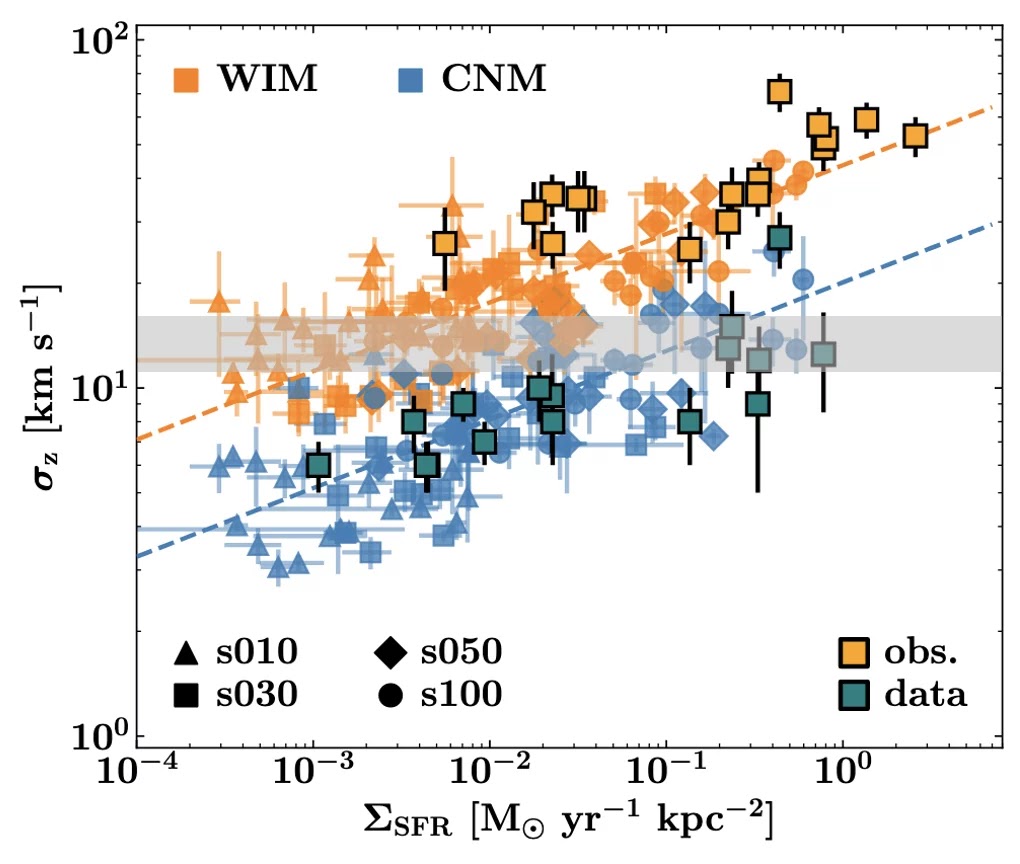
This plot shows the velocity dispersion (y-axis) as a function of the star formation rate (x-axis) for the warm-ionized medium (WIM, ~ 10.000 K, orange squares) and the cold neutral medium (CNM, ~ 300K, blue squares). The sound speed of the WIM is indicated by the grey band. The simulations follow the observed trends (Leroy et al. 2008, data points with black boxes) very well. The velocity dispersion increases with star formation rate and the warm gas motions become supersonic. © MPA


This map shows the diagnostic line-ratios (BPT diagram) with galaxies from the SDSS (grey) in the background. While the simulation overall (pink star) is in the star formation regime (left), a look at higher resolution (green-yellow dots) reveals significant emission in the AGN regime (right). The two lines (dotted, Kauffman et al. 2003 and solid, Kewley et al. 2001) are predictions separating galaxies with ionization by stellar radiation from radiation from active galactic nuclei (AGN, i.e. accreting supermassive black holes). In this simulation, however, the emission is generated by diffuse ionized gas heated by supernova shocks and not by AGN radiation. If this radiation were excluded the whole region would move in the direction of the arrow. © MPA


All stars in galaxies form in the dense gas of the interstellar medium (ISM). Ionizing radiation from newly born massive stars and supernova explosions lets the gas shine at characteristic wavelengths of certain atoms and ions. The relative strength of such line fluxes is an important observational diagnostic to reveal the internal state and composition of the ISM. However, emission by diffuse ionized gas has different flux ratios making accurate predictions difficult. Scientist at MPA and their European collaborators have used supercomputers to simulate a realistic star forming interstellar medium and to quantify the contribution of the diffuse gas. This finding allows for a more accurate interpretation of observations also at early cosmic times when these extreme conditions are more common than in the local Universe. 

The interstellar medium (ISM) is the backbone of every galaxy that actively forms stars. Gas accreted from the cosmic web or returned from previous generations of stars accumulates here. Dense regions in the ISM cool and collapse into molecular clouds, the nursery of newly forming stars. Most of these stars have masses like our Sun or lower. However, about one in a hundred is more massive than eight solar masses. These massive stars emit strong ionizing radiation and expel material from their surfaces as stellar winds. At the end of their lives, they die as supernovae, dumping enormous amounts of energy into the ISM. These processes are termed as “feedback” and change the conditions of the ISM resulting in a complex interplay between star formation and the turbulent, multiphase structure of the gas. Modern supercomputer simulations can study this in detail.

Scientists at MPA and collaborators at the Universities of Cologne and Heidelberg, the Czech Academy of Sciences, the Institute d’Astrophysique de Paris, and the École Polytechnique Fédérale de Lausanne of the SILCC (Simulating the Life Cycle of molecular Clouds) supercomputing project have used SuperMUC-NG at the Leibnitz Supercomputing Center, one of the world’s fastest supercomputers, to simulate a realistic star forming ISM with all fundamental constituents. This includes gas, stars, radiation, and dust, but also the non-thermal components magnetic fields and cosmic-rays. The complex interaction of the ISM with stellar feedback processes has been simulated with conditions prevailing in a typical spiral galaxy in the local Universe, similar to the solar neighborhood. In addition, models with higher gas density represent more extreme conditions in the local Universe, like in interacting galaxies, or galaxies at earlier cosmic epochs with higher gas fractions.

The simulations are very realistic and explain many details seen in observations. Their multi-phase gas structure, star formation properties, and kinematic properties agree very well with direct ISM observations. In regions with higher star formation rates, the supernova explosions trigger higher turbulent velocities in the cold (< 300 Kelvin) and warm (~ 10000 Kelvin) gas with a similar trend as observed. At high star formation rates, the warm ISM motions become supersonic and magneto-hydrodynamic shocks become ubiquitous.

The ISM is mainly composed of hydrogen and helium but is also enriched with traces of heavier elements such as oxygen or nitrogen. When these elements are ionized and excited by stellar radiation, they start emitting at specific wavelengths when they return to lower energy levels. Some of these transitions, like the [OIII] emission of doubly ionized oxygen, happens in extremely rarefied gas which only exist in space, typically in so-called HII regions around massive stars. It is therefore sometimes referred to as a “forbidden” line. The relative strength of this line emission is an important observational diagnostic to reveal the internal state and composition of the ISM at all cosmic epochs.

For example, the flux ratios of emission lines are used to characterize e.g. the density of the ISM, abundances of heavy elements, or the source of the ionizing radiation. However, also in regions without massive stars and their ionizing radiation, shocks can heat up the gas leading to collisional ionization of the same elements. This diffuse ionized gas (DIG) has very different flux ratios than the gas ionized by stellar radiation in HII regions. The uncertain contribution of the DIG in observations makes accurate predictions about the ISM structure difficult.

The research team has used simulations of a large region of the ISM to construct detailed maps for the expected emission in hydrogen, oxygen and nitrogen lines. The whole region has flux ratio properties similar to the ISM of star forming galaxies in the local Universe. However, a much higher resolution reveals the contribution of the DIG. In the line-ratio diagram (known as the BPT diagram) it populates a region, which is traditionally associated with the presence of an active galactic nucleus. In this case, however, the ionized gas with a temperature of ~ 20.000 Kelvin is created by supersonic turbulence in the warm ionized gas (WIM) triggered by many supernova explosions.

Simulations and data analysis were carried out on supercomputers at MPCDF and SuperMUC-NG at the Leibnitz Supercomputing Center (LRZ).

This work is supported by MPCDF and Gauss Centre for Supercomputing

More Information: The SILCC project


Authors

Thorsten Naab
Scientific Staff
tel.2295

tnaab@mpa-garching.mpg.de

Tim-Eric Rathjen

Original publications:

1.
Rahtjen, T.-E., Naab. T. et al.
SILCC VII - Gas kinematics and multiphase outflows of the simulated
ISM at high gas surface densities
submitted to MNRAS
Source

2.
Rahtjen, T.-E., Naab, T. et al.
Optical emission lines from the simulated interstellar medium in prep