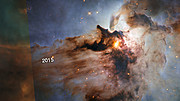
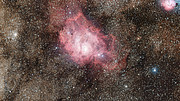
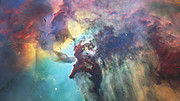
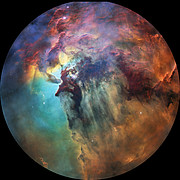
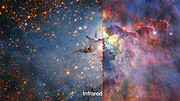
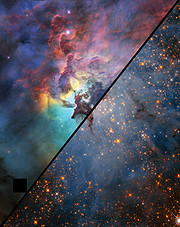
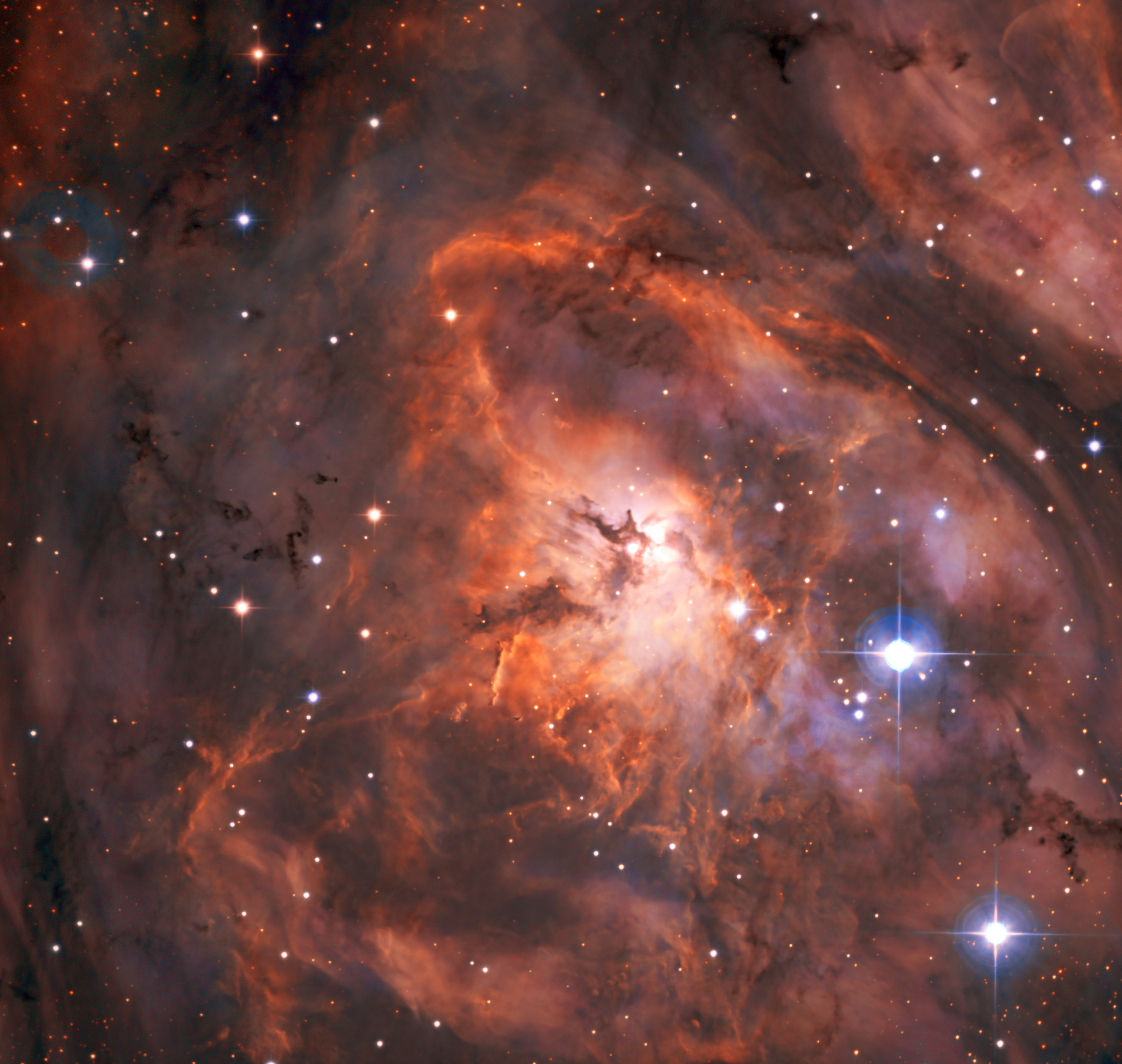
This image combines 678 separate images taken by NSF–DOE Vera C. Rubin Observatory in just over seven hours of observing time. Combining many images in this way clearly reveals otherwise faint or invisible details, such as the clouds of gas and dust that comprise the Trifid Nebula (top) and the Lagoon Nebula, which are several thousand light-years away from Earth. Credit: NSF–DOE Vera C. Rubin Observatory
From distant stars and galaxies to asteroids whizzing through the Solar System, this next-generation facility unveils its first imagery and brings the night sky to life like never before
The NSF–DOE Vera C. Rubin Observatory, a major new scientific facility jointly funded by the U.S. National Science Foundation and the U.S. Department of Energy's Office of Science, released its first imagery today at an event in Washington, D.C. The imagery shows cosmic phenomena captured at an unprecedented scale. In just over 10 hours of test observations, NSF–DOE Rubin Observatory has already captured millions of galaxies and Milky Way stars and thousands of asteroids. The imagery is a small preview of Rubin Observatory's upcoming 10-year scientific mission to explore and understand some of the Universe's biggest mysteries.
“The NSF-DOE Vera C. Rubin Observatory demonstrates that the United States remains at the forefront of international basic science and highlights the remarkable achievements we get when the many parts of the national research enterprise work together,” said Michael Kratsios, director of the White House Office of Science and Technology Policy. “The Rubin Observatory is an investment in our future, which will lay down a cornerstone of knowledge today on which our children will proudly build tomorrow.”
“NSF–DOE Rubin Observatory will capture more information about our Universe than all optical telescopes throughout history combined,” said Brian Stone, performing the duties of the NSF director. “Through this remarkable scientific facility, we will explore many cosmic mysteries, including the dark matter and dark energy that permeate the Universe.”
“We’re entering a golden age of American science,” said Harriet Kung, acting director of DOE's Office of Science. “NSF–DOE Rubin Observatory reflects what’s possible when the federal government backs world-class engineers and scientists with the tools to lead. This facility will drive discovery, inspire future innovators and unleash American excellence through scientific leadership.”
Made from over 1100 images captured by NSF–DOE Vera C. Rubin Observatory, the video begins with a close-up of two galaxies then zooms out to reveal about 10 million galaxies. Those 10 million galaxies are roughly 0.05% of the approximately 20 billion galaxies Rubin Observatory will capture during its 10-year Legacy Survey of Space and Time. Credit: NSF–DOE Vera C. Rubin Observatory
The result of more than two decades of work, Rubin Observatory is perched at the summit of Cerro Pachón in Chile, where dry air and dark skies provide one of the world's best observing locations. Rubin’s innovative 8.4-meter telescope has the largest digital camera ever built, which feeds a powerful data processing system. Later in 2025, Rubin will begin its primary mission, the Legacy Survey of Space and Time, in which it will ceaselessly scan the sky nightly for 10 years to precisely capture every visible change.
The result of more than two decades of work, Rubin Observatory is perched at the summit of Cerro Pachón in Chile, where dry air and dark skies provide one of the world's best observing locations. Rubin’s innovative 8.4-meter telescope has the largest digital camera ever built, which feeds a powerful data processing system. Later in 2025, Rubin will begin its primary mission, the Legacy Survey of Space and Time, in which it will ceaselessly scan the sky nightly for 10 years to precisely capture every visible change.
The result will be an ultrawide, ultra-high-definition
time-lapse record of the Universe. It will bring the sky to life with a
treasure trove of billions of scientific discoveries. The images will
reveal asteroids and comets, pulsating stars, supernova explosions, far-off galaxies and perhaps cosmic phenomena that no one has seen before.
In about 10 hours of observations, NSF–DOE Vera C. Rubin Observatory discovered 2104 never-before-seen asteroids in our Solar System, including seven near-Earth asteroids (which pose no danger). Annually, about 20,000 asteroids are discovered in total by all other ground and space-based observatories. Rubin Observatory alone will discover millions of new asteroids within the first two years of the Legacy Survey of Space and Time. Rubin will also be the most effective observatory at spotting interstellar objects passing through the Solar System. Credit: NSF–DOE Vera C. Rubin Observatory
Rubin Observatory is named in honor of trailblazing U.S. astronomer Vera C. Rubin, who found conclusive evidence of vast quantities of invisible material known as dark matter. Understanding the nature of dark matter, dark energy and other large-scale cosmic mysteries is a central focus of Rubin Observatory's mission. Dark energy is what scientists call the mysterious and colossally powerful force that appears to be causing galaxies in the Universe to move away from each other at an accelerating rate. Although dark matter and dark energy collectively comprise 95% of the Universe, their properties remain unknown.
Rubin Observatory will also be the most efficient and effective Solar System discovery machine ever built. Rubin will take about a thousand images of the Southern Hemisphere sky every night, allowing it to cover the entire visible Southern sky every three to four nights. In doing so, it will find millions of unseen asteroids, comets and interstellar objects. Rubin will be a game changer for planetary defense by spotting far more asteroids than ever before, potentially identifying some that might impact the Earth or Moon.
The amount of data gathered by Rubin Observatory in its first year alone will be greater than that collected by all other optical observatories combined. This treasure trove of data will help scientists make countless discoveries about the Universe and will serve as an incomparable resource for scientific exploration for decades to come.
To learn more about Rubin Observatory, download educational resources for teachers and students, and find out how you can get involved as a citizen scientist, visit the NSF–DOE Vera C. Rubin Observatory website.
Rubin Observatory is a joint program of NSF NOIRLab and DOE’s SLAC National Accelerator Laboratory, who will cooperatively operate Rubin. NOIRLab is managed by the Association of Universities for Research in Astronomy (AURA).
“Releasing our first scientific imagery marks an extraordinary milestone for NSF–DOE Rubin Observatory. It represents the culmination of about two decades of dedication, innovation, and collaboration by a global team,” said Željko Ivezić, Director of Rubin Observatory Construction. “With construction now complete, we’re turning our eyes fully to the sky — not just to take images, but to begin a whole new era of discovery.”
The LSST Camera at the heart of Rubin Observatory captures extremely fine features in distant galaxies, stars, and other celestial objects. A team of scientists, engineers, and technicians at SLAC National Accelerator Laboratory designed and constructed the camera, which is roughly the size of a small car and weighs almost 6200 pounds (2800 kilograms). Each image taken by the LSST Camera covers an area on the sky as big as 45 full Moons.
"Making the world’s largest digital camera will let scientists explore the cosmos in new ways, and at a scale that enables discoveries that should fundamentally change our understanding of the Universe,” said Aaron Roodman, Director of the LSST Camera and Deputy Director of NSF–DOERubin Construction from SLAC National Accelerator Laboratory. “Just as you would with the camera in your phone, it is finally time to point and shoot — our science begins now."
“I want to extend my gratitude to the brilliant and dedicated team of people who made this milestone possible,” said SLAC Director John Sarrao. “Rubin Observatory, and the LSST Camera at its heart, are unprecedented tools and a testament to the expertise, partnerships and leadership that drive discoveries forward, benefitting the nation and the world.”
During its ten-year survey, Rubin will generate approximately 20 terabytes of data per night, plus an additional 15 petabyte catalog database. In 10 years, Rubin data processing will generate around 500 petabytes, and the final dataset will contain billions of objects with trillions of measurements. With regular data releases, scientists will be able to conduct their own investigations into Rubin’s data remotely, enabling and expediting countless discoveries about our Universe and advancing science in ways we can’t yet predict.
“We are so thrilled to share NSF–DOE Rubin Observatory’s first images with the world — it’s a proud moment for our whole team,” said Sandrine Thomas, Deputy Director of Rubin Construction and Associate Director of Rubin Observatory for Rubin Summit Operations, “While we still have a few important months of commissioning and testing ahead, everything we learn now brings us closer to full science operations later this year. Today is just the beginning!”
Rubin also brings the power of astronomical data and interactive learning to educators and students around the world through an online public engagement platform developed by a team of astronomers, educators, and web design experts, which provides tools and activities to engage and interact with a subset of Rubin Observatory data.
Rubin Observatory’s First Look images were also shared with over 300 public and private Watch Parties hosted by partner institutions, planetariums, observatories, museums, libraries, amateur astronomy societies, schools, and universities around the world.
“It is not every day that a revolution stares you in the face, but that is precisely what the Rubin Observatory team — together with our colleagues at the NSF and DOE — has delivered with these first images. Astronomy is on the brink of transformation!” said Matt Mountain, AURA President. AURA is the managing organization for the Rubin Construction project and NSF NOIRLab. “Congratulations to the entire team for mastering the complexity of a fully active telescope and a pioneering optical system — imaging vast swaths of the sky with extraordinary precision with the world’s largest astronomical camera, and streaming data into an audacious real-time processing system. Everyone at AURA is proud to be part of this landmark moment — and the incredible science that now lies just ahead.”
More information about the imagery included in this release — along with additional First Look images and videos — can be found on rubinobservatory.org. Rubin is also introducing its interactive, easy-to-use SkyViewer app, which offers both guided and free-form exploration of select Rubin images.
The public is also invited to experience Rubin Observatory’s wide and deep image of the cosmos through sound. An interactive sonification, available in the SkyViewer app, lets users drift across Rubin Observatory’s ultra-detailed view of the cosmos, translating the colors and brightness of distant galaxies and stars into an immersive, never-ending soundscape.
Source: Vera C. Rubin Observatory/News
More information
NSF–DOE Vera C. Rubin Observatory, funded by the U.S.
National Science Foundation and the U.S. Department of Energy’s Office
of Science, is a groundbreaking new astronomy and astrophysics
observatory under construction on Cerro Pachón in Chile, with first
light expected in 2025. It is named after astronomer Vera Rubin, who
provided the first convincing evidence for the existence of dark matter.
Using the largest camera ever built, Rubin will repeatedly scan the sky
for 10 years and create an ultra-wide, ultra-high-definition,
time-lapse record of our Universe.
NSF–DOE Vera C. Rubin Observatory is a joint initiative of the U.S. National Science Foundation (NSF) and the U.S. Department of Energy’s Office of Science (DOE/SC). Its primary mission is to carry out the Legacy Survey of Space and Time, providing an unprecedented data set for scientific research supported by both agencies. Rubin is operated jointly by NSF NOIRLab and SLAC National Accelerator Laboratory. NSF NOIRLab is managed by the Association of Universities for Research in Astronomy (AURA) and SLAC is operated by Stanford University for the DOE. France provides key support to the construction and operations of Rubin Observatory through contributions from CNRS/IN2P3. Rubin Observatory is privileged to conduct research in Chile and gratefully acknowledges additional contributions from more than 40 international organizations and teams.
The U.S. National Science Foundation (NSF) is an independent federal agency created by Congress in 1950 to promote the progress of science. NSF supports basic research and people to create knowledge that transforms the future.
The DOE’s Office of Science is the single largest supporter of basic research in the physical sciences in the United States and is working to address some of the most pressing challenges of our time.
NSF NOIRLab, the U.S. National Science Foundation center for ground-based optical-infrared astronomy, operates the International Gemini Observatory (a facility of NSF, NRC–Canada, ANID–Chile, MCTIC–Brazil, MINCyT–Argentina, and KASI–Republic of Korea), NSF Kitt Peak National Observatory (KPNO), NSF Cerro Tololo Inter-American Observatory (CTIO), the Community Science and Data Center (CSDC), and NSF–DOE Vera C. Rubin Observatory (in cooperation with DOE’s SLAC National Accelerator Laboratory). It is managed by the Association of Universities for Research in Astronomy (AURA) under a cooperative agreement with NSF and is headquartered in Tucson, Arizona.
The scientific community is honored to have the opportunity to conduct astronomical research on I’oligam Du’ag (Kitt Peak) in Arizona, on Maunakea in Hawai‘i, and on Cerro Tololo and Cerro Pachón in Chile. We recognize and acknowledge the very significant cultural role and reverence of I’oligam Du’ag (Kitt Peak) to the Tohono O’odham Nation, and Maunakea to the Kanaka Maoli (Native Hawaiians) community.
SLAC National Accelerator Laboratory explores how the universe works at the biggest, smallest and fastest scales and invents powerful tools used by researchers around the globe. As world leaders in ultrafast science and bold explorers of the physics of the universe, we forge new ground in understanding our origins and building a healthier and more sustainable future. Our discovery and innovation help develop new materials and chemical processes and open unprecedented views of the cosmos and life’s most delicate machinery. Building on more than 60 years of visionary research, we help shape the future by advancing areas such as quantum technology, scientific computing and the development of next-generation accelerators. SLAC is operated by Stanford University for the U.S. Department of Energy’s Office of Science.
Links
Contacts:
Ranpal Gill
Communications Manager for Rubin Construction
Email: rgill@lsst.org
Josie Fenske
Public Information Officer
NSF NOIRLab
Email: comms@noirlab.edu
Aaron Groff
Media Relations Lead
SLAC National Accelerator Laboratory
Email: agroff@slac.stanford.edu
Shari Lifson
AURA Communications Coordinator
Email: slifson@aura-astronomy.org