Tuesday, March 27, 2012

Public to get access to spectacular infrared images of galaxies

Left: The mid-infrared (24 micron) image of M91 as seen with the Spitzer Space Telescope. M91 is the prototype example of a barred spiral galaxy. Although the spiral arms are easily seen in mid-infrared light, the bar is only faintly visible.

Right: NGC 4772 contains a dust ring that is bright in mid-infrared light. Dust rings like this are common in many spiral galaxies.

These galaxies is just two of the over 200 galaxies for which reprocessed Spitzer Space Telescope data are being released to the general public for the first time.

For the first time, the general public will be able to browse detailed infrared images of more than 200 galaxies. The pictures, originating from data from the orbiting Spitzer Space Telescope, are currently being released to the general public. Dr. George Bendo of the Jodrell Bank Centre for Astrophysics will highlight the new imagery at the National Astronomy Meeting in Manchester from 27-30 March.

The pictures are mid-infrared (24 micron wavelength) reprocessed images of nearby galaxies observed with Spitzer between 2003 and 2009. Amongst the images are the objects M60, M61, M88, M91 and M98, all of which lie between 47 and 63 million light years away in the large cluster of galaxies found in the direction of the constellation of Virgo.

The mid-infrared light from these galaxies primarily traces interstellar dust heated by the hot young stars found in the places where stars are forming. These images, which are being made available to the public for the first time, are a small sample of those that will be released later in the year.

Dr. Bendo explains how complicated it was to make the data usable for science. "The 24-160 micron Spitzer images need expert processing to be suitable for scientists, let alone the general public and until now many of them had been overlooked. I volunteered to do this work for these galaxies as they will soon be observed by the Herschel Space Observatory at far-infrared wavelengths." With processed Spizter data, astronomers will be able to make a direct comparison between the views from each telescope.

He is delighted to be bringing the Spitzer material to the public: "These data show the intimate connection between the interstellar dust in galaxies, here seen shining in infrared light, and the formation of stars on a grand scale. Now anyone with internet access can download these extraordinary pictures for themselves and take a look at some of the objects being studied by the world's leading astronomers, as part of their effort to better understand the universe we live in."

Example images

The mid-infrared (24 micron) images below are a sample of the over 200 galaxy images that are being released to the general public. Click on any link below to see the full-sized version of the image.

Left: M60 is actually two galaxies that appear next to each other in the sky but are actually physically separated from each other. The larger elliptical galaxy looks relatively faint and contains little dust to produce mid-infrared light, but the smaller spiral galaxy contains a lot of dust and looks much brighter.

Center: M61 is one of the larger spiral galaxies in the Virgo Cluster. The spiral arms and the nucleus in this galaxy are both locations where many hot young stars are forming. These stars heat up the interstellar dust that looks very bright in mid-infrared light.

Right: M88 is currently underoing a process where the interstellar gas and dust in the galaxy are colliding with gas between the galaxies in the Virgo Cluster. This process will eventually strip away much of the gas and dust in the galaxy.

Left: M98 contains a structure that looks like a dust ring. While these dust rings may be common in spiral galaxies, they can be difficult to spot in visible light.

Center: NGC 891 is a spiral galaxy that we see edge-on from Earth. In visible light, we see a dark dust lane across the disc of the galaxy where the interstellar dust abosrbs starlight, but in infrared images like this one, we see that energy re-radiated in infrared light.

Right: NGC 4698 is another spiral galaxy with a very well-defined dust ring. The centre of the galaxy contains an active galactic nucleus. Astronomers hypothesize that such active galactic nuclei contain supermassive black holes. While the black hole itself would produce no light, the region around the black hole can very very bright and could be producing the infrared light seen from the centre of this galaxy.

Left: NGC 3953 contains a very small bar in its centre that looks like a thin slash in this mid-infrared image. Bars like this one can transfer gas and dust (like the dust we see in this mid-infrared image) into the centres of galaxies.

Center: NGC 4298 and NGC 4302 both appear close to each other in sky but are actually further apart than implied by this image. Both of these galaxies are located in the Virgo Cluster and are falling towards the centre of the cluster.

Right: NGC 4565 is an edge-on spiral galaxy. In visible light, we would see a bright bulge in the centre of this galaxy, but the bulge is virtually invisible in mid-infrared light. We would also see the interstellar dust in the disc appear as a dark cloud across this galaxy, but that dust appears like a narrow edge-on disc in mid-infrared light.


Editors notes:
Further information

The scientific data are available from:
http://hedam.oamp.fr/
http://www.jb.man.ac.uk/~gbendo/exchange/SpitzerData/spitzerdata_main.html

For more information, please see:
http://www.spitzer.caltech.edu/
http://coolcosmos.ipac.caltech.edu/

Contacts

For more information please contact

Dr. George Bendo
Jodrell Bank Centre for Astrophysics
University of Manchester
United Kingdom
Tel: +44 (0)161 27 54258
Mob: +44 (0)77 2250 3332
Email: george.bendo@manchester.ac.uk

NAM 2012 Press Office 0900 - 1730 GMT, 27-29 April; 0900 - 1630 GMT 30 April)
Room 3.214
University Place building
University of Manchester
Manchester
UK
Tel: +44 (0)161 306 7313

Dr Robert Massey
Royal Astronomical Society
Mob: +44 (0)794 124 8035
Email: rm@ras.org.uk

Anita Heward
Royal Astronomical Society
Mob: +44 (0)7756 034 243
Email: anitaheward@btinternet.com

Dr Klaus Jaeger
Pressereferent / Press Officer im Vorstand der Astronomischen Gesellschaft
Tel: +49 6221 528 379
Email: pressereferent@astronomische-gesellschaft.de

Dan Cochlin
Media Officer (Faculty of Engineering and Physical Sciences)
University of Manchester
Tel: +44 (0)161 275 8387
Email: daniel.cochlin@manchester.ac.uk

NAM 2012

Bringing together more than 900 astronomers and space scientists, the National Astronomy Meeting (NAM 2012) will take place from 27-30 March 2012 in the University Place conference centre at the University of Manchester in the UK. The conference is a joint meeting of the Royal Astronomical Society (RAS) and the German Astronomische Gesellschaft (AG) and is held in conjunction with the UK Solar Physics (UKSP: www.uksolphys.org) and Magnetosphere Ionosphere Solar Terrestrial (MIST: www.mist.ac.uk) meetings. NAM 2012 is principally sponsored by the RAS, AG, STFC and the University of Manchester.

The Royal Astronomical Society

The Royal Astronomical Society (RAS: www.ras.org.uk), founded in 1820, encourages and promotes the study of astronomy, solar-system science, geophysics and closely related branches of science. The RAS organises scientific meetings, publishes international research and review journals, recognizes outstanding achievements by the award of medals and prizes, maintains an extensive library, supports education through grants and outreach activities and represents UK astronomy nationally and internationally. Its more than 3500 members (Fellows), a third based overseas, include scientific researchers in universities, observatories and laboratories as well as historians of astronomy and others.

The Astronomische Gesellschaft (AG)

The Astronomische Gesellschaft (AG: www.astronomische-gesellschaft.de), founded in 1863, is a modern astronomical society with more than 800 members dedicated to the advancement of astronomy and astrophysics and the networking between astronomers. It represents German astronomers, organises scientific meetings, publishes journals, offers grants, recognises outstanding work through awards and places a high priority on the support of talented young scientists, public outreach and astronomy education in schools.

The Science and Technology Facilities Council

The Science and Technology Facilities Council (STFC: www.stfc.ac.uk) is keeping the UK at the forefront of international science and tackling some of the most significant challenges facing society such as meeting our future energy needs, monitoring and understanding climate change, and global security. The Council has a broad science portfolio and works with the academic and industrial communities to share its expertise in materials science, space and ground-based astronomy technologies, laser science, microelectronics, wafer scale manufacturing, particle and nuclear physics, alternative energy production, radio communications and radar. It enables UK researchers to access leading international science facilities for example in the area of astronomy, the European Southern Observatory.

Jodrell Bank Centre for Astrophysics

The Jodrell Bank Centre for Astrophysics (JBCA: www.jb.man.ac.uk/) is part of the School of Physics & Astronomy at the University of Manchester. JBCA is split over two main sites: the Alan Turing Building in Manchester and the Jodrell Bank Observatory in Cheshire. At Jodrell Bank Observatory, the new Jodrell Bank Discovery Centre is a key focus for our work in public engagement and education. Jodrell Bank is a world leader in radio astronomy-related research and technology development with a research programme extending across much of modern astrophysics. The group operates the e-MERLIN national radio astronomy facility and the iconic Lovell Telescope, hosts the UK ALMA Regional Centre Node and is home to the international office of the SKA Organisation. Funded by the University, the Science & Technology Facilities Council and the European Commission, it is one of the UK's largest astrophysics research groups.

Monday, March 26, 2012

Hubble Spies a UFO

NGC 2683
Credit: ESA/Hubble & NASA

The NASA/ESA Hubble Space Telescope has spotted a UFO — well, the UFO Galaxy, to be precise. NGC 2683 is a spiral galaxy seen almost edge-on, giving it the shape of a classic science fiction spaceship. This is why the astronomers at the Astronaut Memorial Planetarium and Observatory gave it this attention-grabbing nickname.

While a bird’s eye view lets us see the detailed structure of a galaxy (such as this Hubble image of a barred spiral), a side-on view has its own perks. In particular, it gives astronomers a great opportunity to see the delicate dusty lanes of the spiral arms silhouetted against the golden haze of the galaxy’s core. In addition, brilliant clusters of young blue stars shine scattered throughout the disc, mapping the galaxy’s star-forming regions.
Perhaps surprisingly, side-on views of galaxies like this one do not prevent astronomers from deducing their structures. Studies of the properties of the light coming from NGC 2683 suggest that this is a barred spiral galaxy, even though the angle we see it at does not let us see this directly.

NGC 2683, discovered on 5 February 1788 by the famous astronomer William Herschel, lies in the Northern constellation of Lynx. A constellation named not because of its resemblance to the feline animal, but because it is fairly faint, requiring the “sensitive eyes of a cat” to discern it. And when you manage to get a look at it, you’ll find treasures like this, making it well worth the effort.

This image is produced from two adjacent fields observed in visible and infrared light by Hubble’s Advanced Camera for Surveys. A narrow strip which appears slightly blurred and crosses most the image horizontally is a result of a gap between Hubble’s detectors. This strip has been patched using images from observations of the galaxy made by ground-based telescopes, which show significantly less detail.

The field of view is approximately 6.5 by 3.3 arcminutes.

Friday, March 23, 2012

New theory on gas-guzzling black holes

Black-hole
(Credit: University of Leicester)
Black-hole
Credit: University of Leicester

Astronomers from the UK and Australia have put forward a new theory about why black holes become so hugely massive – claiming some of them have no ‘table manners’, and tip their ‘food’ directly into their mouths, eating more than one course simultaneously.

The team from the University of Leicester and Monash University in Australia sought to establish how some black holes grow so fast that they are billions of times heavier than the sun. Their research is due to published in the Monthly Notices of the Royal Astronomical Society.

Professor Andrew King from the Department of Physics and Astronomy, University of Leicester, said: “Almost every galaxy has an enormously massive black hole in its centre. Our own galaxy, the Milky Way, has one about four million times heavier than the sun. But some galaxies have black holes a thousand times heavier still. We know they grew very quickly after the Big Bang.’’

“These hugely massive black holes were already full--grown when the universe was very young, less than a tenth of its present age.”

Black holes grow by sucking in gas. This forms a disc around the hole and spirals in, but usually so slowly that the holes could not have grown to these huge masses in the entire age of the universe. `We needed a faster mechanism,' says Chris Nixon, also at Leicester, “so we wondered what would happen if gas came in from different directions.”

Nixon, King and their colleague Daniel Price in Australia made a computer simulation of two gas discs orbiting a black hole at different angles. After a short time the discs spread and collide, and large amounts of gas fall into the hole. According to their calculations black holes can grow 1,000 times faster when this happens.

“If two guys ride motorbikes on a Wall of Death and they collide, they lose the centrifugal force holding them to the walls and fall,” says King. The same thing happens to the gas in these discs, and it falls in towards the hole.

This may explain how these black holes got so big so fast. “We don't know exactly how gas flows inside galaxies in the early universe,” said King, “but I think it is very promising that if the flows are chaotic it is very easy for the black hole to feed.”

STFC is the UK sponsor of astronomy.

The full press release is available on the University of Leicester web site

Page last updated: 23 March 2012 by Jill Little

Cygnus Loop Nebula

Cygnus Loop Nebula
Credit: NASA/JPL-Caltech

Full Resolution TIFF [6000x6000, 47.5 MB]
Full Resolution JPEG [6000x6000, 13.6 MB]
Screen Resolution JPEG [450x450, 191 KB]

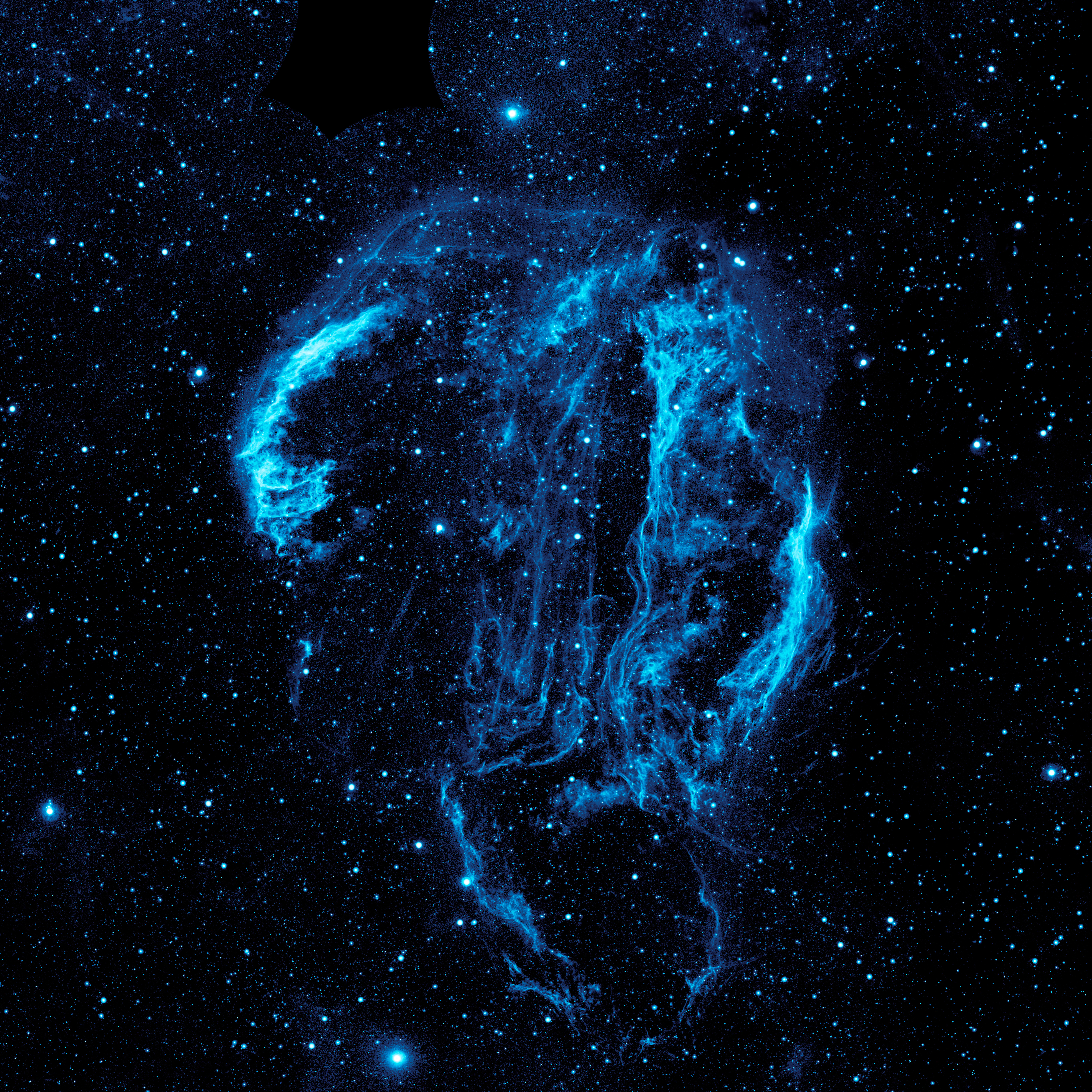
Wispy tendrils of hot dust and gas glow brightly in this ultraviolet image of the Cygnus Loop nebula, taken by NASA's Galaxy Evolution Explorer. The nebula lies about 1,500 light-years away, and is a supernova remnant, left over from a massive stellar explosion that occurred between 5,000 to 8,000 years ago. The Cygnus Loop extends over three times the size of the full moon in the night sky, and is tucked next to one of the "swan's wings" in the constellation of Cygnus.

The filaments of gas and dust visible here in ultraviolet light were heated by the shockwave from the supernova, which is still spreading outward from the original explosion. The original supernova would have been bright enough to be seen clearly from Earth with the naked eye.

Source: Galex

Thursday, March 22, 2012

Planet Starship: Runaway Planets Zoom at a Fraction of Light-Speed

In this artist’s conception, a runaway planet zooms through interstellar space. New research suggests that the supermassive black hole at our galaxy’s center can fling planets outward at relativistic speeds. Eventually, such worlds will escape the Milky Way and travel through the lonely intergalactic void. In this illustration, a glowing volcano on the planet’s surface hints at active plate tectonics that may keep the planet warm. Credit: David A. Aguilar (CfA)

Cambridge, MA - Seven years ago, astronomers boggled when they found the first runaway star flying out of our Galaxy at a speed of 1.5 million miles per hour. The discovery intrigued theorists, who wondered: If a star can get tossed outward at such an extreme velocity, could the same thing happen to planets?

New research shows that the answer is yes. Not only do runaway planets exist, but some of them zoom through space at a few percent of the speed of light - up to 30 million miles per hour.

"These warp-speed planets would be some of the fastest objects in our Galaxy. If you lived on one of them, you'd be in for a wild ride from the center of the galaxy to the Universe at large," said astrophysicist Avi Loeb of the Harvard-Smithsonian Center for Astrophysics.

"Other than subatomic particles, I don't know of anything leaving our galaxy as fast as these runaway planets," added lead author Idan Ginsburg of Dartmouth College.

Such speedy worlds, called hypervelocity planets, are produced in the same way as hypervelocity stars. A double-star system wanders too close to the supermassive black hole at the galactic center. Strong gravitational forces rip the stars from each other, sending one away at high speed while the other is captured into orbit around the black hole.

For this study, the researchers simulated what would happen if each star had a planet or two orbiting nearby. They found that the star ejected outward could carry its planets along for the ride. The second star, as it's captured by the black hole, could have its planets torn away and flung into the icy blackness of interstellar space at tremendous speeds.

A typical hypervelocity planet would slingshot outward at 7 to 10 million miles per hour. However, a small fraction of them could gain much higher speeds under ideal conditions.

Current instruments can't detect a lone hypervelocity planet since they are dim, distant, and very rare. However, astronomers could spot a planet orbiting a hypervelocity star by watching for the star to dim slightly when the planet crosses its face in a transit.

For a hypervelocity star to carry a planet with it, that planet would have to be in a tight orbit. Therefore, the chances of seeing a transit would be relatively high, around 50 percent.

"With one-in-two odds of seeing a transit, if a hypervelocity star had a planet, it makes a lot of sense to watch for them," said Ginsburg.

Eventually, such worlds will escape the Milky Way and travel through the intergalactic void.

"Travel agencies advertising journeys on hypervelocity planets might appeal to particularly adventurous individuals," added Loeb.

The research will be published in the Monthly Notices of the Royal Astronomical Society, in a paper authored by Idan Ginsburg, Avi Loeb, and Gary Wegner (Dartmouth College).

Headquartered in Cambridge, Mass., the Harvard-Smithsonian Center for Astrophysics (CfA) is a joint collaboration between the Smithsonian Astrophysical Observatory and the Harvard College Observatory. CfA scientists, organized into six research divisions, study the origin, evolution and ultimate fate of the universe.

For more information, contact:

David A. Aguilar
Director of Public Affairs
Harvard-Smithsonian Center for Astrophysics
617-495-7462
daguilar@cfa.harvard.edu

Christine Pulliam
Public Affairs Specialist
Harvard-Smithsonian Center for Astrophysics
617-495-7463
cpulliam@cfa.harvard.edu

Wednesday, March 21, 2012

Dawn Sees New Surface Features on Giant Asteroid

In this image from NASA's Dawn spacecraft, bright material extends out from the crater Canuleia on Vesta. The bright material appears to have been thrown out of the crater during the impact that created it. Image credit: NASA/JPL-Caltech/UCLA/MPS/DLR/IDA/UMD. Full image and caption | Image gallery

This image, made from data obtained by NASA's Dawn spacecraft, shows a perspective view of a layered young crater in the Rheasilvia basin at Vesta. Image credit: NASA/JPL-Caltech/UCLA/MPS/DLR/IDA/PSI. Full image and caption


The interplay of bright and dark material at the rim of Marcia crater on Vesta is visible in this image mosaic taken by NASA's Dawn spacecraft. Image credit: NASA/JPL-Caltech/UCLA/MPS/DLR/IDA/LPI/ASU. Full image and caption

This image from NASA's Dawn spacecraft shows a young crater on Vesta that is 9 miles (15 kilometers) in diameter. Image credit: NASA/JPL-Caltech/UCLA/MPS/DLR/IDA. Full image and caption

PASADENA, Calif. – NASA's Dawn spacecraft has revealed unexpected details on the surface of the giant asteroid Vesta. New images and data highlight the diversity of Vesta's surface and reveal unusual geologic features, some of which were never previously seen on asteroids.

These results were discussed today at the Lunar and Planetary Science Conference at The Woodlands, Texas.

Vesta is one of the brightest objects in the solar system and the only asteroid in the so-called main belt between Mars and Jupiter visible to the naked eye from Earth. Dawn has found that some areas on Vesta can be nearly twice as bright as others, revealing clues about the asteroid's history.

"Our analysis finds this bright material originates from Vesta and has undergone little change since the formation of Vesta over 4 billion years ago," said Jian-Yang Li, a Dawn participating scientist at the University of Maryland, College Park. "We're eager to learn more about what minerals make up this material and how the present Vesta surface came to be."

Bright areas appear everywhere on Vesta but are most predominant in and around craters. The areas vary from several hundred feet to around 10 miles (16 kilometers) across. Rocks crashing into the surface of Vesta seem to have exposed and spread this bright material. This impact process may have mixed the bright material with darker surface material.

While scientists had seen some brightness variations in previous images of Vesta from NASA's Hubble Space Telescope, Dawn scientists also did not expect such a wide variety of distinct dark deposits across its surface. The dark materials on Vesta can appear dark gray, brown and red. They sometimes appear as small, well-defined deposits around impact craters. They also can appear as larger regional deposits, like those surrounding the impact craters scientists have nicknamed the "snowman."

"One of the surprises was the dark material is not randomly distributed," said David Williams, a Dawn participating scientist at Arizona State University, Tempe. "This suggests underlying geology determines where it occurs."

The dark materials seem to be related to impacts and their aftermath. Scientists theorize carbon-rich asteroids could have hit Vesta at speeds low enough to produce some of the smaller deposits without blasting away the surface.

Higher-speed asteroids also could have hit Vesta's surface and melted the volcanic basaltic crust, darkening existing surface material. That melted conglomeration appears in the walls and floors of impact craters, on hills and ridges, and underneath brighter, more recent material called ejecta, which is material thrown out from a space rock impact.

Vesta's dark materials suggest the giant asteroid may preserve ancient materials from the asteroid belt and beyond, possibly from the birth of the solar system.

"Some of these past collisions were so intense they melted the surface," said Brett Denevi, a Dawn participating scientist at the Johns Hopkins University Applied Physics Laboratory in Laurel, Md. "Dawn's ability to image the melt marks a unique find. Melting events like these were suspected, but never before seen on an asteroid."

Dawn launched in September 2007. It will reach its second destination, Ceres, in February 2015.

"Dawn's ambitious exploration of Vesta has been going beautifully," said Marc Rayman, Dawn chief engineer at NASA's Jet Propulsion Laboratory in Pasadena, Calif. "As we continue to gather a bounty of data, it is thrilling to reveal fascinating alien landscapes."

To view the new images, visit: http://www.nasa.gov/dawn and http://dawn.jpl.nasa.gov .

Dawn's mission is managed by JPL for NASA's Science Mission Directorate in Washington. Dawn is a project of the directorate's Discovery Program, managed by NASA's Marshall Space Flight Center in Huntsville, Ala. UCLA is responsible for overall Dawn mission science. Orbital Sciences Corp. in Dulles, Va., designed and built the spacecraft. The German Aerospace Center, the Max Planck Institute for Solar System Research, the Italian Space Agency and the Italian National Astrophysical Institute are international partners on the mission team. JPL is managed for NASA by the California Institute of Technology in Pasadena.


Jia-Rui Cook
Jet Propulsion Laboratory, Pasadena, Calif.
818-354-0850
jccook@jpl.nasa.gov

Dwayne Brown 202-358-1726
NASA Headquarters, Washington
dwayne.c.brown@nasa.gov

VISTA Stares Deep into the Cosmos

VISTA stares deep into the cosmos

PR Image eso1213b
Highlights of VISTA’s deep infrared view of the COSMOS field

PR Image eso1213c
The COSMOS field in the constellation of Sextans

PR Image eso1213d
Wide-field view of the COSMOS field

Videos

PR Video eso1213a
Zooming into VISTA's deep view of the COSMOS field

PR Video eso1213b
Panning over VISTA's deep view of the COSMOS field

Treasure trove of new infrared data made available to Astronomers

ESO's VISTA telescope has created the widest deep view of the sky ever made using infrared light. This new picture of an unremarkable patch of sky comes from the UltraVISTA survey and reveals more than 200 000 galaxies. It forms just one part of a huge collection of fully processed images from all the VISTA surveys that is now being made available by ESO to astronomers worldwide. UltraVISTA is a treasure trove that is being used to study distant galaxies in the early Universe as well as for many other science projects.

ESO’s VISTA telescope has been trained on the same patch of sky repeatedly to slowly accumulate the very dim light of the most distant galaxies. In total more than six thousand separate exposures with a total effective exposure time of 55 hours, taken through five different coloured filters, have been combined to create this picture. This image from the UltraVISTA survey is the deepest [1] infrared view of the sky of its size ever taken.

The VISTA telescope at ESO’s Paranal Observatory in Chile is the world’s largest survey telescope and the most powerful infrared survey telescope in existence. Since it started work in 2009 (eso0949) most of its observing time has been devoted to public surveys, some covering large parts of the southern skies and some more focused on small areas. The UltraVISTA survey has been devoted to the COSMOS field ([2], eso1124, heic0701), an apparently almost empty patch of sky which has already been extensively studied using other telescopes, including the NASA/ESA Hubble Space Telescope [3]. UltraVISTA is the deepest of the six VISTA surveys by far and reveals the faintest objects.

Data from the VISTA surveys — totalling more than 6 terabytes of images — are now being processed in data centres in the United Kingdom, and in the case of UltraVISTA in France, and are flowing back into the ESO science archive and being made available to astronomers around the world.

At first glance the UltraVISTA image looks unremarkable, a few bright stars and a sprinkling of fainter ones. But in fact almost all of those fainter objects are not stars in the Milky Way, but very remote galaxies, each containing billions of stars. Enlarging the image to fill the screen, and zooming in reveals more and more of them, and the image records more than 200 000 galaxies in total.

The expansion of the Universe shifts light from distant objects towards longer wavelengths. For starlight coming from the most distant galaxies that we can observe, this means that most of the light falls in the infrared part of the spectrum when it gets to Earth. As a highly sensitive infrared telescope with a wide field of view, VISTA is uniquely powerful for spotting distant galaxies in the early Universe. By studying galaxies in redshifted light at successively larger distances, astronomers can also trace how galaxies were built up and evolved over the history of the cosmos.

Close inspection of the picture reveals tens of thousands of previously unknown reddish objects scattered between the more numerous cream-coloured galaxies. These are mostly very remote galaxies seen when the Universe was only a small fraction of its present age. Early studies of the UltraVISTA images, in combination with images from other telescopes, have revealed the presence of many galaxies that are seen when the Universe was less than a billion years old and a few are seen at even earlier times.

Although the current UltraVISTA image is already the deepest infrared image of its size in existence observations are continuing. The final result, a few years from now, will be significantly deeper still.

Surveys are vital resources for astronomers and ESO has put in place a programme [4] so that the rich heritage from both VISTA and its visible-light companion, the VLT Survey Telescope (VST, eso1119), will be accessible to astronomers for decades to come.

Notes

[1] Astronomers use the word deep to mean images taken with very long total exposures that can detect the faintest possible objects. Normally many shorter exposures are taken and later digitally combined.

[2] UltraVISTA has imaged the COSMOS field in the constellation of Sextans (The Sextant). This region of sky has been mapped by a multitude of telescopes so that a series of studies and investigations can benefit from this wealth of data. UltraVISTA covers 1.5 square degrees, about eight times the area of the full Moon and slightly smaller than the full COSMOS field.

[3] The new UltraVISTA observations provide the very deep infrared observations of the COSMOS field that complement observations at different wavelengths of light from other telescopes, both on Earth and in space.

[4] Data from ESO’s telescopes normally goes straight into a huge digital archive. But a new initiative, called Phase 3 is collecting highly processed ESO data from groups of astronomers around Europe and making them available in ready-to-use form. The processing of large astronomical images, such as those from survey telescopes, is challenging and requires major computing resources and specialist expertise. So the provision of fully processed and comprehensively described uniform data, rather than raw data from the telescopes, greatly helps the community to fully exploit the data.

More information

The year 2012 marks the 50th anniversary of the founding of the European Southern Observatory (ESO). ESO is the foremost intergovernmental astronomy organisation in Europe and the world’s most productive astronomical observatory. It is supported by 15 countries: Austria, Belgium, Brazil, the Czech Republic, Denmark, France, Finland, Germany, Italy, the Netherlands, Portugal, Spain, Sweden, Switzerland and the United Kingdom. ESO carries out an ambitious programme focused on the design, construction and operation of powerful ground-based observing facilities enabling astronomers to make important scientific discoveries. ESO also plays a leading role in promoting and organising cooperation in astronomical research. ESO operates three unique world-class observing sites in Chile: La Silla, Paranal and Chajnantor. At Paranal, ESO operates the Very Large Telescope, the world’s most advanced visible-light astronomical observatory and two survey telescopes. VISTA works in the infrared and is the world’s largest survey telescope and the VLT Survey Telescope is the largest telescope designed to exclusively survey the skies in visible light. ESO is the European partner of a revolutionary astronomical telescope ALMA, the largest astronomical project in existence. ESO is currently planning a 40-metre-class European Extremely Large optical/near-infrared Telescope, the E-ELT, which will become “the world’s biggest eye on the sky”.

Links

Photos of VISTA
The UltraVISTA project site
VISTA public data release
More information about the COSMOS survey

Contacts

James S. Dunlop
Institute for Astronomy, University of Edinburgh, Royal Observatory
Edinburgh, UK
Tel: +44 131 668 8477
Email: jsd@roe.ac.uk

Marijn Franx
Leiden Observatory
Leiden, Netherlands
Tel: +31 71 527 5870
Email: franx@strw.leidenuniv.nl

Johan Fynbo
Dark Cosmology Centre, University of Copenhagen
Copenhagen, Denmark
Tel: +45 3532 5983
Email: jfynbo@dark-cosmology.dk

Olivier Le Fèvre
Laboratoire d'Astrophysique de Marseille
Marseille, France
Tel: +33 4 91 05 59 85
Email: Olivier.LeFevre@oamp.fr

Henry Joy McCracken
Institut d'astrophysique de Paris
Paris, France
Email: hjmcc@iap.fr

Magda Arnaboldi
ESO
Garching bei München, Germany
Tel: +49 89 3200 6599
Email: marnabol@eso.org

Richard Hook
ESO, La Silla, Paranal, E-ELT and Survey Telescopes Public Information Officer
Garching bei München, Germany
Tel: +49 89 3200 6655
Cell: +49 151 1537 3591
Email: rhook@eso.org

Tuesday, March 20, 2012

Explosive Stars with Good Table Manners

These images from Swift's Ultraviolet/Optical Telescope (UVOT) show the nearby spiral galaxy M101 before and after the appearance of SN 2011fe (circled, right), which was discovered on Aug. 24, 2011. At a distance of 21 million light-years, it was the nearest Type Ia supernova since 1986. Left: View constructed from images taken in March and April 2007. Right: The supernova was so bright that most UVOT exposures were short, so this view includes imagery from August through November 2011 to better show the galaxy. Credit: NASA/Swift/Peter Brown, Univ. of Utah. High Resolution Image (jpg) - Low Resolution Image (jpg)

Cambridge, MA - An exploding star known as a Type Ia supernova plays a key role in our understanding of the universe. Studies of Type Ia supernovae led to the discovery of dark energy, which garnered the 2011 Nobel Prize in Physics. Yet the cause of this variety of exploding star remains elusive.

All evidence points to a white dwarf that feeds off its companions star, gaining mass, growing unstable, and ultimately detonating. But does that white dwarf draw material from a Sun-like star, an evolved red giant star, or from a second white dwarf? Or is something more exotic going on? Clues can be collected by searching for "cosmic crumbs" left over from the white dwarf's last meal.

In two comprehensive studies of SN 2011fe - the closest Type Ia supernova in the past two decades - there is new evidence that indicates that the white dwarf progenitor was a particularly picky eater, leading scientists to conclude that the companion star was not likely to be a Sun-like star or an evolved giant.

"It's hard to understand how a white dwarf could eat itself to death while showing such good table manners," said Alicia Soderberg of the Harvard-Smithsonian Center for Astrophysics (CfA).

Soderberg and her colleagues examined SN 2011fe with a suite of instruments in wavelengths ranging from X-rays to radio. They saw no sign of stellar material recently devoured by the white dwarf. Instead, the explosion occurred in a remarkably clean environment.

"This white dwarf was a tidy eater," said Laura Chomiuk of the CfA, lead author of one of the two papers.

Additional studies using NASA's Swift satellite, which examined a large number of more distant Type Ia supernovae, appear to rule out giant stars as companions for the white-dwarf progenitors. Those results were described in a NASA press release.

Taken together, these studies suggest that Type Ia supernovae likely originate from a more exotic scenario, possibly the explosive merger of two white dwarfs.

"This is an exciting time in Type Ia supernova research since it brings us closer to solving one of the longest-standing mysteries in the life cycles of stars," said Raffaella Margutti of the CfA, lead author of the second paper.

The two papers on SN 2011fe are available online at http://arxiv.org/abs/1201.0994 and http://arxiv.org/abs/1202.0741.

Headquartered in Cambridge, Mass., the Harvard-Smithsonian Center for Astrophysics (CfA) is a joint collaboration between the Smithsonian Astrophysical Observatory and the Harvard College Observatory. CfA scientists, organized into six research divisions, study the origin, evolution and ultimate fate of the universe.

For more information, contact:

David A. Aguilar
Director of Public Affairs
Harvard-Smithsonian Center for Astrophysics
617-495-7462
daguilar@cfa.harvard.edu

Christine Pulliam
Public Affairs Specialist
Harvard-Smithsonian Center for Astrophysics
617-495-7463
cpulliam@cfa.harvard.edu

Surprising Discovery of a Rare "Emerald-Cut" Galaxy

An international team of astronomers—from Australia, Germany, Switzerland, and Finland—has discovered a rare, rectangular-shaped galaxy (LEDA 074886) that has a striking resemblance to an emerald-cut diamond. While using the Subaru Prime Focus Camera (Suprime-Cam) to look for globular clusters of stars swarming around NGC 1407, a bright, giant galaxy in the Constellation Eridanus and 700 million light years from Earth, the researchers discovered an unusually shaped dwarf galaxy toward the edge of their image. Professor Alister Graham (Swinburne University of Technology, Australia), lead author of the paper describing the research, said, "It's one of those things that just makes you smile because it shouldn't exist, or rather, you don't expect it to exist." Its discovery allows astronomers to obtain useful information for modeling other galaxies.

Figure: False-color image of LEDA 074886 taken with Subaru Telescope's Suprime-Cam. The central contrast has been adjusted to reveal the inner disk/bar-like component. Dr. Lee Spitler (Swinburne University of Technology, Australia) took this image.

Most galaxies in the universe around us exist in one of three forms: ellipsoidal, disk-like (usually in the shape of a flattened circular disk hosting a spiral pattern of stars), or irregular. Dwarf galaxies, probably the most common galaxies in the Universe, are small and have low intrinsic brightness (i.e., luminosity). One of the reasons that LEDA 074886 was hard to find is its dwarf-like status; it has 50 times less stars than our own Milky Way Galaxy, and its distance from Earth is equivalent to that spanned by 700 Milky Way galaxies placed end-to-end. The combined advantages of Subaru's large 8.2m primary mirror and its camera at prime focus gave the researchers such a wide field of view that they could observe objects beyond their intended targets and make the surprising discovery of the emerald-shaped dwarf galaxy. Additional information gleaned from the use of green, red, and infrared filters along with the good image quality seeing in the observation enabled the researchers to see and measure a stellar disk embedded within the rectangular-shaped galaxy. The blue color of the inner disk suggested a younger average age for this stellar population.

The astronomers suspect that the emerald-cut galaxy may resemble an inflated disk seen side-on, like a short cylinder. Research co-author Professor Duncan Forbes (Swinburne University of Technology, Australia) explained, "One possibility is that the galaxy may have formed out of the collision of two spiral galaxies. While the pre-existing stars from the initial galaxies were strewn to large orbits creating the emerald-cut shape, the gas sank to the mid-plane where it condensed to form new stars and the disk that we have observed."

Despite its apparent uniqueness, partly due to its chance orientation, the team has gathered useful information for modeling other galaxies. While the outer rectangular shape is somewhat like galaxy simulations that don't involve the production of new stars, the disk-like structure is comparable with simulations involving star formation. "This highlights the importance of combining lessons learned from both types of past simulations, for better understanding of galaxy evolution," says Professor Graham. When our own disk-shaped Milky Way Galaxy collides with the disk-shaped Andromeda Galaxy in about three billion years from now, we may become inhabitants of a rectangular looking galaxy.

Reference:

The paper presenting the results of this research, "Leda 074886: A Remarkable Rectangular-Looking Galaxy", will appear in the Astrophysical Journal. It is tentatively scheduled for the May 1, 2012, Issue 750-1. Authors of the paper are:
Graham, A.W., Swinburne University of Technology, Australia
Spitler, L.R., Swinburne University of Technology, Australia
Forbes, D.A., Swinburne University of Technology, Australia
Lisker, T., Heidelberg University, Germany
Moore, B. University of Zurich, Switzerland
Janz, J., University of Oulu, Finland

Monday, March 19, 2012

The VLT goes lion hunting

Messier 95
Credit:ESO

The Very Large Telescope has captured another member of the Leo I group of galaxies, in the constellation of Leo (The Lion). The galaxy Messier 95 stands boldly face-on, offering an ideal view of its spiral structure. The spiral arms form an almost perfect circle around the galactic centre before they spread out, creating a mane-like effect of which any lion would be proud.

Another, perhaps even more striking, feature of Messier 95 is its blazing golden core. It contains a nuclear star-forming ring, almost 2000 light-years across, where a large proportion of the galaxy’s star formation takes place. This phenomenon occurs mostly in barred spiral galaxies such as Messier 95 and our home, the Milky Way.

In the Leo I group, Messier 95 is outshone by its brother Messier 96 (see potw1143). Messier 96 is in fact the brightest member of the group and — as “leader of the pride” — also gives Leo I its alternative name of the M 96 group. Nevertheless, Messier 95 also makes for a spectacular image.

Friday, March 16, 2012

IC 1396 Nebula

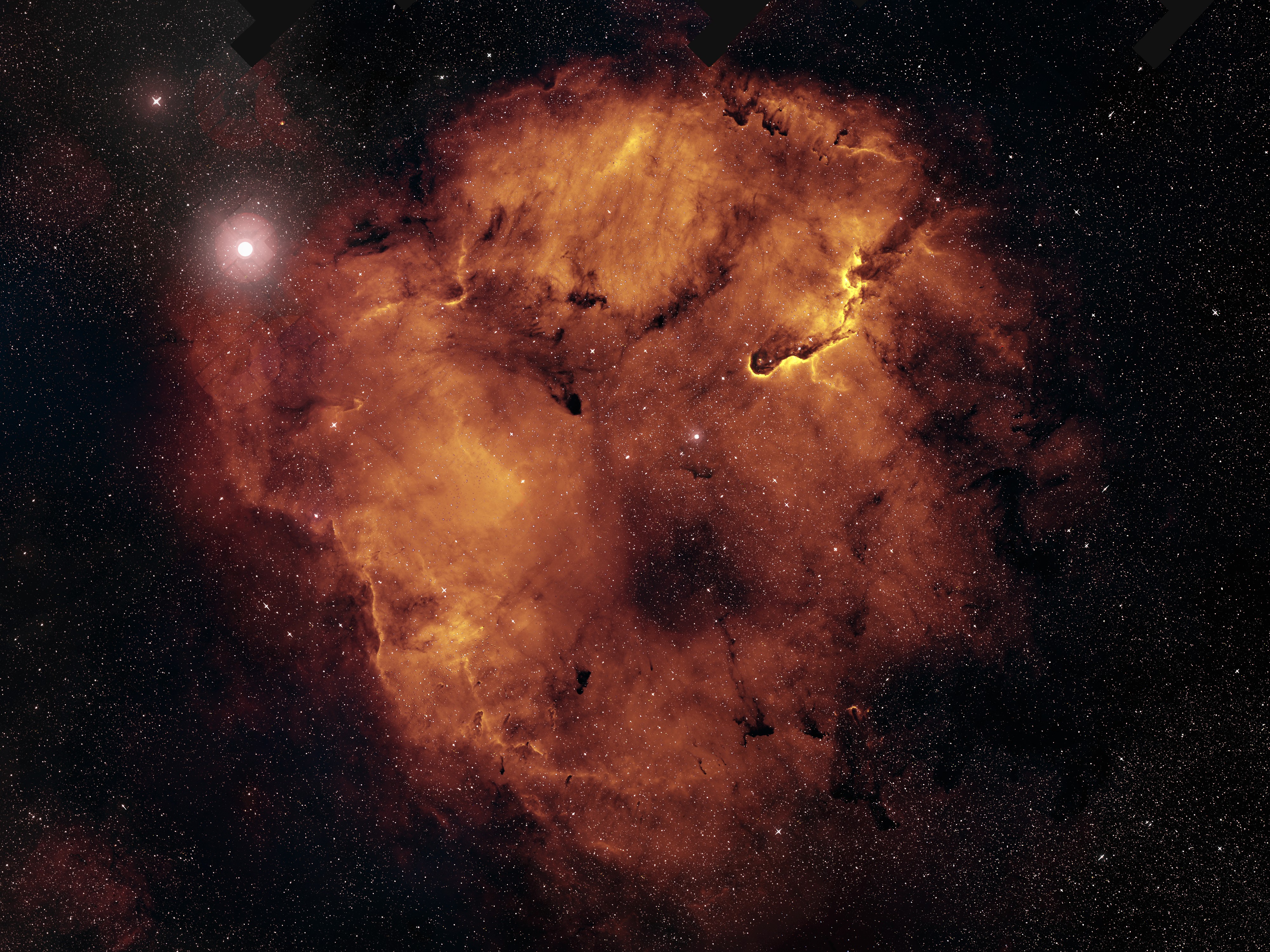
IC 1396 in the constellation Cepheus imaged in the red light from hydrogen atoms. This image was obtained as part of the INT/WFC Photometric Hydrogen-Alpha Survey of the Northern Galactic Plane (IPHAS). Credit: Geert Barentsen & Jorick Vink (Armagh Observatory) & the IPHAS Collaboration. [ JPEG | TIFF ]

IC1396, also called the Elephant's Trunk Nebula, is one of the largest emission nebulae in the Northern Sky with a diameter of 3 degrees. It is a giant cloud of gas and dust at a distance of 2400 light years from Earth. It is illuminated by the massive O-type star HD 206267 in the centre. Radiation and winds from this hot star are thought to compress parts of the cloud and trigger star formation.

The mosaic shown here was assembled from ~400 exposures taken in the H-alpha, Sloan r' and Sloan i' bands using the Wide Field Camera (WFC) on the 2.5m Isaac Newton Telescope (INT). The data were taken by multiple observers between 2004 and 2009 as part of the INT/WFC Photometric Halpha Survey of the Northern Galactic Plane (IPHAS). The mosaic was created using the Montage toolkit maintained by NASA/IPAC. Saturation spikes and artefacts have been removed by hand.

Photometric analysis of this data revealed more than 100 previously unknown pre-main sequence stars which are still accreting material from a circumstellar disk (Barentsen et al. 2011).

References and more information:

Barentsen G.; Vink J.; Drew J. E.; Greimel R.; Wright N. J., Drake J. J., Martin E. L., Valdivielso L., Corradi R. L. M., 2011, "T Tauri candidates and accretion rates using IPHAS: method and application to IC1396", MNRAS, 415, 103. arXiv:1103.1646v1.
INT/WFC Photometric Halpha Survey of the Northern Galactic Plane: http://www.iphas.org
Montage toolkit: http://montage.ipac.caltech.edu


Javier Méndez
Public Relations Officer
Last modified: 16 March 2012

Glittering Jewels of Messier 9

PR Image heic1205a
Hubble image of Messier 9

PR Image heic1205b
Wide-field view of Messier 9 (ground-based image)

Videos

PR Video heic1205a
Zoom into Messier 9

PR Video heic1205b
Pan across Messier 9

The NASA/ESA Hubble Space Telescope has produced the most detailed image so far of Messier 9, a globular star cluster located close to the centre of the galaxy. This ball of stars is too faint to see with the naked eye, yet Hubble can see over 250 000 individual stars shining in it.

Messier 9, pictured here, is a globular cluster, a roughly spherical swarm of stars that lies around 25 000 light-years from Earth, near the centre of the Milky Way, so close that the gravitational forces from the galactic centre pull it slightly out of shape.

Globular clusters are thought to harbour some of the oldest stars in our galaxy, born when the Universe was just a small fraction of its current age. As well as being far older than the Sun — around twice its age — the stars of Messier 9 also have a markedly different composition, and are enriched with far fewer heavier elements than the Sun.

In particular, the elements crucial to life on Earth, like oxygen and carbon, and the iron that makes up our planet’s core, are very scarce in Messier 9 and clusters like it. This is because the Universe’s heavier elements were gradually formed in the cores of stars, and in supernova explosions. When the stars of Messier 9 formed, there were far smaller quantities of these elements in existence.

Messier 9, as its name suggests, was discovered by the great French astronomer Charles Messier in 1764. Even through the most advanced telescopes of the day, none of the stars in the cluster could be seen individually. Messier, seeing only a faint smudge, therefore classified the object as a nebula — or “cloud” in Latin. It was only later in the 18th century that astronomers, most notably William Herschel, began to spot stars within the cluster.

The contrast between Messier’s equipment and the tools at the disposal of today’s astronomers is stark. Hubble’s image, the highest resolution image yet made of Messier 9, is able to resolve individual stars, right into the crowded centre of the cluster. Over 250 000 of them are neatly focused on the detector of Hubble’s Advanced Camera for Surveys, in an image which covers an area no bigger than the size of the head of a pin held at arm’s length.

As well as showing the individual stars, Hubble’s image clearly shows the different colours of the stars. A star’s colour is directly related to its temperature — counter-intuitively, perhaps, the redder it is, the cooler it is; and the bluer it is, the hotter. The wide range of stellar temperatures here is clearly displayed by the broad palette of colours visible in Hubble’s image of Messier 9.

Messier 9’s neighbourhood is interesting too, and is marked by two vast and dark nebulae. These pitch-black clouds of interstellar dust are known as Barnard 259 (to the south-east of Messier 9) and Barnard 64 (to the west), and are clearly visible in wide-field images of the cluster.

Notes

The Hubble Space Telescope is a project of international cooperation between ESA and NASA.
Image credit: NASA & ESA

Links


Images of Hubble

Contacts

Oli Usher
Hubble/ESA
Garching bei München, Germany
Tel: +49-89-3200-6855
Email: ousher@eso.org

Thursday, March 15, 2012

Astronomers Using NASA's Hubble Discover Quasars Acting as Gravitational Lenses

Quasar Lenses
SDSS J0919+2720, SDSS J1005+4016 and SDSS J0827+5224
Credit: NASA, ESA, and F. Courbin (EPFL, Switzerland)

Astronomers using NASA's Hubble Space Telescope have found several examples of galaxies containing quasars, which act as gravitational lenses, amplifying and distorting images of galaxies aligned behind them.

Quasars are among the brightest objects in the universe, far outshining the total starlight of their host galaxies. Quasars are powered by supermassive black holes.

To find these rare cases of galaxy-quasar combinations acting as lenses, a team of astronomers led by Frederic Courbin at the Ecole Polytechnique Federale de Lausanne (EPFL, Switzerland) selected 23,000 quasar spectra in the Sloan Digital Sky Survey (SDSS). They looked for the spectral imprint of galaxies at much greater distances that happened to align with foreground galaxies. Once candidates were identified, Hubble's sharp view was used to look for gravitational arcs and rings (which are indicated by the arrows in these three Hubble photos) that would be produced by gravitational lensing.

Quasar host galaxies are hard or even impossible to see because the central quasar far outshines the galaxy. Therefore, it is difficult to estimate the mass of a host galaxy based on the collective brightness of its stars. However, gravitational lensing candidates are invaluable for estimating the mass of a quasar's host galaxy because the amount of distortion in the lens can be used to estimate a galaxy's mass.

The next step for the team is to build a catalog of "quasar-lenses" that will allow them to determine masses for a statistically significant number of quasar host galaxies and to compare them with galaxies without quasars. With the numerous wide-field surveys that will start in the near future or that are already started, hundreds of thousands of quasars will be accessible for looking for lensing effects.

The team involved in this research includes: F. Courbin, C. Faure, F. Rerat, M. Tewes, and G. Meylan (EPFL, Switzerland), S.G. Djorgovski, A. Mahabal (Caltech), D. Stern (JPL), T. Boroson (NOAO), D. Sluse (Bonn University, Germany), and R. Dheeraj (University of Maryland). The full study will be published in the journal of Astronomy and Astrophysics.

For additional information, contact:

Ray Villard
Space Telescope Science Institute, Baltimore, Md.
410-338-4514
villard@stsci.edu

Frederic Courbin
Ecole Polytechnique Federale de Lausanne (EPFL), Versoix, Switzerland
011-41-22-379-24-18
frederic.courbin@epfl.ch

Wednesday, March 14, 2012

NASA Releases New WISE Mission Catalog of Entire Infrared Sky

This is a mosaic of the images covering the entire sky as observed by the Wide-field Infrared Survey Explorer (WISE), part of its All-Sky Data Release. Image Credit: NASA/JPL-Caltech/UCLA. Full image and caption - Rectangular view

Over 11,000 years ago, a massive, supergiant star came to the end of its life. The star's core collapsed to form an incredibly dense ball of neutrons, and its exterior was blasted away in an immense release of energy astronomers call a supernova. Image Credit: NASA/JPL-Caltech/UCLA. Full image and caption - enlarge image

PASADENA -- NASA unveiled a new atlas and catalog of the entire infrared sky today showing more than a half billion stars, galaxies and other objects captured by the Wide-field Infrared Survey Explorer (WISE) mission.

"Today, WISE delivers the fruit of 14 years of effort to the astronomical community," said Edward Wright, WISE principal investigator at UCLA, who first began working on the mission with other team members in 1998.

WISE launched Dec. 14, 2009, and mapped the entire sky in 2010 with vastly better sensitivity than its predecessors. It collected more than 2.7 million images taken at four infrared wavelengths of light, capturing everything from nearby asteroids to distant galaxies. Since then, the team has been processing more than 15 trillion bytes of returned data. A preliminary release of WISE data, covering the first half of the sky surveyed, was made last April.

The WISE catalog of the entire sky meets the mission's fundamental objective. The individual WISE exposures have been combined into an atlas of more than 18,000 images covering the sky and a catalog listing the infrared properties of more than 560 million individual objects found in the images. Most of the objects are stars and galaxies, with roughly equal numbers of each. Many of them have never been seen before.

WISE observations have led to numerous discoveries, including the elusive, coolest class of stars. Astronomers hunted for these failed stars, called "Y-dwarfs," for more than a decade. Because they have been cooling since their formation, they don't shine in visible light and could not be spotted until WISE mapped the sky with its infrared vision.

WISE also took a poll of near-Earth asteroids, finding there are significantly fewer mid-size objects than previously thought. It also determined NASA has found more than 90 percent of the largest near-Earth asteroids.

Other discoveries were unexpected. WISE found the first known "Trojan" asteroid to share the same orbital path around the sun as Earth. One of the images released today shows a surprising view of an "echo" of infrared light surrounding an exploded star. The echo was etched in the clouds of gas and dust when the flash of light from the supernova explosion heated surrounding clouds. At least 100 papers on the results from the WISE survey already have been published. More discoveries are expected now that astronomers have access to the whole sky as seen by the spacecraft.

"With the release of the all-sky catalog and atlas, WISE joins the pantheon of great sky surveys that have led to many remarkable discoveries about the universe," said Roc Cutri, who leads the WISE data processing and archiving effort at the Infrared and Processing Analysis Center at the California Institute of Technology in Pasadena. "It will be exciting and rewarding to see the innovative ways the science and educational communities will use WISE in their studies now that they have the data at their fingertips."

NASA's Jet Propulsion Laboratory (JPL) in Pasadena, Calif., manages and operates WISE for NASA's Science Mission Directorate in Washington. The mission was competitively selected under NASA's Explorers Program, which is managed by NASA's Goddard Space Flight Center in Greenbelt, Md. The science instrument was built by the Space Dynamics Laboratory in Logan, Utah, and the spacecraft was built by Ball Aerospace and Technologies Corp., in Boulder, Colo. Science operations, data processing and archiving take place at the Infrared Processing and Analysis Center at the California Institute of Technology in Pasadena. Caltech manages JPL for NASA.

For a collection of WISE images released to date, visit: http://wise.ssl.berkeley.edu/gallery_images.html

An introduction and quick guide to accessing the WISE all-sky archive for astronomers is online at: http://wise2.ipac.caltech.edu/docs/release/allsky/

For more information about WISE, visit: http://www.nasa.gov/wise


Whitney Clavin 818-354-4673
Jet Propulsion Laboratory, Pasadena, Calif.
whitney.clavin@jpl.nasa.gov

J.D. Harrington 202-358-5241
NASA Headquarters, Washington
j.d.harrington@nasa.gov