Showing posts with label SN 2011fe. Show all posts

Sunday, March 21, 2021

LCO Scientists Use Supernovae to Make a New Measurement of the Hubble Constant


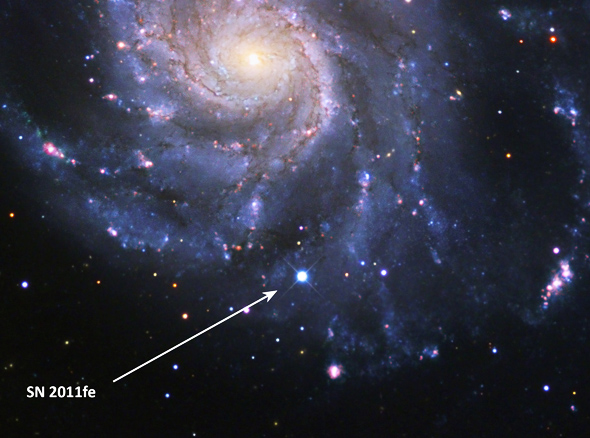
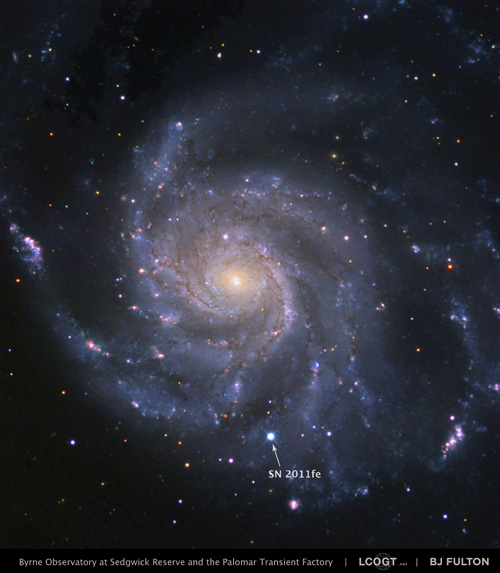
SN 2011fe in the galaxy M101 is a Type Ia supernova, the type used as standard candles in this study.  This composite image was created from data taken by Las Cumbres Observatory and the Palomar Transient Factory.  Credit: BJ Fulton / LCO / PTF.

One of the longest standing and most controversial questions in astronomy is — how fast is the universe expanding today? New work, including measurements made by Las Cumbres Observatory, has applied new techniques to the problem and found a surprising answer.

Astronomers call the local expansion rate of the universe the Hubble constant, H0, (pronounced H-naught). Measurements have gotten extremely precise in recent years — some claim to have measured it to better than a few percent. Different groups have come up with results that vary by more than 10% — far larger than the claimed uncertainty. Complicating matters, the measurements seem to cluster high or low depending on where they are made in the universe. The Hubble constant measured from nearby supernovae tends to be high, while measurements built up from the afterglow of the Big Bang — the Cosmic Microwave Background — give a low value. Some have argued that this is a crisis for the field, one requiring “new physics.” Perhaps an unknown property of Dark Energy is causing the local expansion rate of the universe to be highly sensitive to the distance at which it is measured. Others argue that there must be some kind of mistake in building the “distance ladder” — in using one set of distance indicators to calibrate another.

The new study, released March 12 in the journal Astronomy & Astrophysics, involves an international team of scientists led by Nandita Khetan, a PhD student at the Gran Sasso Science Institute in Italy, and an associate researcher at the Istituto Nazionale di Fisica Nucleare. It used the Surface Brightness Fluctuations of galaxies to calibrate the distances to nature’s best distance indicators — Type Ia supernovae. Type Ia supernovae are used as “standard candles” to map out distances in the universe. They were used to determine that the universe was accelerating in its expansion, leading to the discovery of Dark Energy that resulted in the 2011 Nobel Prize in Physics.

The standard candle method relies on measuring the apparent brightness of a distant known light, say a 100W light bulb, and using the difference between the apparent and intrinsic brightness to work out how far away the light is. This requires knowing the intrinsic power output —the wattage — of the “standard candle,” something that is unknown for Type Ia supernovae. Astronomers have to calibrate their brightness using a handful of nearby supernovae in galaxies with distances determined by other means. Traditionally this has been done with galaxies whose distances are known from observations of Cepheid variable stars. The new paper research swaps out the Cepheids for a different fundamental calibrator, Surface Brightness Fluctuations. This measures the resolution of individual stars in different galaxies, since stars tend to blur together the farther away a galaxy is. It is similar to how a street will appear rough when photographed up close, but smooth when seen from farther away.

The new study found an answer that is in between the two discordant values of the expansion rate of the universe. This argues that perhaps new physics isn’t needed after all. It may be that previous researchers overestimated the precision of their studies.

Andy Howell, a staff scientist at Las Cumbres Observatory, and adjunct faculty at the University of California Santa Barbara, is the Principal Investigator of the Global Supernova Project, a worldwide collaboration that provided some of the observations of supernovae used in the study. He explains, “At a recent conference about this Hubble Constant crisis, after each speaker walked through their methodology, I couldn’t find any problems with what they were doing. I started to question whether we do need new physics to explain the different Hubble constants. But now we, like several studies before ours, found an answer in the middle. Maybe there’s some weirdness to some of the other measurements that we don’t fully understand. That’s more comforting, because you don’t want to upend our understanding of physics unless you have to.”

The new work does not undermine the discovery or characterization of Dark Energy, since that relies on only relative, not absolute, measurements of supernovae and has been verified by other means.

The new supernova observations were obtained with Las Cumbres Observatory’s worldwide network of robotic telescopes, specifically designed to study time-variable phenomena like supernovae. Howell adds, “Supernovae are hard to observe, because you need just a little bit of telescope time per night, over months. But a robotic telescope network is perfect for this — nobody has to travel — the telescopes can make the observations wherever and whenever they are needed. This is what we built Las Cumbres Observatory for and I’m delighted to see it being used to refine our understanding of the universe.”

The study “A new measurement of the Hubble constant using Type Ia supernovae calibrated with surface brightness fluctuations” involves an international team of scientists with expertise in supernova observations, Surface Brightness Fluctuations, and theory working, at the Gran Sasso Science Institute, INAF, INFN, DARK-Niels Bohr Institute, University of Copenhagen, Centre for Astrophysics and Supercomputing, Swinburne University, Las Cumbres Observatory, UC Santa Barbara, and UC Davis.

Source:  Las Cumbres Observatory (LCO)/News


Wednesday, June 19, 2013

Unusual Supernova is Doubly Unusual for Being Perfectly Normal

From the “Backyard Supernova,” the Berkeley Lab-led Nearby Supernova Factory has built a benchmark atlas for normal Type Ia’s

Supernova 2011fe was discovered just hours after it exploded in the Big Dipper. Studies by the Nearby Supernova Factory of its spectrum as it evolved over time have produced a benchmark atlas of data by which to measure all future Type Ia’s. (B. J. Fulton, Las Cumbres Observatory Global Telescope Network.)

August, 2011, saw the dazzling appearance of the closest and brightest Type Ia supernova since Type Ia’s were established as “standard candles” for measuring the expansion of the universe. The brilliant visitor, labeled SN 2011fe, was caught by the Palomar Transient Factory less than 12 hours after it exploded in the Pinwheel Galaxy in the Big Dipper.

Easy to see through binoculars, 2011fe was soon dubbed the Backyard Supernova. Major astronomical studies from the ground and from space followed close on its heels, recording its luminosity and colors as it rapidly brightened and then slowly faded away. 
 
The international Nearby Supernova Factory (SNfactory), led by Greg Aldering of the U.S. Department of Energy’s Lawrence Berkeley National Laboratory (Berkeley Lab), has now released a unique dataset based on 32 nights of repeated observations of 2011fe with the SuperNova Integral Field Spectrograph (SNIFS), built by the SNfactory’s partners in Lyon and Paris, France, and mounted on the University of Hawaii’s 2.2-meter telescope on Mauna Kea. The observations began two weeks before the supernova reached its peak brightness and continued for over three months after maximum light had passed. 

“We’d never before seen a Type Ia supernova this early,” says Aldering, a cosmologist in Berkeley Lab’s Physics Division. “Our measurements showed how remarkably normal 2011fe is.”

SNfactory member Rui Pereira of the Institut de Physique Nucléaire de Lyon says that the collected data “will be the benchmark atlas for all future studies of Type Ia’s.” Pereira is the lead author of the article presenting the observations in the journal Astronomy & Astrophysics.

Why a perfectly normal supernova is so odd

Type Ia supernovae aren’t so much standard candles as “standardizable” ones. Graphs of how their brightness and spectral features change over time – their light curves – vary, but because timing and brightness are related, the light curves can be stretched (or squeezed) to match the standard. SN 2011fe’s light curve falls right in the peak of the distribution – as astrophysicists say, it has “stretch 1.”

Rollin Thomas, of Berkeley Lab’s Computational Research Division, was deeply involved in the 2011fe analysis. As new data arrived from the telescope each night he recalls thinking “please don’t be peculiar, please don’t be peculiar,” and was pleased to find that the supernova was so normal.

2011fe not only looks like a textbook case, it passes important tests. Its brightness at different times (epochs) could be accurately recorded because the distance to its home galaxy had been measured independently, and there was little or no dust in the line of sight to affect color or brightness.


 SN2011fe animated time series 
(SNfactory, Pereira et al. 2013)

Normal as it is, however, 2011fe’s light curve doesn’t match the leading computational models, none of which fit the SNfactory data. Given the unavoidable uncertainties of supernova observation, says Aldering, “to date it has been a little too easy to cobble data together, depending on what you think it should be.” The SNfactory’s benchmark atlas raises the bar. “From now on researchers won’t be able to arbitrarily tweak knobs in their models.”

The 2011fe gold-standard atlas will help answer many longstanding questions about Type Ia supernovae, including the progenitors of these titanic thermonuclear explosions and the mechanisms of the explosions themselves.

The single degenerate model of Type Ia progenitors posits a single white dwarf that steals extra mass from a large companion star. (Electron “degeneracy” is a result of tight packing of atoms in a white dwarf.) In the resulting supernova explosion there should be signs of interaction with the companion, or what’s left of it. In the double degenerate model, two white dwarfs collide. The resulting supernova would show no signs of interaction with a companion.

“The 2011fe observations can be used to test these models,” says Aldering. “For 2011fe, the existing models of the double-degenerate scenario agreed best at some epochs, but the single-degenerate scenario was better at others. And for some epochs both agreed very poorly with the data, suggesting these models have a way to go.”

The 2011fe data also point to unburned carbon as characteristic of the spectrum of a normal Type Ia. The finding adds support for a particular model, “pure turbulent deflagration,” compared to two-stage explosions that would eliminate most excess carbon.
Carbon surviving from the original white dwarf indicates that different supernovae burn material with a range of different efficiencies when they explode. Methods for detecting unburned carbon, which may often have been missed in the past, are suggested by the 2011fe data.

In sum, says Aldering, “The SN 2011fe atlas offers unprecedented detail and a solid point of reference for Type Ia physics. We’ve never had data like this. It’s a dream opportunity to stimulate deeper thinking about these markers of the expansion of the universe.”

This work was supported by DOE’s Office of Science; the Gordon and Betty Moore Foundation; the French National Center for Scientific Research (CNRS) National Institute of Nuclear and Particle Physics (IN2P3) and National Institute for Earth Sciences and Astronomy (INSU); the French National Program of Cosmology and Galaxies (PNCG); and the Transregional Research Center, “The Dark Universe” (TRR33), of the German Research Foundation (DFG).

* * *

“Spectrophotometric time series of SN 2011fe from the Nearby Supernova Factory,” by Rui Pereira, Rollin C. Thomas, Greg Aldering, Pierre Antilogus, Charles Baltay, Sandra Benitez-Herrera, Sébastien Bongard, Clement Buton, Arnaud Canto, Flora Cellier-Holzem, Juncheng Chen, Mike Childress, Nicolas Chotard, Yannick Copin, Hannah K. Fakhouri, Michael Fink, Dominique Fouchez, Emmanuel Gangler, Julien Guy, Wolfgang Hillebrandt, Eric Y. Hsiao, Matthias Kerschhaggi, Marek Kowalski, Markus Kromer, Jakob Nordin, Peter Nugent, Kerstin Paech, Reynald Pain, Emmanuel Pécontal, Saul Perlmutter, David Rabinowitz, Mickael Rigault, Karl Runge, Clare Saunders, Gerard Smadja, Charling Tao, Stefan Taubenberger, André Tilquin. and Chao Wu (The Nearby Supernova Factory), will appear in Astronomy & Astrophysics and is available online at http://www.aanda.org/articles/aa/abs/2013/06/aa21008-12/aa21008-12.html.

The SNfactory has constructed an animation of SN 2011fe’s light curve, showing a wide range of wavelengths varying in brightness at different epochs as the spectrum evolves. Available online at http://www.youtube.com/watch?v=8t9ZWOrUtCc, the animation is an exemplar of a normal Type Ia light curve and an ideal teaching tool. 

SN 2011fe was discovered on August 24, 2011, by Peter Nugent of Berkeley Lab’s Computational Research Division, who leads the Lab’s collaboration in the multi-institutional Palomar Transient Factory (PTF), while he was searching PTF data arriving at Lab’s National Energy Research Scientific Computing Center (NERSC). See http://newscenter.lbl.gov/news-releases/2011/12/14/sn-2011fe/.
Nearby Supernova Factory partners include the Lawrence Berkeley National Laboratory, the Institut de Physique Nucleaire

de Lyon, the Laboratoire de Physique Nucleaire et des Hautes Energies, the Centre de Recherche Astronomique de Lyon, Yale University, Universitat Bonn, the Tsinghua Center for Astrophysics, the Max Planck Institute for Astrophysics, and the Centre de Physique des Particules de Marseille.

Lawrence Berkeley National Laboratory addresses the world’s most urgent scientific challenges by advancing sustainable energy, protecting human health, creating new materials, and revealing the origin and fate of the universe. Founded in 1931, Berkeley Lab’s scientific expertise has been recognized with 13 Nobel prizes. The University of California manages Berkeley Lab for DOE’s Office of Science. For more, visit http://www.lbl.gov.

DOE’s Office of Science is the single largest supporter of basic research in the physical sciences in the Unites States, and is working to address some of the most pressing challenges of our time. For more information, please visit the Office of Science website at http://science.energy.gov/. 
 

Source: Lawrence Berkeley National Laboratory


Monday, February 18, 2013

Surprising Results From the Earliest Near-Infrared Spectroscopy of a Type Ia Supernova


Figure 1. Color image of SN 2011fe in M101
Credit: B. J. Fulton/LCOGT/PTF
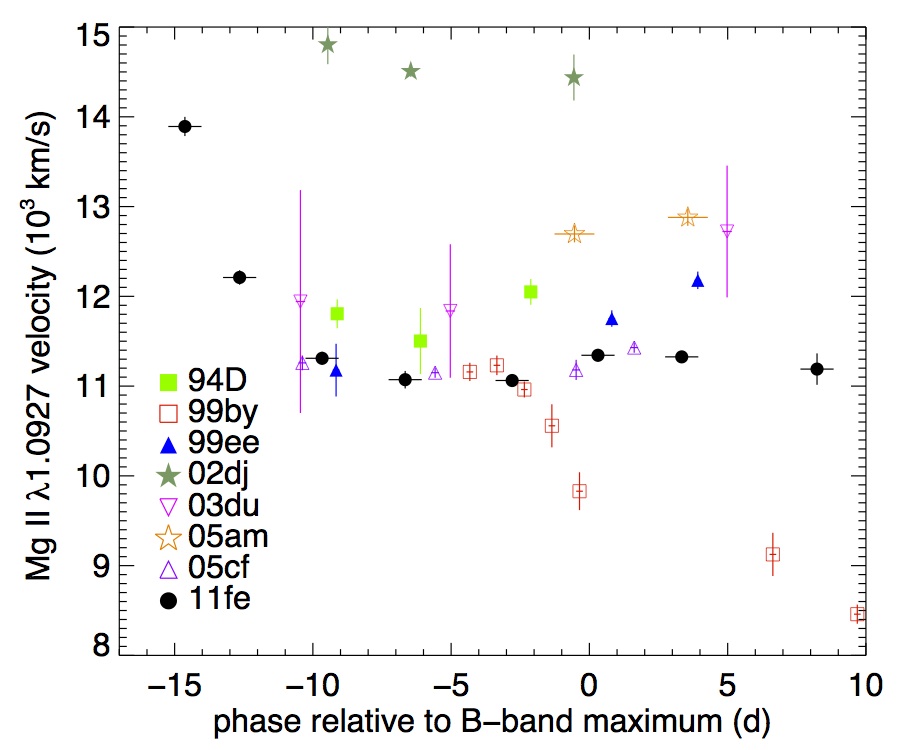
Figure 2. Time evolution of SN Ia near-infrared magnesium velocity. The magnesium velocity of the GNIRS SN 2011fe spectra underwent a rapid decline and an extended period of constant velocity. Note that SN 1999by is a spectroscopically peculiar SN Ia, much like SN 1991bg. The magnesium velocity of normal SNe Ia all show similar constant behavior as that of SN 2011fe.

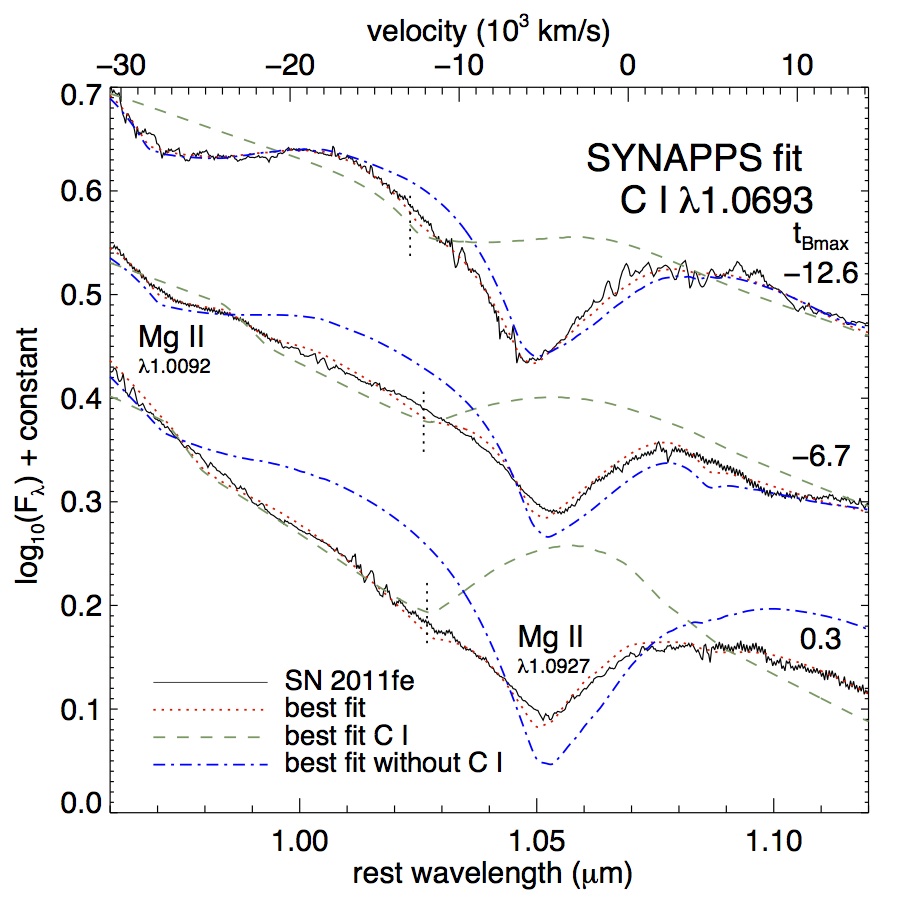
Figure 3. Model spectrum fit to the GNIRS spectra of SN 2011fe around the near-infrared carbon line. The observed spectra are plotted as solid black curves. The best-fit model spectra are plotted as follows: with all ions, with carbon only, and with all ions except carbon. These are plotted as red dotted, green dashed, and blue dash-dotted curves, respectively. The vertical dotted lines mark the location of the best-fit carbon velocity. The phases relative to maximum light are noted.

Gemini Near-Infrared Spectrograph (GNIRS) observations lead to surprising results on the nature of Type Ia supernovae (SNe Ia). Time-series near-infrared spectra of SN 2011fe hint that more SNe Ia harbor unprocessed carbon than previously believed, and what we thought was the main driver of the luminosity-decline rate Phillips relation may not be correct. 
 
Understanding the true nature of Type Ia supernovae (SNe Ia) is a linchpin of contemporary cosmology. Specifically, these explosions are critical for tracking the expansion history and acceleration of our universe. Commonly called “dark energy,” the discovery of this universal acceleration was the basis for the 2011 Nobel Prize in Physics. 

Now, researchers using the Gemini Near-Infrared Spectrograph (GNIRS), at the Gemini North telescope on Hawaii’s Mauna Kea, have taken a major leap forward in understanding SNe Ia with the first detection of unprocessed carbon in near-infrared spectra of a normal Type Ia supernova. The supernova (Figure 1), denoted SN 2011fe, was discovered by the Palomar Transient Factory (PTF) within hours of its explosion on August 24, 2011 in the nearby galaxy Messier 101, located about 21 million light years away and a popular target for amateur astronomers. 

Carnegie Supernova Project postdoc Eric Hsiao reports that these near-infrared observations (a month-long time series consisting of nine spectra with GNIRS and one with SpeX on NASA’s Infrared Telescope Facility), “…provide an ideal baseline to compare with other objects,” and adds that, “Previous studies have detected carbon in optical spectra, but in this work we were able to detect it for the first time in the infrared and capture its time evolution.” Hsiao, at Las Campanas Observatory in Chile, also worked with Howie Marion, a post-doc researcher the Harvard-Smithsonian Center for Astrophysics (CfA) in Cambridge Mass., and Mark Phillips the Associate Director of Las Campanas Observatory and team leader for the Carnegie Supernova Project. The work is accepted for publication in an upcoming issue of The Astrophysical Journal

Prior to this finding, the supernova community relied on very early optical spectra for the study of unprocessed carbon, leftover from the progenitor white dwarf. With this work, the team shows that the near infrared is a better wavelength region to survey this unprocessed material. There are hints that the number of SNe Ia harboring unprocessed carbon may have been grossly underestimated from previous studies in the optical, a result that would have profound impact on our understanding of these explosions. 

The team’s observations also confirmed the long-standing prediction that magnesium, a marker for the boundary between carbon and oxygen burning, would decrease rapidly in velocity and then settle into a constant velocity as SNe Ia evolve (Figure 2). The variation in the location of the carbon/oxygen burning boundary between supernovae is believed to be the main driver of the Phillips relation. While a large range of magnesium velocities was found, there was surprisingly no correlation with the supernovae’s peak luminosities. The team acknowledges that more work needs to be done to understand this unexpected finding. 

Watch for a more detailed article in the March issue of GeminiFocus (e-published on April 1, 2013) and see the preprint of The Astrophysical Journal paper by Hsiao et al. on astro-ph at: http://arxiv.org/abs/1301.6287.


In-Depth 

The following details are provided for readers desiring more details of a technical nature.

A key ingredient to realizing the full potential of near-infrared SN Ia cosmology is near-infrared spectroscopy, such that the peak luminosities can be accurately converted to the rest frame. With the limited size of the world’s current sample, the time evolution and the diversity of the near-infrared spectral features are poorly understood. These uncertainties directly affect the determination of the peak luminosity. To improve our knowledge of this relatively unexplored wavelength region, the Carnegie Supernova Project and the CfA Supernova Group have embarked on a joint program to obtain a statistically significant sample of near-infrared spectroscopic observations.

Using high quality GNIRS spectra and a more sophisticated spectrum modeling technique, Hsiao et al. were able to detect carbon, a first in the near-infrared wavelengths for a normal SN Ia. Figure 3, shows the comparison between observed and model spectra. The near-infrared carbon line studied is relatively isolated and ideally located between two magnesium lines. The team’s model spectra shows that the presence of carbon is required to produce the observed “flattened” profile near 1.03 micron.

Furthermore, the time-series GNIRS observations indicate that the influence of carbon increases with time (Figure 3). The carbon line in the optical, on the other hand, usually disappears very early, requiring that the supernova be discovered at a very young age. The team proposes that the delay in the onset of the near-infrared carbon feature can be explained simply by the change in the ionization condition. As the supernova ejecta expands, the temperature decreases. The optical carbon line in its first ionized state then gradually recombines into neutral carbon which forms the ever stronger neutral carbon feature in the near-infrared. Due to this fortuitous delay in its appearance, the near-infrared neutral carbon feature is potentially a superior probe of unprocessed material to the more commonly used optical feature.


Tuesday, March 20, 2012

Explosive Stars with Good Table Manners

These images from Swift's Ultraviolet/Optical Telescope (UVOT) show the nearby spiral galaxy M101 before and after the appearance of SN 2011fe (circled, right), which was discovered on Aug. 24, 2011. At a distance of 21 million light-years, it was the nearest Type Ia supernova since 1986. Left: View constructed from images taken in March and April 2007. Right: The supernova was so bright that most UVOT exposures were short, so this view includes imagery from August through November 2011 to better show the galaxy. Credit: NASA/Swift/Peter Brown, Univ. of Utah. High Resolution Image (jpg) - Low Resolution Image (jpg)

Cambridge, MA - An exploding star known as a Type Ia supernova plays a key role in our understanding of the universe. Studies of Type Ia supernovae led to the discovery of dark energy, which garnered the 2011 Nobel Prize in Physics. Yet the cause of this variety of exploding star remains elusive.

All evidence points to a white dwarf that feeds off its companions star, gaining mass, growing unstable, and ultimately detonating. But does that white dwarf draw material from a Sun-like star, an evolved red giant star, or from a second white dwarf? Or is something more exotic going on? Clues can be collected by searching for "cosmic crumbs" left over from the white dwarf's last meal.

In two comprehensive studies of SN 2011fe - the closest Type Ia supernova in the past two decades - there is new evidence that indicates that the white dwarf progenitor was a particularly picky eater, leading scientists to conclude that the companion star was not likely to be a Sun-like star or an evolved giant.

"It's hard to understand how a white dwarf could eat itself to death while showing such good table manners," said Alicia Soderberg of the Harvard-Smithsonian Center for Astrophysics (CfA).

Soderberg and her colleagues examined SN 2011fe with a suite of instruments in wavelengths ranging from X-rays to radio. They saw no sign of stellar material recently devoured by the white dwarf. Instead, the explosion occurred in a remarkably clean environment.

"This white dwarf was a tidy eater," said Laura Chomiuk of the CfA, lead author of one of the two papers.

Additional studies using NASA's Swift satellite, which examined a large number of more distant Type Ia supernovae, appear to rule out giant stars as companions for the white-dwarf progenitors. Those results were described in a NASA press release.

Taken together, these studies suggest that Type Ia supernovae likely originate from a more exotic scenario, possibly the explosive merger of two white dwarfs.

"This is an exciting time in Type Ia supernova research since it brings us closer to solving one of the longest-standing mysteries in the life cycles of stars," said Raffaella Margutti of the CfA, lead author of the second paper.

The two papers on SN 2011fe are available online at http://arxiv.org/abs/1201.0994 and http://arxiv.org/abs/1202.0741.

Headquartered in Cambridge, Mass., the Harvard-Smithsonian Center for Astrophysics (CfA) is a joint collaboration between the Smithsonian Astrophysical Observatory and the Harvard College Observatory. CfA scientists, organized into six research divisions, study the origin, evolution and ultimate fate of the universe.

For more information, contact:

David A. Aguilar
Director of Public Affairs
Harvard-Smithsonian Center for Astrophysics
617-495-7462
daguilar@cfa.harvard.edu

Christine Pulliam
Public Affairs Specialist
Harvard-Smithsonian Center for Astrophysics
617-495-7463
cpulliam@cfa.harvard.edu

Wednesday, December 14, 2011

Closest Type Ia Supernova in Decades Solves a Cosmic Mystery

Early close-ups of a Type Ia supernova allow Berkeley Lab scientists and their colleagues to picture its progenitor and infer how it exploded

The Palomar Transient Factory caught SN 2011fe in the Pinwheel Galaxy in the vicinity of the Big Dipper on 24 August, 2011. Found just hours after it exploded and only 21 million light years away, the discovery triggered the closest-ever look at a young Type Ia supernova. (Image by B. J. Fulton, Las Cumbres Observatory Global Telescope Network. Click here for better resolution.)

Type Ia supernovae (SN Ia’s) are the extraordinarily bright and remarkably similar “standard candles” astronomers use to measure cosmic growth, a technique that in 1998 led to the discovery of dark energy – and 13 years later to a Nobel Prize, “for the discovery of the accelerating expansion of the universe.” The light from thousands of SN Ia’s has been studied, but until now their physics – how they detonate and what the star systems that produce them actually look like before they explode – has been educated guesswork.

Peter Nugent of the U.S. Department of Energy’s Lawrence Berkeley National Laboratory (Berkeley Lab) heads the Computational Cosmology Center in the Lab’s Computational Research Division and also leads the Lab’s collaboration in the multi-institutional Palomar Transient Factory (PTF). On August 24 of this year, searching data as it poured into DOE’s National Energy Research Scientific Computing Center (NERSC) from an automated telescope on Palomar Mountain in California, Nugent spotted a remarkable object. It was shortly confirmed as a Type Ia supernova in the Pinwheel Galaxy, some 21 million light-years distant. That’s unusually close by cosmic standards, and the nearest SN Ia since 1986; it was subsequently given the official name SN 2011fe.

Nugent says, “We caught the supernova just 11 hours after it exploded, so soon that we were later able to calculate the actual moment of the explosion to within 20 minutes. Our early observations confirmed some assumptions about the physics of Type Ia supernovae, and we ruled out a number of possible models. But with this close-up look, we also found things nobody had dreamed of.”

“When we saw SN2011fe, I fell off my chair,” says PTF team member Mansi Kasliwal of the Carnegie Institution for Science and the California Institute of Technology. “Its brightness was too faint to be a supernova and too bright to be nova. Only follow-up observations in the next few hours revealed that this was actually an exceptionally young Type Ia supernova.”

Because they could closely study the supernova during its first few days, the team was able to gather the first direct evidence for what at least one SN Ia looked like before it exploded, and what happened next. Their results are reported in the 15 December, 2011, issue of the journal Nature.

Confirming a carbon-oxygen white dwarf

Scientists long ago developed models of Type Ia supernovae based on their evolving brightness and spectra. The models assume the progenitor is a binary system – about half of all stars are in binary systems – in which a very dense, very small white-dwarf star made of carbon and oxygen orbits a companion, from which it sweeps up additional matter. There’s a specific limit to how massive the white dwarf can grow, equal to about 1.4 times the mass of our sun, before it can no longer support itself against gravitational collapse.

“As it approaches the limit, conditions are met in the center so that the white dwarf detonates in a colossal thermonuclear explosion, which converts the carbon and oxygen to heavier elements including nickel,” says Nugent. “A shock wave rips through it and ejects the material in a bright expanding photosphere. Much of the brightness comes from the heat of the radioactive nickel as it decays to cobalt. Light also comes from ejecta being heated by the shock wave, and if this runs into the companion star it can be reheated, adding to the luminosity.”

By examining how SN 2011fe’s brightness evolved – its so-called early-time light curve – and the features of its early-time spectra, members of the PTF team were able to constrain how big the exploding star was, when it exploded, what might have happened during the explosion, and what kind of binary star system was involved.

The first observations of SN 2011fe were carried out at the Liverpool Telescope at La Palma in the Canary Islands, followed within hours by the Shane Telescope at Lick Observatory in California and the Keck I Telescope on Mauna Kea in Hawaii. These were shortly followed by NASA’s orbiting Swift Observatory.

Says Nugent, “We made an absurdly conservative assumption that the earliest luminosity was due entirely to the explosion itself and would increase over time in proportion to the size of the expanding fireball, which set an upper limit on the radius of the progenitor.”

Daniel Kasen, an assistant professor of astronomy and physics at the University of California at Berkeley and a faculty scientist in Berkeley Lab’s Nuclear Science Division, explains that “it only takes a few seconds for the shock wave to tear apart the star, but the debris heated in the explosion will continue to glow for several hours. The bigger the star, the brighter this afterglow. Because we caught this supernova so early, and with such sensitive observations, we were able to directly constrain the size of the progenitor.”

“Sure enough, it could only have been a white dwarf,” says Nugent. “The spectra gave us the carbon and oxygen, so we knew we had the first direct evidence that a Type Ia supernova does indeed start with a carbon-oxygen white dwarf.”

The expected and the unexpected

“The early-time light curve also constrained the radius of the binary system,” says Nugent, “so we got rid of a whole bunch of models,” ranging from old red giant stars to other white dwarfs in a so-called “double-degenerate” system.

Kasen explains that “if there was a giant companion star orbiting nearby, we should have seen some fireworks when the debris from the supernova crashed into it.” A red giant would have made the supernova brighter by several orders of magnitude early on. “Because we didn’t observe any bright flashes like that, we determined that the companion star could not have been much bigger than our sun.”

Nor was there much chance the companion was another white dwarf in a double-degenerate system, unless it had somehow avoided being torn apart and littering the surroundings with debris. A shock wave plowing through that kind of rubble would have produced a burst of early light the observers couldn’t have missed. So unless the companion was positioned almost exactly between the exploding star and the observers on Earth, closer to it than a 10th the diameter of our sun – an unlikely set of circumstances – the white dwarf’s companion had to be a main-sequence star.

While these observations pointed to a “normal” SN Ia, the way the white dwarf exploded held surprises. Typical of what would be expected, early spectra obtained by the Lick three-meter telescope showed many intermediate-mass elements spewing out of the expanding fireball, including ionized oxygen, magnesium, silicon, calcium, and iron, traveling 16,000 kilometers a second – more than five percent of the speed of light. Yet some oxygen was traveling much faster, at over 20,000 kilometers a second.

“The high-velocity oxygen shows that the oxygen wasn’t evenly distributed when the white dwarf blew up,” Nugent says, “indicating unusual clumpiness in the way it was dispersed.” But more interesting, he says, is that “whatever the mechanism of the explosion, it showed a tremendous amount of mixing, with some radioactive nickel mixed all the way to the photosphere. So the brightness followed the expanding surface almost exactly. This is not something any of us would have expected.”

PTF team member Mark Sullivan of the University of Oxford says, “Understanding how these giant explosions create and mix materials is important because supernovae are where we get most of the elements that make up the Earth and even our own bodies – for instance, these supernovae are a major source of iron in the universe. So we are all made of bits of exploding stars.”

“It is rare that you have eureka moments in science, but it happened four times on this supernova,” says Andy Howell, coleader of PTF’s SN Ia team: “The super-early discovery; the crazy first spectrum; when we figured out it had to be a white dwarf; and then, the Holy Grail, when we figured out details of the second star.”

Howell adds, “We’re like Captain Ahab … except our white whale is a white dwarf. We’re obsessed with proving they cause supernovae, but the evidence has been eluding us for decades.” This time, he says, “We got our whale … and we lived.”

“This first close SN Ia in the era of modern instrumentation will undoubtedly become the best-studied thermonuclear supernova in history,” the PTF team notes in their Nature paper, and “will form the new foundation upon which our knowledge of more distant Type Ia supernovae is built.”

Two decades after the Berkeley-Lab-based Supernova Cosmology Project, led by 2011 Nobel Prize-winner in Physics Saul Perlmutter, proved that Type Ia supernovae could be used to measure the expansion history of the universe, Berkeley Lab astrophysicists and computer scientists have finally gotten a close-up look at what these remarkable cosmic mileposts really look like.
###

“Supernova 2011fe from an exploding carbon-oxygen white dwarf star,” by Peter E. Nugent, Mark Sullivan, S. Bradley Cenko, Rollin C. Thomas, Daniel Kasen, D. Andrew Howell, David Bersier, Joshua S. Bloom, S. R. Kulkarni, Michael T. Kandrashoff, Alexei V. Filippenko, Jeffrey M. Silverman, Geoffrey W. Marcy, Andrew W. Howard, Howard T. Isaacson, Kate Maguire, Nao Suzuki, James E. Tarlton, Yen-Chen Pan, Lars Bildsten, Benjamin J. Fulton, Jerod T. Parrent, David Sand, Philipp Podsiadlowski, Federica B. Bianco, Benjamin Dilday, Melissa L. Graham, Joe Lyman, Phil James, Mansi M. Kasliwal, Nicholas M. Law, Robert M. Quimby, Isobel M. Hook, Emma S. Walker, Paolo Mazzali, Elena Pian, Eran O. Ofek, Avishay Gal-Yam and Dovi Poznanski, appears in the 15 December, 2011, issue of Nature. Berkeley Lab authors in addition to Peter Nugent include Rollin Thomas, Daniel Kasen, Nao Suzuki, and Dovi Poznanski.

The Palomar Transient Factory is an international collaboration of scientists and engineers from the California Institute of Technology, DOE’s National Energy Research Scientific Computing Center at Lawrence Berkeley National Laboratory, NASA’s Infrared Processing and Analysis Center, the University of California at Berkeley, Las Cumbres Observatory Global Telescope Network, the University of Oxford, Columbia University, the Weizmann Institute of Science in Israel, and Pennsylvania State University. The Principal Investigator of the PTF is Caltech’s Professor S. R. Kulkarni. The High Performance Wireless Research and Education Network (HPWREN) of the University of California at San Diego’s Applied Network Research provides Palomar Observatory’s high-speed data connection. Visit the PTF website at http://www.astro.caltech.edu/ptf/

The National Energy Research Scientific Computing Center (NERSC), located at Lawrence Berkeley National Laboratory, is the primary high-performance computing facility for scientific research sponsored by the U.S. Department of Energy’s Office of Science. Visit their website at http://www.nersc.gov/

DOE’s Office of Science is the single largest supporter of basic research in the physical sciences in the Unites States, and is working to address some of the most pressing challenges of our time. For more information, please visit the Office of Science website at http://science.energy.gov/

Lawrence Berkeley National Laboratory addresses the world’s most urgent scientific challenges by advancing sustainable energy, protecting human health, creating new materials, and revealing the origin and fate of the universe. Founded in 1931, Berkeley Lab’s scientific expertise has been recognized with 13 Nobel prizes. The University of California manages Berkeley Lab for DOE’s Office of Science. For more, visit http://www.lbl.gov