Showing posts with label IC 1396. Show all posts

Friday, March 16, 2012

IC 1396 Nebula

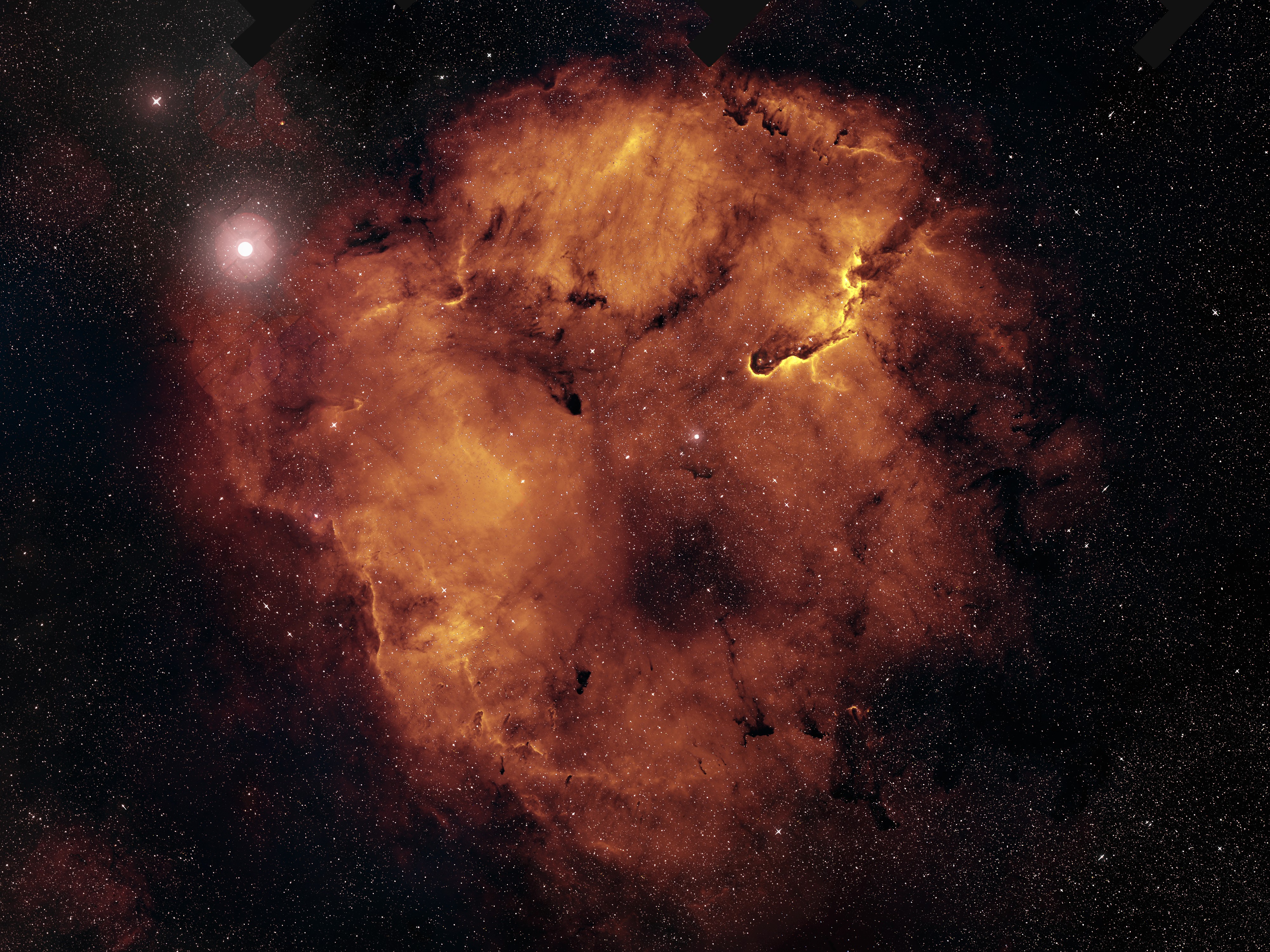
IC 1396 in the constellation Cepheus imaged in the red light from hydrogen atoms. This image was obtained as part of the INT/WFC Photometric Hydrogen-Alpha Survey of the Northern Galactic Plane (IPHAS). Credit: Geert Barentsen & Jorick Vink (Armagh Observatory) & the IPHAS Collaboration. [ JPEG | TIFF ]

IC1396, also called the Elephant's Trunk Nebula, is one of the largest emission nebulae in the Northern Sky with a diameter of 3 degrees. It is a giant cloud of gas and dust at a distance of 2400 light years from Earth. It is illuminated by the massive O-type star HD 206267 in the centre. Radiation and winds from this hot star are thought to compress parts of the cloud and trigger star formation.

The mosaic shown here was assembled from ~400 exposures taken in the H-alpha, Sloan r' and Sloan i' bands using the Wide Field Camera (WFC) on the 2.5m Isaac Newton Telescope (INT). The data were taken by multiple observers between 2004 and 2009 as part of the INT/WFC Photometric Halpha Survey of the Northern Galactic Plane (IPHAS). The mosaic was created using the Montage toolkit maintained by NASA/IPAC. Saturation spikes and artefacts have been removed by hand.

Photometric analysis of this data revealed more than 100 previously unknown pre-main sequence stars which are still accreting material from a circumstellar disk (Barentsen et al. 2011).

References and more information:

Barentsen G.; Vink J.; Drew J. E.; Greimel R.; Wright N. J., Drake J. J., Martin E. L., Valdivielso L., Corradi R. L. M., 2011, "T Tauri candidates and accretion rates using IPHAS: method and application to IC1396", MNRAS, 415, 103. arXiv:1103.1646v1.
INT/WFC Photometric Halpha Survey of the Northern Galactic Plane: http://www.iphas.org
Montage toolkit: http://montage.ipac.caltech.edu


Javier Méndez
Public Relations Officer
Last modified: 16 March 2012

Saturday, June 11, 2011

Blowin in the Stellar Wind

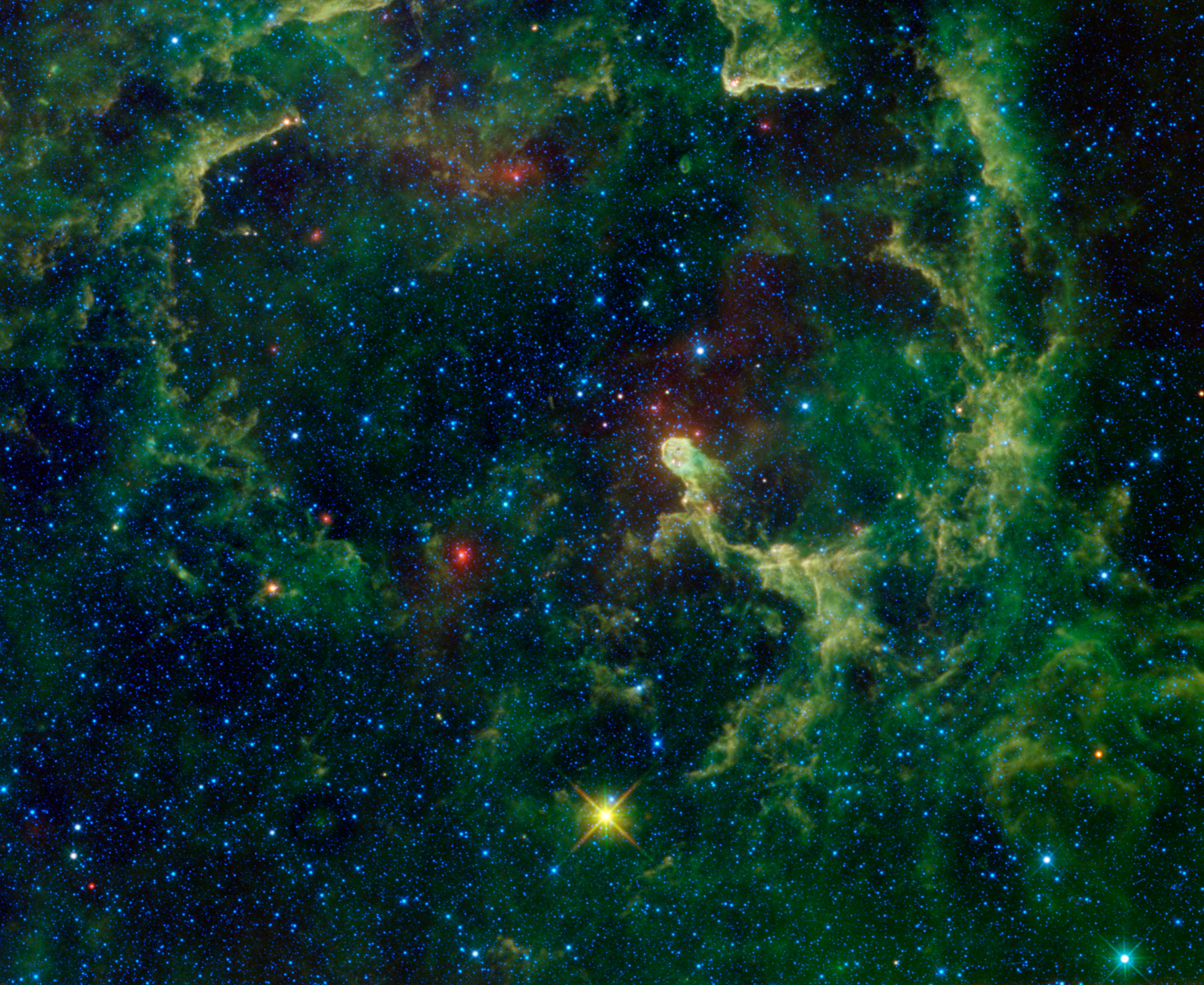
IC 1396
Image Credit: NASA/JPL-Caltech/WISE Team

Download Options

small (113K) 400 x 327 JPEG
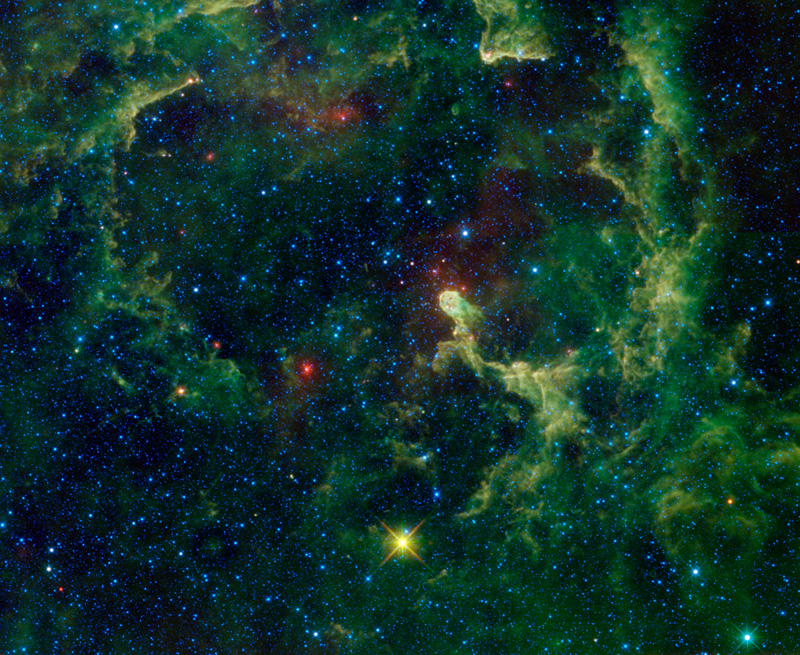
medium (465K) 800 x 655 JPEG
large (1.36M) 1600 x 1309 JPEG
extra large (3.36M) 3200 x 2618 JPEG
original (66.5M) 7700 x 6300 TIF

Packaged image (1.89M) 2400 x 3000 JPG
Packaged image (38.7M) 8 x 10 in. PDF

Like dust being blown around by the wind here on Earth, space dust can be blown around by the wind and radiation from stars. This image of the Elephant’s Trunk nebula from NASA’s Wide-field Survey Explorer, or WISE, shows clouds of dust and gas being pushed and eroded by a massive star. The bright ‘trunk’ of the nebula near the center is an especially dense cloud holding up against the star’s powerful radiation and stellar wind, like a windsock standing strong while the rest of the gas and dust gets broken up and swept away.

‘Elephant trunk’ is a term commonly used by astronomers for this type of structure. Similar structures can be found in many other nebulae, however this is the only nebula that uses the term in its moniker. More distant examples of elephant trunks can be seen in previously featured WISE images such as LBN 211.91-01.37 (link to http://wise.ssl.berkeley.edu/gallery_LBN211.91-01.37.html ) and the Soul Nebula (link to http://wise.ssl.berkeley.edu/gallery_Soul_Nebula.html ). They’re all formed in basically the same way – a nearby massive star (or cluster) emitting vast amounts of ultraviolet radiation and stellar winds that clear out all of the gas and dust surrounding it, leaving behind only the most dense parts of the cloud. These dense portions then protect some of the gas ‘downwind’ creating a trunk-like feature.

The culprit star here, HR8281, is located close the center of the image. It’s one of the three bright blue stars near the upper left tip of the trunk that form a triangle about as wide as the glowing tip of the trunk. Of those three, it’s the uppermost one in the center. Its destructive effects on the surrounding nebula can be seen by the dark cavity it’s created, outlined by the brighter dust clouds encircling it. The entire nebula, also known as IC1396A, fills most of the field of view. It’s located only 2,450 light-years away, quite close compared to other similar nebulae. The trunk itself is about 30 light-years long, while the full nebula stretches over 100 light-years across.

If you look closely at the tip of the elephant trunk you can see a small dark area, appearing as a sort of opening. This is a small void in the gas formed by a pair of new baby stars that recently formed in the dense cloud. Their radiation and wind is clearing out the nearby gas and dust, creating a smaller version of the same effect seen on a larger scale in the full image. The reddish stars scattered throughout the image are likely new stars just forming that and are still wrapped inside their dusty cocoons.
The colors used in this image represent specific wavelengths of infrared light. Blue and cyan (blue-green) represent light emitted at wavelengths of 3.4 and 4.6 microns, which is predominantly from stars. Green and red represent light from 12 and 22 microns, respectively, which is mostly emitted by dust.

About the Objects

Names: Elephant Trunk Nebula; IC 1396A; LBN 452

Type: Nebula > Emission > HII Region Distance: 2,450 light years
Size: ~100 light years across

About the Images


Postion of Object (J2000):): RA=21h 38m 57m; Dec=+57° 29’ 20”

Constellation: Cepheus
Orientation: North is 43 degrees right of straight up

Color Mapping: Blue=3.4 microns; Cyan=4.6 microns; Green=12 microns; Red=22 microns