Showing posts with label Cygnus. Show all posts

Thursday, June 15, 2023

Motion in the Cygnus Loop Supernova Remnant


H-alpha image of a segment of the supernova remnant in 2001. The numbers along the top indicate the proper motion, in milliarcseconds per year, of that section of the shock front. Bottom: H-alpha images from 2020 (red) and 2001 (cyan). Credit: Sankrit et al. 2023


If we could see the Cygnus Loop supernova remnant without the aid of a telescope, it would span an area of the sky six times as wide as a full Moon. The Cygnus Loop is a wispy, rapidly expanding shell of gas that marks the grave site of a massive star that exploded some 20,000 years ago. In a recent research article, Ravi Sankrit (Space Telescope Science Institute) and collaborators present new Hubble Space Telescope observations of a small portion of this famous supernova remnant. Paired with previous Hubble observations from 2001 and 1997, the new images clearly demonstrate how the remnant’s shock front has expanded over time. In the images above and to the right, red and cyan mark the position of the shock front in 2020 and 2001, respectively. By analyzing the shock’s location, Sankrit’s team found that the shock hasn’t slowed at all over the past 22 years, speeding into interstellar space at 240 kilometers each second. While this seems incredibly fast, it’s actually on the slow end for a supernova shock wave. To learn more about these new observations of the Cygnus Loop, be sure to check out the full article linked below.

If we could see the Cygnus Loop supernova remnant without the aid of a telescope, it would span an area of the sky six times as wide as a full Moon. The Cygnus Loop is a wispy, rapidly expanding shell of gas that marks the grave site of a massive star that exploded some 20,000 years ago. In a recent research article, Ravi Sankrit (Space Telescope Science Institute) and collaborators present new Hubble Space Telescope observations of a small portion of this famous supernova remnant. Paired with previous Hubble observations from 2001 and 1997, the new images clearly demonstrate how the remnant’s shock front has expanded over time. In the images above and to the right, red and cyan mark the position of the shock front in 2020 and 2001, respectively. By analyzing the shock’s location, Sankrit’s team found that the shock hasn’t slowed at all over the past 22 years, speeding into interstellar space at 240 kilometers each second. While this seems incredibly fast, it’s actually on the slow end for a supernova shock wave. To learn more about these new observations of the Cygnus Loop, be sure to check out the full article linked below.

By Kerry Hensley

Citation

“Third Epoch HST Imaging of a Nonradiative Shock in the Cygnus Loop Supernova Remnant,” Ravi Sankrit et al 2023 ApJ 948 97. doi:10.3847/1538-4357/acc860


Monday, April 05, 2021

Hubble Revisits the Veil Nebula

Veil Nebula
Text credit: European Space Agency (ESA)
Image credit: ESA/Hubble & NASA, Z. Levay

This image taken by the NASA/ESA Hubble Space Telescope revisits the Veil Nebula, which was featured in a previous Hubble image release. In this image, new processing techniques have been applied, bringing out fine details of the nebula’s delicate threads and filaments of ionized gas.

To create this colorful image, observations were taken by Hubble's Wide Field Camera 3 instrument using five different filters. The new post-processing methods have further enhanced details of emissions from doubly ionized oxygen (seen here in blues), ionized hydrogen, and ionized nitrogen (seen here in reds).

The Veil Nebula lies around 2,100 light-years from Earth in the constellation of Cygnus (the Swan), making it a relatively close neighbor in astronomical terms. Only a small portion of the nebula was captured in this image.

The Veil Nebula is the visible portion of the nearby Cygnus Loop, a supernova remnant formed roughly 10,000 years ago by the death of a massive star. That star – which was 20 times the mass of the Sun – lived fast and died young, ending its life in a cataclysmic release of energy. Despite this stellar violence, the shockwaves and debris from the supernova sculpted the Veil Nebula’s delicate tracery of ionized gas – creating a scene of surprising astronomical beauty.

The Veil Nebula is also featured in Hubble’s Caldwell Catalog, a collection of astronomical objects that have been imaged by Hubble and are visible to amateur astronomers in the night sky.

Media contact:

Claire Andreoli
NASA's
Goddard Space Flight Center, Greenbelt, Md.
301-286-1940

claire.andreoli@nasa.gov

Editor: Lynn Jenner
 

Thursday, December 20, 2012

WIYN/NOAO: A Panoramic Loop in Cygnus

Giant supernova remnant, Cygnus Loop. The Image Gallery page for this image includes links to the full resolution version, which is more than 24,000 pixels on a side. Image Credit: T.A. Rector (University of Alaska Anchorage), Richard Cool (University of Arizona) and WIYN/NOAO/AURA/NSF
 
As an end of the year finale, the National Optical Astronomy Observatory (NOAO) and WIYN partners offer this new wide-field image of the Cygnus loop.  Three degrees on a side, this image covers an area of the sky about 45 times that of the full moon.  But it does so without sacrificing high resolution.  The image is over 600 million pixels in size, making it one of the largest astronomical images ever made. 

The Cygnus Loop is a large supernova remnant: the gaseous remains of a massive star that exploded long ago. It is located about 1,500 light-years from Earth in the direction of the constellation Cygnus, the Swan.  Astronomers estimate the supernova explosion that produced the nebula occurred between 5,000 to 10,000 years ago. First noted in 1784 by William Herschel, it is so large that its many parts have been catalogued as separate objects, including NGC 6992, NGC 6995 and IC 1340 along the eastern (left) side of the image, NGC 6974 and NGC 6979 near the top-center, and the Veil Nebula (NGC 6960) and Pickering’s Triangle along the western (right) edge.  The bright star near the western edge of the image, known as 52 Cygnus, is not associated with the supernova.

The data were obtained with the NOAO Mosaic 1 camera, with observations in the Oxygen [OIII] (blue), Sulphur [S II] (green) and Hydrogen-Alpha (red) filters.  When mounted on the WIYN 0.9 meter telescope the Mosaic camera has a one square degree field of view.  The Cygnus Loop was observed with nine separate telescope pointings in a 3x3 grid pattern.

The observations were originally obtained in 2003 by Richard Cool, while he was a graduate student at the University of Arizona, as part of a project to precisely measure the distance to the Cygnus Loop. Dr. Cool, now at the MMT Observatory in Arizona, said, “Often, astronomical research reduces images to dry tables of numerical information that we analyze in order to more deeply understand our universe.  Images like this are amazing because they can remind you of the big picture and beauty that surrounds us”.  In 2003 the computing power available was insufficient to process the data into a single, full-resolution color image.  Nine years later, the data were re-reduced and processed by Travis Rector to create the image presented here.  Dr. Rector has produced a remarkable series of color images from NOAO telescopes.  They can be found at his website and on a dedicated NOAO image gallery page.

Images like this demonstrate that even relatively small telescopes when equipped with modern cameras are capable of producing cutting-edge research. The 0.9 meter telescope at Kitt Peak is operated by the WIYN Consortium. It has been in operation since 1960, when the original telescope was first installed at the site now occupied by the WIYN 3.5 meter telescope.  Today, the 0.9 meter is regularly used by graduate students and faculty for a variety of research projects.

The WIYN 0.9 meter Observatory is a partnership including Austin Peay State University, Haverford College, Indiana University, Rochester Institute of Technology, San Francisco State University, University of Wisconsin-Madison, University of Wisconsin- Stevens Point, University of Wisconsin-Whitewater, and Wisconsin Space Grant consortium.

NOAO is operated by Association of Universities for Research in Astronomy Inc. (AURA) under a cooperative agreement with the National Science Foundation.

Science Contact

Dr. Travis Rector 
Department of Physics and Astronomy 
University of Alaska Anchorage 
3211 Providence Dr. 
Anchorage, AK 99508 

Friday, March 23, 2012

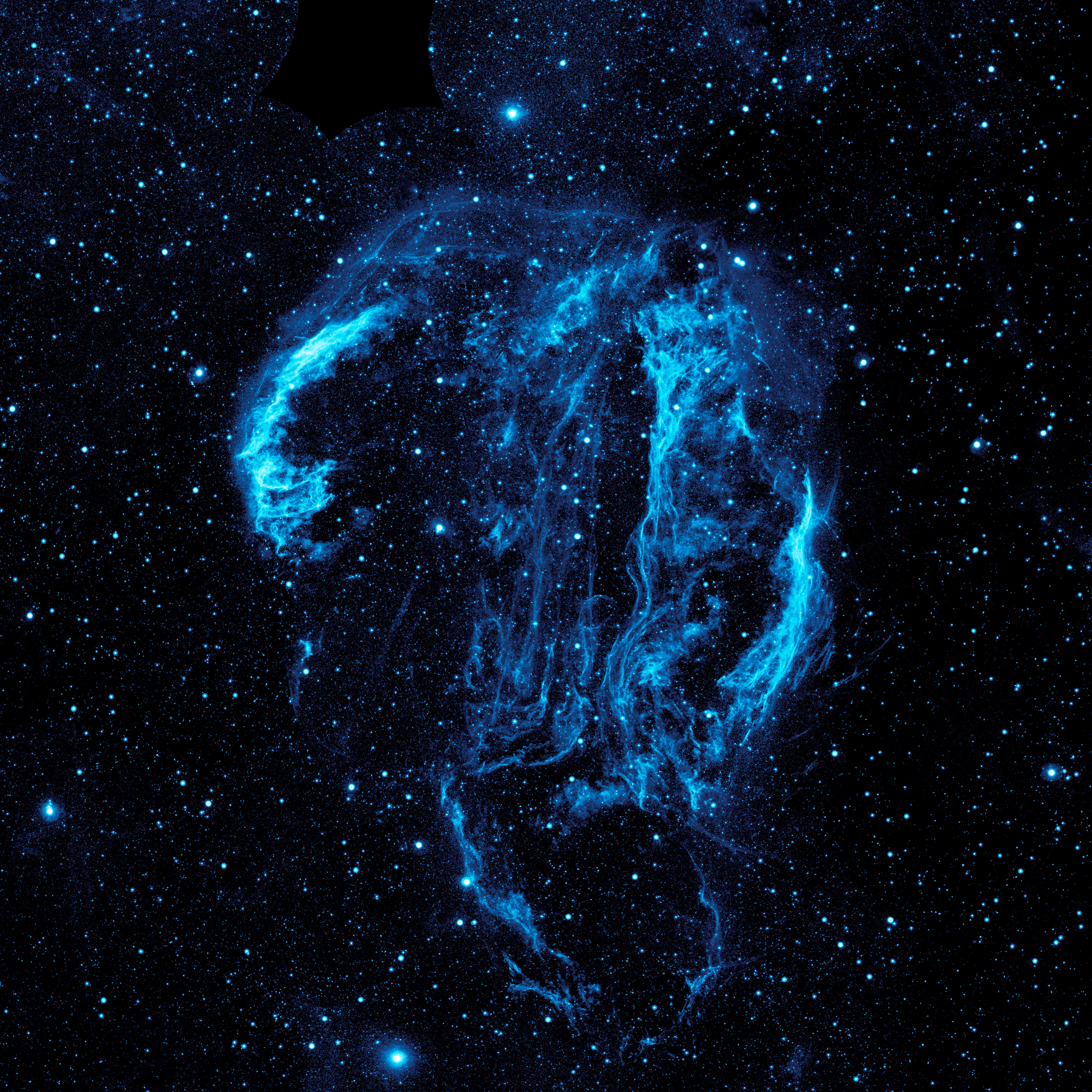
Cygnus Loop Nebula

Cygnus Loop Nebula
Credit: NASA/JPL-Caltech

Full Resolution TIFF [6000x6000, 47.5 MB]
Full Resolution JPEG [6000x6000, 13.6 MB]
Screen Resolution JPEG [450x450, 191 KB]

Wispy tendrils of hot dust and gas glow brightly in this ultraviolet image of the Cygnus Loop nebula, taken by NASA's Galaxy Evolution Explorer. The nebula lies about 1,500 light-years away, and is a supernova remnant, left over from a massive stellar explosion that occurred between 5,000 to 8,000 years ago. The Cygnus Loop extends over three times the size of the full moon in the night sky, and is tucked next to one of the "swan's wings" in the constellation of Cygnus.

The filaments of gas and dust visible here in ultraviolet light were heated by the shockwave from the supernova, which is still spreading outward from the original explosion. The original supernova would have been bright enough to be seen clearly from Earth with the naked eye.

Source: Galex