Wednesday, January 19, 2011

The Orion Nebula: Still Full of Surprises

PR Image eso1103a
The Orion Nebula

The jewel in Orion’s sword

PR Video eso1103a
Zooming in on the Orion Nebula

PR Video eso1103b
Panning across the Orion Nebula

This ethereal-looking image of the Orion Nebula was captured using the Wide Field Imager on the MPG/ESO 2.2-metre telescope at the La Silla Observatory, Chile. This nebula is much more than just a pretty face, offering astronomers a close-up view of a massive star-forming region to help advance our understanding of stellar birth and evolution. The data used for this image were selected by Igor Chekalin (Russia), who participated in ESO’s Hidden Treasures 2010 astrophotography competition. Igor’s composition of the Orion Nebula was the seventh highest ranked entry in the competition, although another of Igor’s images was the eventual overall winner.

The Orion Nebula, also known as Messier 42, is one of the most easily recognisable and best-studied celestial objects. It is a huge complex of gas and dust where massive stars are forming and is the closest such region to the Earth. The glowing gas is so bright that it can be seen with the unaided eye and is a fascinating sight through a telescope. Despite its familiarity and closeness there is still much to learn about this stellar nursery. It was only in 2007, for instance, that the nebula was shown to be closer to us than previously thought: 1350 light-years, rather than about 1500 light-years.

Astronomers have used the Wide Field Imager on the MPG/ESO 2.2-metre telescope at ESO’s La Silla Observatory in Chile to observe the stars within Messier 42. They found that the faint red dwarfs in the star cluster associated with the glowing gas radiate much more light than had previously been thought, giving us further insights into this famous object and the stars that it hosts. The data collected for this science project, with no original intention to make a colour image, have now been reused to create the richly detailed picture of Messier 42 shown here.

The image is a composite of several exposures taken through a total of five different filters. Light that passed through a red filter as well as light from a filter that shows the glowing hydrogen gas, were coloured red. Light in the yellow–green part of the spectrum is coloured green, blue light is coloured blue and light that passed through an ultraviolet filter has been coloured purple. The exposure times were about 52 minutes through each filter.

This image was processed by ESO using the observational data found by Igor Chekalin (Russia) [1], who participated in ESO’s Hidden Treasures 2010 astrophotography competition [2], organised by ESO in October–November 2010, for everyone who enjoys making beautiful images of the night sky using real astronomical data.

Notes

[1] Igor searched through ESO’s archive and identified datasets that he used to compose his image of Messier 42, which was the seventh highest ranked entry in the competition, out of almost 100 entries. His original work can be seen here. Igor Chekalin was awarded the first prize of the competition for his composition of Messier 78, and he also submitted an image of NGC3169, NGC3166 and SN 2003cg, which was ranked second highest.

[2] ESO’s Hidden Treasures 2010 competition gave amateur astronomers the opportunity to search through ESO’s vast archives of astronomical data, hoping to find a well-hidden gem that needed polishing by the entrants. Participants submitted nearly 100 entries and ten skilled people were awarded some extremely attractive prizes, including an all expenses paid trip for the overall winner to ESO's Very Large Telescope (VLT) on Cerro Paranal, in Chile, the world’s most advanced optical telescope. The ten winners submitted a total of 20 images that were ranked as the highest entries in the competition out of the near 100 images.

More information

ESO, the European Southern Observatory, is the foremost intergovernmental astronomy organisation in Europe and the world’s most productive astronomical observatory. It is supported by 15 countries: Austria, Belgium, Brazil, the Czech Republic, Denmark, France, Finland, Germany, Italy, the Netherlands, Portugal, Spain, Sweden, Switzerland and the United Kingdom. ESO carries out an ambitious programme focused on the design, construction and operation of powerful ground-based observing facilities enabling astronomers to make important scientific discoveries. ESO also plays a leading role in promoting and organising cooperation in astronomical research. ESO operates three unique world-class observing sites in Chile: La Silla, Paranal and Chajnantor. At Paranal, ESO operates the Very Large Telescope, the world’s most advanced visible-light astronomical observatory and VISTA, the world’s largest survey telescope. ESO is the European partner of a revolutionary astronomical telescope ALMA, the largest astronomical project in existence. ESO is currently planning a 42-metre European Extremely Large optical/near-infrared Telescope, the E-ELT, which will become “the world’s biggest eye on the sky”.

Links
ESO’s Hidden Treasures 2010 competition

Research papers:
http://adsabs.harvard.edu/abs/2009ApJS..183..261D
http://iopscience.iop.org/0004-637X/722/2/1092
Photos of La Silla Observatory

Contacts

Richard Hook
ESO, La Silla, Paranal, E-ELT and Survey Telescopes Public Information Officer
Garching bei München, Germany
Tel: +49 89 3200 6655
Cell: +49 151 1537 3591
Email: rhook@eso.org

Tuesday, January 18, 2011

Inclined Orbits Prevail in Exoplanetary Systems

Figure 1:Schematic Diagram of the Rossiter-McLaughlin (RM) Effect. Because of stellar rotation called “spin”, the stellar surface or “disk” has two parts: the approaching side (blue) and the receding side (red). During a planetary passage or “transit”, the observed radial velocity (RV) or speed of the star exhibits an apparent irregularity because of the stellar spin. When the transiting planet blocks the approaching side of the disk (blue), the star appears to be receding, and the RV shows an apparent red-shift. When the transiting planet conceals the receding side of the stellar disk, the star appears to be approaching, and the RV exhibits an apparent blue-shift. These anomalous RV shifts occur along the trajectory of the planet relative to the stellar disk.

The diagram shows two different trajectories. The left panels indicate alignment between the stellar spin axis and the planetary orbital axis while the right panels show misalignment of the two axes by 50 degrees. Therefore, precise measurements of RVs during a planetary transit enable an estimation of the angle between the two axes.


Figure 2:The RM Effect in the HAT-P-11 System Based on May 2010 Observations at the Subaru Telescope. The red line shows the RVs taken by the Subaru Telescope’s High Dispersion Spectrograph (HDS) while the blue one shows the published RVs taken with the Keck Telescope’s High Resolution Echelle Spectrometer (HIRES).

The solid black line represents the best-fit curve. Each RV error exhibited in this figure includes stellar jitter. The bottom panel shows the RV residuals from the best-fit curve. Residuals are measurements from the observations minus those for best-fit.


Figure 3:The RM Effect in the XO-4 System Based on January 2010 Observations at the Subaru Telescope.

Measurements of the RVs taken by the Subaru Telescope are shown in relation to two lines: 1) a solid line that shows the best-fit curve and 2) a dotted line that shows a model curve, assuming a perfect spin-orbit alignment. The bottom shows the residuals of the RV data from the best-fit curve.


Figure 4:Illustration of the HAT-P-11 System Based on Observations from Subaru Telescope. The planet orbits the star in a highly inclined orbit.

A research team led by astronomers from the University of Tokyo and the National Astronomical Observatory of Japan (NAOJ) has discovered that inclined orbits may be typical rather than rare for exoplanetary systems -- those outside of our solar system. Their measurements of the angles between the axes of the star's rotation (stellar rotational axis) and the planet's orbit (planetary orbital axis) of exoplanets HAT-P-11b and XO-4b demonstrate that these exoplanets' orbits are highly tilted. This is the first time that scientists have measured the angle for a small planet like HAT-P-11 b. The new findings provide important observational indicators for testing different theoretical models of how the orbits of planetary systems have evolved.

Since the discovery of the first exoplanet in 1995, scientists have identified more than 500 exoplanets, planets outside of our solar system, nearly all of which are giant planets. Most of these giant exoplanets closely orbit their host stars, unlike our solar system's giant planets, like Jupiter, that orbit the Sun from a distance. Accepted theories propose that these giant planets originally formed from abundant planet-forming materials far from their host stars and then migrated to their current close locations. Different migration processes have been suggested to explain close-in giant exoplanets.

Disk-planet interaction models of migration focus on interactions between the planet and its protoplanetary disk, the disk from which it originally formed. Sometimes these interactions between the protoplanetary disk and the forming planet result in forces that make the planet fall toward the central star. This model predicts that the spin axis of the star and the orbital axis of the planet will be in alignment with each other.

Planet-planet interaction models of migration have focused on mutual scatterings among giant planets. Migration can occur from planet scattering, when multiple planets scatter during the creation of two or more giant planets within the protoplanetary disk. While some of the planets scatter from the system, the innermost one may establish a final orbit very close to the central star. Another planet-planet interaction scenario, Kozai migration, postulates that the long-term gravitational interaction between an inner giant planet and another celestial object such as a companion star or an outer giant planet over time may alter the planet's orbit, moving an inner planet closer to the central star. Planet-planet migration interactions, including planet-planet scattering and Kozai migration, could produce an inclined orbit between the planet and the stellar axis.

Overall, the inclination of the orbital axes of close-in planets relative to the host stars' spin axes emerges as a very important observational basis for supporting or refuting migration models upon which theories of orbital evolution center. A research group led by astronomers from the University of Tokyo and NAOJ concentrated their observations with the Subaru Telescope on investigating these inclinations for two systems known to have planets: HAT-P-11 and XO-4. The group measured the Rossiter-McLaughlin (hereafter, RM) effect of the systems and found evidence that their orbital axes incline relative to the spin axes of their host stars.

The RM effect refers to apparent irregularities in the radial velocity or speed of a celestial object in the observer's line of sight during planetary transits. Unlike the spectral lines that are generally symmetrical in measures of radial velocity, those with the RM effect deviate into an asymmetrical pattern (see Figure 1). Such apparent variation in radial velocity during a transit reveals the sky-projected angle between the stellar spin axis and planetary orbital axis. Subaru Telescope has participated in previous discoveries of the RM effect, which scientists have investigated for approximately thirty-five exoplanetary systems thus far.

In January 2010, a research team led by the current team's astronomers from the University of Tokyo and the National Astronomical Observatory of Japan used the Subaru Telescope to observe the planetary system XO-4, which lies 960 light years away from Earth in the Lynx region. The system's planet is about 1.3 times as massive as Jupiter and has a circular orbit of 4.13 days. Their detection of the RM effect showed that the orbital axis of the planet XO-4 b tilts to the spin axis of the host star. Only the Subaru Telescope has measured the RM effect for this system so far.

In May and July 2010, the current research team conducted targeted observations of the HAT-P-11 exoplanetary system, which lies 130 light years away from the Earth toward the constellation Cygnus. The Neptune-sized planet HAT-P-11 b orbits its host star in a non-circular (eccentric) orbit of 4.89 days and is among the smallest exoplanets ever discovered. Until this research, scientists had only detected the RM effect for giant planets. The detection of the RM effect for smaller-sized planets is challenging because the signal of the RM effect is proportional to the size of the planet; the smaller the transiting planet, the fainter the signal.

;The team took advantage of the enormous light-collecting power of the Subaru Telescope's 8.2m mirror as well as the precision of its High Dispersion Spectrograph. Their observations not only resulted it the first detection of the RM effect for a smaller Neptune-sized exoplanet but also provided evidence that the orbital axis of the planet inclines to the stellar spin axis by approximately 103 degrees in the sky. A research group in the U.S. used the Keck Telescope and made independent observations of the RM effect of the same system in May and August 2010; their results were similar to those from the University of Tokyo/NAOJ team's May and July 2010 observations.

The current team's observations of the RM effect for the planetary systems HAT-P-11 and XO-4 have shown that they have planetary orbits highly tilted to the spin axes of their host stars. The latest observational results about these systems, including those obtained independently of the findings reported here, suggest that such highly inclined planetary orbits may commonly exist in the universe. The planet-planet scenario of migration, whether caused by planet-planet scattering or Kozai migration, rather than the planet-disk scenario could account for their migration to the present locations.

However, measurements of the RM effect for individual systems cannot decisively discriminate between the migration scenarios. Statistical analysis can help scientists determine which, if any, process of migration is responsible for the highly inclined orbits of giant planets. Since different migration models predict different distributions of the angle between the stellar axis and planetary orbit, developing a large sample of the RM effect enables scientists to support the most plausible migration process. Inclusion of the measurements of the RM effect for such a small-sized planet as HAT-P-11 b in the sample will play an important role in discussions of planetary migration scenarios.

Many research groups are planning to make observations of the RM effect with telescopes around the world. The current team and the Subaru Telescope will play an integral role in investigations to come. Continuous observations of transiting exoplanetary systems will contribute to an understanding of the formation and migration history of planetary systems in the near future.

NOTE 1:
This migration model is based on the Kozai cycle introduced in 1962 by Yoshihide Kozai, the founding Director General of the National Astronomical Observatory of Japan.

Monday, January 17, 2011

Islands of Stars in the River

NGC 1345
Credit: ESA/Hubble & NASA


The spiral galaxy NGC 1345 and its loose and ragged arms dominate this rich image from the NASA/ESA Hubble Space Telescope. It is a member of the Eridanus Galaxy Cluster — a group of about 70 galaxies that lies 85 million light-years away in the constellation of Eridanus (the River). This region of the night sky is well populated with bright galaxies, with the Fornax Cluster of galaxies also nearby on the celestial sphere, although the two clusters are actually separated by about 20 million light-years. Collectively, they are known as the Fornax Supercluster or the Southern Supercluster.

John Herschel discovered NGC 1345 in 1835 from South Africa. He described it as small and very faint and it is still far from easy to see it even with quite a large amateur telescope, where it appears as a small, circular fuzz.

Apart from the main galaxy that dominates the picture, lots more distant galaxies of many shapes and sizes can be seen in this image, some shining right through the foreground galaxy. NGC 1345 itself features an elongated bar extending from the nucleus and spiral arms that emanate outwards, making it a barred spiral type. Classifying galaxy shapes is an important part of astronomical research as it tells us much about how the Universe has evolved. But computers aren’t really ideal for the task; people are much better at recognising shapes, which is why a citizen-science project called Galaxy Zoo: Hubble is asking members of the public to help sift through the vast archive of images and classify galaxies by type. If you would like to join the cause, there’s a link to the project below.

This picture was created from images taken with the Wide Field Channel of Hubble’s Advanced Camera for Surveys. Images taken through a blue filter (F435W) were coloured blue and images through a near-infrared filter (F814W) were coloured red. The exposure times were 17.5 minutes per filter in total and the field of view is 3.2 by 1.6 arcminutes.

Links
http://www.galaxyzoo.org/

Saturday, January 15, 2011

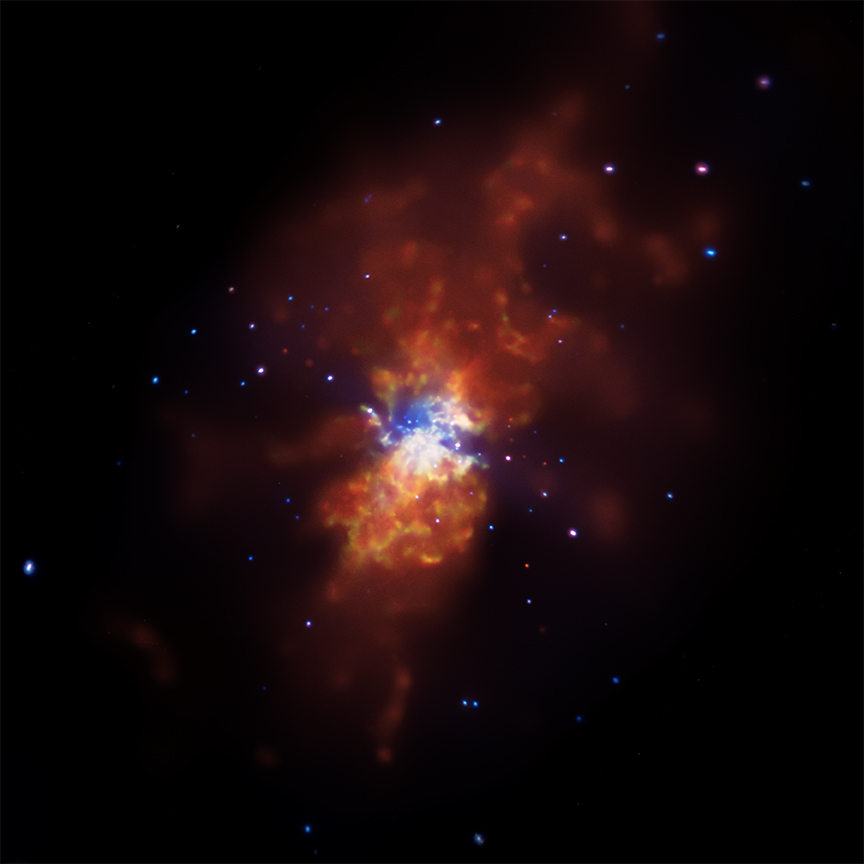
M82: Chandra Images Torrent of Star Formation

M82
Credit NASA/CXC/Wesleyan/R.Kilgard et al.


A new Chandra X-ray Observatory image of Messier 82, or M82, shows the result of star formation on overdrive. M82 is located about 12 million light years from Earth and is the nearest place to us where the conditions are similar to those when the Universe was much younger with lots of stars forming.

M82 is a so-called starburst galaxy, where stars are forming at rates that are tens or even hundreds of times higher than in a normal galaxy. The burst of star birth may be caused by a close encounter or collision with another galaxy, which sends shock waves rushing through the galaxy. In the case of M82, astronomers think that a brush with its neighbor galaxy M81 millions of years ago set off this torrent of star formation.

M82 is seen nearly edge-on with its disk crossing from about 10 o'clock to about 4 o'clock in this image from Chandra (where low, medium, and high-energy X-rays are colored red, green, and blue respectively.) Among the 104 point-like X-ray sources in the image, eight so far have been observed to be very bright in X-rays and undergo clear changes in brightness over periods of weeks and years. This means they are excellent candidates to be black holes pulling material from companion stars that are much more massive than the Sun. Only a handful of such binary systems are known in the Local Group of galaxies containing the Milky Way and M31.

Chandra observations are also important in understanding the rapid rate at which supernovas explode in starburst galaxies like M82. When the shock waves travel through the galaxy, they push on giant clouds of gas and dust, which causes them to collapse and form massive stars. These stars, in turn, use up their fuel quickly and explode as supernovas. These supernovas produce expanding bubbles of multimillion-degree gas that extend for millions light years away from the galaxy's disk. These bubbles are seen as the large red areas to the upper right and lower left of the image.

NASA's Marshall Space Flight Center in Huntsville, Ala., manages the Chandra program for NASA's Science Mission Directorate in Washington. The Smithsonian Astrophysical Observatory controls Chandra's science and flight operations from Cambridge, Mass.

Fast Facts for M82:

Scale: Image is 12.75 arcmin across (44,500 light years)
Category: Normal Galaxies & Starburst Galaxies, Black Holes
Coordinates (J2000) RA 09h 55m 50.70s | Dec +69° 40' 37.00
Constellation: Ursa Major
Observation Date: 7 pointings from Sep 20, 1999 to Jul 28, 2010
Observation Time: 142 hours 47 min (5 days, 22 hours, 47 min)
Obs. ID: 361, 10542-10545, 10925, 11800
Color Code: Red (0.3-1.1 keV); Green (0.7-2.2 keV); Blue (2.2-6 kev)
Instrument: ACIS
Also Known As: Cigar Galaxy
Distance Estimate: About 12 million light years

GRS 1915+105: Taking the Pulse of a Black Hole System

GRS 1915+105
Credit X-ray (NASA/CXC/Harvard/J.Neilsen et al); Optical (Palomar DSS2)


This optical and infrared image from the Digitized Sky Survey shows the crowded field around the binary system GRS 1915+105 (GRS 1915 for short) located near the plane of our Galaxy. The top-left inset shows a close-up of the Chandra image of GRS 1915 , and the bottom-right inset shows the remarkable "heartbeats" seen in the X-ray light from this system. Using Chandra and the Rossi X-ray Timing Explorer (RXTE), astronomers have discovered what drives these heartbeats and given new insight into the ways that black holes can regulate their intake and severely curtail their growth.

GRS 1915 contains a black hole about 14 times the mass of the Sun that is feeding off material from a nearby companion star. As the material swirls toward the black hole, a disk forms. The black hole in GRS 1915 has been estimated to rotate at the maximum possible rate, allowing material in the inner disk to orbit very close to the black hole -- at a radius only 20% larger than the event horizon -- where the material travels at 50% the speed of light.

Researchers monitored this black hole system with Chandra and RXTE over a period of eight hours. As they watched, GRS 1915 gave off a short, bright pulse of X-ray light approximately every 50 seconds. This type of rhythmic cycle closely resembles an electrocardiogram of a human heart -- though at a slower pace. It was previously known that GRS 1915 can develop such heartbeats, but researchers gained new understanding into what drives the beats, and used the pulses to figure out what controls how much material the black hole consumes from the RXTE data.


The astronomers also used Chandra's high-resolution spectrograph to study the effects of this heartbeat variation on regions of the disk very far from the black hole, at distances of about 100,000 to a million times the radius of the event horizon. By analyzing the Chandra spectrum, they found a very strong wind being driven away from the outer parts of the disk. The rate of mass expelled in this wind is remarkably high, as much as 25 times the maximum rate at which matter falls onto the black hole. This massive wind drains material from the outer disk and eventually causes the heartbeat variation to shut down.

Fast Facts for GRS 1915+105:

Scale: 5 degrees across (58 light years)
Category: Black Holes, Neutron Stars/X-ray Binaries
Coordinates: (J2000) RA 19h 15m 11.60s | Dec +10° 56' 44.00''
Constellation: Aquila
Observation Date: May 23rd, 2001
Observation Time: 8 hours 20 min
Obs. ID: 1945
Color Code: X-ray (Violet); Optical (Red, Green, Blue)
Instrument: ACIS/HETG
Distance Estimate: 40,000 light years

Friday, January 14, 2011

Herschel celebrates one year of spectacular science

Herschel is celebrating one year of spectacular science. Today, a meeting at the Royal Astronomical Society in London is showcasing some of the latest groundbreaking research. Herschel is a far-infrared telescope, and its three scientific instruments detect light with a wavelength typically several hundred times longer than visible light that we see. Instead of seeing stars, this allows Herschel to observe gas and dust between the stars. Herschel is a flagship mission of the UK Space Agency, which funds the UK's involvement in Herschel’s UK-led SPIRE instrument.

Herschel is observing objects in our Galaxy and beyond, in an effort to understand when the first stars formed, how galaxies evolved into those we see around us today, and how planets form. Prof Derek Ward-Thompson, Cardiff University, one of the organisers of the meeting, said “this represents an opportunity to showcase the work taking place with Herschel data here in the UK. We are grateful to the RAS for hosting us, and I look forward to hearing about the latest developments.”

The Andromeda Galaxy shown in the far-infrared (left) and visible (right), with a composite image in the middle. Image credit: Robert Gendler (visible) ; ESA / Herschel / SPIRE / HELGA (far-infrared)

Far-infrared images are often complementary to images at other wavelengths. This is demonstrated admirably by the recently released image of the Andromeda Galaxy. Andromeda is as close as we can get to a twin of our own Milky Way, with the two being the largest members of the Local Group of galaxies. At a relatively close 2.5 million light years, astronomers can study the Andromeda Galaxy in much greater detail than other more distant galaxies.

The optical light traces the stars in the spiral arms, tilted over with respect to our view from Earth, and laced with dark dust lanes. When seen by Herschel the stars are not shown, but instead the dust itself is glowing, with the brightest areas being those regions which are warmed by stars forming within. “These two images demonstrate very clearly how observations in different parts of the spectrum complement each other. While in the optical we see mainly the older stars, in the far-infrared we see dust which traces the gas where new stars are forming.” said the Herschel Project Scientist Göran Pilbratt from ESA.

The proximity of Andromeda allows astronomers to study features which are, ironically, very hard to observe in our own Galaxy due to having to look through the entire disc of the Milky Way. It is also useful for bridging the gap between observations of dust and gas in the Milky Way, and those of much more distant galaxies.

The spiral galaxy Messier 61 (centre) with four fainter galaxies nearby (labelled). Image credit: ESA / SPIRE / HeViCS

The Virgo Cluster of galaxies comprises around two thousand individual galaxies, and lies around fifty million light years away. By observing large areas in and around the Virgo Cluster, astronomers will use the Herschel images to study galaxies of all shapes and sizes and in a range of environments. One particular galaxy, Messier 61, is one of the largest in the cluster, around the same size as the Milky Way.

In the Herschel image, Messier 61 is not alone, with four much fainter objects visible close by. Two of them are much smaller galaxies which are orbiting Messier 61, not unlike the Magellanic Clouds which orbit the Milky Way. A third galaxy may be in a similar situation, while the fourth is merely a background Galaxy. Dr Jonathan Davies, Cardiff University, who leads the “HeViCS” project which is studying the Virgo cluster, said “Virgo represents an excellent opportunity to investigate how a large cluster of thousands of galaxies can influence how any one individual galaxy evolves and changes with time. This will give us a better insight into how galaxies form and how many of them evolve into the beautiful spiral structures we see today, as typified by Messier 61.”

One of the main advantages of Herschel is that it can see objects of a huge range of physical sizes. As the most powerful far-infrared telescope ever built, Herschel can see the late stages of the formation of planetary systems like our own Solar System. A new image of a star called Eta Corvi shows not the star itself, but a huge belt surrounding it about four times the size of the Solar System's Kuiper belt .

Our own Kuiper Belt lies beyond the orbit of Neptune and contains objects of a range of sizes, including the dwarf planets Pluto and Eris. Eta Corvi’s belt is similar, made up of icy objects ranging in size from micron-sized grains to comets many kilometres in diameter. This image was taken as part of a survey of nearby stars by the DEBRIS Collaboration, an international team of astronomers, including Dr Jane Greaves from the University of St Andrews and Dr Grant Kennedy, from the University of Cambridge, who will be presenting this work to the RAS.

The star Eta Corvi as seen by Herschel. An outer ring of icy, comet-like bodies is seen, much like the Kuiper Belt in our Solar System that contains objects such as Pluto, and the system contains a second warmer, dusty belt. The size of our Solar System is shown for scale. Image credit: ESA / Herschel / SPIRE / PACS / DEBRIS

This remarkable system is also home to a second, brighter dust ring much closer to the star, so close that the dust is about the temperature of boiling water. While Herschel can’t see the dust disc in detail, other observations have proved its existence. The best explanation for its existence is that comets are currently being scattered in from the large outer belt by planets.

"A system with both hot and cold dust like Eta Corvi is very rare, and gives us something we can compare with important aspects of our Solar System’s formation” said Laura Churcher, a PhD student at the Institute of Astronomy, University of Cambridge. It is thought that a similar process in our own Solar System nearly 4 billion years ago resulted in a spike in comet impacts on the Earth and Moon.

The research topics being presented at the Royal Astronomical Society are a few highlights of the research taking place using Herschel data. Dr David Clements, Imperial College London, and co-organiser of the meeting, said “it’s fantastic to see so many interesting things being done with Herschel data. The UK is a true world leader in this kind of astronomy, from instrument building to doing the science with the observations and the theoretical work behind it all. The breadth and depth of what we’re seeing at this RAS meeting just re-emphasises that point.”

Submitted by Chris North

Thursday, January 13, 2011

Astronomers 'Weigh' Heaviest Known Black Hole in our Cosmic Neighborhood

Artist's concept of what a future telescope might see in looking at the black hole at the heart of the galaxy M87. Clumpy gas swirls around the black hole in an accretion disk, feeding the central beast. The black area at center is the black hole itself, defined by the event horizon, beyond which nothing can escape. The bright blue jet shooting from the region of the black hole is created by gas that never made it into the hole itself but was instead funneled into a very energetic jet. Credit: Gemini Observatory/AURA illustration by Lynette Cook.

SEATTLE — Astronomers led by Karl Gebhardt of The University of Texas at Austin have measured the most massive known black hole in our cosmic neighborhood by combining data from a giant telescope in Hawai'i and a smaller telescope in Texas. The result is an ironclad mass of 6.6 billion Suns for the black hole in the giant elliptical galaxy M87. This enormous mass is the largest ever measured for a black hole using a direct technique. Given its massive size, M87 is the best candidate for future studies to actually "see" a black hole for the first time, rather than relying on indirect evidence of their existence as astronomers have for decades.

The results were presented in a press conference Wednesday, January 12, at the 217th meeting of the American Astronomical Society in Seattle, and two papers detailing the results will be published soon in The Astrophysical Journal. Additional images can be found in the McDonald Observatory press release.

Gebhardt, the Herman & Joan Suit Professor of Astrophysics at the University, led a team of researchers using the 8-meter Gemini North telescope in Hawai'i to probe the motions of stars around the black hole in the center of the massive galaxy M87.

University of Texas graduate student Jeremy Murphy has used the Harlan J. Smith Telescope at the University's McDonald Observatory in West Texas to probe the outer reaches of the galaxy — the so-called "dark halo." The dark halo is a region surrounding the galaxy filled with "dark matter," an unknown type of mass that gives off no light but is detectable by its gravitational effect on other objects.

In order to pin down the black hole's mass conclusively, Gebhardt says, one must account for all the components in the galaxy. Thus, studies of both the central and outermost regions of a galaxy are necessary to "see" the influence of the dark halo, the black hole, and the stars. But when all of these components are considered together, Gebhardt says, the results on the black hole are definitive, meeting what he calls the "gold standard" for weighing a black hole accurately.

Gebhardt used the Near-Infrared Field Spectrograph (NIFS) on Gemini to measure the speed of the stars as they orbit the black hole. The study was improved by Gemini's use of "adaptive optics," a system which compensates, in real time, for shifts in the atmosphere that can blur details seen by telescopes on the ground.

Together with the telescope’s large collecting area, the adaptive optics system allowed Gebhardt and Texas graduate student Joshua Adams to track the stars at M87’s heart with 10 times greater resolution than previous studies. “The result was only possible by combining the advantages of telescope size and spatial resolution at levels usually restricted to ground and space facilities, respectively,” Adams says.

Astronomer Tod Lauer of the National Optical Astronomy Observatory, also involved in the Gemini observations, says "Our ability to obtain such a robust black hole mass for M87 bodes well for our ongoing efforts to hunt for even larger black holes in galaxies more distant than M87."

Texas graduate student Jeremy Murphy used a very different instrument to track the motions of stars at the outskirts of the galaxy. Studying the stars' movements in these distant regions gives astronomers insight into what the unseen dark matter in the halo is doing. For this work, Murphy employed an innovative instrument called VIRUS-P on McDonald Observatory's Harlan J. Smith Telescope.

Studying the distant edges of a galaxy, far from the bright center, is a tricky business, Gebhardt says.

"That has been an enormous struggle for a long time, trying to get what the dark halo is doing at the edge of the galaxy, simply because, when you look there, the stellar light is faint," he says. "This is where the VIRUS-P data comes in, because it can observe such a huge chunk of sky at once."

This means the instrument can add together the faint light from many dim stars and add them together to create one detailed observation. This kind of instrument is called an "integral field unit spectrograph," and VIRUS-P is the world's largest.

"The ability of VIRUS-P to dig deep into the outer halo of M87 and tell us how the stars are moving is impressive," Murphy says. "It has quickly become the leading instrument for this type of work."

The combined Gemini and McDonald data have allowed the team to weigh M87's black hole at 6.6 billion Suns. But weighing such a massive black hole is only one step toward a greater goal.

"My ultimate goal is to understand how the stars assembled themselves in a galaxy over time," Gebhardt says.

"How do you make a galaxy? These two datasets probe such an enormous range, in terms of what the mass is in the galaxy. That's the first step to answering this question. It's very hard to understand how the mass accumulates unless you know exactly what's the distribution of mass: how much is in the black hole, how much is in the stars, how much is in the dark halo."

Today's conclusions also hint at another tantalizing possibility for the future: the chance to actually "see" a black hole.

"There's no direct evidence yet that black holes exist," Gebhardt says, " ... zero, absolutely zero observational evidence. To infer a black hole currently, we choose the 'none of above' option. This is basically because alternative explanations are increasingly being ruled out."

However, he says that the black hole in M87 is so massive that astronomers someday may be able to detect its "event horizon" — the edge of a black hole, beyond which nothing can escape. The event horizon of M87's black hole is about three times larger than the orbit of Pluto — large enough to swallow our solar system whole.

Though the technology does not yet exist, M87's event horizon covers a patch of sky large enough to be imaged by future telescopes. Gebhardt says future astronomers could use a world-wide network of submillimeter telescopes to look for the shadow of the event horizon on a disk of gas that surrounds M87's black hole.

Video:Karl Gebhardt discusses McDonald Observatory's VIRUS-P instrument used in this study. Available from McDonald Observatory's YouTube channel: http://www.youtube.com/mcdonaldobservatory

The Gemini Observatory is an international collaboration with two identical 8-meter telescopes. The Frederick C. Gillett Gemini Telescope is located at Mauna Kea, Hawai'i (Gemini North) and the other telescope at Cerro Pachón in central Chile (Gemini South), and hence provide full coverage of both hemispheres of the sky. Both telescopes incorporate new technologies that allow large, relatively thin mirrors under active control to collect and focus both optical and infrared radiation from space.

The Gemini Observatory provides the astronomical communities in each partner country with state-of-the-art astronomical facilities that allocate observing time in proportion to each country's contribution. In addition to financial support, each country also contributes significant scientific and technical resources. The national research agencies that form the Gemini partnership include: the US National Science Foundation (NSF), the UK Science and Technology Facilities Council (STFC), the Canadian National Research Council (NRC), the Chilean Comisión Nacional de Investigación Cientifica y Tecnológica (CONICYT), the Australian Research Council (ARC), the Argentinean Consejo Nacional de Investigaciones Científicas y Técnicas (CONICET) and the Brazilian Conselho Nacional de Desenvolvimento Científico e Tecnológico CNPq). The observatory is managed by the Association of Universities for Research in Astronomy, Inc. (AURA) under a cooperative agreement with the NSF. The NSF also serves as the executive agency for the international partnership.

Any opinions, findings, and conclusions or recommendations expressed in this material are those of the author(s) and do not necessarily reflect the views of the National Science Foundation.

Media Contacts:

Rebecca Johnson
McDonald Observatory, The University of Texas at Austin
Cell: (512) 689-0240
Desk: (512) 475-6763
rjohnson@astro.as.utexas.edu

Peter Michaud
Gemini Observatory, Hilo Hawai‘i
Cell: (808) 936-6643
Desk: (808) 974-2510
pmichaud@gemini.edu

Stephen Pompea
National Optical Astronomy Observatory
Cell: (520) 907-2493
Desk: (520) 318-8285
spompea@noao.edu

Science Contacts:

Dr. Karl Gebhardt
McDonald Observatory, The University of Texas at Austin
Cell: (512) 590-5206
Desk: (512) 471-1473
gebhardt@astro.as.utexas.edu

Dr. Tod Lauer
National Optical Astronomy Observatory
Cell: (520) 861-4618
Desk: (520) 318-8290
lauer@noao.edu

Jeremy Murphy
The University of Texas at Austin
Cell: (520) 905-0739
Desk: (512) 471-3462
murphy@astro.as.utexas.edu

Joshua Adams
The University of Texas at Austin
Phone: (512) 471-1495
jjadams@astro.as.utexas.edu

Partner Galaxies Wildly Different In New WISE Image

This image from NASA's Wide-Field Infrared Survey Explorer, or WISE, features two stunning galaxies engaged in an intergalactic dance. The galaxies, Messier 81 and Messier 82, swept by each other a few hundred million years ago, and will likely continue to twirl around each other multiple times before eventually merging into a single galaxy. Image credit: NASA/JPL-Caltech/UCLA. Full image caption

PASADENA, Calif. -- NASA's Wide-field Infrared Survey Explorer has captured a new view of two companion galaxies -- a somewhat tranquil spiral beauty and its rambunctious partner blazing with smoky star formation.

The unlikely pair, named Messier 81 and Messier 82, got to know each other a lot better during an encounter that occurred a few hundred million years ago. As they swept by each other, gravitational interactions triggered new bursts of star formation. In the case of Messier 82, also known as the Cigar galaxy, the encounter has likely triggered a tremendous wave of new star birth at its core. Intense radiation from newborn massive stars is blowing copious amounts of gas and smoky dust out of the galaxy, as seen in the WISE image in yellow hues.

The new image is online at: http://www.nasa.gov/mission_pages/WISE/multimedia/gallery/pia13454.html . The Cigar galaxy is pictured above Messier 81.

"What's unique about the WISE view of this duo is that we can see both galaxies in one shot, and we can really see their differences," said Ned Wright of UCLA, the principal investigator of WISE. "Because the Cigar galaxy is bursting with star formation, it's really bright in the infrared, and looks dramatically different from its less active companion."

The WISE mission completed its main goal of mapping the sky in infrared light in October 2010, covering it one-and-one-half times before its frozen coolant ran out, as planned. During that time, it snapped pictures of hundreds of millions of objects, the first batch of which will be released to the astronomy community in April 2011. WISE is continuing its scan of the skies without coolant using two of its four infrared channels -- the two shorter-wavelength channels not affected by the warmer temperatures. The mission's ongoing survey is now focused primarily on asteroids and comets.

Because WISE has imaged the entire sky, it excels at producing large mosaics like this new picture of Messier 81 and Messier 82, which covers a patch of sky equivalent to three-by-three full moons, or 1.5 by 1.5 degrees.

It is likely these partner galaxies will continue to dance around each other, and eventually merge into a single entity. They are both spiral galaxies, but Messier 82 is seen from an edge-on perspective, and thus appears in visible light as a thin, cigar-like bar. When viewed in infrared light, Messier 82 is the brightest galaxy in the sky. It is what scientists refer to as a starburst galaxy because it is churning out large amounts of new stars.

"The WISE picture really shows how spectacular Messier 82 shines in the infrared even though it is relatively puny in both size and mass compared to its big brother, Messier 81," said Tom Jarrett, a member of the WISE team at the California Institute of Technology in Pasadena.

In this WISE view, infrared light has been color coded so that we can see it with our eyes. The shortest wavelengths (3.4 and 3.6 microns) are shown in blue and blue-green, or cyan, and the longer wavelengths (12 and 22 microns) are green and red. Messier 82 appears in yellow hues because its cocoon of dust gives off longer wavelengths of light (the yellow is a result of combining green and red). This dust is made primarily of polycyclic aromatic hydrocarbons, which are found on Earth as soot.

Messier 81, also known as Bode's galaxy, appears blue in the infrared image because it is not as dusty. The blue light is from stars in the galaxy. Knots of yellow seen dotting the spiral arms are dusty areas of recent star formation, most likely triggered by the galaxy's encounter with its rowdy partner.

"It's striking how the same event stimulated a classic spiral galaxy in Messier 81, and a raging starburst in Messier 82," said WISE Project Scientist Peter Eisenhardt of NASA's Jet Propulsion Laboratory in Pasadena, Calif. "WISE is finding the most extreme starbursts across the whole sky, out to distances over a thousand times greater than Messier 82."

Messier 81 is one of the brightest galaxies in the sky in visible light. Both it and its partner can be seen with binoculars on a dark, clear night in the northern constellation of Ursa Major, which contains the Big Dipper. The galaxies are 12 million light-years away from Earth.

JPL manages WISE for NASA's Science Mission Directorate. The mission was competitively selected under NASA's Explorers Program, which NASA's Goddard Space Flight Center in Greenbelt, Md., manages. The Space Dynamics Laboratory in Logan, Utah, built the science instrument, and Ball Aerospace & Technologies Corp. of Boulder, Colo., built the spacecraft. Science operations and data processing take place at the Infrared Processing and Analysis Center at the California Institute of Technology in Pasadena. More information is online at http://www.nasa.gov/wise , http://wise.astro.ucla.edu and http://www.jpl.nasa.gov/wise .

Whitney Clavin 818-354-4673
Jet Propulsion Laboratory, Pasadena, Calif.
whitney.clavin@jpl.nasa.gov

The Two-faced Whirlpool Galaxy

Spiral Galaxy M51
Credit for the NICMOS Image: NASA, ESA, M. Regan and B. Whitmore (STScI), and R. Chandar (University of Toledo). Credit for the ACS Image: NASA, ESA, S. Beckwith (STScI), and the Hubble Heritage Team (STScI/AURA)

These images by NASA's Hubble Space Telescope show off two dramatically different face-on views of the spiral galaxy M51, dubbed the Whirlpool Galaxy.

The image at left, taken in visible light, highlights the attributes of a typical spiral galaxy, including graceful, curving arms, pink star-forming regions, and brilliant blue strands of star clusters.

In the image at right, most of the starlight has been removed, revealing the Whirlpool's skeletal dust structure, as seen in near-infrared light. This new image is the sharpest view of the dense dust in M51. The narrow lanes of dust revealed by Hubble reflect the galaxy's moniker, the Whirlpool Galaxy, as if they were swirling toward the galaxy's core.

To map the galaxy's dust structure, researchers collected the galaxy's starlight by combining images taken in visible and near-infrared light. The visible-light image captured only some of the light; the rest was obscured by dust. The near-infrared view, however, revealed more starlight because near-infrared light penetrates dust. The researchers then subtracted the total amount of starlight from both images to see the galaxy's dust structure.

The red color in the near-infrared image traces the dust, which is punctuated by hundreds of tiny clumps of stars, each about 65 light-years wide. These stars have never been seen before. The star clusters cannot be seen in visible light because dense dust enshrouds them. The image reveals details as small as 35 light-years across.

Astronomers expected to see large dust clouds, ranging from about 100 light-years to more than 300 light-years wide. Instead, most of the dust is tied up in smooth and diffuse dust lanes. An encounter with another galaxy may have prevented giant clouds from forming.

Probing a galaxy's dust structure serves as an important diagnostic tool for astronomers, providing invaluable information on how the gas and dust collapse to form stars. Although Hubble is providing incisive views of the internal structure of galaxies such as M51, the planned James Webb Space Telescope (JWST) is expected to produce even crisper images.

Researchers constructed the image by combining visible-light exposures from Jan. 18 to 22, 2005, with the Advanced Camera for Surveys (ACS) and near-infrared–light pictures taken in December 2005 with the Near Infrared Camera and Multi-Object Spectrometer (NICMOS).

The Best Way to Measure Dark Energy Just Got Better

A Type Ia supernova occurs when a white dwarf accretes material from a companion star until it exceeds the Chandrasekhar limit and explodes. By studying these exploding stars, astronomers can measure dark energy and the expansion of the universe. CfA scientists have found a way to correct for small variations in the appearance of these supernovae, so that they become even better standard candles. The key is to sort the supernovae based on their color. Credit: NASA/CXC/M. Weiss

Seattle, WA - Dark energy is a mysterious force that pervades all space, acting as a "push" to accelerate the Universe's expansion. Despite being 70 percent of the Universe, dark energy was only discovered in 1998 by two teams observing Type Ia supernovae. A Type 1a supernova is a cataclysmic explosion of a white dwarf star.

These supernovae are currently the best way to measure dark energy because they are visible across intergalactic space. Also, they can function as "standard candles" in distant galaxies since the intrinsic brightness is known. Just as drivers estimate the distance to oncoming cars at night from the brightness of their headlights, measuring the apparent brightness of a supernova yields its distance (fainter is farther). Measuring distances tracks the effect of dark energy on the expansion of the Universe.

The best way of measuring dark energy just got better, thanks to a new study of Type Ia supernovae led by Ryan Foley of the Harvard-Smithsonian Center for Astrophysics. He has found a way to correct for small variations in the appearance of these supernovae, so that they become even better standard candles. The key is to sort the supernovae based on their color.

"Dark energy is the biggest mystery in physics and astronomy today. Now, we have a better way to tackle it," said Foley, who is a Clay Fellow at the Center. He presented his findings in a press conference at the 217th meeting of the American Astronomical Society.

The new tool also will help astronomers to firm up the cosmic distance scale by providing more accurate distances to faraway galaxies.

Type Ia supernovae are used as standard candles, meaning they have a known intrinsic brightness. However, they're not all equally bright. Astronomers have to correct for certain variations. In particular, there is a known correlation between how quickly the supernova brightens and dims (its light curve) and the intrinsic peak brightness.

Even when astronomers correct for this effect, their measurements still show some scatter, which leads to inaccuracies when calculating distances and therefore the effects of dark energy. Studies looking for ways to make more accurate corrections have had limited success until now.

"We've been looking for this sort of 'second-order effect' for nearly two decades," said Foley.

Foley discovered that after correcting for how quickly Type Ia supernovae faded, they show a distinct relationship between the speed of their ejected material and their color: the faster ones are slightly redder and the slower ones are bluer.

Previously, astronomers assumed that redder explosions only appeared that way because of intervening dust, which would also dim the explosion and make it appear farther than it was. Trying to correct for this, they would incorrectly calculate that the explosion was closer than it appeared. Foley's work shows that some of the color difference is intrinsic to the supernova itself.

The new study succeeded for two reasons. First, it used a large sample of more than 100 supernovae. More importantly, it went back to "first principles" and reexamined the assumption that Type Ia supernovae are one average color.

The discovery provides a better physical understanding of Type Ia supernovae and their intrinsic differences. It also will allow cosmologists to improve their data analysis and make better measurements of dark energy - an important step on the road to learning what this mysterious force truly is, and what it means for the future of the cosmos.

Headquartered in Cambridge, Mass., the Harvard-Smithsonian Center for Astrophysics (CfA) is a joint collaboration between the Smithsonian Astrophysical Observatory and the Harvard College Observatory. CfA scientists, organized into six research divisions, study the origin, evolution and ultimate fate of the universe.

For more information, contact:

David A. Aguilar
Director of Public Affairs
Harvard-Smithsonian Center for Astrophysics
617-495-7462
daguilar@cfa.harvard.edu

Christine Pulliam
Public Affairs Specialist
Harvard-Smithsonian Center for Astrophysics
617-495-7463
cpulliam@cfa.harvard.edu

Wednesday, January 12, 2011

NASA Satellites Find High-Energy Surprises in 'Constant' Crab Nebula

The combined data from several NASA satellites has astonished astronomers by revealing unexpected changes in X-ray emission from the Crab Nebula, once thought to be the steadiest high-energy source in the sky.

"For 40 years, most astronomers regarded the Crab as a standard candle," said Colleen Wilson-Hodge, an astrophysicist at NASA's Marshall Space Flight Center in Huntsville, Ala., who presented the findings today at the American Astronomical Society meeting in Seattle. "Now, for the first time, we're clearly seeing how much our candle flickers."

The Crab Nebula is the wreckage of an exploded star whose light reached Earth in 1054. It is one of the most studied objects in the sky. At the heart of an expanding gas cloud lies what's left of the original star's core, a superdense neutron star that spins 30 times a second. All of the Crab's high-energy emissions are thought to be the result of physical processes that tap into this rapid spin.

This view of the Crab Nebula in visible light comes from the Hubble Space Telescope and spans 12 light-years. The supernova remnant, located 6,500 light-years away in the constellation Taurus, is among the best-studied objects in the sky. Credit: NASA/ESA/ASU/J. Hester. Larger image

For decades, astronomers have regarded the Crab's X-ray emissions as so stable that they've used it to calibrate space-borne instruments. They also customarily describe the emissions of other high-energy sources in "millicrabs," a unit derived from the nebula's output.

"The Crab Nebula is a cornerstone of high-energy astrophysics," said team member Mike Cherry at Louisiana State University in Baton Rouge, La. (LSU), "and this study shows us that our foundation is slightly askew." The story unfolded when Cherry and Gary Case, also at LSU, first noticed the Crab's dimming in observations by the Gamma-ray Burst Monitor (GBM) aboard NASA's Fermi Gamma-ray Space Telescope.

The team then analyzed GBM observations of the object from August 2008 to July 2010 and found an unexpected but steady decline of several percent at four different "hard" X-ray energies, from 12,000 to 500,000 electron volts (eV). For comparison, visible light has energies between 2 and 3 eV.

With the Crab's apparent constancy well established, the scientists needed to prove that the fadeout was real and was not an instrumental problem associated with the GBM. "If only one satellite instrument had reported this, no one would have believed it," Wilson-Hodge said.

So the team amassed data from the fleet of sensitive X-ray observatories now in orbit: NASA's Rossi X-Ray Timing Explorer (RXTE) and Swift satellites and the European Space Agency's International Gamma-Ray Astrophysics Laboratory (INTEGRAL). The results confirm a real intensity decline of about 7 percent at energies between 15,000 to 50,000 eV over two years. They also show that the Crab has brightened and faded by as much as 3.5 percent a year since 1999.


X-ray data from NASA's Fermi, RXTE, and Swift satellites and the European Space Agency's International Gamma-Ray Astrophysics Laboratory (INTEGRAL) confirm that the Crab Nebula's output has declined about 7 percent in two years at energies from 15,000 to 50,000 electron volts. They also show that the Crab has brightened or faded by as much as 3.5 percent a year since 1999. Fermi's Large Area Telescope (LAT) has detected powerful gamma-ray flares (magenta lines) as well. (Image credit: NASA's Goddard Space Flight Center). Larger version -
Unlabeled version

NASA's Chandra X-ray Observatory reveals the complex X-ray-emitting central region of the Crab Nebula. This image is 9.8 light-years across. Chandra observations were not compatible with the study of the nebula's X-ray variations. Credit: NASA/CXC/SAO/F. Seward et al. Larger image

The scientists say that astronomers will need to find new ways to calibrate instruments in flight and to explore the possible effects of the inconstant Crab on past findings. A paper on the results will appear in the Feb. 1 issue of The Astrophysical Journal Letters.

Fermi's other instrument, the Large Area Telescope, has detected unprecedented gamma-ray flares from the Crab, showing that it is also surprisingly variable at much higher energies. A study of these events was published Thursday, Jan. 6, in Science Express.

The nebula's power comes from the central neutron star, which is also a pulsar that emits fast, regular radio and X-ray pulses. This pulsed emission exhibits no changes associated with the decline, so it cannot be the source. Instead, researchers suspect that the long-term changes probably occur in the nebula's central light-year, but observations with future telescopes will be needed to know for sure.

This region is dominated by four high-energy structures: an X-ray-emitting jet; an outflow of particles moving near the speed of light, called a "pulsar wind"; a disk of accumulating particles where the wind terminates; and a shock front where the wind abruptly slows.

"This environment is dominated by the pulsar's magnetic field, which we suspect is organized precariously," said Roger Blandford, who directs the Kavli Institute for Particle Astrophysics and Cosmology, jointly located at the Department of Energy's SLAC National Accelerator Laboratory and Stanford University. "The X-ray changes may involve some rearrangement of the magnetic field, but just where this happens is a mystery."

The Crab Nebula is a supernova remnant located 6,500 light-years away in the constellation Taurus.

NASA's Fermi is an astrophysics and particle physics partnership managed by NASA's Goddard Space Flight Center in Greenbelt, Md., and developed in collaboration with the U.S. Department of Energy, with important contributions from academic institutions and partners in France, Germany, Italy, Japan, Sweden and the United States.

The GBM Instrument Operations Center is located at the National Space Science Technology Center in Huntsville, Ala. The team includes a collaboration of scientists from UAH, NASA's Marshall Space Flight Center in Huntsville, the Max Planck Institute for Extraterrestrial Physics in Germany and other institutions.

NASA Goddard manages Swift, RXTE and a guest observer facility for U.S. participation in the European Space Agency's INTEGRAL mission.

Related Link:

Download related video and visuals from NASA Goddard's Scientific Visualization Studio

Contact

Lynn Chandler
NASA's Goddard Space Flight Center, Greenbelt, Md.
301-286-2806
lynn.chandler-1@nasa.gov

Janet Anderson
NASA's Marshall Space Flight Center, Huntsville, Ala.
256-544-6162
janet.l.anderson@nasa.gov

Astronomers Discover New Clues to Galaxy Evolution

Examples of some of the newly discovered double active nuclei. On the left are traditional astronomical "seeing limited" images from the Sloan Digital Sky Survey (SDSS); the central box is shown expanded on the right, as observed with the Keck telescope and Adaptive Optics. (In some images there is a further zoom-in on the central portion, shown in the upper right.) Double active nuclei -- each powered by a supermassive black hole -- are easily discerned in the Keck images, which have the resolution similar to that of the Hubble Space Telescope, but are obtained from the ground, using the Laser Guide Star Adaptive Optics technology, which removes the atmospheric blur. Credit: S. G. Djorgovski, H. Fu, et al., Caltech

SEATTLE, WA - Astronomers at the California Institute of Technology (Caltech), University of Illinois at Urbana-Champaign (UIUC), and University of Hawai’i (UH) have discovered 16 close-knit pairs of supermassive black holes in merging galaxies. The research findings, based on observations done at the W. M. Keck Observatory on Mauna Kea, were presented in Seattle this week at the 217th meeting of the American Astronomical Society.The black-hole pairs, also called binaries, are about a hundred to a thousand times closer together than most that have been observed before, providing astronomers a glimpse into how these behemoths and their host galaxies merge—a crucial part of understanding the evolution of the universe. Although few similarly close pairs have been seen previously, this is the largest population of such objects observed as the result of a systematic search.

“This is a very nice confirmation of theoretical predictions,” says S. George Djorgovski, Professor of Astronomy at Caltech. “These close pairs are a missing link between the wide binary systems seen previously and the merging black-hole pairs at even smaller separations that we believe must be there.”

As the universe has evolved, galaxies have collided and merged to form larger ones. Nearly every one—or perhaps all—of these large galaxies contains a giant black hole at its center, with a mass millions—or even billions—of times higher than the sun’s. Material such as interstellar gas falls into the black hole, producing enough energy to outshine galaxies composed of a hundred billion stars. The hot gas and black hole form an active galactic nucleus, the brightest and most distant of which are called quasars. The prodigious energy output of active galactic nuclei can affect the evolution of galaxies themselves.

While galaxies merge, so should their central black holes, producing an even more massive black hole in the nucleus of the resulting galaxy. Such collisions are expected to generate bursts of gravitational waves, which have yet to be detected. Some merging galaxies should contain pairs of active nuclei, indicating the presence of supermassive black holes on their way to coalescing. Until now, astronomers have generally observed only widely separated pairs—binary quasars—which are typically hundreds of thousands of light-years apart.

“If our understanding of structure formation in the universe is correct, closer pairs of active nuclei must exist,” adds Adam Myers, a research scientist at UIUC and one of the coauthors of the research that has been submitted for publication in the Astrophysical Journal. “However, they would be hard to discern in typical images blurred by Earth’s atmosphere.”

The solution was to use Laser Guide Star Adaptive Optics, a technique that enables astronomers to remove the atmospheric blur and capture images as sharp as those taken from space. One such system is deployed on the W. M. Keck Observatory’s 10-meter telescopes on Mauna Kea.

The W. M. Keck Observatory operates two 10-meter optical/infrared telescopes on the summit of Mauna Kea. The Observatory is a private 501(c) 3 organization and a scientific partnership of the California Institute of Technology, the University of California and NASA.

Cosmology Standard Candle not so Standard After All

This image layout illustrates how NASA's Spitzer Space Telescope was able to show that a "standard candle" used to measure cosmological distances is shrinking -- a finding that affects precise measurements of the age, size and expansion rate of our universe. Image credit: NASA/JPL-Caltech/Iowa State. Full image and caption

PASADENA, Calif. -- Astronomers have turned up the first direct proof that "standard candles" used to illuminate the size of the universe, termed Cepheids, shrink in mass, making them not quite as standard as once thought. The findings, made with NASA's Spitzer Space Telescope, will help astronomers make even more precise measurements of the size, age and expansion rate of our universe.

Standard candles are astronomical objects that make up the rungs of the so-called cosmic distance ladder, a tool for measuring the distances to farther and farther galaxies. The ladder's first rung consists of pulsating stars called Cepheid variables, or Cepheids for short. Measurements of the distances to these stars from Earth are critical in making precise measurements of even more distant objects. Each rung on the ladder depends on the previous one, so without accurate Cepheid measurements, the whole cosmic distance ladder would come unhinged.

Now, new observations from Spitzer show that keeping this ladder secure requires even more careful attention to Cepheids. The telescope's infrared observations of one particular Cepheid provide the first direct evidence that these stars can lose mass-or essentially shrink. This could affect measurements of their distances.

"We have shown that these particular standard candles are slowly consumed by their wind," said Massimo Marengo of Iowa State University, Ames, Iowa, lead author of a recent study on the discovery appearing in the Astronomical Journal. "When using Cepheids as standard candles, we must be extra careful because, much like actual candles, they are consumed as they burn."

The star in the study is Delta Cephei, which is the namesake for the entire class of Cepheids. It was discovered in 1784 in the constellation Cepheus, or the King. Intermediate-mass stars can become Cepheids when they are middle-aged, pulsing with a regular beat that is related to how bright they are. This unique trait allows astronomers to take the pulse of a Cepheid and figure out how bright it is intrinsically-or how bright it would be if you were right next to it. By measuring how bright the star appears in the sky, and comparing this to its intrinsic brightness, it can then be determined how far away it must be.

This calculation was famously performed by astronomer Edwin Hubble in 1924, leading to the revelation that our galaxy is just one of many in a vast cosmic sea. Cepheids also helped in the discovery that our universe is expanding and galaxies are drifting apart.

Cepheids have since become reliable rungs on the cosmic distance ladder, but mysteries about these standard candles remain. One question has been whether or not they lose mass. Winds from a Cepheid star could blow off significant amounts of gas and dust, forming a dusty cocoon around the star that would affect how bright it appears. This, in turn, would affect calculations of its distance. Previous research had hinted at such mass loss, but more direct evidence was needed.

Marengo and his colleague used Spitzer's infrared vision to study the dust around Delta Cephei. This particular star is racing along through space at high speeds, pushing interstellar gas and dust into a bow shock up ahead. Luckily for the scientists, a nearby companion star happens to be lighting the area, making the bow shock easier to see. By studying the size and structure of the shock, the team was able to show that a strong, massive wind from the star is pushing against the interstellar gas and dust. In addition, the team calculated that this wind is up to one million times stronger than the wind blown by our sun. This proves that Delta Cephei is shrinking slightly.

Follow-up observations of other Cepheids conducted by the same team using Spitzer have shown that other Cepheids, up to 25 percent observed, are also losing mass.

"Everything crumbles in cosmology studies if you don't start up with the most precise measurements of Cepheids possible," said Pauline Barmby of the University of Western Ontario, Canada, lead author of the follow-up Cepheid study published online Jan. 6 in the Astronomical Journal. "This discovery will allow us to better understand these stars, and use them as ever more precise distance indicators."

Other authors of this study include N. R. Evans and G.G. Fazio of the Harvard-Smithsonian Center for Astrophysics, Cambridge, Mass.; L.D. Matthews of Harvard-Smithsonian and the Massachusetts Institute of Technology Haystack Observatory, Westford; G. Bono of the Università di Roma Tor Vergata and the INAF-Osservatorio Astronomico di Roma in Rome, Italy; D.L. Welch of the McMaster University, Ontario, Canada; M. Romaniello of the European Southern Observatory, Garching, Germany; D. Huelsman of Harvard-Smithsonian and University of Cincinnati, Ohio; and K. Y. L. Su of the University of Arizona, Tucson.

The Spitzer observations were made before it ran out of its liquid coolant in May 2009 and began its warm mission.

NASA's Jet Propulsion Laboratory, Pasadena, Calif., manages the Spitzer Space Telescope mission for NASA's Science Mission Directorate, Washington. Science operations are conducted at the Spitzer Science Center at the California Institute of Technology, also in Pasadena. Caltech manages JPL for NASA. For more information about Spitzer, visit http://spitzer.caltech.edu/ and http://www.nasa.gov/spitzer .

Whitney Clavin 818-354-4673 Jet Propulsion Laboratory, Pasadena, Calif.
whitney.clavin@jpl.nasa.gov