Thursday, October 14, 2010

The Many Infrared 'Personalities' of the Sculptor Galaxy

The Sculptor galaxy is shown in different infrared hues, in this new mosaic from NASA's Wide-field Infrared Survey Explorer, or WISE. Image credit: NASA/JPL-Caltech/UCLA. Full image and caption

The Sculptor galaxy is shown in different infrared hues, in this new mosaic from NASA's Wide-field Infrared Survey Explorer, or WISE. The main picture is a composite of infrared light captured with all four of the space telescope's infrared detectors.

The red image at bottom right shows the galaxy's active side. Infant stars are heating up their dusty cocoons, particularly in the galaxy's core, making the Sculptor galaxy burst with infrared light. This light -- color-coded red in this view -- was captured using WISE's longest-wavelength, 22-micron detector. The dusty burst of stars is so intense in the core that it generates diffraction spikes. Diffraction spikes are telescope artifacts normally seen only around very bright stars.

The green image at center right reveals the galaxy's emerging young stars, concentrated in the core and spiral arms. Ultraviolet light from these hot stars is being absorbed by tiny dust or soot particles left over from their formation, making the particles glow with infrared light that has been color-coded green in this view. WISE can see this light with a detector designed to capture wavelengths of 12 microns.

The blue image at top right was taken with the two shortest-wavelength detectors on WISE (3.4 and 4.6 microns). It shows stars of all ages, which can be found not just in the core and spiral arms, but throughout the galaxy.

The Sculptor galaxy, or NGC 253, was discovered in 1783 by Caroline Herschel, a sister and collaborator of the discoverer of infrared light, Sir William Herschel. It was named after the constellation in which it is found, and is part of a cluster of galaxies known as the Sculptor group. The Sculptor galaxy can be seen by observers in the southern hemisphere with a pair of good binoculars.

NGC 253 is an active galaxy, which means that a significant fraction of its energy output does not come from normal populations of stars within the galaxy. The extraordinarily high amount of star formation occurring in the nucleus of this galaxy has led astronomers to classify it as a "starburst" galaxy. At a distance of approximately 10.5 million light-years away, NGC 253 is the closest starburst galaxy to our Milky Way galaxy. However, the starburst alone cannot explain all the activity observed in the nucleus. One strong possibility is that a giant black hole lurks at the heart of it all, similar to the one that lies at the center of the Milky Way.

In late September of this year, after surveying the sky about one-and-a-half times, WISE exhausted its supply of the frozen coolant needed to chill its longest-wavelength detectors -- the 12- and 22-micron channels. The satellite is continuing to survey the sky with its two remaining detectors, focusing primarily on asteroids and comets. Read more about this survey, called the NEOWISE Post-Cryogenic mission, at:
http://www.jpl.nasa.gov/news/news.cfm?release=2010-320

Whitney Clavin 818-354-4673
Jet Propulsion Laboratory, Pasadena, Calif.
Whitney.clavin@jpl.nasa.gov

Wednesday, October 13, 2010

Growing Galaxies Gently

PR Image eso1040a
Artist’s impression of a young galaxy accreting material

New observations from ESO’s Very Large Telescope have, for the first time, provided direct evidence that young galaxies can grow by sucking in the cool gas around them and using it as fuel for the formation of many new stars. In the first few billion years after the Big Bang the mass of a typical galaxy increased dramatically and understanding why this happened is one of the hottest problems in modern astrophysics. The results appear in the 14 October issue of the journal Nature.

The first galaxies formed well before the Universe was one billion years old and were much smaller than the giant systems — including the Milky Way — that we see today. So somehow the average galaxy size has increased as the Universe has evolved. Galaxies often collide and then merge to form larger systems and this process is certainly an important growth mechanism. However, an additional, gentler way has been proposed.

A European team of astronomers has used ESO’s Very Large Telescope to test this very different idea — that young galaxies can also grow by sucking in cool streams of the hydrogen and helium gas that filled the early Universe and forming new stars from this primitive material. Just as a commercial company can expand either by merging with other companies, or by hiring more staff, young galaxies could perhaps also grow in two different ways — by merging with other galaxies or by accreting material.

The team leader, Giovanni Cresci (Osservatorio Astrofisico di Arcetri) says: “The new results from the VLT are the first direct evidence that the accretion of pristine gas really happened and was enough to fuel vigorous star formation and the growth of massive galaxies in the young Universe.” The discovery will have a major impact on our understanding of the evolution of the Universe from the Big Bang to the present day. Theories of galaxy formation and evolution may have to be re-written.

The group began by selecting three very distant galaxies to see if they could find evidence of the flow of pristine gas from the surrounding space and the associated formation of new stars. They were very careful to make sure that their specimen galaxies had not been disturbed by interactions with other galaxies. The selected galaxies were very regular, smoothly rotating discs, similar to the Milky Way, and they were seen about two billion years after the Big Bang (at a redshift of around three).

In galaxies in the modern Universe the heavy elements [1] are more abundant close to the centre. But when Cresci’s team mapped their selected distant galaxies with the SINFONI spectrograph on the VLT [2] they were excited to see that in all three cases there was a patch of the galaxy, close to the centre, with fewer heavy elements, but hosting vigorously forming stars, suggesting that the material to fuel the star formation was coming from the surrounding pristine gas that is low in heavy elements. This was the smoking gun that provided the best evidence yet of young galaxies accreting primitive gas and using it to form new generations of stars.

As Cresci concludes: “This study has only been possible because of the outstanding performance of the SINFONI instrument on the VLT. It has opened a new window for studying the chemical properties of very distant galaxies. SINFONI provides information not only in two spatial dimensions, but also in a third, spectral dimension, which allows us to see the internal motions inside galaxies and study the chemical composition of the interstellar gas.”

Notes

[1] The gas filling the early Universe was almost all hydrogen and helium. The first generations of stars processed this primitive material to create heavier elements such as oxygen, nitrogen and carbon by nuclear fusion. When this material was subsequently spewed back into space by intense particle winds from massive young stars and supernova explosions the amounts of heavy elements in the galaxy gradually increased. Astronomers refer to elements other than hydrogen and helium as “heavy elements”.

[2] By carefully splitting up the faint light coming from a galaxy into its component colours using powerful telescopes and spectrographs, astronomers can identify the fingerprints of different chemicals in remote galaxies, and measure the amounts of heavy elements present. With the SINFONI instrument on the VLT astronomers can go one better and get a separate spectrum for each part of an object. This allows them to make a map that shows the quantity of heavy elements present in different parts of a galaxy and also determine where in the galaxy star formation is occurring most vigorously.

More information

This research was presented in a paper, Gas accretion in distant galaxies as the origin of chemical abundance gradients, by Cresci et al., to appear in Nature on 14 October 2010.

The team is composed of G. Cresci (Osservatorio Astrofisico di Arcetri, Italy), F. Mannucci (Osservatorio Astrofisico di Arcetri, Italy), R. Maiolino (INAF, Osservatorio Astronomico di Roma, Italy), A. Marconi (Universitá di Firenze, Italy), A. Gnerucci (Universitá di Firenze, Italy) and L. Magrini (Osservatorio Astrofisico di Arcetri, Italy).

ESO, the European Southern Observatory, is the foremost intergovernmental astronomy organisation in Europe and the world’s most productive astronomical observatory. It is supported by 14 countries: Austria, Belgium, the Czech Republic, Denmark, France, Finland, Germany, Italy, the Netherlands, Portugal, Spain, Sweden, Switzerland and the United Kingdom. ESO carries out an ambitious programme focused on the design, construction and operation of powerful ground-based observing facilities enabling astronomers to make important scientific discoveries. ESO also plays a leading role in promoting and organising cooperation in astronomical research. ESO operates three unique world-class observing sites in Chile: La Silla, Paranal and Chajnantor. At Paranal, ESO operates the Very Large Telescope, the world’s most advanced visible-light astronomical observatory and VISTA, the world’s largest survey telescope. ESO is the European partner of a revolutionary astronomical telescope ALMA, the largest astronomical project in existence. ESO is currently planning a 42-metre European Extremely Large optical/near-infrared Telescope, the E-ELT, which will become “the world’s biggest eye on the sky”.

Links
Research paper

Contacts

Giovanni Cresci
Osservatorio Astrofisico di Arcetri
Italy
Tel: +39 055 275 2230
Cell: +39 335 680 3756
Email: gcresci@arcetri.astro.it

Douglas Pierce-Price
ESO
Garching bei München, Germany
Tel: +49 89 3200 6759
Email: dpiercep@eso.org

Richard Hook
ESO, La Silla, Paranal, E-ELT and Survey telescopes Public Information Officer
Garching, Germany
Tel: +49 89 3200 6655
Email: rhook@eso.org

Hubble Finds that a Bizarre X-Shaped Intruder Is Linked to an Unseen Asteroid Collision

Asteroid P/2010 A2
Credit: NASA, ESA, and D. Jewitt (UCLA)

Last January astronomers thought they had witnessed a fresh collision between two asteroids when images from NASA's Hubble Space Telescope revealed a bizarre X-shaped object at the head of a comet-like trail of material.

After using Hubble to track the oddball body for five months, astronomers were surprised to find that they had missed the suspected smashup by a year.

"We thought this event had just occurred," says astronomer David Jewitt of the University of California in Los Angeles and leader of the Hubble observations. "We expected the debris field to expand dramatically, like shrapnel flying from a hand grenade. So we rushed to apply for Hubble time to watch the aftermath. But what happened was quite the opposite. We found that the object is expanding very, very slowly and that it started not a week but nearly a year before our January observations."

By his calculation, the encounter happened in February or March 2009. Still, Jewitt is excited about the Hubble observations because they are the first snapshots of a suspected asteroid collision. Jewitt's results appear in the October 14 issue of the science journal Nature.

The peculiar object, dubbed P/2010 A2, was found cruising around the asteroid belt, a reservoir of millions of rocky bodies between the orbits of Mars and Jupiter. Encounters between asteroids are assumed to be common, and destructive. In fact, Jewitt estimates that modest-sized asteroids smash into each other roughly once a year. When the objects collide, they inject dust into interplanetary space. But until now, astronomers have relied on models to make predictions about the frequency of these collisions and the amount of dust produced.

"These observations are important because we need to know where the dust in the solar system comes from, and how much of it comes from colliding asteroids as opposed to 'outgassing' comets," Jewitt explains. "We can also apply this knowledge to the dusty debris disks around other stars, because these are thought to be produced by collisions between unseen bodies in the disks. Knowing how the dust was produced will yield clues about those invisible bodies."

The Hubble images, taken from January to May 2010 with Wide Field Camera 3, reveal a point-like object about 400 feet (120 meters) wide, with a long, flowing dust tail behind a never-before-seen X pattern. The observations also show that the object retained its X shape even as the debris field slowly expanded. Particle sizes in the tail are estimated to vary from about 1/25th of an inch (a millimeter) to an inch (2.5 centimeters) in diameter. P/2010 A2 was 102 million miles from Earth when Hubble first observed it in January 2010.

The 400-foot-wide object in the Hubble image is the remnant of a slightly larger precursor body. Astronomers think a smaller rock, perhaps 10 to 15 feet (3 to 5 meters) wide, slammed into the larger one. The pair probably collided at high speed, about 11,000 miles (18,000 kilometers) an hour, which smashed and vaporized the small asteroid and stripped material from the larger one. Jewitt estimates that the violent encounter was as powerful as the detonation of a small atomic bomb.

Radiation pressure from the Sun then swept the debris behind the remnant asteroid, forming a comet-like tail. The tail contains enough dust to make a ball 65 feet (20 meters) wide, most of it blown out of the bigger body by the impact-caused explosion.

The two asteroids were probably no strangers to collisions. They were themselves most likely relics from impacts between larger asteroids that occurred tens or hundreds of millions of years ago. This collisional grinding from large sizes down to small is thought to be one of the main processes by which asteroids are destroyed.

Astronomers do not have a good explanation for the X shape. The crisscrossed filaments at the head of the tail might suggest that the colliding asteroids were not perfectly symmetrical. Material ejected from the impact, therefore, did not make a symmetrical pattern, a bit like the ragged splash made by throwing a brick into a lake. Larger particles in the X disperse very slowly and give this structure its longevity.

Although the Hubble images give compelling evidence for an asteroid collision, Jewitt says he still does not have enough information to rule out all alternative ideas. In one such scenario, a small asteroid's rotation increases from sunlight pressure and loses mass, forming the comet-like tail.

Catching colliding asteroids is difficult, Jewitt says, because large impacts are rare while small ones, such as the one that produced P/2010 A2, are exceedingly faint. The two asteroids whose remains make up P/2010 A2 were unknown before the smashup because they were too faint to be noticed. The collision itself was unobservable because it happened when the asteroids were in the same direction as the Sun. About 10 or 11 months later, in January 2010, the Lincoln Near-Earth Research (LINEAR) Program Sky Survey spotted the comet-like tail produced by the collision. But only Hubble resolved the X pattern, offering unequivocal evidence that something stranger than a comet outgassing had occurred.

Jewitt is confident that future telescopes will find plenty of asteroid encounters. The planned Large Synoptic Survey Telescope (LSST) should spot dozens of asteroid collisions shortly after they happen, Jewitt says. The LSST is a wide-field survey observatory that will scan the sky weekly for transitory events such as supernovas and near-Earth asteroids.

Astronomers plan to use Hubble again in 2011 to view the remnant asteroid. Jewitt and his colleagues hope to see how far the dust has been swept back by the Sun's radiation and how the mysterious X-shaped structure has evolved.

CONTACT

Donna Weaver
Space Telescope Science Institute, Baltimore, Md.
410-338-4493
dweaver@stsci.edu

David Jewitt
University of California, Los Angeles, Calif.
310-825-2521
jewitt@ucla.edu

Ghosts of the Future: First Giant Structures of the Universe

An infrared/optical representative-color image of a massive galaxy cluster located 7 billion light-years from Earth. This cluster weighs as much as 800 trillion Suns. Galaxies with "old" stellar populations, like modern-day ellipticals, are circled in yellow; galaxies with "young" stellar populations, like modern-day spirals, are circled in blue. Images taken with the Infrared Array Camera on the Spitzer Space Telescope and the Mosaic-II camera on the Blanco 4-meter telescope at the Cerro Tololo Inter-American Observatory. The field of view is 4 x 4 arcminutes. Credit: Infrared Image: NASA/JPL-Caltech/M. Brodwin (Harvard-Smithsonian CfA) Optical Image: CTIO Blanco 4-m telescope/J. Mohr (LMU Munich). Low Resolution Image (jpg)

This optical image of the newfound galaxy cluster highlights how faint and reddened these galaxies are due to their great distance. The cluster remained hidden until the South Pole Telescope spotted it by looking for distortions in the cosmic microwave background. (Such distortions are called the Sunyaev-Zel'dovich effect.) The blue streak is a satellite passing through the field of view during the timed exposure. The field of view is 4 x 4 arcminutes. Credit: CTIO Blanco 4-m telescope/J. Mohr (LMU Munich). Low Resolution Image (jpg)

Cambridge, MA - Astronomers using the South Pole Telescope report that they have discovered the most massive galaxy cluster yet seen at a distance of 7 billion light-years. The cluster (designated SPT-CL J0546-5345) weighs in at around 800 trillion Suns, and holds hundreds of galaxies.

"This galaxy cluster wins the heavyweight title. It's among the most massive clusters ever found at this distance," said Mark Brodwin, a Smithsonian astronomer at the Harvard-Smithsonian Center for Astrophysics. Brodwin is first author on the paper announcing the discovery, which appeared in the Astrophysical Journal.

Redshift measures how light from a distant object has been stretched by the universe's expansion. Located in the southern constellation Pictor (the Painter), the cluster has a redshift of z=1.07. This puts it at a distance of about 7 billion light-years, meaning we see it as it appeared 7 billion years ago, when the universe was half as old as now and our solar system didn't exist yet.

Even at that young age, the cluster was almost as massive as the nearby Coma cluster. Since then, it should have grown about four times larger. If we could see it as it appears today, it would be one of the most massive galaxy clusters in the universe.

"This cluster is full of 'old' galaxies, meaning that it had to come together very early in the universe's history - within the first two billion years," stated Brodwin.

Galaxy clusters like this can be used to study how dark matter and dark energy influenced the growth of cosmic structures. Long ago, the universe was smaller and more compact, so gravity had a greater influence. It was easier for galaxy clusters to grow, especially in areas that already were denser than their surroundings.

"You could say that the rich get richer, and the dense get denser," quipped Harvard astronomer Robert Kirshner, commenting on the study.

As the universe expanded at an accelerating rate due to dark energy, it grew more diffuse. Dark energy now dominates over the pull of gravity and chokes off the formation of new galaxy clusters.

Brodwin and his colleagues spotted their quarry in the first 200 square degrees of data collected from the new South Pole Telescope. The SPT is currently completing its pioneering millimeter-wave survey of a huge swath of sky covering 2,500 square degrees.

They're hunting for giant galaxy clusters using the Sunyaev-Zel'dovich effect - a small distortion of the cosmic microwave background (a pervasive all-sky glow left over from the Big Bang). Such distortions are created as background radiation passes through a large galaxy cluster.

Surveying for this effect has significant advantages over other search techniques. It works just as well for very distant clusters as for nearby clusters, which allows astronomers to find very rare, distant, massive clusters. Further, it provides accurate measurements of the masses of these clusters, which are crucial to unraveling the nature of dark energy.

The main goal of the SPT survey is to find a large sample of massive galaxy clusters in order to measure the equation of state of the dark energy, which characterizes cosmic inflation and the accelerated expansion of the universe. Additional goals include understanding the evolution of hot gas within galaxy clusters, studying the evolution of massive galaxies in clusters, and identifying distant, gravitationally lensed, rapidly star-forming galaxies.

Once this distant cluster was found, the team studied it with the Infrared Array Camera on the Spitzer Space Telescope to pinpoint galaxies within the cluster. Detailed observations of the galaxies' speeds with the Magellan telescopes in Chile proved that the galaxy cluster was a heavyweight.

The team expects to find many more giant galaxy clusters lurking in the distance once the South Pole Telescope survey is completed.

"After many years of effort, these early successes are very exciting. The full SPT survey, to be completed next year, will rewrite the book on the most massive clusters in the early universe," added Brodwin.

The South Pole Telescope is an NSF funded project run by an international collaboration involving scientists at over a dozen institutions. See http://pole.uchicago.edu for more information.Headquartered in Cambridge, Mass., the Harvard-Smithsonian Center for Astrophysics (CfA) is a joint collaboration between the Smithsonian Astrophysical Observatory and the Harvard College Observatory. CfA scientists, organized into six research divisions, study the origin, evolution and ultimate fate of the universe.

For more information, contact:

David A. Aguilar
Director of Public Affairs
Harvard-Smithsonian Center for Astrophysics
617-495-7462
daguilar@cfa.harvard.edu

Christine Pulliam
Public Affairs Specialist
Harvard-Smithsonian Center for Astrophysics
617-495-7463
cpulliam@cfa.harvard.edu

Tuesday, October 12, 2010

Giant Star Goes Supernova, Smothered by its Own Dust

While searching the skies for black holes using the Spitzer Space Telescope Deep Wide Field Survey, Ohio State University astronomers discovered a giant supernova that was smothered in its own dust. In this artist’s rendering, an outer shell of gas and dust -- which erupted from the star hundreds of years ago -- obscures the supernova within. This event in a distant galaxy hints at one possible future for the brightest star system in our own Milky Way. Image courtesy of NASA/JPL-Caltech/R. Hurt.

COLUMBUS, Ohio -- A giant star in a faraway galaxy recently ended its life with a dust-shrouded whimper instead of the more typical bang.

Ohio State University researchers suspect that this odd event -- the first one of its kind ever viewed by astronomers – was more common early in the universe.

It also hints at what we would see if the brightest star system in our galaxy became a supernova.

In a paper published online in the Astrophysical Journal, Christopher Kochanek, a professor of astronomy at Ohio State, and his colleagues describe how the supernova appeared in late August 2007, as part of the Spitzer Space Telescope Deep Wide Field Survey.

The astronomers were searching the survey data for active galactic nuclei (AGN), super-massive black holes at the centers of galaxies. AGN radiate enormous amounts of heat as material is sucked into the black hole. In particular, the astronomers were searching for hot spots that varied in temperature, since these could provide evidence of changes in how the material was falling into the black hole.

Normally, astronomers wouldn’t expect to find a supernova this way, explained then-Ohio State postdoctoral researcher Szymon Kozlowski. Supernovae release most of their energy as light, not heat.

But one very hot spot, which appeared in a galaxy some 3 billion light years from Earth, didn’t match the typical heat signal of an AGN. The visible spectrum of light emanating from the galaxy didn’t show the presence of an AGN, either – the researchers confirmed that fact using the 10-meter Keck Telescope in Hawaii.

Enormous heat flared from the object for a little over six months, then faded away in early March 2008 – another clue that the object was a supernova.

“Over six months, it released more energy that our sun could produce in its entire lifetime,” Kozlowski said.

The astronomers knew that if the source were a supernova, the extreme amount of energy it emitted would qualify it as a big one, or a “hypernova.” The temperature of the object was around 1,000 Kelvin (about 700 degrees Celsius) -- only a little hotter than the surface of the planet Venus. They wondered -- what could absorb that much light energy and dissipate it as heat?

The answer: dust, and a lot of it.

Using what they learned from the Spitzer survey, the astronomers worked backward to determine what kind of star could have spawned the supernova, and how the dust was able to partly muffle the explosion. They calculated that the star was probably a giant, at least 50 times more massive than our sun. Such massive stars typically belch clouds of dust as they near the end of their existence.

This particular star must have had at least two such ejections, they determined – one about 300 years before the supernova, and one only about four years before it. The dust and gas from both ejections remained around the star, each in a slowly expanding shell. The inner shell – the one from four years ago – would be very close to the star, while the outer shell from 300 years ago would be much farther away.

“We think the outer shell must be nearly opaque, so it absorbed any light energy that made it through the inner shell and converted it to heat,” said Kochanek, who is also the Ohio Eminent Scholar in Observational Cosmology.

That’s why the supernova showed up on the Spitzer survey as a hot dust cloud.

Krzysztof Stanek, professor of astronomy at Ohio State, said that stars probably choked on their own dust much more often in the distant past.

“These events are much more likely to happen in a small, low metallicity galaxy,” he said -- meaning a young galaxy that hadn’t been around long enough for its stars to fuse hydrogen and helium into the more complex chemicals that astronomers refer to as “metals.”

Still, Kozlowski added that more such supernovae will likely be found by NASA’s Wide-field Infrared Explorer (WISE), which was launched in December 2009. “I would expect WISE to see 100 of these events in two years, now that we know what to look for,” he said.

Because of the alignment of the galaxy with Earth and our sun, astronomers were not able to see what the event looked like to the naked eye while it was happening. But Kochanek believes that we might see the star brighten a decade or so from now. That’s how long it will take for the shockwave from the exploding star to reach the inner dust shell and slam it into the outer shell. Then we’ll have something to see here on Earth.

We do have at least one chance to see a similar light show closer to home, though.

“If Eta Carinae went supernova right now, this is what it would probably look like,” Kochanek said, referring to the brightest star system in our Milky Way Galaxy.

The two stars that make up Eta Carinae are 7,500 light years away, and they host a distinctive dust shell dubbed the Homunculus Nebula, among other layers of dust. Astronomers believe that the nebula was created when the larger of the two stars underwent a massive eruption around 1840, and that future eruptions are likely.

NASA's Jet Propulsion Laboratory, Pasadena, Calif., manages the Spitzer Space Telescope mission for NASA's Science Mission Directorate, Washington. Science operations are conducted at the Spitzer Science Center at the California Institute of Technology, also in Pasadena. Caltech manages JPL for NASA.

This work was sponsored by NASA and the National Science Foundation. Kozlowski has since taken a new postdoctoral position at Warsaw University Observatory in Poland.

Contact: Christopher Kochanek, (614) 292-5954; Kochanek.1@osu.edu or Szymon Kozlowski, (614) 292-1773; simkoz@astronomy.ohio-state.edu or simkoz@astrouw.edu.pl

The original article can be found here: http://researchnews.osu.edu/archive/dustynova.htm

Written by Pam Frost Gorder, (614) 292-9475; Gorder.1@osu.edu

Monday, October 11, 2010

G327.1-1.1: Pushing the Envelope

G327.1-1.1
Credit X-ray: NASA/CXC/SAO/T.Temim et al.
and ESA/XMM-Newton Radio: SIFA/MOST and CSIRO/ATNF/ATCA;
Infrared: UMass/IPAC-Caltech/NASA/NSF/2MASS

JPEG (713.7 kb) - Tiff (10.1 MB) - PS (14.8 MB) - More Images

Zoom-In (flash)

Tour of G327.1-1.1 (Runtime: 01:08) - More Animations

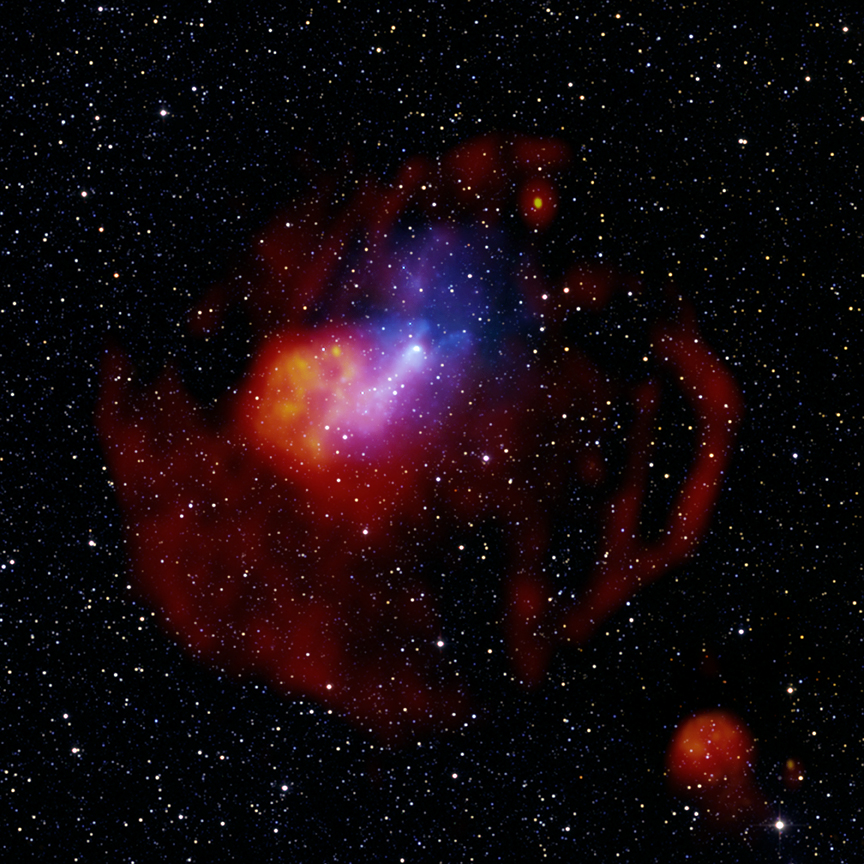
G327.1-1.1 is the aftermath of a massive star that exploded as a supernova in the Milky Way galaxy. A highly magnetic, rapidly spinning neutron star called a pulsar was left behind after the explosion and is producing a wind of relativistic particles, seen in X-rays by Chandra and XMM-Newton (blue) as well as in the radio data (red and yellow). This structure is called a pulsar wind nebula. The likely location of the spinning neutron star is shown in the labeled version. The large red circle shows radio emission from the blast wave, and the composite image also contains infrared data from the 2MASS survey (red, green, and blue) that show the stars in the field.

No clear explanation is yet known for the unusual nature of G327.1-1.1, including the off-center position of the pulsar wind nebula seen in the radio data and the comet-like shape of the X-ray emission. One possibility is that we are seeing the effects of a shock wave bouncing backwards off of the shell of material swept up by the blast wave produced by the explosion, the so-called "reverse shock" from the blast wave. The pulsar is moving upwards, away from the center of the explosion, but the pulsar wind nebula is being swept towards the bottom-left of the image by the reverse shock wave that is also traveling towards the bottom-left. The direction of the pulsar's motion and of the reverse shock are shown in the labeled version.

Labeled Version - G327.1-1.1
Credit X-ray: NASA/CXC/SAO/T.Temim et al.
and ESA/XMM-Newton Radio: SIFA/MOST and CSIRO/ATNF/ATCA;
Infrared: UMass/IPAC-Caltech/NASA/NSF/2MASS

The X-ray observations allow scientists to estimate the energy released during the supernova explosion and the age of the remnant, as well as the amount of material being swept up as the blast wave from the explosion expands. The faint bubble that the pulsar appears to be creating may also be revealing the fresh pulsar wind being blown into the region cleared out by the reverse shock.

A paper describing these results appeared in The Astrophysical Journal in February 2009 with Tea Temim of the Harvard-Smithsonian Center for Astrophysics (CfA), Patrick Slane (CfA), Bryan Gaensler (University of Sydney), Jack Hughes (Rutgers) and Eric Van Der Swaluw (Royal Netherlands Meterological Institute) as authors.

Fast Facts for G327.1-1.1:

Scale: Image is 25 arcmin on a side (211 light years on a side)
Category: Supernovas & Supernova Remnants, Neutron Stars/X-ray Binaries
Coordinates; (J2000) RA 15h 54m 25.0s | Dec -55° 04' 06.0''
Constellation: Norma
Observation Date: 07/15/2001
Observation; Time: 14 hours
Obs. ID: 1955
Color Code: X-ray (Blue); Radio [MOST] (Red); Radio [ATCA] (Yellow); Infrared (RGB)
Instrument: ACIS
References: Temim, T, et al, 2009, ApJ 691:895-906
Distance Estimate: 29000 light years

Saturday, October 09, 2010

NASA Mission to Asteroid Gets Help from Hubble Space Telescope

Asteroid Vesta Credit: NASA, ESA, and J.-Y. Li (University of Maryland,
College Park),
and L. McFadden (NASA GSFC)

WASHINGTON — NASA's Hubble Space Telescope has captured images of the large asteroid Vesta that will help scientists refine plans for the Dawn spacecraft's rendezvous with Vesta in July 2011.

Scientists have constructed a video from the images that will help improve pointing instructions for Dawn as it is placed in a polar orbit around Vesta. Analyses of Hubble images revealed a pole orientation, or tilt, of approximately four degrees more to the asteroid's east than scientists previously thought.

This means the change of seasons between the southern and northern hemispheres of Vesta may take place about a month later than previously expected while Dawn is orbiting the asteroid. The result is a change in the pattern of sunlight expected to illuminate the asteroid. Dawn needs solar illumination for imaging and some mapping activities.

"While Vesta is the brightest asteroid in the sky, its small size makes it difficult to image from Earth," said Jian-Yang Li, a scientist participating in the Dawn mission from the University of Maryland in College Park. "The new Hubble images give Dawn scientists a better sense of how Vesta is spinning because our new views are 90 degrees different from our previous images. It's like having a street-level view and adding a view from an airplane overhead."

The recent images were obtained by Hubble's Wide Field Camera 3 in February. The images complemented previous ones of Vesta taken from ground-based telescopes and Hubble's Wide Field and Planetary Camera 2 between 1983 and 2007. Li and his colleagues looked at 216 new images — and a total of 446 Hubble images overall — to clarify how Vesta was spinning. The journal Icarus recently published the report online.

"The new results give us food for thought as we make our way toward Vesta," said Christopher Russell, Dawn's principal investigator at the University of California, Los Angeles. "Because our goal is to take pictures of the entire surface and measure the elevation of features over most of the surface to an accuracy of about 33 feet, or the height of a three-story building, we need to pay close attention to the solar illumination. It looks as if Vesta is going to have a late northern spring next year, or at least later than we planned."

Launched in September 2007, Dawn will leave Vesta to encounter the dwarf planet Ceres in 2015. Vesta and Ceres are the most massive objects in the main asteroid belt between Mars and Jupiter. Scientists study these celestial bodies as examples of the building blocks of terrestrial planets like Earth. Dawn is approximately 134 million miles away from Vesta. Next summer, the spacecraft will make its own measurements of Vesta's rotating surface and allow mission managers to pin down its axis of spin.

"Vesta was discovered just over 200 years ago, and we are excited now to be on the threshold of exploring it from orbit," said Bob Mase, Dawn's project manager at NASA's Jet Propulsion Laboratory (JPL) in Pasadena, Calif. "We planned this mission to accommodate our imprecise knowledge of Vesta. Ours is a journey of discovery and, with our ability to adapt, we are looking forward to collecting excellent science data at our target."

The Dawn mission is managed by JPL for NASA's Science Mission Directorate at the agency's headquarters in Washington. Orbital Sciences Corporation of Dulles, Va., designed and built the spacecraft. Several international space organizations are part of the mission team.

To see the Vesta images and video, visit:

http://www.nasa.gov/mission_pages/dawn/multimedia/vestavid20101008.html
http://hubblesite.org/news/2010/33

To learn more about Dawn and its mission to the asteroid belt, visit:

http://www.nasa.gov/dawn

The Hubble Space Telescope is a project of international cooperation between NASA and the European Space Agency. NASA's Goddard Space Flight Center manages the telescope. The SpaceTelescope Science Institute (STScI) conducts Hubble science operations. STScI is operated for NASA by the Association of Universities for Research in Astronomy, Inc., in Washington, D.C.

Contact

Dwayne Brown
Headquarters, Washington
202-358-1726
dwayne.c.brown@nasa.gov

Jia-Rui Cook / D.C. Agle
Jet Propulsion Laboratory, Pasadena, Calif.
818-354-0850/393-9011
jia-rui.c.cook@jpl.nasa.gov / david.c.agle@jpl.nasa.gov

Ray Villard
Space Telescope Science Institute, Baltimore
410-338-4514
villard@stsci.edu

Thursday, October 07, 2010

Ground-Based Images of Asteroid Lutetia Complement Spacecraft Flyby

Fig 1. Adaptive optics images of asteroid (21) Lutetia obtained at the W.M. Keck Observatory. Here Lutetia is shown at 10 different times during the night of 2008 Dec 2 UT, plus other times. Here the scale is shown in arcseconds, a measure of angular size. These images have been processed (deconvolved) to enhance clarity. The light and dark markings across the surface are artifacts of the processing and are not real. The changing outline of the asteroid, not any surface markings, is used to derive the asteroid shape. Credit: Dr. Benoit Carry (Paris Observatory), Dr. Al Conrad (Keck Observatory), and Dr. William Merline (Southwest Research Institute)

The W. M. Keck Observatory operates two 10-meter optical/infrared telescopes on the summit of Mauna Kea on the island of Hawai’i and is a scientific partnership of the California Institute of Technology, the University of California and NASA. Credit: Credit: Pablo McLoud/WMKO

Kamuela, HI, Oct. 7, 2010 - The European Space Agency (ESA) Rosetta spacecraft recently beamed back to Earth a dramatic set of close-up images as it flew past the asteroid Lutetia, on its way to a comet rendezvous in 2014. But even before Rosetta made its close encounter with the 100-kilometer sized asteroid, astronomers using three of the world’s largest telescopes, including the W. M. Keck Observatory, were busy making their own assessment of the asteroid’s shape and size, as well as searching for its satellites. Their pre-flyby images are being compared this week with those from Rosetta at a meeting of the Division for Planetary Sciences of the American Astronomical Society in Pasadena, California, revealing that the ground-based images are amazingly accurate.

These telescopes all use adaptive optics (AO), which moves the blurring caused by the Earth’s atmosphere. Using something like a fun-house mirror in reverse, AO allows clear pictures to be made, from Earth’s surface, of distant astronomical objects that were impossible to see previously. “Adaptive optics has set in motion an astronomical revolution, bringing new worlds into better view, ranging from asteroids that were previously unresolved pinpoints of light, to the discovery of new planets in other solar systems,” said Dr. William Merline of Southwest Research Institute (SwRI) in Boulder, Colorado, lead scientist of the international team that made the observations, funded by NASA and the National Science Foundation. Two of the telescopes are atop Mauna Kea in Hawaii: the W.M. Keck telescope with its 10-meter mirror and the Gemini telescope, equipped with an 8-meter mirror. The 8-meter Very Large Telescope (VLT) of the European Southern Observatory in Chile was also used.

“We carefully evaluated the size and shape of Lutetia, and pinned down the orientation of its spin pole using telescopes on Earth, prior to the flyby,” reported Dr. Jack Drummond, an astronomer at Starfire Optical Range in Albuquerque, New Mexico, where AO was first developed in the early 1990s and can be considered the cradle of adaptive optics. Drummond is an expert in turning AO images into models of asteroids, detailing their shapes and sizes. He is the lead author on the first of two papers predicting the appearance of Lutetia, which are now in press in the journal Astronomy and Astrophysics. Drummond adds, “after the many years developing these techniques at Starfire, it is gratifying to see how well they work when put to this kind of test.”

Rosetta’s Lutetia encounter provided a rare chance to combine the strengths of spacecraft and ground-based approaches to understand the complex shapes and elusive sizes of asteroids. For decades, astronomers watched Lutetia change brightness as it rotates. Before adaptive optics, such “lightcurve” studies were the only way astronomers could infer the shape of a body like Lutetia. “A sphere will have a flat lightcurve, an egg will have a lightcurve that goes up and down smoothly like an ocean swell, but an irregular potato-shape will look like your EKG on a bad day!”, says Dr. Al Conrad of Keck Observatory, where many of the observations were made.

While lightcurves provide approximate shape, they cannot provide fine detail nor absolute scale. “AO has dramatically improved our ability to determine asteroid shapes from the ground by providing both of these missing ingredients,” said team member Dr. Benoit Carry of Paris Observatory, who led the efforts to produce the “shape model”, derived by combining AO images with decades of lightcurve observations taken on smaller telescopes. “We dubbed this new technique KOALA, for Knitted Occultation Adaptive Optics, and Lightcurve Analysis. With it, we can make much improved use of our own data and of previous studies,” adds Carry, who leads the second paper and worked to develop KOALA in collaboration with Dr. Mikko Kaasalainen of Tampere University, Finland. The results were provided to the Rosetta mission teams ahead of the flyby to assist in planning.

Such ground-based imaging can help prepare for spacecraft flybys in other ways as well. “We determined that the spin pole of the asteroid was highly inclined, and almost in its orbital plane, much like that of Uranus,” says Carry. “We predicted that Rosetta would see only the northern hemisphere and that the southern hemisphere would be dark and cold,” he said --- predictions borne out by the flyby data.

“This encounter enables us to verify, validate, and calibrate our method of combining AO data with lightcurve studies,” noted Merline. “Our goal is to apply this technique to many other asteroids to find their sizes and shapes. The validation from these flyby images gives us confidence that we can do so. We can observe about 200 asteroids in this manner now, and that number will increase as larger telescopes are built,” he adds.

“The tremendous power of the Keck telescope, when coupled with AO, is demonstrated superbly in the Lutetia data,” says Conrad. Because asteroids have no active geology, such as volcanoes or tectonics, their shapes result from collision with other, smaller, asteroids. “Details of shape, such as flat facets or apparent concavities, help reveal the history of asteroid collisions,” he adds. The importance of collisions can be seen in the crater-marked surface of the Moon, reminding us that asteroids continue to pose a threat to Earth.

The AO images from large telescopes, used in concert with lightcurves and the spacecraft images, go beyond validation, however. By combining all data, Lutetia’s shape could be accurately determined, allowing astronomers to compute its volume. Moreover, measurements of the gravitational tug from Lutetia on the spacecraft as it flew past the asteroid will yield a very accurate mass. Mass and volume, taken together, will provide the density of Lutetia. Density is the concept of how much something weighs for its size. For example, two wrapped birthday gifts of the same size, one of Styrofoam™ and one of lead, would invoke very different speculations from a recipient. Asteroid compositions could potentially span the full range from ice to rock to iron. Different compositions of an asteroid could be distinguished by different densities. Astronomers use this “birthday present” approach, combined with information from studies of the brightness and color of the surface, to infer the type of rock (or ice or metal) that makes up an asteroid.

Lutetia was first categorized as an M-type asteroid in the 1970s by team member Dr. Clark Chapman, also of SwRI. “Some people think that M-type asteroids must be metallic, but it has always been known that some might be rocky, like the so-called enstatite chondrite meterorites,” says Chapman. “While Lutetia is not metallic, its composition is still a mystery and it may even be unlike anything we have in our meteorite collections. We hope that getting an accurate density will help us answer this question,” he says. The spacecraft data will be combined with past and future ground-based observations, and the secret of Lutetia’s composition may be revealed in
the coming months.

In addition to studying its size and shape, the scientists also searched for satellites of Lutetia, but none were found. “We wanted to know if satellites were present because they would at the same time provide new objects for study during the flyby, but would also pose a risk to the spacecraft that could be avoided with prior knowledge,” says Merline.

The W. M. Keck Observatory operates two 10-meter optical/infrared telescopes on the summit of Mauna Kea. The twin telescopes feature a suite of advanced instrumentation including imagers, multi-object spectrographs, high-resolution spectrographs, integral-field spectroscopy and a world-leading laser guide star adaptive optics system. The Observatory is a private 501(c) 3 organization and a scientific partnership of the California Institute of Technology, the University of California and NASA.

Hubble Astronomers Uncover an Overheated Early Universe

History of the Universe
This diagram traces the evolution of the universe from the big bang to the present. Two watershed epochs are shown. Not long after the big bang, light from the first stars burned off a fog of cold hydrogen in a process called reionization. At a later epoch quasars, the black-hole-powered cores of active galaxies, pumped out enough ultraviolet light to reionize the primordial helium. Credit: NASA, ESA, and A. Feild (STScI). Release Images
Helium Reionization in the Early Universe
This ultraviolet-light data from the Hubble Space Telescope's Cosmic Origins Spectrograph shows strong helium II absorption and transmission lines from a quasar, identifying an era 11.7 to 11.3 billion years ago when electrons were stripped from primeval helium atoms — a process called reionization. Object Names: HE 2347-4342, QSO B2347-4342. Credit: Shull et al., ApJ, 722: 1312-1324, October 20, 2010 .

If you think global warming is bad, 11 billion years ago the entire universe underwent, well, universal warming.

The consequence was that fierce blasts of radiation from voracious black holes stunted the growth of some small galaxies for a stretch of 500 million years.

This is the conclusion of a team of astronomers who used the new capabilities of NASA's Hubble Space Telescope to probe the invisible, remote universe.

Using the newly installed Cosmic Origins Spectrograph (COS) they have identified an era, from 11.7 to 11.3 billion years ago, when the universe stripped electrons off from primeval helium atoms — a process called ionization. This process heated intergalactic gas and inhibited it from gravitationally collapsing to form new generations of stars in some small galaxies. The lowest-mass galaxies were not even able to hold onto their gas, and it escaped back into intergalactic space.

Michael Shull of the University of Colorado and his team were able to find the telltale helium spectral absorption lines in the ultraviolet light from a quasar — the brilliant core of an active galaxy. The quasar beacon shines light through intervening clouds of otherwise invisible gas, like a headlight shining through a fog. The beam allows for a core-sample probe of the clouds of gas interspersed between galaxies in the early universe.

The universe went through an initial heat wave over 13 billion years ago when energy from early massive stars ionized cold interstellar hydrogen from the big bang. This epoch is actually called reionization because the hydrogen nuclei were originally in an ionized state shortly after the big bang.

But Hubble found that it would take another 2 billion years before the universe produced sources of ultraviolet radiation with enough energy to do the heavy lifting and reionize the primordial helium that was also cooked up in the big bang.

This radiation didn't come from stars, but rather from quasars. In fact the epoch when the helium was being reionized corresponds to a transitory time in the universe's history when quasars were most abundant.

The universe was a rambunctious place back then. Galaxies frequently collided, and this engorged supermassive black holes in the cores of galaxies with infalling gas. The black holes furiously converted some of the gravitational energy of this mass to powerful far-ultraviolet radiation that would blaze out of galaxies. This heated the intergalactic helium from 18,000 degrees Fahrenheit to nearly 40,000 degrees. After the helium was reionized in the universe, intergalactic gas again cooled down and dwarf galaxies could resume normal assembly. "I imagine quite a few more dwarf galaxies may have formed if helium reionization had not taken place," said Shull.

So far Shull and his team only have one sightline to measure the helium transition, but the COS science team plans to use Hubble to look in other directions to see if the helium reionization uniformly took place across the universe.

The science team's results will be published in the October 20 issue of The Astrophysical Journal.

Contact

Ray Villard
Space Telescope Science Institute, Baltimore, Md.
410-338-4514
villard@stsci.edu

Jim Scott
University of Colorado, Boulder, Colo.
303-492-3114
jim.scott@colorado.edu

Michael Shull
University of Colorado, Boulder, Colo.
303-492-7827
michael.shull@colorado.edu

Wednesday, October 06, 2010

VISTA Reveals the Secret of the Unicorn

PR Image eso1039a
Infrared VISTA view of a stellar nursery in Monoceros

PR Image eso1039b
Infrared/visible light comparison of views of a stellar nursery in Monoceros

PR Image eso1039c
Extracts from the VISTA image of the Monoceros R2 star forming region

PR Image eso1039d
Star formation in the constellation of Monoceros

PR Image eso1039e
Wide-field view of the field around Monoceros R2

PR Video eso1039a
Zooming in on a stellar nursery in Monoceros

PR Video eso1039b
Infrared/visible crossfade of the Monoceros R2 star-forming region

A new infrared image from ESO’s VISTA survey telescope reveals an extraordinary landscape of glowing tendrils of gas, dark clouds and young stars within the constellation of Monoceros (the Unicorn). This star-forming region, known as Monoceros R2, is embedded within a huge dark cloud. The region is almost completely obscured by interstellar dust when viewed in visible light, but is spectacular in the infrared.

An active stellar nursery lies hidden inside a massive dark cloud rich in molecules and dust in the constellation of Monoceros. Although it appears close in the sky to the more familiar Orion Nebula it is actually almost twice as far from Earth, at a distance of about 2700 light-years. In visible light a grouping of massive hot stars creates a beautiful collection of reflection nebulae where the bluish starlight is scattered from parts of the dark, foggy outer layers of the molecular cloud. However, most of the new-born massive stars remain hidden as the thick interstellar dust strongly absorbs their ultraviolet and visible light.

In this gorgeous infrared image taken from ESO’s Paranal Observatory in northern Chile, the Visible and Infrared Survey Telescope for Astronomy (VISTA [1], eso0949) penetrates the dark curtain of cosmic dust and reveals in astonishing detail the folds, loops and filaments sculpted from the dusty interstellar matter by intense particle winds and the radiation emitted by hot young stars.

“When I first saw this image I just said ‘Wow!’ I was amazed to see all the dust streamers so clearly around the Monoceros R2 cluster, as well as the jets from highly embedded young stellar objects. There is such a great wealth of exciting detail revealed in these VISTA images,” says Jim Emerson, of Queen Mary, University of London and leader of the VISTA consortium.

With its huge field of view, large mirror and sensitive camera, VISTA is ideal for obtaining deep, high quality infrared images of large areas of the sky, such as the Monoceros R2 region. The width of VISTA’s field of view is equivalent to about 80 light-years at this distance. Since the dust is largely transparent at infrared wavelengths, many young stars that cannot be seen in visible-light images become apparent. The most massive of these stars are less than ten million years old.

The new image was created from exposures taken in three different parts of the near-infrared spectrum. In molecular clouds like Monoceros R2, the low temperatures and relatively high densities allow molecules to form, such as hydrogen, which under certain conditions emit strongly in the near infrared. Many of the pink and red structures that appear in the VISTA image are probably the glows from molecular hydrogen in outflows from young stars.

Monoceros R2 has a dense core, no more than two light-years in extent, which is packed with very massive young stars, as well as a cluster of bright infrared sources, which are typically new-born massive stars still surrounded by dusty discs. This region lies at the centre of the image, where a much higher concentration of stars is visible on close inspection and where the prominent reddish features probably indicate emission from molecular hydrogen.

The rightmost of the bright clouds in the centre of the picture is NGC 2170, the brightest reflection nebula in this region. In visible light, the nebulae appear as bright, light blue islands in a dark ocean, while in the infrared frenetic factories are revealed in their interiors where hundreds of massive stars are coming into existence. NGC 2170 is faintly visible through a small telescope and was discovered by William Herschel from England in 1784.

Stars form in a process that typically lasts few million years and which takes place inside large clouds of interstellar gas and dust, hundreds of light-years across. Because the interstellar dust is opaque to visible light, infrared and radio observations are crucial in the understanding of the earliest stages of the stellar evolution. By mapping the southern sky systematically, VISTA will gather some 300 gigabytes per night, providing a huge amount of information on those regions that will be studied in greater detail by the Very Large Telescope (VLT), the Atacama Large Millimeter/submillimeter Array (ALMA) and, in the future, by the European Extremely Large Telescope (E-ELT).

Notes

[1] With its 4.1-metre primary mirror, VISTA is the largest survey telescope in the world and is equipped with the largest infrared camera on any telescope, with 67 million pixels. It is dedicated to sky surveys, which began early in 2010. Located on a peak next to Cerro Paranal, the home of the ESO VLT in northern Chile, VISTA shares the same exceptional observing conditions. Due to the remarkable quality of the sky in this area of the Atacama Desert, one of the driest sites on Earth, Cerro Armazones, located only 20 km away from Cerro Paranal, has been recently selected as the site for the future E-ELT.

More information

ESO, the European Southern Observatory, is the foremost intergovernmental astronomy organisation in Europe and the world’s most productive astronomical observatory. It is supported by 14 countries: Austria, Belgium, the Czech Republic, Denmark, France, Finland, Germany, Italy, the Netherlands, Portugal, Spain, Sweden, Switzerland and the United Kingdom. ESO carries out an ambitious programme focused on the design, construction and operation of powerful ground-based observing facilities enabling astronomers to make important scientific discoveries. ESO also plays a leading role in promoting and organising cooperation in astronomical research. ESO operates three unique world-class observing sites in Chile: La Silla, Paranal and Chajnantor. At Paranal, ESO operates the Very Large Telescope, the world’s most advanced visible-light astronomical observatory and VISTA, the world’s largest survey telescope. ESO is the European partner of a revolutionary astronomical telescope ALMA, the largest astronomical project in existence. ESO is currently planning a 42-metre European Extremely Large optical/near-infrared Telescope, the E-ELT, which will become “the world’s biggest eye on the sky”.

Links

The VISTA telescope

Contacts

Richard Hook
ESO, Paranal, La Silla, E-ELT and Survey Telescopes Public Information Officer
Garching bei München, Germany
Tel: +49 89 3200 6655
Email: rhook@eso.org

The Outbursts of Fornax

A false color image of the radio-wavelength emitting lobes in the galaxy Fornax A. This hot gas spans a distance of over one million light years. A new paper by CfA astronomers suggests that they are caused by the collision of another galaxy with Fornax in which dust and gas from the neighbor ends up triggering jets from the black hole at the galaxy's nucleus. Credit: Ed Fomalont (NRAO) et al., VLA, NRAO, AUI, NSF

The galaxy Fornax A, at a distance of about 74 million light-years, is one of the nearest and brightest galaxies with giant radio lobes. These huge radio lobes -- they span a million light-years -- are immense reservoirs of hot gas glowing brightly at radio wavelengths. They are thought to have been generated by oppositely-pointed jets of particles streaming out from the galaxy's supermassive black hole. A collision between Fornax and a smaller galaxy may have swept material towards the black hole, creating the jets that in turn so brightly illuminate the ambient material. Exactly how this process occurs, however, is not known, in part because the black hole is obscured deep inside the galaxy's nuclear region. We still do not know, for example, whether the outbursts are one-time events, as perhaps is suggested by the collision scenario, or whether they recur, and on what timescales.

CfA graduate student Lauranne Lanz, together with CfA astronomers Christine Jones, Bill Forman, Matt Ashby, Ralph Kraft, and Ryan Hickox, combined the radio images of Fornax A with infrared images from the Spitzer Space Telescope and X-ray images from the Chandra X-ray Observatory and the XMM-Newton X-ray satellite to help answer some of the puzzles around these dramatic lobes. By carefully modeling and then subtracting the starlight seen in the Spitzer images, the scientists were able to reveal excess dust emission around the nuclear region, and moreover show that the dust lies in two irregular arcs sweeping across about ten thousand light-years. The existence of that infrared dust emission is puzzling: Fornax A is a type of galaxy thought to be relatively dust-free.

When combined with X-ray and radio information for the same locations, however, the dust enabled the astronomers to construct a more complete picture of what is going on. Most likely the galaxy collided about 400 million years ago with a gas-rich neighbor -- one having 2-3 times the gas in Fornax A itself -- but with many fewer stars (perhaps only 10%). The dust comes from the neighboring galaxy; the collision also helped to funnel gas from the neighbor and trigger the outburst from the black hole. The geometry of the nuclear region, and the presence of two X-ray cavities, further suggest that unless there are some nuclear regions still undetected in the radio, which is a possibility, there were likely to have been not one but two outbursts during the past 400 million years that contributed to the structures observed. The new paper helps to unravel the mysterious origins of these dramatic radio lobes, and also highlights the importance of multiwavelength observations.

Destroyer of Worlds

An optical image of a ring of dust, possibly in the process of forming planets, around a nearby young star; the bright star itself has been masked out. New results from infrared studies suggest even old stars can generate dusty rings by triggering destructive collisions between bodies orbiting around them. Credit: NASA/Hubble Space Telescope

Astronomers, in addition to discovering extrasolar planets (about 500 of them currently have known orbital parameters), have detected excess, warm infrared dust emission around many stars. This emission, first spotted by the Infrared Astronomy Satellite (IRAS) in the 1980's, appears to come from small particles in disks around the stars that might be in the early stages of planet formation. In some cases, models of the dust temperature and spatial distribution suggest that the disk has a gap, perhaps excavated by a planet at the appropriate orbital distance.

Since planets are made from circumstellar materials, the dust rings in very young systems could be remnants of the planet building process. That dust, however, is thought to disappear after only a few hundred million years; when it is seen in older stellar systems, astronomers surmise, it must have been somehow replenished. One popular scenario is that planets or asteroids in the system collide and fragment, thereby generating the dust. Very old stars, however, (ones that are about a billion years old or more, the sun being about 4.5 billion years old) should not have warm dust according to this reasoning. Those stellar systems should have stabilized, and the time for such collisions should have long past. It is a problem, then, that warm dust is seen around some very old stars. Moreover, since any newly made dust will also rapidly dissipate, there must be some mechanism that regularly regenerates it. Astronomers trying to piece together a coherent history of planet formation and evolution are trying to figure out the answers to these questions.

SAO astronomers Marco Matranga, Jeremy Drake, Vinay Kashyap, and Research Associate Massimo Marengo, together with a colleague, suggest an answer for one set of stars in this puzzle. They used the Spitzer Space Telescope to study the excess warm infrared emission around three evolved stellar systems, each of which is a binary with two stars in close orbits. The measured infrared emission can be as much as 1.9% of the total emission of these systems. They note that the binary stars are known to be magnetically active (surface sun-spots are detected in their atmosphere), and they argue that magnetic fields interacting with winds can induce changes in the binary stars' orbits. These changes can in turn disrupt the overall stability of the system and trigger new collisions between bodies in orbit around the stars, with the consequent production of new dust. In effect, these binary stars are destroyers of the worlds in orbit around them, worlds that otherwise had survived for a billion years. Besides helping to resolve one long-standing puzzle, the new paper points to the complex nature of stellar planetary system, and the importance of multi-wavelength data analyses.

Tuesday, October 05, 2010

WISE Captures Key Images of Comet Mission's Destination

This visitor from deep space, seen here by NASA's Wide-field Infrared Survey Explorer, or WISE, is comet Hartley 2 -- the destination for NASA's EPOXI mission. Image credit: NASA/JPL-Caltech/UCLA. Full image and caption

Compass and Scale Image for Comet 103/P Hartley 2
Illustration Credit: NASA, ESA, and Z. Levay (STScI)
Science Credit: NASA, ESA, and H. Weaver
(The Johns Hopkins University/Applied Physics Lab

PASADENA, Calif. -- NASA's Wide-field Infrared Survey Explorer, or WISE, caught a glimpse of the comet that the agency's EPOXI mission will visit in November. The WISE observation will help the EPOXI team put together a large-scale picture of the comet, known as Hartley 2.

"WISE's infrared vision provides data that complement what EPOXI will see with its visible-light and near-infrared instruments," said James Bauer, of NASA's Jet Propulsion Laboratory, Pasadena, Calif. "It's as if WISE can see an entire country, and EPOXI will visit its capital."

WISE's infrared vision will allow the telescope to get a new estimate of the size of the comet's nucleus, or core, as well as a more thorough look at the sizes of dust particles that surround it. This information, when combined with what EPOXI finds as it gets closer to Hartley 2, will reveal how the comet has changed over time.

The WISE image is available at: http://photojournal.jpl.nasa.gov/catalog/PIA13438.

On Nov. 4, the EPOXI mission, which uses the already "in flight" Deep Impact flyby spacecraft, will reach its closet approach to Hartley 2. The spacecraft will examine the dusty, icy body in detail as it flies by, providing the best, extended view of a comet in history. WISE and several other ground- and space-based telescopes are participating in the viewing, working together to tackle mysteries about our solar system's origins that are frozen inside comets.

For stargazers, opportunities to view the comet are possible throughout October. On Wednesday, Oct. 20, Hartley 2 will reach its closest approach to Earth since it was discovered in 1986. The comet will be approximately 17.7 million kilometers away (11 million miles) and should be visible with the naked eye near the constellation Perseus if viewed in dark skies. Observers will need binoculars or telescopes from urban areas in the Northern Hemisphere. Southern Hemisphere stargazers will be able to see the comet later in the month.

WISE captured its view of the comet during an ongoing scan of the sky in infrared light. The mission has been busy cataloging hundreds of millions of objects, from comets to distant, powerful galaxies. In late September, it used up its frozen cryogen coolant as expected and began a new phase of its survey. Called the NEOWISE Post-Cryogenic Mission, it primarily focuses on finding additional asteroids and comets. To date, the WISE mission has observed more than 150,000 asteroids and 110 comets, including Hartley 2.

"Astronomers can reference our catalogue to get detailed infrared data about their favorite asteroid or comet," said Amy Mainzer, the principal investigator of NEOWISE at JPL. "Space missions can also use our observations for more information on their targets, as EPOXI is doing."

WISE's view of Hartley 2 was taken on May 10, 2010. It gives astronomers a unique look at the comet, complementing what other telescopes can see. Because WISE scanned the whole sky, it captured the most extensive view of Hartley 2's trail, the dusty path left by the comet on its repeated journey around the sun.

Bauer said, "We want to know how the comet behaves as it comes toward the sun and out of deep freeze. The WISE image is one critical puzzle piece of many that will give a comprehensive view of the behavior of the comet through the time of the encounter."

The comet started to show signs of activity in the spring, spitting out gas and dust. By July, there were clear jets of gas. "Comparing the dust early on to what we see later with EPOXI helps us understand how the activity started on Hartley 2," said Michael A'Hearn, the principal investigator of EPOXI at the University of Maryland in College Park.

The term EPOXI is a combination of the names for the two extended mission components: the Extrasolar Planet Observations and Characterization (EPOCh), and the Hartley 2 flyby, called the Deep Impact eXtended Investigation (DIXI). The name NEOWISE comes from combining WISE and the acronym for near-Earth object, NEO.

More information about EPOXI is at: http://www.nasa.gov/epoxi and http://epoxi.umd.edu/.

More information about WISE is at: http://www.nasa.gov/wise and http://wise.astro.ucla.edu/ .

JPL, a division of the California Institute, manages WISE and EPOXI for NASA.

Whitney Clavin 818-354-4673
Jet Propulsion Laboratory, Pasadena, Calif.
whitney.clavin@jpl.nasa.gov

J.D. Harrington 202-358-5241
NASA Headquarters, Washington
j.d.harrington@nasa.gov