Showing posts with label P/2010 A2. Show all posts

Thursday, June 29, 2017

Korean Astronomers Dissect a Fragmented Asteroid

Figure 1. Rotational light curve of the largest fragment of P/2010 A2. Time-series g’-band photometry over two nights (upper panel) and phase based on the best-fit double-peaked period of 11.36 hr (lower panel). A sine curve with a period of 11.36 hr was plotted in the upper panel (gray line). 

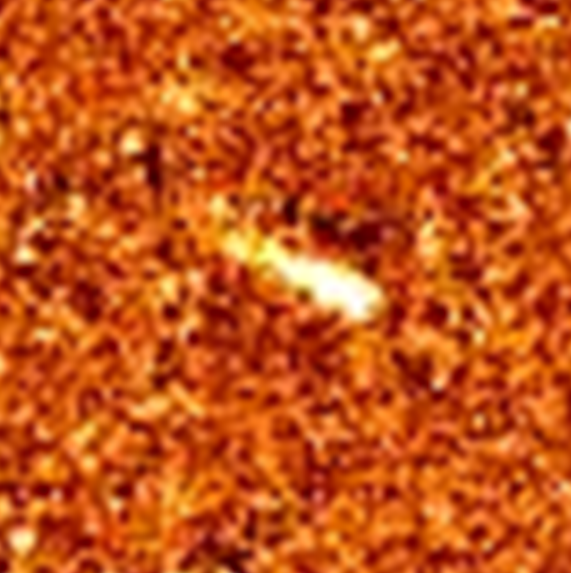
Figure 2. Composite image of asteroid P/2010 A2 constructed from data from the Gemini Multi-Object Spectrograph on Gemini North. The team used this data to compare against models of the object’s structure and dynamics.


A team of Korean astronomers uses imaging from the Gemini Multi-Object Spectrograph (GMOS) on Gemini North to characterize the rotation of active asteroid P/2010 A2’s largest fragment. The observations show that this faint and tiny (about the size of an American football field) asteroid, which underwent a mass ejection episode, is slowly rotating, indicative of an impact fragmentation rather a rotational breakup.

In January 2017, the active and fragmented main belt asteroid P/2010 A2 (hereafter A2) made its closest approach to the Earth after its 2010 discovery, when it exhibited a mysterious comet-like dust trail. Prior to this year’s passage, the fragments had not yet been characterized, due to the extremely small size (~120 meters in diameter) and faintness of this object. A Korean team, led by Yoonyoung Kim of Seoul National University, received time on Gemini North to observe the object’s 2017 close passage when the fragments and associated debris swarm were just over one astronomical unit away. 

According to Kim, a variety of hypotheses have been suggested to explain the history of this body, including rotational breakup, impact cratering, or shattering. The team determined a rotation period ~11.36 hours for the largest fragment. If the fragment’s spin period has been constant after the mass ejection, which Kim says is reasonable to believe, then it fails to meet the critical spin rate for rotational breakup. The observations also reveal that the largest fragment has a highly-elongated shape with about a 2:1 ratio. Looking at the size distributions of the ejecta and other fragments, the team concludes that the body likely underwent impact shattering in order to produce the observed morphology. 

The study’s light curve is shown in Figure 1 and presents the largest fragment’s double-peaked period of 11.36 +/- 0.02 hours. Figure 2 presents a composite from the imaging data revealing the array of fragments and debris used to determine the mass of the largest fragment is about 80% of the system’s mass with the other fragments and ejecta making up the remaining 20%. All figures are from the accepted paper scheduled for publication in The Astrophysical Journal Letters. A preprint is available here. 

Paper Abstract:
 

We report new observations of the active asteroid P/2010 A2 taken when it made its closest approach to the Earth (1.06 au in 2017 January) after its first discovery in 2010. Despite a crucial role of the rotational period in clarifying its ejection mechanism, the rotational property of P/2010 A2 has not yet been studied due to the extreme faintness of this tiny object (∼120 m in diameter). Taking advantage of the best observing geometry since the discovery, we succeed in obtaining the rotational light curve of the largest fragment with Gemini/GMOS-N. We find that (1) the largest fragment has a double-peaked period of 11.36±0.02 hr spinning much slower than its critical spin period; (2) the largest fragment is a highly elongated object (a/b⩾1.94) with an effective radius of 61.9+16.8−9.2 m; (3) the size distribution of the ejecta follows a broken power law (the power indices of the cumulative size distributions of the dust and fragments are 2.5±0.1 and 5.2±0.1, respectively); (4) the mass ratio of the largest fragment to the total ejecta is around 0.8; and (5) the dust cloud morphology is in agreement with the anisotropic ejection model in Kim et al. These new characteristics of the ejecta obtained in this work are favorable to the impact shattering hypothesis. 


Friday, October 22, 2010

When is a comet not a comet? Rosetta finds out

ESA's Rosetta sees the debris trail left by asteroid P/2010 A2 with its OSIRIS camera system. The picture was taken in March 2010. Credits: ESA / MPS for OSIRIS Team MPS/UPD/LAM/IAA/RSSD/INTA/UPM/DASP/IDA. HI-RES PNG (Size: 429 kb)

It was a case of celestial hit and run. Two asteroids, both in the wrong place at the wrong time. The result: one big trail of debris and a case of mistaken identity. Now, however, ESA’s comet-chaser Rosetta has unravelled the truth.

Using its OSIRIS camera, Rosetta made the breakthrough because it is far from Earth and so it could look at mystery object ‘P/2010 A2’ from a unique perspective. This showed that instead of being a comet, as first suspected, we are seeing the debris from a pair of colliding asteroids.

An automated survey telescope on Earth discovered P/2010 A2 in January 2010. It was immediately designated a comet because it has a tail – but calling it a comet never felt comfortable. It was located in the inner asteroid belt on a nearly circular orbit, whereas most comets move on giant elliptical paths that sweep them from the outer reaches of the Solar System down towards the Sun and out again.

Asteroid P/2010 A2 as seen by the camera system OSIRIS on ESA’s space probe Rosetta. The picture was taken in March 2010. Credits: ESA / MPS for OSIRIS Team MPS/UPD/LAM/IAA/RSSD/INTA/UPM/DASP/IDA. HI-RES JPEG (Size: 1337 kb)

Also, P/2010 A2 did not appear to possess a central condensation from which the tail grew – it was just a tail.

“We knew that we needed to look at P/2010 A2 from a different angle and Rosetta provided exactly that,” says Colin Snodgrass of the Max Planck Institute for Solar System Research in Germany.

Comparing the Rosetta images with those taken from Earth, computer modelling has now shown that the tail is not a continuous stream of ejected material, as would be the case for a comet. Instead, it was thrown into space in a single eruption.

The most likely cause would be a collision between two asteroids. If so, when did it happen?

Dr Snodgrass and colleagues found that the shape and size of the trail, as seen more clearly by Rosetta, allowed them to make a remarkably precise estimate for when the collision must have occurred.

They nailed down the date of the impact to within a ten-day window, centred around 10 February 2009, almost a year before its discovery.

“We are really quite confident about that date because of the quality of the data we used,” says Dr Snodgrass.

An international team, including Jessica Agarwal, a former ESA research fellow used the Hubble Space Telescope to resolve a single remaining asteroid, about 120 m across, at the head of the trail.

Using this in their computer modelling of the collision, Dr Snodgrass and colleagues found that the other asteroid was probably tiny, originally just a few metres across, and so was destroyed in the event.

“It is truly exciting to see an object that has been in a collision so recently,” says Rita Schulz, ESA Rosetta Project Scientist.

Such impacts are estimated to take place just once every billion years for each asteroid. But, as there are so many asteroids, there is likely to be a collision of this type every dozen years or so throughout the asteroid belt.

As technology improves, so surveys become more sensitive, and Dr Snodgrass expects the next generation of sky surveys to pick up collisions between even smaller asteroids every year.

“Asteroid P/2010 A2 could be a taste of things to come,” he says.

Artist's impression of the Rosetta Spacecraft
Credits: ESA - C. Carreau

Wednesday, October 13, 2010

Hubble Finds that a Bizarre X-Shaped Intruder Is Linked to an Unseen Asteroid Collision

Asteroid P/2010 A2
Credit: NASA, ESA, and D. Jewitt (UCLA)

Last January astronomers thought they had witnessed a fresh collision between two asteroids when images from NASA's Hubble Space Telescope revealed a bizarre X-shaped object at the head of a comet-like trail of material.

After using Hubble to track the oddball body for five months, astronomers were surprised to find that they had missed the suspected smashup by a year.

"We thought this event had just occurred," says astronomer David Jewitt of the University of California in Los Angeles and leader of the Hubble observations. "We expected the debris field to expand dramatically, like shrapnel flying from a hand grenade. So we rushed to apply for Hubble time to watch the aftermath. But what happened was quite the opposite. We found that the object is expanding very, very slowly and that it started not a week but nearly a year before our January observations."

By his calculation, the encounter happened in February or March 2009. Still, Jewitt is excited about the Hubble observations because they are the first snapshots of a suspected asteroid collision. Jewitt's results appear in the October 14 issue of the science journal Nature.

The peculiar object, dubbed P/2010 A2, was found cruising around the asteroid belt, a reservoir of millions of rocky bodies between the orbits of Mars and Jupiter. Encounters between asteroids are assumed to be common, and destructive. In fact, Jewitt estimates that modest-sized asteroids smash into each other roughly once a year. When the objects collide, they inject dust into interplanetary space. But until now, astronomers have relied on models to make predictions about the frequency of these collisions and the amount of dust produced.

"These observations are important because we need to know where the dust in the solar system comes from, and how much of it comes from colliding asteroids as opposed to 'outgassing' comets," Jewitt explains. "We can also apply this knowledge to the dusty debris disks around other stars, because these are thought to be produced by collisions between unseen bodies in the disks. Knowing how the dust was produced will yield clues about those invisible bodies."

The Hubble images, taken from January to May 2010 with Wide Field Camera 3, reveal a point-like object about 400 feet (120 meters) wide, with a long, flowing dust tail behind a never-before-seen X pattern. The observations also show that the object retained its X shape even as the debris field slowly expanded. Particle sizes in the tail are estimated to vary from about 1/25th of an inch (a millimeter) to an inch (2.5 centimeters) in diameter. P/2010 A2 was 102 million miles from Earth when Hubble first observed it in January 2010.

The 400-foot-wide object in the Hubble image is the remnant of a slightly larger precursor body. Astronomers think a smaller rock, perhaps 10 to 15 feet (3 to 5 meters) wide, slammed into the larger one. The pair probably collided at high speed, about 11,000 miles (18,000 kilometers) an hour, which smashed and vaporized the small asteroid and stripped material from the larger one. Jewitt estimates that the violent encounter was as powerful as the detonation of a small atomic bomb.

Radiation pressure from the Sun then swept the debris behind the remnant asteroid, forming a comet-like tail. The tail contains enough dust to make a ball 65 feet (20 meters) wide, most of it blown out of the bigger body by the impact-caused explosion.

The two asteroids were probably no strangers to collisions. They were themselves most likely relics from impacts between larger asteroids that occurred tens or hundreds of millions of years ago. This collisional grinding from large sizes down to small is thought to be one of the main processes by which asteroids are destroyed.

Astronomers do not have a good explanation for the X shape. The crisscrossed filaments at the head of the tail might suggest that the colliding asteroids were not perfectly symmetrical. Material ejected from the impact, therefore, did not make a symmetrical pattern, a bit like the ragged splash made by throwing a brick into a lake. Larger particles in the X disperse very slowly and give this structure its longevity.

Although the Hubble images give compelling evidence for an asteroid collision, Jewitt says he still does not have enough information to rule out all alternative ideas. In one such scenario, a small asteroid's rotation increases from sunlight pressure and loses mass, forming the comet-like tail.

Catching colliding asteroids is difficult, Jewitt says, because large impacts are rare while small ones, such as the one that produced P/2010 A2, are exceedingly faint. The two asteroids whose remains make up P/2010 A2 were unknown before the smashup because they were too faint to be noticed. The collision itself was unobservable because it happened when the asteroids were in the same direction as the Sun. About 10 or 11 months later, in January 2010, the Lincoln Near-Earth Research (LINEAR) Program Sky Survey spotted the comet-like tail produced by the collision. But only Hubble resolved the X pattern, offering unequivocal evidence that something stranger than a comet outgassing had occurred.

Jewitt is confident that future telescopes will find plenty of asteroid encounters. The planned Large Synoptic Survey Telescope (LSST) should spot dozens of asteroid collisions shortly after they happen, Jewitt says. The LSST is a wide-field survey observatory that will scan the sky weekly for transitory events such as supernovas and near-Earth asteroids.

Astronomers plan to use Hubble again in 2011 to view the remnant asteroid. Jewitt and his colleagues hope to see how far the dust has been swept back by the Sun's radiation and how the mysterious X-shaped structure has evolved.

CONTACT

Donna Weaver
Space Telescope Science Institute, Baltimore, Md.
410-338-4493
dweaver@stsci.edu

David Jewitt
University of California, Los Angeles, Calif.
310-825-2521
jewitt@ucla.edu

Tuesday, February 02, 2010

Suspected Asteroid Collision Leaves Odd X-Pattern of Trailing Debris

Credit: NASA, ESA, and D. Jewitt (UCLA)

NASA's Hubble Space Telescope has imaged a mysterious X-shaped debris pattern and trailing streamers of dust that suggest a head-on collision between two asteroids. Astronomers have long thought that the asteroid belt is being ground down through collisions, but such a smashup has never before been seen.

The comet-like object imaged by Hubble, called P/2010 A2, was first discovered by the LINEAR (Lincoln Near-Earth Asteroid Research program) sky survey on January 6. New Hubble images taken on January 25 and 29 show a complex X-pattern of filamentary structures near the nucleus.

"This is quite different from the smooth dust envelopes of normal comets," says principal investigator David Jewitt of the University of California at Los Angeles. "The filaments are made of dust and gravel, presumably recently thrown out of the nucleus. Some are swept back by radiation pressure from sunlight to create straight dust streaks. Embedded in the filaments are co-moving blobs of dust that likely originate from tiny unseen parent bodies."

Hubble also shows that the main nucleus of P/2010 A2 lies outside its own halo of dust. This has never before been seen in a comet-like object. The nucleus is estimated to be 460 feet (140 meters) in diameter.

Normal comets fall into the inner regions of the solar system from icy reservoirs in the Kuiper Belt and Oort Cloud. As comets near the Sun and warm, ices near the surface vaporize and eject material from the solid comet nucleus via jets. But P/2010 A2 may have a different origin. It orbits in the warm, inner regions of the asteroid belt where its nearest neighbors are dry rocky bodies lacking volatile materials.

This leaves open the possibility that the complex debris tail is the result of an impact between two bodies rather than ices from a parent body simply turning into vapor. Asteroid collisions are energetic, with an average impact speed over 11,000 miles per hour (5 km/s, or five times faster than a rifle bullet).

"If this interpretation is correct, two small and previously unknown asteroids recently collided, creating a shower of debris that is being swept back into a tail from the collision site by the pressure of sunlight," says Jewitt.

The main nucleus of P/2010 A2 would be the surviving remnant of this so-called hypervelocity collision. "The filamentary appearance of P/2010 A2 is different from anything seen in Hubble images of normal comets, consistent with the action of a different process," says Jewitt. An impact origin would also be consistent with the absence of gas in spectra recorded using ground-based telescopes.

The asteroid belt itself contains abundant evidence for ancient collisions that have shattered precursor bodies into fragments. The orbit of P/2010 A2 is itself consistent with membership in the Flora asteroid family, produced by collisional shattering a few hundred million years ago. (One fragment of that ancient smashup may have struck Earth 65 million years ago, triggering a mass extinction that wiped out the dinosaurs.) But, until now, no such asteroid-asteroid collision has been caught "in the act."

Continued observations with Hubble and an armada of ground-based telescopes may reveal the mechanisms by which natural impacts generate dust to supply the zodiacal cloud, a plane of dust in our solar system.

At the time of the Hubble observations, the object was approximately 180 million miles (300 million km) from the Sun and 90 million miles (140 million km) from Earth. The Hubble images were recorded with the new Wide Field Camera 3 (WFC3).

CONTACT

Ray Villard
Space Telescope Science Institute, Baltimore, Md.
410-338-4514

villard@stsci.edu

David Jewitt
University of California, Los Angeles, Calif.
310-825-2521

jewitt@ucla.edu