Showing posts with label RCW 120. Show all posts

Saturday, June 19, 2021

The Give and Take of Mega-Flares From Stars

M8 (Lagoon Nebula) and RCW 120
Credit: X-ray: NASA/CXC/Penn State/K. Getman, et al; Infrared: NASA/JPL/Spitzer

Press Image, Caption, and Videos

The long relationships between stars and the planets around them — including the Sun and the Earth — may be even more complex than previously thought. This is one conclusion of a new study involving thousands of stars using NASA's Chandra X-ray Observatory.

By conducting the largest survey ever of star-forming regions in X-rays, a team of researchers has helped outline the link between very powerful flares, or outbursts, from youthful stars, and the impact they could have on planets in orbit.

"Our work tells us how the Sun may have behaved and affected the young Earth billions of years ago," said Kostantin Getman of Pennsylvania State University in University Park, Pennsylvania who led the study. "In some ways, this is our ultimate origin story: how the Earth and Solar System came to be."

The scientists examined Chandra's X-ray data of more than 24,000 stars in 40 different regions where stars are forming. They captured over a thousand stars that gave off flares that are vastly more energetic than the most powerful flare ever observed by modern astronomers on the Sun, the "Solar Carrington Event" in 1859. "Super" flares are at least one hundred thousand times more energetic than the Carrington Event and "mega" flares up to 10 million times more energetic.

These powerful flares observed by Chandra in this work occur in all of the star-forming regions and among young stars of all different masses, including those similar to the Sun. They are also seen at all different stages in the evolution of young stars, ranging from early stages when the star is heavily embedded in dust and gas and surrounded by a large planet-forming disk, to later stages when planets would have formed and the disks are gone. The stars in the study have ages estimated to be less than 5 million years, compared to the Sun's age of 4.5 billion years.

The team found several super-flares occur per week for each young star, averaged over the whole sample, and about two mega-flares every year.

"We want to know what kinds of impact — good and bad — these flares have on the early lives of planets," said co-author Eric Feigelson, also of Penn State. "Flares this powerful can have major implications."

Over the past two decades, scientists have argued that these giant flares can help "give" planets to still-forming stars by driving gas away from disks of material that surround them. This can trigger the formation of pebbles and other small rocky material that is a crucial step for planets to form.

On the other hand, these flares may "take away" from planets that have already formed by blasting any atmospheres with powerful radiation, possibly resulting in their complete evaporation and destruction in less than 5 million years.

The researchers also performed detailed modeling of 55 bright super- and mega-flares and found that most of them resemble long-lasting flares seen on the Sun that produce "coronal mass ejections," powerful ejections of charged particles that can damage planetary atmospheres. The Solar Carrington Event involved such an ejection.

This work is also important for understanding the flares themselves. The team found that the properties of the flares, such as their brightness and frequency, are the same for young stars with and without planet-forming disks. This implies that the flares are likely similar to those seen on the Sun, with loops of magnetic field having both footprints on the surface of the star, rather than one anchored to the disk and one to the star.

"We've found that these giant flares are like ones on the Sun but are just greatly magnified in energy and frequency, and the size of their magnetic loops," said co-author Gordon Garmire from the Huntingdon Institute for X-ray Astronomy in Huntingdon, Pennsylvania". Understanding these stellar outbursts may help us understand the most powerful flares and coronal mass ejections from the Sun."

This work was presented at the recent meeting of the American Astronomical Society and is described in a paper led by Getman that was accepted for publication in The Astrophysical Journal, and is available here. NASA's Marshall Space Flight Center manages the Chandra program. The Smithsonian Astrophysical Observatory's Chandra X-ray Center controls science from Cambridge, Massachusetts, and flight operations from Burlington, Massachusetts.


Other materials about the findings are available at: http://chandra.si.edu

For more Chandra images, multimedia and related materials, visit: http://www.nasa.gov/chandra

Media contacts:

Megan Watzke
Chandra X-ray Center, Cambridge, Mass.
617-496-7998

mwatzke@cfa.harvard.edu

Molly Porter
Marshall Space Flight Center, Huntsville, Alabama
256-544-0034

molly.a.porter@nasa.gov

 Source: NASA’s Chandra X-ray Observatory/Press Room

Friday, June 04, 2021

Young Nebula Hints at Formation of Stars in Early Universe


Composite image of the nebula RCW 120. The ring-shaped clouds around the nebula were detected by the Spitzer Space Telescope. SOFIA measured the glowing gas shown in red and blue to study the nebula’s expansion speed and determine its age. The blue gas represents gas expanding in the direction toward Earth and the red away from Earth. The expansion is triggering the birth of stellar neighbors at breakneck speeds – and revealing the nebula is younger than previously believed. Credit: NASA/JPL-Caltech/SOFIA

Columbia, MD–June 4, 2021. Astronomers are still trying to understand how stars and galaxies formed in the early universe. Now, scientists, using the Stratospheric Observatory for Infrared Astronomy, (SOFIA), have new clues from a glowing nebula filled with clouds of hot gas and dust known as RCW 120. Data from SOFIA suggest that this nebula may be representative of how stars formed in the early universe.

Scientists using SOFIA, a joint project of NASA and the German Space Agency at DLR, found the stellar wind emanating from the nebula's central massive star is making the nebula expand rapidly. The expansion is triggering the birth of stellar neighbors at breakneck speeds – and revealing the nebula is younger than previously believed. The results are published in Science Advances.

Located in the southern Milky Way about 4,300 light years from Earth, in clouds near the constellation Scorpius, researchers discovered that the powerful stellar winds are expanding the nebula incredibly fast at 33,000 miles per hour (or 53,000 km per hour), which corresponds to 15 kilometers per second. The surrounding gas clouds are getting compressed as the nebula pushes into them — triggering the birth of new stars near the clouds’ edges. “

The expansion speed was also used to determine the nebula’s age. It turns out RCW 120 is much younger than previously believed, having formed less than 150,000 years ago.

“The nebula is giving us a window into what star formation may have been like in the early universe,” said Dr. Matteo Luisi, a postdoctoral fellow at West Virginia University in Morgantown, West Virginia. “We can’t go back to study the early universe, so we depend on observations like these to understand how the universe transformed from the Big Bang to the universe we see today.”

Astronomers call the effects stars have on their neighbors’ creation “feedback.” But exactly how feedback can help or hinder star formation is still somewhat of a mystery. SOFIA previously found that a stellar wind in the Orion Nebula is clearing a bubble free of material needed to form new stars. Now, in the nebula RCW 120, the energy from the original star is triggering the birth of new generations.

The nebula’s young age suggests that star formation triggered by an existing star’s feedback can happen very quickly and may have been responsible for the high rate of star formation in the universe’s earliest eras.

The observations were made while flying in the skies above Christchurch, New Zealand, in 2019. Using SOFIA’s instrument called the German Receiver for Astronomy at Terahertz Frequencies, or GREAT, researchers studied the chemical fingerprint of ionized carbon gas to measure the nebula's expansion speed. Unlike infrared images, this fingerprint measures how fast the gas is moving, which can be used to learn how existing stars are affecting future generations. These results are part of an international project to understand the effects of stellar feedback in a variety of star-forming regions.

Contact

Suraiya Farukhi, Ph.D.
Director, External Communications

sfarukhi@usra.edu
443-812-6945


About SOFIA

SOFIA is a joint project of NASA and the German Aerospace Center. NASA’s Ames Research Center in California’s Silicon Valley manages the SOFIA program, science, and mission operations in partnership with Universities Space Research Association, headquartered in Columbia, Maryland, and the German SOFIA Institute at the University of Stuttgart. The aircraft is maintained and operated by NASA’s Armstrong Flight Research Center, Building 703, in Palmdale, California.

About USRA

Founded in 1969, under the auspices of the National Academy of Sciences at the request of the U.S. Government, the Universities Space Research Association (USRA), is a nonprofit corporation chartered to advance space-related science, technology and engineering. USRA operates scientific institutes and facilities, and conducts other major research and educational programs, under Federal funding. USRA engages the university community and employs in-house scientific leadership, innovative research and development, and project management expertise. More information about USRA is available at www.usra.edu.


Monday, April 25, 2016

New Herschel maps and catalogues reveal stellar nurseries across the Galactic Plane

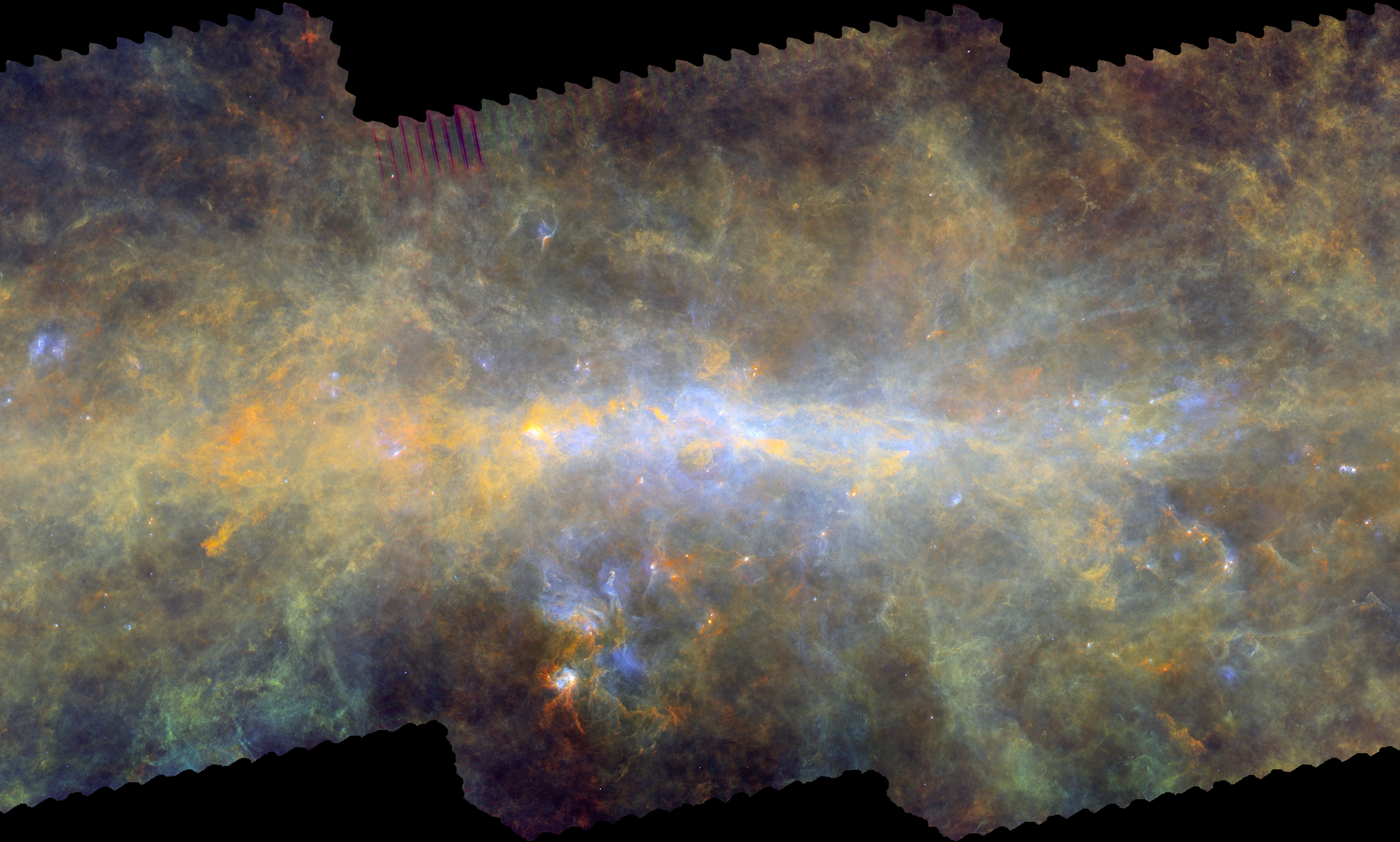
Herschel's view of the Galactic Plane. 
Credit: ESA/Herschel/PACS, SPIRE/Hi-GAL Project

Herschel's view of RCW 120
Credit: ESA/Herschel/PACS, SPIRE/Hi-GAL Project

Herschel's view of the Galactic Centre
Credit: ESA/Herschel/PACS, SPIRE/Hi-GAL Project


ESA's Herschel mission releases today a series of unprecedented maps of star-forming hubs in the plane of our Milky Way galaxy. This is accompanied by a set of catalogues of hundreds of thousands of compact sources that span all phases leading to the birth of stars in our Galaxy. These maps and catalogues will be very valuable resources for astronomers, to exploit scientifically and for planning follow-up studies of particularly interesting regions in the Galactic Plane.

During its four years of operations (2009-2013), the Herschel space observatory scanned the sky at far-infrared and sub-millimetre wavelengths. Observations in this portion of the electromagnetic spectrum are sensitive to some of the coldest objects in the Universe, including cosmic dust, a minor but crucial component of the interstellar material from which stars are born.


The Herschel infrared Galactic Plane Survey (Hi-GAL) is the largest of all observing programmes carried out with Herschel, in terms of both observing time – over 900 hours of total observations, equivalent to almost 40 days – and sky coverage – about 800 square degrees, or two percent of the entire sky. Its aim was to map the entire disc of the Milky Way, where most of its stars form and reside, in five of Herschel's wavelength channels: 70, 160, 250, 350 and 500 μm.

Over the past two years, the Hi-GAL team has processed the data to obtain a series of calibrated maps of extraordinary quality and resolution. With a dynamical range of at least two orders of magnitude, these maps reveal the emission by diffuse material as well as huge filamentary structures and individual, point-like sources scattered across the images.


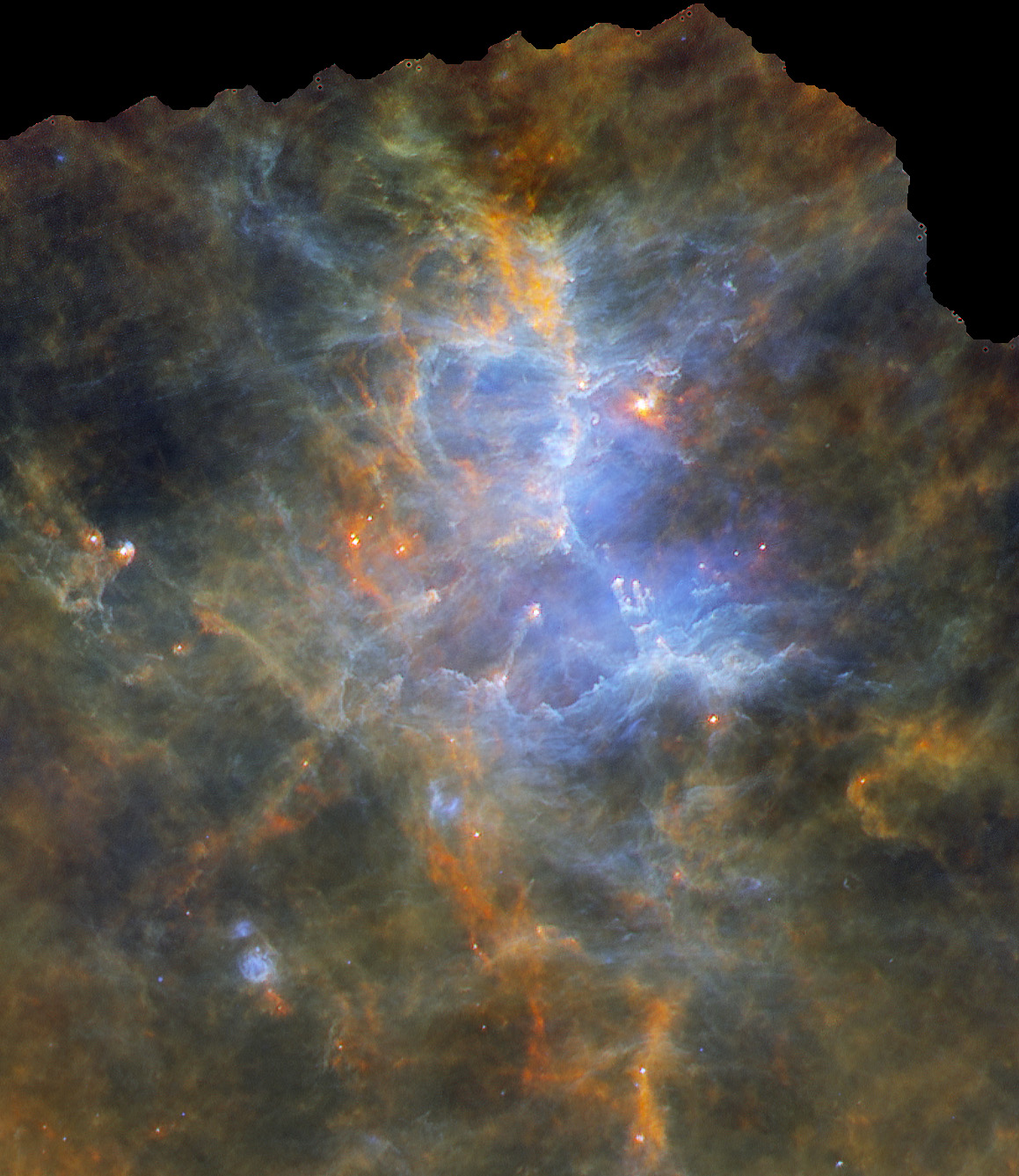
Herschel's view of the Eagle Nebula
Credit: ESA/Herschel/PACS, SPIRE/Hi-GAL Project 
 

The images provide an unprecedented view of the Galactic Plane, ranging from diffuse interstellar material to denser filamentary structures of gas and dust that fragment into clumps where star formation sets in. They include pre-stellar clumps, protostars in various evolutionary stages and compact cores on the verge of turning into stars, as well as fully-fledged stars and the bubbles carved by their highly energetic radiation.

Today, the team releases the first part of this data set, consisting of 70 maps, each measuring two times two degrees, and provided in the five surveyed wavelengths.

"These maps are not only stunning from an aesthetic point of view, but they represent a rich data set for astronomers to investigate the different phases of star formation in our Galaxy," explains Sergio Molinari from IAPS/INAF, Italy, Principal Investigator for the Hi-GAL Project.

Astronomers have been able to avail of data from Hi-GAL from the very beginning of the observing programme since the team agreed to waive their right to a proprietary period. The observations have been made available through the ESA Herschel Science Archive, including raw data as well as data products generated by systematic pipeline processing. The data has regularly been reprocessed to gradually higher quality and fidelity products.

The present release represents an extra step in the data processing. The newly released maps are accompanied by source catalogues in each of the five bands, which can be directly used by the community to study a variety of subjects, including the distribution of diffuse dust and of star-forming regions across the Galactic Plane.

The maps cover the inner part of the Milky Way, towards the Galactic Centre as seen from the Sun, with Galactic longitudes between +68° and -70°. A second release, with the remaining part of the survey, is foreseen for the end of 2016.

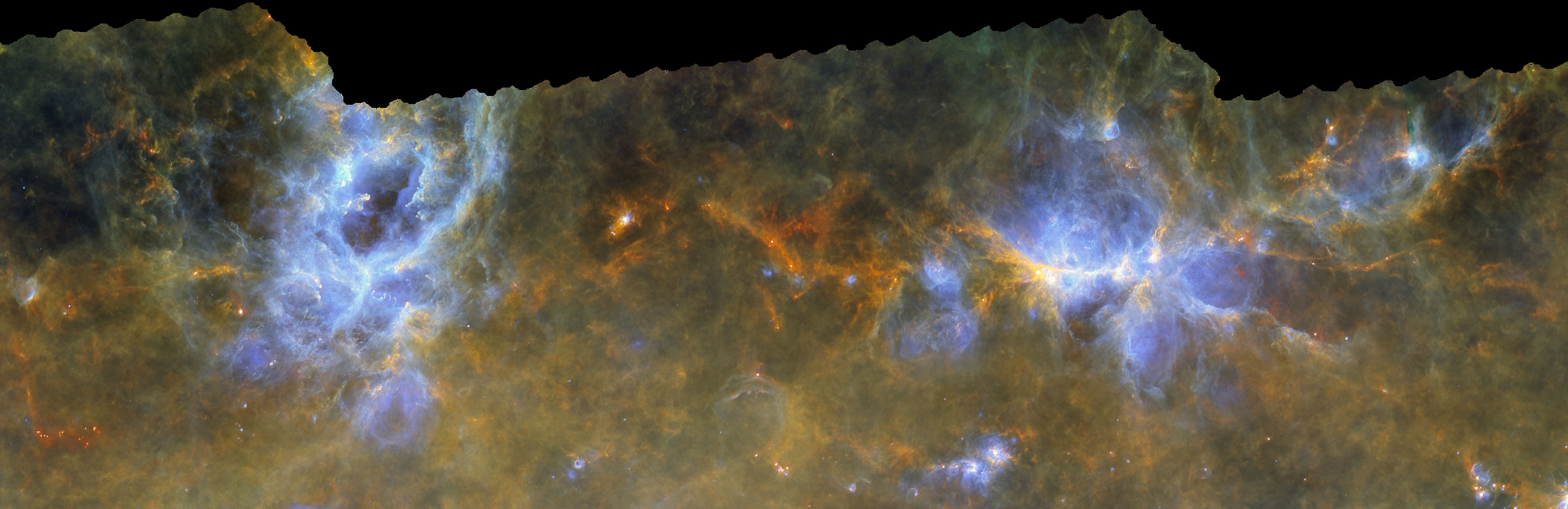
Herschel's view of the War and Peace and Cat's Paw nebulas
Credit: ESA/Herschel/PACS, SPIRE/Hi-GAL Project


"It is not straightforward to extract compact sources from far-infrared images, where pre-stellar clumps and other proto-stellar objects are embedded in the diffuse interstellar medium that also shines brightly at the same wavelengths," explains Molinari.

"For this reason, we developed a special technique to extract individual sources from the maps, maximising the contrast in order to amplify the compact objects with respect to the background."

result is a set of five catalogues, one for each of the surveyed wavelengths, listing the source position, flux, size, signal-to-noise ratio and other parameters related to their emission. The largest catalogue is the one compiled from the 160-μm maps, with over 300 000 sources.

"The Hi-GAL maps and catalogues provide a complete census of stellar nurseries in the inner Galaxy," says Göran Pilbratt, Herschel Project Scientist at ESA.

"These will be an extremely useful resource for studies of star formation across the Milky Way, helping astronomers to delve into the Galactic Plane and also to identify targets for follow-up observations with other facilities."


Related publication


S. Molinari, et al., "Hi-GAL, the Herschel infrared Galactic Plane Survey: photometric maps and compact source catalogues. First data release for Inner Milky Way: +68°≥ l ≥ −70°", 2016, Astronomy & Astrophysics.  


More information


Herschel is an ESA space observatory with science instruments provided by European-led Principal Investigator consortia and with important participation from NASA.

Herschel was launched on 14 May 2009 and completed science observations on 29 April 2013.


The Herschel infrared Galactic Plane Survey (Hi-GAL) started out as one of the 21 Open Time Key Programmes carried out with the observatory, and later gained additional time in subsequent calls for observing proposals.


Contact

Sergio Molinari
IAPS/INAF
Roma, Italy
Email: Sergio.molinari@iaps.inaf.it
Phone: +39-06-4993-4396

Göran Pilbratt
Herschel Project Scientist
ESA, The Netherlands
Email:
gpilbratt@cosmos.esa.int
Phone: +31-71-565-3621


Source:  ESA/Herschel

Monday, October 14, 2013

A Galactic bubble with a large surprise

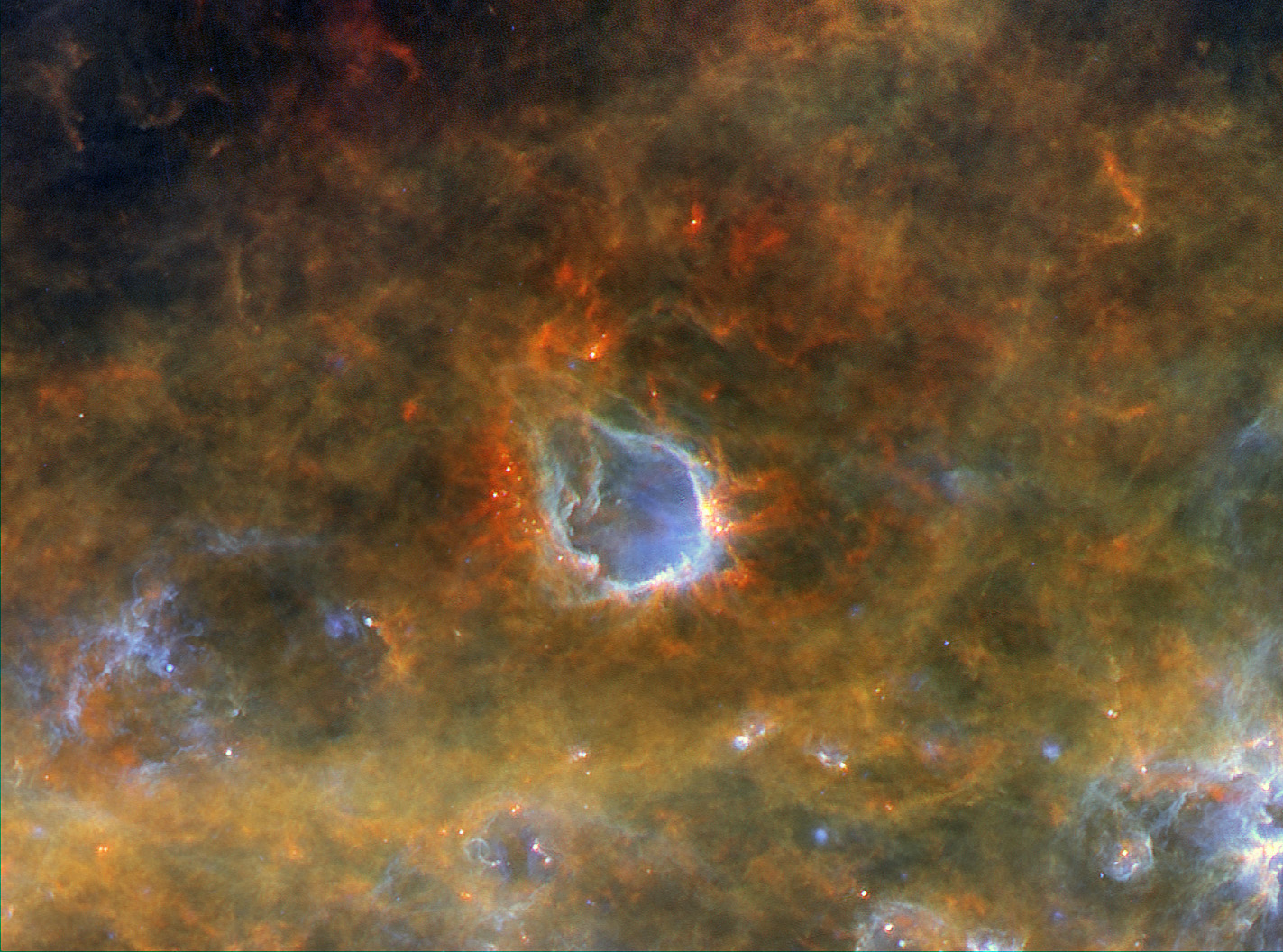
RCW 120 is a bubble blown by a central star (not visible at these infrared wavelengths) that has exerted enough pressure in the bubble ‘walls’ that material can begin collapsing into the next generation of star. The bright knot in the bottom right of the bubble is one such stellar embryo, which is surrounding by material amounting to 2000 solar masses. The star already has a mass of about 8–10 Suns, and will likely grow larger still. RCW 120 lies about 4300 light-years away.
The image was created from data collected using the PACS and SPIRE instruments on ESA’s Herschel space observatory, covering wavelengths of 100µm (blue), 160µm (green) and 250µm (red). Copyright: ESA/PACS/SPIRE/HOBYS Consortia 

Nestled within the shell around this large bubble is an embryonic star that is already a hefty eight times more massive than our Sun. 
 
This image, by ESA’s Herschel space observatory, was originally presented in the first announcement of scientific results  from the mission in May 2010. 

This week Herschel scientists will meet again at ESA’s ESTEC establishment in the Netherlands to present, discuss, and take stock of the scientific breakthroughs of the entire mission at The Universe Explored by Herschel symposium. 

The Galactic bubble shown in this image was just one of many surprising results of the mission. 

It is about 4300 light-years away and has been blown by a star at its centre. The star is not visible at these infrared wavelengths but pushes on the surrounding dust and gas with nothing more than the power of its starlight. 

The pressure exerted on the surrounding material is such that it has begun collapsing into new stars. 

The bright knot to the right of the base of the bubble is an unexpectedly large, embryonic star, revealed to Herschel’s infrared detectors by heating up the surrounding dense clumps of gas and dust. 

Herschel’s observations have shown that it already contains at least eight times the mass of our Sun, and that it is still surrounded by an additional 2000 solar masses of gas and dust from which it can feed further. 

Not all of the material will fall onto the star, however, as some will be blasted away by the intense radiation emitted by the star. Some stars reach an impressive 150 solar masses, but just how large this stellar embryo will grow remains to be seen. 

This week, scientists will not only discuss star formation, but also what the Herschel space observatory has revealed about planetary system evolution, galaxy formation, the interstellar medium and more. A full programme can be found here

Herschel was launched on 14 May 2009 and completed science observations on 29 April 2013. 

Source: ESA


Thursday, June 16, 2011

A Green Ring Fit for a Superhero

This glowing emerald nebula seen by NASA's Spitzer Space Telescope is reminiscent of the glowing ring wielded by the superhero Green Lantern. Image credit: NASA/JPL-Caltech. Full image and caption

This glowing emerald nebula seen by NASA's Spitzer Space Telescope is reminiscent of the glowing ring wielded by the superhero Green Lantern. In the comic books, the diminutive Guardians of the Planet "Oa" forged his power ring, but astronomers believe rings like this are actually sculpted by the powerful light of giant "O" stars. O stars are the most massive type of star known to exist.

Named RCW 120 by astronomers, this region of hot gas and glowing dust can be found in the murky clouds encircled by the tail of the constellation Scorpius. The green ring of dust is actually glowing in infrared colors that our eyes cannot see, but show up brightly when viewed by Spitzer's infrared detectors. At the center of this ring are a couple of giant stars whose intense ultraviolet light carved out the bubble, though they blend in with the other stars when viewed in infrared.

Rings like this are so common in Spitzer's observations that astronomers have even enlisted the help of the public to help find and catalog them all. Anyone interested in joining the search as a citizen scientist can visit "The Milky Way Project," part of the "Zooniverse" of public astronomy projects, at http://www.milkywayproject.org/ .

The flat plane of our galaxy is located toward the bottom of the picture, and the ring is slightly above the plane. The green haze seen at the bottom of the image is the diffuse glow of dust from the galactic plane.

NASA's Jet Propulsion Laboratory, Pasadena, Calif., manages the Spitzer Space Telescope mission for NASA's Science Mission Directorate, Washington. Science operations are conducted at the Spitzer Science Center at the California Institute of Technology in Pasadena. Caltech manages JPL for NASA. For more information about Spitzer, visit http://spitzer.caltech.edu/ and http://www.nasa.gov/spitzer

Whitney Clavin (818) 354-4673
Jet Propulsion Laboratory, Pasadena, Calif.
whitney.clavin@jpl.nasa.gov


Composite image of RCW 120 as seen in the infrared by Herschel and Spitzer. Red and yellow show cool dust, seen by Herschel. Bluer colours show warmer dust detected by Spitzer, as well as stars which are either in front of or behind the ring. The insets show the individual images from the two satellites. See below for download options. Image credit: ESA/Herschel/PACS/SPIRE/HOBYS (Herschel) ; NASA/JPL-Caltech (Spitzer).

Thursday, May 06, 2010

Herschel unveils rare massive stars in the act of forming

New images from ESA's Herschel space observatory reveal high-mass protostars around two ionised regions in our Galaxy. The detection of these rare stars in an early phase of evolution is key to understanding the mysterious formation of massive stars.

This is one of the many discoveries presented this week at the Herschel First Results Symposium, ESLAB 2010, held at the European Space Research and Technology Centre, Noordwijk, The Netherlands.

Massive stars are the rare birds of astrophysics. With a mass over eight times that of the Sun, these stars are much less common than their lower-mass counterparts. In addition, they are short-lived, consuming their nuclear fuel at a rapid rate before ending their life in spectacular manner as a supernova. Their scarcity means that observations of these rare giants can prove difficult to obtain, but characterising these elusive objects is essential for understanding the chemical and dynamical evolution of galaxies.

The mechanism leading to the formation of massive stars is still largely debated. Detecting these objects in their earliest phases is a highly challenging task, since they are embedded in dusty cocoons that hide them from view. However, the dust that absorbs their light re-emits it at infrared wavelengths, making an infrared observatory such as Herschel a unique tool for locating newborn massive stars in their natal nests.

RCW 120 as seen by Herschel. Credit: ESA, PACS & SPIRE Consortia, A. Zavagno (Laboratoire d'Astrophysique de Marseille) for the Herschel HOBYS and Evolution of Interstellar Dust Key Programmes

One theory that has been put forward predicts that massive stars form at the outskirts of HII regions. An HII region is a bubble of hot hydrogen gas which has been ionised by the powerful radiation emitted by a central massive star formed in a previous generation. Temperature differences between the interior (up to 10 000 Kelvin) and the surrounding material (cooler than 100 Kelvin) cause these bubbles to expand and to reach supersonic speeds. This expanding bubble sweeps up a layer of neutral material around it, which then fragments into the dense seeds of a new generation of high-mass stars.

New data from Herschel targeting two distinct HII regions in our Galaxy, namely RCW 120 and N49, yield strong evidence in favour of this scenario. Thanks to its unprecedented resolution and sensitivity over a wide range of infrared wavelengths, ESA's new space observatory has imaged, for the first time, a handful of very young, massive stars on the border of both regions. These objects, which came to life less than a few tens of thousands of years ago, have never before been observed.

"We can finally witness the long-sought-after triggered formation of massive stars," says Annie Zavagno from Laboratoire d'Astrophysique de Marseille. "The high density of the material surrounding these bubbles and the intense motions due to stellar winds might be responsible for this particularly efficient star-forming process, leading to a new population of more massive stars around them."

The 'collect and collapse' model.
Credit: Deharveng & Zavagno

"Exploiting the unique combination of PACS and SPIRE, the two cameras on board Herschel, with a total spectral coverage that extends beyond the far-infrared into the sub-millimetre, the newly released images have refined our view on the birth of stars around expanding HII regions," says Göran Pilbratt, Herschel Project Scientist. "As a result of this new data, astronomers have been able not only to spot previously undetected young stars, but also to characterise their physical properties."

Particularly striking is the discovery, around RCW 120, of a massive protostar with a mass 8-10 times larger than the Sun's. "This object appears to be surrounded by a huge envelope of about 2000 solar masses, and it will continue to grow into an even more massive fully-fledged star," adds Zavagno.

Over the course of the next few months, PACS and SPIRE will target several other galactic HII regions that exhibit evidence of triggered star formation, in order to study this process in greater detail and to shed new light on the mechanisms producing high-mass stars in our Galaxy.

Notes to Editors

Herschel is an ESA space observatory with science instruments provided by European-led Principal Investigator consortia, with important participation from NASA.

PACS is an imaging photometer and integral field line spectrometer covering wavelengths between 57 and 210 µm. PACS was built by a consortium of institutes and university departments from across Europe, and is led by Albrecht Poglitsch of the Max-Planck-Institute for Extraterrestrial Physics, Garching, Germany. Consortium members are: Austria: UVIE; Belgium: IMEC, KUL, CSL; France: CEA, OAMP; Germany: MPE, MPIA; Italy: IFSI, OAP/OAT, OAA/CAISMI, LENS, SISSA; Spain: IAC.

The SPIRE instrument comprises an imaging photometer (camera) and an imaging spectrometer. The camera operates in three wavelength bands centred on 250, 350 and 500 μm, and so can make images of the sky simultaneously in three submillimetre “colours”. The spectrometer covers the range 200 – 670 μm, allowing the spectral features of atoms and molecules to be measured. SPIRE has been developed by a consortium of institutes led by Cardiff Univ. (UK) and including Univ. Lethbridge (Canada); NAOC (China); CEA, LAM (France); IFSI, Univ. Padua (Italy); IAC (Spain); Stockholm Observatory (Sweden); Imperial College London, RAL, UCL-MSSL, UKATC, Univ. Sussex (UK); and Caltech, JPL, NHSC, Univ. Colorado (USA). This development has been supported by national funding agencies: CSA (Canada); NAOC (China); CEA, CNES, CNRS (France); ASI (Italy); MCINN (Spain); SNSB (Sweden); STFC (UK); and NASA (USA). The SPIRE consortium is led by Prof. Matt Griffin of Cardiff University, United Kingdom.

The results reported here are based on a subset of observations from the following Herschel Key Programmes: HOBYS: the Herschel imaging survey of OB Young Stellar objects, led by Principal Investigator Frédérique Motte (SAp/CEA Saclay, France); Evolution of Interstellar Dust, led by Principal Investigator Alain Abergel (Institut d'Astrophysique Spatiale, IAS, France); and Hi-GAL: the Herschel Infrared Galactic Plane Survey, led by Principal Investigator Sergio Molinari (IFSI-INAF, Italy).

Related publications

Zavagno, A., et al., "Star formation triggered by the Galactic HII region RCW 120", 2010
Zavagno, A., et al., "Star formation triggered by HII regions in our Galaxy", 2010

Both papers will appear in a special issue of the journal Astronomy & Astrophysics dedicated to Herschel's first results.

Contacts

Annie Zavagno
Laboratoire d'Astrophysique de Marseille, France
Email:
annie.zavagno@oamp.fr
Phone: +33-4-95-04-41-55

Göran Pilbratt, Herschel Project Scientist
Research and Scientific Support Department
Science and Robotic Exploration Directorate, ESA, The Netherlands
Email:
gpilbratt@rssd.esa.int
Phone: +31-71-565-3621