A Cosmic Bat in Flight

Around NGC 1788

The Cosmic Bat in the Constellation Orion
Videos
ESOcast 195 Light: A Cosmic Bat in Flight
ESOcast 196 Light: 20 Years of exploring the Universe
Zooming into the Cosmic Bat
ESO’s Cosmic Gems Programme captures the Cosmic Bat’s dusty clouds
Hidden in one of the darkest corners of
the Orion constellation, this Cosmic Bat is spreading its hazy wings
through interstellar space two thousand light-years away. It is
illuminated by the young stars nestled in its core — despite being
shrouded by opaque clouds of dust, their bright rays still illuminate
the nebula. Too dim to be discerned by the naked eye, NGC 1788 reveals
its soft colours to ESO's Very Large Telescope in this image — the most
detailed to date.
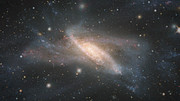
ESO's Very Large Telescope (VLT) has caught a glimpse of an ethereal nebula hidden away in the darkest corners of the constellation of Orion (The Hunter) — NGC 1788, nicknamed the Cosmic Bat. This bat-shaped reflection nebula
doesn’t emit light — instead it is illuminated by a cluster of young
stars in its core, only dimly visible through the clouds of dust.
Scientific instruments have come a long way since NGC 1788 was first
described, and this image taken by the VLT is the most detailed portrait
of this nebula ever taken.
Even though this ghostly nebula in Orion appears to be
isolated from other cosmic objects, astronomers believe that it was
shaped by powerful stellar winds
from the massive stars beyond it. These streams of scorching plasma are
thrown from a star’s upper atmosphere at incredible speeds, shaping the
clouds secluding the Cosmic Bat’s nascent stars.
NGC 1788 was first described by the German–British astronomer William Herschel,
who included it in a catalogue that later served as the basis for one
of the most significant collections of deep-sky objects, the New General Catalogue (NGC) [1]. A nice image of this small and dim nebula had already been captured by the MPG/ESO 2.2-metre telescope
at ESO's La Silla Observatory, but this newly observed scene leaves it
in the proverbial dust. Frozen in flight, the minute details of this
Cosmic Bat's dusty wings were imaged for the twentieth anniversary of
one of ESO's most versatile instruments, the FOcal Reducer and low
dispersion Spectrograph 2 (FORS2).
FORS2 is an instrument mounted on Antu, one of the VLT's 8.2-metre Unit Telescopes at the Paranal Observatory, and its ability to image large areas of the sky in exceptional detail has made it a coveted member of ESO's fleet of cutting-edge scientific instruments.
Since its first light 20 years ago, FORS2 has become known as “the
Swiss army knife of instruments”. This moniker originates from its
uniquely broad set of functions [2].
FORS2’s versatility extends beyond purely scientific uses — its ability
to capture beautiful high-quality images like this makes it a
particularly useful tool for public outreach.
This image was taken as part of ESO’s Cosmic Gems
programme, an outreach initiative that uses ESO telescopes to produce
images of interesting, intriguing or visually attractive objects for the
purposes of education and public outreach. The programme makes use of
telescope time that cannot be used for science observations, and — with
the help of FORS2 — produces breathtaking images of some of the most
striking objects in the night sky, such as this intricate reflection
nebula. In case the data collected could be useful for future scientific
purposes, these observations are saved and made available to
astronomers through the ESO Science Archive.
Notes
[1] In 1864 John Herschel published the General Catalogue of Nebulae and Clusters,
which built on extensive catalogues and contained entries for more than
five thousand intriguing deep-sky objects. Twenty-four years later,
this catalogue was expanded by John Louis Emil Dreyer and published as
the New General Catalogue of Nebulae and Clusters of Stars (NGC), a comprehensive collection of stunning deep-sky objects.
[2] In addition to being able to image large areas of the sky with precision, FORS2 can also measure the spectra
of multiple objects in the night sky and analyse the polarisation of
their light. Data from FORS2 are the basis of over 100 scientific
studies published every year.
More Information
ESO is the foremost intergovernmental astronomy organisation in Europe
and the world’s most productive ground-based astronomical observatory by
far. It has 16 Member States: Austria, Belgium, the Czech Republic,
Denmark, France, Finland, Germany, Ireland, Italy, the Netherlands,
Poland, Portugal, Spain, Sweden, Switzerland and the United Kingdom,
along with the host state of Chile and with Australia as a Strategic
Partner. ESO carries out an ambitious programme focused on the design,
construction and operation of powerful ground-based observing facilities
enabling astronomers to make important scientific discoveries. ESO also
plays a leading role in promoting and organising cooperation in
astronomical research. ESO operates three unique world-class observing
sites in Chile: La Silla, Paranal and Chajnantor. At Paranal, ESO
operates the Very Large Telescope and its world-leading Very Large
Telescope Interferometer as well as two survey telescopes, VISTA working
in the infrared and the visible-light VLT Survey Telescope. Also at
Paranal ESO will host and operate the Cherenkov Telescope Array South,
the world’s largest and most sensitive gamma-ray observatory. ESO is
also a major partner in two facilities on Chajnantor, APEX and ALMA, the
largest astronomical project in existence. And on Cerro Armazones,
close to Paranal, ESO is building the 39-metre Extremely Large
Telescope, the ELT, which will become “the world’s biggest eye on the
sky”.
Links
Contacts
Calum Turner
ESO Public Information Officer
Garching bei München, Germany
Tel: +49 89 3200 6670
Email: pio@eso.org
Source: ESO/News