Showing posts with label NASA's Swift satellite. Show all posts

Monday, June 27, 2016

X-ray Echoes of a Shredded Star Provide Close-up of 'Killer' Black Hole


Now astronomers using archival observations from Swift, the European Space Agency's (ESA) XMM-Newton observatory and the Japan-led Suzaku satellite have identified the reflections of X-ray flares erupting during the event. Led by Erin Kara, a postdoctoral researcher at NASA's Goddard Space Flight Center in Greenbelt, Maryland, and the University of Maryland, College Park (UMCP), the team has used these light echoes, or reverberations, to map the flow of gas near a newly awakened black hole for the first time.

"While we don't yet understand what causes X-ray flares near the black hole, we know that when one occurs we can detect its echo a couple of minutes later, once the light  has reached and illuminated parts of the flow," Kara explained. "This technique, called X-ray reverberation mapping, has been previously used to explore stable disks around black holes, but this is the first time we've applied it to a newly formed disk produced by a tidal disruption."

In this artist's rendering, a thick accretion disk has formed around a supermassive black hole following the tidal disruption of a star that wandered too close. Stellar debris has fallen toward the black hole and collected into a thick chaotic disk of hot gas. Flashes of X-ray light near the center of the disk result in light echoes that allow astronomers to map the structure of the funnel-like flow, revealing for the first time strong gravity effects around a normally quiescent black hole. Credits: NASA/Swift/Aurore Simonnet, Sonoma State University


Stellar debris falling toward a black hole collects into a rotating structure called an accretion disk. There the gas is compressed and heated to millions of degrees before it eventually spills over the black hole's event horizon, the point beyond which nothing can escape and astronomers cannot observe. The Swift J1644+57 accretion disk was thicker, more turbulent and more chaotic than stable disks, which have had time to settle down into an orderly routine. The researchers present the findings in a paper published online in the journal Nature on Wed., June 22.

One surprise from the study is that high-energy X-rays arise from the inner part of the disk. Astronomers had thought most of this emission originated from a narrow jet of particles accelerated to near the speed of light.

In blazars, the most luminous galaxy class powered by supermassive black holes, jets produce most of the highest-energy emission.

"We do see a jet from Swift J1644, but the X-rays are coming from a compact region near the black hole at the base of a steep funnel of inflowing gas we're looking down into," said co-author Lixin Dai, a postdoctoral researcher at UMCP. "The gas producing the echoes is itself flowing outward along the surface of the funnel at speeds up to half the speed of light."

X-rays originating near the black hole excite iron ions in the whirling gas, causing them to fluoresce with a distinctive high-energy glow called iron K-line emission. As an X-ray flare brightens and fades, the gas follows in turn after a brief delay depending on its distance from the source.

"Direct light from the flare has different properties than its echo, and we can detect reverberations by monitoring how the brightness changes across different X-ray energies," said co-author Jon Miller, a professor of astronomy at the University of Michigan in Ann Arbor.

Swift J1644+57 is one of only three tidal disruptions that have produced high-energy X-rays, and to date it remains the only event caught at the peak of this emission. These star shredding episodes briefly activate black holes astronomers wouldn't otherwise know about. For every black hole now actively accreting gas and producing light, astronomers think nine others are dormant and dark. These quiescent black holes were active when the universe was younger, and they played an important role in how galaxies evolved. Tidal disruptions therefore offer a glimpse of the silent majority of supersized black holes.

Images from Swift's Ultraviolet/Optical (white, purple) and X-Ray telescopes (yellow and red) were combined in this composite of Swift J1644+57, an X-ray outburst astronomers classify as a tidal disruption event. The event is seen only in the X-ray image, which is a 3.4-hour exposure taken on March 28, 2011. The outburst was triggered when a passing star came too close to a supermassive black hole. The star was torn apart, and much of the gas fell toward the black hole. To date, this is the only tidal disruption event emitting high-energy X-rays that astronomers have caught at peak luminosity. Credits: NASA/Swift/Stefan Immler.  Click here for an unlabeled version of this image.


"If we only look at active black holes, we might be getting a strongly biased sample," said team member Chris Reynolds, a professor of astronomy at UMCP. "It could be that these black holes all fit within some narrow range of spins and masses. So it’s important to study the entire population to make sure we’re not biased."

The researchers estimate the mass of the Swift J1644+57 black hole at about a million times that of the sun but did not measure its spin. With future improvements in understanding and modeling accretion flows, the team thinks it may be possible to do so.     

ESA's XMM-Newton satellite was launched in December 1999 from Kourou, French Guiana. NASA funded elements of the XMM-Newton instrument package and provides the NASA Guest Observer Facility at Goddard, which supports use of the observatory by U.S. astronomers. Suzaku operated from July 2005 to August 2015 and was developed at the Japanese Institute of Space and Astronautical Science, which is part of the Japan Aerospace Exploration Agency, in collaboration with NASA and other Japanese and U.S. institutions.

NASA's Swift satellite was launched in November 2004 and is managed by Goddard. It is operated in collaboration with Penn State University in University Park, the Los Alamos National Laboratory in New Mexico, and Orbital Sciences Corp. in Dulles, Virginia, with international collaborators in the U.K., Italy, Germany and Japan.


Editor: Ashley Morrow


Wednesday, June 22, 2016

Astronomers Find the First 'Wind Nebula' Around a Magnetar

Astronomers have discovered a vast cloud of high-energy particles called a wind nebula around a rare ultra-magnetic neutron star, or magnetar, for the first time. The find offers a unique window into the properties, environment and outburst history of magnetars, which are the strongest magnets in the universe.  
 

A neutron star is the crushed core of a massive star that ran out of fuel, collapsed under its own weight, and exploded as a supernova. Each one compresses the equivalent mass of half a million Earths into a ball just 12 miles (20 kilometers) across, or about the length of New York's Manhattan Island. Neutron stars are most commonly found as pulsars, which produce radio, visible light, X-rays and gamma rays at various locations in their surrounding magnetic fields. When a pulsar spins these regions in our direction, astronomers detect pulses of emission, hence the name.

This illustration compares the size of a neutron star to Manhattan Island in New York, which is about 13 miles long. A neutron star is the crushed core left behind when a massive star explodes as a supernova and is the densest object astronomers can directly observe. Credits: NASA's Goddard Space Flight Center

Typical pulsar magnetic fields can be 100 billion to 10 trillion times stronger than Earth's. Magnetar fields reach strengths a thousand times stronger still, and scientists don't know the details of how they are created. Of about 2,600 neutron stars known, to date only 29 are classified as magnetars.

The newfound nebula surrounds a magnetar known as Swift J1834.9-0846 -- J1834.9 for short -- which was discovered by NASA's Swift satellite on Aug. 7, 2011, during a brief X-ray outburst. Astronomers suspect the object is associated with the W41 supernova remnant, located about 13,000 light-years away in the constellation Scutum toward the central part of our galaxy. 

"Right now, we don't know how J1834.9 developed and continues to maintain a wind nebula, which until now was a structure only seen around young pulsars," said lead researcher George Younes, a postdoctoral researcher at George Washington University in Washington. "If the process here is similar, then about 10 percent of the magnetar's rotational energy loss is powering the nebula’s glow, which would be the highest efficiency ever measured in such a system."

A month after the Swift discovery, a team led by Younes took another look at J1834.9 using the European Space Agency's (ESA) XMM-Newton X-ray observatory, which revealed an unusual lopsided glow about 15 light-years across centered on the magnetar. New XMM-Newton observations in March and October 2014, coupled with archival data from XMM-Newton and Swift, confirm this extended glow as the first wind nebula ever identified around a magnetar. A paper describing the analysis will be published by The Astrophysical Journal.

"For me the most interesting question is, why is this the only magnetar with a nebula? Once we know the answer, we might be able to understand what makes a magnetar and what makes an ordinary pulsar," said co-author Chryssa Kouveliotou, a professor in the Department of Physics at George Washington University’s Columbian College of Arts and Sciences.

The most famous wind nebula, powered by a pulsar less than a thousand years old, lies at the heart of the Crab Nebula supernova remnant in the constellation Taurus. Young pulsars like this one rotate rapidly, often dozens of times a second. The pulsar's fast rotation and strong magnetic field work together to accelerate electrons and other particles to very high energies. This creates an outflow astronomers call a pulsar wind that serves as the source of particles making up in a wind nebula.

The best-known wind nebula is the Crab Nebula, located about 6,500 light-years away in the constellation Taurus. At the center is a rapidly spinning neutron star that accelerates charged particles like electrons to nearly the speed of light. As they whirl around magnetic field lines, the particles emit a bluish glow. This image is a composite of Hubble observations taken in late 1999 and early 2000. The Crab Nebula spans about 11 light-years. Credits: NASA, ESA, J. Hester and A. Loll (Arizona State University)

"Making a wind nebula requires large particle fluxes, as well as some way to bottle up the outflow so it doesn't just stream into space," said co-author Alice Harding, an astrophysicist at NASA's Goddard Space Flight Center in Greenbelt, Maryland. "We think the expanding shell of the supernova remnant serves as the bottle, confining the outflow for a few thousand years. When the shell has expanded enough, it becomes too weak to hold back the particles, which then leak out and the nebula fades away." This naturally explains why wind nebulae are not found among older pulsars, even those driving strong outflows.

A pulsar taps into its rotational energy to produce light and accelerate its pulsar wind. By contrast, a magnetar outburst is powered by energy stored in the super-strong magnetic field. When the field suddenly reconfigures to a lower-energy state, this energy is suddenly released in an outburst of X-rays and gamma rays. So while magnetars may not produce the steady breeze of a typical pulsar wind, during outbursts they are capable of generating brief gales of accelerated particles.

"The nebula around J1834.9 stores the magnetar's energetic outflows over its whole active history, starting many thousands of years ago," said team member Jonathan Granot, an associate professor in the Department of Natural Sciences at the Open University in Ra'anana, Israel. "It represents a unique opportunity to study the magnetar's historical activity, opening a whole new playground for theorists like me."

ESA's XMM-Newton satellite was launched on Dec. 10, 1999, from Kourou, French Guiana, and continues to make observations. NASA funded elements of the XMM-Newton instrument package and provides the NASA Guest Observer Facility at Goddard, which supports use of the observatory by U.S. astronomers.


Editor: Ashley Morrow


Saturday, July 11, 2015

NASA's Swift Reveals a Black Hole Bull's-eye


The Swift X-ray image of V404 Cygni covers a patch of the sky equal to about half the apparent diameter of the full moon. This image shows the rings as they appeared on June 30. Credits: NASA's Scientific Visualization Studio (left), Andrew Beardmore (Univ. of Leicester); NASA/Swift (right)


What looks like a shooting target is actually an image of nested rings of X-ray light centered on an erupting black hole. On June 15, NASA's Swift satellite detected the start of a new outburst from V404 Cygni, where a black hole and a sun-like star orbit each other. Since then, astronomers around the world have been monitoring the ongoing light show.

On June 30, a team led by Andrew Beardmore at the University of Leicester, U.K., imaged the system using the X-ray Telescope aboard Swift, revealing a series concentric rings extending about one-third the apparent size of a full moon. A movie made by combining additional observations acquired on July 2 and 4 shows the expansion and gradual fading of the rings.

Astronomers say the rings result from an "echo" of X-ray light. The black hole's flares emit X-rays in all directions. Dust layers reflect some of these X-rays back to us, but the light travels a longer distance and reaches us slightly later than light traveling a more direct path. The time delay creates the light echo, forming rings that expand with time.   

Detailed analysis of the expanding rings shows that they all originate from a large flare that occurred on June 26 at 1:40 p.m. EDT. There are multiple rings because there are multiple reflecting dust layers between 4,000 and 7,000 light-years away from us. Regular monitoring of the rings and how they change as the eruption continues will allow astronomers to better understand their nature.

"The flexible planning of Swift observations has given us the best dust-scattered X-ray ring images ever seen," Beardmore said. "With these observations we can make a detailed study of the normally invisible interstellar dust in the direction of this black hole."

V404 Cygni is located about 8,000 light-years away. Every couple of decades the black hole fires up in an outburst of high-energy light. Its previous eruption ended in 1989.

The investigating team includes scientists from the Universities of Leicester, Southampton, and Oxford in the U.K., the University of Alberta in Canada, and the European Space Agency in Spain.

Swift was launched in November 2004 and is managed by NASA's Goddard Space Flight Center in Greenbelt, Maryland. Goddard operates the spacecraft in collaboration with Penn State University in University Park, Pennsylvania, the Los Alamos National Laboratory in New Mexico and Orbital Sciences Corp. in Dulles, Virginia. International collaborators are located in the United Kingdom and Italy. The mission includes contributions from Germany and Japan.


Related Links


Saturday, November 23, 2013

NASA Sees 'Watershed' Cosmic Blast in Unique Detail

On April 27, a blast of light from a dying star in a distant galaxy became the focus of astronomers around the world. The explosion, known as a gamma-ray burst and designated GRB 130427A, tops the charts as one of the brightest ever seen.

A trio of NASA satellites, working in concert with ground-based robotic telescopes, captured never-before-seen details that challenge current theoretical understandings of how gamma-ray bursts work.


This animation shows the most common type of gamma-ray burst, thought to occur when a massive star collapses, forms a black hole, and blasts particle jets outward at nearly the speed of light. Viewing into a jet greatly boosts its apparent brightness. A Fermi image of GRB 130427A ends the sequence.Image Credit: NASA's Goddard Space Flight Center. Download this video in HD formats from NASA Goddard's Scientific Visualization Studio
 
"We expect to see an event like this only once or twice a century, so we're fortunate it happened when we had the appropriate collection of sensitive space telescopes with complementary capabilities available to see it," said Paul Hertz, director of NASA's Astrophysics Division in Washington.

Gamma-ray bursts are the most luminous explosions in the cosmos, thought to be triggered when the core of a massive star runs out of nuclear fuel, collapses under its own weight, and forms a black hole. The black hole then drives jets of particles that drill all the way through the collapsing star and erupt into space at nearly the speed of light.

Gamma-rays are the most energetic form of light. Hot matter surrounding a new black hole and internal shock waves produced by collisions within the jet are thought to emit gamma-rays with energies in the million-electron-volt (MeV) range, or roughly 500,000 times the energy of visible light. The most energetic emission, with billion-electron-volt (GeV) gamma rays, is thought to arise when the jet slams into its surroundings, forming an external shock wave.

The Gamma-ray Burst Monitor (GBM) aboard NASA's Fermi Gamma-ray Space Telescope captured the initial wave of gamma rays from GRB 130427A shortly after 3:47 a.m. EDT April 27. In its first three seconds alone, the "monster burst" proved brighter than almost any burst previously observed.

In the most common type of gamma-ray burst, illustrated here, a dying massive star forms a black hole (left), which drives a particle jet into space. Light across the spectrum arises from hot gas near the black hole, collisions within the jet, and from the jet's interaction with its surroundings.Image Credit: NASA's Goddard Space Flight Center

"The spectacular results from Fermi GBM show that our widely accepted picture of MeV gamma rays from internal shock waves is woefully inadequate," said Rob Preece, a Fermi team member at the University of Alabama in Huntsville who led the GBM study.

NASA's Swift Gamma-ray Burst Mission detected the burst almost simultaneously with the GBM and quickly relayed its position to ground-based observatories.

Telescopes operated by Los Alamos National Laboratory in New Mexico as part of the Rapid Telescopes for Optical Response (RAPTOR) Project quickly turned to the spot. They detected an optical flash that peaked at magnitude 7 on the astronomical brightness scale, easily visible through binoculars. It is the second-brightest flash ever seen from a gamma-ray burst.

Just as the optical flash peaked, Fermi's Large Area Telescope (LAT) detected a spike in GeV gamma-rays reaching 95 GeV, the most energetic light ever seen from a burst. This relationship between a burst's optical light and its high-energy gamma-rays defied expectations.

"We thought the visible light for these flashes came from internal shocks, but this burst shows that it must come from the external shock, which produces the most energetic gamma-rays," said Sylvia Zhu, a Fermi team member at the University of Maryland in College Park.

The LAT detected GRB 130427A for about 20 hours, far longer than any previous burst. For a gamma-ray burst, it was relatively nearby. Its light traveled 3.8 billion years before arriving at Earth, about one-third the travel time for light from typical bursts.

"Detailed observations by Swift and ground-based telescopes clearly show that GRB 130427A has properties more similar to typical distant bursts than to nearby ones," said Gianpiero Tagliaferri, a Swift team member at Brera Observatory in Merate, Italy.
These maps show the sky at energies above 100 MeV as seen by Fermi's LAT instrument. Left: The sky during a 3-hour interval before GRB 130427A. Right: A 3-hour map ending 30 minutes after the burst. GRB 130427A was located in the constellation Leo, near its border with Ursa Major.Image Credit: NASA/DOE/Fermi LAT Collaboration
Swift's X-Ray Telescope took this 0.1-second exposure of GRB 130427A at 3:50 a.m. EDT on April 27, just moments after Fermi and Swift detected the outburst. The image is 6.5 arcminutes across.Image Credit: NASA/Swift/Stefan Immler

This extraordinary event enabled NASA's newest X-ray observatory, the Nuclear Spectroscopic Telescope Array (NuSTAR), to make a first-time detection of a burst afterglow in high-energy, or "hard," X-rays after more than a day. Taken together with Fermi LAT data, these observations challenge long-standing predictions.

GRB 130427A is the subject of five papers published online Nov. 21. Four of these, published by Science Express, highlight contributions by Fermi, Swift and RAPTOR. The NuSTAR study is published in The Astrophysical Journal Letters.

NASA's Fermi Gamma-ray Space Telescope is an international and multi-agency astrophysics and particle physics partnership managed by NASA's Goddard Space Flight Center in Greenbelt, Md., and supported by the U.S. Department of Energy's Office of Science. Goddard also manages NASA's Swift mission, which is operated in collaboration with Pennsylvania State University in University Park, Pa., and international partners. NASA's NuSTAR mission is led by the California Institute of Technology and managed by NASA's Jet Propulsion Laboratory, both in Pasadena, with contributions from international partners.

Related Links

Francis Reddy


Monday, March 18, 2013

NASA's Swift, Chandra Explore a Youthful 'Star Wreck'

This composite of supernova remnant G306.3–0.9 merges Chandra X-ray observations (blue), infrared data acquired by the Spitzer Space Telescope (red and cyan) and radio observations (purple) from the Australia Telescope Compact Array. The image is 20 arcminutes across, which corresponds to 150 light-years at the remnant's estimated distance. Credit: X-ray: NASA/CXC/Univ. of Michigan/M. Reynolds et al; Infrared: NASA/JPL-Caltech; Radio: CSIRO/ATNF/ATCA.  › Larger image
 
While performing an extensive X-ray survey of our galaxy's central regions, NASA's Swift satellite has uncovered the previously unknown remains of a shattered star. Designated G306.3–0.9 after the coordinates of its sky position, the new object ranks among the youngest-known supernova remnants in our Milky Way galaxy.

"Astronomers have previously cataloged more than 300 supernova remnants in the galaxy," said lead scientist Mark Reynolds, a postdoctoral researcher at the University of Michigan in Ann Arbor. "Our analysis indicates that G306.3–0.9 is likely less than 2,500 years old, making it one of the 20 youngest remnants identified." 

Astronomers estimate that a supernova explosion occurs once or twice a century in the Milky Way. The expanding blast wave and hot stellar debris slowly dissipate over hundreds of thousands of years, eventually mixing with and becoming indistinguishable from interstellar gas.

A wider view places G306.3–0.9 in context with star-formation regions in southern Centaurus. Chandra X-ray observations (blue), Spitzer infrared data (red, cyan), and radio observations (purple) from the Australia Telescope Compact Array are merged in this composite. The image is one degree across, which corresponds to 450 light-years at the remnant's estimated distance. Credit: X-ray: NASA/CXC/Univ. of Michigan/M. Reynolds et al; Infrared: NASA/JPL-Caltech; Radio: CSIRO/ATNF/ATCA. › Larger image

Like fresh evidence at a crime scene, young supernova remnants give astronomers the best opportunity for understanding the nature of the original star and the details of its demise.

Supernova remnants emit energy across the electromagnetic spectrum, from radio to gamma rays, and important clues can be found in each energy band. X-ray observations figure prominently in revealing the motion of the expanding debris, its chemical content, and its interaction with the interstellar environment, but supernova remnants fade out in X-ray light after 10,000 years. Indeed, only half of those known in the Milky Way galaxy have been detected in X-rays at all.

Reynolds leads the Swift Galactic Plane Survey, a project to image a two-degree-wide strip along the Milky Way’s central plane at X-ray and ultraviolet energies at the same time. Imaging began in 2011 and is expected to complete this summer.

"The Swift survey leverages infrared imaging previously compiled by NASA’s Spitzer Space Telescope and extends it into higher energies," said team member Michael Siegel, a research associate at the Swift Mission Operations Center (MOC) in State College, Pa., which is operated by Penn State University. "The infrared and X-ray surveys complement each other because light at these energies penetrates dust clouds in the galactic plane, while the ultraviolet is largely extinguished."

This image from Swift’s X-ray Telescope was taken on Feb. 22, 2011, as part of the Galactic Plane Survey. The dots in the image indicate where X-rays struck the detector. Despite this short 8.5-minute exposure, the extended circular patch of G306.3–0.9 stands out. The image is 25.5 arcminutes across. Credit: NASA/Swift/Stefan Immler.   › Larger image

On Feb. 22, 2011, Swift imaged a survey field near the southern border of the constellation Centaurus. Although nothing unusual appeared in the ultraviolet exposure, the X-ray image revealed an extended, semi-circular source reminiscent of a supernova remnant. A search of archival data revealed counterparts in Spitzer infrared imagery and in radio data from the Molonglo Observatory Synthesis Telescope in Australia.

To further investigate the object, the team followed up with an 83-minute exposure using NASA’s Chandra X-ray Observatory and additional radio observations from the Australia Telescope Compact Array (ATCA), located near the town of Narrabri in New South Wales.

"The fantastic sensitivity of ATCA has enabled us to image what, at radio wavelengths, turns out to be the dimmest remnant we have ever seen in our galaxy," said team member Cleo Loi, an undergraduate student at the University of Sydney who led the analysis of the radio observations.

A paper describing the team’s findings will appear in an upcoming edition of The Astrophysical Journal and was published online on Friday.

Using an estimated distance of 26,000 light-years for G306.3–0.9, the scientists determined that the explosion’s shock wave is racing through space at about 1.5 million mph (2.4 million km/h). The Chandra observations reveal the presence of iron, neon, silicon and sulfur at temperatures exceeding 50 million degrees F (28 million C), a reminder not only of the energies involved but of the role supernovae play in seeding the galaxy with heavy elements produced in the hearts of massive stars.

"We don’t yet have enough information to determine what type of supernova this was and therefore what type of star exploded, but we’ve planned a further Chandra observation to improve the picture,” said coauthor Jamie Kennea, also a researcher at the Swift MOC. "We see no compelling evidence that the explosion formed a neutron star, and this is something we hope can be determined one way or the other by future work."


Related Links:

› Paper: "G306.3-0.9: A Newly Discovered Young Galactic Supernova Remnant"
› "NASA's Swift Narrows Down Origin of Important Supernova Class" (03.20.12)
› "NASA's Swift Satellite Catches a Star Going 'Kaboom!'" (05.21.08)
› Supernova Remnants at NASA's Imagine the Universe!
› Chandra: Supernovas and Supernova Remnants


Francis Reddy
NASA's Goddard Space Flight Center, Greenbelt, Md.

Monday, October 08, 2012

NASA's Swift Satellite Discovers a New Black Hole in our Galaxy


An X-ray outburst caught by NASA's Swift on Sept. 16, 2012, resulted from a flood of gas plunging toward a previously unknown black hole. Gas flowing from a sun-like star collects into a disk around the black hole. Normally, this gas would steadily spiral inward. But in this system, named Swift J1745-26, the gas collects for decades before suddenly surging inward. Credit: NASA's Goddard Space Flight Center . Download video in high resolution from Goddard's Scientific Visualization Studio

 NASA's Swift satellite recently detected a rising tide of high-energy X-rays from a source toward the center of our Milky Way galaxy. The outburst, produced by a rare X-ray nova, announced the presence of a previously unknown stellar-mass black hole.

 "Bright X-ray novae are so rare that they're essentially once-a-mission events and this is the first one Swift has seen," said Neil Gehrels, the mission's principal investigator, at NASA's Goddard Space Flight Center in Greenbelt, Md. "This is really something we've been waiting for."

 An X-ray nova is a short-lived X-ray source that appears suddenly, reaches its emission peak in a few days and then fades out over a period of months. The outburst arises when a torrent of stored gas suddenly rushes toward one of the most compact objects known, either a neutron star or a black hole.

 The rapidly brightening source triggered Swift's Burst Alert Telescope twice on the morning of Sept. 16, and once again the next day.

 Named Swift J1745-26 after the coordinates of its sky position, the nova is located a few degrees from the center of our galaxy toward the constellation Sagittarius. While astronomers do not know its precise distance, they think the object resides about 20,000 to 30,000 light-years away in the galaxy's inner region.

 Ground-based observatories detected infrared and radio emissions, but thick clouds of obscuring dust have prevented astronomers from catching Swift J1745-26 in visible light.

 The nova peaked in hard X-rays -- energies above 10,000 electron volts, or several thousand times that of visible light -- on Sept. 18, when it reached an intensity equivalent to that of the famous Crab Nebula, a supernova remnant that serves as a calibration target for high-energy observatories and is considered one of the brightest sources beyond the solar system at these energies.

 Even as it dimmed at higher energies, the nova brightened in the lower-energy, or softer, emissions detected by Swift's X-ray Telescope, a behavior typical of X-ray novae. By Wednesday, Swift J1745-26 was 30 times brighter in soft X-rays than when it was discovered and it continued to brighten.

 "The pattern we're seeing is observed in X-ray novae where the central object is a black hole. Once the X-rays fade away, we hope to measure its mass and confirm its black hole status," said Boris Sbarufatti, an astrophysicist at Brera Observatory in Milan, Italy, who currently is working with other Swift team members at Penn State in University Park, Pa.

 The black hole must be a member of a low-mass X-ray binary (LMXB) system, which includes a normal, sun-like star. A stream of gas flows from the normal star and enters into a storage disk around the black hole. In most LMXBs, the gas in the disk spirals inward, heats up as it heads toward the black hole, and produces a steady stream of X-rays.

 But under certain conditions, stable flow within the disk depends on the rate of matter flowing into it from the companion star. At certain rates, the disk fails to maintain a steady internal flow and instead flips between two dramatically different conditions -- a cooler, less ionized state where gas simply collects in the outer portion of the disk like water behind a dam, and a hotter, more ionized state that sends a tidal wave of gas surging toward the center.

 "Each outburst clears out the inner disk, and with little or no matter falling toward the black hole, the system ceases to be a bright source of X-rays," said John Cannizzo, a Goddard astrophysicist. "Decades later, after enough gas has accumulated in the outer disk, it switches again to its hot state and sends a deluge of gas toward the black hole, resulting in a new X-ray outburst."

 This phenomenon, called the thermal-viscous limit cycle, helps astronomers explain transient outbursts across a wide range of systems, from protoplanetary disks around young stars, to dwarf novae -- where the central object is a white dwarf star -- and even bright emission from supermassive black holes in the hearts of distant galaxies.

 Swift, launched in November 2004, is managed by Goddard Space Flight Center. It is operated in collaboration with Penn State, the Los Alamos National Laboratory in New Mexico and Orbital Sciences Corp. in Dulles, Va., with international collaborators in the United Kingdom and Italy and including contributions from Germany and Japan.

Related Links:
Francis Reddy
NASA's Goddard Space Flight Center, Greenbelt, Md.

Thursday, April 28, 2011

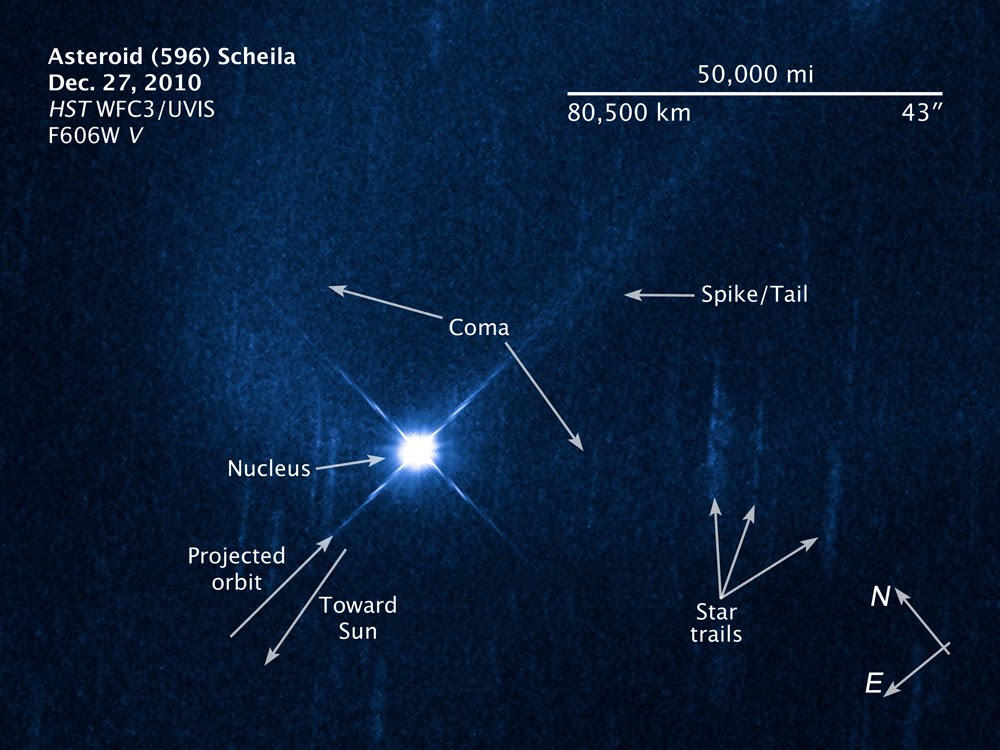
NASA's SWIFT and Hubble Probe Asteroid Collision Debris

Annotated Illustration and Compass Image
of Hubble Image of Asteroid (596) Scheila

Credit:
NASA, ESA, D. Jewitt (UCLA), and M. Mutchler (STScI)

Asteroid (596) Scheila
Faint dust plumes bookend asteroid (596) Scheila, which is overexposed in this composite image. Visible and ultraviolet images from Swift's UVOT (circled) are merged with a Digital Sky Survey image of the same region. The UVOT images were acquired on Dec. 15, 2010, when the asteroid was about 232 million miles from Earth. Credit: NASA/Swift/DSS/D. Bodewits (University of Maryland, College Park)

Late last year, astronomers noticed an asteroid named Scheila had unexpectedly brightened, and it was sporting short-lived plumes. Data from NASA's Swift satellite and Hubble Space Telescope showed these changes likely occurred after Scheila was struck by a much smaller asteroid.

"Collisions between asteroids create rock fragments, from fine dust to huge boulders, that impact planets and their moons," said Dennis Bodewits, an astronomer at the University of Maryland in College Park and lead author of the Swift study. "Yet this is the first time we've been able to catch one just weeks after the smash-up, long before the evidence fades away."

Asteroids are rocky fragments thought to be debris from the formation and evolution of the solar system approximately 4.6 billion years ago. Millions of them orbit the Sun between Mars and Jupiter in the main asteroid belt. Scheila is approximately 70 miles across and orbits the Sun every five years.

"The Hubble data are most simply explained by the impact, at 11,000 mph, of a previously unknown asteroid about 100 feet in diameter," said Hubble team leader David Jewitt at the University of California in Los Angeles. Hubble did not see any discrete collision fragments, unlike its 2009 observations of P/2010 A2, the first identified asteroid collision.

The studies will appear in the May 20 edition of The Astrophysical Journal Letters and are available online.

Astronomers have known for decades that comets contain icy material that erupts when warmed by the Sun. They regarded asteroids as inactive rocks whose densities, surfaces, shapes, and sizes were determined by mutual impacts. However, this simple picture has grown more complex over the past few years.

During certain parts of their orbits, some objects, once categorized as asteroids, clearly develop comet-like features that can last for many months. Others display much shorter outbursts. Icy materials may be occasionally exposed, either by internal geological processes or by an external one, such as an impact.

On Dec. 11, 2010, images from the University of Arizona's Catalina Sky Survey, a project of NASA's Near Earth Object Observations Program, revealed Scheila to be twice as bright as expected and immersed in a faint comet-like glow. Looking through the survey's archived images, astronomers inferred the outburst began between Nov. 11 and Dec. 3.

Three days after the outburst was announced, Swift's Ultraviolet/Optical Telescope (UVOT) captured multiple images and a spectrum of the asteroid. Ultraviolet sunlight breaks up the gas molecules surrounding comets; water, for example, is transformed into hydroxyl and hydrogen. But none of the emissions most commonly identified in comets, such as hydroxyl or cyanogen, show up in the UVOT spectrum. The absence of gas around Scheila led the Swift team to reject scenarios where exposed ice accounted for the activity.

Images show the asteroid was flanked in the north by a bright dust plume and in the south by a fainter one. The dual plumes formed as small dust particles excavated by the impact were pushed away from the asteroid by sunlight. Hubble observed the asteroid's fading dust cloud on Dec. 27, 2010, and Jan. 4, 2011.

The two teams found the observations were best explained by a collision with a small asteroid impacting Scheila's surface at an angle of less than 30 degrees, leaving a crater 1,000 feet across. Laboratory experiments show a more direct strike probably wouldn't have produced two distinct dust plumes. The researchers estimated the crash ejected more than 660,000 tons of dust — equivalent to nearly twice the mass of the Empire State Building.

The Swift team also includes Michael F. A'Hearn, Jian-Yang Li, and Sebastien Besse at the University of Maryland, College Park, and Wayne Landsman at NASA's Goddard Space Flight Center in Greenbelt, Md. Additional members of the Hubble team include Harold Weaver at the Johns Hopkins University Applied Physics Laboratory in Laurel, Md.; Max Mutchler at the Space Telescope Science Institute in Baltimore; Stephen Larson at the University of Arizona, Tucson; and Jessica Agarwal at the University of Potsdam in Germany.

"The dust cloud around Scheila could be 10,000 times as massive as the one ejected from comet 9P/Tempel 1 during NASA's University of Maryland-led Deep Impact mission," said co-author Michael Kelley, also at the University of Maryland. "Collisions allow us to peek inside comets and asteroids. Ejecta kicked up by Deep Impact contained lots of ice, and the absence of ice in Scheila's interior shows that it's entirely unlike comets."

Contact:

Trent J. Perrotto
Headquarters, Washington
202-358-0321
trent.j.perrotto@nasa.gov

Lynn Chandler
Goddard Space Flight Center, Greenbelt, Md.
301-286-2806
lynn.chandler-1@nasa.gov

Ray Villard
Space Telescope Science Institute, Baltimore, Md.
410-338-4514
villard@stsci.edu

Wednesday, May 26, 2010

NASA's Swift Survey finds 'Smoking Gun' of Black Hole Activation

The optical counterparts of many active galactic nuclei (circled) detected by the Swift BAT Hard X-ray Survey clearly show galaxies in the process of merging. These images, taken with the 2.1-meter telescope at Kitt Peak National Observatory in Arizona, show galaxy shapes that are either physically intertwined or distorted by the gravity of nearby neighbors. These AGN were known prior to the Swift survey, but Swift has found dozens of new ones in more distant galaxies. Credit: NASA/Swift/NOAO/Michael Koss and Richard Mushotzky (Univ. of Marylan)


Data from an ongoing survey by NASA's Swift satellite have helped astronomers solve a decades-long mystery about why a small percentage of black holes emit vast amounts of energy.

Only about one percent of supermassive black holes exhibit this behavior. The new findings confirm that black holes "light up" when galaxies collide, and the data may offer insight into the future behavior of the black hole in our own Milky Way galaxy. The study will appear in the June 20 issue of The Astrophysical Journal Letters.

The intense emission from galaxy centers, or nuclei, arises near a supermassive black hole containing between a million and a billion times the sun's mass. Giving off as much as 10 billion times the sun's energy, some of these active galactic nuclei (AGN) are the most luminous objects in the universe. They include quasars and blazars.

"Theorists have shown that the violence in galaxy mergers can feed a galaxy's central black hole," said Michael Koss, the study's lead author and a graduate student at the University of Maryland in College Park. "The study elegantly explains how the black holes switched on."

Until Swift's hard X-ray survey, astronomers never could be sure they had counted the majority of the AGN. Thick clouds of dust and gas surround the black hole in an active galaxy, which can block ultraviolet, optical and low-energy, or soft X-ray, light. Infrared radiation from warm dust near the black hole can pass through the material, but it can be confused with emissions from the galaxy's star-forming regions. Hard X-rays can help scientists directly detect the energetic black hole.

Since 2004, the Burst Alert Telescope (BAT) aboard Swift has been mapping the sky using hard X-rays.

"Building up its exposure year after year, the Swift BAT Hard X-ray Survey is the largest, most sensitive and complete census of the sky at these energies," said Neil Gehrels, Swift's principal investigator at NASA's Goddard Space Flight Center in Greenbelt, Md.

The survey, which is sensitive to AGN as far as 650 million light-years away, uncovered dozens of previously unrecognized systems.

"The Swift BAT survey is giving us a very different picture of AGN," Koss said. The team finds that about a quarter of the BAT galaxies are in mergers or close pairs. "Perhaps 60 percent of these galaxies will completely merge in the next billion years. We think we have the 'smoking gun' for merger-triggered AGN that theorists have predicted."

Other members of the study team include Richard Mushotzky and Sylvain Veilleux at the University of Maryland and Lisa Winter at the Center for Astrophysics and Space Astronomy at the University of Colorado in Boulder.

"We've never seen the onset of AGN activity so clearly," said Joel Bregman, an astronomer at the University Michigan, Ann Arbor, who was not involved in the study. "The Swift team must be identifying an early stage of the process with the Hard X-ray Survey."

Swift, launched in November 2004, is managed by Goddard. It was built and is being operated in collaboration with Penn State, the Los Alamos National Laboratory in New Mexico, and General Dynamics in Falls Church, Va.; the University of Leicester and Mullard Space Sciences Laboratory in the United Kingdom; Brera Observatory and the Italian Space Agency in Italy; plus additional partners in Germany and Japan.


This simulation follows the collision of two spiral galaxies that harbor giant black holes. The merger stirs up gas in both galaxies. Infalling gas "switches on" the black hole and creates an active galactic nucleus (AGN). Credit: Volker Springel and Tiziana Di Matteo (Max Planck Institute for Astrophysics), Lars Hernquist (Harvard Univ.) Download Video
See the original animation at: http://web.phys.cmu.edu/~tiziana/BHGrow/

Click here for multimedia related to the May 26, 2010, NASA briefing on Swift's findings.

Francis Reddy
NASA's Goddard Space Flight Center