Showing posts with label Gum 29. Show all posts

Saturday, January 24, 2026

Dwarf stars in a glittering sky

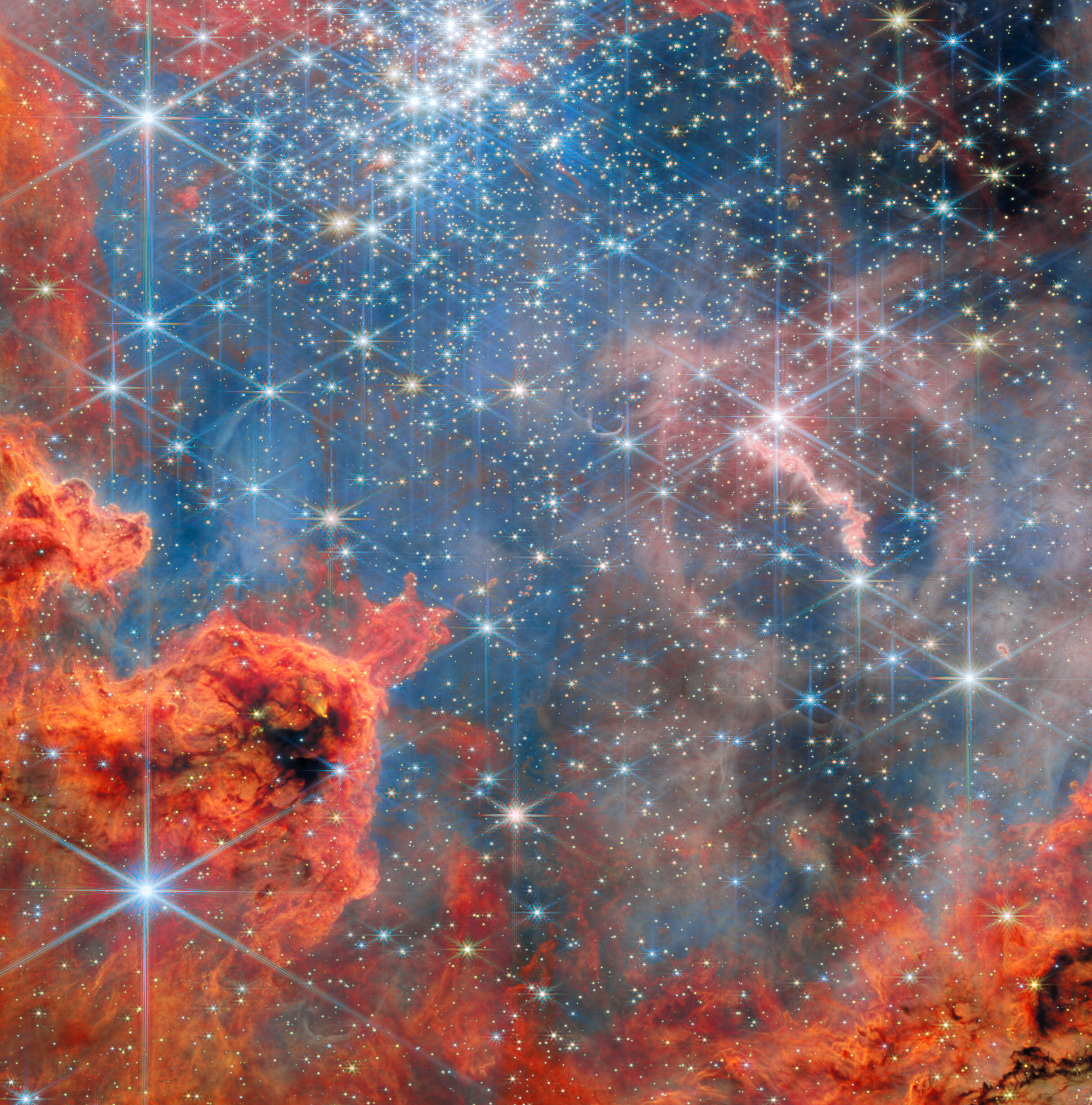
A cluster of stars inside a large nebula. The clouds of gas and dust are predominantly bright red in colour and wispy, akin to flames. They are clumped in the bottom-left corner. Other clouds, deeper in the cluster behind many of the stars, appear pale pink. The stars are concentrated in the top half of the image and are mostly small, bright white and six-pointed. They cast blue light over the nebula. Other stars with very long spikes surrounding them lie in the foreground. Credit: ESA/Webb, NASA & CSA, V. Almendros-Abad, M. Guarcello, K. Monsch, and the EWOCS team.


The final ESA/Webb Picture of the Month feature for 2025 showcases a festive-looking region filled with glowing clouds of gas and thousands of sparkling stars. This star cluster, known as Westerlund 2, resides in a stellar breeding ground known as Gum 29, located 20,000 light-years away from Earth in the constellation Carina (the Keel).

This image of Westerlund 2 uses data from Webb’s Near-InfraRed Camera (NIRCam) and Mid-InfraRed Instrument (MIRI). The cluster measures between 6 light-years and 13 light-years across, and is host to some of our Milky Way galaxy's hottest, brightest, and most massive stars. It was also the feature of Hubble’s 25th anniversary image in 2015.

;: This new Webb image captures the bright, brilliant cluster near the top that is packed with young, massive stars whose intense light shapes the entire scene. Below and around them, swirls of orange and red gas form sculpted walls and tangled clouds - material that is being pushed, eroded, and illuminated by the cluster’s powerful radiation. Threaded throughout the view are countless tiny stars just beginning to shine, some still surrounded by the gas and dust from which they formed. The soft blues and pinks are wisps of thinner material drifting between the denser clouds. Scattered across the field are also many bright stars much closer to us, whose sharp, star-shaped patterns are created by Webb’s optics. The result is a vivid portrait of a stellar nursery in action, where intense energy from newborn stars carves dramatic shapes into the surrounding nebula and drives the ongoing cycle of star formation.

These new Webb observations of Westerlund 2 have revealed, for the first time, the full population of brown dwarfs in this extremely massive young star cluster, including objects as small as about 10 times the mass of Jupiter. This data is allowing astronomers to find several hundred stars with discs in various evolutionary states to facilitate our understanding of how discs evolve and how planets form in such massive young clusters. This image was developed using data from Webb’s programme #3523 (M. Guarcello) as part of the Extended Westerlund 1 and 2 Open Clusters Survey (EWOCS).


Links


Saturday, May 30, 2020

Hubble Finds that "Distance" From the Brightest Stars is Key to Preserving Primordial Discs

The star cluster Westerlund 2
Westerlund 2 — Hubble’s 25th anniversary image

Wide-field image of Westerlund 2 (ground-based image)


Videos

Pan across Westerlund 2

Flight through star cluster Westerlund 2 - slow


The NASA/ESA Hubble Space Telescope was used to conduct a three-year study of the crowded, massive and young star cluster Westerlund 2. The research found that the material encircling stars near the cluster’s centre is mysteriously devoid of the large, dense clouds of dust that would be expected to become planets in a few million years. Their absence is caused by the cluster’s most massive and brightest stars that erode and disperse the discs of gas and dust of neighbouring stars. This is the first time that astronomers have analysed an extremely dense star cluster to study which environments are favourable to planet formation.

This time-domain study from 2016 to 2019 sought to investigate the properties of stars during their early evolutionary phases and to trace the evolution of their circumstellar environments [1]. Such studies had previously been confined to the nearest, low-density, star-forming regions. Astronomers have now used the Hubble Space Telescope to extend this research to the centre of one of the few young massive clusters in the Milky Way, Westerlund 2, for the first time.

Astronomers have now found that planets have a tough time forming in this central region of the cluster. The observations also reveal that stars on the cluster’s periphery do have immense planet-forming dust clouds embedded in their discs. To explain why some stars in Westerlund 2 have a difficult time forming planets while others do not, researchers suggest this is largely due to location. The most massive and brightest stars in the cluster congregate in the core. Westerlund 2 contains at least 37 extremely massive stars, some weighing up to 100 solar masses. Their blistering ultraviolet radiation and hurricane-like stellar winds act like blowtorches and erode the discs around neighbouring stars, dispersing the giant dust clouds.

“Basically, if you have monster stars, their energy is going to alter the properties of the discs,” explained lead researcher Elena Sabbi, of the Space Telescope Science Institute in Baltimore, USA. “You may still have a disc, but the stars change the composition of the dust in the discs, so it’s harder to create stable structures that will eventually lead to planets. We think the dust either evaporates away in 1 million years, or it changes in composition and size so dramatically that planets don’t have the building blocks to form.”

Westerlund 2 is a unique laboratory in which to study stellar evolutionary processes because it’s relatively nearby, is quite young, and contains a rich stellar population. The cluster resides in a stellar breeding ground known as Gum 29, located roughly 14 000 light-years away in the constellation of Carina (The Ship’s Keel). The stellar nursery is difficult to observe because it is surrounded by dust, but Hubble’s Wide Field Camera 3 can peer through the dusty veil in near-infrared light, giving astronomers a clear view of the cluster. Hubble’s sharp vision was used to resolve and study the dense concentration of stars in the central cluster.

“With an age of less than about two million years, Westerlund 2 harbours some of the most massive, and hottest, young stars in the Milky Way,” said team member Danny Lennon of the Instituto de Astrofísica de Canarias and the Universidad de La Laguna. “The ambient environment of this cluster is therefore constantly bombarded by strong stellar winds and ultraviolet radiation from these giants that have masses of up to 100 times that of the Sun.”

Sabbi and her team found that of the nearly 5000 stars in Westerlund 2 with masses between 0.1 and 5 times the Sun’s mass, 1500 of them show dramatic fluctuations in their luminosity, which is commonly accepted as being due to the presence of large dusty structures and planetesimals. Orbiting material would temporarily block some of the starlight, causing fluctuations in brightness. However, Hubble only detected the signature of dust particles around stars outside the central region. They did not detect these dips in brightness in stars residing within four light-years of the centre. 

“We think they are planetesimals or structures in formation,” Sabbi explained. “These could be the seeds that eventually lead to planets in more evolved systems. These are the systems we don’t see close to very  massive stars. We see them only in systems outside the centre.”

Thanks to Hubble, astronomers can now see how stars are accreting in environments that are like the early Universe, where clusters were dominated by monster stars. So far, the best known nearby stellar environment that contains massive stars is the starbirth region in the Orion Nebula. However, Westerlund 2 is a richer target because of its larger stellar population. 

“Westerlund 2 gives us much better statistics on how mass affects the evolution of  stars, how rapidly they evolve, and we see the evolution of stellar discs and the importance of stellar feedback in modifying the properties of these systems,” said Sabbi. “We can use all of this information to inform models of planet formation and stellar evolution.”

This cluster will also be an excellent target for follow-up observations with the upcoming NASA/ESA/CSA James Webb Space Telescope, an infrared observatory. Hubble has helped astronomers identify the stars that have possible planetary structures. With the Webb telescope, researchers will be able to study which discs around stars are not accreting material and which discs still have material that could build up into planets. Webb will also study the chemistry of the discs in different evolutionary phases and watch how they change, to help astronomers determine what role the environment plays in their evolution.

“A major conclusion of this work is that the powerful ultraviolet radiation of massive stars alters the discs around neighbouring stars,” said Lennon. “If this is confirmed with measurements by the James Webb Space Telescope, this result may also explain why planetary systems are rare in old massive globular clusters.”


Notes

[1] These observations were made under Hubble observing programs #14087, #15362, and #15514.


More Information

The Hubble Space Telescope is a project of international cooperation between ESA and NASA.

The international team of astronomers in this study consists of E. Sabbi, M. Gennaro, J. Anderson, V. Bajaj, N. Bastian, J. S. Gallagher, III, M. Gieles, D. J. Lennon, A. Nota, K. C. Sahu, and P. Zeidler.

Image credit: NASA, ESA, the Hubble Heritage Team (STScI/AURA), A. Nota (ESA/STScI), and the Westerlund 2 Science Team


Links

Elena Sabbi
Space Telescope Science Institute
Baltimore, MD, USA
Email:
sabbi@stsci.edu

Bethany Downer
ESA/Hubble, Public Information Officer
Garching, Germany
Email:
Bethany.Downer@partner.eso.org


Friday, April 24, 2015

Celestial fireworks celebrate Hubble’s 25th anniversary

Westerlund 2 — Hubble’s 25th anniversary image

Wide-field image of Westerlund 2 (ground-based image)

The star cluster Westerlund 2

Star-forming region Gum 29

Pillars around Westerlund 2

New stars around Westerlund 2 

******************************************************************************************


VIDEOS

Hubblecast Episode 84: A starry snapshot for Hubble’s 25th

Zoom into Westerlund 2

Westerlund 2 for fulldome

Pan across Westerlund 2

Flight through star cluster Westerlund 2 — fast

Flight through star cluster Westerlund 2 - slow


The glittering tapestry of young stars flaring to life in this new NASA/ESA Hubble Space Telescope image aptly resembles an exploding shell in a fireworks display. This vibrant image of the star cluster Westerlund 2 has been released to celebrate Hubble’s 25th year in orbit and a quarter of a century of new discoveries, stunning images and outstanding science.

On 24 April 1990 the NASA/ESA Hubble Space Telescope was sent into orbit aboard the space shuttle Discovery as the first space telescope of its kind. It offered a new view of the Universe and has, for 25 years, reached and surpassed all expectations, beaming back data and images that have changed scientists’ understanding of the Universe and the public’s perception of it.

In this image, the sparkling centrepiece of Hubble’s silver anniversary fireworks is a giant cluster of about 3000 stars called Westerlund 2 [1][2]. The cluster resides in a raucous stellar breeding ground known as Gum 29, located 20 000 light-years away in the constellation Carina.

The stellar nursery is difficult to observe because it is surrounded by dust, but Hubble’s Wide Field Camera 3 peered through the dusty veil in near-infrared light, giving astronomers a clear view of the cluster. Hubble’s sharp vision resolves the dense concentration of stars in the central cluster, which measures only about 10 light-years across.

The giant star cluster is only about two million years old, but contains some of the brightest, hottest and most massive stars ever discovered. Some of the heftiest stars are carving deep cavities in the surrounding material by unleashing torrents of ultraviolet light and high speed streams of charged particles, known as stellar winds. These are etching away the enveloping hydrogen gas cloud in which the stars were born and are responsible for the weird and wonderful shapes of the clouds of gas and dust in the image.

The pillars in the image are composed of dense gas and dust, and are resisting erosion from the fierce radiation and powerful winds. These gaseous monoliths are a few light-years tall and point to the central cluster. Other dense regions surround the pillars, including dark filaments of dust and gas.

Besides sculpting the gaseous terrain, the brilliant stars can also help create a succeeding generation of offspring. When the stellar winds hit dense walls of gas, they create shocks, which generate a new wave of star birth along the wall of the cavity. The red dots scattered throughout the landscape are a rich population of forming stars that are still wrapped in their gas and dust cocoons. These stellar foetuses have not yet ignited the hydrogen in their cores to light-up as stars. However, Hubble’s near-infrared vision allows astronomers to identify these fledglings. The brilliant blue stars seen throughout the image are mostly in the foreground.

The image’s central region, containing the star cluster, blends visible-light data taken by the Advanced Camera for Surveys and near-infrared exposures taken by the Wide Field Camera 3. The surrounding region is composed of visible-light observations taken by the Advanced Camera for Surveys.

This image is a testament to Hubble’s observational power and demonstrates that, even with 25 years of operations under its belt, Hubble’s story is by no means over. Hubble has set the stage for its companion the James Webb Space Telescope — scheduled for launch in 2018 — but will not be immediately replaced by this new feat of engineering, instead working alongside it. Now, 25 years after launch, is the time to celebrate Hubble’s future potential as well as its remarkable history.


Notes

[1] A new anniversary image is released every year; last year Hubble snapped the ethereal Monkey Head Nebula (heic1406). The year 2013 saw the release of a strikingly delicate view of the Horsehead Nebula (heic1307), and Hubble’s 22nd year was marked by a huge mosaic of a celestial spider (heic1206)! Other images include a multicoloured view of Saturn (opo9818a), a Tolkien-esque shot of the Carina Nebula (heic1007a), and a beautiful cosmic rose made up of merging galaxies (heic1107a). More anniversary images can be seen here.

[2] Westerlund 2 is named after Swedish astronomer Bengt Westerlund, who discovered the grouping in the 1960s.


Notes for Editors

The Hubble Space Telescope is a project of international cooperation between ESA and NASA.


More Information

Image credit: NASA, ESA, the Hubble Heritage Team (STScI/AURA), A. Nota (ESA/STScI), and the Westerlund 2 Science Team

The original observations of Westerlund 2 were obtained by the science team: Antonella Nota (ESA/STScI), Elena Sabbi (STScI), Eva Grebel and Peter Zeidler (Astronomisches Rechen-Institut Heidelberg), Monica Tosi (INAF, Osservatorio Astronomico di Bologna), Alceste Bonanos (National Observatory of Athens, Astronomical Institute), Carol Christian (STScI/AURA) and Selma de Mink (University of Amsterdam). Follow-up observations were made by the Hubble Heritage team: Zoltan Levay (STScI), Max Mutchler, Jennifer Mack, Lisa Frattare, Shelly Meyett, Mario Livio, Carol Christian (STScI/AURA), and Keith Noll (NASA/GSFC).


Links

Contacts

Georgia Bladon
ESA/Hubble, Public Information Officer
Garching, Germany
Cell: +44 7816291261
Email:
gbladon@partner.eso.org

Ray Villard
Space Telescope Science Institute
Baltimore, USA
Tel: +1-410-338-4514
Email:
villard@stsci.edu