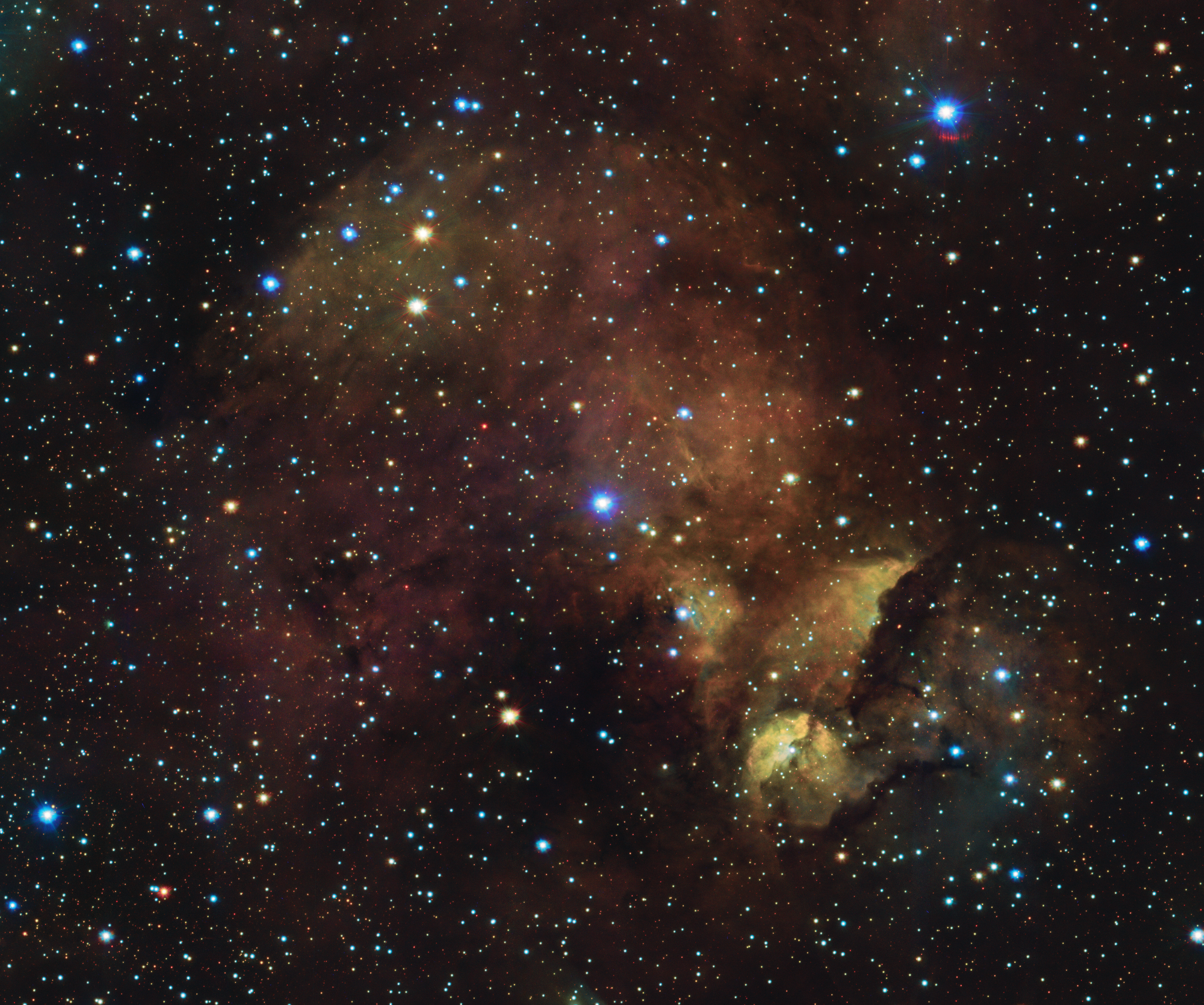
Image of the most massive planet-hosting star pair observed to date
Image of the most massive planet-hosting star pair observed to date (with annotations)
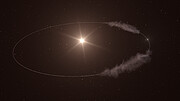
Artist impression showing b Centauri and its giant planet b Centauri b
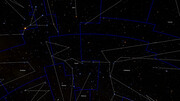
Location of b Centauri in the constellation of Centaurus
Videos
Surprise planet found around extreme star pair (ESOcast 247 Light)
The European Southern Observatory’s Very
Large Telescope (ESO’s VLT) has captured an image of a planet orbiting b
Centauri, a two-star system that can be seen with the naked eye. This
is the hottest and most massive planet-hosting star system found to
date, and the planet was spotted orbiting it at 100 times the distance
Jupiter orbits the Sun. Some astronomers believed planets could not
exist around stars this massive and this hot — until now.
“Finding a planet around b Centauri was very exciting since it completely changes the picture about massive stars as planet hosts,”
explains Markus Janson, an astronomer at Stockholm University, Sweden
and first author of the new study published online today in Nature.
Located approximately 325 light-years away in the
constellation Centaurus, the b Centauri two-star system (also known as
HIP 71865) has at least six times the mass of the Sun, making it by far
the most massive system around which a planet has been confirmed. Until
now, no planets had been spotted around a star more than three times as
massive as the Sun.
Most massive stars are also very hot, and this system is no
exception: its main star is a so-called B-type star that is over three
times as hot as the Sun. Owing to its intense temperature, it emits
large amounts of ultraviolet and X-ray radiation.
The large mass and the heat from this type of star have a
strong impact on the surrounding gas, that should work against planet
formation. In particular, the hotter a star is, the more high-energy
radiation it produces, which causes the surrounding material to
evaporate faster. “B-type stars are generally considered
The European Southern Observatory’s Very
Large Telescope (ESO’s VLT) has captured an image of a planet orbiting b
Centauri, a two-star system that can be seen with the naked eye. This
is the hottest and most massive planet-hosting star system found to
date, and the planet was spotted orbiting it at 100 times the distance
Jupiter orbits the Sun. Some astronomers believed planets could not
exist around stars this massive and this hot — until now.
“Finding a planet around b Centauri was very exciting since it completely changes the picture about massive stars as planet hosts,”
explains Markus Janson, an astronomer at Stockholm University, Sweden
and first author of the new study published online today in Nature.
Located approximately 325 light-years away in the
constellation Centaurus, the b Centauri two-star system (also known as
HIP 71865) has at least six times the mass of the Sun, making it by far
the most massive system around which a planet has been confirmed. Until
now, no planets had been spotted around a star more than three times as
massive as the Sun.
Most massive stars are also very hot, and this system is no
exception: its main star is a so-called B-type star that is over three
times as hot as the Sun. Owing to its intense temperature, it emits
large amounts of ultraviolet and X-ray radiation.
The large mass and the heat from this type of star have a
strong impact on the surrounding gas, that should work against planet
formation. In particular, the hotter a star is, the more high-energy
radiation it produces, which causes the surrounding material to
evaporate faster. “B-type stars are generally considered as quite
destructive and dangerous environments, so it was believed that it
should be exceedingly difficult to form large planets around them,” Janson says.
But the new discovery shows planets can in fact form in such severe star systems. “The
planet in b Centauri is an alien world in an environment that is
completely different from what we experience here on Earth and in our
Solar System,” explains co-author Gayathri Viswanath, a PhD student at Stockholm University. “It’s
a harsh environment, dominated by extreme radiation, where everything
is on a gigantic scale: the stars are bigger, the planet is bigger, the
distances are bigger.”
Indeed, the planet discovered, named b Centauri (AB)b or b
Centauri b, is also extreme. It is 10 times as massive as Jupiter,
making it one of the most massive planets ever found. Moreover, it moves
around the star system in one of the widest orbits yet discovered, at a
distance a staggering 100 times greater than the distance of Jupiter
from the Sun. This large distance from the central pair of stars could
be key to the planet’s survival.
These results were made possible thanks to the sophisticated Spectro-Polarimetric High-contrast Exoplanet REsearch instrument (SPHERE) mounted on ESO’s VLT in Chile. SPHERE has successfully imaged several planets orbiting stars other than the Sun before, including taking the first ever-image of two planets orbiting a Sun-like star.
However, SPHERE was not the first instrument to image this
planet. As part of their study, the team looked into archival data on
the b Centauri system and discovered that the planet had actually been
imaged more than 20 years ago by the ESO 3.6-m telescope, though it was not recognised as a planet at the time.
With ESO’s Extremely Large Telescope (ELT),
due to start observations later this decade, and with upgrades to the
VLT, astronomers may be able to unveil more about this planet’s
formation and features. “It will be an intriguing task to try to figure out how it might have formed, which is a mystery at the moment,” concludes Janson.
More InformationThis research was presented in a paper tilted "A wide-orbit
giant planet in the high-mass b Centauri binary system" to appear in Nature (DOI: 10.1038/s41586-021-04124-8).
The team is composed of Markus Janson (Department of
Astronomy, Stockholm University, Sweden [SU]), Raffaele Gratton (INAF
Osservatorio Astronomico di Padova, Italy [INAF-Padova]), Laetitia Rodet
(Cornell Center for Astrophysics and Planetary Science, Department of
Astronomy, Cornell University, USA), Arthur Vigan (Aix-Marseille
Université, CNRS, CNES, Laboratoire d’Astrophysique de Marseille, France
[LAM]), Mickaël Bonnefoy (Univ. Grenoble Alpes, CNRS, Institute for
Planetary sciences and Astrophysics, France [IPAG] and LAM), Philippe
Delorme (IPAG), Eric E. Mamajek (Jet Propulsion Laboratory, California
Institute of Technology, USA [JPL]), Sabine Reffert (Landessternwarte,
Zentrum für Astronomie der Universität Heidelberg, Germany [ZAH]), Lukas
Stock (ZAH and IPAG), Gabriel-Dominique Marleau (Institut für
Astronomie und Astrophysik, Universität Tübingen, Germany;
Physikalisches Institut, Universität Bern, Switzerland [UNIBE];
Max-Planck-Institut für Astronomie, Heidelberg, Germany), Maud Langlois
(Centre de Recherche Astrophysique de Lyon [CRAL], CNRS, Université
Lyon, France), Gaël Chauvin (Unidad Mixta Internacional Franco-Chilena
de Astronomía, CNRS/INSU and Departamento de Astronomía, Universidad de
Chile, Santiago, Chile, and Institute of Planetology and Astrophysics,
Grenoble, France), Silvano Desidera (INAF-Padova), Simon Ringqvist (SU),
Lucio Mayer (Center for Theoretical Physics and Cosmology, Institute
for Computational Science, University of Zurich, Switzerland [CTAC]),
Gayathri Viswanath (SU), Vito Squicciarini (INAF-Padova, Department of
Physics and Astronomy “Galileo Galilei”, University of Padova, Italy),
Michael R. Meyer (Department of Astronomy, University of Michigan, USA),
Matthias Samland (SU and MPIA), Simon Petrus (IPAG), Ravit Helled
(CTAC), Matthew A. Kenworthy (Leiden Observatory, Leiden University,
Netherlands), Sascha P. Quanz (ETH Zurich, Institute for Particle
Physics and Astrophysics, Switzerland [ETH Zurich]), Beth Biller
(Scottish Universities Physics Alliance, Institute for Astronomy, Royal
Observatory, University of Edinburgh, UK), Thomas Henning (MPIA), Dino
Mesa (INAF-Padova), Natalia Engler (ETH Zurich), Joseph C. Carson
(College of Charleston, Department of Physics & Astronomy, USA).
The European Southern Observatory (ESO) enables scientists worldwide to discover the secrets of the Universe for the benefit of all. We design, build and operate world-class observatories on the ground — which astronomers use to tackle exciting questions and spread the fascination of astronomy — and promote international collaboration in astronomy. Established as an intergovernmental organisation in 1962, today ESO is supported by 16 Member States (Austria, Belgium, the Czech Republic, Denmark, France, Finland, Germany, Ireland, Italy, the Netherlands, Poland, Portugal, Spain, Sweden, Switzerland and the United Kingdom), along with the host state of Chile and with Australia as a Strategic Partner. ESO’s headquarters and its visitor centre and planetarium, the ESO Supernova, are located close to Munich in Germany, while the Chilean Atacama Desert, a marvellous place with unique conditions to observe the sky, hosts our telescopes. ESO operates three observing sites: La Silla, Paranal and Chajnantor. At Paranal, ESO operates the Very Large Telescope and its Very Large Telescope Interferometer, as well as two survey telescopes, VISTA working in the infrared and the visible-light VLT Survey Telescope. Also at Paranal ESO will host and operate the Cherenkov Telescope Array South, the world’s largest and most sensitive gamma-ray observatory. Together with international partners, ESO operates APEX and ALMA on Chajnantor, two facilities that observe the skies in the millimetre and submillimetre range. At Cerro Armazones, near Paranal, we are building “the world’s biggest eye on the sky” — ESO’s Extremely Large Telescope. From our offices in Santiago, Chile we support our operations in the country and engage with Chilean partners and society.
Links
Contacts:
Markus Janson
Department of Astronomy, Stockholm University
Stockholm, Sweden
Tel: +46 8-553 785 48
Email: markus.janson@astro.su.se
Gayathri Viswanath
Department of Astronomy, Stockholm University
Stockholm, Sweden
Email: gayathri.viswanath@astro.su.se
Matthias Samland
Max Planck Institute for Astronomy
Heidelberg, Germany
Email: samland@mpia.de
Gaël Chauvin
Unidad Mixta Internacional Franco-Chilena de Astronomía, Departamento de
Astronomía, Universidad de Chile, and Institute of Planetology and
Astrophysics of Grenoble
Santiago/Grenoble, Chile/France
Email: gael.chauvin@univ-grenoble-alpes.fr
Raffaele Gratton
INAF Osservatorio Astronomico di Padova
Padova, Italy
Tel: +39 049 8293442
Email: raffaele.gratton@inaf.it
Sascha Quanz
ETH Zurich, Institute for Particle Physics and Astrophysics
Zurich, Switzerland
Tel: +39 049 8293442
Email: sascha.quanz@phys.ethz.ch
Beth Biller
Scottish Universities Physics Alliance, Institute for Astronomy, Royal Observatory, University of Edinburgh
Edinburgh, UK
Email: bb@roe.ac.uk
Matthew Kenworthy
Leiden Observatory, Leiden University
Leiden, Netherlands
Tel: +31 64 172 0331
Email: kenworthy@strw.leidenuniv.nl
Bárbara Ferreira
ESO Media Manager
Garching bei München, Germany
Tel: +49 89 3200 6670
Cell: +49 151 241 664 00
Email: press@eso.org