Westerlund 2 - NGC 346 - Cygnus OB3
Cat's Paw Nebula (NGC 6334) - Pelican Nebula (NGC 7000) - Flame Nebula (NGC 2024)
Cat's Paw Nebula (NGC 6334) - Pelican Nebula (NGC 7000) - Flame Nebula (NGC 2024)
Visual Description: Spring Collection
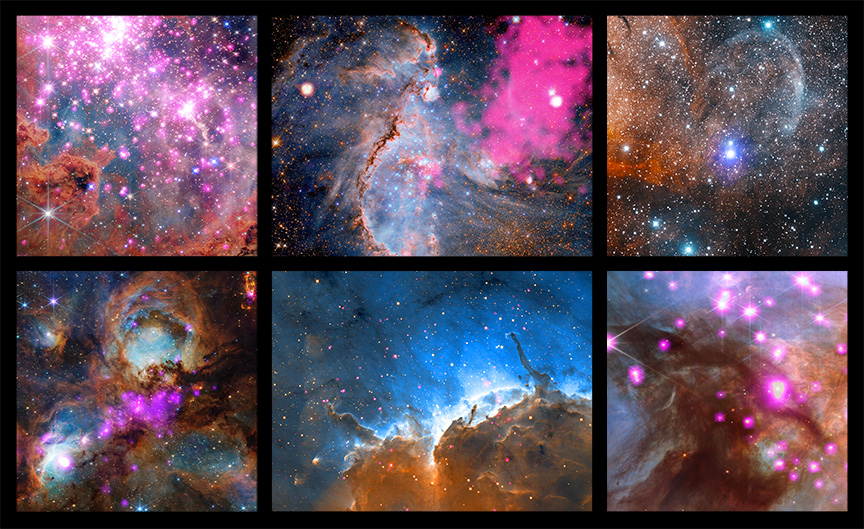
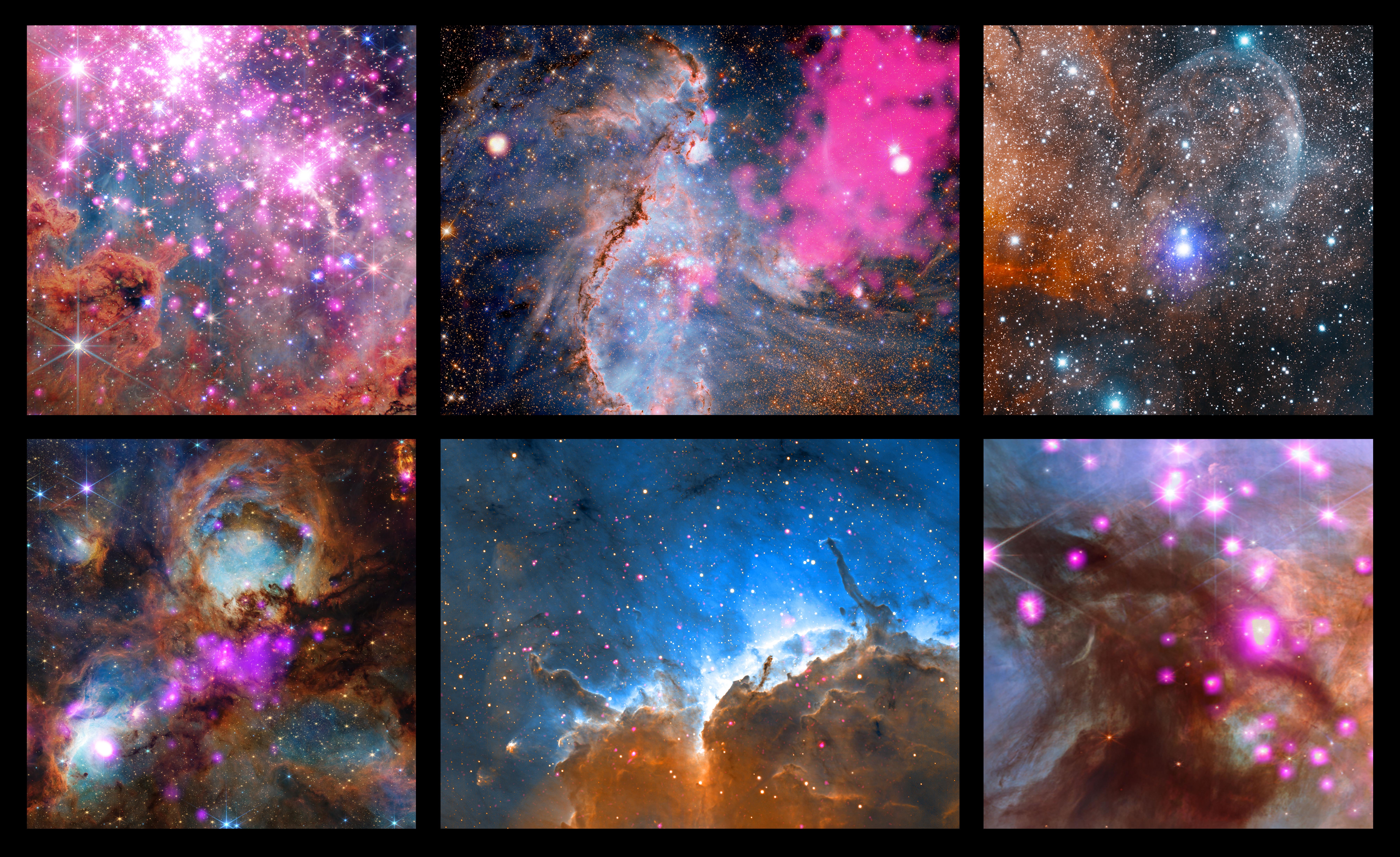
This release features a series of composite images, each highlighting a different star-forming region, or "stellar nursery". The bright, colorful images are individually labeled, and presented in a three by two grid.
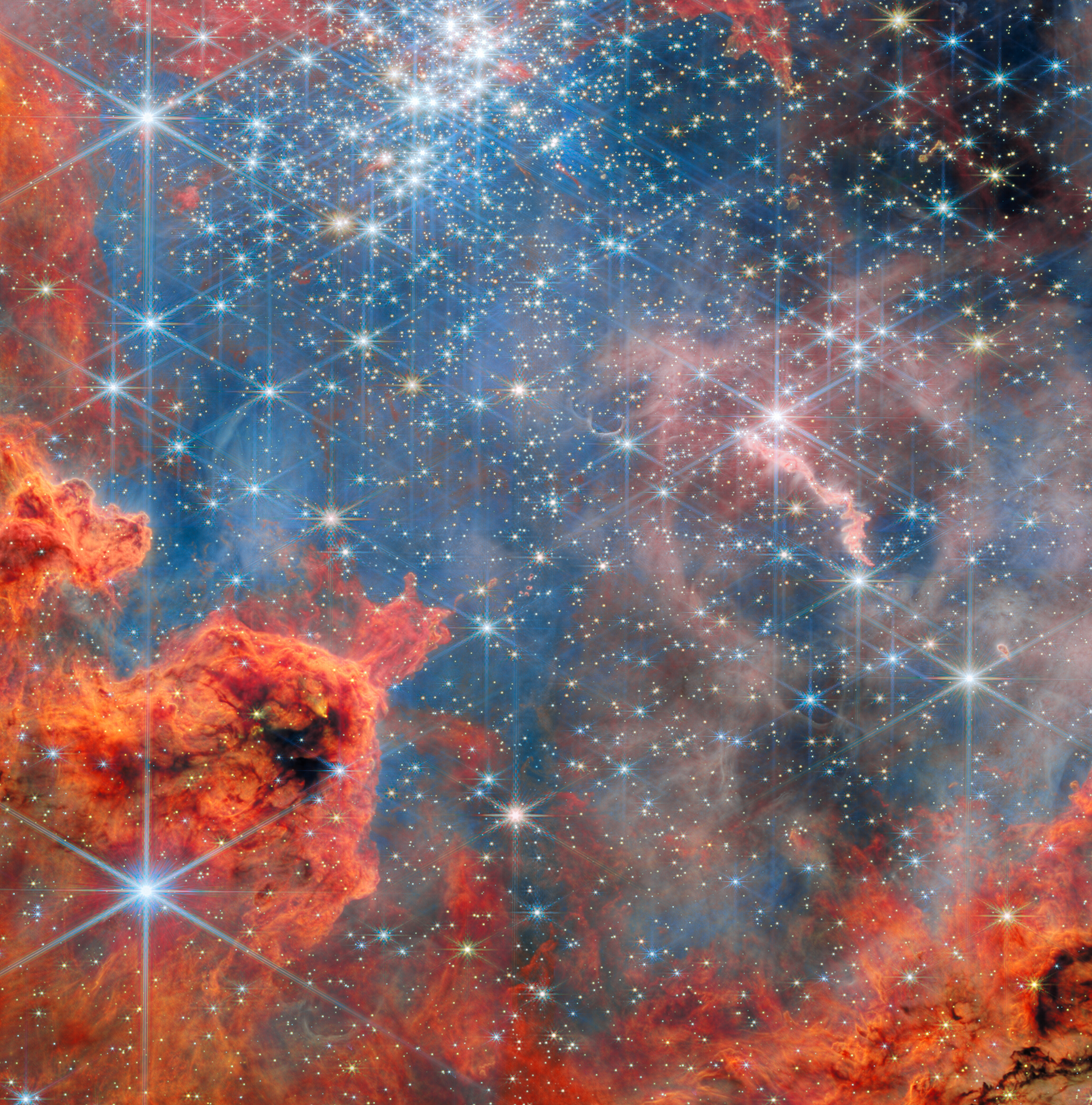
The first image, in the grid's upper left, features a young star cluster known as Westerlund 2. Here, scores of gleaming white specks ringed in neon pink are scattered across the image in a band that stretches from our lower right to our upper left, and beyond. The pink data represent stars seen with Chandra. Clouds of brick-orange dust enter the image from our lower left, and spread along the bottom edge of the frame.
Centered at the top of the grid is NGC 346, a star-forming region in the Small Magellanic Cloud. Here, tiny specks in golden orange, neon blue, and white, are scattered across a dark blue sky. Long streaks of hazy cloud coalesce on the left side of the image. A large, bright, neon pink X-ray cloud, seen with Chandra, hangs in the upper right.
In the upper right corner of the grid is Cygnus OB3, the most mature stellar nursery in the batch. Here, tiny white gleaming specks fill a black sky tinged with golden orange and silver haze. Several larger white spheres with faint outer rings in blues and greens dot the image, including a black hole and a massive star at the center of the frame.
In the second row of the grid, at our lower left, is a composite image of the Cat's Paw Nebula. Here, pockets of starry blue sky appear behind thick, overlapping rings of dark orange cloud. At the center of the image, tucked amongst the clouds, is a mottled patch of purple. This patch represents X-ray data gathered by Chandra. Centered at the bottom of the grid is the Pelican Nebula. Here, a hazy blue sky dotted with pink, white, and golden specks stretches across much of the frame. A dense, dark-orange cloud enters the composite image from lower right. Long, finger-like tendrils grow out of the cloud, as if reaching for distant baby stars.
And finally, at the lower righthand corner of the grid, is a composite image of the Flame Nebula. Here, a dense dusty-grey haze blankets the frame. Several dozen young stars light up the dust and gas cloud, white at the core with thick, neon purple-pink halos showing X-rays collected by Chandra.
The first image, in the grid's upper left, features a young star cluster known as Westerlund 2. Here, scores of gleaming white specks ringed in neon pink are scattered across the image in a band that stretches from our lower right to our upper left, and beyond. The pink data represent stars seen with Chandra. Clouds of brick-orange dust enter the image from our lower left, and spread along the bottom edge of the frame.
Centered at the top of the grid is NGC 346, a star-forming region in the Small Magellanic Cloud. Here, tiny specks in golden orange, neon blue, and white, are scattered across a dark blue sky. Long streaks of hazy cloud coalesce on the left side of the image. A large, bright, neon pink X-ray cloud, seen with Chandra, hangs in the upper right.
In the upper right corner of the grid is Cygnus OB3, the most mature stellar nursery in the batch. Here, tiny white gleaming specks fill a black sky tinged with golden orange and silver haze. Several larger white spheres with faint outer rings in blues and greens dot the image, including a black hole and a massive star at the center of the frame.
In the second row of the grid, at our lower left, is a composite image of the Cat's Paw Nebula. Here, pockets of starry blue sky appear behind thick, overlapping rings of dark orange cloud. At the center of the image, tucked amongst the clouds, is a mottled patch of purple. This patch represents X-ray data gathered by Chandra. Centered at the bottom of the grid is the Pelican Nebula. Here, a hazy blue sky dotted with pink, white, and golden specks stretches across much of the frame. A dense, dark-orange cloud enters the composite image from lower right. Long, finger-like tendrils grow out of the cloud, as if reaching for distant baby stars.
And finally, at the lower righthand corner of the grid, is a composite image of the Flame Nebula. Here, a dense dusty-grey haze blankets the frame. Several dozen young stars light up the dust and gas cloud, white at the core with thick, neon purple-pink halos showing X-rays collected by Chandra.
- This week, the Earth passes the point in its orbit when days in the northern hemisphere become longer than nights and spring begins.
- This collection of spring-themed images is meant to celebrate the “flowering” that occurs throughout space.
- There are six star-forming regions in these composite images, containing X-rays from Chandra and data from other telescopes.
- The objects are NGC 7000 (aka, the Pelican Nebula), the Cat’s Paw Nebula, NGC 346, the Flame Nebula, Westerlund 2, and Cygnus OB3.
In the Northern Hemisphere this week, the calendar officially passes from winter into spring when the length of the day and the night become equal as the days become longer. Meanwhile, there are places in space where blooms of the stellar variety are always growing.
This collection of images from NASA’s Chandra X-ray Observatory and other telescopes contains regions where stars are forming. Often nicknamed “stellar nurseries,” they are cosmic gardens from which stars – not plants – emerge from the interstellar soil of gas and dust. X-rays are energetic enough that they can penetrate the gas and dust of these stellar nurseries, giving insight to the young stars and other high-energy phenomena that are happening within, including the effects of X-rays on any planets or planet-forming disks orbiting stars.
And, like gardens here on Earth, some stellar nurseries bloom before others. These images are listed roughly by their age, representing a span from “early” to “late spring,” cosmically speaking.
The Pelican Nebula (also known as NGC 7000) and the Cat’s Paw Nebula both contain stars that are mainly about a million years old. By comparison, the Sun is over 4.5 billion years old — or more than 4,000 times the age of these stars. In this new image of the Pelican Nebula, X-rays from Chandra (pink) are combined with an optical image from NASA’s Hubble Space Telescope (red, green, and blue). Meanwhile, the Cat’s Paw Nebula image has Chandra X-ray data (pink) overlaid on infrared data from NASA’s James Webb Space Telescope (red, orange, yellow, green, cyan and blue).
For stars that are slightly older — with ages between about one and three million years old — we look to NGC 346, the Flame Nebula, and Westerlund 2. For NGC 346, a star-forming region in the Small Magellanic Cloud, X-rays from Chandra (purple) are combined with an optical image from Hubble (red, green, and blue). In the Flame Nebula composite, Chandra’s X-rays (purple) are found throughout the gas and dust-filled landscape in infrared light seen by NASA’s James Webb Space Telescope (red, green, and blue). This Westerlund 2 image contains X-ray data from Chandra (purple) and infrared data from Webb (red, orange, green, cyan, and blue).
The most mature stars in these spring-themed images is the region around Cygnus X-1, a binary system where a black hole is partnered with a massive star. In this image of the Cygnus OB3 region, X-rays from Chandra (blue) are combined with optical data from Kitt Peak National Observatory (red and blue).
The companion star to the black hole in Cygnus X-1 is particularly interesting. Because it more than 20 times more massive than the Sun, it is likely going to explode in a supernova in the future. This event would seed the area with new elements that will become the cosmic soil for the next generation of stars.
This process of supernova explosions sending essential elements out into space will happen to many of the most massive stars in these stellar nurseries, underscoring the similar rhythms between the cycle of life here on Earth and the cycle of the stars across space.
NASA's Marshall Space Flight Center in Huntsville, Alabama, manages the Chandra program. The Smithsonian Astrophysical Observatory's Chandra X-ray Center controls science operations from Cambridge, Massachusetts, and flight operations from Burlington, Massachusetts.
This collection of images from NASA’s Chandra X-ray Observatory and other telescopes contains regions where stars are forming. Often nicknamed “stellar nurseries,” they are cosmic gardens from which stars – not plants – emerge from the interstellar soil of gas and dust. X-rays are energetic enough that they can penetrate the gas and dust of these stellar nurseries, giving insight to the young stars and other high-energy phenomena that are happening within, including the effects of X-rays on any planets or planet-forming disks orbiting stars.
And, like gardens here on Earth, some stellar nurseries bloom before others. These images are listed roughly by their age, representing a span from “early” to “late spring,” cosmically speaking.
The Pelican Nebula (also known as NGC 7000) and the Cat’s Paw Nebula both contain stars that are mainly about a million years old. By comparison, the Sun is over 4.5 billion years old — or more than 4,000 times the age of these stars. In this new image of the Pelican Nebula, X-rays from Chandra (pink) are combined with an optical image from NASA’s Hubble Space Telescope (red, green, and blue). Meanwhile, the Cat’s Paw Nebula image has Chandra X-ray data (pink) overlaid on infrared data from NASA’s James Webb Space Telescope (red, orange, yellow, green, cyan and blue).
For stars that are slightly older — with ages between about one and three million years old — we look to NGC 346, the Flame Nebula, and Westerlund 2. For NGC 346, a star-forming region in the Small Magellanic Cloud, X-rays from Chandra (purple) are combined with an optical image from Hubble (red, green, and blue). In the Flame Nebula composite, Chandra’s X-rays (purple) are found throughout the gas and dust-filled landscape in infrared light seen by NASA’s James Webb Space Telescope (red, green, and blue). This Westerlund 2 image contains X-ray data from Chandra (purple) and infrared data from Webb (red, orange, green, cyan, and blue).
The most mature stars in these spring-themed images is the region around Cygnus X-1, a binary system where a black hole is partnered with a massive star. In this image of the Cygnus OB3 region, X-rays from Chandra (blue) are combined with optical data from Kitt Peak National Observatory (red and blue).
The companion star to the black hole in Cygnus X-1 is particularly interesting. Because it more than 20 times more massive than the Sun, it is likely going to explode in a supernova in the future. This event would seed the area with new elements that will become the cosmic soil for the next generation of stars.
This process of supernova explosions sending essential elements out into space will happen to many of the most massive stars in these stellar nurseries, underscoring the similar rhythms between the cycle of life here on Earth and the cycle of the stars across space.
NASA's Marshall Space Flight Center in Huntsville, Alabama, manages the Chandra program. The Smithsonian Astrophysical Observatory's Chandra X-ray Center controls science operations from Cambridge, Massachusetts, and flight operations from Burlington, Massachusetts.
Source: NASA’s Chandra X-ray Observatory
Visual Description:
This release features a series of composite images, each highlighting a different star-forming region, or "stellar nursery". The bright, colorful images are individually labeled, and presented in a three by two grid.
The first image, in the grid's upper left, features a young star cluster known a Westerlund 2. Here, scores of gleaming white specks ringed in neon pink are scattered across the image in a band that stretches from our lower right to our upper left, and beyond. The pink data represent stars seen with Chandra. Clouds of brick-orange dust enter the image from our lower left, and spread along the bottom edge of the frame.
Centered at the top of the grid is NGC 346, a star-forming region in the Small Magellanic Cloud. Here, tiny specks in golden orange, neon blue, and white, are scattered across a dark blue sky. Long streaks of hazy cloud coalesce on the left side of the image. A large, bright, neon pink X-ray cloud, seen with Chandra, hangs in the upper right.
In the upper right corner of the grid is Cygnus OB3, the most mature stellar nursery in the batch. Here, tiny white gleaming specks fill a black sky tinged with golden orange and silver haze. Several larger white spheres with faint outer rings in blues and greens dot the image, including a black hole and a massive star at the center of the frame.
In the second row of the grid, at our lower left, is a composite image of the Cat's Paw Nebula. Here, pockets of starry blue sky appear behind thick, overlapping rings of dark orange cloud. At the center of the image, tucked amongst the clouds, is a mottled patch of purple. This patch represents X-ray data gathered by Chandra.
Centered at the bottom of the grid is the Pelican Nebula. Here, a hazy blue sky dotted with pink, white, and golden specks stretches across much of the frame. A dense, dark-orange cloud enters the composite image from lower right. Long, finger-like tendrils grow out of the cloud, as if reaching for distant baby stars.
And finally, at the lower righthand corner of the grid, is a composite image of the Flame Nebula. Here, a dense dusty-grey haze blankets the frame. Several dozen young stars light up the dust and gas cloud, white at the core with thick, neon purple-pink halos showing X-rays collected by Chandra.
The first image, in the grid's upper left, features a young star cluster known a Westerlund 2. Here, scores of gleaming white specks ringed in neon pink are scattered across the image in a band that stretches from our lower right to our upper left, and beyond. The pink data represent stars seen with Chandra. Clouds of brick-orange dust enter the image from our lower left, and spread along the bottom edge of the frame.
Centered at the top of the grid is NGC 346, a star-forming region in the Small Magellanic Cloud. Here, tiny specks in golden orange, neon blue, and white, are scattered across a dark blue sky. Long streaks of hazy cloud coalesce on the left side of the image. A large, bright, neon pink X-ray cloud, seen with Chandra, hangs in the upper right.
In the upper right corner of the grid is Cygnus OB3, the most mature stellar nursery in the batch. Here, tiny white gleaming specks fill a black sky tinged with golden orange and silver haze. Several larger white spheres with faint outer rings in blues and greens dot the image, including a black hole and a massive star at the center of the frame.
In the second row of the grid, at our lower left, is a composite image of the Cat's Paw Nebula. Here, pockets of starry blue sky appear behind thick, overlapping rings of dark orange cloud. At the center of the image, tucked amongst the clouds, is a mottled patch of purple. This patch represents X-ray data gathered by Chandra.
Centered at the bottom of the grid is the Pelican Nebula. Here, a hazy blue sky dotted with pink, white, and golden specks stretches across much of the frame. A dense, dark-orange cloud enters the composite image from lower right. Long, finger-like tendrils grow out of the cloud, as if reaching for distant baby stars.
And finally, at the lower righthand corner of the grid, is a composite image of the Flame Nebula. Here, a dense dusty-grey haze blankets the frame. Several dozen young stars light up the dust and gas cloud, white at the core with thick, neon purple-pink halos showing X-rays collected by Chandra.
Fast Facts for Westerlund 2:
Credit: X-ray: NASA/CXC/SAO/Sejong Univ./Hur et al; Infrared: ESA/Webb, NASA & CSA, V. Almendros-Abad, M. Guarcello, K. Monsch, and the EWOCS team. Image Processing: NASA/CXC/SAO/L. Frattare and K. Arcand
Release Date: March 19, 2026Scale: Image is about 2.1 arcmin (12 light-years) across.
Category: Normal Stars & Star Clusters
Coordinates (J2000): RA: 10h 23m 58.60s | Dec: -57° 44' 40.62"
Constellation: Carina
Observation Date(s): 3 pointings from Aug 2003 to Sep 2006
Observation Time: 37 hours and 30 minutes (1 day 13 hours 30 minutes)
Obs. IDs: 3501, 6410, 6411
Instrument: ACIS
Color Code: X-ray: purple; Infrared: red, orange, green, cyan, and blue
Distance Estimate: About 20,000 light-years from Earth
Fast Facts for NGC 346:
Credit: X-ray: NASA/CXC/SAO; Optical: ESA/Hubble and NASA, A. Nota, P. Massey, E. Sabbi, C. Murray, M. Zamani (ESA/Hubble); Image Processing: NASA/CXC/SAO/L. Frattare
Release Date: March 19, 2026Scale: Image is about 3.8 arcmin (220 light-years) across.
Category: Normal Stars & Star Clusters
Coordinates (J2000): RA: 00h 59m 05.1s | Dec: -72° 10' 33.2"
Constellation: Tucana
Observation Date(s): May 15, 2001
Observation Time: 27 hours 25 minutes (1 days 3 hours 25 minutes)
Obs. IDs: 1881
Instrument: ACIS
Color Code: X-ray: purple; Optical: red, green, and blue
Distance Estimate: About 200,000 light-years from Earth
Fast Facts for Cygnus OB3:
Credit: X-ray: NASA/CXC/SAO; Optical: T.A. Rector (University of Alaska Anchorage) and H. Schweiker (WIYN and NOIRLab/NSF/AURA). Image Processing: NASA/CXC/SAO/L. Frattare
Release Date: March 19, 2026Scale: Image is about 26.5 arcmin (50 light-years) across.
Category: Normal Stars and Star Clusters & Black Holes
Coordinates (J2000): RA: 19h 58m 22s | Dec: +35° 12' 6"
Constellation: Cygnus
Observation Date(s): 3 observations from Jan 2002 to Apr 2003
Observation Time: 14 hours 18 minutes
Obs. IDs: 2742, 2743, 3814
Instrument: ACIS
Color Code: X-ray: blue; Optical: H-alpha: red, and Sulphur [S II]: blue
Distance Estimate: About 6,500 light-years from Earth
Fast Facts for Cat's Paw Nebula (NGC 6334):
Credit: X-ray: NASA/SAO/CXC; Infrared: NASA/ESA/CSA/STScI; Image Processing: NASA/CXC/SAO/J. Major
Release Date: March 19, 2026Scale: Image is about 72 arcmin (91 light-years) across.
Category: Normal Stars and Star Clusters
Coordinates (J2000): RA: 5h 46m 45.8s | Dec: +0° 0′ 08.1"
Constellation: Scorpius
Observation Date(s): 10 observations from Aug 2002 to Jul 2016
Observation Time: 85 hours 28 minutes (3 days 13 hours 28 minutes)
Obs. IDs: 2573, 2574 ,3844, 4591, 8975, 12382, 13436, 18082, 18081, 18876
Instrument: ACIS
Color Code: X-ray: pink; Infrared: red, orange, yellow, green cyan, and blue
Distance Estimate: About 4,370 light-years from Earth
Fast Facts for Pelican Nebula (NGC 7000):
Credit: X-ray: NASA/CXC/SAO/F. Damiani; Optical: J. Bally/University of Colorado, B. Reipurth/University of Hawaii and NOIRLab/NSF/AURA; Image Processing: NASA/CXC/SAO/L. Frattare
Release Date: March 19, 2026Scale: Image is about 19.3 arcmin (0.9 light-years) across.
Category: Normal Stars and Star Clusters
Coordinates (J2000): RA: 20h 50m 48s | Dec: +44° 21′ 0"
Constellation: Cygnus
Observation Date(s): 2 observations on Nov 20, 2012
Observation Time: 12 hours 6 minutes
Obs. IDs: 13647, 15592
Instrument: ACIS
Color Code: X-ray: purple; Optical: red, green, and blue Distance Estimate: About 1,800 light-years from Earth
Fast Facts for Flame Nebula (NGC 2024):
Credit: X-ray: NASA/CXC/PSU/K. Getman, E. Feigelson, M. Kuhn & the MYStIX team; JWST Image: NASA, ESA, CSA,STScI, M. Meyer (University of Michigan), M. De Furio (UT Austin), M. Robberto (STScI), A. Pagan (STScI); Image Processing: NASA/CXC/SAO/L. Frattare
Release Date: March 19, 2026
Scale: Image is about 2.2 arcmin (1 light-years) across.
Category: Normal Stars and Star Clusters
Coordinates (J2000): RA: 05h 41m 46.30s | Dec: -01° 55′ 28.70"
Constellation: Orion
Observation Date(s): 1 observation Aug 2001
Observation Time: 20 hours 57 minutes
Obs. IDs: 1878
Instrument: ACIS
Color Code: X-ray: purple; Infrared: red, green, and blue
Distance Estimate: About 1,350 light-years from Earth