Sunday, June 20, 2021

New image captures galaxy cluster emerging from cosmic web


Composite image using MUSTANG-2, Chandra, and SDSS data. The faint red glow shows the hot gas at large radii. galaxies present in MUSTANG-2 and Chandra appear as point sources (in magenta) and density of the comparatively cool gas (in blue); galaxies in optical (SDSS) data are in the foreground. Credit: Phillip Cigan/Stefano Andreon/Charles Romero


The tumultuous evolution of a galaxy cluster captured close to its formation in the cosmic web

An international team of astronomers using the National Science Foundation’s Green Bank Telescope (GBT) in Green Bank, West Virginia, and the NASA’s Chandra X-ray Observatory have captured a snapshot of a massive galaxy cluster, very close to the epoch when it began to emerge from the cosmic web.

The light of the galaxy cluster IDCSJ1426+3508, located at z=1.75, has been captured after travelling almost 10 Gyr (75% of the Universe’s age.) This new measurement allows astronomers to record the properties of its tenuous hot gas, which fills the whole cluster – at the earliest epochs probed so far – and more precisely than for any other very distant cluster.

The incredible age recorded by this measurement – and the unprecedented precision – is made possible by the joint use of ACIS-I on Chandra, allowing the team to measure the gas density of the cluster, and the MUSTANG-2 camera on GBT, allowing them to measure the gas pressure at the various cluster locations. The red color of the outer cluster region indicates that the gas gets hotter with increasing distance from the center, from 50 to 150-million degrees Celsius.

MUSTANG-2 is a 223-feedhorn bolometer camera, with the current fastest mapping speed for continuum observations at 90 GHz with resolution of 10″ or less. ACIS-I is a wide field X-ray camera and delivers the sharpest resolution, 1″, among all X-ray missions.

By comparing the gas properties of IDCSJ1426+3508 to plausible present-day descendants, the team identified the cluster’s potential evolution. “It was quite tumultuous – everywhere but in the center­ – temperatures get hotter in spite of new cold gas incorporated from peripheral regions,” commented Stefano Andreon, lead author of the article, of the INAF-Osservatorio Astronomico di Brera. “Instead,” continued Charles Romero of the Green Bank Observatory and the University of Pennsylvania, “the cluster center has preserved its properties in spite of the many perturbations excerced by the tumultuous and hostile environment, indicating that a feedback mechanism is counter-balancing every disturbance.”

“One swallow doesn’t make a summer,” Stefano intervened, “The evolution of galaxy clusters is likely diverse, the reason why we are observing, and inviting colleagues to observe other clusters emerging from the cosmic web in the hope of identifying an overall common pattern and also individual differences.” Charles concludes, “Of course, we’re interested in how clusters evolve through time, not just from the perspective of astrophysics, for example ‘heat transport’, but cluster evolution is a foundational component of our ability to learn about cosmology from clusters of galaxies.”

To learn more about Green Bank Observatory Observatory science and to see research opportunities visit our website.

The Green Bank Observatory is a facility of the National Science Foundation and is operated by Associated Universities, Inc. MUSTANG-2 was developed by Simon Dicker and the University of Pennsylvania with funding provided by the University and the National Science Foundation.

Written by

Contacts:

Jill Malusky,
Green Bank Observatory Public Relations,

jmalusky@nrao.edu


Saturday, June 19, 2021

The Give and Take of Mega-Flares From Stars

M8 (Lagoon Nebula) and RCW 120
Credit: X-ray: NASA/CXC/Penn State/K. Getman, et al; Infrared: NASA/JPL/Spitzer

Press Image, Caption, and Videos

The long relationships between stars and the planets around them — including the Sun and the Earth — may be even more complex than previously thought. This is one conclusion of a new study involving thousands of stars using NASA's Chandra X-ray Observatory.

By conducting the largest survey ever of star-forming regions in X-rays, a team of researchers has helped outline the link between very powerful flares, or outbursts, from youthful stars, and the impact they could have on planets in orbit.

"Our work tells us how the Sun may have behaved and affected the young Earth billions of years ago," said Kostantin Getman of Pennsylvania State University in University Park, Pennsylvania who led the study. "In some ways, this is our ultimate origin story: how the Earth and Solar System came to be."

The scientists examined Chandra's X-ray data of more than 24,000 stars in 40 different regions where stars are forming. They captured over a thousand stars that gave off flares that are vastly more energetic than the most powerful flare ever observed by modern astronomers on the Sun, the "Solar Carrington Event" in 1859. "Super" flares are at least one hundred thousand times more energetic than the Carrington Event and "mega" flares up to 10 million times more energetic.

These powerful flares observed by Chandra in this work occur in all of the star-forming regions and among young stars of all different masses, including those similar to the Sun. They are also seen at all different stages in the evolution of young stars, ranging from early stages when the star is heavily embedded in dust and gas and surrounded by a large planet-forming disk, to later stages when planets would have formed and the disks are gone. The stars in the study have ages estimated to be less than 5 million years, compared to the Sun's age of 4.5 billion years.

The team found several super-flares occur per week for each young star, averaged over the whole sample, and about two mega-flares every year.

"We want to know what kinds of impact — good and bad — these flares have on the early lives of planets," said co-author Eric Feigelson, also of Penn State. "Flares this powerful can have major implications."

Over the past two decades, scientists have argued that these giant flares can help "give" planets to still-forming stars by driving gas away from disks of material that surround them. This can trigger the formation of pebbles and other small rocky material that is a crucial step for planets to form.

On the other hand, these flares may "take away" from planets that have already formed by blasting any atmospheres with powerful radiation, possibly resulting in their complete evaporation and destruction in less than 5 million years.

The researchers also performed detailed modeling of 55 bright super- and mega-flares and found that most of them resemble long-lasting flares seen on the Sun that produce "coronal mass ejections," powerful ejections of charged particles that can damage planetary atmospheres. The Solar Carrington Event involved such an ejection.

This work is also important for understanding the flares themselves. The team found that the properties of the flares, such as their brightness and frequency, are the same for young stars with and without planet-forming disks. This implies that the flares are likely similar to those seen on the Sun, with loops of magnetic field having both footprints on the surface of the star, rather than one anchored to the disk and one to the star.

"We've found that these giant flares are like ones on the Sun but are just greatly magnified in energy and frequency, and the size of their magnetic loops," said co-author Gordon Garmire from the Huntingdon Institute for X-ray Astronomy in Huntingdon, Pennsylvania". Understanding these stellar outbursts may help us understand the most powerful flares and coronal mass ejections from the Sun."

This work was presented at the recent meeting of the American Astronomical Society and is described in a paper led by Getman that was accepted for publication in The Astrophysical Journal, and is available here. NASA's Marshall Space Flight Center manages the Chandra program. The Smithsonian Astrophysical Observatory's Chandra X-ray Center controls science from Cambridge, Massachusetts, and flight operations from Burlington, Massachusetts.


Other materials about the findings are available at: http://chandra.si.edu

For more Chandra images, multimedia and related materials, visit: http://www.nasa.gov/chandra

Media contacts:

Megan Watzke
Chandra X-ray Center, Cambridge, Mass.
617-496-7998

mwatzke@cfa.harvard.edu

Molly Porter
Marshall Space Flight Center, Huntsville, Alabama
256-544-0034

molly.a.porter@nasa.gov

 Source: NASA’s Chandra X-ray Observatory/Press Room

Friday, June 18, 2021

Scrambled magnetic fields and Gamma-Ray Bursts: Space scientists solve a decades-long puzzle

Impression of a GRB outflow showing the prompt phase (gamma-ray flash), reverse shock and forward shock

Bath astrophysicists find the magnetic field in Gamma-Ray Bursts is scrambled after the ejected material crashes into, and shocks, the surrounding medium.

An international team of scientists, led by astrophysicists from the University of Bath, has measured the magnetic field in a far-off Gamma-Ray Burst, confirming for the first time a decades-long theoretical prediction – that the magnetic field in these blast waves becomes scrambled after the ejected material crashes into, and shocks, the surrounding medium.

Black holes are formed when massive stars (at least 40 times larger than our Sun) die in a catastrophic explosion that powers a blast wave. These extremely energetic events drive out material at velocities close to the speed of light, and power bright, short-lived gamma-ray flashes that can be detected by satellites orbiting the Earth – hence their name, Gamma-Ray Bursts (GRBs).

Magnetic fields may be threaded through the ejected material and, as the spinning black hole forms, these magnetic fields twist into corkscrew shapes that are thought to focus and accelerate the ejected material.

The magnetic fields can’t be seen directly, but their signature is encoded in the light produced by charged particles (electrons) that whiz around the magnetic field lines. Earth-bound telescopes capture this light, which has travelled for millions of years across the Universe.

Head of Astrophysics at Bath and gamma-ray expert Professor Carole Mundell, said: “We measured a special property of the light – polarisation – to directly probe the physical properties of the magnetic field powering the explosion. This is a great result and solves a long-standing puzzle of these extreme cosmic blasts – a puzzle I’ve been studying for a long time.”

Capturing the light early

The challenge is to capture the light as soon as possible after a burst and decode the physics of the blast, the prediction being that any primordial magnetics fields will ultimately be destroyed as the expanding shock front collides with the surrounding stellar debris.

This model predicts light with high levels of polarisation (>10%) soon after the burst when the large-scale primordial field is still intact and driving the outflow. Later, the light should be mostly unpolarised as the field is scrambled in the collision.

Mundell’s team was first to discover highly polarised light minutes after the burst that confirmed the presence of primordial fields with large-scale structure. But the picture for expanding forward shocks has proved more controversial.

Teams who observed GRBs in slower time – hours to a day after a burst – found low polarisation and concluded the fields had long-since been destroyed, but could not say when or how. In contrast, a team of Japanese astronomers announced an intriguing detection of 10% polarised light in a GRB, which they interpreted as a polarised forward shock with long-lasting ordered magnetic fields.

Lead author of the new study, Bath PhD student Nuria Jordana-Mitjans, said: “These rare observations were difficult to compare, as they probed very different timescales and physics. There was no way to reconcile them in the standard model.”

The mystery remained unsolved for over a decade, until the Bath team’s analysis of GRB 141220A.

In the new paper, published today in the Monthly Notices of the Royal Astronomical Society, Professor Mundell’s team report the discovery of very low polarisation in forward-shock light detected just 90 seconds after the blast of GRB 141220A. The super-speedy observations were made possible by the team’s intelligent software on the fully autonomous robotic Liverpool Telescope and the novel RINGO3 polarimeter – the instrument that logged the GRB’s colour, brightness, polarisation and rate of fade. Putting together this data, the team was able to prove that:

  • GRB 141220A The light originated in the forward shock.
  • The magnetic field length scales were much smaller than the Japanese team inferred.
  • The blast was likely powered by the collapse of ordered magnetic fields in the first moments of the formation of a new black hole.
  • The mysterious detection of polarisation by the Japanese team could be explained by a contribution of polarised light from the primordial magnetic field before it was destroyed in the shock.

Ms Jordana-Mitjans said: “This new study builds on our research that has shown the most powerful GRBs can be powered by large-scale ordered magnetic fields, but only the fastest telescopes will catch a glimpse of their characteristic polarisation signal before they are lost to the blast.”

Professor Mundell added: “We now need to push the frontiers of technology to probe the earliest moments of these blasts, capture statistically significant numbers of bursts for polarisation studies and put our research into the wider context of real-time multimessenger follow-up of the extreme Universe.”

Read the full paper


Media enquiries

Vittoria D'Alessio

vda26@bath.ac.uk
+44 (0)1225 383135

Media Centre

Find information for journalists, bloggers and online commentators

Source: University of Bath/Announcements


Thursday, June 17, 2021

Study of Young Chaotic Star System Reveals Planet Formation Secrets


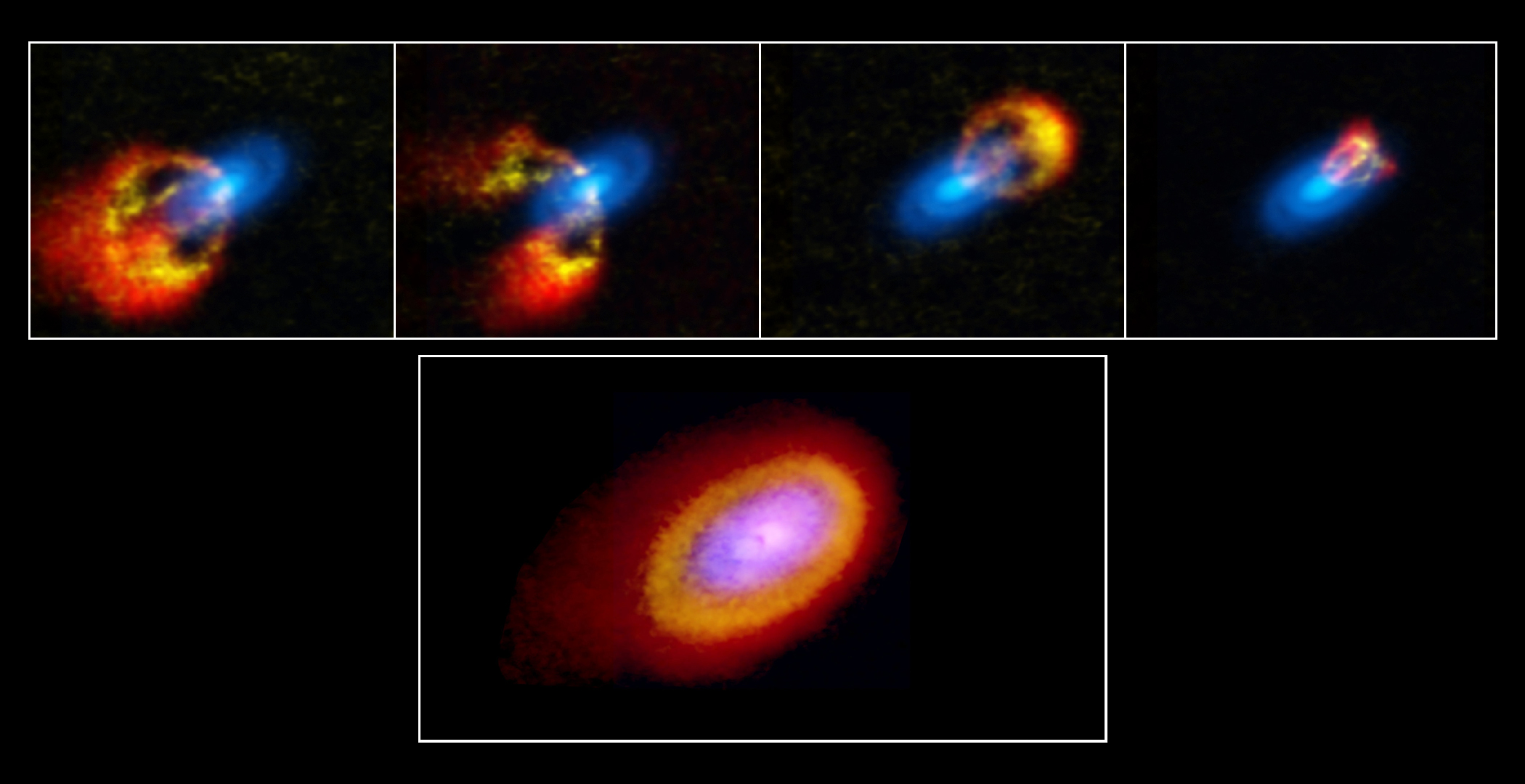
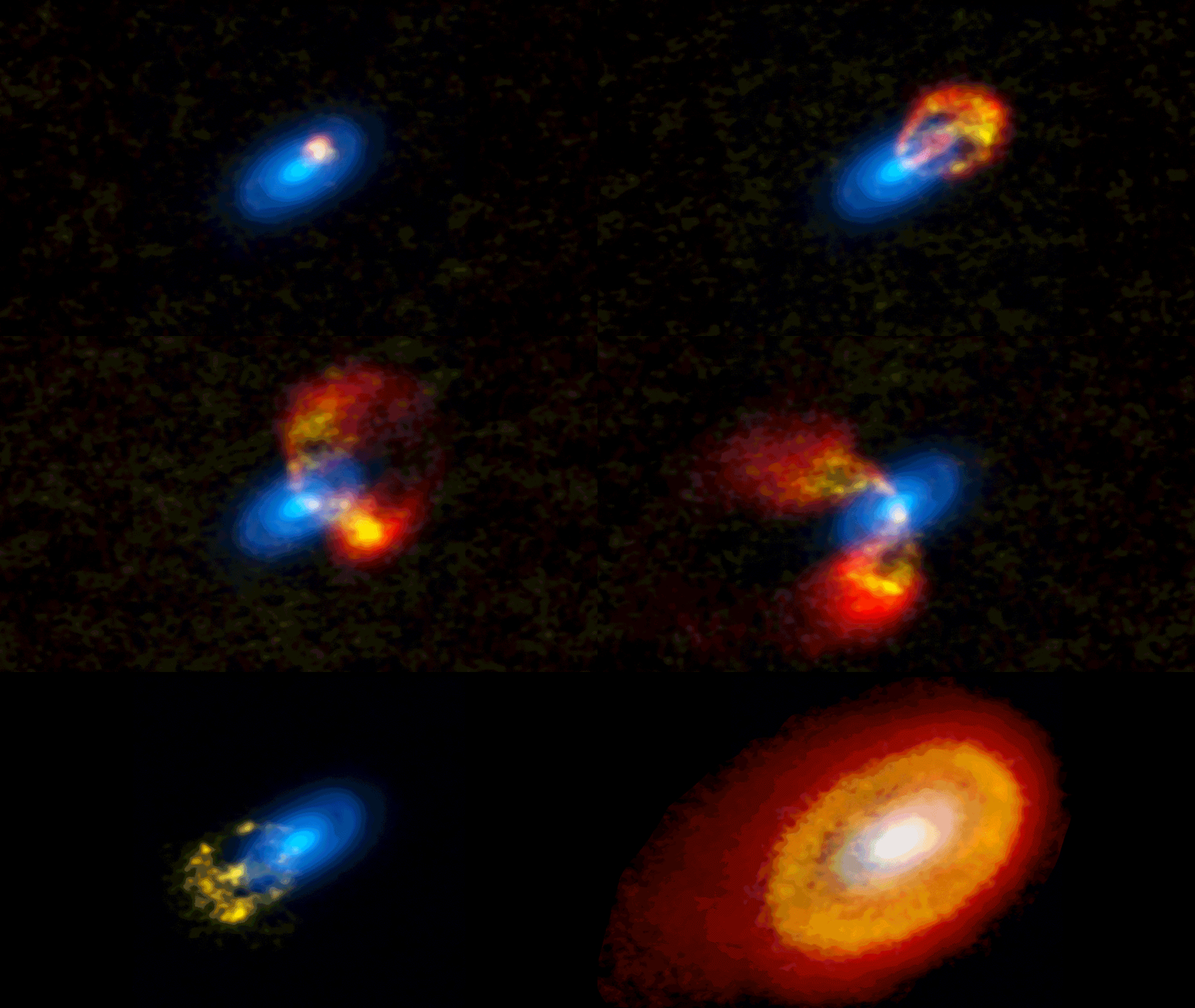
Using gas velocity data, scientists observing Elias 2-27 were able to directly measure the mass of the young star’s protoplanetary disk and also trace dynamical perturbations in the star system. Visible in this paneled composite are the dust continuum 0.87mm emission data (blue), along with emissions from gases C18O (yellow) and 13CO (red). Credit: ALMA (ESO/NAOJ/NRAO)/T. Paneque-Carreño (Universidad de Chile), B. Saxton (NRAO). Hi-Res File


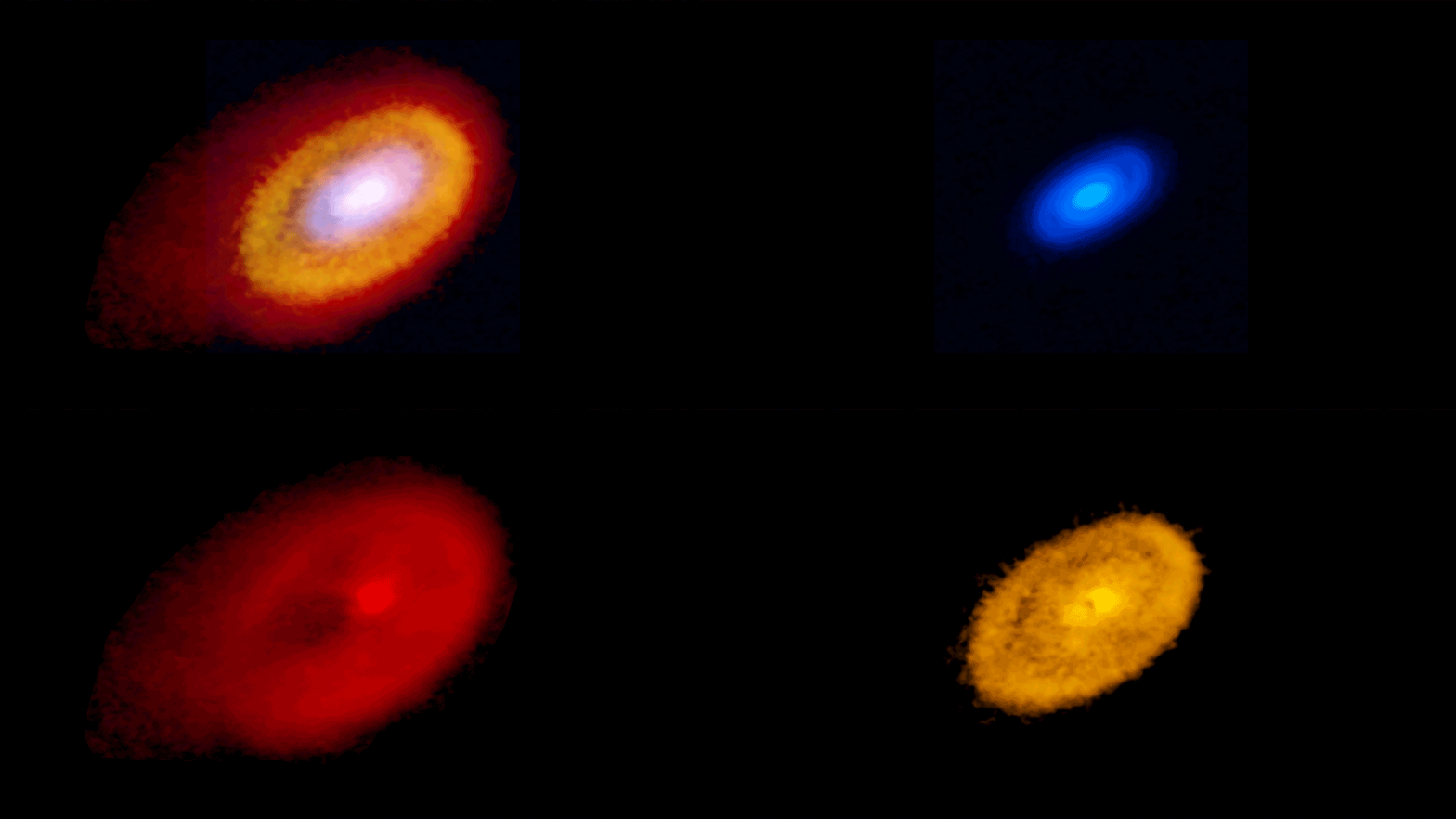
Multiple molecular tracers helped scientists to better understand the gases present in the disk surrounding Elias 2-27. Visible in this composite are the 0.87mm dust continuum data (blue), C18O emission (yellow), and 13CO emission (red). Credit: ALMA (ESO/NAOJ/NRAO)/T. Paneque-Carreño (Universidad de Chile), B. Saxton (NRAO). Hi-Res File


Multiple molecular tracers helped scientists to better understand the gases present in the disk surrounding Elias 2-27. Visible in this animation are the 0.87mm dust continuum data (blue), C18O emission (yellow), and 13CO emission (red), with each layer shown individually and in composite. Credit: ALMA (ESO/NAOJ/NRAO)/T. Paneque-Carreño (Universidad de Chile), B. Saxton (NRAO).
Hi-Res File


Using gas velocity data, scientists observing Elias 2-27 were able to directly measure the mass of the young star’s protoplanetary disk and also trace dynamical perturbations in the star system. Visible in this animation are the dust continuum 0.87mm emission data (blue), along with emissions from gases C18O (yellow) and 13CO (red). Credit: ALMA (ESO/NAOJ/NRAO)/T. Paneque-Carreño (Universidad de Chile), B. Saxton (NRAO).
Hi-Res File 
 

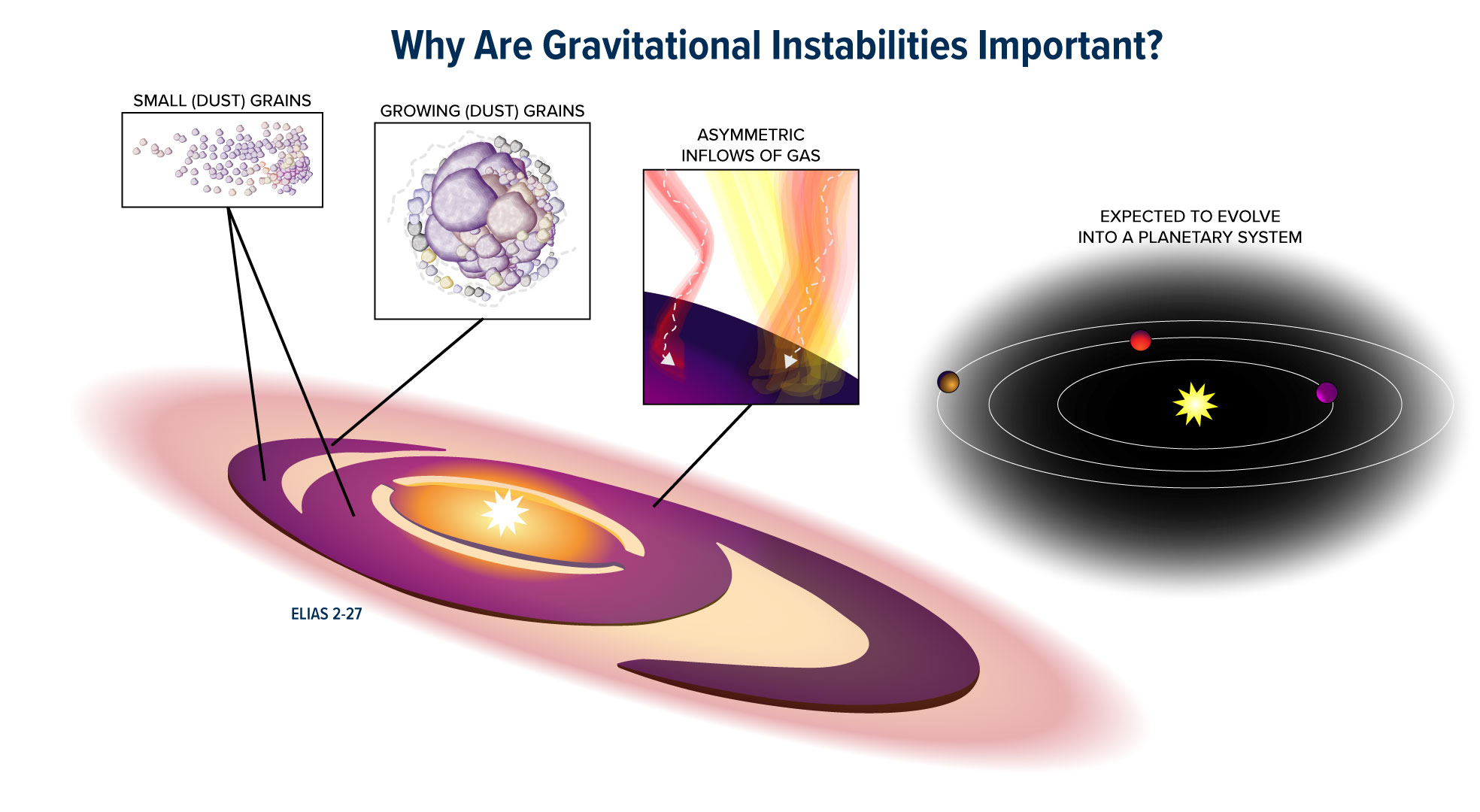
Elias 2-27 is a young star located just 378 light-years from Earth. The star is host to a massive protoplanetary disk of gas and dust, one of the key elements to planet formation. In this graphic illustration, dust is distributed along a spiral-shaped morphology first discovered in Elias 2-27 in 2016. The larger dust grains are found along the spiral arms while the smaller dust grains are distributed all around the protoplanetary disk. Asymmetric inflows of gas were also detected during the study, indicating that there may still be material infalling into the disk. Scientists believe that Elias 2-27 may eventually evolve into a planetary system, with gravitational instabilities causing the formation of giant planets. Because this process takes millions of years to occur, scientists can only observe the beginning stages. Credit: ALMA (ESO/NAOJ/NRAO)/T. Paneque-Carreño (Universidad de Chile), B. Saxton (NRAO).
Hi-Res File


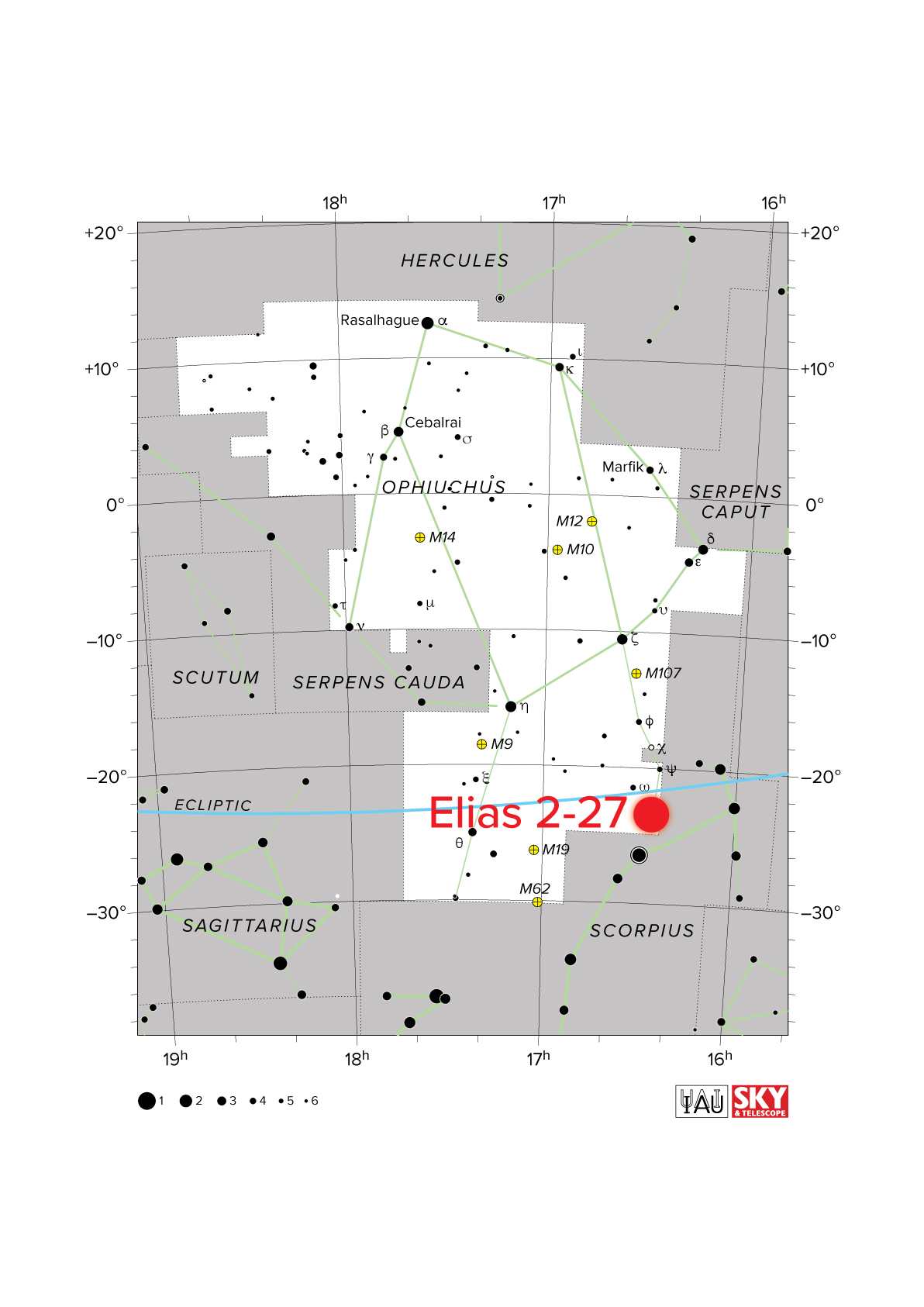
Elias 2-27 is a young star located 378 light-years from Earth, in the star-forming region of the Ophiuchus Molecular Cloud in the constellation Ophiuchus. Credit: ALMA (ESO/NAOJ/NRAO)/T. Paneque-Carreño (Universidad de Chile), B. Saxton (NRAO).
Hi-Res File


New observations of young stellar object Elias 2-27 confirm gravitational instabilities and planet-forming disk mass as key to formation of giant planets

A team of scientists using the Atacama Large Millimeter/submillimeter Array (ALMA) to study the young star Elias 2-27 have confirmed that gravitational instabilities play a key role in planet formation, and have for the first time directly measured the mass of protoplanetary disks

using gas velocity data, potentially unlocking one of the mysteries of planet formation. The results of the research are published today in two papers in The Astrophysical Journal.

Protoplanetary disks—planet-forming disks made of gas and dust that surround newly formed young stars—are known to scientists as the birthplace of planets. The exact process of planet formation, however, has remained a mystery. The new research, led by Teresa Paneque-Carreño—a recent graduate of the Universidad de Chile and PhD student at the University of Leiden and the European Southern Observatory, and the primary author on the first of the two papers—focuses on unlocking the mystery of planet formation.

During observations, scientists confirmed that the Elias 2-27 star system—a young star located less than 400 light-years away from Earth in the constellation Ophiuchus—was exhibiting evidence of gravitational instabilities which occur when planet-forming disks carry a large fraction of the system’s stellar mass. “How exactly planets form is one of the main questions in our field. However, there are some key mechanisms that we believe can accelerate the process of planet formation,” said Paneque-Carreño. “We found direct evidence for gravitational instabilities in Elias 2-27, which is very exciting because this is the first time that we can show kinematic and multi-wavelength proof of a system being gravitationally unstable. Elias 2-27 is the first system that checks all of the boxes.”

Elias 2-27’s unique characteristics have made it popular with ALMA scientists for more than half a decade. In 2016, a team of scientists using ALMA discovered a pinwheel of dust swirling around the young star. The spirals were believed to be the result of density waves, commonly known to produce the recognizable arms of spiral galaxies—like the Milky Way Galaxy—but at the time, had never before been seen around individual stars.

“We discovered in 2016 that the Elias 2-27 disk had a different structure from other already studied systems, something not observed in a protoplanetary disk before: two large-scale spiral arms. Gravitational instabilities were a strong possibility, but the origin of these structures remained a mystery and we needed further observations,” said Laura Pérez, Assistant Professor at the Universidad de Chile and the principal investigator on the 2016 study. Together with collaborators, she proposed further observations in multiple ALMA bands that were analyzed with Paneque-Carreño as a part of her M.Sc. thesis at Universidad de Chile.

In addition to confirming gravitational instabilities, scientists found perturbations—or disturbances—in the star system above and beyond theoretical expectations. “There may still be new material from the surrounding molecular cloud falling onto the disk, which makes everything more chaotic,” said Paneque-Carreño, adding that this chaos has contributed to interesting phenomena that have never been observed before, and for which scientists have no clear explanation. “The Elias 2-27 star system is highly asymmetric in the gas structure. This was completely unexpected, and it is the first time we’ve observed such vertical asymmetry in a protoplanetary disk.”

Cassandra Hall, Assistant Professor of Computational Astrophysics at the University of Georgia, and a co-author on the research, added that the confirmation of both vertical asymmetry and velocity perturbations—the first large-scale perturbations linked to spiral structure in a protoplanetary disk—could have significant implications for planet formation theory. “This could be a ‘smoking gun’ of gravitational instability, which may accelerate some of the earliest stages of planet formation. We first predicted this signature in 2020, and from a computational astrophysics point of view, it’s exciting to be right.”

Paneque-Carreño added that while the new research has confirmed some theories, it has also raised new questions. “While gravitational instabilities can now be confirmed to explain the spiral structures in the dust continuum surrounding the star, there is also an inner gap, or missing material in the disk, for which we do not have a clear explanation.”

One of the barriers to understanding planet formation was the lack of direct measurement of the mass of planet-forming disks, a problem addressed in the new research. The high sensitivity of ALMA Band 6, paired with Bands 3 and 7, allowed the team to more closely study the dynamical processes, density, and even the mass of the disk. “Previous measurements of protoplanetary disk mass were indirect and based only on dust or rare isotopologues. With this new study, we are now sensitive to the entire mass of the disk,” said Benedetta Veronesi—a graduate student at the University of Milan and postdoctoral researcher at École normale supérieure de Lyon, and the lead author on the second paper. “This finding lays the foundation for the development of a method to measure disk mass that will allow us to break down one of the biggest and most pressing barriers in the field of planet formation. Knowing the amount of mass present in planet-forming disks allows us to determine the amount of material available for the formation of planetary systems, and to better understand the process by which they form.” Although the team has answered a number of key questions about the role of gravitational instability and disk mass in planet formation, the work is not yet done. “Studying how planets form is difficult because it takes millions of years to form planets. This is a very short time-scale for stars, which live thousands of millions of years, but a very long process for us,” said Paneque-Carreño. “What we can do is observe young stars, with disks of gas and dust around them, and try to explain why these disks of material look the way they do. It’s like looking at a crime scene and trying to guess what happened. Our observational analysis paired with future in-depth analysis of Elias 2-27 will allow us to characterize exactly how gravitational instabilities act in planet-forming disks, and gain more insight into how planets are formed.”


Resources

Spiral Arms and a Massive Dust Disk with non-Keplerian Kinematics: Possible Evidence for Gravitational Instability in the Disk of Elias 2-27, Paneque-Carreño et al. ApJ, preview [
https://arxiv.org/pdf/2103.14048.pdf]

A Dynamical Measurement of the Disk Mass in Elias 2-27, Veronesi et al. ApJ, preview [
https://arxiv.org/pdf/2104.09530.pdf]


About ALMA

The Atacama Large Millimeter/submillimeter Array (ALMA), an international astronomy facility, is a partnership of the European Organisation for Astronomical Research in the Southern Hemisphere (ESO), the U.S. National Science Foundation (NSF) and the National Institutes of Natural Sciences (NINS) of Japan in cooperation with the Republic of Chile. ALMA is funded by ESO on behalf of its Member States, by NSF in cooperation with the National Research Council of Canada (NRC) and the Ministry of Science and Technology (MOST) and by NINS in cooperation with the Academia Sinica (AS) in Taiwan and the Korea Astronomy and Space Science Institute (KASI).

ALMA construction and operations are led by ESO on behalf of its Member States; by the National Radio Astronomy Observatory (NRAO), managed by Associated Universities, Inc. (AUI), on behalf of North America; and by the National Astronomical Observatory of Japan (NAOJ) on behalf of East Asia. The Joint ALMA Observatory (JAO) provides the unified leadership and management of the construction, commissioning and operation of ALMA..”


Media Contact:

Amy C. Oliver
Public Information Officer, ALMA
Public Information & News Manager, NRAO
+1 434 242 9584

aoliver@nrao.edu

Nicolás Lira
Education and Public Outreach Coordinator
Joint ALMA Observatory, Santiago – Chile
+56 2 2467 6519

nicolas.lira@alma.cl


Wednesday, June 16, 2021

Mystery of Betelgeuse’s dip in brightness solved

Betelgeuse’s surface before and during its 2019–2020 Great Dimming
 
Betelgeuse’s surface before and during its 2019–2020 Great Dimming (with annotations)
 
Image of Betelgeuse’s surface taken in March 2020
 
Image of Betelgeuse’s surface taken in January 2020
 
Image of Betelgeuse’s surface taken in December 2019
 
Image of Betelgeuse’s surface taken in January 2019
 
Wide-field view of the region of the sky where Betelgeuse is located 
 
The star Betelgeuse in the constellation of Orion


Videos

Who Turned off the Lights on Betelgeuse? (ESOcast 238 Light)
 
How Betelgeuse changed in brightness in 2019–2020
 
Artist’s animation of Betelgeuse and its dusty veil
Artist’s animation of Betelgeuse and its dusty veil 
 
Zooming in on Betelgeuse


Mystery of Betelgeuse’s dip in brightness solved

When Betelgeuse, a bright orange star in the constellation of Orion, became visibly darker in late 2019 and early 2020, the astronomy community was puzzled. A team of astronomers have now published new images of the star’s surface, taken using the European Southern Observatory’s Very Large Telescope (ESO’s VLT), that clearly show how its brightness changed. The new research reveals that the star was partially concealed by a cloud of dust, a discovery that solves the mystery of the “Great Dimming” of Betelgeuse.

Betelgeuse’s dip in brightness — a change noticeable even to the naked eye — led Miguel Montargès and his team to point ESO’s VLT towards the star in late 2019. An image from December 2019, when compared to an earlier image taken in January of the same year, showed that the stellar surface was significantly darker, especially in the southern region. But the astronomers weren’t sure why.

The team continued observing the star during its Great Dimming, capturing two other never-before-seen images in January 2020 and March 2020. By April 2020, the star had returned to its normal brightness.

“For once, we were seeing the appearance of a star changing in real time on a scale of weeks,” says Montargès, from the Observatoire de Paris, France, and KU Leuven, Belgium. The images now published are the only ones we have that show Betelgeuse’s surface changing in brightness over time.

In their new study, published today in Nature, the team revealed that the mysterious dimming was caused by a dusty veil shading the star, which in turn was the result of a drop in temperature on Betelgeuse’s stellar surface.

Betelgeuse’s surface regularly changes as giant bubbles of gas move, shrink and swell within the star. The team concludes that some time before the Great Dimming, the star ejected a large gas bubble that moved away from it. When a patch of the surface cooled down shortly after, that temperature decrease was enough for the gas to condense into solid dust.

“We have directly witnessed the formation of so-called stardust,” says Montargès, whose study provides evidence that dust formation can occur very quickly and close to a star’s surface. “The dust expelled from cool evolved stars, such as the ejection we’ve just witnessed, could go on to become the building blocks of terrestrial planets and life,” adds Emily Cannon, from KU Leuven, who was also involved in the study.

Rather than just the result of a dusty outburst, there was some speculation online that Betelgeuse’s drop in brightness could signal its imminent death in a spectacular supernova explosion. A supernova hasn’t been observed in our galaxy since the 17th century, so present-day astronomers aren’t entirely sure what to expect from a star in the lead-up to such an event. However, this new research confirms that Betelgeuse's Great Dimming was not an early sign that the star was heading towards its dramatic fate.

Witnessing the dimming of such a recognisable star was exciting for professional and amateur astronomers alike, as summed up by Cannon: “Looking up at the stars at night, these tiny, twinkling dots of light seem perpetual. The dimming of Betelgeuse breaks this illusion.”

The team used the Spectro-Polarimetric High-contrast Exoplanet REsearch (SPHERE) instrument on ESO’s VLT to directly image the surface of Betelgeuse, alongside data from the GRAVITY instrument on ESO’s Very Large Telescope Interferometer (VLTI), to monitor the star throughout the dimming. The telescopes, located at ESO’s Paranal Observatory in Chile’s Atacama Desert, were a “vital diagnostic tool in uncovering the cause of this dimming event,” says Cannon. “We were able to observe the star not just as a point but could resolve the details of its surface and monitor it throughout the event,” Montargès adds.

Montargès and Cannon are looking forward to what the future of astronomy, in particular what ESO’s Extremely Large Telescope (ELT), will bring to their study of Betelgeuse, a red supergiant star. “With the ability to reach unparalleled spatial resolutions, the ELT will enable us to directly image Betelgeuse in remarkable detail,” says Cannon. “It will also significantly expand the sample of red supergiants for which we can resolve the surface through direct imaging, further helping us to unravel the mysteries behind the winds of these massive stars.”


More Information

This research was presented in the paper “A dusty veil shading Betelgeuse during its Great Dimming” (https://doi.org/10.1038/s41586-021-03546-8) to appear in Nature.

The team is composed of M. Montargès (LESIA, Observatoire de Paris, Université PSL, CNRS, Sorbonne Université, Université de Paris France [LESIA] and Institute of Astronomy, KU Leuven, Belgium [KU Leuven]), E. Cannon (KU Leuven), E. Lagadec (Université Côte d’Azur, Observatoire de la Côte d’Azur, CNRS, Laboratoire Lagrange, Nice, France [OCA]), A. de Koter (Anton Pannekoek Institute for Astronomy, University of Amsterdam, The Netherlands and KU Leuven), P. Kervella (LESIA), J. Sanchez-Bermudez (Max Planck Institute for Astronomy, Heidelberg, Germany [MPIA] and Instituto de Astronomía, Universidad Nacional Autónoma de México, Mexico City, Mexico), C. Paladini (European Southern Observatory, Santiago, Chile [ESO-Chile]), F. Cantalloube (MPIA), L. Decin (KU Leuven and School of Chemistry, University of Leeds, UK), P. Scicluna (ESO-Chile), K. Kravchenko (Max Planck Institute for Extraterrestrial Physics, Germany), A. K. Dupree (Center for Astrophysics | Harvard & Smithsonian, Cambridge, MA, USA), S. Ridgway (NSF’s NOIRLab, Tucson, AZ, USA), M. Wittkowski (European Southern Observatory, Garching bei Munchen, Germany [ESO-Garching]), N. Anugu (Steward Observatory, University of Arizona, Tucson, AZ, USA and School of Physics and Astronomy, University of Exeter, UK [Exeter]), R. Norris (Physics Department, New Mexico Institute of Mining and Technology, Socorro, USA), G. Rau (NASA Goddard Space Flight Center, Exoplanets & Stellar Astrophysics Laboratory, Greenbelt, MD, USA [NASA Goddard] and Department of Physics, Catholic University of America, Washington, DC USA), G. Perrin (LESIA), A. Chiavassa (OCA), S. Kraus (Exeter), J. D. Monnier (Department of Astronomy, University of Michigan, Ann Arbor, MI, USA [Michigan]), F. Millour (OCA), J.-B. Le Bouquin (Univ. Grenoble Alpes, CNRS, IPAG, Grenoble, France and Michigan), X. Haubois (ESO-Chile), B. Lopez (OCA), P. Stee (OCA), and W. Danchi (NASA Goddard).

ESO is the foremost intergovernmental astronomy organisation in Europe and the world’s most productive ground-based astronomical observatory by far. It has 16 Member States: Austria, Belgium, the Czech Republic, Denmark, France, Finland, Germany, Ireland, Italy, the Netherlands, Poland, Portugal, Spain, Sweden, Switzerland and the United Kingdom, along with the host state of Chile and with Australia as a Strategic Partner. ESO carries out an ambitious programme focused on the design, construction and operation of powerful ground-based observing facilities enabling astronomers to make important scientific discoveries. ESO also plays a leading role in promoting and organising cooperation in astronomical research. ESO operates three unique world-class observing sites in Chile: La Silla, Paranal and Chajnantor. At Paranal, ESO operates the Very Large Telescope and its world-leading Very Large Telescope Interferometer as well as two survey telescopes, VISTA working in the infrared and the visible-light VLT Survey Telescope. Also at Paranal ESO will host and operate the Cherenkov Telescope Array South, the world’s largest and most sensitive gamma-ray observatory. ESO is also a major partner in two facilities on Chajnantor, APEX and ALMA, the largest astronomical project in existence. And on Cerro Armazones, close to Paranal, ESO is building the 39-metre Extremely Large Telescope, the ELT, which will become “the world’s biggest eye on the sky”.


Links


Contacts

Miguel Montargès
LESIA, Observatoire de Paris, PSL University
Paris, France
Tel: +33 (0)1 45 07 76 95
Email:
miguel.montarges@observatoiredeparis.psl.eu

Emily Cannon
Institute of Astronomy, KU Leuven
Leuven, Belgium
Email:
emily.cannon@kuleuven.be

Bárbara Ferreira
ESO Media Manager
Garching bei München, Germany
Tel: +49 89 3200 6670
Cell: +49 151 241 664 00
Email:
press@eso.org

Source: ESO/News


Tuesday, June 15, 2021

Jets from Massive Protostars Might be Very Different from Lower-Mass Systems, Astronomers Find


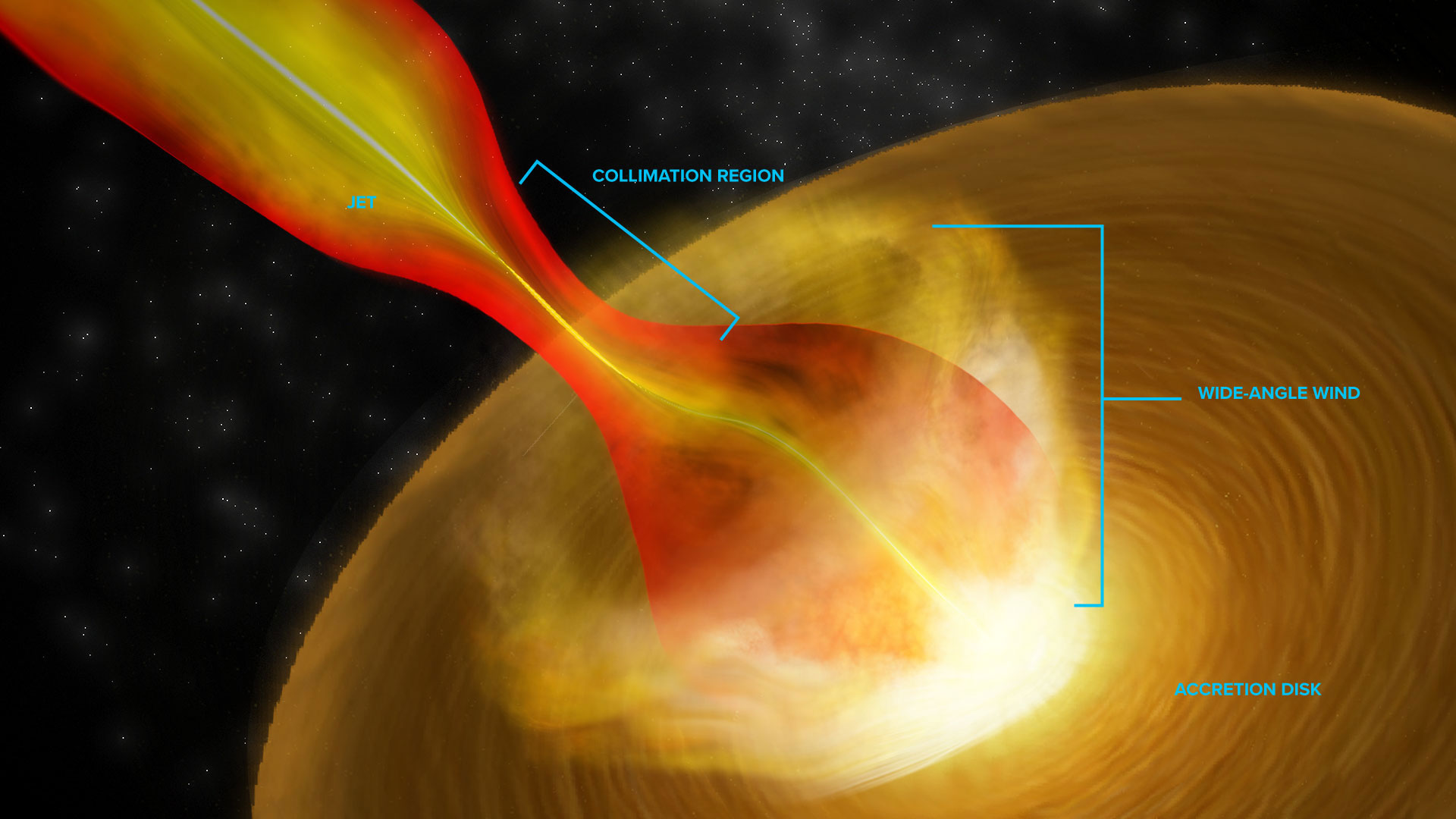
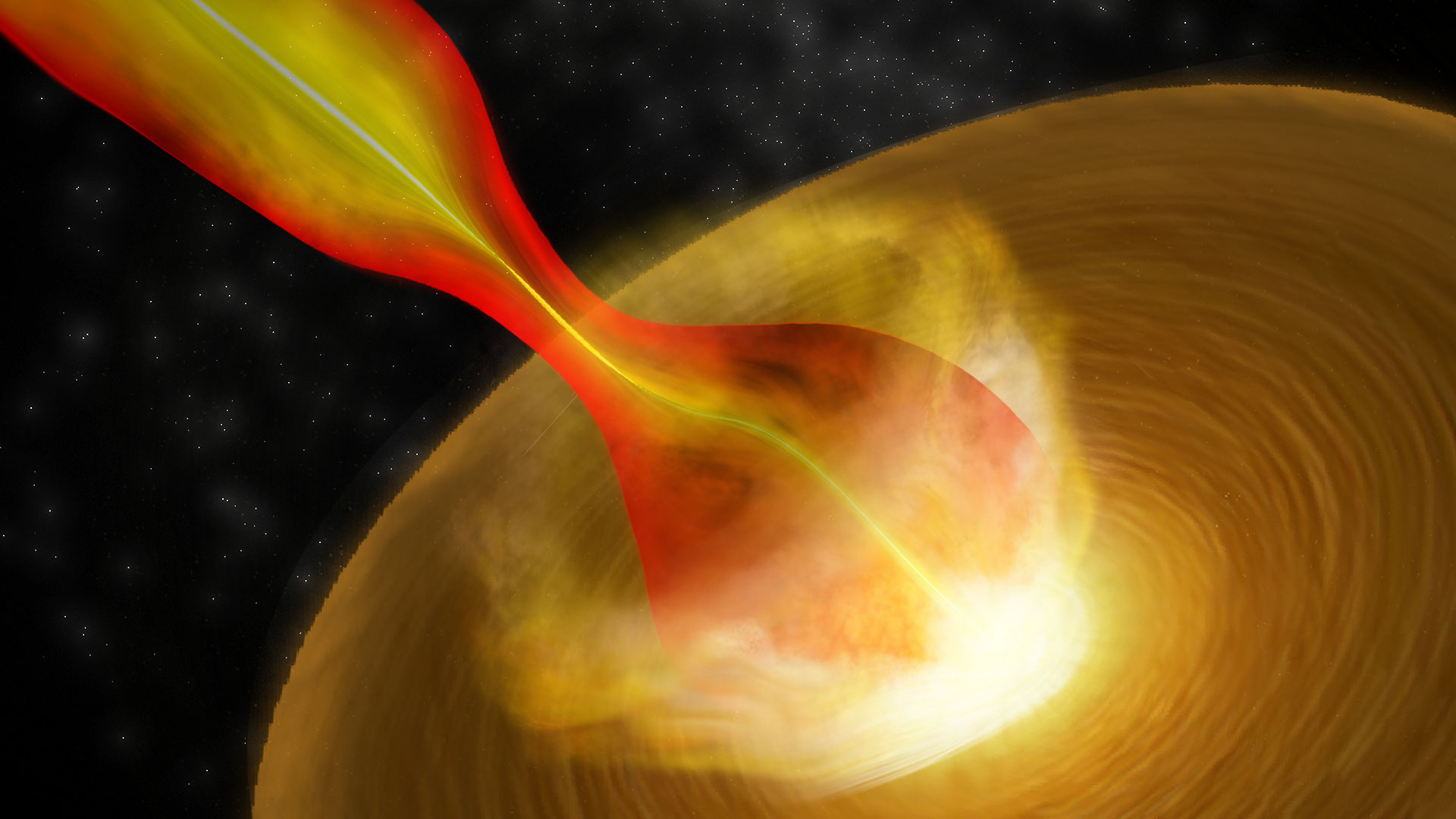
Artist's conception of the young star Cep A HW2, showing a wide-angle wind originating close to the star and a disk of material orbiting the star (called an accretion disk), with a much narrower jet farther away. Credit: Bill Saxton, NRAO/AUI/NSF.
Hi-Res File

VLA image of the jet from protostar Cep A HW2
Credit: Carrasco-Gonzalez et al., Bill Saxton, NRAO/AUI/NSF.
Hi-Res File


VLA image of the jet from protostar Cep A HW2, with surrounding area shown in Hubble Space Telescope image. Circles indicate location of the accretion disk, not seen in this image. Credit: Carrasco-Gonzalez et al.; Bill Saxton, NRAO/AUI/NSF; STScI.
Hi-Res File

Artist's conception of Cep A HW2 and its jet, with labels
Credit: Bill Saxton, NRAO/AUI/NSF.
Hi-Res File

Location of Cep A HW2 in the sky
Credit: Bill Saxton, NRAO/AUI/NSF.
Hi-Res File


Astronomers studying the fast-moving jet of material ejected by a still-forming, massive young star found a major difference between that jet and those ejected by less-massive young stars. The scientists made the discovery by using the U.S. National Science Foundation’s Karl G. Jansky Very Large Array (VLA) to make the most detailed image yet of the inner region of such a jet coming from a massive young star.
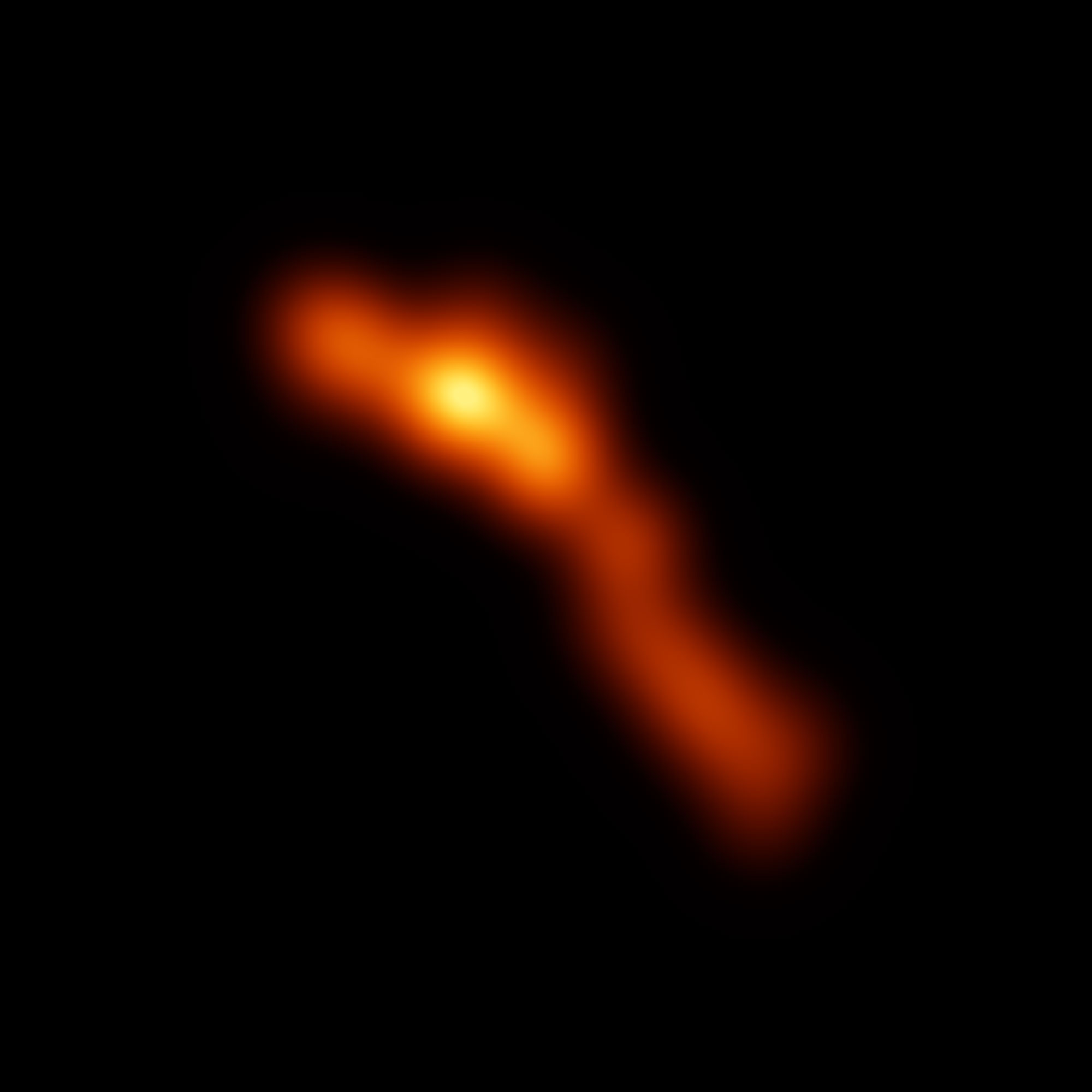
Both low- and high-mass young stars, or protostars, propel jets outward perpendicular to a disk of material closely orbiting the star. In stars with masses similar to the Sun, these jets are narrowed, or focused, relatively tightly near to the star in a process called collimation. Because most high-mass protostars are more distant, studying the regions close to them has been more difficult, so astronomers were unclear if this was the case with them.

A team of scientists observed a massive protostar called Cep A HW2, located about 2,300 light-years from Earth in the constellation Cepheus. Cep A HW2 is expected to develop into a new star about 10 times more massive than the Sun. The new VLA images showed the finest detail yet seen in such an object, giving the astronomers their first view of the innermost portion of the jet, a portion roughly as long as the diameter of the Solar System.

“What we saw is very different from what usually is seen in the jets from low-mass stars,” said Adriana Rodriguez-Kamenetzky, of the National Autonomous University of Mexico (UNAM).

In lower-mass protostars, observations have shown the jets to be collimated as close to the star as only a few times the Earth-Sun distance.

In Cep A HW2, however, “We see not a single jet, but two things — a wide-angle wind originating close to the star, then a highly-collimated jet some distance away,” said Alberto Sanna, of the Osservatorio Astronomico di Cagliari (INAF) in Italy. The collimated jet starts at a distance from the star comparable to the distance from the Sun to Uranus or Neptune.

The discovery raises two main possibilities, the astronomers said.

First, the same mechanism could be at work in both high-mass and low-mass protostars, but the collimation distance could be determined by the mass, occurring farther away in more-massive systems. The second possibility is that high-mass stars might produce only the wide-angle wind seen in Cep A HW2, with collimation only coming when physical conditions around the star restrict the flow.

“That case would point to a major difference in the mechanisms at work in protostars of different masses,” said Carlos Carrasco-Gonzalez, also of UNAM, leader of the work. “Answering this question is important to understanding how stars of all masses form,” he added.

Carrasco-Gonzalez and his colleagues are reporting their findings in the Astrophysical Journal.

The National Radio Astronomy Observatory is a facility of the National Science Foundation, operated under cooperative agreement by Associated Universities, Inc.

Scientific Paper on arXiv


Media Contact:

Dave Finley, Public Information Officer
(505) 241-9210

dfinley@nrao.edu

Monday, June 14, 2021

Scientists discover new exoplanet with an atmosphere ripe for study

An artist's rendering of TOI-1231 b, a Neptune-like planet about 90 light years away from Earth
Credit: NASA/JPL-Caltech

An international group of collaborators, including scientists from NASA’s Jet Propulsion Laboratory and The University of New Mexico, have discovered a new, temperate sub-Neptune sized exoplanet with a 24-day orbital period orbiting a nearby M dwarf star. The recent discovery offers exciting research opportunities thanks to the planet’s substantial atmosphere, small star, and how fast the system is moving away from the Earth.

The research, titled TOI-1231 b: A Temperate, Neptune-Sized Planet Transiting the Nearby M3 Dwarf NLTT 24399, will be published in a future issue of The Astronomical Journal. The exoplanet, TOI-1231 b, was detected using photometric data from the Transiting Exoplanet Survey Satellite (TESS) and followed up with observations using the Planet Finder Spectrograph (PFS) on the Magellan Clay telescope at Las Campanas Observatory in Chile. The PFS is a sophisticated instrument that detects exoplanets through their gravitational influence on their host stars. As the planets orbit their hosts, the measured stellar velocities vary periodically, revealing the planetary presence and information about their mass and orbit.

The observing strategy adopted by NASA's TESS, which divides each hemisphere into 13 sectors that are surveyed for roughly 28 days, is producing the most comprehensive all-sky search for transiting planets. This approach has already proven its capability to detect both large and small planets around stars ranging from sun-like down to low-mass M dwarf stars. M dwarf stars, also known as a red dwarf, are the most common type of star in the Milky Way making up some 70 percent of all stars in the galaxy.

M dwarfs are smaller and possess a fraction of the sun’s mass and have low luminosity. Because an M dwarf is smaller, when a planet of a given size transits the star, the amount of light that is blocked out by the planet is larger, making the transit more easily detectable. Imagine an Earth-like planet passing in front of a star the size of the sun, it's going to block out a tiny bit of light; but if it's passing in front of a star that's a lot smaller, the proportion of light that's blocked out will be larger. In a sense, this creates a larger shadow on the surface of the star, making planets around M dwarfs more easily detectable and easier to study.

Although it enables the detection of exoplanets across the sky, TESS's survey strategy also produces significant observational biases based on orbital period. Exoplanets must transit their host stars at least twice within TESS 's observing span to be detected with the correct period by the Science Processing Operations Center (SPOC) pipeline and the Quick Look Pipeline (QLP), which search the 2-minute and 30-minute cadence TESS data, respectively. Because 74 percent of TESS' total sky coverage is only observed for 28 days, the majority of TESS exoplanets detected have periods less than 14 days. TOI-1231 b’s 24-day period, therefore, makes its discovery even more valuable.

NASA JPL scientist Jennifer Burt, the lead author of the paper, along with her collaborators including Diana Dragomir, an assistant professor in UNM’s Department of Physics and Astronomy, measured both the radius and mass of the planet.

“Working with a group of excellent astronomers spread across the globe, we were able to assemble the data necessary to characterize the host star and measure both the radius and mass of the planet,” said Burt. “Those values in turn allowed us to calculate the planet’s bulk density and hypothesize about what the planet is made out of. TOI-1231 b is pretty similar in size and density to Neptune, so we think it has a similarly large, gaseous atmosphere.”

“Another advantage of exoplanets orbiting M dwarf hosts is that we can measure their masses easier because the ratio of the planet mass to the stellar mass is also larger. When the star is smaller and less massive, it makes detection methods work better because the planet suddenly plays a bigger role as it stands out more easily in relation to the star,” explained Dragomir. “Like the shadow cast on the star. The smaller the star, the less massive the star, the more the effect of the planet can be detected.

“Even though TOI 1231 b is eight times closer to its star than the Earth is to the Sun, its temperature is similar to that of Earth, thanks to its cooler and less bright host star,” says Dragomir. “However, the planet itself is actually larger than earth and a little bit smaller than Neptune – we could call it a sub-Neptune.”

Burt and Dragomir, who actually initiated this research while they were Fellows at MIT’s Kavli Institute, worked with scientists specializing in observing and characterizing the atmospheres of small planets to figure out which current and future space-based missions might be able to peer into TOI-1231 b’s outer layers to inform researchers exactly what kinds of gases are swirling around the planet. With a temperature around 330 Kelvin or 140 degrees Fahrenheit, TOI-1231 b is one of the coolest, small exoplanets accessible for atmospheric studies discovered thus far.

Past research suggests planets this cool may have clouds high in their atmospheres, which makes it hard to determine what types of gases surround them. But new observations of another small, cool planet called K2-18 b broke this trend and showed evidence of water in its atmosphere, surprising many astronomers.

“TOI-1231 b is one of the only other planets we know of in a similar size and temperature range, so future observations of this new planet will let us determine just how common (or rare) it is for water clouds to form around these temperate worlds,” said Burt.

Additionally, with its host star's high Near-Infrared (NIR) brightness, it makes an exciting target for future missions with the Hubble Space Telescope (HST) and the James Webb Space Telescope (JWST). The first set of these observations, led by one of the paper’s co-authors, should take place later this month using the Hubble Space Telescope.

“The low density of TOI-1231 b indicates that it is surrounded by a substantial atmosphere rather than being a rocky planet. But the composition and extent of this atmosphere are unknown!” said Dragomir. “TOI-1231 b could have a large hydrogen or hydrogen-helium atmosphere, or a denser water vapor atmosphere. Each of these would point to a different origin, allowing astronomers to understand whether and how planets form differently around M dwarfs when compared to the planets around our Sun, for example. Our upcoming HST observations will begin to answer these questions, and JWST promises an even more thorough look into the planet’s atmosphere.”

Another way to study the planet’s atmosphere is to investigate whether gas is being blown away, by looking for evidence of atoms like hydrogen and helium surrounding the planet as it transits across the face of its host star. Generally, hydrogen atoms are almost impossible to detect because their presence is masked by interstellar gas. But this planet-star system offers a unique opportunity to apply this method because of how fast it’s moving away from the Earth.

“One of the most intriguing results of the last two decades of exoplanet science is that, thus far, none of the new planetary systems we’ve discovered look anything like our own solar system,” said Burt. “They’re full of planets between the size of Earth and Neptune on orbits much shorter than Mercury’s, so we don’t have any local examples to compare them to. This new planet we’ve discovered is still weird – but it’s one step closer to being somewhat like our neighborhood planets. Compared to most transiting planets detected thus far, which often have scorching temperatures in the many hundreds or thousands of degrees, TOI-1231 b is positively frigid.”

In closing, Dragomir reflects that “this planet joins the ranks of just two or three other nearby small exoplanets that will be scrutinized with every chance we get and using a wide range of telescopes, for years to come so keep an eye out for new TOI-1231 b developments!”

** This article is in press at The Astronomical Journal. A pre-print version can be found here.

By Steve Carr

Media Contact
Steve Carr
Manager, Communications
University of New Mexico
505-277-1821

scarr@unm.edu


Saturday, June 12, 2021

ALMA Discovers Earliest Gigantic Black Hole Storm


Artist’s impression of a galactic wind driven by a supermassive black hole located in the center of a galaxy. The intense energy emanating from the black hole creates a galaxy-scale flow of gas that blows away the interstellar matter that is the material for forming stars. Credit: ALMA (ESO/NAOJ/NRAO). Hi-res imagem


ALMA image of the distant galaxy J1243+0100 hosting a supermassive black hole in its center. The distribution of the quiet gas in the galaxy is shown in yellow, and the distribution of high-speed galactic wind is shown in blue. The wind is located in the galaxy center, which indicates the supermassive black hole drives the wind. Credit: ALMA (ESO/NAOJ/NRAO), Izumi et al.


Researchers using the Atacama Large Millimeter/submillimeter Array (ALMA) discovered a titanic galactic wind driven by a supermassive black hole 13.1 billion years ago. This is the earliest-yet-observed example of such wind to date and is a telltale sign that huge black holes have a profound effect on the growth of galaxies from the very early history of the Universe.

At the center of many large galaxies hides a supermassive black hole that is millions to billions of times more massive than the Sun. Interestingly, the mass of the black hole is roughly proportional to the mass of the central region (bulge) of the galaxy in the nearby Universe. At first glance, this may seem obvious, but it is actually very strange. The reason is that the sizes of galaxies and black holes differ by about ten orders of magnitude. Based on this proportional relationship between the masses of two objects that are so different in size, astronomers believe that galaxies and black holes grew and evolved together (coevolution) through some kind of physical interaction.

A galactic wind can provide this kind of physical interaction between black holes and galaxies. A supermassive black hole swallows a large amount of matter. As that matter begins to move at high speed due to the black hole’s gravity, it emits intense energy, which can push the surrounding matter outward. This is how the galactic wind is created.

“The question is when did galactic winds come into existence in the Universe?” says Takuma Izumi, the lead author of the research paper and a researcher at the National Astronomical Observatory of Japan (NAOJ). “This is an important question because it is related to an important problem in astronomy: How did galaxies and supermassive black holes coevolve?”

The research team first used NAOJ’s Subaru Telescope to search for supermassive black holes. Thanks to its wide-field observation capability, they found more than 100 galaxies with supermassive black holes in the Universe more than 13 billion years ago [1].

Then, the research team utilized ALMA’s high sensitivity to investigate the gas motion in the host galaxies of the black holes. ALMA observed a galaxy HSC J124353.93+010038.5 (hereafter J1243+0100), discovered by the Subaru Telescope, and captured radio waves emitted by the dust and carbon ions in the galaxy [2].

Detailed analysis of the ALMA data revealed that there is a high-speed gas flow moving at 500 km per second in J1243+0100. This gas flow has enough energy to push away the stellar material in the galaxy and stop the star formation activity. The gas flow found in this study is truly a galactic wind, and it is the oldest observed example of a galaxy with a huge wind of galactic size. The previous record-holder was a galaxy about 13 billion years ago, so this observation pushes the start back another 100 million years.

The team also measured the motion of the quiet gas in J1243+0100 and estimated the mass of the galaxy’s bulge, based on its gravitational balance, to be about 30 billion times that of the Sun. The mass of the galaxy’s supermassive black hole, estimated by another method, was about 1% of that. The mass ratio of the bulge to the supermassive black hole in this galaxy is almost identical to the mass ratio of black holes to galaxies in the modern Universe. This implies that the coevolution of supermassive black holes and galaxies has been occurring since less than a billion years after the birth of the Universe.

“Our observations support recent high-precision computer simulations which have predicted that coevolutionary relationships were in place even at about 13 billion years ago,” comments Izumi. “We are planning to observe a large number of such objects in the future and hope to clarify whether or not the primordial coevolution seen in this object is an accurate picture of the general Universe at that time.”


Notes

[1] For more information, please see the Subaru Telescope press release issued on March 13, 2019, “Astronomers Discover 83 Supermassive Black Holes in the Early Universe“. The number of galaxies with supermassive black holes discovered was 83 at the time of this announcement, but the number of discoveries has now increased to over 100.

[2] The redshift of this object is z=7.07. Using the cosmological parameters measured with Planck (H0=67.3km/s/Mpc, Ωm=0.315, Λ=0.685: Planck 2013 Results), we can calculate the distance to the object to be 13.1 billion light-years. (Please refer to “Expressing the distance to remote objects” for the details.)


Additional Information

These observation results are presented as Takuma Izumi et al. “Subaru High-z Exploration of Low-Luminosity Quasars (SHELLQs). XIII. Large-scale Feedback and Star Formation in a Low-Luminosity Quasar at z = 7.07,” in the Astrophysical Journal on June 14, 2021.

The original image release was published by the National Astronomical Observatory of Japan (NAOJ) an ALMA partner on behalf of East Asia.

This research was supported by the Japan Society for Promotion of Science (JSPS) KAKENHI (No. JP20K14531, JP17H06130, 1146 JP17H01114, JP19J00892), the Leading Initiative for Excellent Young Researchers, MEXT, Japan (HJH02007), NAOJ ALMA Scientific Research Grant (2017-06B, 2020-16B), Spanish MICINN (PID2019-10GB-C33 and “Unit of Excellence María de Maeztu 2020-2023” awarded to ICCUB (CEX2019-000918-M)), National Science Foundation of China (11721303, 11991052, 11950410493, 12073003), National Key R&D Program of China (2016YFA0400702), European Research Council (ERC) Consolidator Grant funding scheme (project ConTExt, grant No. 648179), Independent Research Fund Denmark grant DFF–7014-00017, and the Danish National Research Foundation under Grant No. 140.

The Atacama Large Millimeter/submillimeter Array (ALMA), an international astronomy facility, is a partnership of the European Southern Observatory (ESO), the U.S. National Science Foundation (NSF) and the National Institutes of Natural Sciences (NINS) of Japan in cooperation with the Republic of Chile. ALMA is funded by ESO on behalf of its Member States, by NSF in cooperation with the National Research Council of Canada (NRC) and the Ministry of Science and Technology (MOST) in Taiwan and by NINS in cooperation with the Academia Sinica (AS) in Taiwan and the Korea Astronomy and Space Science Institute (KASI). ALMA construction and operations are led by ESO on behalf of its Member States; by the National Radio Astronomy Observatory (NRAO), managed by Associated Universities, Inc. (AUI), on behalf of North America; and by the National Astronomical Observatory of Japan (NAOJ) on behalf of East Asia. The Joint ALMA Observatory (JAO) provides the unified leadership and management of the construction, commissioning and operation of ALMA.


Contacts

Nicolás Lira
Education and Public Outreach Coordinator
Joint ALMA Observatory, Santiago - Chile

Phone: +56 2 2467 6519
Cell phone: +56 9 9445 7726
Email: nicolas.lira@alma.cl

Masaaki Hiramatsu
Education and Public Outreach Officer, NAOJ Chile
Observatory, Tokyo - Japan
Phone:
+81 422 34 3630
Email: hiramatsu.masaaki@nao.ac.jp

Amy C. Oliver
Public Information & News Manager
National Radio Astronomical Observatory (NRAO), USA
Phone:
+1 434 242 9584
Email: aoliver@nrao.edu

Bárbara Ferreira
ESO Public Information Officer
Garching bei München, Germany
Phone:
+49 89 3200 6670
Email: pio@eso.org


Friday, June 11, 2021

Black holes help with star birth


Virtual milky way: Gas density around a massive central galaxy in a group in the virtual universe of the TNG50 simulation. Gas inside the galaxy corresponds to the bright vertical structure: a gaseous disk. To the left and right of that structure are bubbles – regions that look like circles in this image, with markedly reduced gas density inside. This geometry of the gas is due to the action of the super massive black hole that hides at the center of the galaxy and that pushes out gas preferably in directions perpendicular to the galaxy gaseous disk, carving regions of lower density. © TNG Collaboration/Dylan Nelson

The cosmic mass monsters clear the way for the formation of new suns in satellite galaxies

Research combining systematic observations with cosmological simulations has found that, surprisingly, black holes can help certain galaxies form new stars. On scales of galaxies, the role of supermassive black holes for star formation had previously been seen as destructive – active black holes can strip galaxies of the gas that galaxies need to form new stars. The new results, published in the journal Nature, showcase situations where active black holes can, instead, "clear the way" for galaxies that orbit inside galaxy groups or clusters, keeping those galaxies from having their star formation disrupted as they fly through the surrounding intergalactic gas.

Active black holes are primarily thought to have a destructive influence on their surroundings. As they blast energy into their host galaxy, they heat up and eject that galaxy's gas, making it more difficult for the galaxy to produce new stars. But now, researchers have found that the same activity can actually help with star formation – at least for the satellite galaxies that orbit the host galaxy.

The counter-intuitive result came out of a collaboration sparked by a lunchtime conversation between astronomers specializing in large-scale computer simulations and observers. As such, it is a good example for the kind of informal interaction that has become more difficult under pandemic conditions.

Astronomical observations that include taking a distant galaxy's spectrum – the rainbow-like separation of a galaxy's light into different wavelengths – allow for fairly direct measurements of the rate at which that galaxy is forming new stars.

Going by such measurements, some galaxies are forming stars at rather sedate rates. In our own Milky Way galaxy, only one or two new stars are born each year. Others undergo brief bursts of excessive star formation activity, called "star bursts", with hundreds of stars born per year. In yet other galaxies, star formation appears to be suppressed, or "quenched," as astronomers say: Such galaxies have virtually stopped forming new stars.

A special kind of galaxy, specimens of which are frequently – almost half of the time – found to be in such a quenched state, are so-called satellite galaxies. These are part of a group or cluster of galaxies, their mass is comparatively low, and they orbit a much more massive central galaxy similar to the way satellites orbit the Earth.

Such galaxies typically form very few new stars, if at all, and since the 1970s, astronomers have suspected that something very much akin to headwind might be to blame: Groups and clusters of galaxies not only contain galaxies, but also rather hot thin gas filling the intergalactic space.

As a satellite galaxy orbits through the cluster at a speed of hundreds of kilometers per second, the thin gas would make it feel the same kind of "headwind" that someone riding a fast bike, or motor-bike, will feel. The satellite galaxy's stars are much too compact to be affected by the steady stream of oncoming intergalactic gas.

But the satellite galaxy's own gas is not: It would be stripped away by the oncoming hot gas in a process known as "ram pressure stripping". On the other hand, a fast-moving galaxy has no chance of pulling in a sufficient amount of intergalactic gas, to replenish its gas reservoir. The upshot is that such satellite galaxies lose their gas almost completely – and with it the raw material needed for star formation. As a result, star-formation activity would be quenched.

The processes in question take place over millions or even billions of years, so we cannot watch them happening directly. But even so, there are ways for astronomers to learn more. They can utilize computer simulations of virtual universes, programmed so as to follow the relevant laws of physics – and compare the results with what we actually observe. And they can look for tell-tale clues in the comprehensive "snapshot" of cosmic evolution that is provided by astronomical observations.

Annalisa Pillepich, a group leader at the Max Planck Institute for Astronomy (MPIA), specializes in simulations of this kind. The IllustrisTNG suite of simulations, which Pillepich has co-led, provides the most detailed virtual universes to date – universes in which researchers can follow the movement of gas around on comparatively small scales.

IllustrisTNG provides some extreme examples of satellite galaxies that have freshly been stripped by ram pressure: so-called "jellyfish galaxies," that are trailing the remnants of their gas like jellyfish are trailing their tentacles. In fact, identifying all the jellyfish in the simulations is a recently launched citizen science project on the Zooniverse platform, where volunteers can help with the research into that kind of freshly quenched galaxy. But, while jellyfish galaxies are relevant, they are not where the present research project started. Over lunch in November 2019, Pillepich recounted a different one of her IllustrisTNG results to Ignacio Martín-Navarro, an astronomer specializing in observations, who was at MPIA on a Marie Curie fellowship. A result about the influence of supermassive black holes that reached beyond the host galaxy, into intergalactic space.

Such supermassive black holes can be found in the center of all galaxies. Matter falling onto such a black hole typically becomes part of a rotating so-called accretion disk surrounding the black hole, before falling into the black hole itself. This fall onto the accretion disk liberates an enormous amount of energy in the form of radiation, and oftentimes also in the form of two jets of quickly moving particles, which accelerate away from the black hole at right angles to the accretion disk. A supermassive black hole that is emitting energy in this way is called an Active Galactic Nucleus, AGN for short.

While IllustrisTNG is not detailed enough to include black hole jets, it does contain physical terms that simulate how an AGN is adding energy to the surrounding gas. And as the simulation showed, that energy injection will lead to gas outflows, which in turn will orient themselves along a path of least resistance: in the case of disk galaxies similar to our own Milky Way, perpendicular to the stellar disk; for so-called elliptical galaxies, perpendicular to a suitable preferred plane defined by the arrangement of the galaxy's stars.

Over time, the bipolar gas outflows, perpendicular to the disk or preferred plane, will go so far as to affect the intergalactic environment – the thin gas surrounding the galaxy. They will push the intergalactic gas away, each outflow creating a gigantic bubble. It was this account that got Pillepich and Martín-Navarro thinking: If a satellite galaxy were to pass through that bubble – would it be affected by the outflow, and would its star formation activity be quenched even further?

Martín-Navarro took up this question within his own domain. He had extensive experience in working with data from one of the largest systematic surveys to date: the Sloan Digital Sky Survey (SDSS), which provides high-quality images of a large part of the Northern hemisphere. In the publicly available data from that survey's 10th data, he examined 30,000 galaxy groups and clusters, each containing a central galaxy and on average 4 satellite galaxies.

In a statistical analysis of those thousands of systems, he found a small, but marked difference between satellite galaxies that were close to the central galaxy's preferred plane and satellites that were markedly above and below. But the difference was in the opposite direction the researchers had expected: Satellites above and below the plane, within the thinner bubbles, were on average not more likely, but about 5% less likely to have had their star formation activity quenched.

With that surprising result, Martín-Navarro went back to Annalisa Pillepich, and the two performed the same kind of statistical analysis in the virtual universe of the IllustrisTNG simulations. In simulations of that kind, after all, cosmic evolution is not put in "by hand" by the researchers. Instead, the software includes rules that model the rules of physics for that virtual universe as naturally as possible, and which also include suitable initial conditions that correspond to the state of our own universe shortly after the Big Bang.

That is why simulations like that leave room for the unexpected – in this particular case, for re-discovering the on-plane, off-plane distribution of quenched satellite galaxies: The virtual universe showed the same 5% deviation for the quenching of satellite galaxies! Evidently, the researchers were on to something.

In time, Pillepich, Martín-Navarro and their colleagues came up with a hypothesis for the physical mechanism behind the quenching variation. Consider a satellite galaxy travelling through one of the thinned-out bubbles the central black hole has blown into the surrounding intergalactic medium. Due to the lower density, that satellite galaxy experiences less headwind, less ram pressure, and is thus less likely to have its gas stripped away.

Then, it is down to statistics. For satellite galaxies that have orbited the same central galaxies several times already, traversing bubbles but also the higher-density regions in between, the effect will not be noticeable. Such galaxies will have lost their gas long ago.

But for satellite galaxies that have joined the group, or cluster, rather recently, location will make a difference: If those satellites happen to land in a bubble first, they are less likely to lose their gas then if they happen to land outside a bubble. This effect could account for the statistical difference for the quenched satellite galaxies.

With the excellent agreement between the statistical analyses of both the SDSS observations and the IllustrisTNG simulations, and with a plausible hypothesis for a mechanism, this is a highly promising result. In the context of galaxy evolution, it is particularly interesting because it confirms, indirectly, the role of active galactic nuclei not only heating intergalactic gas up, but actively "pushing it away", to create lower-density regions. And as with all promising results, there are now a number of natural directions that either Martín-Navarro, Pillepich and their colleagues or other scientists can take in order to explore further.

Contact

Markus Pössel
Head of press and public relations
Max Planck Institute for Astronomy, Heidelberg
+49 6221 528-261

pr@mpia.de

Annalisa Pillepich
Max Planck Institute for Astronomy, Heidelberg
+49 6221 528-395

pillepich@mpia.de

Original publication

I. Martín-Navarro et al
Anisotropic satellite galaxy quenching modulated by supermassive black hole activity

Nature, June 10, 221


DOI