Showing posts with label massive protostar. Show all posts

Thursday, July 24, 2025

Groundbreaking Magnetic Field Discovery Near Massive Protostar Made Possible by NSF NRAO’s Very Large Array

Schematic of circular polarization being detected in radio waves from a massive protostar surrounded by a disk and driving a bipolar jet. This is an artistic image, not drawn to scale. Credit: AG Cheriyan/IIST


The U.S. National Science Foundation National Radio Astronomy Observatory (NSF NRAO) proudly announces a major breakthrough in our understanding of star formation, thanks to the unparalleled capabilities of the U.S. National Science Foundation Karl G. Jansky Very Large Array (NSF VLA). An international team, led by astronomers from the Indian Institute of Space Science and Technology (IIST) and the Indian Institute of Science (IISc), has for the first time detected circular polarization in radio emission originating from a massive protostar, IRAS 18162-2048—unveiling fresh clues about the cosmic forces shaping our universe.

Circularly polarized radio waves have been directly observed from a young, massive protostar, a phenomenon previously recorded only near black holes and low-mass protostars, demonstrating a new link between diverse cosmic environments. This rare signal, detected using the NSF VLA, has enabled astronomers to infer magnetic field strengths of about 20–35 Gauss close to the forming star. These values are roughly 100 times stronger than Earth’s magnetic field—providing the first direct clues to magnetic field strengths in such extreme environments. The findings reinforce a long-standing theory that the mechanisms launching powerful astrophysical jets are fundamentally similar, from low-mass stars through to supermassive black holes.

NSF NRAO is honored to contribute this critical technology and support to discoveries that deepen humanity’s knowledge of the cosmos. You can read the full releases from IIST and IISc here and here.


About NRAO

The National Radio Astronomy Observatory (NRAO) is a facility of the U.S. National Science Foundation, operated under cooperative agreement by Associated Universities, Inc.


Tuesday, June 15, 2021

Jets from Massive Protostars Might be Very Different from Lower-Mass Systems, Astronomers Find


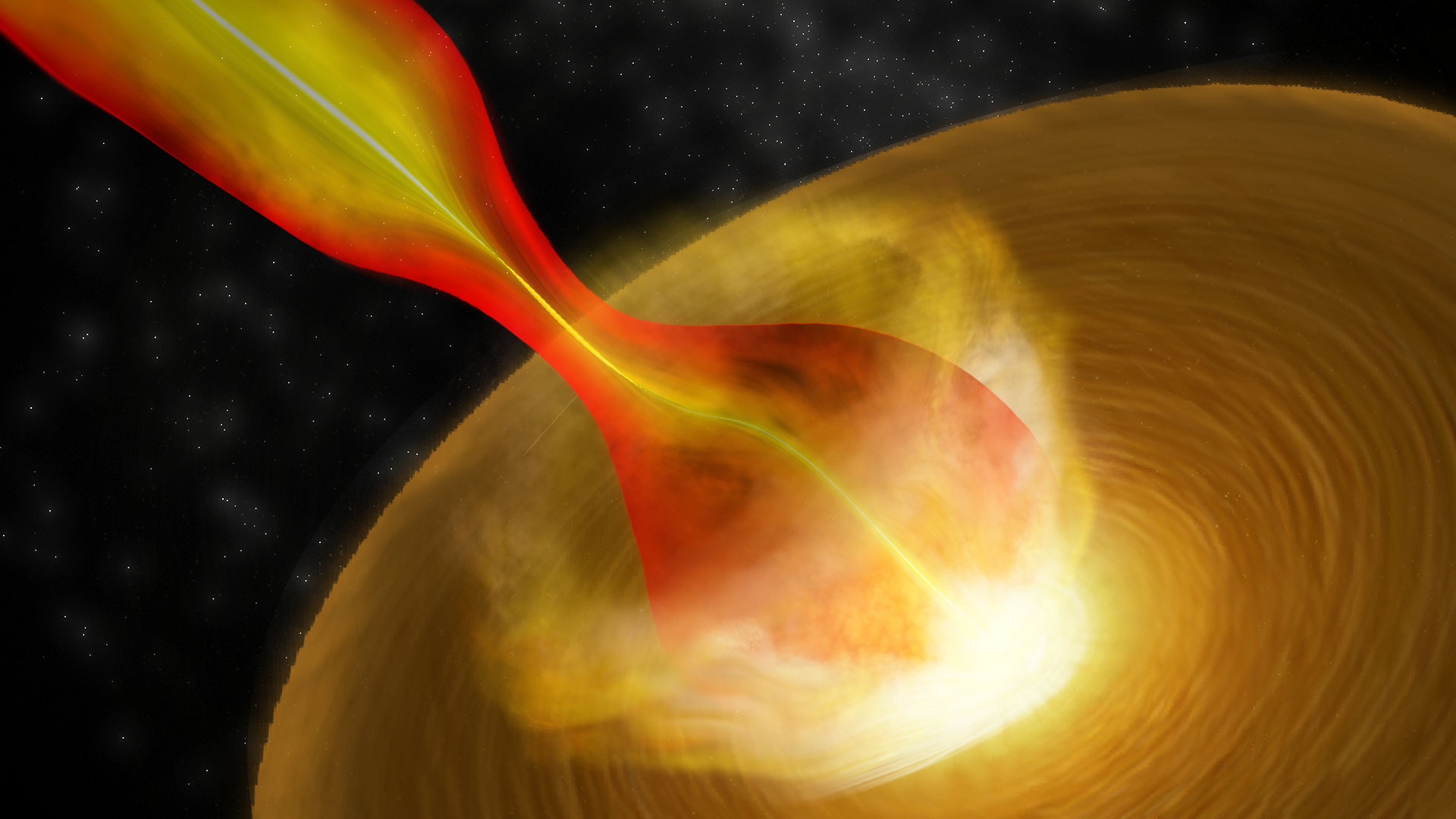
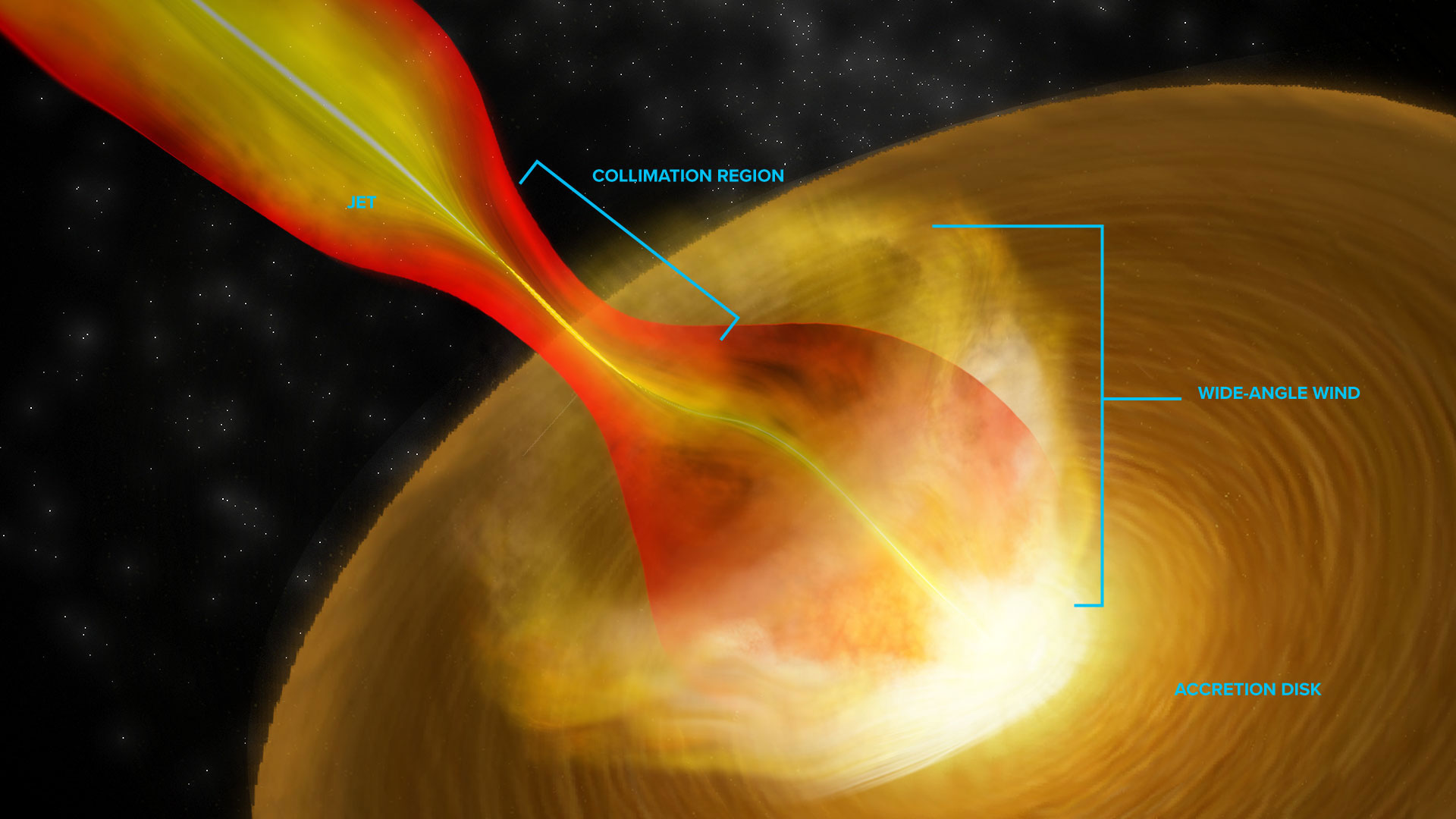
Artist's conception of the young star Cep A HW2, showing a wide-angle wind originating close to the star and a disk of material orbiting the star (called an accretion disk), with a much narrower jet farther away. Credit: Bill Saxton, NRAO/AUI/NSF.
Hi-Res File

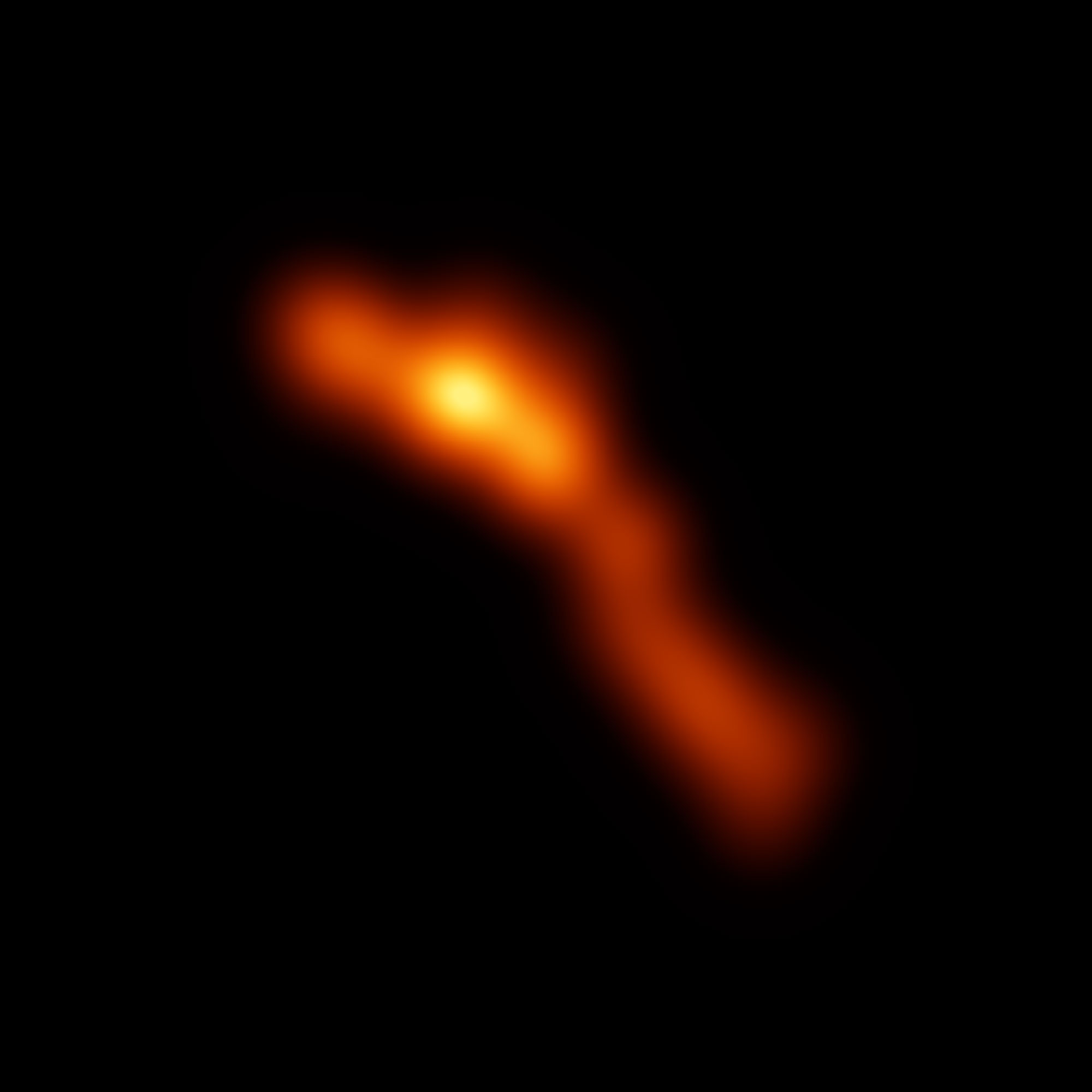
VLA image of the jet from protostar Cep A HW2
Credit: Carrasco-Gonzalez et al., Bill Saxton, NRAO/AUI/NSF.
Hi-Res File


VLA image of the jet from protostar Cep A HW2, with surrounding area shown in Hubble Space Telescope image. Circles indicate location of the accretion disk, not seen in this image. Credit: Carrasco-Gonzalez et al.; Bill Saxton, NRAO/AUI/NSF; STScI.
Hi-Res File

Artist's conception of Cep A HW2 and its jet, with labels
Credit: Bill Saxton, NRAO/AUI/NSF.
Hi-Res File

Location of Cep A HW2 in the sky
Credit: Bill Saxton, NRAO/AUI/NSF.
Hi-Res File


Astronomers studying the fast-moving jet of material ejected by a still-forming, massive young star found a major difference between that jet and those ejected by less-massive young stars. The scientists made the discovery by using the U.S. National Science Foundation’s Karl G. Jansky Very Large Array (VLA) to make the most detailed image yet of the inner region of such a jet coming from a massive young star.

Both low- and high-mass young stars, or protostars, propel jets outward perpendicular to a disk of material closely orbiting the star. In stars with masses similar to the Sun, these jets are narrowed, or focused, relatively tightly near to the star in a process called collimation. Because most high-mass protostars are more distant, studying the regions close to them has been more difficult, so astronomers were unclear if this was the case with them.

A team of scientists observed a massive protostar called Cep A HW2, located about 2,300 light-years from Earth in the constellation Cepheus. Cep A HW2 is expected to develop into a new star about 10 times more massive than the Sun. The new VLA images showed the finest detail yet seen in such an object, giving the astronomers their first view of the innermost portion of the jet, a portion roughly as long as the diameter of the Solar System.

“What we saw is very different from what usually is seen in the jets from low-mass stars,” said Adriana Rodriguez-Kamenetzky, of the National Autonomous University of Mexico (UNAM).

In lower-mass protostars, observations have shown the jets to be collimated as close to the star as only a few times the Earth-Sun distance.

In Cep A HW2, however, “We see not a single jet, but two things — a wide-angle wind originating close to the star, then a highly-collimated jet some distance away,” said Alberto Sanna, of the Osservatorio Astronomico di Cagliari (INAF) in Italy. The collimated jet starts at a distance from the star comparable to the distance from the Sun to Uranus or Neptune.

The discovery raises two main possibilities, the astronomers said.

First, the same mechanism could be at work in both high-mass and low-mass protostars, but the collimation distance could be determined by the mass, occurring farther away in more-massive systems. The second possibility is that high-mass stars might produce only the wide-angle wind seen in Cep A HW2, with collimation only coming when physical conditions around the star restrict the flow.

“That case would point to a major difference in the mechanisms at work in protostars of different masses,” said Carlos Carrasco-Gonzalez, also of UNAM, leader of the work. “Answering this question is important to understanding how stars of all masses form,” he added.

Carrasco-Gonzalez and his colleagues are reporting their findings in the Astrophysical Journal.

The National Radio Astronomy Observatory is a facility of the National Science Foundation, operated under cooperative agreement by Associated Universities, Inc.

Scientific Paper on arXiv


Media Contact:

Dave Finley, Public Information Officer
(505) 241-9210

dfinley@nrao.edu