Tuesday, December 17, 2019

ESO Telescope Images Stunning Central Region of Milky Way, Finds Ancient Star Burst

HAWK-I view of the Milky Way’s central region

Details of the HAWK-I view of the Milky Way’s central region

Location of the Galactic centre in the night sky


Videos
ESOcast 213 Light: Stunning stars in the Milky Way central region

Pan across the Milky Way’s central region

Zoom of the Milky Way’s central region

The Milky Way’s central region in visible light and near-infrared
PR Video eso1920d
The Milky Way’s central region in visible light and near-infrared 

The Milky Way’s central region observed with VISTA and HAWK-I
The Milky Way’s central region observed with VISTA and HAWK-I 


 Image Comparisons
The Milky Way’s central region in visible light and near-infrared
The Milky Way’s central region observed with VISTA and HAWK


ESO’s Very Large Telescope (VLT) has observed the central part of the Milky Way with spectacular resolution and uncovered new details about the history of star birth in our galaxy. Thanks to the new observations, astronomers have found evidence for a dramatic event in the life of the Milky Way: a burst of star formation so intense that it resulted in over a hundred thousand supernova explosions.

"Our unprecedented survey of a large part of the Galactic centre has given us detailed insights into the formation process of stars in this region of the Milky Way," says Rainer Schödel from the Institute of Astrophysics of Andalusia in Granada, Spain, who led the observations. "Contrary to what had been accepted up to now, we found that the formation of stars has not been continuous,” adds Francisco Nogueras-Lara, who led two new studies of the Milky Way central region while at the same institute in Granada.

In the study, published today in Nature Astronomy, the team found that about 80% of the stars in the Milky Way central region formed in the earliest years of our galaxy, between eight and 13.5 billion years ago. This initial period of star formation was followed by about six billion years during which very few stars were born. This was brought to an end by an intense burst of star formation around one billion years ago when, over a period of less than 100 million years, stars with a combined mass possibly as high as a few tens of million Suns formed in this central region.

“The conditions in the studied region during this burst of activity must have resembled those in ‘starburst’ galaxies, which form stars at rates of more than 100 solar masses per year,” says Nogueras-Lara, who is now based at the Max Planck Institute for Astronomy in Heidelberg, Germany. At present, the whole Milky Way is forming stars at a rate of about one or two solar masses per year.

“This burst of activity, which must have resulted in the explosion of more than a hundred thousand supernovae, was probably one of the most energetic events in the whole history of the Milky Way,” he adds. During a starburst, many massive stars are created; since they have shorter lifespans than lower-mass stars, they reach the end of their lives much faster, dying in violent supernova explosions.

This research was possible thanks to observations of the Galactic central region done with ESO’s HAWK-I instrument on the VLT in the Chilean Atacama Desert. This infrared-sensitive camera peered through the dust to give us a remarkably detailed image of the Milky Way’s central region, published in October in Astronomy & Astrophysics by Nogueras-Lara and a team of astronomers from Spain, the US, Japan and Germany. The stunning image shows the galaxy’s densest region of stars, gas and dust, which also hosts a supermassive black hole, with an angular resolution of 0.2 arcseconds. This means the level of detail picked up by HAWK-I is roughly equivalent to seeing a football (soccer ball) in Zurich from Munich, where ESO’s headquarters are located.

This image is the first release of the GALACTICNUCLEUS survey. This programme relied on the large field of view and high angular resolution of HAWK-I on ESO’s VLT to produce a beautifully sharp image of the central region of our galaxy. The survey studied over three million stars, covering an area corresponding to more than 60 000 square light-years at the distance of the Galactic centre (one light-year is about 9.5 trillion kilometres).


More Information

This research was presented in the paper “GALACTICNUCLEUS: A high angular resolution JHKs imaging survey of the Galactic Centre: II. First data release of the catalogue and the most detailed CMDs of the GC” published in Astronomy & Astrophysics and in “Early formation and recent starburst activity in the nuclear disc of the Milky Way” to appear in Nature Astronomy (doi: 10.1038/s41550-019-0967-9).

The team of the Astronomy & Astrophysics paper is composed of F. Nogueras-Lara (Instituto de Astrofísica de Andalucía, Granada, Spain [IAA-CSIC]), R. Schödel (IAA-CSIC), A. T. Gallego-Calvente (IAA-CSIC), H. Dong (IAA-CSIC), E. Gallego-Cano (IAA and Centro Astronómico Hispano-Alemán, Almería, Spain), B. Shahzamanian (IAA-CSIC), J. H. V. Girard (Space Telescope Science Institute, Baltimore, USA), S. Nishiyama (Miyagi University of Education, Sendai, Japan), F. Najarro (Departamento de Astrofísica, Centro de Astrobiología CAB (CSIC-INTA), Torrejón de Ardoz, Spain), N. Neumayer (Max Planck Institute for Astronomy, Heidelberg, Germany).

The team of the Nature Astronomy paper is composed of F. Nogueras-Lara (Instituto de Astrofísica de Andalucía, Granada, Spain [IAA-CSIC]), R. Schödel (IAA-CSIC), A. T. Gallego-Calvente (IAA-CSIC), E. Gallego-Cano (IAA-CSIC), B. Shahzamanian (IAA-CSIC), H. Dong (IAA-CSIC), N. Neumayer (Max Planck Institute for Astronomy, Heidelberg, Germany), M. Hilker (European Southern Observatory, Garching bei München, Germany), F. Najarro (Departamento de Astrofísica, Centro de Astrobiología, Torrejón de Ardoz, Spain), S. Nishiyama (Miyagi University of Education, Sendai, Japan), A. Feldmeier-Krause (The Department of Astronomy and Astrophysics. The University of Chicago, Chicago, US), J. H. V. Girard (Space Telescope Science Institute, Baltimore, USA) and S. Cassisi (INAF-Astronomical Observatory of Abruzzo, Teramo, Italy).

ESO is the foremost intergovernmental astronomy organisation in Europe and the world’s most productive ground-based astronomical observatory by far. It has 16 Member States: Austria, Belgium, the Czech Republic, Denmark, France, Finland, Germany, Ireland, Italy, the Netherlands, Poland, Portugal, Spain, Sweden, Switzerland and the United Kingdom, along with the host state of Chile and with Australia as a Strategic Partner. ESO carries out an ambitious programme focused on the design, construction and operation of powerful ground-based observing facilities enabling astronomers to make important scientific discoveries. ESO also plays a leading role in promoting and organising cooperation in astronomical research. ESO operates three unique world-class observing sites in Chile: La Silla, Paranal and Chajnantor. At Paranal, ESO operates the Very Large Telescope and its world-leading Very Large Telescope Interferometer as well as two survey telescopes, VISTA working in the infrared and the visible-light VLT Survey Telescope. Also at Paranal ESO will host and operate the Cherenkov Telescope Array South, the world’s largest and most sensitive gamma-ray observatory. ESO is also a major partner in two facilities on Chajnantor, APEX and ALMA, the largest astronomical project in existence. And on Cerro Armazones, close to Paranal, ESO is building the 39-metre Extremely Large Telescope, the ELT, which will become “the world’s biggest eye on the sky”.


Links


Contacts

Francisco Nogueras-Lara
Max Planck Institute for Astronomy
Heidelberg, Germany
Tel: +49 6221 528-393
Email:
nogueras@mpia.de

Rainer Schödel
Instituto de Astrofísica de Andalucía (IAA-CSIC)
Granada, Spain
Tel: +34 958 230 529
Email:
rainer@iaa.es

Bárbara Ferreira
ESO Public Information Officer
Garching bei München, Germany
Tel: +49 89 3200 6670
Cell: +49 151 241 664 00
Email: pio@eso.org


Source: ESO/News


Monday, December 16, 2019

Radio Jupiter: Seeing the Giant Planet in a New Light

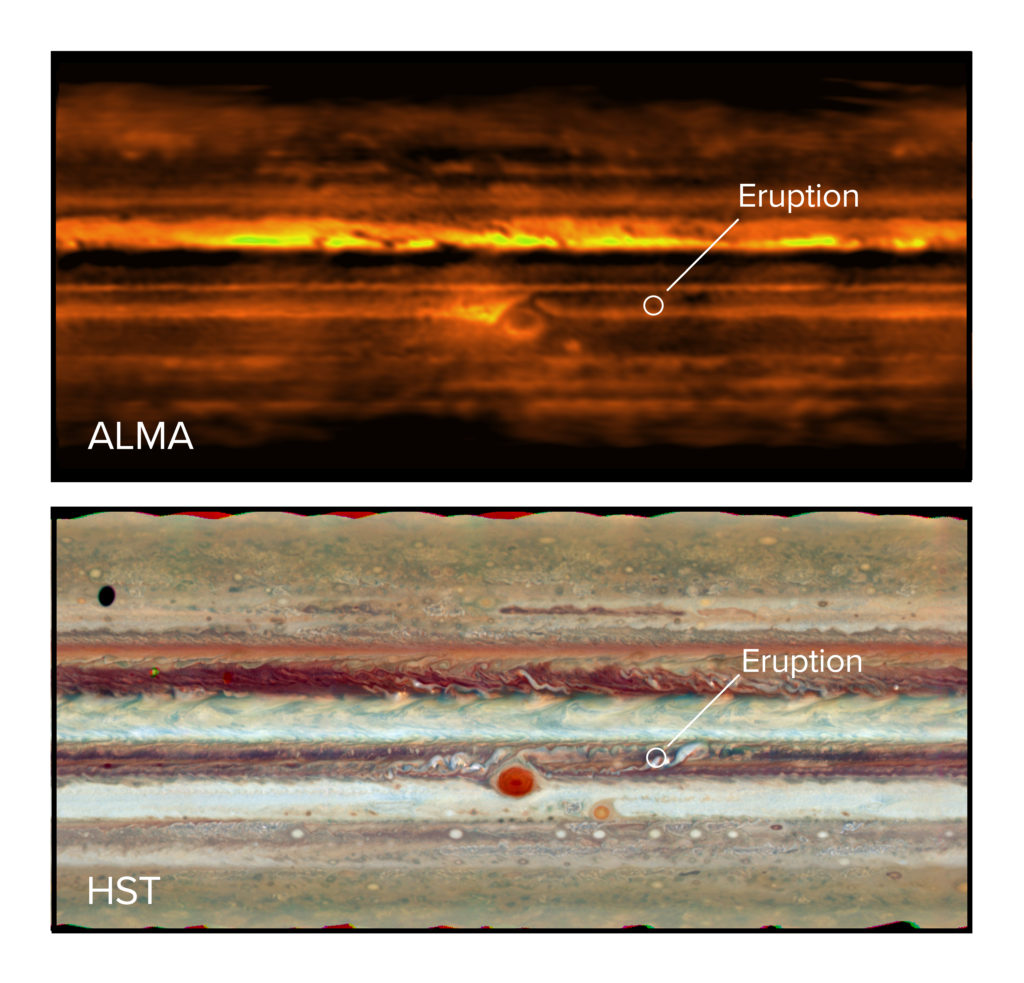
Radio image of Jupiter made with ALMA. Bright bands indicate high temperatures and dark bands low temperatures. The dark bands correspond to the zones on Jupiter, which are often white at visible wavelengths. The bright bands correspond to the brown belts on the planet. This image contains over 10 hours of data, so fine details are smeared by the planet's rotation. Credit: ALMA (ESO/NAOJ/NRAO), I. de Pater et al.; NRAO/AUI NSF, S. Dagnello

Flat map of Jupiter in radio waves with ALMA (top) and visible light with the Hubble Space Telescope (bottom). The eruption in the South Equatorial Belt is visible in both images. Credit: ALMA (ESO/NAOJ/NRAO), I. de Pater et al.; NRAO/AUI NSF, S. Dagnello; NASA/Hubble. Hi-res image

Burke and Franklin's antenna array.
Credit: Carnegie Institution of Washington. Hi-res image

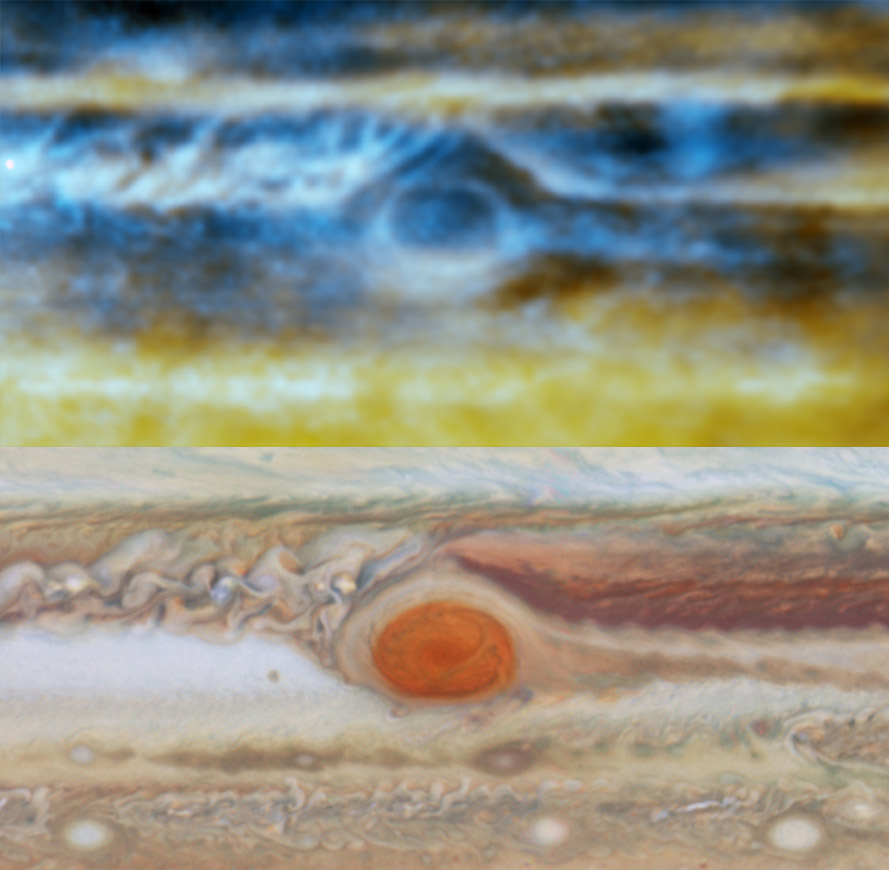
Radio image (bottom) captured by the VLA of Jupiter's Great Red Spot, compared with a visible-light image (top) from the Hubble Space Telescope. Credit: de Pater, et al., NRAO/AUI/NSF; NASA. Hi-res image

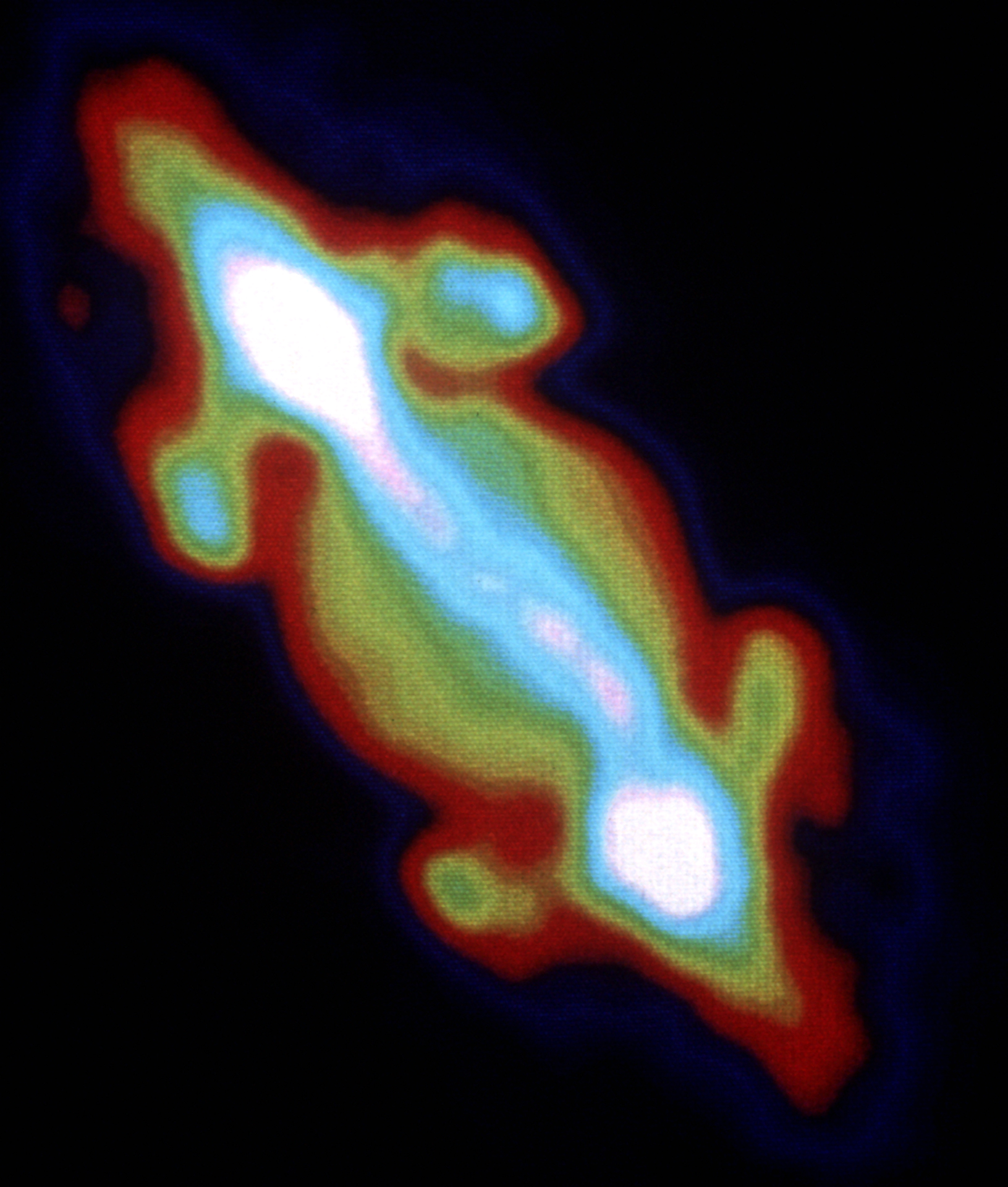
A 2003 image of Jupiter. The lobes on each side of the planet are caused by Jupiter's strong magnetosphere.
Credit: NRAO/AUI/NSF. Hi-res image


Jupiter is the largest planet in our solar system. It is also the brightest planet at radio frequencies. While radio astronomy often focuses on more distant objects such as nebulae and galaxies, the radio astronomy of planets begins with Jupiter.

While other planets in our solar system emit radio light, Jupiter is by far the most radio bright. When charged particles in space interact with Jupiter’s magnetic field, they emit radio light through a process known as synchrotron radiation. The first radio observation of Jupiter was made by Bernard Burke and Kenneth Franklin in 1955. They weren’t expecting such a signal, so they initially thought it was the radio noise of a farm-hand driving home. But subsequent observations showed the signal was Jovian in origin.

In addition to its synchrotron emissions, Jupiter also gives off radio light due to thermal emissions. These fainter emissions were first mapped by the Very Large Array (VLA). The VLA’s antennas can work together in a wide configuration to capture faint and high-resolution radio images.

When the VLA was upgraded in 2011, it greatly increased its sensitivity and imaging capabilities. In 2013 the VLA gathered the first radio images of Jupiter’s atmosphere. It allowed us to peer into Jupiter’s thick atmosphere. Observations in visible light are limited by the cloud layer of Jupiter. But radio light penetrates these cloud layers more easily. The VLA observations let us see 100 kilometers below the visible clouds. They captured details of the great red spot, and how ammonia within Jupiter’s cloud layer rises and falls.

Recently the Atacama Large Millimeter/submillimeter Array (ALMA) also captured even higher resolution images of Jupiter’s thermal emissions. ALMA operates at shorter wavelengths than the VLA. Since shorter wavelengths are absorbed more readily by Jupiter’s atmosphere, ALMA’s observation only penetrates about 50 kilometers below Jupiter’s cloud layer. But ALMA’s high resolution allowed astronomers to create a three-dimensional map of ammonia gas within the atmosphere. This helps us understand the mechanisms that drive storms on Jupiter.

As radio technology has advanced, the radio astronomy of Jupiter has become much more accessible. With only modest radio equipment, you can observe the radio light of Jupiter for yourselves. Projects such as NASA’s Radio JOVE encourage students and amateur scientists to observe radio emissions from Jupiter and other bright radio sources. The project teaches students about radio astronomy and engages in citizen science research projects.

Jupiter has long inspired humanity to look toward the stars. From Galileo’s first view through his telescope, to the radio arrays of the VLA and ALMA, the light of Jupiter at all wavelengths has much to offer.


Reference: de Pater, Imke, et al. “Peering through Jupiter’s clouds with radio spectral imaging.” Science 352.6290 (2016): 1198-1201.

Reference: de Pater, Imke, et al. “First ALMA Millimeter-wavelength Maps of Jupiter, with a Multiwavelength Study of Convection.” The Astronomical Journal 158.4 (2019): 139.


Saturday, December 14, 2019

Interstellar Comet 2I/Borisov Swings Past the Sun

Comet 2I/Borisov Near and at Perihelion
Credits: NASA, ESA, and D. Jewitt (UCLA)

These two images, taken by NASA's Hubble Space Telescope, capture comet 2I/Borisov streaking though our solar system and on its way back to interstellar space. It is only the second interstellar object known to have passed through the solar system.

"Hubble gives us the best upper limit of the size of comet Borisov's nucleus, which is the really important part of the comet," said David Jewitt, a UCLA professor of planetary science and astronomy, whose team has captured the best and sharpest look at this first confirmed interstellar comet. "Surprisingly, our Hubble images show that its nucleus is more than 15 times smaller than earlier investigations suggested it might be. Our Hubble images show that the radius is smaller than half-a-kilometer. Knowing the size is potentially useful for beginning to estimate how common such objects may be in the solar system and our galaxy. Borisov is the first known interstellar comet, and we would like to learn how many others there are."

Crimean amateur astronomer Gennady Borisov discovered the comet on August 30, 2019 and reported the position measurements to the International Astronomical Union's Minor Planet Center in Cambridge, Massachusetts. The Center for Near-Earth Object Studies at the Jet Propulsion Laboratory, working with the Minor Planet Center, computed an orbit for the comet which shows that it came from elsewhere in our Milky Way galaxy, point of origin unknown.

Nevertheless, observations by numerous telescopes show that the comet's chemical composition is similar to the comets found inside our solar system, providing evidence that comets also form around other stars. By the middle of 2020 the comet will have already zoomed past Jupiter's distance of 500 million miles on its way back into the frozen abyss of interstellar space.

[left] November 16, 2019 photo

The comet appears in front of a distant background spiral galaxy (2MASX J10500165-0152029). The galaxy's bright central core is smeared in the image because Hubble was tracking the comet. Comet Borisov was approximately 203 million miles from Earth in this exposure. Its tail of ejected dust streaks off to the upper right. The comet has been artificially colored blue to discriminate fine detail in the halo of dust, or coma, surrounding the central nucleus. It also helps to visually separate the comet from the background galaxy.

[right] December 9, 2019 photo

Hubble revisited the comet shortly after its closest approach to the Sun where it received maximum heating after spending most of its life in frigid interstellar space. The comet also reached a breathtaking maximum speed of about 100,000 miles per hour. Comet Borisov is 185 million miles from Earth in this photo, near the inner edge of the asteroid belt but below it. The nucleus, an agglomeration of ices and dust, is still too small to be resolved. The bright central portion is a coma made up of dust leaving the surface. The comet will make its closest approach to Earth in late December at a distance of 180 million miles.

The Hubble Space Telescope is a project of international cooperation between the European Space Agency (ESA) and NASA. NASA's Goddard Space Flight Center in Greenbelt, Maryland, manages the telescope. The Space Telescope Science Institute (STScI) in Baltimore, Maryland, conducts Hubble science operations. STScI is operated for NASA by the Association of Universities for Research in Astronomy in Washington, D.C. The Minor Planet Center and the Center for Near-Earth Orbit Studies are projects of NASA’s Near-Earth Object Observations Program of the Planetary Defense Coordination Office at NASA Headquarters.


Contact

Ray Villard
Space Telescope Science Institute, Baltimore, Maryland
410-338-4514
villard@stsci.edu

Stuart Wolpert
UCLA, Los Angeles, California
swolpert@stratcomm.ucla.edu

David Jewitt
UCLA, Los Angeles, California
jewitt@ucla.edu


Related Links


Friday, December 13, 2019

Galactic Diversity

Credit: ESA/Hubble & NASA, D. Rosario et al.

NGC 3175 is located around 50 million light-years away in the constellation of Antlia (The Air Pump). The galaxy can be seen slicing across the frame in this image from the NASA/ESA Hubble Space Telescope, with its mix of bright patches of glowing gas, dark lanes of dust, bright core, and whirling, pinwheeling arms coming together to paint a beautiful celestial scene.

The galaxy is the eponymous member of the NGC 3175 group, which has been called a nearby analogue for the Local Group. The Local Group contains our very own home galaxy, the Milky Way, and around 50 others — a mix of spiral, irregular, and dwarf galaxies. The NGC 3175 group contains a couple of large spiral galaxies — the subject of this image, and NGC 3137 — and numerous lower-mass spiral and satellite galaxies. Galaxy groups are some of the most common galactic gatherings in the cosmos, and they comprise 50 or so galaxies all bound together by

This image comprises observations from Hubble’s Wide Field Camera 3.


Thursday, December 12, 2019

Newfound Martian Aurora Actually the Most Common; Sheds Light on Mars’ Changing Climate

Conceptual image depicting the early Martian environment (right) – believed to contain liquid water and a thicker atmosphere – versus the cold, dry environment seen at Mars today (left). Credits: NASA’s Goddard Space Flight Center. Hi-res image

A type of Martian aurora first identified by NASA’s MAVEN spacecraft in 2016 is actually the most common form of aurora occurring on the Red Planet, according to new results from the mission. The aurora is known as a proton aurora and can help scientists track water loss from Mars’ atmosphere.

At Earth, aurora are commonly seen as colorful displays of light in the night sky near the polar regions, where they are also known as the northern and southern lights. However, the proton aurora on Mars happens during the day and gives off ultraviolet light, so it is invisible to the human eye but detectable to the Imaging UltraViolet Spectrograph (IUVS) instrument on the MAVEN (Mars Atmosphere and Volatile EvolutioN) spacecraft.

MAVEN’s mission is to investigate how the Red Planet lost much of its atmosphere and water, transforming its climate from one that might have supported life to one that is cold, dry, and inhospitable. Since the proton aurora is generated indirectly by hydrogen derived from Martian water that’s in the process of being lost to space, this aurora could be used to help track ongoing Martian water loss.

“In this new study using MAVEN/IUVS data from multiple Mars years, the team has found that periods of increased atmospheric escape correspond with increases in proton aurora occurrence and intensity,” said Andréa Hughes of Embry-Riddle Aeronautical University in Daytona Beach, Florida. Hughes is lead author of a paper on this research published December 12 in the Journal of Geophysical Research, Space Physics. “Perhaps one day, when interplanetary travel becomes commonplace, travelers arriving at Mars during southern summer will have front-row seats to observe Martian proton aurora majestically dancing across the dayside of the planet (while wearing ultraviolet-sensitive goggles, of course). These travelers will witness firsthand the final stages of Mars losing the remainder of its water to space.” Hughes is presenting the research on December 12 at the American Geophysical Union meeting in San Francisco. 

Different phenomena produce different kinds of aurora. However, all aurora at Earth and Mars are powered by solar activity, whether it be explosions of high-speed particles known as solar storms, eruptions of gas and magnetic fields known as coronal mass ejections, or gusts in the solar wind, a stream of electrically conducting gas that blows continuously into space at around a million miles per hour. For example, the northern and southern lights at Earth happen when violent solar activity disturbs Earth’s magnetosphere, causing high velocity electrons to slam into gas particles in Earth’s nightside upper atmosphere and make them glow. Similar processes generate Mars’ discrete and diffuse aurora – two types of aurora that were previously observed on the Martian nightside.

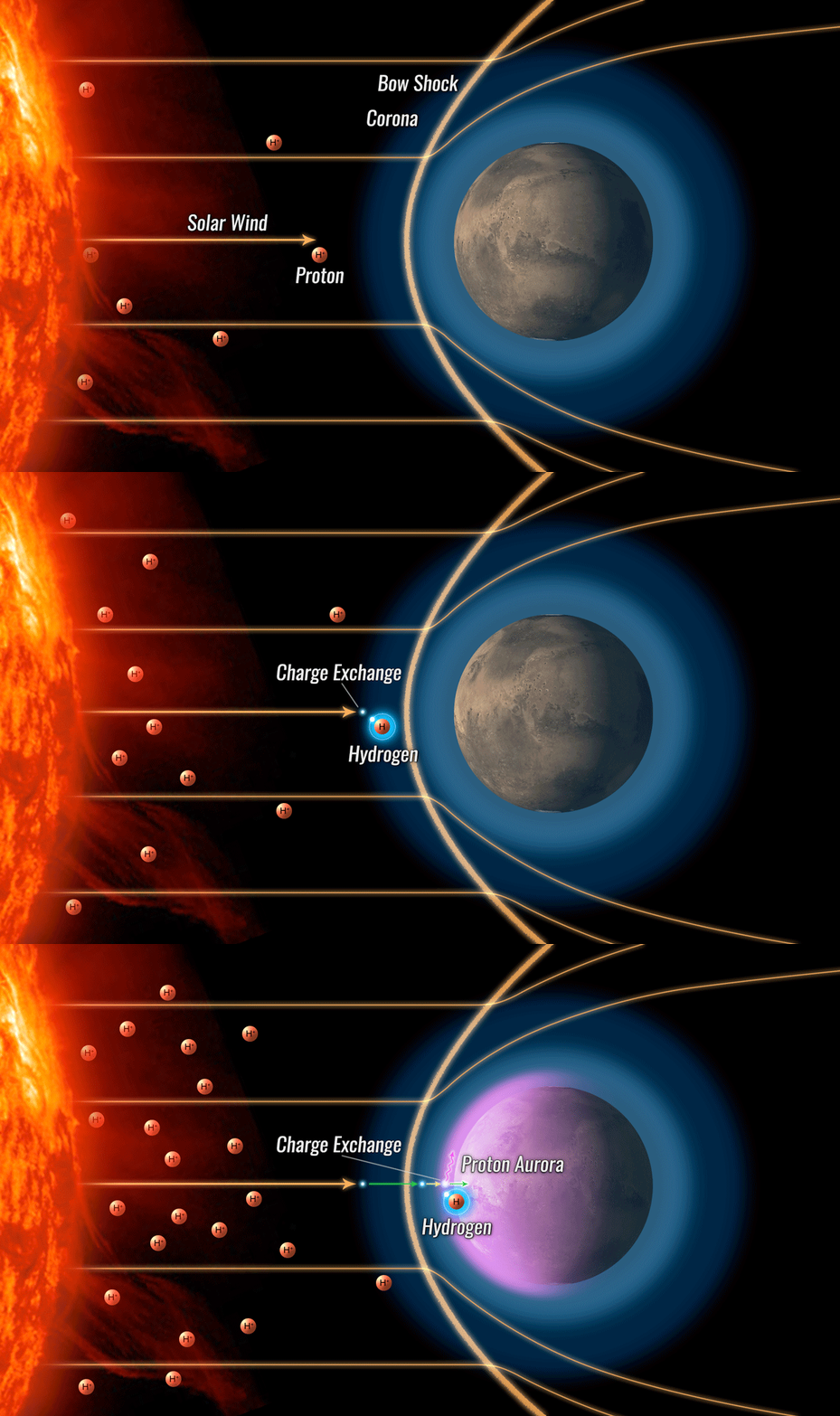
This animation shows a proton aurora at Mars. First, a solar wind proton approaches Mars at high speed and encounters a cloud of hydrogen surrounding the planet. The proton steals an electron from a Martian hydrogen atom, thereby becoming a neutral atom. The atom passes through the bowshock, a magnetic obstacle surrounding Mars, because neutral particles are not affected by magnetic fields. Finally, the hydrogen atom enters Mars' atmosphere and collides with gas molecules, causing the atom to emit ultraviolet light.Credits: NASA/MAVEN/Goddard Space Flight Center/Dan Gallagher. Download this graphic

Proton aurora form when solar wind protons (which are hydrogen atoms stripped of their lone electrons by intense heat) interact with the upper atmosphere on the dayside of Mars. As they approach Mars, the protons coming in with the solar wind transform into neutral atoms by stealing electrons from hydrogen atoms in the outer edge of the Martian hydrogen corona, a huge cloud of hydrogen surrounding the planet. When those high-speed incoming atoms hit the atmosphere, some of their energy is emitted as ultraviolet light.

Images of Mars proton aurora. MAVEN’s Imaging Ultraviolet Spectrograph observes the atmosphere of Mars, making images of neutral hydrogen and proton aurora simultaneously (left). Observations under normal conditions show hydrogen on the disk and in the extended atmosphere of the planet from a vantage point on the nightside (middle). Proton aurora is visible as a significant brightening on the limb and disk (right); with the contribution of neutral hydrogen subtracted, the distribution of proton aurora is revealed, showing that it peaks in brightness just off the Martian disk as energetic neutrals slam into the atmosphere. Credits: Embry-Riddle Aeronautical University/LASP, U. of Colorado

When the MAVEN team first observed the proton aurora, they thought it was a relatively unusual occurrence. “At first, we believed that these events were rather rare because we weren’t looking at the right times and places,” said Mike Chaffin, research scientist at the University of Colorado Boulder’s Laboratory for Atmospheric and Space Physics (LASP) and second author of the study. “But after a closer look, we found that proton aurora are occurring far more often in dayside southern summer observations than we initially expected.” The team has found proton aurora in about 14 percent of their dayside observations, which increases to more than 80 percent of the time when only dayside southern summer observations are considered. “By comparison, IUVS has detected diffuse aurora on Mars in a few percent of orbits with favorable geometry, and discrete aurora detections are rarer still in the dataset,” said Nick Schneider, coauthor and lead of the IUVS team at LASP.

The correlation with the southern summer gave a clue as to why proton aurora are so common and how they could be used to track water loss. During southern summer on Mars, the planet is also near its closest distance to the Sun in its orbit and huge dust storms can occur. Summer warming and dust activity appear to cause proton auroras by forcing water vapor high in the atmosphere. Solar extreme ultraviolet light breaks the water into its components, hydrogen and oxygen. The light hydrogen is weakly bound by Mars’ gravity and enhances the hydrogen corona surrounding Mars, increasing hydrogen loss to space. More hydrogen in the corona makes interactions with solar-wind protons more common, making proton aurora more frequent and brighter.div>

All the conditions necessary to create Martian proton aurora (e.g., solar wind protons, an extended hydrogen atmosphere, and the absence of a global dipole magnetic field) are more commonly available at Mars than those needed to create other types of aurora,” said Hughes. “Also, the connection between MAVEN’s observations of increased atmospheric escape and increases in proton aurora frequency and intensity means that proton aurora can actually be used as a proxy for what’s happening in the hydrogen corona surrounding Mars, and therefore, a proxy for times of increased atmospheric escape and water loss.”

This research was funded by the MAVEN mission. MAVEN's principal investigator is based at the University of Colorado's Laboratory for Atmospheric and Space Physics in Boulder, Colorado, and NASA Goddard manages the MAVEN project. NASA is exploring our Solar System and beyond, uncovering worlds, stars, and cosmic mysteries near and far with our powerful fleet of space and ground-based missions.

Source: NASA/Mars


Bill Steigerwald / Nancy Jones
NASA Goddard Space Flight Center, Greenbelt, Md.
301-286-8955 / 301-286-0039
william.a.steigerwald@nasa.gov / nancy.n.jones@nasa.gov

Editor: Bill Steigerwald


Wednesday, December 11, 2019

ALMA Spots Most Distant Dusty Galaxy Hidden in Plain Sight

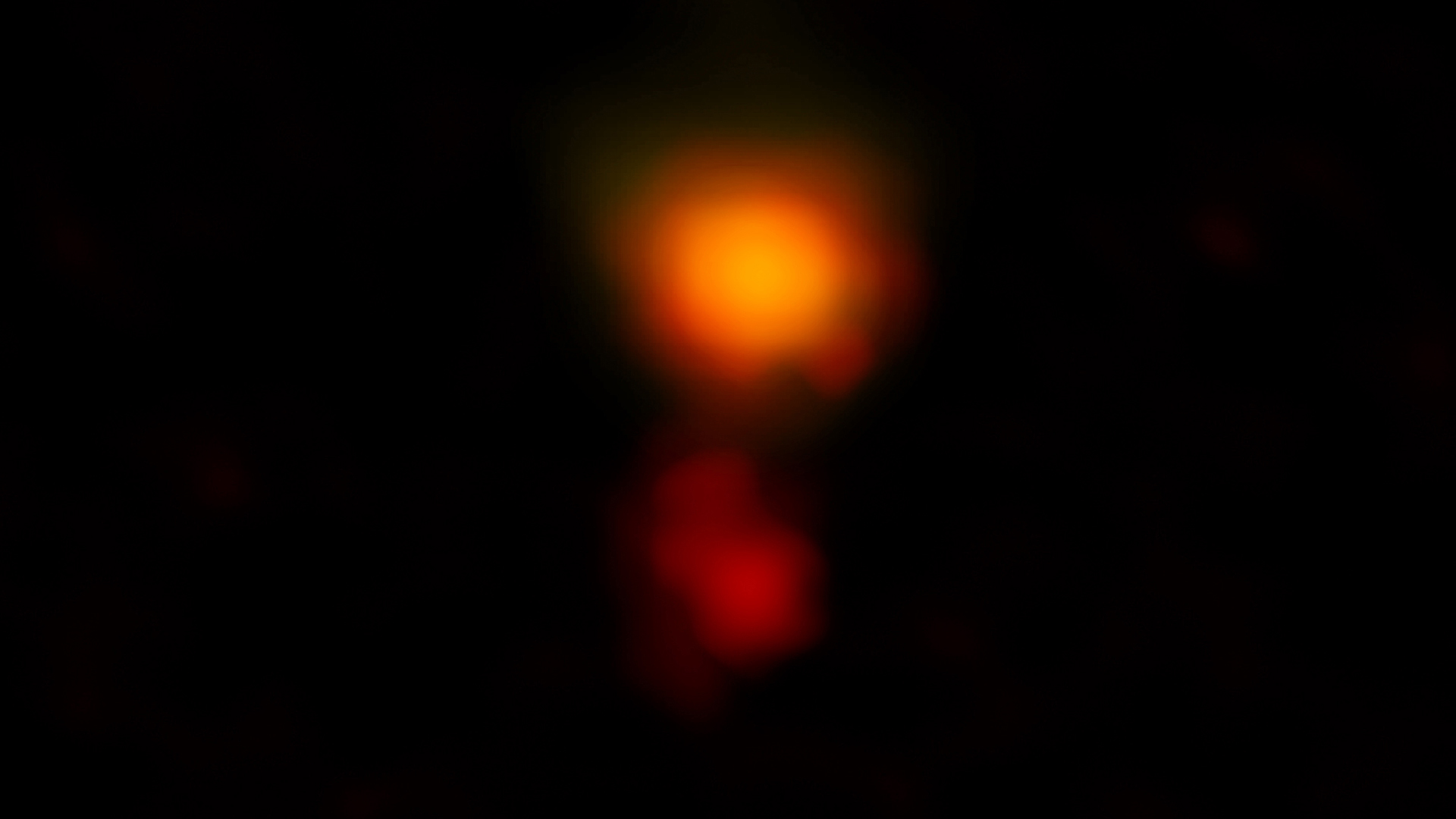
ALMA radio image of the dusty star-forming galaxy called MAMBO-9. The galaxy consists of two parts, and it is in the process of merging. Credit: ALMA (ESO/NAOJ/NRAO), C.M. Casey et al.; NRAO/AUI/NSF, B. Saxton. Hi-Res File

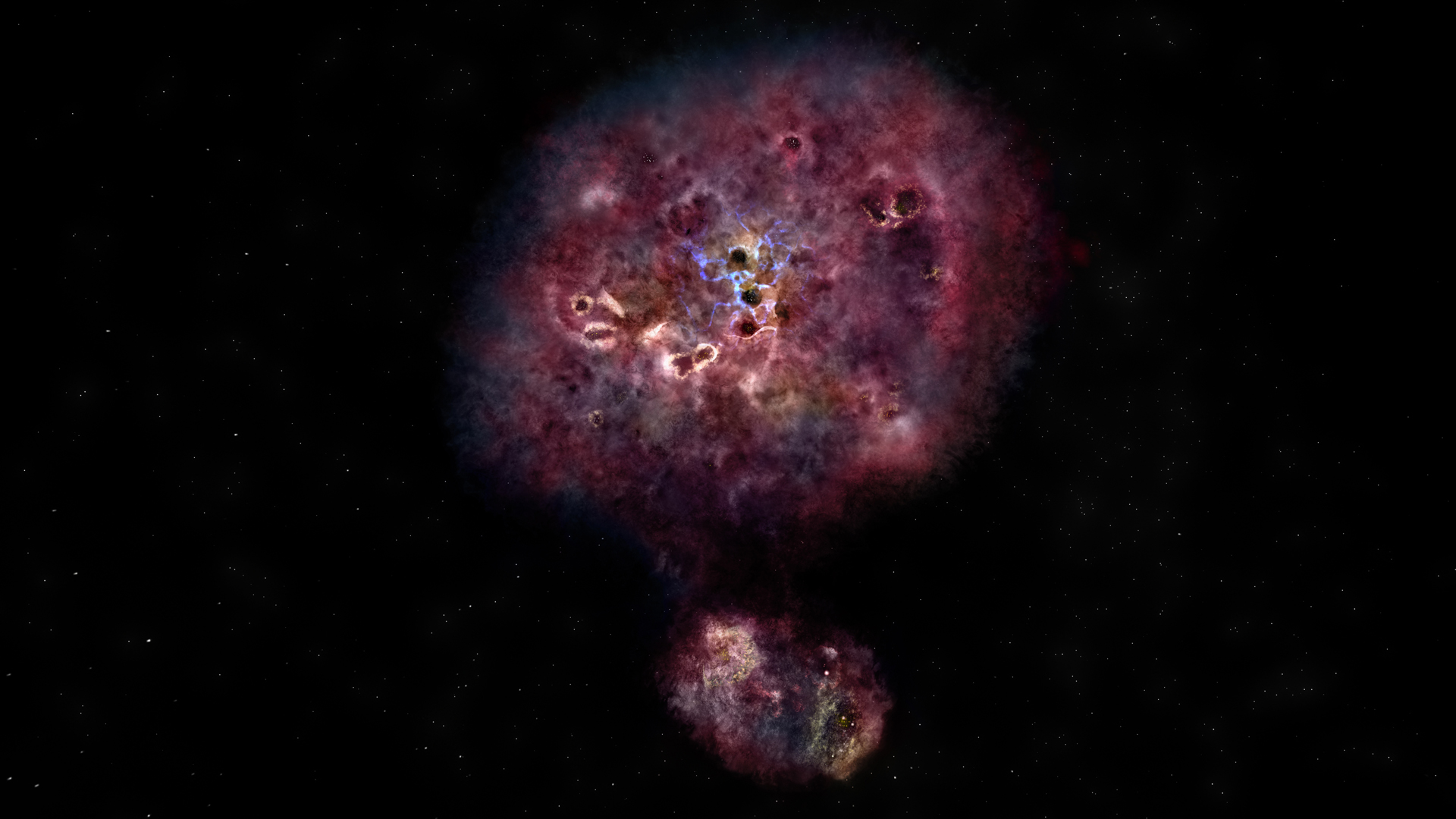
Artist impression of what MAMBO-9 would look like in visible light. The galaxy is very dusty and it has yet to build most of its stars. Credit: NRAO/AUI/NSF, B. Saxton. Hi-Res File


#WAWUA - ALMA is a timemachine! from NRAO Outreach on Vimeo.
The light from MAMBO-9 travelled about 13 billion years to reach ALMA’s antennas. That means that we can see what the galaxy looked like in the past. Watch this video to learn how ALMA works as a time-machine. Credit: María Corrêa-Mendes et al. - ALMA (ESO/NAOJ/NRAO)


Astronomers using the Atacama Large Millimeter/submillimeter Array (ALMA) have spotted the light of a massive galaxy seen only 970 million years after the Big Bang. This galaxy, called MAMBO-9, is the most distant dusty star-forming galaxy that has ever been observed without the help of a gravitational lens.

Dusty star-forming galaxies are the most intense stellar nurseries in the universe. They form stars at a rate up to a few thousand times the mass of the Sun per year (the star-forming rate of our Milky Way is just three solar masses per year) and they contain massive amounts of gas and dust. Such monster galaxies are not expected to have formed early in the history of the universe, but astronomers have already discovered several of them as seen when the cosmos was less than a billion years old. One of them is galaxy SPT0311-58, which ALMA observed in 2018.

Because of their extreme behavior, astronomers think that these dusty galaxies play an important role in the evolution of the universe. But finding them is easier said than done. “These galaxies tend to hide in plain sight,” said Caitlin Casey of the University of Texas at Austin and lead author of a study published in The Astrophysical Journal. “We know they are out there, but they are not easy to find because their starlight is hidden in clouds of dust.”

MAMBO-9’s light was already detected ten years ago by co-author Manuel Aravena, using the Max-Planck Millimeter BOlometer (MAMBO) instrument on the IRAM 30-meter telescope in Spain and the Plateau de Bure Interferometer in France. But these observations were not sensitive enough to reveal the distance of the galaxy. “We were in doubt if it was real, because we couldn’t find it with other telescopes. But if it was real, it had to be very far away,” says Aravena, who was at that time a PhD student in Germany and is currently working for the Universidad Diego Portales in Chile.

Thanks to ALMA’s sensitivity, Casey and her team have now been able to determine the distance of MAMBO-9. “We found the galaxy in a new ALMA survey specifically designed to identify dusty star-forming galaxies in the early universe,” said Casey. “And what is special about this observation, is that this is the most distant dusty galaxy we have ever seen in an unobstructed way.” The light of distant galaxies is often obstructed by other galaxies closer to us. These galaxies in front work as a gravitational lens: they bend the light from the more distant galaxy. This lensing effect makes it easier for telescopes to spot distant objects (this is how ALMA could see galaxy SPT0311-58). But it also distorts the image of the object, making it harder to make out the details.

In this study, the astronomers saw MAMBO-9 directly, without a lens, and this allowed them to measure its mass. “The total mass of gas and dust in the galaxy is enormous: ten times more than all the stars in the Milky Way. This means that it has yet to build most of its stars,” Casey explained. The galaxy consists of two parts, and it is in the process of merging.

Casey hopes to find more distant dusty galaxies in the ALMA survey, which will give insight into how common they are, how these massive galaxies formed so early in the universe, and why they are so dusty. “Dust is normally a by-product of dying stars,” she said. “We expect one hundred times more stars than dust. But MAMBO-9 has not produced that many stars yet and we want to find out how dust can form so fast after the Big Bang.”

“Observations with new and more capable technology can produce unexpected findings like MAMBO-9,” said Joe Pesce, National Science Foundation Program Officer for NRAO and ALMA. “While it is challenging to explain such a massive galaxy so early in the history of the universe, discoveries like this allow astronomers to develop an improved understanding of, and ask ever more questions about, the universe.”


The light from MAMBO-9 travelled about 13 billion years to reach ALMA’s antennas (the universe is approximately 13.8 billion years old today). That means that we can see what the galaxy looked like in the past (Watch this video to learn how ALMA works as a time-machine). Today, the galaxy would probably be even bigger, containing one hundred times more stars than the Milky Way, residing in a massive galaxy cluster.

The National Radio Astronomy Observatory is a facility of the National Science Foundation, operated under cooperative agreement by Associated Universities, Inc.


Media contact:

Iris Nijman
News and Public Information Manager
National Radio Astronomy Observatory (NRAO)
inijman@nrao.edu
+1 (434) 296-0314

Science contact:

Caitlin Casey
Assistant Professor of Astronomy
University of Texas at Austin
cmcasey@utexas.edu
+1 (512) 471-3405


Reference:  

“Physical characterization of an unlensed dusty star-forming galaxy at z = 5.85,” C.M. Casey et. al., The Astrophysical Journal. DOI: 10.3847/1538-4357/ab52ff

The Atacama Large Millimeter/submillimeter Array (ALMA), an international astronomy facility, is a partnership of the European Organisation for Astronomical Research in the Southern Hemisphere (ESO), the U.S. National Science Foundation (NSF) and the National Institutes of Natural Sciences (NINS) of Japan in cooperation with the Republic of Chile. ALMA is funded by ESO on behalf of its Member States, by NSF in cooperation with the National Research Council of Canada (NRC) and the Ministry of Science and Technology (MOST) and by NINS in cooperation with the Academia Sinica (AS) in Taiwan and the Korea Astronomy and Space Science Institute (KASI).

ALMA construction and operations are led by ESO on behalf of its Member States; by the National Radio Astronomy Observatory (NRAO), managed by Associated Universities, Inc. (AUI), on behalf of North America; and by the National Astronomical Observatory of Japan (NAOJ) on behalf of East refereAsia. The Joint ALMA Observatory (JAO) provides the unified leadership and management of the construction, commissioning and operation of ALMA.


Tuesday, December 10, 2019

How to Shape a Spiral Galaxy

Magnetic fields in NGC 1086, or M77, are shown as streamlines over a visible light and X-ray composite image of the galaxy from the Hubble Space Telescope, the Nuclear Spectroscopic Array, and the Sloan Digital Sky Survey. The magnetic fields align along the entire length of the massive spiral arms — 24,000 light years across (0.8 kiloparsecs) — implying that the gravitational forces that created the galaxy’s shape are also compressing the its magnetic field. This supports the leading theory of how the spiral arms are forced into their iconic shape known as “density wave theory.” SOFIA studied the galaxy using far-infrared light (89 microns) to reveal facets of its magnetic fields that previous observations using visible and radio telescopes could not detect. Credits: NASA/SOFIA; NASA/JPL-Caltech/Roma Tre Univ. Hi-res image

Our Milky Way galaxy has an elegant spiral shape with long arms filled with stars, but exactly how it took this form has long puzzled scientists. New observations of another galaxy are shedding light on how spiral-shaped galaxies like our own get their iconic shape.

Magnetic fields play a strong role in shaping these galaxies, according to research from the Stratospheric Observatory for Infrared Astronomy, or SOFIA. Scientists measured magnetic fields along the spiral arms of the galaxy called NGC 1068, or M77. The fields are shown as streamlines that closely follow the circling arms.

“Magnetic fields are invisible, but they may influence the evolution of a galaxy,” said Enrique Lopez-Rodriguez, a Universities Space Research Association scientist at the SOFIA Science Center at NASA’s Ames Research Center in California’s Silicon Valley. “We have a pretty good understanding of how gravity affects galactic structures, but we’re just starting to learn the role magnetic fields play.”

The M77 galaxy is located 47 million light years away in the constellation Cetus. It has a supermassive active black hole at its center that is twice as massive as the black hole at the heart of our Milky Way galaxy. The swirling arms are filled with dust, gas and areas of intense star formation called starbursts.

SOFIA’s infrared observations reveal what human eyes cannot: magnetic fields that closely follow the newborn-star-filled spiral arms. This supports the leading theory of how these arms are forced into their iconic shape known as “density wave theory.” It states that dust, gas and stars in the arms are not fixed in place like blades on a fan. Instead, the material moves along the arms as gravity compresses it, like items on a conveyor belt.

The magnetic field alignment stretches across the entire length of the massive, arms — approximately 24,000 light years across. This implies that the gravitational forces that created the galaxy’s spiral shape are also compressing its magnetic field, supporting the density wave theory. The results are published in the Astrophysical Journal. 

“This is the first time we’ve seen magnetic fields aligned at such large scales with current star birth in the spiral arms,” said Lopez-Rodriquez. “It’s always exciting to have observational evidence that supports theories.”

Celestial magnetic fields are notoriously difficult to observe. SOFIA’s newest instrument, the High-resolution Airborne Wideband Camera-Plus, or HAWC+, uses far-infrared light to observe celestial dust grains, which align perpendicular to magnetic field lines. From these results, astronomers can infer the shape and direction of the otherwise invisible magnetic field. Far-infrared light provides key information about magnetic fields because the signal is not contaminated by emission from other mechanisms, such as scattered visible light and radiation from high-energy particles. SOFIA’s ability to study the galaxy with far infrared light, specifically at the wavelength of 89 microns, revealed previously unknown facets of its magnetic fields.

Further observations are necessary to understand how magnetic fields influence the formation and evolution of other types of galaxies, such as those with irregular shapes.

SOFIA, the Stratospheric Observatory for Infrared Astronomy, is a Boeing 747SP jetliner modified to carry a 106-inch diameter telescope. It is a joint project of NASA and the German Aerospace Center, DLR. NASA’s Ames Research Center in California’s Silicon Valley manages the SOFIA program, science and mission operations in cooperation with the Universities Space Research Association headquartered in Columbia, Maryland, and the German SOFIA Institute (DSI) at the University of Stuttgart. The aircraft is maintained and operated from NASA’s Armstrong Flight Research Center Building 703, in Palmdale, California. The HAWC+ instrument was developed and delivered to NASA by a multi-institution team led by the Jet Propulsion Laboratory in Pasadena, California.


Media Contact


Felicia Chou
NASA Headquarters, Washington
202-358-0257

felicia.chou@nasa.gov

Editor: Kassandra Bell

Source: NASA/SOFIA


Monday, December 09, 2019

Cloudy with a Chance of Dust

Credit: ESO

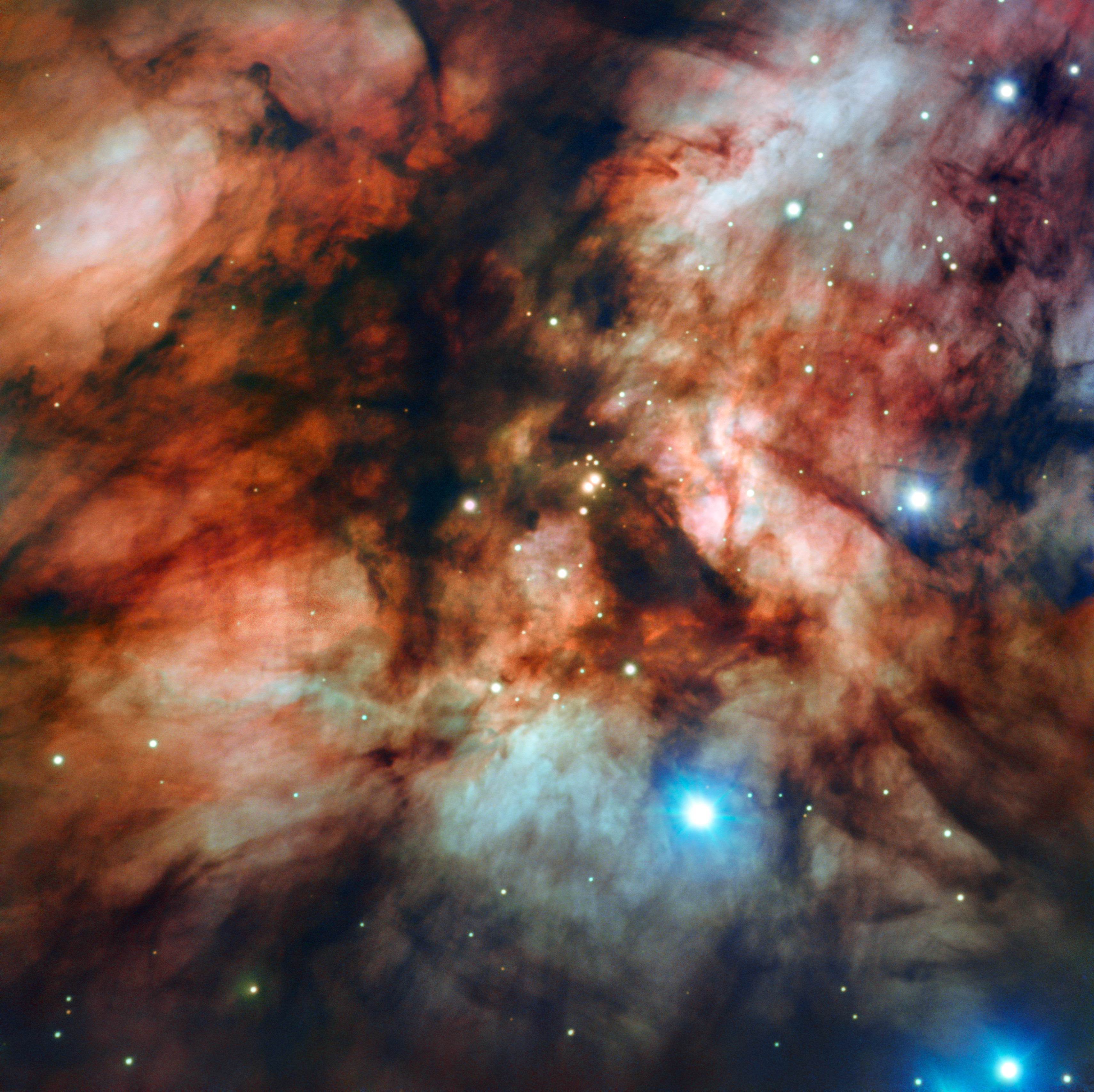
This cloud-strewn new image of RCW 36 (or Gum 20) was captured by ESO’s Focal Reducer and low dispersion Spectrograph (FORS). It shows one of the sites of massive-star formation closest to our Solar System, about 2300 light-years away. Located in the constellation of Vela (The Sails), the RCW 36 emission nebula is only part of an even larger star formation complex, known as the Vela Molecular Ridge.

Some areas in the clouds of RCW 36 are dense enough to block out background light, creating patches and wisps of inky black. Despite the dark appearance of these clouds, they are the only places in the Universe in which star formation occurs; clumps of molecular hydrogen and cosmic dust  collapse and come together to form stars encircled by small families of planets, as in our own Solar System.

FORS is mounted on ESO’s Very Large Telescope, one of the world's most advanced astronomical observatories. This image was selected as part of the ESO Cosmic Gems programme, an initiative that produces images of scientifically interesting and visually attractive objects using ESO telescopes for the purposes of education and public outreach. The programme makes use of telescope time that cannot be used for science observations. All data collected may also be suitable for scientific purposes, and are made available to astronomers through ESO’s science archive.

Source: ESO/potw


Saturday, December 07, 2019

Scientists Reveal Potential New Class of X-ray Star System Research

The large donor star has a tear-drop shape because it is filling its Roche lobe, donating mass to two compact stars in a tight binary that correspond to a pair of neutron stars or black holes. If the mass-gaining binary were simply a single star, mass would flow steadily through one point, the L1 point. Because the mass gainer is a binary, we see interesting patterns of mass flow, executing a complex dance. Credit: Sophie Schroeder, Niels Bohr Institute, and Morgan Macleod, Institute for Theory and Computation at CfA. animation.mp4

Cambridge, MA - A scientist at the Center for Astrophysics | Harvard & Smithsonian has announced the discovery that mass in triple star systems takes on the characteristics of recipient stars before mass is actually transferred, which may allow scientists to re-examine previously labeled binary star systems for evidence of a third companion.

"Scientists already knew that the transfer of mass from one star to another is one of the most important processes in astronomy, because it produces events that release tremendous amounts of energy -- from Type Ia supernovae to the merger of black holes. I wanted to extend this to understand what happens if one star transfers mass to a pair of stars," said Rosanne Di Stefano, astronomer at CfA. "To do that I had to generalize the familiar process of star-to-star mass flow."

Di Stefano suggests that the flow of mass is similar to the flow of water through a faucet. "The mass-giving star takes on a tear-drop shape, filling its 'Roche Lobe' and transferring mass through a small region called the L1 point," said Di Stefano. "The Roche Lobe and the L1 point provide a mathematical basis for computing exactly what happens to transferred mass in a binary where both gravity and rotation influence the flow of matter."

While the base of knowledge for binary star systems is broad and growing, our understanding of mass transfer in triple-star systems is more limited. Astronomical observations have established that triple-star systems are common, and even dominant amongst the population of known high-mass stars.

"In triple-star systems, instead of a fixed position with respect to the rotating stars, like we see in binary systems, the L1 point executes an orbit over a three-dimensional surface, and the shape of the Roche Lobe pulsates in a periodic fashion,” said Di Stefano. "This means that mass is pulled away from the donor star with its motion already imprinted with the periodicity of the inner binary, even though it has yet to travel to that binary, and the visual outcome looks much like an elegant, yet explosive Pas de trois."

Followup revealed that the pulsation also had the effect of increasing the rate of mass flow, with a stunning outcome for discerning observers. "If the inner binary consists of stellar remnants, the high rate of mass flow can make these systems among the brightest X-ray sources in galactic populations. This suggests that X-ray astronomers may be able to identify mass-transfer triples," said Di Stefano. “But what’s really exciting is that this new ability to identify triples in X-ray may allow us to discover that some systems previously thought to be X-ray binaries are actually a new class of star system: an X-ray triple with mass transfer from the outer star to an inner binary."

Di Stefano's work is published in the Monthly Notices of the Royal Astronomical Society, and is accompanied by a dynamical simulation by Sophie Schroeder, Niels Bohr Institute, and Morgan Macleod, Institute for Theory and Computation at CfA.


About Center for Astrophysics | Harvard & Smithsonian


Headquartered in Cambridge, Mass., the Center for Astrophysics | Harvard & Smithsonian (CfA) is a collaboration between the Smithsonian Astrophysical Observatory and the Harvard College Observatory. CfA scientists, organized into six research divisions, study the origin, evolution and ultimate fate of the universe.


Media Contact:

Amy Oliver, Public Affairs
Center for Astrophysics | Harvard & Smithsonian
Fred Lawrence Whipple Observatory
amy.oliver@cfa.harvard.edu


Friday, December 06, 2019

NASA’s Exoplanet-Hunting Mission Catches a Natural Comet Outburst in Unprecedented Detail

This animation shows an explosive outburst of dust, ice and gases from comet 46P/Wirtanen that occurred on September 26, 2018 and dissipated over the next 20 days. The images, from NASA’s TESS spacecraft, were taken every three hours during the first three days of the outburst. Credits: Farnham et al./NASA. View enlarged image

Using data from NASA’s Transiting Exoplanet Survey Satellite (TESS), astronomers at the University of Maryland (UMD), in College Park, Maryland, have captured a clear start-to-finish image sequence of an explosive emission of dust, ice and gases during the close approach of comet 46P/Wirtanen in late 2018. This is the most complete and detailed observation to date of the formation and dissipation of a naturally-occurring comet outburst. The team members reported their results in the November 22 issue of The Astrophysical Journal Letters.

“TESS spends nearly a month at a time imaging one portion of the sky. With no day or night breaks and no atmospheric interference, we have a very uniform, long-duration set of observations,” said Tony Farnham, a research scientist in the UMD Department of Astronomy and the lead author of the research paper. “As comets orbit the Sun, they can pass through TESS’ field of view. Wirtanen was a high priority for us because of its close approach in late 2018, so we decided to use its appearance in the TESS images as a test case to see what we could get out of it. We did so and were very surprised!”

Normal comet activity is driven by sunlight vaporizing the ices near the surface of the nucleus, and the outflowing gases drag dust off the nucleus to form the coma. However, many comets are known to experience occasional spontaneous outbursts that can significantly, but temporarily increase the comet's activity. It is not currently known what causes outbursts, but they are related to the conditions on the comet's surface. A number of potential trigger mechanisms have been proposed, including a thermal event, in which a heat wave penetrates into a pocket of highly volatile ices, causing the ice to rapidly vaporize and produce an explosion of activity, and a mechanical event, where a cliff collapses, exposing fresh ice to direct sunlight. Thus, studies of the outburst behavior, especially in the early brightening stages that are difficult to capture, can help us understand the physical and thermal properties of the comet.

Although Wirtanen came closest to Earth on December 16, 2018, the outburst occurred earlier in its approach, beginning on September 26, 2018. The initial brightening of the outburst occurred in two distinct phases, with an hour-long flash followed by a more gradual second stage that continued to grow brighter for another 8 hours. This second stage was likely caused by the gradual spreading of comet dust from the outburst, which causes the dust cloud to reflect more sunlight overall. After reaching peak brightness, the comet faded gradually over a period of more than two weeks. Because TESS takes detailed, composite images every 30 minutes, the team was able to view each phase in exquisite detail.

“With 20 days’ worth of very frequent images, we were able to assess changes in brightness very easily. That’s what TESS was designed for, to perform its primary job as an exoplanet surveyor,” Farnham said. “We can’t predict when comet outbursts will happen. But even if we somehow had the opportunity to schedule these observations, we couldn’t have done any better in terms of timing. The outburst happened mere days after the observations started.”

The team has generated a rough estimate of how much material may have been ejected in the outburst, about one million kilograms (2.2 million pounds), which could have left a crater on the comet of around 20 meters (about 65 feet) across. Further analysis of the estimated particle sizes in the dust tail may help improve this estimate. Observing more comets will also help to determine whether multi-stage brightening is rare or commonplace in comet outbursts.

TESS has also detected for the first time Wirtanen’s dust trail. Unlike a comet’s tail—the spray of gas and fine dust that follows behind a comet, growing as it approaches the sun—a comet’s trail is a field of larger debris that traces the comet’s orbital path as it travels around the sun. Unlike a tail, which changes direction as it is blown by the solar wind, the orientation of the trail stays more or less constant over time.

“The trail more closely follows the orbit of the comet, while the tail is offset from it, as it gets pushed around by the sun’s radiation pressure. What’s significant about the trail is that it contains the largest material,” said Michael Kelley, an associate research scientist in the UMD Department of Astronomy and a co-author of the research paper. “Tail dust is very fine, a lot like smoke. But trail dust is much larger—more like sand and pebbles. We think comets lose most of their mass through their dust trails. When the Earth runs into a comet’s dust trail, we get meteor showers.”

While the current study describes initial results, Farnham, Kelley and their colleagues look forward to further analyses of Wirtanen, as well as other comets in TESS’ field of view. “We also don’t know what causes natural outbursts and that’s ultimately what we want to find,” Farnham said. “There are at least four other comets in the same area of the sky where TESS made these observations, with a total of about 50 comets expected in the first two years’ worth of TESS data. There’s a lot that can come of these data.”

TESS is a NASA Astrophysics Explorer mission led and operated by MIT in Cambridge, Massachusetts, and managed by NASA's Goddard Space Flight Center. Additional partners include Northrop Grumman, based in Falls Church, Virginia; NASA’s Ames Research Center in California’s Silicon Valley; the Harvard-Smithsonian Center for Astrophysics in Cambridge, Massachusetts; MIT’s Lincoln Laboratory; and the Space Telescope Science Institute in Baltimore. More than a dozen universities, research institutes and observatories worldwide are participants in the mission.

Claire Andreoli
NASA’s Goddard Space Flight Center
301-286 -1940
claire.andreoli@nasa.gov

Matthew Wright
University of Maryland, College Park
301-405-9267
mewright@umd.edu

Source: NASA/TESS


Thursday, December 05, 2019

First Giant Planet around White Dwarf Found

Artist’s impression of the WDJ0914+1914 system

Location of WDJ0914+1914 in the constellation of Cancer


Videos

ESOcast 212 Light: First Giant Planet around White Dwarf Found

Artist’s animation of the WDJ0914+1914 system

Artist’s animation of the Sun becoming a red giant


ESO observations indicate the Neptune-like exoplanet is evaporating

Researchers using ESO’s Very Large Telescope have, for the first time, found evidence of a giant planet associated with a white dwarf star. The planet orbits the hot white dwarf, the remnant of a Sun-like star, at close range, causing its atmosphere to be stripped away and form a disc of gas around the star. This unique system hints at what our own Solar System might look like in the distant future.

“It was one of those chance discoveries,” says researcher Boris Gänsicke, from the University of Warwick in the UK, who led the study, published today in Nature. The team had inspected around 7000 white dwarfs observed by the Sloan Digital Sky Survey and found one to be unlike any other. By analysing subtle variations in the light from the star, they found traces of chemical elements in amounts that scientists had never before observed at a white dwarf. “We knew that there had to be something exceptional going on in this system, and speculated that it may be related to some type of planetary remnant.” 

To get a better idea of the properties of this unusual star, named WDJ0914+1914, the team analysed it with the X-shooter instrument on ESO’s Very Large Telescope in the Chilean Atacama Desert. These follow-up observations confirmed the presence of hydrogen, oxygen and sulphur associated with the white dwarf. By studying the fine details in the spectra taken by ESO’s X-shooter, the team discovered that these elements were in a disc of gas swirling into the white dwarf, and not coming from the star itself.

“It took a few weeks of very hard thinking to figure out that the only way to make such a disc is the evaporation of a giant planet,” says Matthias Schreiber from the University of Valparaiso in Chile, who computed the past and future evolution of this system.

The detected amounts of hydrogen, oxygen and sulphur are similar to those found in the deep atmospheric layers of icy, giant planets like Neptune and Uranus. If such a planet were orbiting close to a hot white dwarf, the extreme ultraviolet radiation from the star would strip away its outer layers and some of this stripped gas would swirl into a disc, itself accreting onto the white dwarf. This is what scientists think they are seeing around WDJ0914+1914: the first evaporating planet orbiting a white dwarf.

Combining observational data with theoretical models, the team of astronomers from the UK, Chile and Germany were able to paint a clearer image of this unique system. The white dwarf is small and, at a blistering 28 000 degrees Celsius (five times the Sun's temperature), extremely hot. By contrast, the planet is icy and large—at least twice as large as the star. Since it orbits the hot white dwarf at close range, making its way around it in just 10 days, the high-energy photons from the star are gradually blowing away the planet's atmosphere. Most of the gas escapes, but some is pulled into a disc swirling into the star at a rate of 3000 tonnes per second. It is this disc that makes the otherwise hidden Neptune-like planet visible.

“This is the first time we can measure the amounts of gases like oxygen and sulphur in the disc, which provides clues to the composition of exoplanet atmospheres,” says Odette Toloza from the University of Warwick, who developed a model for the disc of gas surrounding the white dwarf.

“The discovery also opens up a new window into the final fate of planetary systems,” adds Gänsicke.

Stars like our Sun burn hydrogen in their cores for most of their lives. Once they run out of this fuel, they puff up into red giants, becoming hundreds of times larger and engulfing nearby planets. In the case of the Solar System, this will include Mercury, Venus, and even Earth, which will all be consumed by the red-giant Sun in about 5 billion years. Eventually, Sun-like stars lose their outer layers, leaving behind only a burnt-out core, a white dwarf. Such stellar remnants can still host planets, and many of these star systems are thought to exist in our galaxy. However, until now, scientists had never found evidence of a surviving giant planet around a white dwarf. The detection of an exoplanet in orbit around WDJ0914+1914, located about 1500 light years away in the constellation of Cancer, may be the first of many orbiting such stars.

According to the researchers, the exoplanet now found with the help of ESO’s X-shooter orbits the white dwarf at a distance of only 10 million kilometres, or 15 times the solar radius, which would have been deep inside the red giant. The unusual position of the planet implies that at some point after the host star became a white dwarf, the planet moved closer to it. The astronomers believe that this new orbit could be the result of gravitational interactions with other planets in the system, meaning that more than one planet may have survived its host star’s violent transition.

“Until recently, very few astronomers paused to ponder the fate of planets orbiting dying stars. This discovery of a planet orbiting closely around a burnt-out stellar core forcefully demonstrates that the Universe is time and again challenging our minds to step beyond our established ideas,” concludes Gänsicke.


More Information

This research was presented in a paper to appear in Nature.

The team is composed of Boris Gänsicke (Department of Physics & Centre for Exoplanets and Habitability, University of Warwick, UK), Matthias Schreiber (Institute of Physics and Astronomy, Millennium Nucleus for Planet Formation, Valparaiso University, Chile), Odette Toloza (Department of Physics, University of Warwick, UK), Nicola Gentile Fusillo (Department of Physics, University of Warwick, UK), Detlev Koester (Institute for Theoretical Physics and Astrophysics, University of Kiel, Germany), and Christopher Manser (Department of Physics, University of Warwick, UK).

ESO is the foremost intergovernmental astronomy organisation in Europe and the world’s most productive ground-based astronomical observatory by far. It has 16 Member States: Austria, Belgium, the Czech Republic, Denmark, France, Finland, Germany, Ireland, Italy, the Netherlands, Poland, Portugal, Spain, Sweden, Switzerland and the United Kingdom, along with the host state of Chile and with Australia as a Strategic Partner. ESO carries out an ambitious programme focused on the design, construction and operation of powerful ground-based observing facilities enabling astronomers to make important scientific discoveries. ESO also plays a leading role in promoting and organising cooperation in astronomical research. ESO operates three unique world-class observing sites in Chile: La Silla, Paranal and Chajnantor. At Paranal, ESO operates the Very Large Telescope and its world-leading Very Large Telescope Interferometer as well as two survey telescopes, VISTA working in the infrared and the visible-light VLT Survey Telescope. Also at Paranal ESO will host and operate the Cherenkov Telescope Array South, the world’s largest and most sensitive gamma-ray observatory.

ESO is also a major partner in two facilities on Chajnantor, APEX and ALMA, the largest astronomical project in existence. And on Cerro Armazones, close to Paranal, ESO is building the 39-metre Extremely Large Telescope, the ELT, which will become “the world’s biggest eye on the sky”.


Links


Contacts

Boris Gänsicke
University of Warwick
UK
Tel: +44 247 657 4741

Matthias Schreiber
Valparaiso University
Chile
Tel: +56 32 299 5518

Odette Toloza
University of Warwick
UK

Nicola Gentile Fusillo (study co-author)
European Southern Observatory and University of Warwick
Germany
Tel: +49 8932 0067 50
Cell: +44 7476 9595 49

Christopher Manser (study co-author)
University of Warwick
UK
Tel: +44 7516 8167 53

Bárbara Ferreira
ESO Public Information Officer
Garching bei München, Germany
Tel: +49 89 3200 6670
Email: pio@eso.org

Source: ESO/News