
Showing posts with label SPT0311-58. Show all posts
Showing posts with label SPT0311-58. Show all posts
Thursday, November 11, 2021
ALMA Scientists Detect Signs of Water in a Galaxy Far, Far Away
This artist’s conception shows the dust continuum and molecular lines of
carbon monoxide and water seen in the pair of galaxies known as
SPT0311-58. ALMA data reveals abundant CO and H2O in the
larger of the two galaxies, indicating that the molecular Universe was
going strong shortly after the elements were initially forged. Credit:
ALMA (ESO/NAOJ/NRAO)/S. Dagnello (NRAO)

These science images show the molecular lines and dust continuum seen in
ALMA observations of the pair of early massive galaxies known as
SPT0311-58. On left: A composite image combining the dust continuum with
molecular lines for H2O and CO. On right: The dust continuum seen in red (top), molecular line for H2O
shown in blue (2nd from top), molecular line transitions for carbon
monoxide, CO(6-5) shown in purple (middle), CO(7-6) shown in magenta
(second from bottom), and CO(10-9) shown in pinks and deep blue
(bottom). Credit: ALMA (ESO/NAOJ/NRAO)/S. Dagnello (NRAO)

This animated gif moves through the dust continuum and molecular lines
for water and carbon monoxide seen in ALMA observations of the pair of
early massive galaxies known as SPT0311-58. This gif begins with a
composite combining the dust continuum with molecular lines for H2O and CO. It is followed by the dust continuum seen in red, molecular lines for H2O
seen in blue, molecular lines for carbon monoxide, CO(10-9) shown in
pinks and deep blue, CO(7-6) shown in magenta, and CO(6-5) shown in
purple. Credit: ALMA (ESO/NAOJ/NRAO)/S. Dagnello (NRAO)
Water has been detected in the most massive galaxy in the early Universe, according to new observations from the Atacama Large Millimeter/submillimeter Array (ALMA). Scientists studying SPT0311-58 found H2O , along with carbon monoxide in the galaxy, which is located nearly 12.88 billion light years from Earth. Detection of these two molecules in abundance suggests that the molecular Universe was going strong shortly after the elements were forged in early stars. The new research comprises the most detailed study of molecular gas content of a galaxy in the early Universe to date and the most distant detection of H2O in a regular star-forming galaxy. The research is published in The Astrophysical Journal.
SPT0311-58 is actually made up of two galaxies, and was first seen by ALMA scientists in 2017 at its location, or time, in the Epoch of Reionization. This epoch occurred at a time when the Universe was just 780 million years old—roughly 5-percent of its current age—and the first stars and galaxies were being born. Scientists believe that the two galaxies may be merging, and that their rapid star formation is not only using up their gas, or star-forming fuel, but that it may eventually evolve the pair into massive elliptical galaxies like those seen in the Local Universe.
“Using high-resolution ALMA observations of molecular gas in the pair of galaxies known collectively as SPT0311-58 we detected both water and carbon monoxide molecules in the larger of the two galaxies. Oxygen and carbon, in particular, are first-generation elements, and in the molecular forms of carbon monoxide and water, they are critical to life as we know it,” said Sreevani Jarugula, an astronomer at the University of Illinois and the principal investigator on the new research. “This galaxy is the most massive galaxy currently known at high redshift, or the time when the Universe was still very young. It has more gas and dust compared to other galaxies in the early Universe, which gives us plenty of potential opportunities to observe abundant molecules and to better understand how these life-creating elements impacted the development of the early Universe.”
Water, in particular, is the third most abundant molecule in the Universe after molecular hydrogen and carbon monoxide. Previous studies of galaxies in the local and early Universe have correlated water emission and the far-infrared emission from dust. “The dust absorbs the ultraviolet radiation from the stars in the galaxy and re-emits it as far-infrared photons,” said Jarugula. “This further excites the water molecules, giving rise to the water emission that scientists are able to observe. In this case, it helped us to detect water emission in this massive galaxy. This correlation could be used to develop water as a tracer of star formation, which could then be applied to galaxies on a cosmological scale.”
Studying the first galaxies to form in the Universe helps scientists to better understand the birth, growth, and evolution of the Universe, and everything in it, including the Solar System and Earth. “Early galaxies are forming stars at a rate thousands of times that of the Milky Way, said Jarugula. “Studying the gas and dust content of these early galaxies informs us of their properties, such as how many stars are being formed, the rate at which gas is converted into stars, how galaxies interact with each other and with the interstellar medium, and more.”
According to Jarugula, there’s plenty left to learn about SPT0311-58 and the galaxies of the early Universe. “This study not only provides answers about where, and how far away, water can exist in the Universe, but also has given rise to a big question: How has so much gas and dust assembled to form stars and galaxies so early in the Universe? The answer requires further study of these and similar star-forming galaxies to get a better understanding of the structural formation and evolution of the early Universe.”
“This exciting result, which shows the power of ALMA, adds to a
growing collection of observations of the early Universe,” said Joe
Pesce, astrophysicist and ALMA Program Director at the National Science
Foundation. “These molecules, important to life on Earth, are forming as
soon as they can, and their observation is giving us insight into the
fundamental processes of a Universe very much different from today’s.”
Additional Information
The original press release was published by the National Radio Astronomy Observatory (NRAO), an ALMA partner on behalf of North America.
The Atacama Large Millimeter/submillimeter Array (ALMA), an international astronomy facility, is a partnership of the European Organisation for Astronomical Research in the Southern Hemisphere (ESO), the U.S. National Science Foundation (NSF) and the National Institutes of Natural Sciences (NINS) of Japan in cooperation with the Republic of Chile. ALMA is funded by ESO on behalf of its Member States, by NSF in cooperation with the National Research Council of Canada (NRC) and the Ministry of Science and Technology (MOST) and by NINS in cooperation with the Academia Sinica (AS) in Taiwan and the Korea Astronomy and Space Science Institute (KASI).
ALMA construction and operations are led by ESO on behalf of its Member States; by the National Radio Astronomy Observatory (NRAO), managed by Associated Universities, Inc. (AUI), on behalf of North America; and by the National Astronomical Observatory of Japan (NAOJ) on behalf of East Asia. The Joint ALMA Observatory (JAO) provides the unified leadership and management of the construction, commissioning and operation of ALMA.
Contacts:
-
Valeria Foncea
Education and Public Outreach Manager
Joint ALMA Observatory Santiago - Chile
Phone: +56 2 2467 6258
Cell phone: +56 9 7587 1963
Email: valeria.foncea@alma.cl
-
Amy C. Oliver
Public Information & News Manager
National Radio Astronomical Observatory (NRAO), USA
Phone: +1 434 242 9584
Email: aoliver@nrao.edu
-
Masaaki Hiramatsu
Education and Public Outreach Officer, NAOJ Chile
Observatory, Tokyo - Japan
Phone: +81 422 34 3630
Email:
- hiramatsu.masaaki@nao.ac.jp
ESO Public Information Officer
Garching bei München, Germany
Phone: +49 89 3200 6670
Email: pio@eso.org
Source: Atacama Large Millimeter/submillimeter Array (ALMA)/News


Wednesday, December 11, 2019
ALMA Spots Most Distant Dusty Galaxy Hidden in Plain Sight

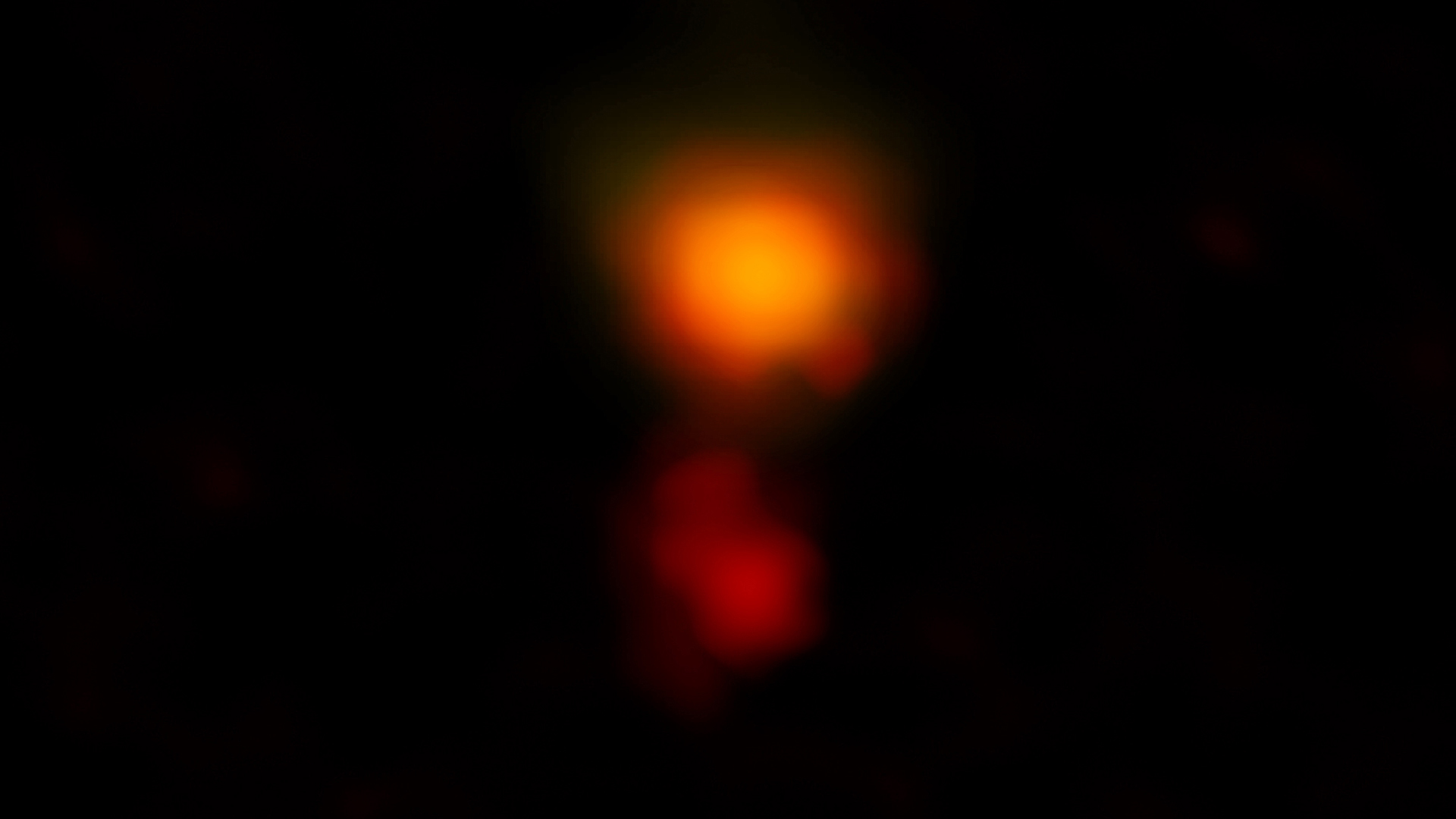
ALMA radio image of the dusty star-forming galaxy called MAMBO-9. The galaxy consists of two parts, and it is in the process of merging.
Credit: ALMA (ESO/NAOJ/NRAO), C.M. Casey et al.; NRAO/AUI/NSF, B. Saxton. Hi-Res File

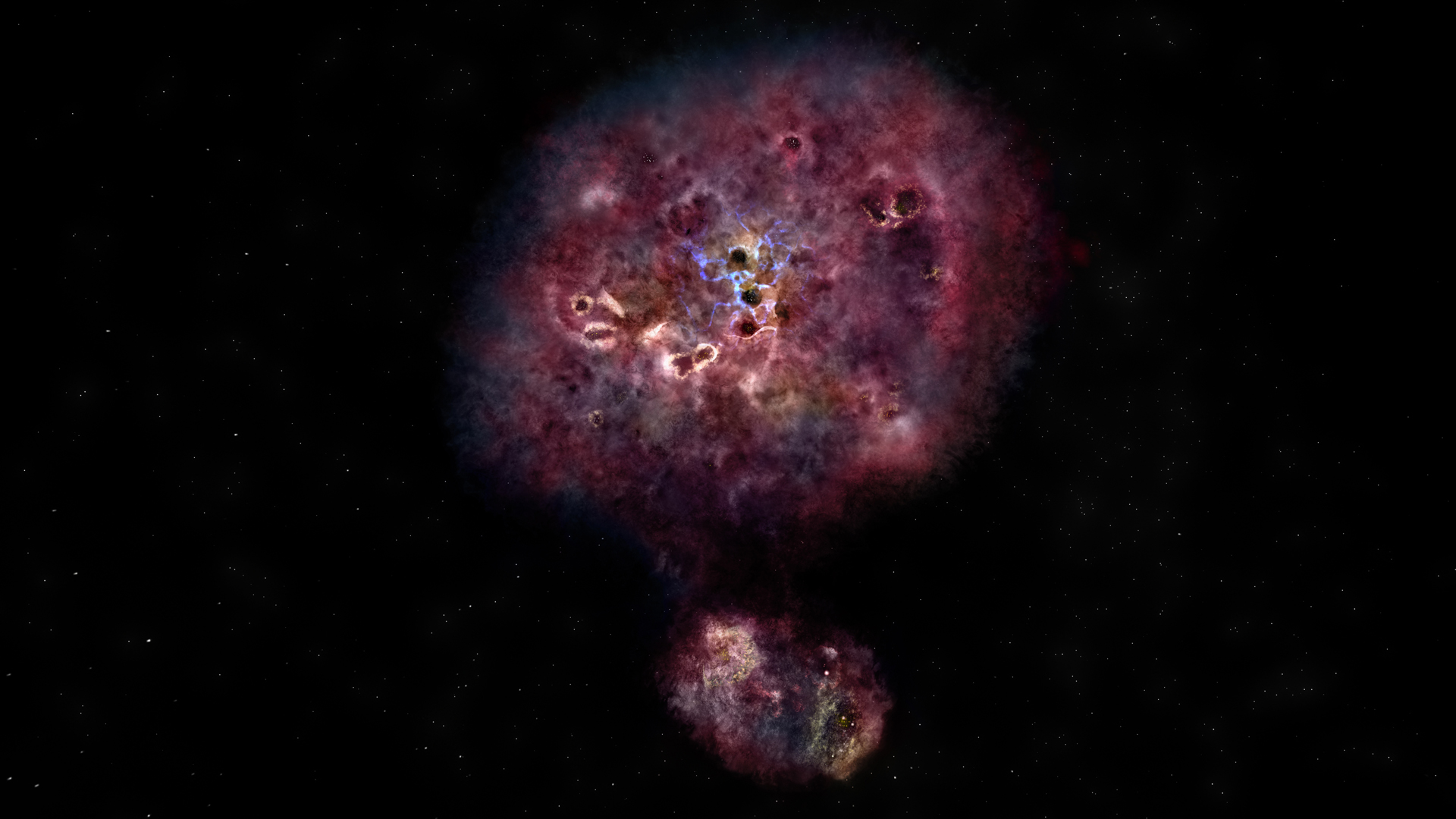
Artist impression of what MAMBO-9 would look like in visible light. The galaxy is very dusty and it has yet to build most of its stars.
Credit: NRAO/AUI/NSF, B. Saxton. Hi-Res File
#WAWUA - ALMA is a timemachine! from NRAO Outreach on Vimeo.
The light from MAMBO-9 travelled about 13 billion years to reach ALMA’s antennas. That means that we can see what the galaxy looked like in the past. Watch this video to learn how ALMA works as a time-machine.
Credit: María Corrêa-Mendes et al. - ALMA (ESO/NAOJ/NRAO)
Astronomers using the Atacama Large Millimeter/submillimeter Array (ALMA)
have spotted the light of a massive galaxy seen only 970 million years after the Big Bang. This galaxy, called MAMBO-9, is the most distant dusty star-forming galaxy that has ever been observed without the help of a gravitational lens.
Dusty star-forming galaxies are the most intense stellar nurseries in the universe. They form stars at a rate up to a few thousand times the mass of the Sun per year (the star-forming rate of our Milky Way is just three solar masses per year) and they contain massive amounts of gas and dust. Such monster galaxies are not expected to have formed early in the history of the universe, but astronomers have already discovered several of them as seen when the cosmos was less than a billion years old. One of them is galaxy SPT0311-58, which ALMA observed in 2018.
Because of their extreme behavior, astronomers think that these dusty galaxies play an important role in the evolution of the universe. But finding them is easier said than done. “These galaxies tend to hide in plain sight,” said Caitlin Casey of the University of Texas at Austin and lead author of a study published in The Astrophysical Journal. “We know they are out there, but they are not easy to find because their starlight is hidden in clouds of dust.”
MAMBO-9’s light was already detected ten years ago by co-author Manuel Aravena, using the Max-Planck Millimeter BOlometer (MAMBO) instrument on the IRAM 30-meter telescope in Spain and the Plateau de Bure Interferometer in France. But these observations were not sensitive enough to reveal the distance of the galaxy. “We were in doubt if it was real, because we couldn’t find it with other telescopes. But if it was real, it had to be very far away,” says Aravena, who was at that time a PhD student in Germany and is currently working for the Universidad Diego Portales in Chile.
Thanks to ALMA’s sensitivity, Casey and her team have now been able to determine the distance of MAMBO-9. “We found the galaxy in a new ALMA survey specifically designed to identify dusty star-forming galaxies in the early universe,” said Casey. “And what is special about this observation, is that this is the most distant dusty galaxy we have ever seen in an unobstructed way.”
The light of distant galaxies is often obstructed by other galaxies closer to us. These galaxies in front work as a gravitational lens: they bend the light from the more distant galaxy. This lensing effect makes it easier for telescopes to spot distant objects (this is how ALMA could see galaxy SPT0311-58). But it also distorts the image of the object, making it harder to make out the details.
In this study, the astronomers saw MAMBO-9 directly, without a lens, and this allowed them to measure its mass. “The total mass of gas and dust in the galaxy is enormous: ten times more than all the stars in the Milky Way. This means that it has yet to build most of its stars,” Casey explained. The galaxy consists of two parts, and it is in the process of merging.
Casey hopes to find more distant dusty galaxies in the ALMA survey, which will give insight into how common they are, how these massive galaxies formed so early in the universe, and why they are so dusty. “Dust is normally a by-product of dying stars,” she said. “We expect one hundred times more stars than dust. But MAMBO-9 has not produced that many stars yet and we want to find out how dust can form so fast after the Big Bang.”
“Observations with new and more capable technology can produce unexpected findings like MAMBO-9,” said Joe Pesce, National Science Foundation Program Officer for NRAO and ALMA. “While it is challenging to explain such a massive galaxy so early in the history of the universe, discoveries like this allow astronomers to develop an improved understanding of, and ask ever more questions about, the universe.”
Media contact:
Iris Nijman
News and Public Information Manager
National Radio Astronomy Observatory (NRAO)
inijman@nrao.edu
+1 (434) 296-0314
Science contact:
Caitlin Casey
Assistant Professor of Astronomy
University of Texas at Austin
cmcasey@utexas.edu
+1 (512) 471-3405
The light from MAMBO-9 travelled about 13 billion years to reach ALMA’s antennas (the universe is approximately 13.8 billion years old today). That means that we can see what the galaxy looked like in the past (Watch this video to learn how ALMA works as a time-machine). Today, the galaxy would probably be even bigger, containing one hundred times more stars than the Milky Way, residing in a massive galaxy cluster.
The National Radio Astronomy Observatory is a facility of the National Science Foundation, operated under cooperative agreement by Associated Universities, Inc.
Media contact:
Iris Nijman
News and Public Information Manager
National Radio Astronomy Observatory (NRAO)
inijman@nrao.edu
+1 (434) 296-0314
Science contact:
Caitlin Casey
Assistant Professor of Astronomy
University of Texas at Austin
cmcasey@utexas.edu
+1 (512) 471-3405
Reference:
“Physical characterization of an unlensed dusty star-forming galaxy at z = 5.85,” C.M. Casey et. al., The Astrophysical Journal. DOI: 10.3847/1538-4357/ab52ff
“Physical characterization of an unlensed dusty star-forming galaxy at z = 5.85,” C.M. Casey et. al., The Astrophysical Journal. DOI: 10.3847/1538-4357/ab52ff
The Atacama Large Millimeter/submillimeter Array (ALMA), an international astronomy facility, is a partnership of the European Organisation for Astronomical Research in the Southern Hemisphere (ESO), the U.S. National Science Foundation (NSF) and the National Institutes of Natural Sciences (NINS) of Japan in cooperation with the Republic of Chile. ALMA is funded by ESO on behalf of its Member States, by NSF in cooperation with the National Research Council of Canada (NRC) and the Ministry of Science and Technology (MOST) and by NINS in cooperation with the Academia Sinica (AS) in Taiwan and the Korea Astronomy and Space Science Institute (KASI).
ALMA construction and operations are led by ESO on behalf of its Member States; by the National Radio Astronomy Observatory (NRAO), managed by Associated Universities, Inc. (AUI), on behalf of North America; and by the National Astronomical Observatory of Japan (NAOJ) on behalf of East refereAsia. The Joint ALMA Observatory (JAO) provides the unified leadership and management of the construction, commissioning and operation of ALMA.
Friday, December 08, 2017
Massive Primordial Galaxies Found Swimming in Vast Ocean of Dark Matter

Credit: NRAO/AUI/NSF; D. Berry

To correct for the effects of gravitational lensing in
these galaxies, the ALMA data (left panel) is compared to a
lensing-distorted model image (second panel from left). The difference
is shown in the third panel from the left. The structure of the galaxy,
after removing the lensing effect, is shown at right. This image loops
through the different velocity ranges within the galaxy, which appear at
different frequencies to ALMA due to the Doppler effect.Credit: ALMA (ESO/NAOJ/NRAO); D. Marrone et al.

Astronomers expect that the first galaxies, those that formed just a few hundred million years after the Big Bang,
would share many similarities with some of the dwarf galaxies we see in
the nearby universe today. These early agglomerations of a few billion
stars would then become the building blocks of the larger galaxies that
came to dominate the universe after the first few billion years.
Ongoing observations with the Atacama Large Millimeter/submillimeter Array
(ALMA), however, have discovered surprising examples of massive,
star-filled galaxies seen when the cosmos was less than a billion years
old. This suggests that smaller galactic building blocks were able to
assemble into large galaxies quite quickly.
The latest ALMA observations push back this epoch of massive-galaxy
formation even further by identifying two giant galaxies seen when the
universe was only 780 million years old, or about 5 percent its current
age. ALMA also revealed that these uncommonly large galaxies are nestled
inside an even-more-massive cosmic structure, a halo of dark matter several trillion times more massive than the sun.
The two galaxies are in such close proximity — less than the distance
from the Earth to the center of our galaxy — that they will shortly
merge to form the largest galaxy ever observed at that period in cosmic
history. This discovery provides new details about the emergence of
large galaxies and the role that dark matter plays in assembling the
most massive structures in the universe.
The researchers report their findings in the journal Nature.
“With these exquisite ALMA observations, astronomers are seeing the
most massive galaxy known in the first billion years of the universe in
the process of assembling itself,” said Dan Marrone, associate professor
of astronomy at the University of Arizona in Tucson and lead author on
the paper.
Astronomers are seeing these galaxies during a period of cosmic
history known as the Epoch of Reionization, when most of intergalactic
space was suffused with an obscuring fog of cold hydrogen gas. As more
stars and galaxies formed, their energy eventually ionized the hydrogen
between the galaxies, revealing the universe as we see it today.
“We usually view that as the time of little galaxies working hard to
chew away at the neutral intergalactic medium,” said Marrone. “Mounting
observational evidence with ALMA, however, has helped to reshape that
story and continues to push back the time at which truly massive
galaxies first emerged in the universe.”
The galaxies that Marrone and his team studied, collectively known as
SPT0311-58, were originally identified as a single source by the South Pole Telescope.
These first observations indicated that this object was very distant
and glowing brightly in infrared light, meaning that it was extremely
dusty and likely going through a burst of star formation. Subsequent
observations with ALMA revealed the distance and dual nature of the
object, clearly resolving the pair of interacting galaxies.
To make this observation, ALMA had some help from a gravitational lens,
which provided an observing boost to the telescope. Gravitational
lenses form when an intervening massive object, like a galaxy or galaxy
cluster, bends the light from more distant galaxies. They do, however,
distort the appearance of the object being studied, requiring
sophisticated computer models to reconstruct the image as it would
appear in its unaltered state.
This “de-lensing” process provided intriguing details about the
galaxies, showing that the larger of the two is forming stars at a rate
of 2,900 solar masses
per year. It also contains about 270 billion times the mass of our sun
in gas and nearly 3 billion times the mass of our sun in dust. “That’s a
whopping large quantity of dust, considering the young age of the
system,” noted Justin Spilker, a recent graduate of the University of
Arizona and now a postdoctoral fellow at the University of Texas at
Austin.
The astronomers determined that this galaxy’s rapid star formation
was likely triggered by a close encounter with its slightly smaller
companion, which already hosts about 35 billion solar masses of stars
and is increasing its rate of starburst at the breakneck pace of 540
solar masses per year.
The researchers note that galaxies of this era are “messier” than the
ones we see in the nearby universe. Their more jumbled shapes would be
due to the vast stores of gas raining down on them and their ongoing
interactions and mergers with their neighbors.
The new observations also allowed the researchers to infer the
presence of a truly massive dark matter halo surrounding both galaxies.
Dark matter provides the pull of gravity that causes the universe to
collapse into structures (galaxies, groups and clusters of galaxies,
etc.).
“If you want to see if a galaxy makes sense in our current
understanding of cosmology, you want to look at the dark matter halo —
the collapsed dark matter structure — in which it resides,” said Chris
Hayward, associate research scientist at the Center for Computational
Astrophysics at the Flatiron Institute in New York City. “Fortunately,
we know very well the ratio between dark matter and normal matter in the
universe, so we can estimate what the dark matter halo mass must be.”
By comparing their calculations with current cosmological
predictions, the researchers found that this halo is one of the most
massive that should exist at that time.
“There are more galaxies discovered with the South Pole Telescope
that we’re following up on,” said Joaquin Vieira of the University of
Illinois at Urbana-Champaign, “and there is a lot more survey data that
we are just starting to analyze. Our hope is to find more objects like
this, possibly even more distant ones, to better understand this
population of extreme dusty galaxies and especially their relation to
the bulk population of galaxies at this epoch.”
“In any case, our next round of ALMA observations should help us
understand how quickly these galaxies came together and improve our
understanding of massive galaxy formation during reionization,” added
Marrone.
The National Radio Astronomy Observatory is a facility of the
National Science Foundation, operated under cooperative agreement by
Associated Universities, Inc.
This research is presented in a paper titled “’Galaxy growth in a
massive halo in the first billion years of cosmic history,” by D.
Marrone, et al., which appears in Advance Online Publication for Nature. [http://www.nature.com/nature].
The Atacama Large Millimeter/submillimeter Array (ALMA), an
international astronomy facility, is a partnership of the European
Organisation for Astronomical Research in the Southern Hemisphere (ESO),
the U.S. National Science Foundation (NSF) and the National Institutes
of Natural Sciences (NINS) of Japan in cooperation with the Republic of
Chile. ALMA is funded by ESO on behalf of its Member States, by NSF in
cooperation with the National Research Council of Canada (NRC) and the
Ministry of Science and Technology (MOST) in Taiwan and by NINS in
cooperation with the Academia Sinica (AS) in Taiwan and the Korea
Astronomy and Space Science Institute (KASI).
ALMA construction and operations are led by ESO on behalf of its
Member States; by the National Radio Astronomy Observatory (NRAO),
managed by Associated Universities, Inc. (AUI), on behalf of North
America; and by the National Astronomical Observatory of Japan (NAOJ) on
behalf of East Asia. The Joint ALMA Observatory (JAO) provides the
unified leadership and management of the construction, commissioning and
operation of ALMA.
Contact:
Charles Blue, Public Information Officer
(434) 296-0314;
cblue@nrao.edu
Subscribe to:
Posts (Atom)