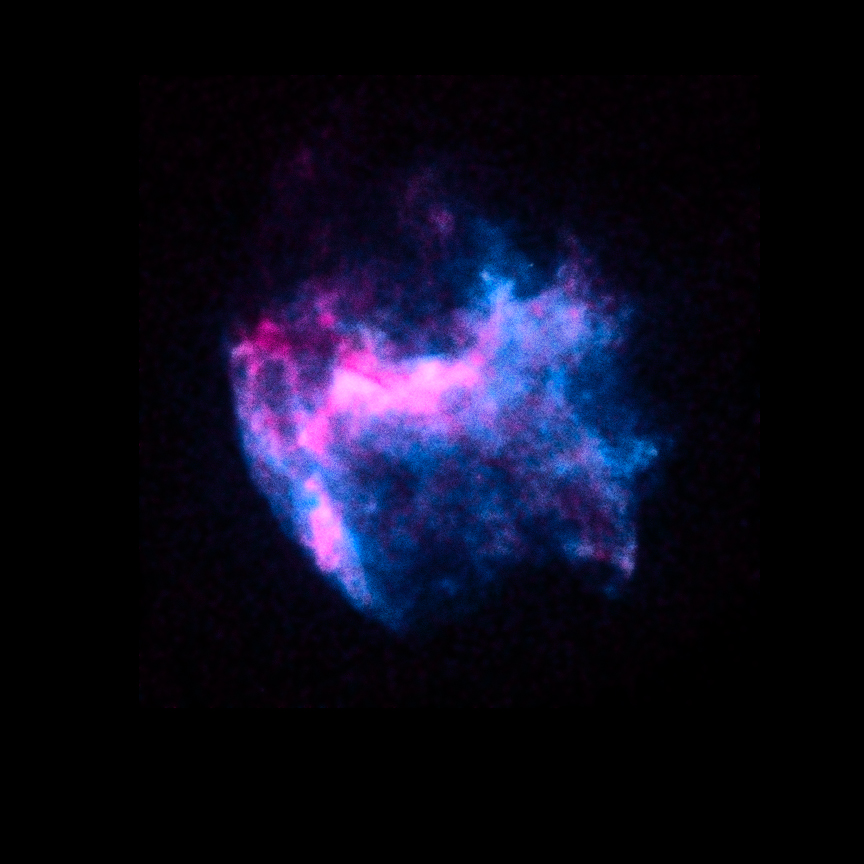
Wednesday, February 20, 2013

3-D Observations of the Outflow from an Active Galactic Nucleus

A Japanese team of astronomers, led by Toru Misawa (Shinshu University), has used the Subaru Telescope to observe a distant gravitationally-lensed quasar (Note 1) and probed an active galactic nucleus in its central region. Looking through multiple sight lines, the astronomers obtained a 3-D view of the quasar and discovered complex small structures inside outflows from the galactic nucleus. These outflows will spread widely and eventually affect the evolution of the host galaxy.

Figure 1: An artist's rendition of the central region of the quasar. A gaseous disk surrounds a central black hole. The outflow is gas streaming from the disk outward along the curved mesh, which indicates the distortion of space/time, and is distinguished from a jet that is blowing vertically. The arrows A, B, and C indicate the light paths observed, which probably pass near the surface of an outflow. (Credit: Shinshu University and the National Astronomical Observatory of Japan)

Quasars are bright central regions of some distant galaxies. Their luminosities are often hundreds of times greater than those of their host galaxies (Note 2). Scientists believe that their light source is a very bright gaseous disk surrounding a supermassive black hole at the center of the galaxy. Gas streams called "outflows" move outward from the disk (Figure 1) and have a substantial influence on surrounding interstellar/intergalactic regions. However, because quasars at large distances look like mere stars, their internal structures are not easy to investigate.

Figure 2: Left: Schematic drawing of the gravitational lensing, showing SDSS J1029+2623 (at ~10 billion light years), a cluster of galaxies (at ~5 billion light years), and Earth. An outflow is a very small domain surrounded by a large ring of dust.  

Right: An Earthly analogy of gravitational lensing. The diagram shows how scenery looks from different directions (without considering the image distortion by the lensing) and serves as a comparison to the lensed images of the quasar. (Credit: Shinshu University and the National Astronomical Observatory of Japan)
 
The current team used the large light-gathering power of the 8.2 m Subaru Telescope mounted with its high-resolution spectrograph HDS (High Dispersion Spectrograph) to observe the quasar SDSS J1029+2623 (from now on referred to as "J 1029") and examine its structure. This quasar is ~10 billion light years distant from Earth (Note 1) toward the constellation Leo, and a massive cluster of galaxies, ~5 billion light years away, lies between the quasar and Earth (Figure 2). Because astronomical objects are usually very distant, they are difficult to study from different angles. Nevertheless, gravitational lensing opens up this possibility. If a cluster of galaxies lies along the line of sight to a distant quasar, then part of the light from the distant quasar (the "lensed quasar") bends around the intervening cluster (the "lensing cluster"), and observers will see more highly resolved and brighter images of the now magnified background quasar. Due to the gravitational lensing by the cluster intervening between J 1029 and Earth, there is significant distortion in the light path from the quasar, and it splits into three images: A, B, and C (Figure 3, Note 3). The maximum separation angle, ~22".5 (Note 4), between images A and B is a current record; it is larger than the typical separation of quasar images lensed by a single galaxy. The team hypothesized that each lensed image could contain information on the outflow from the quasar when viewed from different angles (Figures 1 and 2).

Figure 3: Color image of the region around SDSS J1029+2623, taken with Hubble Space Telescope. Quasar images (marked with A, B, and C) are gravitationally lensed by a foreground cluster of galaxies. Three galaxies of the lensing cluster (marked as G1a, b and G2) are visible. (Credit: Shinshu University, the National Astronomical Observatory of Japan, and Kavli Institute for the Physics and Mathematics of the Universe)

The team used Subaru Telescope's HDS to perform spectroscopic observations of the brightest two images A and B (Note 5), and their results supported their hypothesis. Any absorber between the quasar and Earth provides absorption features in the spectra of the quasar images. While most absorption features originate from foreground objects that are physically unrelated to the quasar, some show clear evidence of origins from the outflow, such as partial coverage by clouds (Note 6). Those features show a clear difference between the images A and B, although they are generally similar (Figure 4). This result supports the idea that the sight lines are going through different areas of the outflow from different directions. When viewed through one eye alone, an object appears to be two-dimensional, but viewing with both eyes yields a 3-D image that provides multi-directional information. This process is analogous to what occurred in the observations (Figure 2, Note 7).

Figure 4: Comparison of absorption features of three elements, carbon, nitrogen, and hydrogen (from top to bottom), seen in spectra of the lensed images A (red line) and B (blue line). All of them arise at the outflow. A horizontal axis is an outflow velocity from the light source, defined as negative if it heads to Earth. The shaded area shows a clear difference between the images A and B. (Credit: Shinshu University and the National Astronomical Observatory of Japan)

It is surprising that the absorption profiles arising in the outflow show clear differences between them, despite the small separation angle of ~22".5. Misawa commented on this discovery saying, "The outflow may not necessarily be homogeneous, but could instead have a complex internal structure with a number of clumpy gas clouds like cirrocumulus clouds in Earth's atmosphere. The team plans to observe the area in image C in more detail." Direct observation of a clumpy structure in tandem with theoretical analysis will contribute to revealing the mysterious formation history of these outflows.

The team has also explored other explanations for the outflows. Because the light paths of the images A and B are different, they have a substantial time difference between them when they reach Earth (Note 8). If the internal structure of the outflow varies with time, the two images deliver information about different epochs even if they pass through the same region of the outflow. The astronomers intend to conduct observations with the Subaru Telescope in March, 2013 to test the "time-variation" scenario.

References:
The research paper on which this release is based was published on-line in the January 15, 2013 edition of The Astronomical Journal: T. Misawa et al., "Spectroscopy along Multiple, Lensed Sight Lines through Outflowing Winds in the Quasar SDSS J1029+2623", vol. 145, issue 2, article id. 48 (2013). The authors of the paper are:
  • T. Misawa, Shinshu University, Japan
  • N. Inada, Nara National College of Technology, Japan
  • K. Ohsuga, National Astronomical Observatory of Japan, Japan
  • P. Gandhi, Institute of Space and Astronautical Science, Japan
  • R. Takahashi, Tomakomai National College of Technology, Japan
  • M. Oguri, Kavli Institute for the Physics and Mathematics of the Universe, Japan
Acknowledgements:
This research was supported by the following:
  • Special Postdoctoral Research Program of RIKEN, the Japan Society for the Promotion of Science (23740148, 23740161)
  • Shinshu University Research Grant for Exploratory Research by Young Scientists
  • The FIRST program "Subaru Measurements of Images and Redshifts (SuMIRe)"
  • World Premier International Research Center Initiative (WPI Initiative), MEXT, Japan
Notes:
  1. It corresponds to a redshift of z~2.197. A "z" or redshift value measures how much the expansion of space has stretched the light from an object. Generally, the greater the observed z value for a galaxy, the more distant it is in time and space from Earth.
  2. Because their appearance is star-like, they are called "quasi-stellar objects" and abbreviated as quasars.
  3. An international team led by Naohisa Inada and Masamune Oguri (both are members of the current research team) discovered the first quasar (SDSS J1004+4112) that is lensed by a cluster of galaxies (http://www.sdss.org/news/releases/20031217.lensing.html). Only three quasars that are lensed by a cluster of galaxies have been discovered so far (SDSS J1004+4112, SDSS J1029+2623, and SDSS J2222+2745). Among them, SDSS J1029+2623 has the largest separation angle.
  4. 1 arcsec (1") is a unit of angle, defined as 1/3600 of 1 degree. Human eyes cannot distinguish such a small angle.
  5. The observed flux ratio of the three lensed images is A:B:C ~ 0.95:1.00:0.24.
  6. This means that an absorber only partially covers the background light source toward the sight line. Because foreground interstellar or intergalactic media are larger than the light source of the quasar by more than several orders, only small gas clouds in the vicinity of the quasar can reproduce a partial coverage.
  7. Similar observation has been also performed for the other lensed quasar DSS J1004+4112 (Green, P. 2006, the Astrophysical Journal, vol. 644, pp.733-741).
  8. The image A leads the image B by 744 days (Fohlmeister, J. et al., 2013, The Astrophysical Journal, vol. 764, 186).

Tuesday, February 19, 2013

Cassini sheds Light on Cosmic Particle Accelerators

The international Cassini spacecraft exploring the magnetic environment of Saturn. The image is not to scale. Saturn’s magnetosphere is depicted in grey, while the complex bow shock region – the shock wave in the solar wind that surrounds the magnetosphere – is shown in blue.

While crossing the bow shock on 3 February 2007, Cassini recorded a particularly strong shock (an Alfvén Mach number of approximately 100) under a ‘quasi-parallel’ magnetic field configuration, during which significant particle acceleration was detected for the first time. The findings provide insight into particle acceleration at the shocks surrounding the remnants of supernova explosions.Copyright ESA

During a chance encounter with an unusually strong blast of solar wind arriving at Saturn, the international Cassini spacecraft detected particles being accelerated to ultra-high energies, similar to the acceleration that takes place around supernova explosions. 

Shock waves are commonplace in the Universe, for example in the aftermath of a stellar explosion as debris accelerates outwards in a supernova remnant, or when the flow of particles from the Sun – the solar wind – impinges on the magnetic field of a planet to form a bow shock. 

Under certain magnetic field orientations and depending on the strength of the shock, particles can be accelerated to close to the speed of light at these boundaries. Indeed, very strong shocks at young supernova remnants are known to boost electrons to ultra-relativistic energies, and may be the dominant source of cosmic rays, high-energy particles that pervade our Galaxy. 

Space telescopes reveal evidence for accelerated electrons at supernova remnant shocks as X-ray emission, but these observations are made at great distances and thus the orientation of the local magnetic field can only be poorly measured at best. Without this crucial information, it is difficult to gain a full understanding of the shock acceleration process. 

Scientists want to understand how the acceleration of electrons in very strong shocks with large ‘Mach numbers’ depends on the angle between the magnetic field and a vector at right angles to the shock front. In particular, they are interested in what happens in a ‘quasi-parallel’ shock, where the field and vector are almost aligned, as may be found in supernova remnants. 

Illustration of quasi-parallel (top) and quasi-perpendicular (bottom) magnetic field conditions at a planetary bow shock. Under quasi-parallel conditions, the magnetic field is roughly pointing toward the shock surface, almost parallel to a vector at right angles to the shock front (red arrow). Under quasi-perpendicular conditions, the magnetic field is close to aligned with the shock surface, that is, almost perpendicular to the shock vector. Copyright ESA

Shocks in the solar wind in the Solar System are much more accessible and can be studied in greater detail. To date, however, particle acceleration has only been seen in ‘quasi-perpendicular’ shocks, where the magnetic field and shock vector are almost perpendicular. 

But this new study by Cassini describes the first detection of significant acceleration of electrons in a quasi-parallel shock at Saturn, coinciding with what may be the strongest shock ever encountered at the ringed planet. 

“Cassini has crossed Saturn’s bow shock hundreds of times, recording typical Alfvén Mach numbers of around 12. But during one particular crossing in early 2007, we measured a value of ~100, during which time the shock was quasi-parallel,” describes Adam Masters of the Institute of Space and Astronautical Science, Japan, and lead author of the paper reporting the results in Nature Physics.  

The findings confirm that, at high Mach numbers like those of the shocks surrounding supernova remnants, quasi-parallel shocks can become considerably more effective electron accelerators than previously thought. This result sheds new light on the complex process of cosmic particle acceleration. 

“Cassini has essentially given us the capability of studying the nature of a supernova shock in situ in our own Solar System, bridging the gap to distant high-energy astrophysical phenomena that are usually only studied remotely,” adds Dr Masters. 

“The Cassini observations have given us a glimpse of a process never before seen directly, providing new information on how high-energy particles, like cosmic rays, are accelerated to such high velocities by magnetic fields throughout the Universe,” says Nicolas Altobelli, ESA’s Cassini project scientist. 

Notes for Editors

“Electron acceleration to relativistic energies at a strong quasi-parallel shock wave” by A. Masters et al. is published in Nature Physics, 17 February 2013.

The electron observations were carried out using the Electron Spectrometer of the Cassini Plasma Spectrometer, and the Low-Energy Magnetospheric Measurements System of the Cassini Magnetospheric Imaging Instrument. The high Alfvén Mach number of MA ~ 100 was measured on 3 February 2007.

The Cassini–Huygens mission is a cooperative project of NASA, ESA and ASI, the Italian space agency. NASA’s Jet Propulsion Laboratory, a division of the California Institute of Technology in Pasadena, manages the mission for NASA’s Science Mission Directorate, Washington.

Source: ESA


Monday, February 18, 2013

Surprising Results From the Earliest Near-Infrared Spectroscopy of a Type Ia Supernova


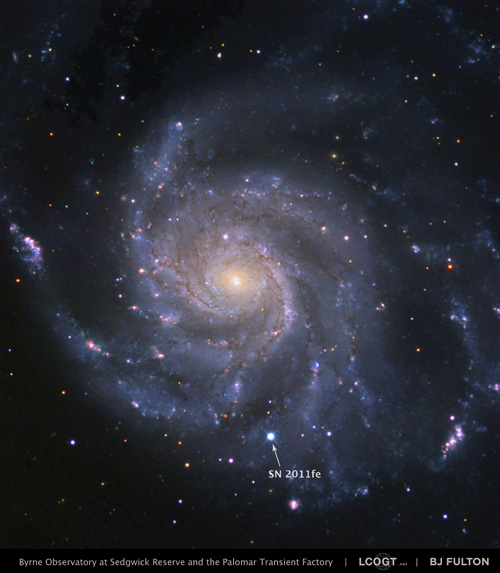
Figure 1. Color image of SN 2011fe in M101
Credit: B. J. Fulton/LCOGT/PTF
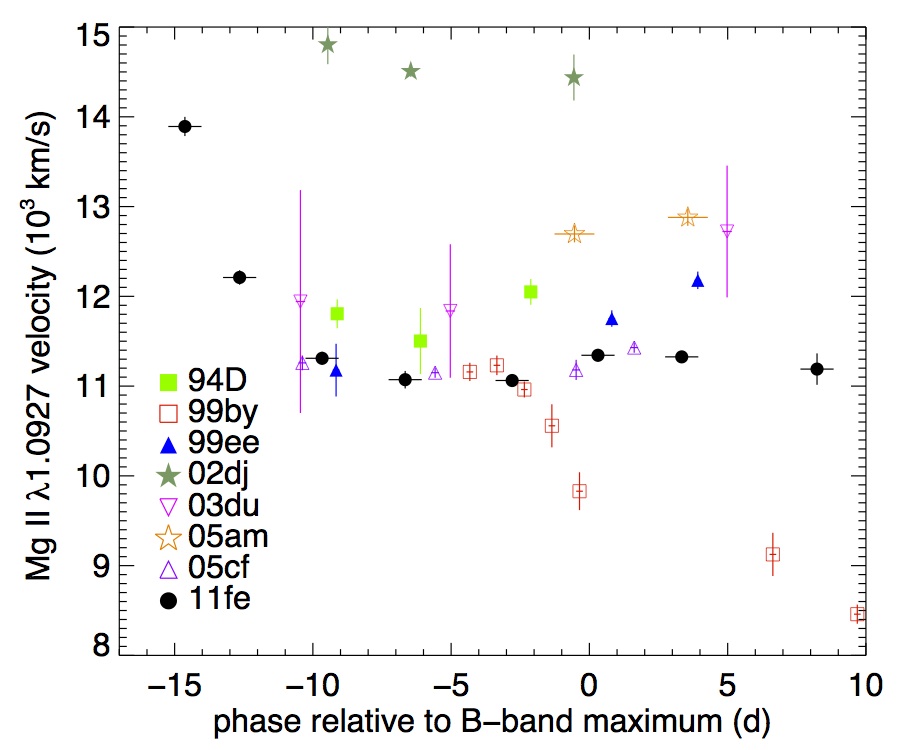
Figure 2. Time evolution of SN Ia near-infrared magnesium velocity. The magnesium velocity of the GNIRS SN 2011fe spectra underwent a rapid decline and an extended period of constant velocity. Note that SN 1999by is a spectroscopically peculiar SN Ia, much like SN 1991bg. The magnesium velocity of normal SNe Ia all show similar constant behavior as that of SN 2011fe.

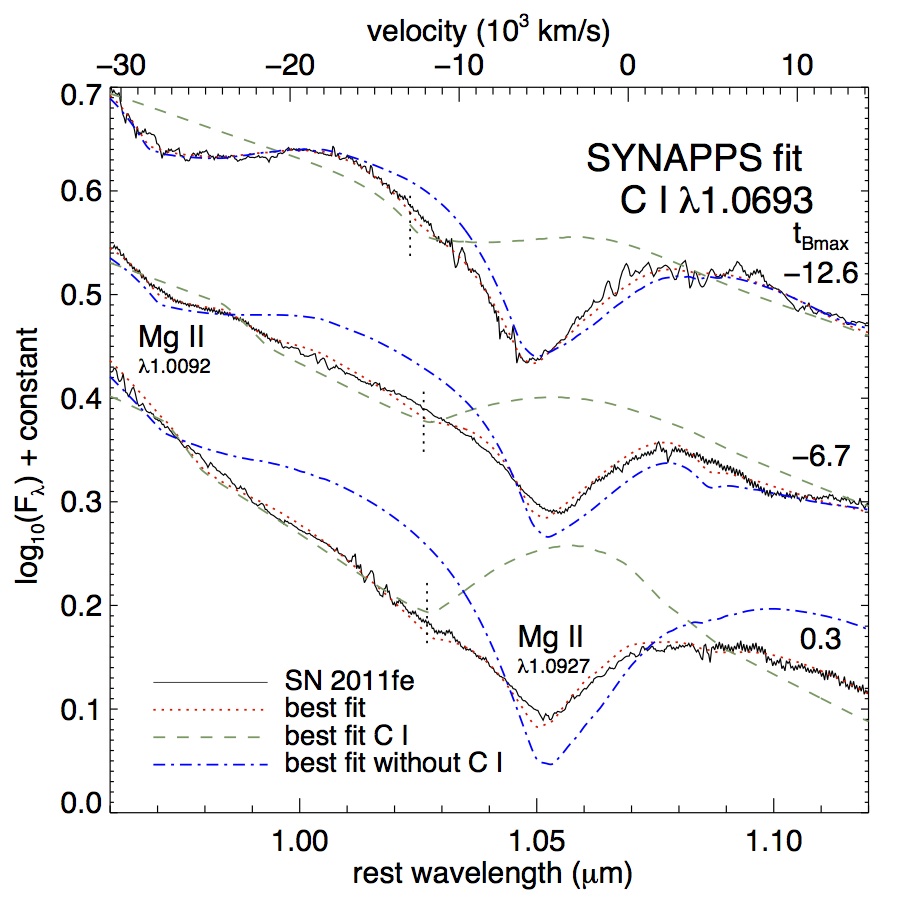
Figure 3. Model spectrum fit to the GNIRS spectra of SN 2011fe around the near-infrared carbon line. The observed spectra are plotted as solid black curves. The best-fit model spectra are plotted as follows: with all ions, with carbon only, and with all ions except carbon. These are plotted as red dotted, green dashed, and blue dash-dotted curves, respectively. The vertical dotted lines mark the location of the best-fit carbon velocity. The phases relative to maximum light are noted.

Gemini Near-Infrared Spectrograph (GNIRS) observations lead to surprising results on the nature of Type Ia supernovae (SNe Ia). Time-series near-infrared spectra of SN 2011fe hint that more SNe Ia harbor unprocessed carbon than previously believed, and what we thought was the main driver of the luminosity-decline rate Phillips relation may not be correct. 
 
Understanding the true nature of Type Ia supernovae (SNe Ia) is a linchpin of contemporary cosmology. Specifically, these explosions are critical for tracking the expansion history and acceleration of our universe. Commonly called “dark energy,” the discovery of this universal acceleration was the basis for the 2011 Nobel Prize in Physics. 

Now, researchers using the Gemini Near-Infrared Spectrograph (GNIRS), at the Gemini North telescope on Hawaii’s Mauna Kea, have taken a major leap forward in understanding SNe Ia with the first detection of unprocessed carbon in near-infrared spectra of a normal Type Ia supernova. The supernova (Figure 1), denoted SN 2011fe, was discovered by the Palomar Transient Factory (PTF) within hours of its explosion on August 24, 2011 in the nearby galaxy Messier 101, located about 21 million light years away and a popular target for amateur astronomers. 

Carnegie Supernova Project postdoc Eric Hsiao reports that these near-infrared observations (a month-long time series consisting of nine spectra with GNIRS and one with SpeX on NASA’s Infrared Telescope Facility), “…provide an ideal baseline to compare with other objects,” and adds that, “Previous studies have detected carbon in optical spectra, but in this work we were able to detect it for the first time in the infrared and capture its time evolution.” Hsiao, at Las Campanas Observatory in Chile, also worked with Howie Marion, a post-doc researcher the Harvard-Smithsonian Center for Astrophysics (CfA) in Cambridge Mass., and Mark Phillips the Associate Director of Las Campanas Observatory and team leader for the Carnegie Supernova Project. The work is accepted for publication in an upcoming issue of The Astrophysical Journal

Prior to this finding, the supernova community relied on very early optical spectra for the study of unprocessed carbon, leftover from the progenitor white dwarf. With this work, the team shows that the near infrared is a better wavelength region to survey this unprocessed material. There are hints that the number of SNe Ia harboring unprocessed carbon may have been grossly underestimated from previous studies in the optical, a result that would have profound impact on our understanding of these explosions. 

The team’s observations also confirmed the long-standing prediction that magnesium, a marker for the boundary between carbon and oxygen burning, would decrease rapidly in velocity and then settle into a constant velocity as SNe Ia evolve (Figure 2). The variation in the location of the carbon/oxygen burning boundary between supernovae is believed to be the main driver of the Phillips relation. While a large range of magnesium velocities was found, there was surprisingly no correlation with the supernovae’s peak luminosities. The team acknowledges that more work needs to be done to understand this unexpected finding. 

Watch for a more detailed article in the March issue of GeminiFocus (e-published on April 1, 2013) and see the preprint of The Astrophysical Journal paper by Hsiao et al. on astro-ph at: http://arxiv.org/abs/1301.6287.


In-Depth 

The following details are provided for readers desiring more details of a technical nature.

A key ingredient to realizing the full potential of near-infrared SN Ia cosmology is near-infrared spectroscopy, such that the peak luminosities can be accurately converted to the rest frame. With the limited size of the world’s current sample, the time evolution and the diversity of the near-infrared spectral features are poorly understood. These uncertainties directly affect the determination of the peak luminosity. To improve our knowledge of this relatively unexplored wavelength region, the Carnegie Supernova Project and the CfA Supernova Group have embarked on a joint program to obtain a statistically significant sample of near-infrared spectroscopic observations.

Using high quality GNIRS spectra and a more sophisticated spectrum modeling technique, Hsiao et al. were able to detect carbon, a first in the near-infrared wavelengths for a normal SN Ia. Figure 3, shows the comparison between observed and model spectra. The near-infrared carbon line studied is relatively isolated and ideally located between two magnesium lines. The team’s model spectra shows that the presence of carbon is required to produce the observed “flattened” profile near 1.03 micron.

Furthermore, the time-series GNIRS observations indicate that the influence of carbon increases with time (Figure 3). The carbon line in the optical, on the other hand, usually disappears very early, requiring that the supernova be discovered at a very young age. The team proposes that the delay in the onset of the near-infrared carbon feature can be explained simply by the change in the ionization condition. As the supernova ejecta expands, the temperature decreases. The optical carbon line in its first ionized state then gradually recombines into neutral carbon which forms the ever stronger neutral carbon feature in the near-infrared. Due to this fortuitous delay in its appearance, the near-infrared neutral carbon feature is potentially a superior probe of unprocessed material to the more commonly used optical feature.


Friday, February 15, 2013

Clues to the Mysterious Origin of Cosmic Rays

VLT/VIMOS observations of the shock front in the remnant of the supernova SN 1006

The remnant of the supernova SN 1006 seen at many different wavelengths

Part of the supernova remnant SN 1006 
seen with the NASA/ESA Hubble Space Telescope

VLT probes remains of medieval supernova

Very detailed new observations with ESO’s Very Large Telescope (VLT) of the remains of a thousand-year-old supernova have revealed clues to the origins of cosmic rays. For the first time the observations suggest the presence of fast-moving particles in the supernova remnant that could be the precursors of such cosmic rays. The results are appearing in the 14 February 2013 issue of the journal Science.

In the year 1006 a new star was seen in the southern skies and widely recorded around the world. It was many times brighter than the planet Venus and may even have rivaled the brightness of the Moon. It was so bright at maximum that it cast shadows and it was visible during the day. More recently astronomers have identified the site of this supernova and named it SN 1006. They have also found a glowing and expanding ring of material in the southern constellation of Lupus (The Wolf) that constitutes the remains of the vast explosion.

It has long been suspected that such supernova remnants may also be where some cosmic rays — very high energy particles originating outside the Solar System and travelling at close to the speed of light — are formed. But until now the details of how this might happen have been a long-standing mystery.

A team of astronomers led by Sladjana Nikolić (Max Planck Institute for Astronomy, Heidelberg, Germany [1]) has now used the VIMOS instrument on the VLT to look at the one-thousand-year-old SN 1006 remnant in more detail than ever before. They wanted to study what is happening where high-speed material ejected by the supernova is ploughing into the stationary interstellar matter — the shock front. This expanding high-velocity shock front is similar to the sonic boom produced by an aircraft going supersonic and is a natural candidate for a cosmic particle accelerator.

For the first time the team has not just obtained information about the shock material at one point, but also built up a map of the properties of the gas, and how these properties change across the shock front. This has provided vital clues to the mystery.

The results were a surprise — they suggest that there were many very rapidly moving protons in the gas in the shock region [2]. While these are not the sought-for high-energy cosmic rays themselves, they could be the necessary “seed particles”, which then go on to interact with the shock front material to reach the extremely high energies required and fly off into space as cosmic rays.

Nikolić explains: “This is the first time we were able to take a detailed look at what is happening in and around a supernova shock front. We found evidence that there is a region that is being heated in just the way one would expect if there were protons carrying away energy from directly behind the shock front.

The study was the first to use an integral field spectrograph [3] to probe the properties of the shock fronts of supernova remnants in such detail. The team now is keen to apply this method to other remnants.
Co-author Glenn van de Ven of the Max Planck Institute for Astronomy, concludes: “This kind of novel observational approach could well be the key to solving the puzzle of how cosmic rays are produced in supernova remnants.

Notes

[1] The new evidence emerged during analysis of the data by Sladjana Nikolić (Max Planck Institute for Astronomy) as part of work towards her doctoral degree at the University of Heidelberg.

[2] These protons are called suprathermal as they are moving much quicker than expected simply from the temperature of the material.

[3] This is achieved using a feature of VIMOS called an integral field unit, where the light recorded in each pixel is separately spread out into its component colours and each of these spectra recorded. The spectra can then be subsequently analysed individually and maps of the velocities and chemical properties of each part of the object created.

More information

This research was presented in a paper “An Integral View of Fast Shocks around Supernova 1006” to appear in the journal Science on 14 February 2013.


The team is composed of Sladjana Nikolić (Max Planck Institute for Astronomy [MPIA], Heidelberg, Germany), Glenn van de Ven (MPIA), Kevin Heng (University of Bern, Switzerland), Daniel Kupko (Leibniz Institute for Astrophysics Potsdam [AIP], Potsdam, Germany), Bernd Husemann (AIP), John C. Raymond (Harvard-Smithsonian Center for Astrophysics, Cambridge, USA), John P. Hughes (Rutgers University, Piscataway, USA), Jesús Falcon-Barroso (Instituto de Astrofísica de Canarias, La Laguna, Spain).


ESO is the foremost intergovernmental astronomy organisation in Europe and the world’s most productive ground-based astronomical observatory by far. It is supported by 15 countries: Austria, Belgium, Brazil, the Czech Republic, Denmark, France, Finland, Germany, Italy, the Netherlands, Portugal, Spain, Sweden, Switzerland and the United Kingdom. ESO carries out an ambitious programme focused on the design, construction and operation of powerful ground-based observing facilities enabling astronomers to make important scientific discoveries. ESO also plays a leading role in promoting and organising cooperation in astronomical research. ESO operates three unique world-class observing sites in Chile: La Silla, Paranal and Chajnantor. At Paranal, ESO operates the Very Large Telescope, the world’s most advanced visible-light astronomical observatory and two survey telescopes. VISTA works in the infrared and is the world’s largest survey telescope and the VLT Survey Telescope is the largest telescope designed to exclusively survey the skies in visible light. ESO is the European partner of a revolutionary astronomical telescope ALMA, the largest astronomical project in existence. ESO is currently planning the 39-metre European Extremely Large optical/near-infrared Telescope, the E-ELT, which will become “the world’s biggest eye on the sky”.
Links

Contacts

Sladjana Nikolić
Max Planck Institute for Astronomy
Heidelberg, Germany
Tel: +49 6221 528 438
Email:
nikolic@mpia.de

Glenn van de Ven
Max Planck Institute for Astronomy
Heidelberg, Germany
Tel: +49 6221 528 275
Email:
glenn@mpia.de

Richard Hook
ESO, La Silla, Paranal, E-ELT & Survey Telescopes Press Officer
Garching bei München, Germany
Tel: +49 89 3200 6655
Cell: +49 151 1537 3591
Email:
rhook@eso.org

Cosmic “flying V” of merging galaxies

 Credit: ESA/Hubble & NASA

This large “flying V” is actually two distinct objects — a pair of interacting galaxies known as IC 2184. Both the galaxies are seen almost edge-on in the large, faint northern constellation of Camelopardalis (The Giraffe), and can be seen as bright streaks of light surrounded by the ghostly shapes of their tidal tails.

These tidal tails are thin, elongated streams of gas, dust and stars that extend away from a galaxy into space. They occur when galaxies gravitationally interact with one another, and material is sheared from the outer edges of each body and flung out into space in opposite directions, forming two tails. They almost always appear curved, so when they are seen to be relatively straight, as in this image, it is clear that we are viewing the galaxies side-on.

Also visible in this image are bursts of bright blue, pinpointing hot regions where the stars from both galaxies have begun to crash together during the merger.

The image consists of visible and infrared observations from Hubble’s Wide Field and Planetary Camera 2.

A version of this picture was entered into the Hubble’s Hidden Treasures image-processing competition by contestant Serge Meunier.

Source: ESA/Hubble - Space Telescope


Thursday, February 14, 2013

W49B: Rare Explosion May Have Created Our Galaxy's Youngest Black Hole

 W49B
Credit X-ray: NASA/CXC/MIT/L.Lopez et al.; 
Infrared: Palomar; Radio: NSF/NRAO/VLA 


animation
 Tour of W49B

The highly distorted supernova remnant shown in this image may contain the most recent black hole formed in the Milky Way galaxy. The image combines X-rays from NASA's Chandra X-ray Observatory in blue and green, radio data from the NSF's Very Large Array in pink, and infrared data from Caltech's Palomar Observatory in yellow.

The remnant, called W49B, is about a thousand years old, as seen from Earth, and is at a distance of about 26,000 light years away.

The supernova explosions that destroy massive stars are generally symmetrical, with the stellar material blasting away more or less evenly in all directions. However, in the W49B supernova, material near the poles of the doomed rotating star was ejected at a much higher speed than material emanating from its equator. Jets shooting away from the star's poles mainly shaped the supernova explosion and its aftermath.

By tracing the distribution and amounts of different elements in the stellar debris field, researchers were able to compare the Chandra data to theoretical models of how a star explodes. For example, they found iron in only half of the remnant while other elements such as sulfur and silicon were spread throughout. This matches predictions for an asymmetric explosion. Also, W49B is much more barrel-shaped than most other remnants in X-rays and several other wavelengths, pointing to an unusual demise for this star.

W49B Elements
Chandra X-ray Image of W49B showing just the iron (purple) and silicon (blue).

The authors also examined what sort of compact object the supernova explosion left behind. Most of the time, massive stars that collapse into supernovas leave a dense spinning core called a neutron star

Astronomers can often detect these neutron stars through their X-ray or radio pulses, although sometimes an X-ray source is seen without pulsations. A careful search of the Chandra data revealed no evidence for a neutron star, implying an even more exotic object might have formed in the explosion, that is, a black hole.

This may be the youngest black hole formed in the Milky Way galaxy, with an age of only about a thousand years, as viewed from Earth (i.e., not including the light travel time). A well-known example of a supernova remnant in our Galaxy that likely contains a black hole is SS433. This remnant is thought to have an age between 17,000 and 21,000 years, as seen from Earth, making it much older than W49B.

The new results on W49B, which were based on about two-and-a-half days of Chandra observing time, appear in a paper in the February 10, 2013 issue of the Astrophysical Journal. The authors of the paper are Laura Lopez, from the Massachusetts Institute of Technology (MIT), Enrico Ramirez-Ruiz from the University of California at Santa Cruz, Daniel Castro, also of MIT, and Sarah Pearson from the University of Copenhagen in Denmark.

FAST FACTS FOR W49B:
Scale: Image is 8.5 arcmin across (60 light years)
Category: Supernovas & Supernova Remnants
Coordinates (J2000): RA 19h 11m 07s | Dec +09° 06' 00"
Constellation: Aquila
Observation Date: August 18-22, 2011
Observation Time: 61 hours 7 min (2 days 13 hours 7 min)
Obs. ID: 13440-13441
Instrument: ACIS
Also Known As: G043.3-00.2
References: Lopez, L et al 2013, ApJ 764, 50; arXiv:1301.0618
Color Code: X-ray (Green, Blue); Infrared (Yellow); Radio (Magenta)

A Valentine Rose

Credit: T.A. Rector (University of Alaska Anchorage) 
and H. Schweiker (WIYN and NOAO/AURA/NSF)

This image of a planetary nebula, which may suggest a rose to some, was obtained with the wide-field view of the National Optical Astronomy Observatory (NOAO) Mosaic 1 camera on the Mayall 4-meter telescope at Kitt Peak National Observatory. 

Sh2-174 is an unusual ancient planetary nebula. A planetary nebula is created when a low-mass star blows off its outer layers at the end of its life. The core of the star remains and is called a white dwarf. Usually the white dwarf can be found very near the center of the planetary nebula. But in the case of Sh2-174 it is off to the right. (It is the very blue star near the center of the blue gas). This asymmetry is due to the planetary nebula’s interaction with the interstellar medium that surrounds it. 

The image was generated by Travis Rector (University of Alaska Anchorage) from observations taken through four different filters which are assigned colors that approximate what the human eye can see: B (blue), I (orange), Hydrogen-alpha (red) and Oxygen [OIII] (blue) filters. In this image, North is up, East is to the left.

Science Contact

Dr. Travis Rector
Department of Physics and Astronomy
University of Alaska Anchorage
3211 Providence Dr.
Anchorage, AK 99508
E-mail:
tarector@uaa.alaska.edu

Wednesday, February 13, 2013

NASA Goddard Team to Participate in Dark Energy Mission

The European Space Agency (ESA) has selected three NASA-nominated science teams to participate in their planned Euclid mission, including one led by NASA's Goddard Space Flight Center in Greenbelt, Md.

NASA is a partner in the Euclid mission, a space telescope designed to probe the mysteries of dark energy and dark matter. Euclid is currently scheduled to launch in 2020.

The Goddard team is led by Alexander Kashlinsky, an astrophysicist with Science Systems and Applications, Inc., in Lanham, Md. The group plans to use Euclid imaging data to explore the cosmic infrared background (CIB), the collective light emitted throughout cosmic history by all sources, including those that cannot be detected directly.

According to theoretical models, the early universe was dark and featureless until the first stars formed. When these stars died, they exploded as supernovae or collapsed into black holes, initiating changes that culminated in the diverse and complex cosmos we observe around us today. Each modification left its imprint in the CIB.

Scientists from the LIBRAE team acquired an early glimpse of the cosmic infrared background (CIB) using NASA's Spitzer Space Telescope as a proof of concept. These panels, about 1 degree across, show the same region in the constellation Boötes. Top: Spitzer's initial infrared view, including foreground stars and fainter galaxies, seen at a wavelength of 4.5 microns. Bottom: Masking out all of the resolved stars and galaxies (grey) reveals the CIB, which is smoothed and enhanced in this view. The known remaining galaxy populations cannot account for the large-scale structure seen in the CIB. LIBRAE will identify the nature and epochs of the new populations responsible for this structure. Credit: NASA/JPL-Caltech/GSFC.  › Larger image


The Euclid spacecraft, shown in this artist's impression, is scheduled to launch in 2020
Credit: ESA/C. Carreau . › Larger image

bearded scientist in front of monitors 
Alexander Kashlinsky at NASA Goddard will lead one of three U.S. teams selected to participate in the European Space Agency's upcoming Euclid mission. Credit: NASA's Goddard Space Flight Center/David Friedlander. › Larger image


The project, named LIBRAE (Looking at Infrared Background Radiation Anisotropies with Euclid), will provide insight into stellar and galactic populations in the early universe that are unobtainable by other means.

"With LIBRAE, we hope to probe the distribution of early CIB source populations with high precision at scales as small as one arcminute to tens of degrees," Kashlinsky explained. "In addition, we will identify the cosmic times where these populations existed and determine what portion of the CIB was generated by stars and what fraction was produced by black holes."

Kashlinsky will be joined by Harvey Moseley of Goddard and Richard Arendt of the University of Maryland Baltimore County. All three work in the Laboratory for Observational Cosmology at Goddard.

Other members include Volker Bromm at the University of Texas in Austin, Matthew Ashby at the Harvard-Smithsonian Center for Astrophysics in Cambridge, Mass., and Günther Hasinger at the Institute for Astronomy in Honolulu. Three European collaborators currently round out the international LIBRAE team.
  
"Euclid's visible and infrared all-sky survey is perfectly suited to the LIBRAE studies of the early universe. We are very pleased to be joining the excellent team that has developed this mission," Moseley said.

The other two U.S. science teams are led by Ranga-Ram Chary of the Infrared Processing and Analysis Center at the California Institute of Technology in Pasadena, Calif., and Jason Rhodes of NASA's Jet Propulsion Laboratory, also in Pasadena.

Euclid will observe up to two billion galaxies occupying more than one-third of the sky with the goal of better understanding the contents of our universe.

The matter we interact with every day -- tables, chairs, people, Earth -- makes up less than five percent of our cosmos. According to current understanding, a mysterious substance called dark matter constitutes 24 percent of the matter in the universe. Dark matter is invisible, neither emitting nor absorbing light, but it exerts a gravitational pull.

Something even more enigmatic, dark energy, makes up about 73 percent of the universe. While dark matter attracts through gravity, dark energy is thought to exert a repulsive force that pushes matter apart. Scientists think dark energy may be responsible for expanding our universe at ever-increasing speeds, an observation that earned the 2011 Nobel Prize in physics.

The primary goal of Euclid's mission is to understand the nature of dark energy and dark matter by accurately measuring the accelerated expansion of the universe through several independent methods.

Euclid is a European Space Agency mission with science instruments and data analysis provided by the Euclid Consortium with important participation from NASA. NASA's Euclid Project Office is based at NASA's Jet Propulsion Laboratory in Pasadena, Calif. JPL will contribute the infrared flight detectors for one of Euclid's two science instruments. NASA Goddard will assist with infrared detector characterization and will perform detailed testing on flight detectors prior to delivery. Three U.S. science teams, led by JPL, Goddard and the Infrared Processing and Analysis Center at Caltech, will contribute to science planning and data analysis. Caltech manages JPL for NASA.

Related Links


Francis Reddy
NASA's Goddard Space Flight Center, Greenbelt, Md.
  

A drop of ink on the luminous sky"

The bright star cluster NGC 6520 and the strangely shaped dark cloud Barnard 86 

 PR Image eso1307b
The cluster NGC 6520 and the dark cloud Barnard 86 in the constellation of Sagittarius 

Wide-field view of the star cluster NGC 6520 and the dark cloud Barnard 86

Videos

Zooming into the star cluster NGC 6520 and the dark cloud Barnard 86

Panning across the star cluster NGC 6520 and the dark cloud Barnard 86

Infrared/visible-light crossfade view of the star cluster NGC 6520 and the dark cloud Barnard 86
Infrared/visible-light crossfade view of the star cluster NGC 6520 and the dark cloud Barnard 86 

Wide Field Imager snaps cosmic gecko


This image from the Wide Field Imager on the MPG/ESO 2.2-metre telescope at ESO’s La Silla Observatory in Chile, shows the bright star cluster NGC 6520 and its neighbour, the strange gecko-shaped dark cloud Barnard 86. This cosmic pair is set against millions of glowing stars from the brightest part of the Milky Way — a region so dense with stars that barely any dark sky is seen across the picture.

This part of the constellation of Sagittarius (The Archer) is one of the richest star fields in the whole sky — the Large Sagittarius Star Cloud. The huge number of stars that light up this region dramatically emphasise the blackness of dark clouds like Barnard 86, which appears at the centre of this new picture from the Wide Field Imager, an instrument mounted on the MPG/ESO 2.2-metre telescope at ESO’s La Silla Observatory in Chile.

This object, a small, isolated dark nebula known as a Bok globule [1], was described as “a drop of ink on the luminous sky” by its discoverer Edward Emerson Barnard [2], an American astronomer who discovered and photographed numerous comets, dark nebulae, one of Jupiter’s moons, and made many other contributions. An exceptional visual observer and keen astrophotographer, Barnard was the first to use long-exposure photography to explore dark nebulae.

Through a small telescope Barnard 86 looks like a dearth of stars, or a window onto a patch of distant, clearer sky. However, this object is actually in the foreground of the star field — a cold, dark, dense cloud made up of small dust grains that block starlight and make the region appear opaque. It is thought to have formed from the remnants of a molecular cloud that collapsed to form the nearby star cluster NGC 6520, seen just to the left of Barnard 86 in this image.

NGC 6520 is an open star cluster that contains many hot stars that glow bright blue-white, a telltale sign of their youth. Open clusters usually contain a few thousand stars that all formed at the same time, giving them all the same age. Such clusters usually only live comparatively short lives, on the order of several hundred million years, before drifting apart.

The incredible number of stars in this area of the sky muddles observations of this cluster, making it difficult to learn much about it. NGC 6520’s age is thought to be around 150 million years, and both this star cluster and its dusty neighbour are thought to lie at a distance of around 6000 light-years from our Sun.

The stars that appear to be within Barnard 86 in the image above are in fact in front of it, lying between us and the dark cloud. Although it is not certain whether this is still happening within Barnard 86, many dark nebulae are known to have new stars forming in their centres  — as seen in the famous Horsehead Nebula (eso0202), the striking object Lupus 3 (eso1303) and to a lesser extent in another of Barnard’s discoveries, the Pipe Nebula (eso1233). However, the light from the youngest stars is blocked by the surrounding dusty regions, and they can only be seen in infrared or longer-wavelength light.

Notes

[1] Bok globules were first observed in the 1940s by astronomer Bart Bok. They are very cold, dark clouds of gas and dust that often have new stars forming at their centres. These globules are rich in dust that scatters and absorbs background light, so they are almost opaque to visible light.

[2] This quotation comes from E. E. Barnard, Dark Regions in the Sky Suggesting an Obscuration of Light, Yerkes Observatory, Nov 15 1913 (available online here).

More information

ESO, the European Southern Observatory, is the foremost intergovernmental astronomy organisation in Europe and the world’s most productive astronomical observatory. It is supported by 15 countries: Austria, Belgium, Brazil, the Czech Republic, Denmark, France, Finland, Germany, Italy, the Netherlands, Portugal, Spain, Sweden, Switzerland and the United Kingdom. ESO carries out an ambitious programme focused on the design, construction and operation of powerful ground-based observing facilities enabling astronomers to make important scientific discoveries. ESO also plays a leading role in promoting and organising cooperation in astronomical research. ESO operates three unique world-class observing sites in Chile: La Silla, Paranal and Chajnantor. At Paranal, ESO operates the Very Large Telescope, the world’s most advanced visible-light astronomical observatory and two survey telescopes. VISTA works in the infrared and is the world’s largest survey telescope and the VLT Survey Telescope is the largest telescope designed to exclusively survey the skies in visible light. ESO is the European partner of a revolutionary astronomical telescope ALMA, the largest astronomical project in existence. ESO is currently planning the 39-metre European Extremely Large optical/near-infrared Telescope, the E-ELT, which will become “the world’s biggest eye on the sky”.

Links

Contacts

Richard Hook
ESO, La Silla, Paranal, E-ELT and Survey Telescopes Public Information Officer
Garching bei München, Germany
Tel: +49 89 3200 6655
Cell: +49 151 1537 3591
Email:
rhook@eso.org

Tuesday, February 12, 2013

Year Three: NASA SDO Mission Highlights


The sun's greatest hits as captured by the Solar Dynamic Observatory from February 2012 to February 2013. Credit: NASA/GSFC. › Download video

On Feb. 11, 2010, NASA launched an unprecedented solar observatory into space. NASA's Solar Dynamics Observatory (SDO) flew up on an Atlas V rocket, carrying instruments that scientists hoped would revolutionize observations of the sun. If all went according to plan, SDO would provide incredibly high-resolution data of the entire solar disk almost as quickly as once a second.

When the science team released its first images in April of 2010, SDO's data exceeded everyone’s hopes and expectations, providing stunningly detailed views of the sun. In the three years since then, SDO's images have continued to show breathtaking pictures and movies of eruptive events on the sun. Such imagery is more than just pretty, they are the very data that scientists study. By highlighting different wavelengths of light, scientists can track how material on the sun moves. Such movement, in turn, holds clues as to what causes these giant explosions, which, when Earth-directed, can disrupt technology in space.

In its third year of observations, however, SDO has also opened up several new, unexpected doors to scientific inquiry. Over the last year scientists spent much time poring over data from comet observations. Comets that travel close to the sun – known as sun-grazers -- have long been observed as they move toward the sun, but the view was always obscured by the sun's bright light when the comets got too close. But SDO has now captured images of two comets as they passed close to the sun.

One of the highlights of NASA's Solar Dynamics Observatory (SDO) during its third year in space: observations of Venus' transit across the Sun. This image was taken just as Venus was leaving the disk of the sun at 12:15 a.m. EDT on Jun. 6, 2012. Credit: NASA/SDO/HMI.  › View larger

In December 2011, Comet Lovejoy swept right through the sun's corona, with its long tail streaming behind it. SDO sent back pictures of the comet's long tail being buffeted by systems around the sun. Such comet tails move in response to the sun's otherwise invisible magnetic field, so they can also act as tracers of the complex magnetic field higher up in the corona, offering scientists a unique way of observing movement there. Observations of the comet's long trail of water vapor and the material its lost, as well as how it vaporizes in the intense radiation of the sun could also be used to study atomic material and their ratios in the corona. SDO's third year, therefore, brought two research communities together: comet researchers who can use solar observations for their studies and solar scientists who can use comet observations to study the sun.

The second novel highlight of SDO's third year occurred on June 5, 2012, when Venus crossed in front of the sun, as viewed from Earth – an occurrence that will not happen again for more than 100 years. SDO cameras trained on the transit to help calibrate its instruments and to learn more about Venus's atmosphere. Since the points at which Venus first touched and later left the sun are known down to minute detail, SDO could use this information to make sure its images are oriented to true solar north – calibrating its orientation to within a tenth of a pixel. Scientists also recorded how the sun's extreme ultraviolet light traveled through Venus's atmosphere in order to learn more about what elements exist around the planet.

The third new area of SDO data came from an always-planned source, the helioseismic and magnetic imager (HMI). The instrument provides real time maps of magnetic fields of the entire surface of the sun, showing how strong they are and – for the first time ever -- in which direction they are pointing. Since HMI is providing a type of data never before collected, and so it has opened up a whole new area of inquiry. Changing and realigning magnetic fields are at the heart of the sun's eruptions, so this too is a crucial set of data. Scientists have spent time over the last year to figure out how to best create visual maps from the data – as well as how to interpret them. The HMI images have been affectionately referred to as "hedgehog pictures" since they show spiky quill like lines pointing out of – or in toward – the sun.
  
White lines represent magnetic field lines looping up out of the sun's surface in this image from SDO's Helioseismological and Magnetic Imager (HMI). Credit: NASA/SDO/HMI. › View larger
 
Studying such complex magnetic motions inside the sun can help scientists understand the complex magnetic fields around the sun, which lead to the eruptions that can cause space weather effects near Earth and other objects in the solar system. Ultimately research into these constantly changing magnetic fields may lead to advance warning of such activity, which can send radiation, particles, and magnetic fields toward Earth and sometimes disrupt technology at Earth and other planets.

SDO is the first mission in a NASA’s Living With a Star program, the goal of which is to develop the scientific understanding necessary to address those aspects of the sun-Earth system that directly affect our lives and society. NASA’s Goddard Space Flight Center in Greenbelt, Md. built, operates, and manages the SDO spacecraft for NASA's Science Mission Directorate in Washington, D.C.

For high resolution media, visit:  http://svs.gsfc.nasa.gov/vis/a010000/a011200/a011203/
 
For more information about NASA's SDO spacecraft, visit:  http://www.nasa.gov/sdo
 
Karen C. Fox
NASA’s Goddard Space Flight Center

Monday, February 11, 2013

A Possible Naked-eye Comet in March

Far beyond the orbits of Neptune and Pluto, where the sun is a pinprick of light not much brighter than other stars, a vast swarm of icy bodies circles the solar system. Astronomers call it the "Oort Cloud," and it is the source of some of history's finest comets. One of them could be heading our way now.


A new ScienceCast video explores the possibility that Comet Pan-STARRS will be visible to the naked eye in early March. Play it! 


An artist's concept of the Oort cloud. More

Comet Pan-STARRS was discovered by the Panoramic Survey Telescope & Rapid Response System atop the Haleakala volcano in Hawaii. Astronomers use the massive 1.8 meter telescope to scan the heavens for Earth-approaching objects, both asteroids and comets, that might pose a danger to our planet. In June 2011 a comet appeared, and it was named "Pan-STARRS" after  the acronym for the telescope. 

In early March, the comet will pass about 100 million miles from Earth as it briefly dips inside the orbit of Mercury.  Most experts expect it to become a naked-eye object about as bright as the stars of the Big Dipper.

"But" says Karl Battams of the Naval Research Lab, "prepare to be surprised. A new comet from the Oort Cloud is always an unknown quantity equally capable of spectacular displays or dismal failures." 

The Oort cloud is named after the 20th-century Dutch astronomer Jan Oort, who argued that such a cloud must exist to account for all the “fresh” comets that fall through the inner solar system.  Unaltered by warmth and sunlight, the distant comets of the Oort cloud are like time capsules, harboring frozen gases and primitive, dusty material drawn from the original solar nebula 4.5 billion years ago.  When these comets occasionally fall toward the sun, they bring their virgin ices with them. 

Because this is Comet Pan-STARRS first visit, it has never been tested by the fierce heat and gravitational pull of the sun.  "Almost anything could happen," says Battams.  On one hand, the comet could fall apart--a fizzling disappointment.  On the other hand, fresh veins of frozen material could open up to spew garish jets of gas and dust into the night sky.

Because of its small distance from the sun, Pan-STARRS should be very active, producing a lot of dust and therefore a nice dust tail," predicts Matthew Knight of the Lowell Observatory.

"However," he cautions, "it could still be difficult to see.  From our point of view on Earth, the comet will be very close to the sun. This means that it is only observable in twilight when the sky is not fully dark."

The best dates to look may be March 12th and 13th when Pan-STARRS emerges in the western sunset sky not far from the crescent Moon. A comet and the Moon, together, framed by twilight-blue is a rare sight.  "My guess is that the primary feature visible to the naked eye will be the gaseous coma around the head of the comet,” says Knight. “The comet's tail will probably require binoculars or a small telescope."

Two other key dates are March 5th when the comet comes closest to Earth (about 100 million miles away) and March 10th, when the comet comes closest to the sun.  The dose of solar heating it receives just inside the orbit of Mercury could be just what the comet needs to push it into the realm of naked-eye visibility.

Comet Pan-STARRS should not be confused with another, even better comet coming later this year.  In Nov. 2013, Comet ISON could shine as brightly as a full Moon in broad daylight when it passes through the atmosphere of the sun: video.

"Two bright comets in one year is a rare treat," says Battams.  "This could be good."
Production editor: Dr. Tony Phillips  
Credit: Science@NASA