Tuesday, January 22, 2013

Betelgeuse braces for a collision

 
Betelgeuse’s enigmatic environment
Copyright ESA/Herschel/PACS/L. Decin et al

Multiple arcs are revealed around Betelgeuse, the nearest red supergiant star to Earth, in this new image from ESA’s Herschel space observatory. The star and its arc-shaped shields could collide with an intriguing dusty ‘wall’ in 5000 years.

Betelgeuse rides on the shoulder of the constellation Orion the Hunter. It can easily be seen with the naked eye in the northern hemisphere winter night sky as the orange–red star above and to the left of Orion’s famous three-star belt.

Roughly 1000 times the diameter of our Sun and shining 100 000 times more brightly, Betelgeuse’s impressive statistics come with a cost. For this star is likely on its way to a spectacular supernova explosion, having already swelled into a red supergiant and shed a significant fraction of its outer layers.

The new far-infrared view from Herschel shows how the star’s winds are crashing against the surrounding interstellar medium, creating a bow shock as the star moves through space at speeds of around 30 km/s.

A series of broken, dusty arcs ahead of the star’s direction of motion testify to a turbulent history of mass loss.

Closer to the star itself, an inner envelope of material shows a pronounced asymmetric structure. Large convective cells in the star’s outer atmosphere have likely resulted in localised, clumpy ejections of dusty debris at different stages in the past.

An intriguing linear structure is also seen further away from the star, beyond the dusty arcs. While some earlier theories proposed that this bar was a result of material ejected during a previous stage of stellar evolution, analysis of the new image suggests that it is either a linear filament linked to the Galaxy’s magnetic field, or the edge of a nearby interstellar cloud that is being illuminated by Betelgeuse.

If the bar is a completely separate object, then taking into account the motion of Betelgeuse and its arcs and the separation between them and the bar, the outermost arc will collide with the bar in just 5000 years, with the red supergiant star itself hitting the bar roughly 12 500 years later.

Notes for editors:

“The enigmatic nature of the circumstellar envelope and bow shock surrounding Betelgeuse as revealed by Herschel,” by L. Decin et al, was published in Astronomy & Astrophysics, December 2012.

For further information, please contact:

Markus Bauer 
ESA Science and Robotic Exploration Communication Officer 
Tel: +31 71 565 6799 
Mob: +31 61 594 3 954
Email:
markus.bauer@esa.int

Leen Decin
Institute of Astronomy, KU Leuven, Belgium
Email:
Leen.Decin@ster.kuleuven.be

Göran Pilbratt
ESA Herschel Project Scientist 
Tel: +31 71 565 3621
Email:
gpilbratt@rssd.esa.int

Monday, January 21, 2013

Shedding Light on the Power of M 82's Superwinds

An international team of astronomers, led by Dr. Kazuya Matsubayshi (Kyoto University), has discovered that outflows of gas from starburst galaxy M 82 (see Note 1 for a reference figure) collide with a "cap" of gas clouds 40,000 light years away from the galactic disk. Shockwaves (Note 2) from M 82's central starburst region are the most likely source of the bright clouds within the cap. The large light-gathering power of Subaru Telescope's 8.2-m mirror and its ability to produce highly detailed images enabled the researchers to make these findings, which provide important clues about the wind's power.

The central regions of starburst galaxies are sites of immense star formation. They give birth to thousands of massive stars, which are dozens of times heavier than the Sun and then explode as supernovae when they die. Many supernovae explosions heat the gas around them to temperatures of more than a million degrees, and this hot gas flows out from the galaxy as galactic wind. These winds are so powerful that they may play an important role in the evolution of galaxies and the inter-galactic medium. However, galactic winds are usually diffuse and difficult to observe; therefore, it has been difficult to confirm their power. Nevertheless, it is possible to precisely estimate their energy level by measuring how far the galactic winds reach.

The current team tackled the issue of shedding light on the processes behind large-scale galactic winds by focusing their research on the "cap" of M 82, one of the closest starburst galaxies to Earth, about 12 million light years away. M 82 has large-scale galactic winds, so-called "superwinds", and its cap consists of gas clouds about 40,000 light years away from its galactic disk. Matsubayashi pinpointed the research question: "Why are there ionized gas clouds so far from the galactic disk? If we investigate the ionization source of the cap, we can confirm whether M 82's galactic winds reach it."

Two possibilities for ionization sources of M 82's cap are: 1) ultraviolet photons from massive stars in M 82's starburst regions and 2) shockwaves caused by the collision of M 82's galactic winds with gas clouds in the cap (Figure 1). The researchers reasoned, "Because we can estimate the intensity of ultraviolet photons from the starburst regions and the pressure of the galactic winds from past observational data, the morphology and H-alpha (Note 3) intensity of the cap region will reveal the answer."

Figure 1: Sketches of possible ionization sources of M 82's cap (Credit: NAOJ)
left: Ultraviolet photons from massive stars in the M 82 starburst region.

right: Ultraviolet photons from shockwaves caused by the collision between M 82's galactic winds and gas clouds.   
The team investigated the ionization source of M 82's cap by observing it with Kyoto 3DII mounted on the Subaru Telescope. They used the Fabry-Perot interferometer, which works as a narrow-band filter that researchers can tune for a desired wavelength. They obtained images of continuum and H-alpha emissions of the cap. (Figure 2)

Figure 2: Images of the cap of M 82 (Credit: NAOJ)
left: H-alpha image of M 82. The contours represent the intensity of X-rays. The brightest region at the lower left of the panel is M 82's center. The diffuse emission region at the upper right is the cap.
center: Continuum image that shows the background area of the cap. The objects in this panel are stars in the Milky Way Galaxy or distant galaxies. There is no detection of a continuum emission from the cap.
right: H-alpha image of the cap. This shows the detection of H-alpha emission from the cap. It also shows that the cap is clumpy rather than uniform. The typical size of clumps is 300 - 500 light years in diameter.   


If UV light from the M 82 starburst regions ionized the clumps of the cap, the H-alpha emission should be ten times weaker than what was observed. In contrast, the H-alpha intensity predicted by the shock model matches well with the measurement from the observations. Therefore, the team concluded that shockwaves from M 82's galactic winds ionized the gas clouds in the cap. This suggests that the galactic winds travel and have direct impacts on inter-galactic gas at least 40,000 light years away from the galactic disk.

The research raises another question: "Do galactic winds affect gas clouds at an even further distance from the galactic disk?" Matsubayashi remarked, "We would like to carry out observations to survey more distant gas clouds ionized by galactic winds."


References:

  • The scientific results on which this release was based were published in the December 10, 2012 edition of The Astrophysical Journal: K. Matsubayashi et al., "Ionization Source of a Minor-Axis Cloud in the Outer Halo of M 82", 761:55 (8pp).
  • For more information about M 82's galactic winds, refer to previous press releases from Subaru Telescope:

Acknowledgements:

This research  was supported by the Japan Society for the Promotion of Science (Nos. 17253001, 1934006, 23244031, 23654068, 24103003)


Note:

1) This reference figure is an image of M 82 viewed edge-on and captured by FOCAS (Faint Object Camera and Spectrograph) mounted on the Subaru Telescope. The red filaments that expand perpendicular to the galactic disk are outflowing ionized gas from many supernovae in the galaxy. (Credit NAOJ)

2) A shockwave is a type of disturbance spreading at supersonic speed in a compressive medium, such as air. Immense explosions or supersonic flights can cause shockwaves.

3) An H-alpha emission is one of the emission lines from hydrogen atoms and results when ionized hydrogen and an electron recombine. The wavelength of H-alpha is 656 nm, and it is the brightest hydrogen emission line in the optical wavelength (400 - 750 nm)

Friday, January 18, 2013

A busy patch of the Great Attractor

Abell 3627 and  ESO 137-002
Credit: ESA/Hubble & NASA

A busy patch of space has been captured in this image from the NASA/ESA Hubble Space Telescope. Scattered with many nearby stars, the field also has numerous galaxies in the background.

Located on the border of Triangulum Australe (The Southern Triangle) and Norma (The Carpenter’s Square), this field covers part of the Norma Cluster (Abell 3627) as well as a dense area of our own galaxy, the Milky Way.

The Norma Cluster is the closest massive galaxy cluster to the Milky Way, and lies about 220 million light-years away. The enormous mass concentrated here, and the consequent gravitational attraction, mean that this region of space is known to astronomers as the Great Attractor, and it dominates our region of the Universe.

The largest galaxy visible in this image is ESO 137-002, a spiral galaxy seen edge on. In this image from Hubble, we see large regions of dust across the galaxy’s bulge. What we do not see here is the tail of glowing X-rays that has been observed extending out of the galaxy — but which is invisible to an optical telescope like Hubble.

Observing the Great Attractor is difficult at optical wavelengths. The plane of the Milky Way — responsible for the numerous bright stars in this image — both outshines (with stars) and obscures (with dust) many of the objects behind it. There are some tricks for seeing through this — infrared or radio observations, for instance — but the region behind the centre of the Milky Way, where the dust is thickest, remains an almost complete mystery to astronomers.

This image consists of exposures in blue and infrared light taken by Hubble’s Advanced Camera for Surveys.

Source: ESA/Hubble - Space Telescope


Thursday, January 17, 2013

A hidden treasure in the Large Magellanic Cloud

 PR Image heic1301a
LHA 120-N11 in the Large Magellanic Cloud 

PR Image heic1301b
Overview of the Large Magellanic Cloud (ground-based image)

 Videos

PR Video heic1301a
Zoom into LHA 120-N11

PR Video heic1301b
Pan across LHA 120-N11

Nearly 200 000 light-years from Earth, the Large Magellanic Cloud, a satellite galaxy of the Milky Way, floats in space, in a long and slow dance around our galaxy. Vast clouds of gas within it slowly collapse to form new stars. In turn, these light up the gas clouds in a riot of colours, visible in this image from the NASA/ESA Hubble Space Telescope.

The Large Magellanic Cloud (LMC) is ablaze with star-forming regions. From the Tarantula Nebula, the brightest stellar nursery in our cosmic neighbourhood, to LHA 120-N 11, part of which is featured in this Hubble image, the small and irregular galaxy is scattered with glowing nebulae, the most noticeable sign that new stars are being born.

The LMC is in an ideal position for astronomers to study the phenomena surrounding star formation. It lies in a fortuitous location in the sky, far enough from the plane of the Milky Way that it is neither outshone by too many nearby stars, nor obscured by the dust in the Milky Way’s centre. It is also close enough to study in detail (less than a tenth of the distance of the Andromeda Galaxy, the closest spiral galaxy), and lies almost face-on to us [1], giving us a bird’s eye view.

LHA 120-N 11 (known as N11 for short) is a particularly bright region of the LMC, consisting of several adjacent pockets of gas and star formation. NGC 1769 (in the centre of this image) and NGC 1763 (to the right, see heic1011) are among the brightest parts.

In the centre of this image, a dark finger of dust blots out much of the light. While nebulae are mostly made of hydrogen, the simplest and most plentiful element in the Universe, dust clouds are home to heavier and more complex elements, which go on to form rocky planets like the Earth. Much finer than household dust (it is more like smoke), this interstellar dust consists of material expelled from previous generations of stars as they died.

The data in this image were identified by Josh Lake, an astronomy teacher at Pomfret School in Connecticut, USA, in the Hubble’s Hidden Treasures image processing competition. The competition invited members of the public to dig out unreleased scientific data from Hubble’s vast archive, and to process them into stunning images.

Josh Lake won first prize in the competition with an image contrasting the light from glowing hydrogen and nitrogen in N11. The image above combines the data he identified with additional exposures taken in blue, green and near infrared light.

Notes

The Hubble Space Telescope is a project of international cooperation between ESA and NASA.

[1] Although the Large Magellanic Cloud is generally classified as an irregular galaxy, it shares some features with spiral galaxies, including a clearly visible bar, and a single spiral-arm-like structure. It is thought that the LMC may be a small spiral galaxy that was pulled out of shape by the Milky Way.

Links
Contacts

Oli Usher
Hubble/ESA
Garching, Germany
Tel: +49-89-3200-6855
Email: ousher@eso.org

Neon lights up exploding stars

Artistic view of a nova explosion depicting the binary stellar system
Credit: David A Hardy and STFC

An international team of nuclear astrophysicists has shed new light on the explosive stellar events known as novae.

These dramatic explosions are driven by nuclear processes and make previously unseen stars visible for a short time. The team of scientists measured the nuclear structure of the radioactive neon produced through this process in unprecedented detail.

Their findings, reported in the US journal Physical Review Letters, show there is much less uncertainty in how quickly one of the key nuclear reactions will occur as well as in the final abundance of radioactive isotopes than has previously been suggested. 

Led by the University of York, UK, and Universitat Politècnica de Catalunya and the Institut d’Estudis Espacials de Catalunya, Spain, the findings will help with the interpretation of future data from gamma ray observing satellites.

While large stars end their lives with spectacular explosions called supernovae, smaller stars, known as white dwarf stars, sometimes experience smaller, but still dramatic explosions called novae. The brightest nova explosions are visible to the naked eye.

A nova occurs when a white dwarf is close enough to a companion star to drag matter – mostly hydrogen and helium – from the outer layers of that star onto itself, building up an envelope. When enough material has accumulated on the surface, a burst of nuclear fusion occurs, causing the white dwarf to brighten and expel the remaining material. Within a few days to months, the glow subsides. The phenomenon is expected to recur after typically 10,000 to 100,000 years.

Traditionally novae are observed in the visible and nearby wavelengths, but this emission only shows up about a week after the explosion and therefore only gives partial information on the event.

Dr Alison Laird, from the University of York’s Department of Physics, said: “The explosion is fundamentally driven by nuclear processes. The radiation related to the decay of isotopes - in particular that from an isotope of fluorine - is actively being sought by current and future gamma ray observing satellite missions as it provides direct insight into the explosion.

“However, to be interpreted correctly, the nuclear reaction rates involved in the production of the fluorine isotope must be known. We have demonstrated that previous assumptions about key nuclear properties are incorrect and have improved our knowledge of the nuclear reaction pathway.”

The experimental work was carried out at the Maier-Leibnitz Laboratory in Garching, Germany, and scientists from the University of Edinburgh played a key role in the interpretation of the data. The study also involved scientists from Canada and the United States.

Dr Anuj Parikh, from the Departament de Fisica i Enginyeria Nuclear at the Universitat Politècnica de Catalunya, said: "The observation of gamma-rays from novae would help to better determine exactly what chemical elements are synthesized in these astrophysical explosions. In this work, details required to calculate the production of the key radioactive fluorine isotope have been measured precisely. This will allow more detailed investigation of the processes and reactions behind the nova.”

This work is part of an ongoing programme of research studying how the elements are synthesised in stars and stellar explosions.

The UK researchers received funding from the Science Technology Funding Council (STFC), and the project received further support from the Spanish MICINN, the EU Feder funds and ESF EUROCORES Program EuroGENESIS.

Notes to editors:
  • Authors: A. M. Laird, S.P. Fox, B.R.Fulton (Department of Physics, University of York, UK); A. Parikh, J. José, R. Longland (Departament de Física i Enginyeria Nuclear, EUETIB, Universitat Politècnica de Catalunya, Barcelona, Spain and the Institut d’Estudis Espacials de Catalunya, Barcelona, Spain);  A. St. J. Murphy, D.J. Mountford (School of Physics and Astronomy, University of Edinburgh, UK); K. Wimmer, (National Superconducting Cyclotron Laboratory, Michigan State University and Department of Physics, Central Michigan University, USA); A. A. Chen, D.Irvine, B.Sambrook (Department of Physics and Astronomy, McMaster University, Hamilton, Canada); C. M. Deibel (Physics Division, Argonne National Laboratory, USA and Joint Institute for Nuclear Astrophysics, Michigan State University, USA);  T. Faestermann, D.Seiler (Physics Department E12, Technische Universität München, Germany and Maier-Leibnitz Laboratory, Garching, Germany); R. Hertenberger, H.F. Wirth (Maier-Leibnitz Laboratory, Garching, Germany and  Fakultät für Physik, Ludwig-Maximilians-Universität München, Germany).
  • The Science and Technology Facilities Council (SFTC) is keeping the UK at the forefront of international science and tackling some of the most significant challenges facing society such as meeting our future energy needs, monitoring and understanding climate change, and global security. The Council has a broad science portfolio and works with the academic and industrial communities to share its expertise in materials science, space and ground-based astronomy technologies, laser science, microelectronics, wafer scale manufacturing, particle and nuclear physics, alternative energy production, radio communications and radar. STFC operates or hosts world class experimental facilities including:
  • in the UK; ISIS pulsed neutron source, the Central Laser Facility, and LOFAR. STFC is also the majority shareholder in Diamond Light Source Ltd.
  • overseas; telescopes on La Palma and Hawaii
  • It enables UK researchers to access leading international science facilities by funding membership of international bodies including European Laboratory for Particle Physics (CERN), the Institut Laue Langevin (ILL), European Synchrotron Radiation Facility (ESRF) and the European Southern Observatory (ESO). STFC also has an extensive public outreach and engagement programme.  It is using its world leading research to inspire and enthuse schools and the general public about the impact and benefits that science can have on society. STFC is one of seven publicly-funded research councils.  It is an independent, non-departmental public body of the Department for Business, Innovation and Skills (BIS). Twitter @STFC_Matters; www.stfc.ac.uk

Source: University of York, Heslington, York, YO10 5DD, UK
 Tel: work01904 322622  | Fax: fax01904 324685

Wednesday, January 16, 2013

Light from the Darkness

The Lupus 3 dark cloud and associated hot young stars 

The Lupus 3 dark cloud in the constellation of Scorpius

Wide-field view of the Lupus 3 dark cloud and associated hot young stars

  Videos
Zooming in on the Lupus 3 dark cloud and associated hot young stars

Panning across the Lupus 3 dark cloud and associated hot young stars


An evocative new image from ESO shows a dark cloud where new stars are forming, along with a cluster of brilliant stars that have already emerged from their dusty stellar nursery. The new picture was taken with the MPG/ESO 2.2-metre telescope at the La Silla Observatory in Chile and is the best image ever taken in visible light of this little-known object.

On the left of this new image there is a dark column resembling a cloud of smoke. To the right shines a small group of brilliant stars. At first glance these two features could not be more different, but they are in fact closely linked. The cloud contains huge amounts of cool cosmic dust and is a nursery where new stars are being born. It is likely that the Sun formed in a similar star formation region more than four billion years ago.
This cloud is known as Lupus 3 and it lies about 600 light-years from Earth in the constellation of Scorpius (The Scorpion). The section shown here is about five light-years across.

As the denser parts of such clouds contract under the effects of gravity they heat up and start to shine. At first this radiation is blocked by the dusty clouds and can only be seen by telescopes observing at longer wavelengths than visible light, such as the infrared. But as the stars get hotter and brighter their intense radiation and stellar winds gradually clear the clouds around them until they emerge in all their glory.

The bright stars right of the centre of this new picture form a perfect example of a small group of such hot young stars. Some of their brilliant blue light is being scattered off the remaining dust around them. The two brightest stars are bright enough to be seen easily with a small telescope or binoculars. They are young stars that have not yet started to shine by nuclear fusion in their cores and are still surrounded by glowing gas [1]. They are probably less than one million years old.

Although they are less obvious at first glance than the bright blue stars, surveys have found many other very young stellar objects in this region, which is one of the closest such stellar nurseries to the Sun.

Star formation regions can be huge, such as the Tarantula Nebula (eso0650) where hundreds of massive stars are being formed. However, most of the stars in our and other galaxies are thought to have formed in much more modest regions like the one shown here, where only two bright stars are visible and no very heavy stars are formed. For this reason, the Lupus 3 region is both fascinating for astronomers and a beautiful illustration of the early stages of the life of stars.

Notes

[1] These are known as Herbig Ae/Be stars after the astronomer who first identified them. The A and B refer to the spectral types of the stars, somewhat hotter than the Sun, and the “e” indicates that emission lines are present in their spectra, due to the glow from the gas around them. They shine by converting gravitational potential energy into heat as they contract.

More information

ESO is the foremost intergovernmental astronomy organisation in Europe and the world’s most productive ground-based astronomical observatory by far. It is supported by 15 countries: Austria, Belgium, Brazil, the Czech Republic, Denmark, France, Finland, Germany, Italy, the Netherlands, Portugal, Spain, Sweden, Switzerland and the United Kingdom. ESO carries out an ambitious programme focused on the design, construction and operation of powerful ground-based observing facilities enabling astronomers to make important scientific discoveries. ESO also plays a leading role in promoting and organising cooperation in astronomical research. ESO operates three unique world-class observing sites in Chile: La Silla, Paranal and Chajnantor. At Paranal, ESO operates the Very Large Telescope, the world’s most advanced visible-light astronomical observatory and two survey telescopes. VISTA works in the infrared and is the world’s largest survey telescope and the VLT Survey Telescope is the largest telescope designed to exclusively survey the skies in visible light. ESO is the European partner of a revolutionary astronomical telescope ALMA, the largest astronomical project in existence. ESO is currently planning the 39-metre European Extremely Large optical/near-infrared Telescope, the E-ELT, which will become “the world’s biggest eye on the sky”.

Links

Contacts

Fernando Comeron
ESO
Garching bei München, Germany
Email: fcomeron@eso.org

Richard Hook
ESO, La Silla, Paranal, E-ELT and Survey Telescopes Public Information Officer
Garching bei München, Germany
Tel: +49 89 3200 6655
Cell: +49 151 1537 3591
Email: rhook@eso.org

Tuesday, January 15, 2013

New Sunspots Producing Space Weather

 
This triptych shows a coronal mass ejection or CME as it burst off of the sun in the morning of Jan. 13, 2013. The images were captured by NASA's Solar Terrestrial Relations Observatory (STEREO). Credit: NASA/STEREO.  › View full image

This image from NASA's Solar Dynamics Observatory was captured on Jan. 13, 2013, at 8:13 p.m. EST. At the center sits a large cluster of sunspots, dubbed Active Region 11654, that rotated over the left limb of the sun on Jan. 10. The region has been responsible for a spate of mild space weather and is now about 120,000 miles end-to-end, which equates to around 14 Earths. Credit: NASA/SDO/HMI.  › View larger

On Jan. 13, 2013, at 2:24 a.m. EST, the sun erupted with an Earth-directed coronal mass ejection or CME. Not to be confused with a solar flare, a CME is a solar phenomenon that can send solar particles into space and reach Earth one to three days later.

Experimental NASA research models, based on observations from the Solar Terrestrial Relations Observatory (STEREO) and the ESA/NASA mission the Solar and Heliospheric Observatory, show that the CME left the sun at speeds of 275 miles per second. This is a fairly typical speed for CMEs, though much slower than the fastest ones, which can be almost ten times that speed.

 When Earth-directed, CMEs can cause a space weather phenomenon called a geomagnetic storm, which occurs when they successfully connect up with the outside of the Earth's magnetic envelope, the magnetosphere, for an extended period of time. In the past, CMEs of this speed have not caused substantial geomagnetic storms. They have caused auroras near the poles but are unlikely to affect electrical systems on Earth or interfere with GPS or satellite-based communications systems.

 Two active regions -- named AR 11652 and AR 11654 by the National Oceanic and Atmospheric Administration (NOAA) – have produced four low-level M-class flares since Jan. 11. Solar flares are powerful bursts of light and radiation. Harmful radiation from a flare cannot pass through Earth's atmosphere to physically affect humans on the ground, however, when intense enough, they can disturb the atmosphere in the layer where GPS and communications signals travel. M-class flares are the weakest flares that can still cause some space weather effects near Earth. The recent flares caused weak radio blackouts and their effects have already subsided.

 NOAA's Space Weather Prediction Center (http://swpc.noaa.gov) is the United States Government official source for space weather forecasts.

 Updates will be provided if needed.

What is a CME?
 For answers to this and other space weather questions, please visit the Spaceweather Frequently Asked Questions page.

 
Karen C. Fox
NASA's Goddard Space Flight Center, Greenbelt, Md.

Monday, January 14, 2013

NASA's Galex Reveals the Largest-Known Spiral Galaxy


This composite of the giant barred spiral galaxy NGC 6872 combines visible light images from the European Southern Observatory's Very Large Telescope with far-ultraviolet (1,528 angstroms) data from NASA's GALEX and 3.6-micron infrared data acquired by NASA's Spitzer Space Telescope. Image credit: NASA's Goddard Space Flight Center/ESO/JPL-Caltech/DSS.  › Full image and caption

Computer simulations of the collision between NGC 6872 and IC 4970 reproduce the basic features of the galaxies as we see them today. Image credit: NASA's Goddard Space Flight Center, after C. Horellou (Onsala Space Observatory) and B. Koribalski (ATNF).  › Full image and caption - enlarge image

PASADENA, Calif. -- The spectacular barred spiral galaxy NGC 6872 has ranked among the biggest stellar systems for decades. Now a team of astronomers from the United States, Chile and Brazil has crowned it the largest known spiral, based on archival data from NASA's Galaxy Evolution Explorer (GALEX) mission, which has since been loaned to the California Institute of Technology in Pasadena.

Measuring tip-to-tip across its two outsized spiral arms, NGC 6872 spans more than 522,000 light-years, making it more than five times the size of our Milky Way galaxy. 

"Without GALEX's ability to detect the ultraviolet light of the youngest, hottest stars, we would never have recognized the full extent of this intriguing system," said lead scientist Rafael Eufrasio, a research assistant at NASA's Goddard Space Flight Center in Greenbelt, Md., who is a doctoral student at Catholic University of America in Washington. He presented the findings Thursday at the American Astronomical Society meeting in Long Beach, Calif.

The galaxy's unusual size and appearance stem from its interaction with a much smaller disk galaxy named IC 4970, which has only about one-fifth the mass of NGC 6872. The odd couple is located 212 million light-years from Earth in the southern constellation Pavo. 

Astronomers think large galaxies, including our own, grew through mergers and acquisitions -- assembling over billions of years by absorbing numerous smaller systems. 

Intriguingly, the gravitational interaction of NGC 6872 and IC 4970 may have done the opposite, spawning what may develop into a new small galaxy. 

"The northeastern arm of NGC 6872 is the most disturbed and is rippling with star formation, but at its far end, visible only in the ultraviolet, is an object that appears to be a tidal dwarf galaxy similar to those seen in other interacting systems," said team member Duilia de Mello, a professor of astronomy at Catholic University.

The tidal dwarf candidate is brighter in ultraviolet than other regions of the galaxy, a sign it bears a rich supply of hot young stars less than 200 million years old. 

The researchers studied the galaxy across the spectrum using archival data from the European Southern Observatory's Very Large Telescope, the Two Micron All Sky Survey, and NASA's Spitzer Space Telescope, as well as GALEX. 

By analyzing the distribution of energy by wavelength, the team uncovered a distinct pattern of stellar age along the galaxy's two prominent spiral arms. The youngest stars appear in the far end of the northwestern arm, within the tidal dwarf candidate, and stellar ages skew progressively older toward the galaxy's center. 

The southwestern arm displays the same pattern, which is likely connected to waves of star formation triggered by the galactic encounter.

A 2007 study by Cathy Horellou at Onsala Space Observatory in Sweden and Baerbel Koribalski of the Australia National Telescope Facility developed computer simulations of the collision that reproduced the overall appearance of the system as we see it today. According to the closest match, IC 4970 made its closest approach about 130 million years ago and followed a path that took it nearly along the plane of the spiral's disk in the same direction it rotates. The current study is consistent with this picture. 

As in all barred spirals, NGC 6872 contains a stellar bar component that transitions between the spiral arms and the galaxy's central regions. Measuring about 26,000 light-years in radius, or about twice the average length found in nearby barred spirals, it is a bar that befits a giant galaxy. 

The team found no sign of recent star formation along the bar, which indicates it formed at least a few billion years ago. Its aged stars provide a fossil record of the galaxy's stellar population before the encounter with IC 4970 stirred things up.

"Understanding the structure and dynamics of nearby interacting systems like this one brings us a step closer to placing these events into their proper cosmological context, paving the way to decoding what we find in younger, more distant systems," said team member and Goddard astrophysicist Eli Dwek. 

The study also included Fernanda Urrutia-Viscarra and Claudia Mendes de Oliveira at the University of Sao Paulo in Brazil and Dimitri Gadotti at the European Southern Observatory in Santiago, Chile. 

The GALEX mission is led by the California Institute of Technology in Pasadena, which is responsible for science operations and data analysis. NASA's Jet Propulsion Laboratory, also in Pasadena, manages the mission and built the science instrument. GALEX was developed under NASA's Explorers Program managed by NASA's Goddard Space Flight Center. In May 2012, NASA loaned GALEX to Caltech, which continues spacecraft operations and data management using private funds.

For more information about GALEX, visit http://www.nasa.gov/galex and http://www.galex.caltech.edu.


Whitney Clavin 818-354-4673
Jet Propulsion Laboratory, Pasadena, Calif.

whitney.clavin@jpl.nasa.gov 

Lynn Chandler 301-286-2806
Goddard Space Flight Center, Greenbelt, Md.

lynn.chandler-1@nasa.gov 

J.D. Harrington 202-358-5241
Headquarters, Washington

j.d.harrington@nasa.gov  


The Farthest Supernova Yet for Measuring Cosmic History

Supernova SCP-0401, nicknamed “Mingus,” was collected by the Hubble Space Telescope in 2004 but could not be positively identified until after the installation of a new camera that serendipitously acquired more data. (Photo Space Telescope Science Institute)

The installation of Hubble’s new Wide Field Camera 3 in 2009 would lead to the eventual confirmation of Supernova SCP-0401. (Photo NASA)

What if you had a “Wayback Television Set” and could watch an entire month of ancient prehistory unfold before your eyes in real time? David Rubin of the U.S. Department of Energy’s Lawrence Berkeley National Laboratory (Berkeley Lab) presented just such a scenario to the American Astronomical Society (AAS) meeting in Long Beach, CA, when he announced the discovery of a striking astronomical object: a Type Ia supernova with a redshift of 1.71 that dates back 10 billion years in time. Labeled SN SCP-0401, the supernova is exceptional for its detailed spectrum and precision color measurement, unprecedented in a supernova so distant.
“This is the most distant supernova anyone has ever found for doing dependable cosmology,” says Rubin, a member of the international Supernova Cosmology Project (SCP) based at Berkeley Lab. “The most important unanswered question we have about the nature of dark energy is whether it varies over time – whether it affects the expansion of the universe differently in different eras. With SN SCP-0401, we have the first example of a well-measured supernova sufficiently far away to study the expansion history of the universe from almost 10 billion years ago.”

The SCP is headed by astrophysicist Saul Perlmutter, a faculty senior scientist in Berkeley Lab’s Physics Division and a professor of physics at the University of California, Berkeley, who puts it this way: “Imagine you’re channel surfing and you come across live news coverage of an exploding star – and then you see the dateline that says it’s July 22nd, 9,947,989,219 BCE! By August 9 the supernova is at its brightest and starts to fade, but you get to watch the whole thing – even though, before the news could ever reach your TV, our solar system had to form, and then our planet, and intelligent life had to evolve on Earth.”

Live-at-the-scene coverage has special advantages. While the light curves of most supernovae with redshifts above 1.5 are either incomplete or not cosmologically useful, because their colors can’t be accurately measured, our imaginary Wayback TV broadcast, says Perlmutter, “has enough high-resolution information to allow us to confidently compare this ancient supernova with much more recent astronomical events.”

Wayback TV is imaginary, but not SN SCP-0401’s high-resolution details. The SCP’s analysis of the new supernova will appear in the January 20, 2013 issue of the Astrophysical Journal.

Most supernovae begin as stars whose cores collapse, but a Type Ia supernova, in the simplest model, begins as a white dwarf star borrowing mass from a companion star; when it reaches critical mass, it erupts in a titanic thermonuclear explosion. While not identical, Type Ia’s are more similar in brightness than any other type of supernova, and their variability can be accurately corrected for comparison.

This makes them excellent “standard candles” for measuring cosmic distances – the dimmer they appear, the farther away they are, and their distance can be confidently measured. At the same time, their redshift is a direct gauge of how much the universe has expanded since the supernova exploded.

Measuring the history of expansion ultimately depends on comparing distance and redshift for enough Type Ia’s over a long expanse of time; this is how accelerating expansion, propelled by dark energy, was independently found by two competing teams and announced in 1998. For this discovery, in 2011 Saul Perlmutter divided the Nobel Prize in Physics with Brian Schmidt and Adam Riess of the competing High-z Supernova Search Team.

The new supernova Rubin announced at the AAS meeting was first spotted in a supernova survey conducted by the Supernova Cosmology Project using the Hubble Space Telescope (HST) in 2004, part of a scheduling sequence in which the two teams shared alternate scans of the sky.

“We were looking for supernovae so far away that they really required the HST, not just to detect them but so we could separate them from their host galaxies, in hopes of getting clean spectra,” says Rob Knop, now of Quest University Canada, who headed the SCP’s search strategy in 2004 and wrote the software that identified likely candidates. Following an SCP tradition of nicknaming candidates after composers, Knop and colleague Rachel Gibbons, both then at Vanderbilt University, named the new contender “Mingus” after the jazz composer.

A needle in a haystack far, far away  

Mingus was so distant it skirted the edge of invisibility, like trying to see a firefly all the way across the United States. And it was red – possibly its intrinsic color but more likely due to very high redshift; only with an accurate spectrum could the researchers tell for sure.

Initial spectra were captured by the Hubble’s Advanced Camera for Surveys (ACS), equipped with a grism (a combined diffraction grating and prism) that collects light from the target object and from nearby objects as well.

“The ACS grism data suggested the most likely match was a Type Ia supernova at redshift 1.7 – very distant and very old – but by itself the ACS could not establish the spectral features which could confirm this,” says SCP member Andrew Fruchter, of the Space Telescope Science Institute.

The problem was solved when a different grism-equipped camera, the Wide Field Camera 3 (WFC3), was installed on the Hubble in 2009. When David Rubin saw the data he realized that the WFC3 had luckily caught some of the spectrum of Mingus’s host galaxy.

Fruchter says, “The new WFC3 data pinned down the host’s redshift at 1.713 – a match to the first estimate for Mingus.” He adds that “each new instrument on HST has enabled new discoveries. It’s exciting to see the Hubble continue to make breakthroughs even as we are building its successor.”

To confirm that far-away Mingus really was a Type Ia, Rubin derived a spectrum model that allowed him to compare its spectrum with published spectra from other Type Ia’s, as well as from core-collapse supernovae, as these objects would appear at redshift 1.713. The best-fit Type Ia spectrum was an almost perfect match with Mingus’s spectrum. With Rubin’s model indicating an over 90-percent chance of its identity – a conservative estimate, at that – Mingus was confirmed as a Type Ia and with confirmation got its more official-sounding designation, SCP-0401.

“To be able to directly compare different Type Ia supernovae, we have to fit their light curves – the time it takes the supernova to reach maximum brightness and the time it takes that brightness to fall off,” says Rubin. “We also have to be able to compare the brightness of the different colors during this process, in order to calibrate the supernova.”

Perlmutter remarks that such calibration “can be a lot like trying to match a particular shade of housepaint when you’ve got a thousand color chips to compare, maybe more.” In this case, calibration meant finding exactly the right shade of red. Both the ACS camera and the Near Infrared Camera and Multi-Object Spectrometer (NICMOS), also carried aboard the Hubble, measured SCP-0401’s apparent brightness in different colors over time.

The cosmological picture from SCP-0401, a single distant data point, begins to sharpen our measurements of dark energy’s possible time variation. This is the first step toward the precision measurements that will require observations of many more Type Ia supernovae as far away as SCP-0401.

Says Rubin, “Hubble is our best bet to find and measure similar distant supernovae. Luckily Hubble has a few good years left.”

###

“Precision measurement of the most distant spectroscopically confirmed supernova Ia with the Hubble Space Telescope,” by David Rubin, Rob Knop, Eli Rykoff, Greg Aldering, Rahman Amanullah, Kyle Barbary, M. Shane Burns, Alex Conley, Natalia Connolly, Susana Deustua, Vitaliy Fadeyev, Hannah Fakhouri, Andrew Fruchter, Rachel Gibbons, Gerson Goldhaber (deceased), Ariel Goobar, Eric Hsiao, Xiaosheng Huang, Marek Kowalski, Chris Lidman, Josh Meyers, Jakob Nordin, Saul Perlmutter, Anthony Spadafora, and Vallery Stanishev – The Supernova Cosmology Project – will appear in the January 20, 2013 issue of the Astrophysical Journal and is currently available as a preprint on arXiv at http://arxiv.org/abs/1205.3494. This work was supported by the U.S. Department of Energy’s Office of Science.

Lawrence Berkeley National Laboratory addresses the world’s most urgent scientific challenges by advancing sustainable energy, protecting human health, creating new materials, and revealing the origin and fate of the universe. Founded in 1931, Berkeley Lab’s scientific expertise has been recognized with 13 Nobel prizes. The University of California manages Berkeley Lab for the U.S. Department of Energy’s Office of Science. For more, visit www.lbl.gov.

DOE’s Office of Science is the single largest supporter of basic research in the physical sciences in the United States, and is working to address some of the most pressing challenges of our time. For more information, please visit the Office of Science website at science.energy.gov/.

Paul Preuss 
510-486-6249   


NASA, ESA Telescopes Find Evidence for Asteroid Belt Around Vega

This artist's concept illustrates an asteroid belt around the bright star Vega. Image credit: NASA/JPL-Caltech. › Full image and caption

Astronomers have discovered what appears to be a large asteroid belt around the bright star Vega, as illustrated here at left in brown. Image credit: NASA/JPL-Caltech . › Full image and caption -  enlarge image

PASADENA, Calif. - Astronomers have discovered what appears to be a large asteroid belt around the star Vega, the second brightest star in northern night skies. The scientists used data from NASA's Spitzer Space Telescope and the European Space Agency's Herschel Space Observatory, in which NASA plays an important role.

 The discovery of an asteroid belt-like band of debris around Vega makes the star similar to another observed star called Fomalhaut. The data are consistent with both stars having inner, warm belts and outer, cool belts separated by a gap. This architecture is similar to the asteroid and Kuiper belts in our own solar system.
What is maintaining the gap between the warm and cool belts around Vega and Fomalhaut? The results strongly suggest the answer is multiple planets. Our solar system's asteroid belt, which lies between Mars and Jupiter, is maintained by the gravity of the terrestrial planets and the giant planets, and the outer Kuiper belt is sculpted by the giant planets.
"Our findings echo recent results showing multiple-planet systems are common beyond our sun," said Kate Su, an astronomer at the Steward Observatory at the University of Arizona, Tucson. Su presented the results Tuesday at the American Astronomical Society meeting in Long Beach, Calif., and is lead author of a paper on the findings accepted for publication in the Astrophysical Journal.
Vega and Fomalhaut are similar in other ways. Both are about twice the mass of our sun and burn a hotter, bluer color in visible light. Both stars are relatively nearby, at about 25 light-years away. The stars are thought to be around 400 million years old, but Vega could be closer to its 600 millionth birthday. Fomalhaut has a single candidate planet orbiting it, Fomalhaut b, which orbits at the inner edge of its cometary belt.
The Herschel and Spitzer telescopes detected infrared light emitted by warm and cold dust in discrete bands around Vega and Fomalhaut, discovering the new asteroid belt around Vega and confirming the existence of the other belts around both stars. Comets and the collisions of rocky chunks replenish the dust in these bands. The inner belts in these systems cannot be seen in visible light because the glare of their stars outshines them.
Both the inner and outer belts contain far more material than our own asteroid and Kuiper belts. The reason is twofold: the star systems are far younger than our own, which has had hundreds of millions more years to clean house, and the systems likely formed from an initially more massive cloud of gas and dust than our solar system.
The gap between the inner and outer debris belts for Vega and Fomalhaut also proportionally corresponds to the distance between our sun's asteroid and Kuiper belts. This distance works out to a ratio of about 1:10, with the outer belt 10 times farther from its host star than the inner belt. As for the large gap between the two belts, it is likely there are several undetected planets, Jupiter-size or smaller, creating a dust-free zone between the two belts. A good comparison star system is HR 8799, which has four known planets that sweep up the space between two similar disks of debris.
"Overall, the large gap between the warm and the cold belts is a signpost that points to multiple planets likely orbiting around Vega and Fomalhaut," said Su.
If unseen planets do, in fact, orbit Vega and Fomalhaut, these bodies will not likely stay hidden.
"Upcoming new facilities such as NASA's James Webb Space Telescope should be able to find the planets," said paper co-author Karl Stapelfeldt, chief of the Exoplanets and Stellar Astrophysics Laboratory at NASA's Goddard Space Flight Center in Greenbelt, Md.
NASA's Jet Propulsion Laboratory, Pasadena, Calif., manages the Spitzer Space Telescope mission for NASA's Science Mission Directorate, Washington. Science operations are conducted at the Spitzer Science Center at the California Institute of Technology in Pasadena. Data are archived at the Infrared Science Archive housed at the Infrared Processing and Analysis Center at Caltech. Caltech manages JPL for NASA. For more information about Spitzer, visit: http://spitzer.caltech.edu and http://www.nasa.gov/spitzer .
Herschel is a European Space Agency cornerstone mission, with science instruments provided by consortia of European institutes and with important participation by NASA. NASA's Herschel Project Office is based at JPL, which contributed mission-enabling technology for two of Herschel's three science instruments. The NASA Herschel Science Center, part of the Infrared Processing and Analysis Center at Caltech, supports the United States astronomical community. 

You can follow JPL News on Facebook at: http://www.facebook.com/nasajpl and on Twitter at: http://www.twitter.com/nasajpl .

Whitney Clavin 818-354-4673
Jet Propulsion Laboratory, Pasadena, Calif.
Whitney.clavin@jpl.nasa.gov

 J.D. Harrington 202-358-5241
 NASA Headquarters, Washington

 j.d.harrington@nasa.gov

Saturday, January 12, 2013

Herschel intercepts asteroid Apophis

ESA's Herschel space observatory made new observations of asteroid Apophis as it approached Earth this weekend. The data shows the asteroid to be bigger than first estimated, and less reflective.


Herschel's three-colour view of asteroid Apophis
Credit: ESA/Herschel/PACS/MACH-11/MPE/B.Altieri (ESAC) 
and C. Kiss (Konkoly Observatory)  

Apophis temperature model
Credit: ESA/Herschel/MACH-11/T.Müller MPE (Germany)

Catalogued as asteroid (99942) Apophis (previously 2004 MN4), it is often nicknamed 'the doomsday asteroid' in popular media, after initial observations made after its discovery in 2004 gave it a 2.7% chance of striking Earth in April 2029.

 With additional data, however, an impact in 2029 was soon ruled out, although the asteroid will pass within 36 000 km of Earth's surface, closer even than the orbits of geostationary satellites.

 The asteroid will return to Earth's neighbourhood again in 2036, but quite how close it will come then is uncertain, as the 2029 approach is predicted to alter its orbit substantially. Obtaining improved physical parameters for Apophis and its orbit is thus of great importance in being able to make better predictions of its future trajectory.

 Herschel had a good opportunity at the weekend, observing the asteroid for about two hours on its approach to Earth, ahead of today's closest encounter at a little less than one tenth of the distance from Earth to the Sun: about 14.5 million km. The observations were made as part of Herschel's Guaranteed Time Programme MACH-11.

 "As well as the data being scientifically important in their own right, understanding key properties of asteroids will provide vital details for missions that might eventually visit potentially hazardous objects," says Laurence O'Rourke, Principal Investigator of the MACH-11 observing programme, from the European Space Astronomy Centre (ESAC), near Madrid, Spain.

 "Apophis is only the second near-Earth asteroid observed by Herschel, and these were the fastest tracked observations by the space telescope – the asteroid moved at a rate of 205 arcseconds per hour as seen from Herschel's viewpoint."

Herschel provided the first thermal infrared observations of Apophis at different wavelengths, which together with optical measurements helped refine estimates of the asteroid's properties. Previous estimates bracketed the asteroid's average diameter at 270 ± 60 m; the new Herschel observations returned a more precise diameter of 325 ± 15 m.

 "The 20% increase in diameter, from 270 to 325 m, translates into a 75% increase in our estimates of the asteroid's volume or mass," says Thomas Müller of the Max Planck Institute for Extraterrestrial Physics in Garching, Germany, who is leading the analysis of the new data.

 By analysing the heat emitted by Apophis, Herschel also provided a new estimate of the asteroid's albedo – a measure of its reflectivity – of 0.23. This value means that 23% of the sunlight falling onto the asteroid is reflected; the rest is absorbed and heats up the asteroid. The previous albedo estimate for Apophis was 0.33.

 Knowing the thermal properties of an asteroid indicates how its orbit might be altered due to subtle heating by the Sun. Known as the Yarkovsky effect, the heating and cooling cycle of a small body as it rotates and as its distance from the Sun changes can instigate long-term changes to the asteroid's orbit.

 "These numbers are first estimates based on the Herschel measurements alone, and other ongoing ground-based campaigns might produce additional pieces of information which will allow us to improve our results," adds Müller.

 "Although Apophis initially caught public interest as a possible Earth impactor, which is now considered highly improbable for the foreseeable future, it is of considerable interest in its own right, and as an example of the class of Near Earth Objects," says Göran Pilbratt, ESA's Herschel Project Scientist.

 "Our unique Herschel measurements play a key role for the physical characterisation of Apophis, and will improve the long-term prediction of its orbit."

Notes for editors
 The observations of asteroid Apophis were made as part of a Herschel Science Centre Guaranteed Time Programme called MACH-11. The 11 asteroids and comets observed in this programme have been or will be visited by spacecraft or are undergoing studies to that end, as is the case for Apophis.

 Four observations were made with PACS, the Photodetector Array Camera & Spectrometer instrument, which contains an imaging photometer (camera) and an imaging spectrometer. The camera operates in three bands centred on 70 μm, 100 μm, and 160 μm, respectively.

 The observations of Apophis began at 23:54:35 on 5 January 2013, and ended at 02:04:12 on 6 January 2013, a total of 2 hours and 10 minutes.

 Apophis is only the second near-Earth asteroid observed with Herschel, after asteroid 2005 YU55 , which was observed during its close approach to Earth in November 2011.

 Herschel is an ESA space observatory with science instruments provided by European-led Principal Investigator consortia and with important participation from NASA. PACS has been developed by a consortium of institutes led by MPE (Germany) and including: UVIE (Austria); KU Leuven, CSL, IMEC (Belgium); CEA, LAM (France); MPIA (Germany); INAF-IFSI/OAA/OAP/OAT, LENS, SISSA (Italy); IAC (Spain). This development has been supported by the funding agencies BMVIT (Austria), ESA-PRODEX (Belgium), CEA/CNES (France), DLR (Germany), ASI/INAF (Italy), and CICYT/MCYT (Spain).
  
For further information, please contact:

Markus Bauer

ESA Science and Robotic Exploration Communication Officer
Tel: +31 71 565 6799
Mob: +31 61 594 3 954
Email: Markus.Bauer@esa.int


Laurence O'Rourke
MACH-11 Principal Investigator
Email: Rourke@esa.int


Thomas Müller
Max Planck Institute for Extraterrestrial Physics
Email: tmueller@mpe.mpg.de

Göran Pilbratt
ESA Herschel Project Scientist
Tel: +31 71 565 3621
Email: gpilbrattr@ssd.esa.int

Friday, January 11, 2013

An archetypal dwarf galaxy

Credit: ESA/Hubble & NASA 

The constellation of Ursa Major (The Great Bear) is home to Messier 101, the Pinwheel Galaxy. One of the biggest and brightest spiral galaxies in the night sky, Messier 101 is also the subject of one of Hubble's most famous images (heic0602). Like the Milky Way, Messier 101 is not alone, with smaller dwarf galaxies in its neighbourhood.

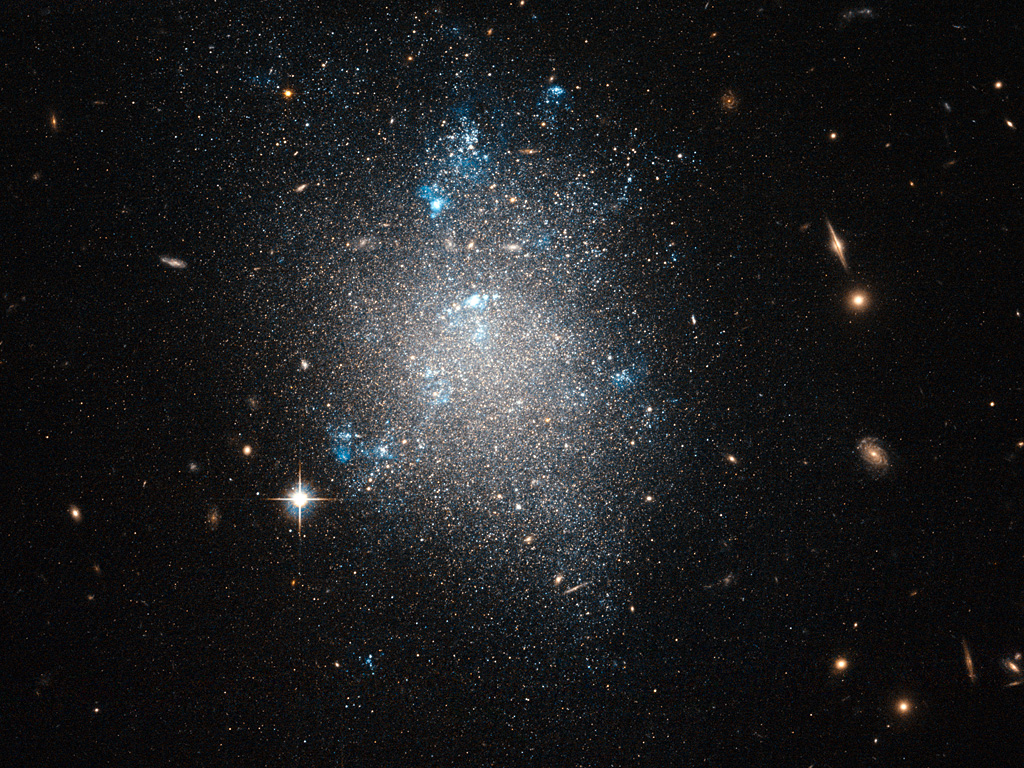
NGC 5477, one of these dwarf galaxies in the Messier 101 group, is the subject of this image from the NASA/ESA Hubble Space Telescope. Without obvious structure, but with visible signs of ongoing starbirth, NGC 5477 looks much like an archetypal dwarf irregular galaxy. The bright nebulae that extend across much of the galaxy are clouds of glowing hydrogen gas in which new stars are forming. These glow pinkish red in real life, although the selection of green and infrared filters through which this image was taken makes them appear almost white.

The observations were taken as part of a project to measure accurate distances to a range of galaxies within about 30 million light-years from Earth, by studying the brightness of red giant stars.

In addition to NGC 5477, the image includes numerous galaxies in the background, including some that are visible right through NGC 5477. This serves as a reminder that galaxies, far from being solid, opaque objects, are actually largely made up of the empty space between their stars.

This image is a combination of exposures taken through green and infrared filters using Hubble's Advanced Camera for Surveys. The field of view is approximately 3.3 by 3.3 arcminutes.

Source: ESA/Hubble - Space Telescope


NASA Telescopes See Weather Patterns in Brown Dwarf

This artist's illustration shows the atmosphere of a brown dwarf called 2MASSJ22282889-431026, which was observed simultaneously by NASA's Spitzer and Hubble space telescopes. The results were unexpected, revealing offset layers of material as indicated in the diagram. For example, the large, bright patch in the outer layer has shifted to the right in the inner layer. The observations indicate this brown dwarf -- a ball of gas that "failed" to become a star -- is marked by wind-driven, planet-size clouds. Image credit: NASA/JPL-Caltech . › Full image and caption

This artist's conception illustrates the brown dwarf named 2MASSJ22282889-431026. NASA's Hubble and Spitzer space telescopes observed the object to learn more about its turbulent atmosphere. Brown dwarfs are more massive and hotter than planets but lack the mass required to become sizzling stars. Their atmospheres can be similar to the giant planet Jupiter's. Image credit: NASA/JPL-Caltech . › Full image and caption  -  enlarge image

This graph shows the brightness variations of the brown dwarf named 2MASSJ22282889-431026 measured simultaneously by both NASA's Hubble and Spitzer space telescopes. As the object rotates every 1.4 hours, its emitted light periodically brightens and dims. Surprisingly, the timing, or phase, of the variations in brightness changes when measured at different wavelengths of infrared light. Image credit: NASA/JPL-Caltech/University of Arizona . › Full image and caption  -  enlarge image

PASADENA, Calif. -- Astronomers using NASA's Spitzer and Hubble space telescopes have probed the stormy atmosphere of a brown dwarf, creating the most detailed "weather map" yet for this class of cool, star-like orbs. The forecast shows wind-driven, planet-sized clouds enshrouding these strange worlds.

Brown dwarfs form out of condensing gas, as stars do, but lack the mass to fuse hydrogen atoms and produce energy. Instead, these objects, which some call failed stars, are more similar to gas planets with their complex, varied atmospheres. The new research is a stepping-stone toward a better understanding not only of brown dwarfs, but also of the atmospheres of planets beyond our solar system.

"With Hubble and Spitzer, we were able to look at different atmospheric layers of a brown dwarf, similar to the way doctors use medical imaging techniques to study the different tissues in your body," said Daniel Apai, the principal investigator of the research at the University of Arizona in Tucson, who presented the results at the American Astronomical Society meeting Tuesday in Long Beach, Calif.

A study describing the results, led by Esther Buenzli, also of the University of Arizona, is published in the Astrophysical Journal Letters.

The researchers turned Hubble and Spitzer simultaneously toward a brown dwarf with the long name of 2MASSJ22282889-431026. They found that its light varied in time, brightening and dimming about every 90 minutes as the body rotated. But more surprising, the team also found the timing of this change in brightness depended on whether they looked using different wavelengths of infrared light.

These variations are the result of different layers or patches of material swirling around the brown dwarf in windy storms as large as Earth itself. Spitzer and Hubble see different atmospheric layers because certain infrared wavelengths are blocked by vapors of water and methane high up, while other infrared wavelengths emerge from much deeper layers.

"Unlike the water clouds of Earth or the ammonia clouds of Jupiter, clouds on brown dwarfs are composed of hot grains of sand, liquid drops of iron, and other exotic compounds," said Mark Marley, research scientist at NASA's Ames Research Center in Moffett Field, Calif., and co-author of the paper. "So this large atmospheric disturbance found by Spitzer and Hubble gives a new meaning to the concept of extreme weather."

Buenzli says this is the first time researchers can probe variability at several different altitudes at the same time in the atmosphere of a brown dwarf. "Although brown dwarfs are cool relative to other stars, they are actually hot by earthly standards. This particular object is about 1,100 to 1,300 degrees Fahrenheit (600 to 700 degrees Celsius)," Buenzli said.

"What we see here is evidence for massive, organized cloud systems, perhaps akin to giant versions of the Great Red Spot on Jupiter," said Adam Showman, a theorist at the University of Arizona involved in the research. "These out-of-sync light variations provide a fingerprint of how the brown dwarf's weather systems stack up vertically. The data suggest regions on the brown dwarf where the weather is cloudy and rich in silicate vapor deep in the atmosphere coincide with balmier, drier conditions at higher altitudes -- and vice versa."

Researchers plan to look at the atmospheres of dozens of additional nearby brown dwarfs using Spitzer and Hubble.

"From studies such as this we will learn much about this important class of objects, whose mass falls between that of stars and Jupiter-sized planets," said Glenn Wahlgren, Spitzer program scientist at NASA Headquarters in Washington. "This technique will see extensive use when we are able to image individual exoplanets."

NASA's Jet Propulsion Laboratory, Pasadena, Calif., manages the Spitzer Space Telescope mission for NASA's Science Mission Directorate, Washington. Science operations are conducted at the Spitzer Science Center at the California Institute of Technology in Pasadena. Data are archived at the Infrared Science Archive housed at the Infrared Processing and Analysis Center at Caltech. Caltech manages JPL for NASA. For more information about Spitzer, visit http://spitzer.caltech.edu and http://www.nasa.gov/spitzer .

The Hubble Space Telescope is a project of international cooperation between NASA and the European Space Agency. NASA's Goddard Space Flight Center in Greenbelt, Md., manages the telescope. The Space Telescope Science Institute (STScI) in Baltimore, Md., conducts Hubble science operations. STScI is operated by the Association of Universities for Research in Astronomy, Inc., in Washington. For more information about Hubble, visit http://www.hubblesite.org and http://www.nasa.gov/hubble .

Whitney Clavin 818-354-4673
Jet Propulsion Laboratory, Pasadena, Calif.

whitney.clavin@jpl.nasa.gov

J.D. Harrington 202-358-5241
Headquarters, Washington

j.d.harrington@nasa.gov