Showing posts with label Abell 3627. Show all posts

Thursday, April 18, 2019

A “Jellyfish” Galaxy Swims Into View of NASA’s Upcoming Webb Telescope

Galaxy ESO 137-001 (Visible)
The spiral galaxy ESO 137-001 is an example of a “jellyfish” galaxy, because blue tendrils of star formation stream away from it like jellyfish tentacles. NASA’s Webb Space Telescope will study those sites of star formation to learn more about conditions there. Credits: NASA, ESA

Galaxy ESO 137-001 (Visible and X-ray) 
This composite view of ESO 137-001 includes visible light from Hubble and X-ray light from the Chandra X-ray Observatory (in blue). It reveals a tail of hot gas that has been stripped from the galaxy.  Credits: NASA, ESA, CXC


Webb will examine clumps of newly formed stars in the galaxy’s tail

As the spiral galaxy ESO 137-001 plunges into a galaxy cluster, gas is being pulled off of it as though it faced a cosmic headwind. Within that gas, stars are forming to create the appearance of giant, blue tentacle-like streamers. Astronomers, puzzled that stars could form within such tumult, plan to use Webb to study this galaxy and its stellar offspring.

If you look at the galaxy ESO 137-001 in visible light, you can see why it’s considered an example of a “jellyfish” galaxy. Blue ribbons of young stars dangle from the galaxy’s disk like cosmic tentacles. If you look at the galaxy in X-ray light, however, you will find a giant tail of hot gas streaming behind the galaxy. After launch, NASA’s James Webb Space Telescope will study ESO 137-001 to learn how the gas is being removed from the galaxy, and why stars are forming within that gaseous tail.

The newly forming stars in the tail are mysterious because processes common in large groups of galaxies should make it difficult for new stars to emerge. Most galaxies live in groups — for example, the Milky Way is a member of the Local Group, which also contains galaxies like Andromeda and the Triangulum spiral. Some galaxies reside in much larger gatherings of hundreds or even thousands of galaxies known as a galaxy cluster. The “jellyfish” galaxy ESO 137-001 is part of a cluster called Abell 3627.

A galaxy cluster isn’t just galaxies surrounded by empty space. The realm between the galaxies is filled with hot, tenuous gas. For galaxies living in the cluster or a wandering galaxy that gets pulled in by the cluster’s gravity, that gas acts like a headwind. That wind can remove gas and dust from the hapless galaxy in a process known as “ram pressure stripping.”

As a result, ram pressure stripping can slow star formation in the affected galaxy. Galaxies need gas to form stars. Eventually, all galaxies run out of gas and star formation stops. Ram pressure stripping can hasten that end.

This is one reason why galaxies in clusters stop forming new stars sooner than their relatives outside of clusters. But, the mechanisms involved are still mysterious.

“Both gas and dust are getting stripped off, but how much and what happens to the stripped material and the galaxy itself are still open questions,” said Stacey Alberts of the University of Arizona, a co-investigator on the project.

A star formation mystery

ESO 137-001 is a spiral galaxy similar in size to the Milky Way, and slightly less massive. Its tail extends across 260,000 light-years of space, almost three times the galaxy’s width. Galactic tails like this are difficult to spot because they are so tenuous. Surprisingly, stars seem to be forming in this tail.

Webb will target sites of star formation at different points along the tail: close to the galaxy, in the middle, and near the end of the tail. Since material at the tail’s end was removed before material close to the galaxy, astronomers can learn how the stripping process changed over time and how that affected conditions to form new stars.

Researchers aren’t sure how stars are able to form at all within the tail since the stripping process should have heated the gas. “We think it’s hard to strip off a molecular cloud that’s already forming stars because it should be tightly bound to the galaxy by gravity. Which means either we’re wrong, or this gas got stripped off and heated up, but then had to cool again so that it could condense and form stars,” explained Alberts.

“Telling these two scenarios apart is one of the things we want to get at,” she added.

Mid-infrared completes the puzzle

The team will examine ESO 137-001 using Webb’s Mid-Infrared Instrument (MIRI). MIRI observes infrared light at wavelengths of 5 to 28 microns, a range known as the mid-infrared. MIRI’s observations will provide 50 times more spatial detail and 20 times better spectral detail than previous work by other infrared observatories.

MIRI is sensitive to light emitted from hydrogen molecules as well as chemical elements like sulfur and oxygen. MIRI also will detect more complex, sooty molecules of carbon and hydrogen known as polycyclic aromatic hydrocarbons (PAHs), which are signposts of star formation. In addition to learning about the composition of gas and dust within these star-forming regions, astronomers will measure the physical conditions of the gas like temperature and density.

The team will combine the new Webb observations with existing data in visible light, X-rays, and at longer far-infrared wavelengths to get a more complete picture of ESO 137-001 and its environment. “Each different wavelength gives you a piece of the puzzle,” said Alberts.

Ultimately, astronomers want to learn more about how stars came to form in the tail. They also want to understand how gas is being stripped from the galaxy, how much is being stripped, and how efficiently it’s being removed. This will provide clues to the eventual fate of ESO 137-001 and the question of whether ram pressure stripping will shut down star formation, leaving behind a dead relic filled with aging, red stars.

The observations described here will be taken as part of Webb’s Guaranteed Time Observation (GTO) program. The GTO program provides dedicated time to the scientists who have worked with NASA to craft the science and instrument capabilities of Webb throughout its development.

The James Webb Space Telescope will be the world's premier space science observatory when it launches in 2021. Webb will solve mysteries of our solar system, look beyond to distant worlds around other stars, and probe the mysterious structures and origins of our universe and our place in it. Webb is an international project led by NASA with its partners, ESA (European Space Agency) and the Canadian Space Agency.

Galaxies are concentrations of stars, gas, dust, and dark matter. They come in a variety of shapes and sizes. Some are fated to collide, like the Milky Way and Andromeda. Credits: NASA, and J. Olmsted (STScI). Youtube


Wednesday, March 05, 2014

Spiral galaxy spills blood and guts

New Hubble image of spiral galaxy ESO 137-001
Hubble and Chandra composite of ESO 137-001

*****************************

Videos

Hubblecast 72: Clues to a cosmic crime

Zooming in on ESO 137-001

Panning across ESO 137-001

3D visualisation of ESO 137-001 (artist’s impression)

Fade between Hubble and Chandra images of ESO 137-001


This new Hubble image shows spiral galaxy ESO 137-001, framed against a bright background as it moves through the heart of galaxy cluster Abell 3627. This cluster is violently ripping the spiral’s entrails out into space, leaving bright blue streaks as telltale clues to this cosmic crime.

This new Hubble image shows ESO 137-001, a galaxy located in the southern constellation of Triangulum Australe (The Southern Triangle) — a delicate and beautiful spiral galaxy, but with a secret.

This image not only captures the galaxy and its backdrop in stunning detail, but also something more dramatic — intense blue streaks streaming outwards from the galaxy, seen shining brightly in ultraviolet light.

These streaks are actually hot young stars, encased in wispy streams of gas that are being torn away from the galaxy by its surroundings as it moves through space. This violent galactic disrobing is due to a process known as ram pressure stripping — a drag force felt by an object moving through a fluid [1]. The fluid in question here is superheated gas, which lurks at the centres of galaxy clusters.

This image also shows other telltale signs of this process, such as the curved appearance of the disc of gas and dust — a result of the forces exerted by the heated gas. The cluster's drag may be strong enough to bend ESO 137-001, but in this cosmic tug-of-war the galaxy's gravitational pull is strong enough to hold on to the majority of its dust — although some brown streaks of dust displaced by the stripping are visible.
Studying ram pressure stripping helps astronomers to better understand the mechanisms that drive the evolution of galaxies. For example, it will leave this galaxy with very little of the cold gas that is essential for star formation, rendering the galaxy effectively incapable of forming new stars.

ESO 137-001 is part of the Norma Cluster, a cluster of galaxies near the centre of the Great Attractor, a region of space that earned its name by being so massive, and having a gravitational pull so strong, that it is pulling entire galaxy clusters towards it. This region is located around 200 million light-years from our galaxy, the Milky Way. Both our galaxy and its home group, the Local Group, are slowly being hauled towards this mysterious region. Hubble also imaged ESO 137-001's neighbour, ESO 137-002, which is also known to have a hot tail of gas extending outwards into space (potw1302).

Despite being relatively close by cosmic standards, catching even a glimpse of the Norma Cluster is no mean feat. Observed from Earth, the cluster lies close to the plane of the Milky Way and is obscured by a thick smog of cosmic dust. But Hubble is up to the challenge — using new data from Hubble's Wide Field Camera 3 (WFC3).

As with most images from Hubble, this is not just a pretty picture; it tells us a great deal about the harsh environment at the heart of a galaxy cluster, and the fate of galaxies like ESO 137-001 that find passage through it.
A version of this image was submitted to the Hubble's Hidden Treasures image processing competition by contestant Serge Meunier.

Notes

[1] A quick and simple analogy for this effect would be to imagine leaning out of a car window as it travelled quickly along a motorway, or walking within a swimming pool.

Notes for editors

The Hubble Space Telescope is a project of international cooperation between ESA and NASA.
The data for this image comes from HST project 12377, with prinicipal investigator Ming Sun.

More information

Image credit: NASA, ESA
Acknowledgements: Ming Sun (UAH), and Serge Meunier

Links

Contacts

Georgia Bladon
Hubble/ESA
Garching bei München, Germany
Tel: +49-89-3200-6855
Email:
gbladon@partner.eso.org


Friday, January 18, 2013

A busy patch of the Great Attractor

Abell 3627 and  ESO 137-002
Credit: ESA/Hubble & NASA

A busy patch of space has been captured in this image from the NASA/ESA Hubble Space Telescope. Scattered with many nearby stars, the field also has numerous galaxies in the background.

Located on the border of Triangulum Australe (The Southern Triangle) and Norma (The Carpenter’s Square), this field covers part of the Norma Cluster (Abell 3627) as well as a dense area of our own galaxy, the Milky Way.

The Norma Cluster is the closest massive galaxy cluster to the Milky Way, and lies about 220 million light-years away. The enormous mass concentrated here, and the consequent gravitational attraction, mean that this region of space is known to astronomers as the Great Attractor, and it dominates our region of the Universe.

The largest galaxy visible in this image is ESO 137-002, a spiral galaxy seen edge on. In this image from Hubble, we see large regions of dust across the galaxy’s bulge. What we do not see here is the tail of glowing X-rays that has been observed extending out of the galaxy — but which is invisible to an optical telescope like Hubble.

Observing the Great Attractor is difficult at optical wavelengths. The plane of the Milky Way — responsible for the numerous bright stars in this image — both outshines (with stars) and obscures (with dust) many of the objects behind it. There are some tricks for seeing through this — infrared or radio observations, for instance — but the region behind the centre of the Milky Way, where the dust is thickest, remains an almost complete mystery to astronomers.

This image consists of exposures in blue and infrared light taken by Hubble’s Advanced Camera for Surveys.

Source: ESA/Hubble - Space Telescope


Thursday, January 21, 2010

ESO 137-001: Two Tails to Tell

Credit X-ray: NASA/CXC/UVa/M. Sun, et al;
H-alpha/Optical: SOAR (UVa/NOAO /UNC/CNPq-Brazil)/M.Sun et al.


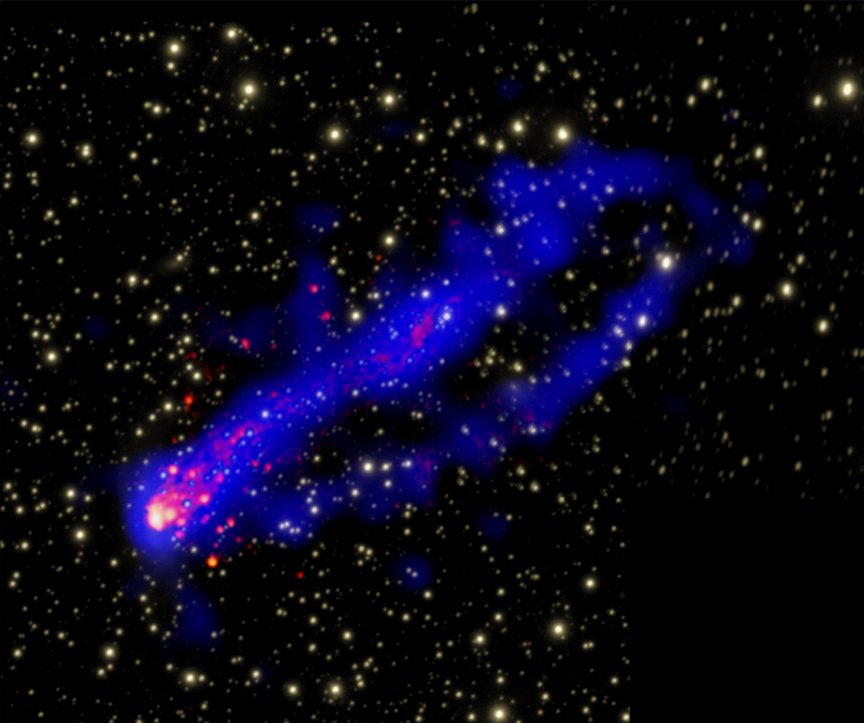
Two spectacular tails of X-ray emission have been seen trailing behind a galaxy using the Chandra X-ray Observatory. A composite image of the galaxy cluster Abell 3627 shows X-rays from Chandra in blue, optical emission in yellow and emission from hydrogen light -- known to astronomers as "H-alpha" -- in red. The optical and H-alpha data were obtained with the Southern Astrophysical Research (SOAR) Telescope in Chile.

At the front of the tail is the galaxy ESO 137-001. The brighter of the two tails has been seen before and extends for about 260,000 light years. The detection of the second, fainter tail, however, was a surprise to the scientists.

The X-ray tails were created when cool gas from ESO 137-001 (with a temperature of about ten degrees above absolute zero) was stripped by hot gas (about 100 million degrees) as it travels towards the center of the galaxy cluster Abell 3627. What astronomers observe with Chandra is essentially the evaporation of the cold gas, which glows at a temperature of about 10 million degrees. Evidence of gas with temperatures between 100 and 1,000 degrees Kelvin in the tail was also found with the Spitzer Space Telescope.

Galaxy clusters are collections of hundreds or even thousands of galaxies held together by gravity that are enveloped in hot gas. The two-pronged tail in this system may have formed because gas has been stripped from the two major spiral arms in ESO 137-001. The stripping of gas is thought to have a significant effect on galaxy evolution, removing cold gas from the galaxy, shutting down the formation of new stars in the galaxy, and changing the appearance of inner spiral arms and bulges because of the effects of star formation.

The H-alpha data shows evidence for star formation in the tails -- the first unambiguous evidence that star formation can occur when cold gas is stripped out of galaxies as they fall through clusters. The Chandra data also reveal an excess of luminous X-ray point sources around the X-ray tails. Some of them are considered to be young massive binary stars associated with nearby young star clusters, giving more evidence of star formation in the tails. The implication is that a large portion of stars between cluster galaxies can be formed in situ.

The X-ray data also reveal that there is little change in temperature of the hot gas in the tails, and also little change in width of the tails with distance from ESO 137-001. Both of these features present challenges to scientists doing simulations of the galaxy tails.

Fast Facts for ESO 137-001:

Scale: Image is 5 arcmin across
Category: Groups & Clusters of Galaxies
Coordinates: (J2000) RA 16h 13m 25.59s | Dec -60° 45' 43.10
Constellation: Norma
Observation Date: 6/12/2008
Observation Time: 39 hours
Obs. ID: 9518
Color Code: X-ray (Blue); Optical (Yellow); H-alpha (Red)
Instrument: ACIS
References: Sun, M., et al, 2010, ApJ 708 946
Distance Estimate: About 230 million light years