Showing posts with label NGC 6872. Show all posts

Friday, September 19, 2014

An interacting colossus

Credit: Image credit: ESA/Hubble & NASA
Acknowledgement: Judy Schmidt (geckzilla.com)

This picture, taken by the NASA/ESA Hubble Space Telescope’s Wide Field Planetary Camera 2 (WFPC2), shows a galaxy known as NGC 6872 in the constellation of Pavo (The Peacock). Its unusual shape is caused by its interactions with the smaller galaxy that can be seen just above NGC 6872, called IC 4970. They both lie roughly 300 million light-years away from Earth.

From tip to tip, NGC 6872 measures over 500 000 light-years across, making it the second largest spiral galaxy discovered to date. In terms of size it is beaten only by NGC 262, a galaxy that measures a mind-boggling 1.3 million light-years in diameter! To put that into perspective, our own galaxy, the Milky Way, measures between 100 000 and 120 000 light-years across, making NGC 6872 about five times its size.

The upper left spiral arm of NGC 6872 is visibly distorted and is populated by star-forming regions, which appear blue on this image. This may have been be caused by IC 4970 recently passing through this arm — although here, recent means 130 million years ago! Astronomers have noted that NGC 6872 seems to be relatively sparse in terms of free hydrogen, which is the basis material for new stars, meaning that if it weren’t for its interactions with IC 4970, NGC 6872 might not have been able to produce new bursts of star formation.

A version of this image was entered into the Hubble’s Hidden Treasures image processing competition by contestant Judy Schmidt.

Source: ESA/Hubble - Space Telescope


Monday, January 14, 2013

NASA's Galex Reveals the Largest-Known Spiral Galaxy


This composite of the giant barred spiral galaxy NGC 6872 combines visible light images from the European Southern Observatory's Very Large Telescope with far-ultraviolet (1,528 angstroms) data from NASA's GALEX and 3.6-micron infrared data acquired by NASA's Spitzer Space Telescope. Image credit: NASA's Goddard Space Flight Center/ESO/JPL-Caltech/DSS.  › Full image and caption

Computer simulations of the collision between NGC 6872 and IC 4970 reproduce the basic features of the galaxies as we see them today. Image credit: NASA's Goddard Space Flight Center, after C. Horellou (Onsala Space Observatory) and B. Koribalski (ATNF).  › Full image and caption - enlarge image

PASADENA, Calif. -- The spectacular barred spiral galaxy NGC 6872 has ranked among the biggest stellar systems for decades. Now a team of astronomers from the United States, Chile and Brazil has crowned it the largest known spiral, based on archival data from NASA's Galaxy Evolution Explorer (GALEX) mission, which has since been loaned to the California Institute of Technology in Pasadena.

Measuring tip-to-tip across its two outsized spiral arms, NGC 6872 spans more than 522,000 light-years, making it more than five times the size of our Milky Way galaxy. 

"Without GALEX's ability to detect the ultraviolet light of the youngest, hottest stars, we would never have recognized the full extent of this intriguing system," said lead scientist Rafael Eufrasio, a research assistant at NASA's Goddard Space Flight Center in Greenbelt, Md., who is a doctoral student at Catholic University of America in Washington. He presented the findings Thursday at the American Astronomical Society meeting in Long Beach, Calif.

The galaxy's unusual size and appearance stem from its interaction with a much smaller disk galaxy named IC 4970, which has only about one-fifth the mass of NGC 6872. The odd couple is located 212 million light-years from Earth in the southern constellation Pavo. 

Astronomers think large galaxies, including our own, grew through mergers and acquisitions -- assembling over billions of years by absorbing numerous smaller systems. 

Intriguingly, the gravitational interaction of NGC 6872 and IC 4970 may have done the opposite, spawning what may develop into a new small galaxy. 

"The northeastern arm of NGC 6872 is the most disturbed and is rippling with star formation, but at its far end, visible only in the ultraviolet, is an object that appears to be a tidal dwarf galaxy similar to those seen in other interacting systems," said team member Duilia de Mello, a professor of astronomy at Catholic University.

The tidal dwarf candidate is brighter in ultraviolet than other regions of the galaxy, a sign it bears a rich supply of hot young stars less than 200 million years old. 

The researchers studied the galaxy across the spectrum using archival data from the European Southern Observatory's Very Large Telescope, the Two Micron All Sky Survey, and NASA's Spitzer Space Telescope, as well as GALEX. 

By analyzing the distribution of energy by wavelength, the team uncovered a distinct pattern of stellar age along the galaxy's two prominent spiral arms. The youngest stars appear in the far end of the northwestern arm, within the tidal dwarf candidate, and stellar ages skew progressively older toward the galaxy's center. 

The southwestern arm displays the same pattern, which is likely connected to waves of star formation triggered by the galactic encounter.

A 2007 study by Cathy Horellou at Onsala Space Observatory in Sweden and Baerbel Koribalski of the Australia National Telescope Facility developed computer simulations of the collision that reproduced the overall appearance of the system as we see it today. According to the closest match, IC 4970 made its closest approach about 130 million years ago and followed a path that took it nearly along the plane of the spiral's disk in the same direction it rotates. The current study is consistent with this picture. 

As in all barred spirals, NGC 6872 contains a stellar bar component that transitions between the spiral arms and the galaxy's central regions. Measuring about 26,000 light-years in radius, or about twice the average length found in nearby barred spirals, it is a bar that befits a giant galaxy. 

The team found no sign of recent star formation along the bar, which indicates it formed at least a few billion years ago. Its aged stars provide a fossil record of the galaxy's stellar population before the encounter with IC 4970 stirred things up.

"Understanding the structure and dynamics of nearby interacting systems like this one brings us a step closer to placing these events into their proper cosmological context, paving the way to decoding what we find in younger, more distant systems," said team member and Goddard astrophysicist Eli Dwek. 

The study also included Fernanda Urrutia-Viscarra and Claudia Mendes de Oliveira at the University of Sao Paulo in Brazil and Dimitri Gadotti at the European Southern Observatory in Santiago, Chile. 

The GALEX mission is led by the California Institute of Technology in Pasadena, which is responsible for science operations and data analysis. NASA's Jet Propulsion Laboratory, also in Pasadena, manages the mission and built the science instrument. GALEX was developed under NASA's Explorers Program managed by NASA's Goddard Space Flight Center. In May 2012, NASA loaned GALEX to Caltech, which continues spacecraft operations and data management using private funds.

For more information about GALEX, visit http://www.nasa.gov/galex and http://www.galex.caltech.edu.


Whitney Clavin 818-354-4673
Jet Propulsion Laboratory, Pasadena, Calif.

whitney.clavin@jpl.nasa.gov 

Lynn Chandler 301-286-2806
Goddard Space Flight Center, Greenbelt, Md.

lynn.chandler-1@nasa.gov 

J.D. Harrington 202-358-5241
Headquarters, Washington

j.d.harrington@nasa.gov  


Wednesday, March 30, 2011

Australian Students Capture Dancing Galaxies

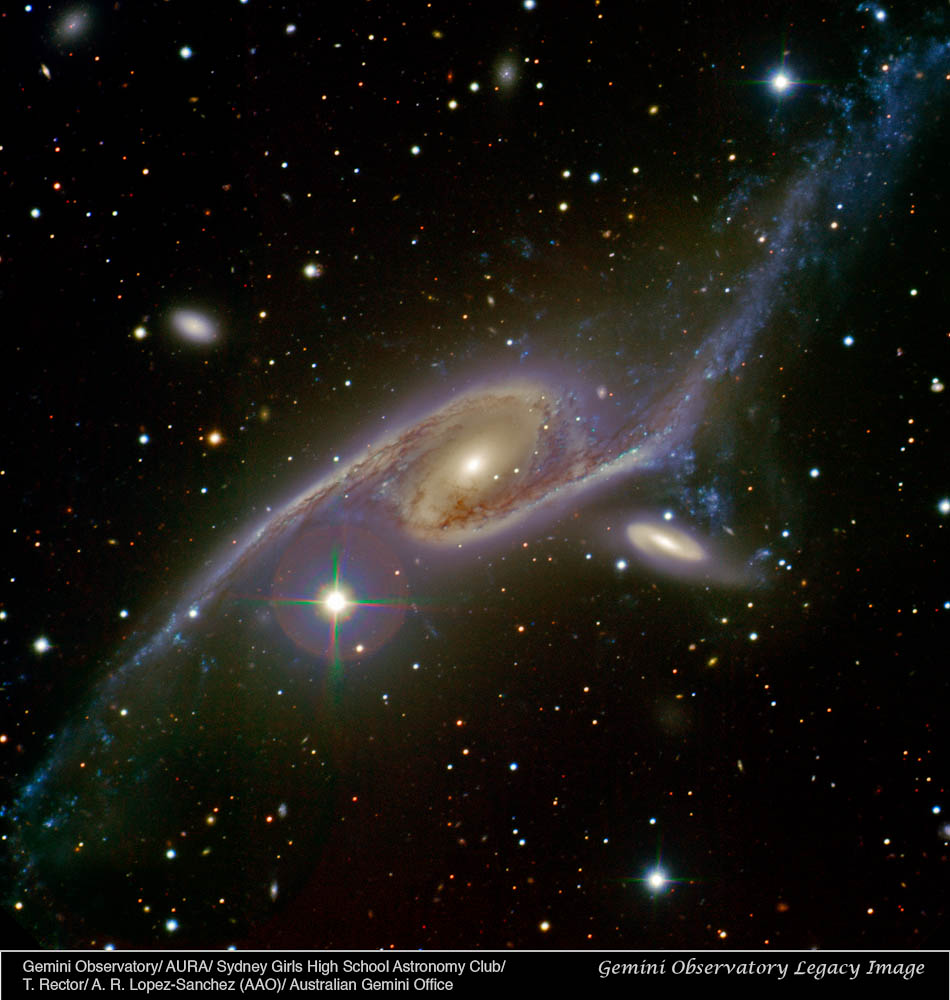
Figure 1: Image of NGC 6872 (left) and companion galaxy IC 4970 (right) locked in a tango as the two galaxies gravitationally interact. The galaxies lie about 200 million light-years away in the direction of the constellation Pavo (the Peacock). Image credit: Sydney Girls High School Astronomy Club, Travis Rector (University of Alaska, Anchorage), Ángel López-Sánchez (Australian Astronomical Observatory/Macquarie University), and the Australian Gemini Office. Download JPG 160 KB | TIFF 13.3 MB

Figure 2: Members of the SGHS Astronomy Club Executive Council receiving the Gemini image on behalf of the entire club.

L-R: Julia Picone-Murray, Katerina Papadakis, Mr Jeff Stanger (the teacher who led the Astronomy Club in 2010), Isabel Colman (Club president), Dr Christopher Onken (Deputy Australian Gemini Scientist), Dr Angel Lopez-Sanchez (Australian Astronomical Observatory), Vivian Yean, Juliet Schilling. Photo credit: Australian Gemini Office.

For the second consecutive year, high school students from across Australia joined in a competition to obtain scientifically useful (and aesthetically pleasing) images using the Gemini Observatory. The spectacular result of this contest, organized by the Australian Gemini Office (AusGO), is revealed here. As the 2010 winning student team suggested, Gemini targeted an interacting galaxy pair which, they assured, “would be more than just a pretty picture.”

The team, made up of students from the Sydney Girls High School (SGHS) Astronomy Club in central Sydney, proposed that Gemini investigate the galaxy pair NGC 6872 and IC 4970 (see Figure 1). The two galaxies are embraced in a graceful galactic dance that, as the team described in the essay to support their entry, “…will also serve to illustrate the situation faced by the Milky Way and the Andromeda galaxy in millions of years.”

The Gemini Multi-Object Spectrograph (GMOS), in its imaging mode on the Gemini South telescope in Chile, collected the photons for the stunning new image. At an event held at SGHS on March 22, 2011 (see Figure 2), the winning team and teachers viewed the image for the first time and filled the room with “oohs” and “aahs” when Christopher Onken (Australian National University/AusGO) unveiled it. Assisting Onken, Angel López-Sánchez (Australian Astronomical Observatory/Macquarie University) highlighted many features of the image and explained galaxy interactions using computer animations and simulations.

The primary galaxy in the image (NGC 6872) exemplifies what happens when galaxies interact and their original structure and form is distorted. When galaxies like these grapple with each other, gravity tugs at their structures, catapulting spiral arms out to enormous distances. In NGC 6872, the arms have been stretched out to span hundreds of thousands of light-years—many times further than the spiral arms of our own Milky Way galaxy. Over hundreds of millions of years, NGC 6872’s arms will fall back toward the central part of the galaxy, and the companion galaxy (IC 4970) will eventually be merged into NGC 6872. The coalescence of galaxies often leads to a burst of new star formation. Already, the blue light of recently created star clusters dot the outer reaches of NGC 6872’s elongated arms. Dark fingers of dust and gas along the arms soak up the visible light. That dust and gas is the raw material out of which future generations of stars could be born.

Searching for these dynamics was a key feature in the essay written by the winning team. To justify the scientific merit of obtaining this image, the team suggested that, “If enough colour data is obtained in the image it may reveal easily accessible information about the different populations of stars, star formation, relative rate of star formation due to the interaction, and the extent of dust and gas present in these galaxies.” The team also presented a more emotional perspective by looking at the impact this image might have on people trying to understand our place in the universe. When viewers consider this image “in contrast to their daily life,” the team explained, “there is a significant possibility of a new awareness or perception of the age and scale of the universe, and their part in it.”

Once the student essays from across Australia were submitted, a volunteer committee (representing science, education, journalism and art) carefully reviewed the submissions to determine a winner. Once the winning team emerged, work began to collect the data. Travis Rector (University of Alaska, Anchorage) planned the details of the observations and selected filters that would bring out the beautiful features of the colliding galaxies when the image was obtained later in 2010.

All three of the top entries earned their classes a “Live from Gemini” event, using a video link between the students and the Gemini control room, for an interactive introduction to the observatory by members of Gemini’s Public Information and Outreach Office. Each of the classes came prepared with probing questions about black holes, galaxies, and exoplanets, which were answered by staff at Gemini's base facility in Hilo Hawai‘i.

Ian Lightbody, who advised the Runner-Up school of Forest Lake College, comments, “The students had a great time and learned a lot. I know I did!”

A new contest is underway for Australian students in 2011, and more details can be found at: http://ausgo.aao.gov.au/contest/.

Thursday, December 10, 2009

IC 4970 and NGC 6872: Galaxy Collision Switches on Black Hole

Credit X-ray: NASA/CXC/SAO/M.Machacek;
Optical: ESO/VLT;
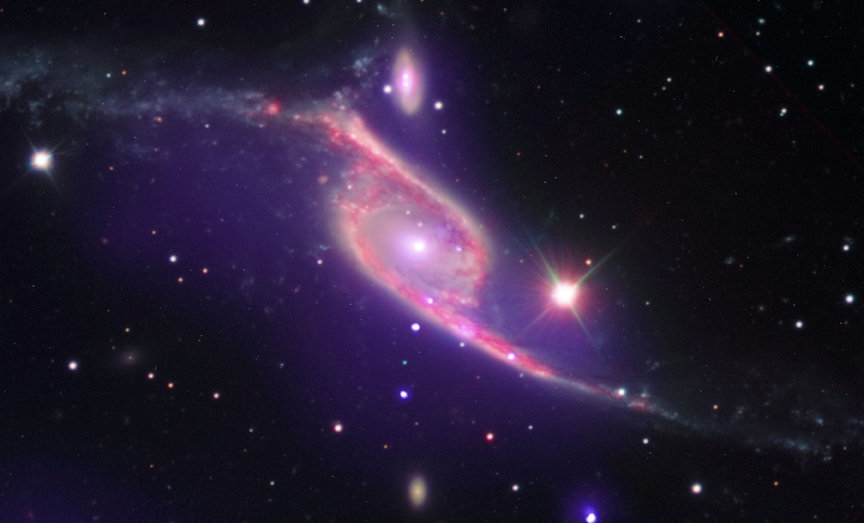
This composite image of data from three different telescopes shows an ongoing collision between two galaxies, NGC 6872 and IC 4970. X-ray data from NASA's Chandra X-ray Observatory is shown in purple, while Spitzer Space Telescope's infrared data is red and optical data from ESO's Very Large Telescope (VLT) is colored red, green and blue.

Astronomers think that supermassive black holes exist at the center of most galaxies. Not only do the galaxies and black holes seem to co-exist, they are apparently inextricably linked in their evolution. To better understand this symbiotic relationship, scientists have turned to rapidly growing black holes - so-called active galactic nucleus (AGN) - to study how they are affected by their galactic environments.

The latest data from Chandra and Spitzer show that IC 4970, the small galaxy at the top of the image, contains an AGN, but one that is heavily cocooned in gas and dust. This means in optical light telescopes, like the VLT, there is little to see. X-rays and infrared light , however, can penetrate this veil of material and reveal the light show that is generated as material heats up before falling onto the black hole (seen as a bright point-like source).

Despite this obscuring gas and dust around IC 4970, the Chandra data suggest that there is not enough hot gas in IC 4970 to fuel the growth of the AGN. Where, then, does the food supply for this black hole come from? The answer lies with its partner galaxy, NGC 6872. These two galaxies are in the process of undergoing a collision, and the gravitational attraction from IC 4970 has likely pulled over some of NGC 6872's deep reservoir of cold gas (seen prominently in the Spitzer data), providing a new fuel supply to power the giant black hole.

Fast Facts for NGC 6872:

Scale: Image is 347 arcsec across (310,000 light years)
Category: Normal Galaxies & Starburst Galaxies
Coordinates:(J2000) RA 20h 16m 57s | Dec -70° 46' 06
Constellation: Pavo
Observation Date December 14 & 16, 2005
Observation Time: 21 hours
Obs. ID: 7248, 7059
Color Code: X-ray (Purple); Optical (Red, Green, Blue)
Instrument: ACIS
References: Machacek, et al., 2008 ApJ 674 142-150
Distance Estimate: About 180 million light years (redshift = 0.01338)