Showing posts with label N11. Show all posts

Tuesday, September 09, 2025

Cloudy cluster

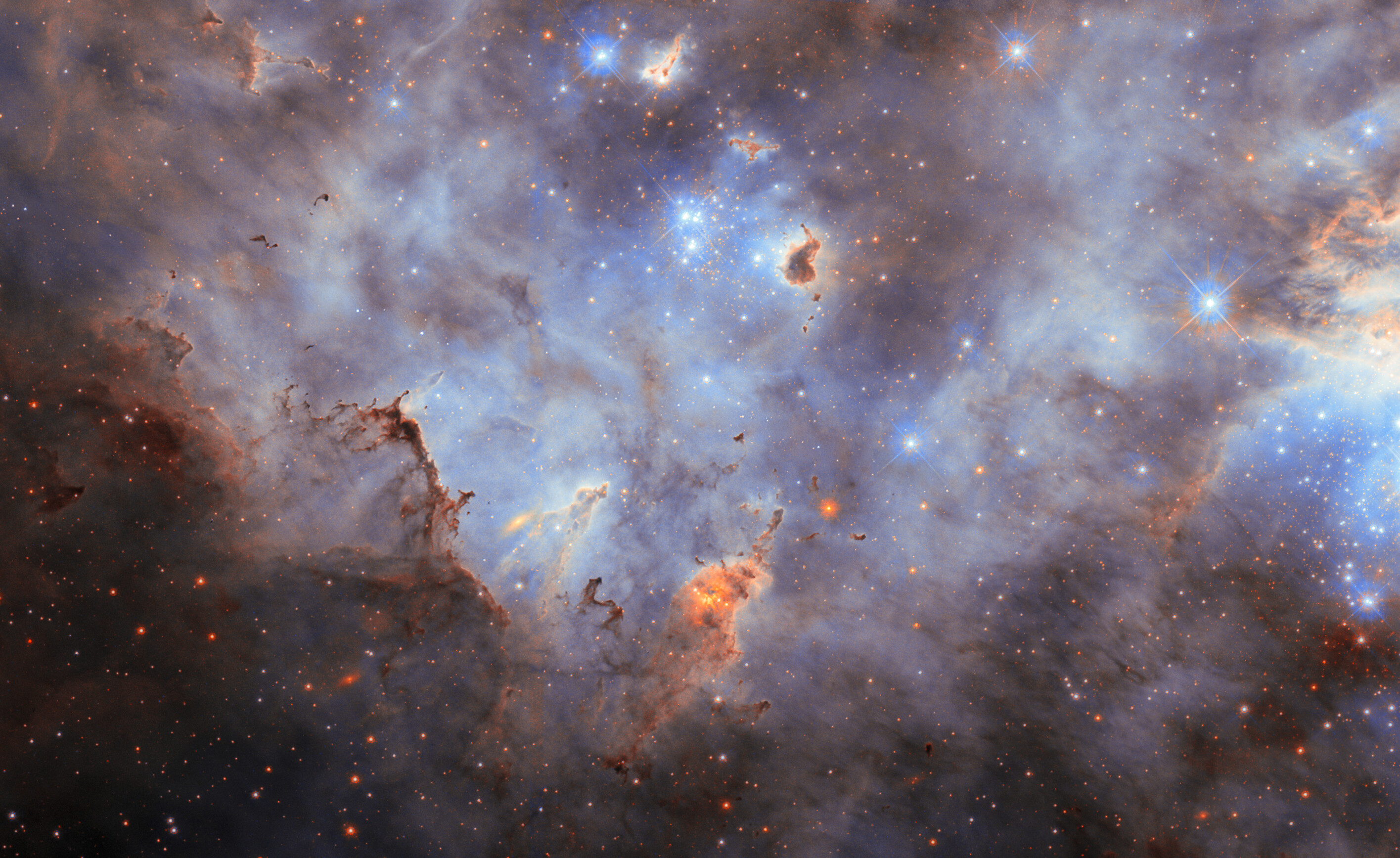
Stars in a star cluster shine brightly blue, with four-pointed spikes radiating from them. The centre shows a small, crowded group of stars while a larger group lies out of view on the left. The nebula is mostly thick, smoky clouds of gas, lit up in blue tones by the stars. Clumps of dust hover before and around the stars; they are mostly dark, but lit around their edges where the starlight erodes them. Credit: ESA/Hubble & NASA, C. Murray, J. Maíz Apellániz.
Large JPEG

This new NASA/ESA Hubble Space Telescope Picture of the Week features a cloudy starscape from an impressive star cluster. This scene is located in the Large Magellanic Cloud, a dwarf galaxy situated about 160 000 light-years away in the constellations Dorado and Mensa. With a mass equal to 10–20% of the mass of the Milky Way, the Large Magellanic Cloud is the largest of the dozens of small galaxies that orbit our galaxy.

The Large Magellanic Cloud is home to several massive stellar nurseries where gas clouds, like those strewn across this image, coalesce into new stars. Today’s image depicts a portion of the galaxy’s second-largest star-forming region, which is called N11. (The most massive and prolific star-forming region in the Large Magellanic Cloud, the Tarantula Nebula, is a frequent target for Hubble.) We see bright, young stars lighting up the gas clouds and sculpting clumps of dust with powerful ultraviolet radiation.

This image marries observations made roughly 20 years apart, a testament to Hubble’s longevity. The first set of observations, which were carried out in 2002–2003, capitalised on the exquisite sensitivity and resolution of the then-newly-installed Advanced Camera for Surveys. Astronomers turned Hubble toward the N11 star cluster to do something that had never been done before at the time: catalogue all the stars in a young cluster with masses between 10% of the Sun’s mass and 100 times the Sun’s mass.

The second set of observations came from Hubble’s newest camera, the Wide Field Camera 3. These images focused on the dusty clouds that suffuse the cluster, bringing a new perspective on cosmic dust.


Thursday, January 17, 2013

A hidden treasure in the Large Magellanic Cloud

 PR Image heic1301a
LHA 120-N11 in the Large Magellanic Cloud 

PR Image heic1301b
Overview of the Large Magellanic Cloud (ground-based image)

 Videos

PR Video heic1301a
Zoom into LHA 120-N11

PR Video heic1301b
Pan across LHA 120-N11

Nearly 200 000 light-years from Earth, the Large Magellanic Cloud, a satellite galaxy of the Milky Way, floats in space, in a long and slow dance around our galaxy. Vast clouds of gas within it slowly collapse to form new stars. In turn, these light up the gas clouds in a riot of colours, visible in this image from the NASA/ESA Hubble Space Telescope.

The Large Magellanic Cloud (LMC) is ablaze with star-forming regions. From the Tarantula Nebula, the brightest stellar nursery in our cosmic neighbourhood, to LHA 120-N 11, part of which is featured in this Hubble image, the small and irregular galaxy is scattered with glowing nebulae, the most noticeable sign that new stars are being born.

The LMC is in an ideal position for astronomers to study the phenomena surrounding star formation. It lies in a fortuitous location in the sky, far enough from the plane of the Milky Way that it is neither outshone by too many nearby stars, nor obscured by the dust in the Milky Way’s centre. It is also close enough to study in detail (less than a tenth of the distance of the Andromeda Galaxy, the closest spiral galaxy), and lies almost face-on to us [1], giving us a bird’s eye view.

LHA 120-N 11 (known as N11 for short) is a particularly bright region of the LMC, consisting of several adjacent pockets of gas and star formation. NGC 1769 (in the centre of this image) and NGC 1763 (to the right, see heic1011) are among the brightest parts.

In the centre of this image, a dark finger of dust blots out much of the light. While nebulae are mostly made of hydrogen, the simplest and most plentiful element in the Universe, dust clouds are home to heavier and more complex elements, which go on to form rocky planets like the Earth. Much finer than household dust (it is more like smoke), this interstellar dust consists of material expelled from previous generations of stars as they died.

The data in this image were identified by Josh Lake, an astronomy teacher at Pomfret School in Connecticut, USA, in the Hubble’s Hidden Treasures image processing competition. The competition invited members of the public to dig out unreleased scientific data from Hubble’s vast archive, and to process them into stunning images.

Josh Lake won first prize in the competition with an image contrasting the light from glowing hydrogen and nitrogen in N11. The image above combines the data he identified with additional exposures taken in blue, green and near infrared light.

Notes

The Hubble Space Telescope is a project of international cooperation between ESA and NASA.

[1] Although the Large Magellanic Cloud is generally classified as an irregular galaxy, it shares some features with spiral galaxies, including a clearly visible bar, and a single spiral-arm-like structure. It is thought that the LMC may be a small spiral galaxy that was pulled out of shape by the Milky Way.

Links
Contacts

Oli Usher
Hubble/ESA
Garching, Germany
Tel: +49-89-3200-6855
Email: ousher@eso.org

Tuesday, June 22, 2010

Hubble captures bubbles and baby stars

Hubble view of the huge star formation region N11 in the Large Magellanic Cloud

Overview of the Large Magellanic Cloud (annotated)

Overview of the Large Magellanic Cloud

The entire Large Magellanic Cloud with annotations

Hubblecast 37: Bubbles and baby stars

Zooming in on N11 in the Large Magellanic Cloud

Panning over N11 in the Large Magellanic Cloud

A spectacular new NASA/ESA Hubble Space Telescope image — one of the largest ever released of a star-forming region — highlights N11, part of a complex network of gas clouds and star clusters within our neighbouring galaxy, the Large Magellanic Cloud. This region of energetic star formation is one of the most active in the nearby Universe.

The Large Magellanic Cloud contains many bright bubbles of glowing gas. One of the largest and most spectacular has the name LHA 120-N 11, from its listing in a catalogue compiled by the American astronomer and astronaut Karl Henize in 1956, and is informally known as N11. Close up, the billowing pink clouds of glowing gas make N11 resemble a puffy swirl of fairground candy floss. From further away, its distinctive overall shape led some observers to nickname it the Bean Nebula. The dramatic and colourful features visible in the nebula are the telltale signs of star formation. N11 is a well-studied region that extends over 1000 light-years. It is the second largest star-forming region within the Large Magellanic Cloud and has produced some of the most massive stars known.

It is the process of star formation that gives N11 its distinctive look. Three successive generations of stars, each of which formed further away from the centre of the nebula than the last, have created shells of gas and dust. These shells were blown away from the newborn stars in the turmoil of their energetic birth and early life, creating the ring shapes so prominent in this image.

Beans are not the only terrestrial shapes to be found in this spectacular high resolution image from the NASA/ESA Hubble Space Telescope. In the upper left is the red bloom of nebula LHA 120-N 11A. Its rose-like petals of gas and dust are illuminated from within, thanks to the radiation from the massive hot stars at its centre. N11A is relatively compact and dense and is the site of the most recent burst of star development in the region.

Other star clusters abound in N11, including NGC 1761 at the bottom of the image, which is a group of massive hot young stars busily pouring intense ultraviolet radiation out into space. Although it is much smaller than our own galaxy, the Large Magellanic Cloud is a very vigorous region of star formation. Studying these stellar nurseries helps astronomers understand a lot more about how stars are born and their ultimate development and lifespan.

Both the Large Magellanic Cloud and its small companion, the Small Magellanic Cloud, are easily seen with the unaided eye and have always been familiar to people living in the southern hemisphere. The credit for bringing these galaxies to the attention of Europeans is usually given to Portuguese explorer Fernando de Magellan and his crew, who viewed it on their 1519 sea voyage. However, the Persian astronomer Abd Al-Rahman Al Sufi and the Italian explorer Amerigo Vespucci recorded the Large Magellanic Cloud in 964 and 1503 respectively.

Notes

The Hubble Space Telescope is a project of international cooperation between ESA and NASA.

Image credit: NASA, ESA and Jesús Maíz Apellániz (Instituto de Astrofísica de Andalucía, Spain)

Links

* N11A release: http://www.spacetelescope.org/news/heic0210/

Contacts

Colleen Sharkey
Hubble/ESA
Garching, Germany
Tel: +49-89-3200-6306
Cell: +49-015115373591
Email:
csharkey@eso.org