Thursday, March 21, 2024

Using Polarization to Improve Quantum Imaging

A stained slice of a mouse brain, as imaged with classical imaging (left) and using the Wang group's ICE method (right). The difference in resolution between the two techniques is clear in the side-by-side comparison focused on an area of detail highlighted in boxes E and F.

A zebrafish is shown classically imaged (left) and using the ICE technique (right), in the presence of unwanted, or stray light, that could interfere with the quality of an image. The black dots in the classical image are imperfections caused by stray light.

Since quantum entanglement allows paired photons to be linked no matter how far apart they might be, Wang is already imagining how his new system could be used to make birefringence measurements in space.


Quantum imaging is a growing field that takes advantage of the counterintuitive and "spooky" ability of light particles, or photons, to become linked, or entangled, under specialized circumstances. If the state of one photon in the entangled duo gets tweaked, so does the other, regardless of how far apart the two photons might be.

Caltech researchers demonstrated last May how such entanglement could double the resolution of classical light microscopes while also preventing an imaging system's light from damaging fragile biological samples. Now the same team has improved upon the technique, making it possible to quantum image whole organ slices and even small organisms.

Led by Lihong Wang, the Bren Professor of Medical Engineering and Electrical Engineering, the new work uses entanglement—what Albert Einstein once famously described as "spooky action at a distance"— to control not only the color and brightness of the light hitting a sample, but also the polarization of that light.

"Our new technique has the potential to pave the way for quantum imaging in many different fields, including biomedical imaging and potentially even remote space sensing," says Wang, who is also the Andrew and Peggy Cherng Medical Engineering Leadership Chair and executive officer for medical engineering.

Like wavelength and intensity, polarization is a fundamental property of light and represents which direction the electric component of a light wave is oriented with respect to the wave's general direction of travel. Most light, including sunlight, is unpolarized, meaning that its electromagnetic waves move and travel in all directions. However, filters called polarizers can be used to create light beams with one specific polarization. A vertical polarizer, for example, only allows photons with vertical polarization to pass through. Those with horizontal polarization (meaning that the electric component of the light wave is oriented horizontally with respect to the direction of travel) will be blocked. Any light with other polarization angles (between vertical and horizontal), will partially pass through. The outcome is a stream of vertically polarized light.

This is how polarized sunglasses reduce glare. They use a vertically polarizing chemical coating to block sunlight that has become horizontally polarized by reflecting off a horizontal surface, such as a lake or snowy field. This means that the wearer only observes vertically polarized light.

When changes in light intensity or color are not enough to give scientists quality images of certain objects, controlling the polarization of the light in an imaging system can sometimes provide more information about the sample and offer a different way to identify contrast between a sample and its background. Detecting the changes in polarization caused by certain samples can also give researchers information about the internal structure and behavior of those materials.

Wang's newest microscopy technique, dubbed quantum imaging by coincidence from entanglement (ICE), takes advantage of entangled photon pairs to obtain higher-resolution images of biological materials, including thicker samples, and to make measurements of materials that have what scientists call birefringent properties.

Rather than consistently bending incoming light waves in the same way, as most materials do, birefringent materials bend those waves to different degrees depending on the light's polarization and the direction in which it is traveling. The most common birefringent materials studied by scientists are calcite crystals. But biological materials, such as cellulose, starch, and many types of animal tissue, including collagen and cartilage, are also birefringent.

If a sample with birefringent properties is placed between two polarizers oriented at 90-degree angles to each other, some of the light going through the sample will be altered in its polarization and will therefore make it through to the detector, even though all the other incoming light should be blocked by the two polarizers. The detected light can then provide information about the structure of the sample. In materials science, for example, scientists use birefringence measurements to get a better understanding of the areas where mechanical stress builds up in plastics.

In Wang's ICE setup, light is passed first through a polarizer and then through a pair of special barium borate crystals, which will occasionally create an entangled photon pair; about one pair is produced for every million photons that pass through the crystals. From there, the two entangled photons will branch off and follow one of the system's two arms: one will travel straight ahead, following what is called the idler arm, while the other traces a more circuitous path called the signal arm that causes the photon to pass through the object of interest. Finally, both photons go through an additional polarizer before reaching two detectors, which record the time of arrival of the detected photons. Here, though, occurs a "spooky" quantum effect because of the entangled nature of the photons: the detector in the idler arm can act as a virtual "pinhole" and "polarization selector" on the signal arm, instantly affecting the location and polarization of the photon incident on the object in the signal arm.

"In the ICE setup, the detectors in the signal and idler arms function as 'real' and 'virtual' pinholes, respectively," says Yide Zhang, lead author of the new paper and a postdoctoral scholar fellowship trainee in medical engineering at Caltech. "This dual pinhole configuration enhances the spatial resolution of the object imaged in the signal arm. Consequently, ICE achieves higher spatial resolution than conventional imaging that utilizes a single pinhole in the signal arm."

"Since each entangled photon pair always arrives at the detectors at the same time, we can suppress noises in the image caused by random photons," adds Xin Tong, co-author of the study and a graduate student in medical and electrical engineering at Caltech.

To determine the birefringent properties of a material with a classical microscopy setup, scientists typically switch through different input states, illuminating an object separately with horizontally, vertically, and diagonally polarized light, and then measuring the corresponding output states with a detector. The goal is to measure how the birefringence of the sample alters the image that the detector receives in each of those states. This information informs scientists about the structure of the sample and can provide images that would not otherwise be possible.

Since quantum entanglement allows paired photons to be linked no matter how far apart they might be, Wang is already imagining how his new system could be used to make birefringence measurements in space. Consider a situation where something of interest, perhaps an interstellar medium, is located light years away from Earth. A satellite in space might be positioned such that it could emit entangled photon pairs using the ICE technique, with two ground stations acting as detectors. The large distance to the satellite would make it impractical to send any kind of signal to adjust the device's source polarization. However, due to entanglement, changing the polarization state in the idler arm would be equivalent to changing the polarization of the source light before the beam hits the object. "Using quantum technology, nearly instantaneously, we can make changes to the polarization state of the photons no matter where they are," Wang says. "Quantum technologies are the future. Out of scientific curiosity, we need to explore this direction."

A paper describing the work, "Quantum imaging of biological organisms through spatial and polarization entanglement," appears in the March 8 issue of the journal Science Advances. In addition to Wang, Zhang, and Tong, the paper's co-authors are medical engineering graduate student David Garrett, postdoctoral scholar research associate Rui Cao, and former postdoctoral scholar research associate Zhe He, who is now at the Shandong Institute of Advanced Technology. The work was supported by funding from Caltech's Center for Sensing to Intelligence and the National Institutes of Health.

Written by Kimm Fesenmaier

Source: Caltech


Contact:

Kimm Fesenmaier
(626) 395‑1217


Wednesday, March 20, 2024

The Spider (and not its web)

An irregular galaxy, consisting of a large central body of dull-coloured stars, with distorted arms around it. The arms are spotted with brightly glowing pink areas where stars are forming, and bluish gas that is brighter than the galactic core. Two large arms flank the left and right of the body, and smaller streams of stars emerge from the top. Other, distant, galaxies can be seen on the edges of the image. Credit: ESA/Hubble & NASA, R. Tully, M. Messa

This gauzy-looking celestial body is UGC 5829, an irregular galaxy that lies about 30 million light-years away. Despite there not being many observations of this relatively faint galaxy, it has the distinction of having a descriptive soubriquet: the Spider Galaxy. Perhaps the distorted galactic arms with their glowing, star-forming tips bring to mind the clawed legs of an arachnid. Somewhat confusingly, there is another, very similarly nicknamed but otherwise entirely distinct, galaxy known as the Spiderweb Galaxy. This galaxy has also been more extensively imaged (notably by Hubble), despite the fact that it lies about 300 times further from Earth than the Spider Galaxy does.

Fortunately, correct galaxy identification does not depend on casual given names. Rather, known galaxies are recorded in at least one catalogue — and often in several — such as the Uppsala General Catalogue of Galaxies, which gives the Spider Galaxy its more formal title of UGC 5829. This same galaxy also has several different designations in various other catalogues: it is, for example, LEDA 31923 in the Lyon-Meudon Extragalactic Database; MCG+06-24-006 in the Morphological Catalogue of Galaxies; and SDSS J104242.78+342657.3 in the Sloan Digital Sky Survey Catalogue. The Spiderweb Galaxy isn’t recorded in all of the same catalogues — each is necessarily limited in scope — but it is included in the LEDA catalogue as LEDA 2826829. It is evidently simpler to not conflate the dull but distinct names LEDA 31923 and LEDA 2826829, than the fun but easily confused Spider and Spiderweb!


Tuesday, March 19, 2024

Citizen Astronomers and AI Discover 30,000 Ring Galaxies

Movie: An AI algorithm trained on approximately 900 ring galaxies selected by GALAXY CRUISE, was able to find over 30,000 ring galaxies in the entire data set. Credit: NAOJ


Building on the synergy between citizen astronomer classifications and Artificial Intelligence, astronomers have discovered approximately 400,000 spiral galaxies and 30,000 ring galaxies in data from the Subaru Telescope. This is the first example of research building on the classification data from the citizen science project "GALAXY CRUISE."

Galaxies display a wide variety of morphologies which reflect the histories of the individual galaxies. Data sets from powerful cutting-edge facilities like the Subaru Telescope contain so many galaxies that astronomers cannot classify them all by hand. In the GALAXY CRUISE citizen science project, professional astronomers asked more than 10,000 citizen astronomer volunteers to do the classifications. But even divided among thousands of volunteers, classification still takes time.

Artificial Intelligence can conduct classifications quickly, but first the AI needs to be trained on a catalog of classification examples prepared by humans.

In this research a team led by Rhythm Shimakawa, associate professor at Waseda University, trained an AI on a set of 20,000 galaxies classified by humans as part of GALAXY CRUISE. The team then turned the AI loose on all 700,000 galaxies in the Subaru Telescope data set. The AI classified 400,000 of them as spiral galaxies and 30,000 as ring galaxies. Even though ring galaxies account for less than 5% of all galaxies, this research yielded a sample large enough for meaningful statistical analysis.

Statistical analysis showed that on average, ring galaxies show intermediate characteristics between spiral and elliptical galaxies. This is consistent with the latest supercomputer simulations.

Shimakawa comments about the role of GALAXY CRUISE in his research and future prospects, "Although AI classification takes less than one hour even for 700,000 galaxies, this work cannot be done without the data collected by GALAXY CRUISE over the past two years. We would like to thank all the citizen astronomers who participate in the project. I hope to see more collaborative outcomes in the future."

These results appeared as Shimakawa et al. "GALAXY CRUISE: Spiral and ring classifications for bright galaxies at z = 0.01-0.3" in Publications of the Astronomical Society of Japan (PASJ)on January 29, 2024.

This research is supported by JSPS KAKENHI Grant Numbers 22H01270 and 22K14078.


About the Subaru Telescope

The Subaru Telescope is a large optical-infrared telescope operated by the National Astronomical Observatory of Japan, National Institutes of Natural Sciences with the support of the MEXT Project to Promote Large Scientific Frontiers. We are honored and grateful for the opportunity of observing the Universe from Maunakea, which has cultural, historical, and natural significance in Hawai`i.


Relevant Links


Monday, March 18, 2024

Hubble Tracks Jupiter's Stormy Weather

PR Image heic2404a
Hubble’s two new views of Jupiter (January 2024)

PR Image heic2404b
Jupiter (5 January 2024)

PR Image heic2404c
Jupiter (6 January 2024)

PR Image heic2404d
Jupiter OPAL observations (January 2024)

PR Image heic2404e
Hubble’s two new views of Jupiter (January 2024, compass image)


Videos

Jupiter rotation (OPAL January 2024) 
PR Video heic2404a
Jupiter rotation (OPAL January 2024)


The giant planet Jupiter, in all its banded glory, is revisited by the NASA/ESA Hubble Space Telescope in these latest images, taken on 5–6 January 2024, that capture both sides of the planet. Hubble monitors Jupiter and the other outer Solar System planets every year under the Outer Planet Atmospheres Legacy programme (OPAL). This is because these large worlds are shrouded in clouds and hazes stirred up by violent winds, leading to a kaleidoscope of ever-changing weather patterns.

The largest and nearest of the giant outer planets, Jupiter's colourful clouds present an ever-changing kaleidoscope of shapes and colours. This is a planet where there is always stormy weather: cyclones, anticyclones, wind shear, and the largest storm in the Solar System, the Great Red Spot. Jupiter has no solid surface and is perpetually covered with largely ammonia ice-crystal clouds that are only about 48 kilometres thick in an atmosphere that's tens of thousands of kilometres deep and give the planet its banded appearance. The bands are produced by air flowing in different directions at various latitudes with speeds approaching 560 kilometres per hour. Lighter-hued areas where the atmosphere rises are called zones. Darker regions where air falls are called belts. When these opposing flows interact, storms and turbulence appear. Hubble tracks these dynamic changes every year with unprecedented clarity, and there are always surprises. The many large storms and small white clouds seen in Hubble's latest images are evidence for a lot of activity going on in Jupiter's atmosphere right now.


[
Image 1
] – Big enough to swallow Earth, the classic Great Red Spot stands out prominently in Jupiter's atmosphere. To its lower right, at a more southerly latitude, is a feature sometimes dubbed Red Spot Jr. This anticyclone was the result of storms merging in 1998 and 2000, and it first appeared red in 2006 before returning to a pale beige in subsequent years. This year it is somewhat redder again. The source of the red coloration is unknown but may involve a range of chemical compounds: sulphur, phosphorus or organic material. Staying in their lanes, but moving in opposite directions, Red Spot Jr. passes the Great Red Spot about every two years. Another small red anticyclone appears in the far north.

[Image 2] – Storm activity also appears in the opposite hemisphere. A pair of storms, a deep red cyclone and a reddish anticyclone, appear next to each other at right of centre. They look so red that at first glance, it looks like Jupiter skinned a knee. These storms are rotating in opposite directions, indicating an alternating pattern of high- and low-pressure systems. For the cyclone, there's an upwelling on the edges with clouds descending in the middle, causing a clearing in the atmospheric haze.The storms are expected to bounce past each other because their opposing clockwise and counterclockwise rotation makes them repel each other.

Toward the left edge of the image is the innermost Galilean moon, Io — the most volcanically active body in the Solar System, despite its small size (only slightly larger than Earth's moon). Hubble resolves volcanic outflow deposits on the surface. Hubble's sensitivity to blue and violet wavelengths clearly reveals interesting surface features.


More information

The Hubble Space Telescope is a project of international cooperation between ESA and NASA.
Image Credit: NASA, ESA, J. DePasquale (STScI), A. Simon (NASA-GSFC)


Links


Contacts

Bethany Downer
ESA/Hubble Chief Science Communications Officer
Email:
Bethany.Downer@esahubble.org


Sunday, March 17, 2024

K2-18b May Not Be Habitable After All

Cartoon showing a variety of exoplanet types. Figuring out whether a planet is rocky or gaseous can be a challenge, as is the case for K2-18b.  Credit: NASA/JPL-Caltech/Lizbeth B. De La Torre

Exoplanet K2-18b made headlines when researchers reported that JWST observations of the planet were consistent with a habitable ocean world. Now, another team has published a different interpretation of the data, suggesting that the purported water world is instead a gas-rich planet with no habitable surface.

An artist’s impression of K2-18b as an ocean world.
Credit:
NASA, ESA, CSA, Joseph Olmsted (STScI)

Everybody Wants to Rule the Find a Habitable World

The small, cool star K2-18 is home to two planets, one of which has garnered plenty of attention in the decade since its discovery. Recently, JWST data of K2-18b, an 8.6-Earth-mass planet, revealed the presence of atmospheric carbon dioxide and methane. Some researchers have interpreted these data, coupled with the non-detection of ammonia, water, and carbon monoxide, to mean that K2-18b is a Hycean world: a rocky planet covered in oceans.

To make matters more interesting, the same research team reported weak evidence for dimethyl sulfide, a compound that on Earth forms almost exclusively due to life. This led many onlookers to the eyebrow-raising conclusion that K2-18b is not just habitable but inhabited.
These intriguing interpretations, however, are far from settled. Is K2-18b truly a habitable ocean world, or could alternative explanations fit the JWST data equally well?

Example simulation output for K2-18b as a gas-rich planet without a habitable surface.
Credit: Wogan et al. 2024

Water World or Gas Planet?

A team led by Nicholas Wogan (NASA Ames Research Center and University of Washington) tackled this question by applying two sets of models to the JWST data. The first set describes rocky planets with surface oceans, with and without life, and the second set describes gaseous planets without a surface and without life. The models predict the planet’s photochemistry — chemical reactions in the atmosphere driven by photons from the host star — and climate.

Wogan’s team found that K2-18b is unlikely to be a lifeless water world, since this type of planet wouldn’t contain enough methane in its atmosphere to produce the signal seen in the JWST observations. Intriguingly, a water world with microbial life is more promising: acetotrophic methanotrophs — a tongue-twisting name for simple methane-producing organisms — may be able to produce the supply of methane seen in the planet’s atmosphere.

JWST transmission spectra (black and gray points with error bars) and modeled spectra for K2-18b as a lifeless ocean world (top left), an ocean world with life (bottom left), and a lifeless gas-rich planet (bottom right). Click to enlarge. Credit: Wogan et al. 2024

Not So Fast…

As exciting as this sounds, Wogan and collaborators found that the uninhabitable gas-rich exoplanet model fits the JWST data equally well, and this model may pose fewer problems. Not only does the ocean-world model require life to explain its atmospheric composition, it’s also hard to reconcile the necessary cool surface temperature with the high likelihood of the planet experiencing a runaway greenhouse effect.

This isn’t the last word on K2-18b — there are features in the planet’s spectrum that aren’t well fit by a lively ocean world or a lifeless gas-rich planet, and both models have their challenges. Future data from JWST might dredge up a detection of ammonia, which would point to a gaseous planet, or dimethyl sulfide, which would tilt the scales considerably toward an inhabited water world. In the meantime, the hunt for habitable planets goes on.

By Kerry Hensley

Citation

“JWST Observations of K2-18b Can Be Explained by a Gas-Rich Mini-Neptune with No Habitable Surface,” Nicholas F. Wogan et al 2024 ApJL 963 L7.
doi:10.3847/2041-8213/ad2616


Saturday, March 16, 2024

An unlikely spiral

A distorted dwarf galaxy, obscured by dust and by bright outbursts caused by star formation, floats roughly in the centre. A few distant galaxies are visible in the background around it, many as little spirals, and also including a prominent elliptical galaxy. A bright star hangs above the galaxy in the foreground, marked by cross-shaped diffraction spikes. Credit: ESA/Hubble & NASA, M. Sun

This image shows LEDA 42160, a galaxy about 52 million light-years from Earth in the constellation Virgo. The dwarf galaxy is one of many forcing its way through the comparatively dense gas in the Virgo cluster, a massive cluster of galaxies. The pressure exerted by this intergalactic gas, known as ram pressure, has dramatic effects on star formation in LEDA 42160, which are presently being studied using the Hubble Space Telescope.

LEDA 42160 falls into the category of ‘Magellanic spiral galaxy’, or type Sm for short, under the de Vaucouleurs galaxy classification system. Magellanic spiral galaxies can be further sub-categorised as barred (SBm), unbarred (SAm) and weakly barred (SABm), where a ‘bar’ is an elongated bar-shape at a galaxy’s core. Generally speaking, Magellanic spiral galaxies are dwarf galaxies with only one single spiral arm. They are named after their prototype, the Large Magellanic Cloud, which is an SBm galaxy. Magellanic spiral galaxies are an interesting example of how galaxy categorisation is actually more nuanced than simply ‘spiral’, ‘elliptical’ or ‘irregular’.


Friday, March 15, 2024

Study Reveals Ancient Ice May Still Exist in Distant Space Objects


Left image was captured by the Multicolor Visible Imaging Camera (MVIC), a part of the ralph instrument aboard New Horizons. Taken on January 1, 2019, just 7 minutes before its closest approach, the spacecraft was only about 6700 km from the surface. Credit for this remarkable capture goes to NASA, Johns Hopkins University Applied Physics Laboratory, and Southwest Research Institute. Right image shows the orbitally averaged temperature at the seasonal skin depth of Arrokoth, calculated based on Umurhan et al.’s 2022 method. The scale is in kilometers, and the view orientation is similar to image on left, looking down towards the south pole
.

March 14, 2024, Mountain View, CA -- A paper recently accepted by Icarus presents findings about the Kuiper Belt Object 486958 Arrokoth, shedding new light on the preservation of volatile substances like carbon monoxide (CO) in such distant celestial bodies. Co-authored by Dr. Samuel Birch at Brown University and SETI Institute senior research scientist Dr. Orkan Umurhan, the paper “Retention of CO Ice and Gas Within 486958 Arrokoth” uses Arrokoth as a case study to propose that many Kuiper Belt Objects (KBOs) - remnants from the dawn of our solar system - could still retain their original volatile ices, challenging previous notions about the evolutionary path of these ancient entities.

Previous KBO evolution models have needed help predicting the fate of volatiles in these cold, distant objects. Many relied on cumbersome simulations or flawed assumptions, underestimating how long these substances could last. The new research offers a simpler yet effective approach, likening the process to how gas escapes through porous rock. It suggests that KBOs like Arrokoth can maintain their volatile ices for billions of years, forming a kind of subsurface atmosphere that slows further ice loss.

“I want to emphasize that the key thing is that we corrected a deep error in the physical model people had been assuming for decades for these very cold and old objects,” said Umurhan. “This study could be the initial mover for re- evaluating the comet interior evolution and activity theory.”


Our model features a porous rubble pile, made up of a mix of CO and refractory amorphous H2O ice, with specific pore radii 𝑟𝑝. The top layer, depicted in brown, undergoes thermal processing in just one orbit, resulting in the loss of CO (both ice and gas) in this layer. Below the sublimation front 𝑟𝑏, shown in dark blue, the original CO ice volume remains intact. Over time, as the sublimation front progresses downward (to the right in the model), CO ice embedded in the amorphous H2O ice matrix begins to sublimate. The gas produced, indicated in light blue, then fills the pores and moves upward, away from the sublimation front.


This study challenges existing predictions and opens up new avenues for understanding the nature of comets and their origins. The presence of such volatile ices in KBOs supports a fascinating narrative of these objects as “ice bombs,” which activate and display cometary behavior upon altering their orbit closer to the sun. This hypothesis could help explain phenomena like the intense outburst activity of comet 29P/Schwassmann– Wachmann, potentially changing the understanding of comets.

As co-investigators on the upcoming CAESAR mission proposal, the researchers are taking a fresh approach to understanding the evolution and activity of cometary bodies. This study has implications for future explorations and is a reminder of the enduring mysteries of our solar system, waiting to be uncovered.

The paper can be found in Icarus here: https://doi.org/10.1016/j.icarus.2024.116027


About the SETI Institute

Founded in 1984, the SETI Institute is a non-profit, multi-disciplinary research and education organization whose mission is to lead humanity’s quest to understand the origins and prevalence of life and intelligence in the Universe and to share that knowledge with the world. Our research encompasses the physical and biological sciences and leverages expertise in data analytics, machine learning and advanced signal detection technologies. The SETI Institute is a distinguished research partner for industry, academia and government agencies, including NASA and NSF.


Contact information

Rebecca McDonald
Director of Communications
SETI Institute

rmcdonald@seti.org


Thursday, March 14, 2024

Ghostly Stellar Tendrils Captured in Largest DECam Image Ever Released

PR Image noirlab2406a
Ghostly Stellar Tendrils of the Vela Supernova Remnant

PR Image noirlab2406b
Vela Supernova Remnant Excerpts

PR Image noirlab2406c
Open Star Cluster [FSR2007] 1410

PR Image noirlab2406d
Planetary Nebula PNG 262.4-01.9

PR Image noirlab2406e
Globular Star Cluster CI Ferrero 54

PR Image noirlab2406f
Supernova Remnant Puppis A

PR Image noirlab2406g
Dark Nebula TGU H1674

PR Image noirlab2406h
Background Galaxy Found in Image of Vela Supernova Remnant


Videos

Cosmoview Episode 77: Ghostly Stellar Tendrils Captured in Largest DECam Image Ever Released 
 PR Video noirlab2406a
Cosmoview Episode 77: Ghostly Stellar Tendrils Captured in Largest DECam Image Ever Released

Cosmoview Episodio 77: Filamentos estelares fantasmales capturados con la imagen de DECam más grande jamás publicada  
PR Video noirlab2406b
Cosmoview Episodio 77: 
Filamentos estelares fantasmales capturados con la imagen de DECam más grande jamás publicada

Pan on the Vela Supernova Remnant  
PR Video noirlab2406c
Pan on the Vela Supernova Remnant

Zooming into the Vela Supernova Remnant  
PR Video noirlab2406d
Zooming into the Vela Supernova Remnant


Dark Energy Camera captures remains of a massive star that exploded nearly 11,000 years ago in huge gigapixel image

With the powerful, 570-megapixel Department of Energy-fabricated Dark Energy Camera (DECam), astronomers have constructed a massive 1.3-gigapixel image showcasing the central part of the Vela Supernova Remnant, the cosmic corpse of a gigantic star that exploded as a supernova. DECam is one of the highest-performing wide-field imaging instruments in the world and is mounted on the US National Science Foundation's Víctor M. Blanco 4-meter Telescope at Cerro Tololo Inter-American Observatory, a Program of NSF’s NOIRLab.

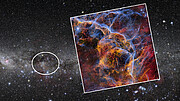
This colorful web of wispy gas filaments is the Vela Supernova Remnant, an expanding nebula of cosmic debris left over from a massive star that exploded about 11,000 years ago. Located around 800 light-years away in the constellation Vela (the Sails), this nebula is one of the nearest supernova remnants to Earth. Though the unnamed star ended its life thousands of years ago, the shockwave its death produced is still propagating into the interstellar medium, carrying glowing tendrils of gas with it.

This image is one of the biggest ever made of this object and was taken with the state-of-the-art wide-field Dark Energy Camera (DECam), built by the Department of Energy and mounted on the US National Science Foundation's Víctor M. Blanco 4-meter Telescope at Cerro Tololo Inter-American Observatory in Chile, a Program of NSF’s NOIRLab. The striking reds, yellows, and blues in this image were achieved through the use of three DECam filters that each collect a specific color of light. Separate images were taken in each filter and then stacked on top of each other to produce this high-resolution color image that showcases the intricate web-like filaments snaking throughout the expanding cloud of gas. This is also the largest DECam image ever released publicly, containing an astounding 1.3 gigapixels [1].

The Vela Supernova Remnant is merely the ghost of a massive star that once was. When the star exploded 11,000 years ago, its outer layers were violently stripped away and flung into the surrounding region, driving the shockwave that is still visible today. As the shockwave expands into the surrounding region, the hot, energized gas flies away from the point of detonation, compressing and interacting with the interstellar medium to produce the stringy blue and yellow filaments seen in the image. The Vela Supernova Remnant is a gigantic structure, spanning almost 100 light-years and extending to twenty times the diameter of the full Moon in the night sky.

Despite the dramatics of the star’s final moments, it wasn’t entirely wiped from existence. After shedding its outer layers, the core of the star collapsed into a neutron star — an ultra-dense ball consisting of protons and electrons that have been smashed together to form neutrons. The neutron star, named the Vela Pulsar, is now an ultra-condensed object with the mass of a star like the Sun contained in a sphere just a few kilometers across. Located in the lower left region of this image, the Vela Pulsar is a relatively dim star that is indistinguishable from its thousands of celestial neighbors. Still reeling from its explosive death, the Vela Pulsar spins rapidly on its own axis and possesses a powerful magnetic field. These properties result in twin beams of radiation that sweep the sky 11 times per second, just like the consistent blips of a rotating lighthouse bulb.

This high-quality image demonstrates the incredible deep and wide capabilities of DECam. From its vantage point in the Chilean Andes, the Blanco telescope receives light that has traveled across the Universe. After entering the telescope’s tube, the light is reflected by a mirror 4-meters (13-feet) wide — a massive, aluminum-coated and precisely shaped piece of glass roughly the weight of a semi-truck. The light is then guided into the optical innards of DECam, passing through a corrective lens nearly a meter (3.3 feet) across before falling on a grid of 62 charge-coupled devices (CCDs), which act like the ‘eyes’ of the camera. The incoming light is then converted into electrical signals which are read out as pixels.

A single image taken with DECam has 570 megapixels, so with multiple exposures stacked on top of one another, the amount of detail that can be captured is truly remarkable. Owing to DECam’s large mosaic of CCDs, astronomers are able to create mesmerizing images of faint astronomical objects, such as the Vela Supernova Remnant, that offer a limitless starscape to explore.


Notes

[1] For comparison, the pixel count of an image taken with the camera in a standard smartphone can range from 12 to 48 megapixels. This image contains a total of 35786 x 35881 pixels, or 1.28 gigapixels.


More information

NSF’s NOIRLab (National Optical-Infrared Astronomy Research Laboratory), the US center for ground-based optical-infrared astronomy, operates the international Gemini Observatory (a facility of NSF, NRC–Canada, ANID–Chile, MCTIC–Brazil, MINCyT–Argentina, and KASI–Republic of Korea), Kitt Peak National Observatory (KPNO), Cerro Tololo Inter-American Observatory (CTIO), the Community Science and Data Center (CSDC), and Vera C. Rubin Observatory (in cooperation with DOE’s SLAC National Accelerator Laboratory). It is managed by the Association of Universities for Research in Astronomy (AURA) under a cooperative agreement with NSF and is headquartered in Tucson, Arizona. The astronomical community is honored to have the opportunity to conduct astronomical research on Iolkam Du’ag (Kitt Peak) in Arizona, on Maunakea in Hawai‘i, and on Cerro Tololo and Cerro Pachón in Chile. We recognize and acknowledge the very significant cultural role and reverence that these sites have to the Tohono O'odham Nation, to the Native Hawaiian community, and to the local communities in Chile, respectively.


Links


Contacts:

Josie Fenske
Jr. Public Information Officer
NSF’s NOIRLab
Email:
josie.fenske@noirlab.edu


Wednesday, March 13, 2024

Cheers! NASA's Webb Finds Ethanol, Other Icy Ingredients for Worlds

Parallel Field to Protostar IRAS 23385 (MIRI Image)
Credits: Image: NASA, ESA, CSA, W.R.M. Rocha (LEI)

Complex Organic Molecules of NGC 1333 IRAS 2A Protostar (MIRI)
Credits: Illustration: NASA, ESA, CSA, Leah Hustak (STScI)


What do margaritas, vinegar, and ant stings have in common? They contain chemical ingredients that NASA’s James Webb Space Telescope has identified surrounding two young protostars known as IRAS 2A and IRAS 23385. Although planets are not yet forming around those stars, these and other molecules detected there by Webb represent key ingredients for making potentially habitable worlds.

An international team of astronomers used Webb’s MIRI (Mid-Infrared Instrument) to identify a variety of icy compounds made up of complex organic molecules like ethanol (alcohol) and likely acetic acid (an ingredient in vinegar). This work builds on previous Webb detections of diverse ices in a cold, dark molecular cloud.

“This finding contributes to one of the long-standing questions in astrochemistry,” said team leader Will Rocha of Leiden University in the Netherlands. “What is the origin of complex organic molecules, or COMs, in space? Are they made in the gas phase or in ices? The detection of COMs in ices suggests that solid-phase chemical reactions on the surfaces of cold dust grains can build complex kinds of molecules.”

As several COMs, including those detected in the solid phase in this research, were previously detected in the warm gas phase, it is now believed that they originate from the sublimation of ices. Sublimation is to change directly from a solid to a gas without becoming a liquid. Therefore, detecting COMs in ices makes astronomers hopeful about improved understanding of the origins of other, even larger molecules in space.

Scientists are also keen to explore to what extent these COMs are transported to planets at much later stages of protostellar evolution. COMs in cold ices are thought to be easier to transport from molecular clouds to planet-forming disks than warm, gaseous molecules. These icy COMs can therefore be incorporated into comets and asteroids, which in turn may collide with forming planets, delivering the ingredients for life to possibly flourish.

The science team also detected simpler molecules, including formic acid (which causes the burning sensation of an ant sting), methane, formaldehyde, and sulfur dioxide. Research suggests that sulfur-containing compounds like sulfur dioxide played an important role in driving metabolic reactions on the primitive Earth.

Of particular interest is that one of the sources investigated, IRAS 2A, is characterized as a low-mass protostar. IRAS 2A may therefore be similar to the early stages of our own solar system. As such, the chemicals identified around this protostar were likely present in the first stages of development of our solar system and later delivered to the primitive Earth.

“All of these molecules can become part of comets and asteroids and eventually new planetary systems when the icy material is transported inward to the planet-forming disk as the protostellar system evolves,” said Ewine van Dishoeck of Leiden University, one of the coordinators of the science program. “We look forward to following this astrochemical trail step-by-step with more Webb data in the coming years.”

These observations were made for the JOYS+ (James Webb Observations of Young ProtoStars) program. The team dedicated these results to team member Harold Linnartz, who unexpectedly passed away in December 2023, shortly after the acceptance of this paper.

This research has been accepted for publication in the journal Astronomy & Astrophysics.

The James Webb Space Telescope is the world's premier space science observatory. Webb is solving mysteries in our solar system, looking beyond to distant worlds around other stars, and probing the mysterious structures and origins of our universe and our place in it. Webb is an international program led by NASA with its partners, ESA (European Space Agency) and the Canadian Space Agency.


About This Release

Credits:

Media Contact:

Bethany Downer
ESA/Webb, Baltimore, Maryland

Christine Pulliam
Space Telescope Science Institute, Baltimore, Maryland

Science: W.R.M. Rocha (LEI)

Permissions: Content Use Policy

Contact Us: Direct inquiries to the News Team.

Related Links and Documents


Tuesday, March 12, 2024

NASA's Webb, Hubble Telescopes Affirm Universe's Expansion Rate, Puzzle Persists

NGC 5468 (Webb NIRCam + Hubble WFC3)
Credits: Image: NASA, ESA, CSA, STScI, Adam G. Riess (JHU, STScI)

Cepheid Variable Star P42 in NGC 5468
Credits: Image: NASA, ESA, CSA, STScI, Adam G. Riess (JHU, STScI)


When you are trying to solve one of the biggest conundrums in cosmology, you should triple check your homework. The puzzle, called the "Hubble Tension," is that the current rate of the expansion of the universe is faster than what astronomers expect it to be, based on the universe's initial conditions and our present understanding of the universe’s evolution.

Scientists using NASA's Hubble Space Telescope and many other telescopes consistently find a number that does not match predictions based on observations from ESA's (European Space Agency's) Planck mission. Does resolving this discrepancy require new physics? Or is it a result of measurement errors between the two different methods used to determine the rate of expansion of space?

Hubble has been measuring the current rate of the universe’s expansion for 30 years, and astronomers want to eliminate any lingering doubt about its accuracy. Now, Hubble and NASA’s James Webb Space Telescope have tag-teamed to produce definitive measurements, furthering the case that something else – not measurement errors – is influencing the expansion rate.

“With measurement errors negated, what remains is the real and exciting possibility we have misunderstood the universe,” said Adam Riess, a physicist at Johns Hopkins University in Baltimore. Riess holds a Nobel Prize for co-discovering the fact that the universe’s expansion is accelerating, due to a mysterious phenomenon now called “dark energy.”

As a crosscheck, an initial Webb observation in 2023 confirmed that Hubble measurements of the expanding universe were accurate. However, hoping to relieve the Hubble Tension, some scientists speculated that unseen errors in the measurement may grow and become visible as we look deeper into the universe. In particular, stellar crowding could affect brightness measurements of more distant stars in a systematic way.

The SH0ES (Supernova H0 for the Equation of State of Dark Energy) team, led by Riess, obtained additional observations with Webb of objects that are critical cosmic milepost markers, known as Cepheid variable stars, which now can be correlated with the Hubble data.

“We’ve now spanned the whole range of what Hubble observed, and we can rule out a measurement error as the cause of the Hubble Tension with very high confidence,” Riess said.

The team’s first few Webb observations in 2023 were successful in showing Hubble was on the right track in firmly establishing the fidelity of the first rungs of the so-called cosmic distance ladder.

Astronomers use various methods to measure relative distances in the universe, depending upon the object being observed. Collectively these techniques are known as the cosmic distance ladder – each rung or measurement technique relies upon the previous step for calibration.

But some astronomers suggested that, moving outward along the “second rung,” the cosmic distance ladder might get shaky if the Cepheid measurements become less accurate with distance. Such inaccuracies could occur because the light of a Cepheid could blend with that of an adjacent star – an effect that could become more pronounced with distance as stars crowd together and become harder to distinguish from one another.

The observational challenge is that past Hubble images of these more distant Cepheid variables look more huddled and overlapping with neighboring stars at ever farther distances between us and their host galaxies, requiring careful accounting for this effect. Intervening dust further complicates the certainty of the measurements in visible light. Webb slices though the dust and naturally isolates the Cepheids from neighboring stars because its vision is sharper than Hubble’s at infrared wavelengths.

“Combining Webb and Hubble gives us the best of both worlds. We find that the Hubble measurements remain reliable as we climb farther along the cosmic distance ladder,” said Riess.

The new Webb observations include five host galaxies of eight Type Ia supernovae containing a total of 1,000 Cepheids, and reach out to the farthest galaxy where Cepheids have been well measured – NGC 5468 – at a distance of 130 million light-years. “This spans the full range where we made measurements with Hubble. So, we've gone to the end of the second rung of the cosmic distance ladder,” said co-author Gagandeep Anand of the Space Telescope Science Institute in Baltimore, which operates the Webb and Hubble telescopes for NASA.

Hubble and Webb’s further confirmation of the Hubble Tension sets up other observatories to possibly settle the mystery. NASA’s upcoming Nancy Grace Roman Space Telescope will do wide celestial surveys to study the influence of dark energy, the mysterious energy that is causing the expansion of the universe to accelerate. ESA's Euclid observatory, with NASA contributions, is pursuing a similar task.

At present it’s as though the distance ladder observed by Hubble and Webb has firmly set an anchor point on one shoreline of a river, and the afterglow of the big bang observed by Planck’s measurement from the beginning of the universe is set firmly on the other side. How the universe’s expansion was changing in the billions of years between these two endpoints has yet to be directly observed. “We need to find out if we are missing something on how to connect the beginning of the universe and the present day,” said Riess.

These findings were published in the February 6, 2024 issue of The Astrophysical Journal Letters.

The Hubble Space Telescope has been operating for over three decades and continues to make ground-breaking discoveries that shape our fundamental understanding of the universe. Hubble is a project of international cooperation between NASA and ESA. NASA's Goddard Space Flight Center in Greenbelt, Maryland, manages the telescope. Goddard also conducts mission operations with Lockheed Martin Space in Denver, Colorado. The Space Telescope Science Institute (STScI) in Baltimore, Maryland, conducts Hubble and Webb science operations for NASA.

The James Webb Space Telescope is the world's premier space science observatory. Webb is solving mysteries in our solar system, looking beyond to distant worlds around other stars, and probing the mysterious structures and origins of our universe and our place in it. Webb is an international program led by NASA with its partners, ESA (European Space Agency) and the Canadian Space Agency.


About This Release

Credits:

Media Contact:

Ray Villard
Space Telescope Science Institute, Baltimore, Maryland

Christine Pulliam
Space Telescope Science Institute, Baltimore, Maryland


Permissions: Content Use Policy

Contact Us: Direct inquiries to the  News Team.

Related Links and Documents


Monday, March 11, 2024

Peering Into the Tendrils of NGC 604 with NASA's Webb

NGC 604 (NIRCam Image)
Credits: Image: NASA, ESA, CSA, STScI

NGC 604 (MIRI Image)
Credits: Image: NASA, ESA, CSA, STScI


The formation of stars and the chaotic environments they inhabit is one of the most well-studied, but also mystery-shrouded, areas of cosmic investigation. The intricacies of these processes are now being unveiled like never before by NASA’s James Webb Space Telescope.

Two new images from Webb’s NIRCam (Near-Infrared Camera) and MIRI (Mid-Infrared Instrument) showcase star-forming region NGC 604, located in the Triangulum galaxy (M33), 2.73 million light-years away from Earth. In these images, cavernous bubbles and stretched-out filaments of gas etch a more detailed and complete tapestry of star birth than seen in the past.

Sheltered among NGC 604’s dusty envelopes of gas are more than 200 of the hottest, most massive kinds of stars, all in the early stages of their lives. These types of stars are B-types and O-types, the latter of which can be more than 100 times the mass of our own Sun. It’s quite rare to find this concentration of them in the nearby universe. In fact, there’s no similar region within our own Milky Way galaxy.

This concentration of massive stars, combined with its relatively close distance, means NGC 604 gives astronomers an opportunity to study these objects at a fascinating time early in their life.

In Webb’s near-infrared NIRCam image, the most noticeable features are tendrils and clumps of emission that appear bright red, extending out from areas that look like clearings, or large bubbles in the nebula. Stellar winds from the brightest and hottest young stars have carved out these cavities, while ultraviolet radiation ionizes the surrounding gas. This ionized hydrogen appears as a white and blue ghostly glow.

The bright orange-colored streaks in the Webb near-infrared image signify the presence of carbon-based molecules known as polycyclic aromatic hydrocarbons, or PAHs. This material plays an important role in the interstellar medium and the formation of stars and planets, but its origin is a mystery. As you travel farther from the immediate clearings of dust, the deeper red signifies molecular hydrogen. This cooler gas is a prime environment for star formation.

Webb’s exquisite resolution also provides insights into features that previously appeared unrelated to the main cloud. For example, in Webb’s image, there are two bright, young stars carving out holes in dust above the central nebula, connected through diffuse red gas. In visible-light imaging from NASA’s Hubble Space Telescope, these appeared as separate splotches.

Webb’s view in mid-infrared wavelengths also illustrates a new perspective into the diverse and dynamic activity of this region. In the MIRI view of NGC 604, there are noticeably fewer stars. This is because hot stars emit much less light at these wavelengths, while the larger clouds of cooler gas and dust glow. Some of the stars seen in this image, belonging to the surrounding galaxy, are red supergiants – stars that are cool but very large, hundreds of times the diameter of our Sun. Additionally, some of the background galaxies that appeared in the NIRCam image also fade. In the MIRI image, the blue tendrils of material signify the presence of PAHs.

NGC 604 is estimated to be around 3.5 million years old. The cloud of glowing gases extends to some 1,300 light-years across.

The James Webb Space Telescope is the world's premier space science observatory. Webb is solving mysteries in our solar system, looking beyond to distant worlds around other stars, and probing the mysterious structures and origins of our universe and our place in it. Webb is an international program led by NASA with its partners, ESA (European Space Agency) and the Canadian Space Agency.


About This Release

Credits:

Media Contact:

Hannah Braun
Space Telescope Science Institute, Baltimore, Maryland

Christine Pulliam
Space Telescope Science Institute, Baltimore, Maryland

Permissions: Content Use Policy

Contact Us: Direct inquiries to the News Team.


Sunday, March 10, 2024

What Are Hubble and Webb Observing Right Now? NASA Tool Has the Answer

NASA's Hubble Space Telescope/NASA's James Webb Space Telescope


It’s not hard to find out what NASA’s Hubble and James Webb space telescopes have observed in the past. Barely a week goes by without news of a cosmic discovery made possible using images, spectra, and other data captured by NASA’s prolific astronomical observatories.

But what are Hubble and Webb looking at right this minute? A shadowy pillar harboring nascent stars? A pair of colliding galaxies? The atmosphere of a distant planet? Galactic light, stretched and distorted on a 13-billion-year journey across space?

NASA’s Space Telescope Live, a web application originally developed in 2016 to deliver real-time updates on Hubble targets, now affords easy access to up-to-date information on current, past, and upcoming observations from both Hubble and Webb.

Designed and developed for NASA by the Space Telescope Science Institute in Baltimore, this exploratory tool offers the public a straightforward and engaging way to learn more about how astronomical investigations are carried out.

With its redesigned user interface and expanded functionality, users can find out not only what planet, star, nebula, galaxy, or region of deep space each telescope is observing at the moment, but also where exactly these targets are in the sky; what scientific instruments are being used to capture the images, spectra, and other data; precisely when and how long the observations are scheduled to occur; the status of the observation; who is leading the research; and most importantly, what the scientists are trying to find out.

Information for observations from approved science programs is available via the Mikulski Archive for Space Telescopes. NASA’s Space Telescope Live offers easy access to this information – not only the current day’s targets, but the entire catalog of past observations as well – with Webb records dating back to its first commissioning targets in January 2022, and Hubble records all the way back to the beginning of its operations in May 1990.

The zoomable sky map centered on the target’s location was developed using the Aladin Sky Atlas, with imagery from ground-based telescopes to provide context for the observation. (Because the Hubble and Webb data must go through preliminary processing, and in many cases preliminary analysis, before being released to the public and astronomy community, real-time imagery is not available in this tool for either telescope.)

Details such as target name and coordinates, scheduled start and end times, and the research topic, are pulled directly from the observation scheduling and proposal planning databases. Links within the tool direct users to the original research proposal, which serves as a gateway to more technical information.

While this latest version of NASA’s Space Telescope Live constitutes a significant transformation from the previous release, the team is already gathering feedback from users and planning additional enhancements to provide opportunities for deeper exploration and understanding.

NASA’s Space Telescope Live is designed to work on desktop and mobile devices, and is accessible via NASA’s official Hubble and Webb websites. Additional details about the content, including public-friendly explanations of the information displayed in the tool, can be found in the User Guide.

The James Webb Space Telescope is the world's premier space science observatory. Webb is solving mysteries in our solar system, looking beyond to distant worlds around other stars, and probing the mysterious structures and origins of our universe and our place in it. Webb is an international program led by NASA with its partners, ESA (European Space Agency) and the Canadian Space Agency.

The Hubble Space Telescope has been operating for over three decades and continues to make ground-breaking discoveries that shape our fundamental understanding of the universe. Hubble is a project of international cooperation between NASA and ESA. NASA's Goddard Space Flight Center in Greenbelt, Maryland, manages the telescope. Goddard also conducts mission operations with Lockheed Martin Space in Denver, Colorado. The Space Telescope Science Institute (STScI) in Baltimore, Maryland, conducts Hubble and Webb science operations for NASA.


About This Release

Credits:

Media Contact:

Margaret W. Carruthers
Space Telescope Science Institute, Baltimore, Maryland

Christine Pulliam
Space Telescope Science Institute, Baltimore, Maryland

Permissions: Content Use Policy

Contact Us: Direct inquiries to the News Team.

Related Links and Documents


Saturday, March 09, 2024

Featured Image: Minidisks in Massive Binaries


From millions of light-years away, how can we tell if a galaxy contains one supermassive black hole or two? It’s a tricky problem: the gas around single supermassive black holes glows across the electromagnetic spectrum and varies on timescales from hours to years, and it’s not obvious how adding a second black hole changes these behaviors. As a step toward differentiating the two scenarios, a team led by John Ryan Westernacher-Schneider (Leiden University and Clemson University) simulated the gas surrounding pairs of black holes. When binary black hole systems ensnare gas from their surroundings, the gas collects in a large accretion disk around both black holes and in smaller disks around the individual black holes. These smaller disks are called minidisks. Each frame above shows a simulated minidisk with different physical parameters. Because of instabilities, the simulated minidisks sometimes become extremely elongated, and if future work suggests that this elongation is likely to happen in real disks, it may provide a way to interpret variations in the light from distant sources and pinpoint binary black holes. To learn more about these minidisk simulations, be sure to check out the full article linked below.

By Kerry Hensley

Citation

“Eccentric Minidisks in Accreting Binaries,” John Ryan Westernacher-Schneider et al 2024 ApJ962 76.
doi:10.3847/1538-4357/ad1a17