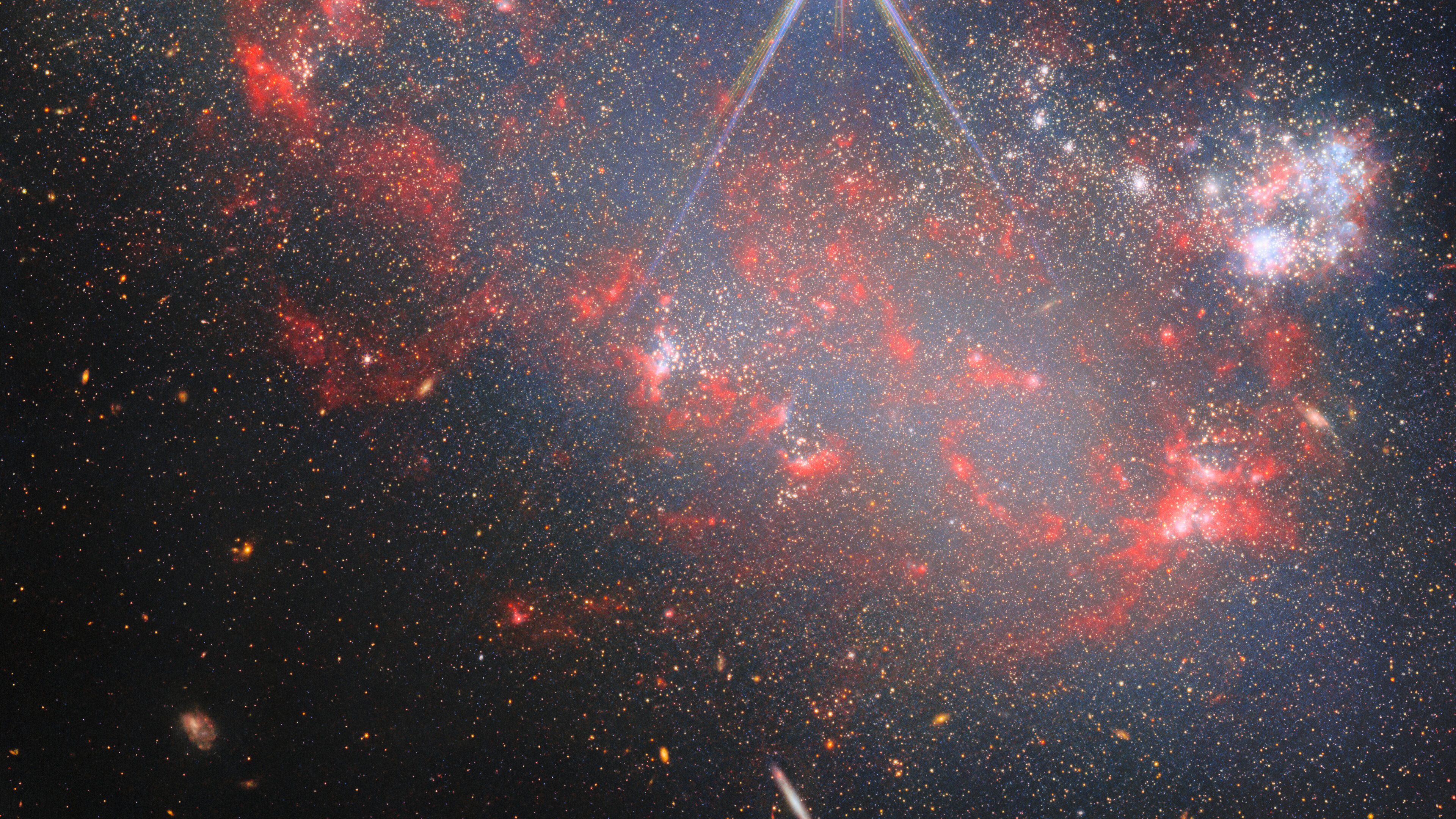
An irregular galaxy, appearing like a broad band of tiny stars. It is denser on one side, with a faint cloud of gas among the stars. Clumps of brighter points are newly formed stars, with the largest lights being star clusters, and with many surrounded in glowing blue gas clouds. Plumes of red dust surround the galaxy. A foreground star appears very large and bright. A few distant alaxies appear in the background. Credit: ESA/Webb, NASA & CSA, A. Leroy
The latest ESA/Webb Picture of the Month is a new, infrared look into the strange final phase of a galactic merger. Arp 263, an irregular galaxy, lies in the constellation Leo at a relatively nearby distance of around 25 million light-years.
Originally discovered in 1784 and also catalogued as NGC 3239, this galaxy was included in American astronomer Halton Arp’s Atlas of Peculiar Galaxies in 1966, as possibly one of the most remarkable and strange galaxies in the sample. Arp categorised it with the galaxies featuring “irregular clumps”. In 2023, the galaxy was featured in an image from the NASA/ESA Hubble Space Telescope, where these clumps are revealed to be bright nebulae between the galaxy’s dense clouds of gas, where stars are forming.
Arp 263 is believed to result from a past galactic merger. Apart from its unusual distorted shape, astronomers have noticed a few features that point to this. It has two short, curved tails of stars, beyond the field of view of this Webb image, which are a feature that’s associated with gravitational interactions. However, there are no nearby galaxies that Arp 263 could be interacting with now. The stars in the galaxy are oriented differently to its hydrogen gas, where they would normally be symmetric, and parts of that gas are moving at different velocities to each other. And, of course, the widespread formation of new stars across Arp 263 is typical of a galaxy whose gas has been seriously shaken up.
Although Arp 263 clearly hasn’t yet settled into a more regular shape after its gravitational tug-of-war, its former companion galaxy is now nowhere to be found. It’s possible that this was a dwarf galaxy small enough to have been already completely dissolved into the larger Arp 263 — or that its companion was simply much more heavy than it was bright, making it difficult to spot as a remnant.
This new image from Webb’s Near-Infrared Camera (NIRCam) reveals an entirely different view of Arp 263, taking us inside the thick gas crowding the galaxy to see the many stars scattered there. These old stars contrast with the several areas of star birth, where multitudes of new stars are forming in numerous clusters. Dust spread throughout the galaxy glows with the light, here shown in red, emitted by complex molecules; around the star-forming regions we also see — in blue colours — hydrogen gas, ionised by starlight and emitting its own light in turn. The most intense area of star formation features a curved chain of compact star clusters, leading to the largest and brightest star-forming nebula. Webb allows us to peek into this stellar nursery and see the stars that have formed within.
The brightest of the bright spots in Arp 263 is a shining star, named BD+17 2217. It appears so large and bright, with long diffraction spikes created by the telescope’s optics, because it is part of our own galaxy. The galaxies that appear in the background are much more distant, most hundreds of millions of light-years away from both us and Arp 263. A few of these galaxies are identifiable as spiral galaxies, but Webb’s NIRCam reveals the hundreds of much more distant galaxies lurking in the background as orange dots.Arp 263
This image was made with data from observing programme #3707 (PI: Leroy), a survey of the nearby, large, star-forming galaxies in the southern sky. These galaxies are close enough that Webb’s sharp vision can deliver a detailed picture of the stars, star clusters and interstellar dust within the galaxy. The observations will be used to better understand the cycle of star formation and how it plays out across galaxies; Arp 263, with its disturbed disc of gas and its chaotic star formation, presents a unique and fascinating target for these investigations.
Links
The latest ESA/Webb Picture of the Month is a new, infrared look into the strange final phase of a galactic merger. Arp 263, an irregular galaxy, lies in the constellation Leo at a relatively nearby distance of around 25 million light-years.
Originally discovered in 1784 and also catalogued as NGC 3239, this galaxy was included in American astronomer Halton Arp’s Atlas of Peculiar Galaxies in 1966, as possibly one of the most remarkable and strange galaxies in the sample. Arp categorised it with the galaxies featuring “irregular clumps”. In 2023, the galaxy was featured in an image from the NASA/ESA Hubble Space Telescope, where these clumps are revealed to be bright nebulae between the galaxy’s dense clouds of gas, where stars are forming.
Arp 263 is believed to result from a past galactic merger. Apart from its unusual distorted shape, astronomers have noticed a few features that point to this. It has two short, curved tails of stars, beyond the field of view of this Webb image, which are a feature that’s associated with gravitational interactions. However, there are no nearby galaxies that Arp 263 could be interacting with now. The stars in the galaxy are oriented differently to its hydrogen gas, where they would normally be symmetric, and parts of that gas are moving at different velocities to each other. And, of course, the widespread formation of new stars across Arp 263 is typical of a galaxy whose gas has been seriously shaken up.
Although Arp 263 clearly hasn’t yet settled into a more regular shape after its gravitational tug-of-war, its former companion galaxy is now nowhere to be found. It’s possible that this was a dwarf galaxy small enough to have been already completely dissolved into the larger Arp 263 — or that its companion was simply much more heavy than it was bright, making it difficult to spot as a remnant.
This new image from Webb’s Near-Infrared Camera (NIRCam) reveals an entirely different view of Arp 263, taking us inside the thick gas crowding the galaxy to see the many stars scattered there. These old stars contrast with the several areas of star birth, where multitudes of new stars are forming in numerous clusters. Dust spread throughout the galaxy glows with the light, here shown in red, emitted by complex molecules; around the star-forming regions we also see — in blue colours — hydrogen gas, ionised by starlight and emitting its own light in turn. The most intense area of star formation features a curved chain of compact star clusters, leading to the largest and brightest star-forming nebula. Webb allows us to peek into this stellar nursery and see the stars that have formed within.
The brightest of the bright spots in Arp 263 is a shining star, named BD+17 2217. It appears so large and bright, with long diffraction spikes created by the telescope’s optics, because it is part of our own galaxy. The galaxies that appear in the background are much more distant, most hundreds of millions of light-years away from both us and Arp 263. A few of these galaxies are identifiable as spiral galaxies, but Webb’s NIRCam reveals the hundreds of much more distant galaxies lurking in the background as orange dots.Arp 263
This image was made with data from observing programme #3707 (PI: Leroy), a survey of the nearby, large, star-forming galaxies in the southern sky. These galaxies are close enough that Webb’s sharp vision can deliver a detailed picture of the stars, star clusters and interstellar dust within the galaxy. The observations will be used to better understand the cycle of star formation and how it plays out across galaxies; Arp 263, with its disturbed disc of gas and its chaotic star formation, presents a unique and fascinating target for these investigations.
Source: ESA/Webb/potm
Links