Friday, March 08, 2024

A matter of perspective

A broad spiral galaxy is seen edge-on, so that its spiral arms can’t be seen. Visible dust and stars trace the disc of the galaxy, surrounded by a glowing halo above and below. The colour of the galaxy changes smoothly between the outer disc at the ends and the bulge in the centre. A few bright stars surround the galaxy on a dark background. Credit: ESA/Hubble & NASA, M. Sun

Here we see NGC 4423, a galaxy that lies about 55 million light-years away in the constellation Virgo. In this image NGC 4423 appears to have quite an irregular, tubular form, so it might be surprising to find out that it is in fact a spiral galaxy. Knowing this, we can make out the denser central bulge of the galaxy, and the less crowded surrounding disc (the part that comprises the spiral arms).

If NGC 4423 were viewed face-on it would resemble the shape that we most associate with spiral galaxies: the spectacular curving arms sweeping out from a bright centre, interspersed with dimmer, darker, less populated regions. But when observing the skies we are constrained by the relative alignments between Earth and the objects that we are observing: we cannot simply reposition Earth so that we can get a better face-on view of NGC 4423!

Of course, celestial objects do not remain sedentary in space, but often move at extremely rapid velocities relative to one another. This might suggest that, should a galaxy be moving in a fortuitous direction relative to Earth, we might be able to view it from a substantially different perspective once it has moved far enough. This is theoretically possible, but the reality is that the distances in space are simply far too big, and human lifetimes far too short, for a noticeable difference in relative alignment to occur. In other words, this is more-or-less the view of NGC 4423 that we will always have!


Thursday, March 07, 2024

Groundbreaking survey reveals secrets of planet birth around dozens of stars

PR Image eso2405a
Planet-forming discs in three clouds of the Milky Way

PR Image eso2405b
Planet-forming discs in the Orion cloud

PR Image eso2405c
Planet-forming discs in the Taurus cloud

PR Image eso2405d
Planet-forming discs in the Chamaeleon cloud

PR Image eso2405e
The MWC 758 planet-forming disc as seen by SPHERE and ALMA


Videos

Survey reveals secrets of planet birth around dozens of stars | ESOcast Light


In a series of studies, a team of astronomers has shed new light on the fascinating and complex process of planet formation. The stunning images, captured using the European Southern Observatory's Very Large Telescope (ESO’s VLT) in Chile, represent one of the largest ever surveys of planet-forming discs. The research brings together observations of more than 80 young stars that might have planets forming around them, providing astronomers with a wealth of data and unique insights into how planets arise in different regions of our galaxy.

“This is really a shift in our field of study,” says Christian Ginski, a lecturer at the University of Galway, Ireland, and lead author of one of three new papers published today in Astronomy & Astrophysics. “We’ve gone from the intense study of individual star systems to this huge overview of entire star-forming regions.”

To date more than 5000 planets have been discovered orbiting stars other than the Sun, often within systems markedly different from our own Solar System. To understand where and how this diversity arises, astronomers must observe the dust- and gas-rich discs that envelop young stars — the very cradles of planet formation. These are best found in huge gas clouds where the stars themselves are forming.

Much like mature planetary systems, the new images showcase the extraordinary diversity of planet-forming discs. “Some of these discs show huge spiral arms, presumably driven by the intricate ballet of orbiting planets,” says Ginski. “Others show rings and large cavities carved out by forming planets, while yet others seem smooth and almost dormant among all this bustle of activity,” adds Antonio Garufi, an astronomer at the Arcetri Astrophysical Observatory, Italian National Institute for Astrophysics (INAF), and lead author of one of the papers.

The team studied a total of 86 stars across three different star-forming regions of our galaxy: Taurus and Chamaeleon I, both around 600 light-years from Earth, and Orion, a gas-rich cloud about 1600 light-years from us that is known to be the birthplace of several stars more massive than the Sun. The observations were gathered by a large international team, comprising scientists from more than 10 countries.

The team was able to glean several key insights from the dataset. For example, in Orion they found that stars in groups of two or more were less likely to have large planet-forming discs. This is a significant result given that, unlike our Sun, most stars in our galaxy have companions. As well as this, the uneven appearance of the discs in this region suggests the possibility of massive planets embedded within them, which could be causing the discs to warp and become misaligned.

While planet-forming discs can extend for distances hundreds of times greater than the distance between Earth and the Sun, their location several hundreds of light-years from us makes them appear as tiny pinpricks in the night sky. To observe the discs, the team employed the sophisticated Spectro-Polarimetric High-contrast Exoplanet REsearch instrument (SPHERE) mounted on ESO’s VLT. SPHERE’s state-of-the-art extreme adaptive optics system corrects for the turbulent effects of Earth’s atmosphere, yielding crisp images of the discs. This meant the team were able to image discs around stars with masses as low as half the mass of the Sun, which are typically too faint for most other instruments available today. Additional data for the survey were obtained using the VLT’s X-shooter instrument, which allowed astronomers to determine how young and how massive the stars are. The Atacama Large Millimeter/submillimeter Array (ALMA), in which ESO is a partner, on the other hand, helped the team understand more about the amount of dust surrounding some of the stars.

As technology advances, the team hopes to delve even deeper into the heart of planet-forming systems. The large 39-metre mirror of ESO’s forthcoming Extremely Large Telescope (ELT), for example, will enable the team to study the innermost regions around young stars, where rocky planets like our own might be forming.

For now, these spectacular images provide researchers with a treasure trove of data to help unpick the mysteries of planet formation. “It is almost poetic that the processes that mark the start of the journey towards forming planets and ultimately life in our own Solar System should be so beautiful,” concludes Per-Gunnar Valegård, a doctoral student at the University of Amsterdam, the Netherlands, who led the Orion study. Valegård, who is also a part-time teacher at the International School Hilversum in the Netherlands, hopes the images will inspire his pupils to become scientists in the future.

Source: ESO/News


More information

This research was presented in three papers to appear in Astronomy & Astrophysics. The data presented were gathered as part of the SPHERE consortium guaranteed time programme, as well as the DESTINYS (Disk Evolution Study Through Imaging of Nearby Young Stars) ESO Large Programme.
  1. “The SPHERE view of the Chamaeleon I star-forming region: The full census of planet-forming disks with GTO and DESTINYS programs” (https://www.aanda.org/10.1051/0004-6361/202244005)

The team is composed of C. Ginski (University of Galway, Ireland; Leiden Observatory, Leiden University, the Netherlands [Leiden]; Anton Pannekoek Institute for Astronomy, University of Amsterdam, the Netherlands [API]), R. Tazaki (API), M. Benisty (Univ. Grenoble Alpes, CNRS, IPAG, France [Grenoble]), A. Garufi (INAF, Osservatorio Astrofisico di Arcetri, Italy), C. Dominik (API), Á. Ribas (European Southern Observatory, Chile [ESO Chile]), N. Engler (ETH Zurich, Institute for Particle Physics and Astrophysics, Switzerland), J. Hagelberg (Geneva Observatory, University of Geneva, Switzerland), R. G. van Holstein (ESO Chile), T. Muto (Division of Liberal Arts, Kogakuin University, Japan), P. Pinilla (Max-Planck-Institut für Astronomie, Germany [MPIA]; Mullard Space Science Laboratory, University College London, UK), K. Kanagawa (Department of Earth and Planetary Sciences, Tokyo Institute of Technology, Japan), S. Kim (Department of Astronomy, Tsinghua University, China), N. Kurtovic (MPIA), M. Langlois (Centre de Recherche Astrophysique de Lyon, CNRS, UCBL, France), J. Milli (Grenoble), M. Momose (College of Science, Ibaraki University, Japan [Ibaraki]), R. Orihara (Ibaraki), N. Pawellek (Department of Astrophysics, University of Vienna, Austria), T. O. B. Schmidt (Hamburger Sternwarte, Germany), F. Snik (Leiden), and Z. Wahhaj (ESO Chile).
  1. “The SPHERE view of the Taurus star-forming region: The full census of planet-forming disks with GTO and DESTINYS programs” (https://www.aanda.org/10.1051/0004-6361/202347586)

The team is composed of A. Garufi (INAF, Osservatorio Astrofisico di Arcetri, Italy [INAF Arcetri]), C. Ginski (University of Galway, Ireland), R. G. van Holstein (European Southern Observatory, Chile [ESO Chile]), M. Benisty (Laboratoire Lagrange, Université Côte d’Azur, Observatoire de la Côte d’Azur, CNRS, France; Univ. Grenoble Alpes, CNRS, IPAG, France [Grenoble]), C. F. Manara (European Southern Observatory, Germany), S. Pérez (Millennium Nucleus on Young Exoplanets and their Moons [YEMS]; Departamento de Física, Universidad de Santiago de Chile, Chile [Santiago]), P. Pinilla (Mullard Space Science Laboratory, University College London, UK), A. Ribas (Institute of Astronomy, University of Cambridge, UK), P. Weber (YEMS, Santiago), J. Williams (Institute for Astronomy, University of Hawai‘i, USA), L. Cieza (Instituto de Estudios Astrofísicos, Facultad de Ingeniería y Ciencias, Universidad Diego Portales, Chile [Diego Portales]; YEMS), C. Dominik (Anton Pannekoek Institute for Astronomy, University of Amsterdam, the Netherlands [API]), S. Facchini (Dipartimento di Fisica, Università degli Studi di Milano, Italy), J. Huang (Department of Astronomy, Columbia University, USA), A. Zurlo (Diego Portales; YEMS), J. Bae (Department of Astronomy, University of Florida, USA), J. Hagelberg (Observatoire de Genève, Université de Genève, Switzerland), Th. Henning (Max Planck Institute for Astronomy, Germany [MPIA]), M. R. Hogerheijde (Leiden Observatory, Leiden University, the Netherlands; API), M. Janson (Department of Astronomy, Stockholm University, Sweden), F. Ménard (Grenoble), S. Messina (INAF - Osservatorio Astrofisico di Catania, Italy), M. R. Meyer (Department of Astronomy, The University of Michigan, USA), C. Pinte (School of Physics and Astronomy, Monash University, Australia; Grenoble), S. Quanz (ETH Zürich, Department of Physics, Switzerland [Zürich]), E. Rigliaco (Osservatorio Astronomico di Padova, Italy [Padova]), V. Roccatagliata (INAF Arcetri), H. M. Schmid (Zürich), J. Szulágyi (Zürich), R. van Boekel (MPIA), Z. Wahhaj (ESO Chile), J. Antichi (INAF Arcetri), A. Baruffolo (Padova), and T. Moulin (Grenoble).
  1. “Disk Evolution Study Through Imaging of Nearby Young Stars (DESTINYS): The SPHERE view of the Orion star-forming region” (https://www.aanda.org/10.1051/0004-6361/202347452)

The team is composed of P.-G. Valegård (Anton Pannekoek Institute for Astronomy, University of Amsterdam, the Netherlands [API]), C. Ginski (University of Galway, Ireland), A. Derkink (API), A. Garufi (INAF, Osservatorio Astrofisico di Arcetri, Italy), C. Dominik (API), Á. Ribas (Institute of Astronomy, University of Cambridge, UK), J. P. Williams (Institute for Astronomy, University of Hawai‘i, USA), M. Benisty (University of Grenoble Alps, CNRS, IPAG, France), T. Birnstiel (University Observatory, Faculty of Physics, Ludwig-Maximilians-Universität München, Germany [LMU]; Exzellenzcluster ORIGINS, Germany), S. Facchini (Dipartimento di Fisica, Università degli Studi di Milano, Italy), G. Columba (Department of Physics and Astronomy "Galileo Galilei" - University of Padova, Italy; INAF – Osservatorio Astronomico di Padova, Italy), M. Hogerheijde (API; Leiden Observatory, Leiden University, the Netherlands [Leiden]), R. G. van Holstein (European Southern Observatory, Chile), J. Huang (Department of Astronomy, Columbia University, USA), M. Kenworthy (Leiden), C. F. Manara (European Southern Observatory, Germany), P. Pinilla (Mullard Space Science Laboratory, University College London, UK), Ch. Rab (LMU; Max-Planck-Institut für extraterrestrische Physik, Germany), R. Sulaiman (Department of Physics, American University of Beirut, Lebanon), A. Zurlo (Instituto de Estudios Astrofísicos, Facultad de Ingeniería y Ciencias, Universidad Diego Portales, Chile; Escuela de Ingeniería Industrial, Facultad de Ingeniería y Ciencias, Universidad Diego Portales, Chile; Millennium Nucleus on Young Exoplanets and their Moons).

The European Southern Observatory (ESO) enables scientists worldwide to discover the secrets of the Universe for the benefit of all. We design, build and operate world-class observatories on the ground — which astronomers use to tackle exciting questions and spread the fascination of astronomy — and promote international collaboration for astronomy. Established as an intergovernmental organisation in 1962, today ESO is supported by 16 Member States (Austria, Belgium, Czechia, Denmark, France, Finland, Germany, Ireland, Italy, the Netherlands, Poland, Portugal, Spain, Sweden, Switzerland and the United Kingdom), along with the host state of Chile and with Australia as a Strategic Partner. ESO’s headquarters and its visitor centre and planetarium, the ESO Supernova, are located close to Munich in Germany, while the Chilean Atacama Desert, a marvellous place with unique conditions to observe the sky, hosts our telescopes. ESO operates three observing sites: La Silla, Paranal and Chajnantor. At Paranal, ESO operates the Very Large Telescope and its Very Large Telescope Interferometer, as well as survey telescopes such as VISTA. Also at Paranal ESO will host and operate the Cherenkov Telescope Array South, the world’s largest and most sensitive gamma-ray observatory. Together with international partners, ESO operates ALMA on Chajnantor, a facility that observes the skies in the millimetre and submillimetre range. At Cerro Armazones, near Paranal, we are building “the world’s biggest eye on the sky” — ESO’s Extremely Large Telescope. From our offices in Santiago, Chile we support our operations in the country and engage with Chilean partners and society.

The Atacama Large Millimeter/submillimeter Array (ALMA), an international astronomy facility, is a partnership of ESO, the U.S. National Science Foundation (NSF) and the National Institutes of Natural Sciences (NINS) of Japan in cooperation with the Republic of Chile. ALMA is funded by ESO on behalf of its Member States, by NSF in cooperation with the National Research Council of Canada (NRC) and the National Science and Technology Council (NSTC) in Taiwan and by NINS in cooperation with the Academia Sinica (AS) in Taiwan and the Korea Astronomy and Space Science Institute (KASI). ALMA construction and operations are led by ESO on behalf of its Member States; by the National Radio Astronomy Observatory (NRAO), managed by Associated Universities, Inc. (AUI), on behalf of North America; and by the National Astronomical Observatory of Japan (NAOJ) on behalf of East Asia. The Joint ALMA Observatory (JAO) provides the unified leadership and management of the construction, commissioning and operation of ALMA.


Links


Contacts

Christian Ginski
University of Galway
Galway, Ireland
Email:
christian.ginski@universityofgalway.ie

Antonio Garufi
INAF’s Arcetri Astrophysical Observatory
Florence, Italy
Email:
antonio.garufi@inaf.it

Per-Gunnar Valegård
University of Amsterdam
Email:
p.g.valegard@uva.nl

Bárbara Ferreira
ESO Media Manager
Garching bei München, Germany
Tel: +49 89 3200 6670
Cell: +49 151 241 664 00
Email:
press@eso.org


Wednesday, March 06, 2024

Webb Unlocks Secrets of One of the Most Distant Galaxies Ever Seen

GOODS-North Field (NIRCam Image)
Credits: Image: NASA, ESA, CSA, STScI, Brant Robertson (UC Santa Cruz), Ben Johnson (CfA), Sandro Tacchella (Cambridge), Marcia Rieke (University of Arizona), Daniel Eisenstein (CfA)

Pristine Gas Clump Near GN-z11
Credits: Illustration: NASA, ESA, CSA, Ralf Crawford (STScI)


Looking deeply into space and time, two teams using NASA’s James Webb Space Telescope have studied the exceptionally luminous galaxy GN-z11, which existed when our 13.8 billion-year-old universe was only about 430 million years old.

Initially detected with NASA’s Hubble Space Telescope, this galaxy — one of the youngest and most distant ever observed — is so bright that it is challenging scientists to understand why. Now, GN-z11 is giving up some of its secrets.

Vigorous Black Hole Is Most Distant Ever Found

A team studying GN-z11 with Webb found the first clear evidence that the galaxy is hosting a central, supermassive black hole that is rapidly accreting matter. Their finding makes this the farthest active supermassive black hole spotted to date.

“We found extremely dense gas that is common in the vicinity of supermassive black holes accreting gas,” explained principal investigator Roberto Maiolino of the Cavendish Laboratory and the Kavli Institute of Cosmology at the University of Cambridge in the United Kingdom. “These were the first clear signatures that GN-z11 is hosting a black hole that is gobbling matter.”

Using Webb, the team also found indications of ionized chemical elements typically observed near accreting supermassive black holes. Additionally, they discovered a very powerful wind being expelled by the galaxy. Such high-velocity winds are typically driven by processes associated with vigorously accreting supermassive black holes.

“Webb’s NIRCam (Near-Infrared Camera) has revealed an extended component, tracing the host galaxy, and a central, compact source whose colors are consistent with those of an accretion disk surrounding a black hole,” said investigator Hannah Übler, also of the Cavendish Laboratory and the Kavli Institute.

Together, this evidence shows that GN-z11 hosts a 2-million-solar-mass, supermassive black hole in a very active phase of consuming matter, which is why it's so luminous.

Pristine Gas Clump in GN-z11’s Halo Intrigues Researchers

A second team, also led by Maiolino, used Webb’s NIRSpec (Near-Infrared Spectrograph) to find a gaseous clump of helium in the halo surrounding GN-z11.

“The fact that we don't see anything else beyond helium suggests that this clump must be fairly pristine,” said Maiolino. “This is something that was expected by theory and simulations in the vicinity of particularly massive galaxies from these epochs — that there should be pockets of pristine gas surviving in the halo, and these may collapse and form Population III star clusters.”

Finding the never-before-seen Population III stars — the first generation of stars formed almost entirely from hydrogen and helium — is one of the most important goals of modern astrophysics. These stars are anticipated to be very massive, very luminous, and very hot. Their expected signature is the presence of ionized helium and the absence of chemical elements heavier than helium.

The formation of the first stars and galaxies marks a fundamental shift in cosmic history, during which the universe evolved from a dark and relatively simple state into the highly structured and complex environment we see today.

In future Webb observations, Maiolino, Übler, and their team will explore GN-z11 in greater depth, and they hope to strengthen the case for the Population III stars that may be forming in its halo.

The research on the pristine gas clump in GN-z11’s halo has been accepted for publication by Astronomy & Astrophysics. The results of the study of GN-z11’s black hole were published in the journal Nature on January 17, 2024. The data was obtained as part of the JWST Advanced Deep Extragalactic Survey (JADES), a joint project between the NIRCam and NIRSpec teams.

The James Webb Space Telescope is the world’s premier space science observatory. Webb is solving mysteries in our solar system, looking beyond to distant worlds around other stars, and probing the mysterious structures and origins of our universe and our place in it. Webb is an international program led by NASA with its partners, ESA (European Space Agency) and the Canadian Space Agency.


About This Release

Credits:

Media Contact:

Ann Jenkins
Space Telescope Science Institute, Baltimore, Maryland

Christine Pulliam
Space Telescope Science Institute, Baltimore, Maryland

Permissions: Content Use Policy

Contact Us: Direct inquiries to the News Team.

Related Links and Documents


Tuesday, March 05, 2024

Astronomers Measure Heaviest Black Hole Pair Ever Found

PR Image noirlab2405a
Artist’s Impression of Heaviest Supermassive Binary Black Hole


Data from Gemini North provide possible explanation for supermassive binary black hole’s halted merger

Using archival data from the Gemini North telescope, a team of astronomers have measured the heaviest pair of supermassive black holes ever found. The merging of two supermassive black holes is a phenomenon that has long been predicted, though never observed. This massive pair gives clues as to why such an event seems so unlikely in the Universe.

Nearly every massive galaxy hosts a supermassive black hole at its center. When two galaxies merge, their black holes can form a binary pair, meaning they are in a bound orbit with one another. It’s hypothesized that these binaries are fated to eventually merge, but this has never been observed [1]. The question of whether such an event is possible has been a topic of discussion amongst astronomers for decades. In a recently published paper in The Astrophysical Journal, a team of astronomers have presented new insight into this question.

The team used data from the Gemini North telescope in Hawai‘i, one half of the International Gemini Observatory operated by NSF’s NOIRLab, which is funded by the U.S. National Science Foundation, to analyze a supermassive black hole binary located within the elliptical galaxy B2 0402+379. This is the only supermassive black hole binary ever resolved in enough detail to see both objects separately [2], and it holds the record for having the smallest separation ever directly measured — a mere 24 light-years [3]. While this close separation foretells a powerful merger, further study revealed that the pair has been stalled at this distance for over three billion years, begging the question; what’s the hold-up?

To better understand the dynamics of this system and its halted merger the team looked to archival data from Gemini North’s Gemini Multi-Object Spectrograph (GMOS), which allowed them to determine the speed of the stars within the vicinity of the black holes. “The excellent sensitivity of GMOS allowed us to map the stars’ increasing velocities as one looks closer to the galaxy’s center,” said Roger Romani, Stanford University physics professor and co-author of the paper. “With that, we were able to infer the total mass of the black holes residing there.”

The team estimates the binary’s mass to be a whopping 28 billion times that of the Sun, qualifying the pair as the heaviest binary black hole ever measured. Not only does this measurement give valuable context to the formation of the binary system and the history of its host galaxy, but it supports the long-standing theory that the mass of a supermassive binary black hole plays a key role in stalling a potential merger [4].

“The data archive serving the International Gemini Observatory holds a gold mine of untapped scientific discovery," says Martin Still, NSF program director for the International Gemini Observatory. "Mass measurements for this extreme supermassive binary black hole are an awe-inspiring example of the potential impact from new research that explores that rich archive.”

Understanding how this binary formed can help predict if and when it will merge — and a handful of clues point to the pair forming via multiple galaxy mergers. The first is that B2 0402+379 is a ‘fossil cluster,’ meaning it is the result of an entire galaxy cluster’s worth of stars and gas merging into one single massive galaxy. Additionally, the presence of two supermassive black holes, coupled with their large combined mass, suggests they resulted from the amalgamation of multiple smaller black holes from multiple galaxies.

Following a galactic merger, supermassive black holes don’t collide head-on. Instead they begin slingshotting past each other as they settle into a bound orbit. With each pass they make, energy is transferred from the black holes to the surrounding stars. As they lose energy, the pair is dragged down closer and closer until they are just light-years apart, where gravitational radiation takes over and they merge. This process has been directly observed in pairs of stellar-mass black holes — the first ever recorded instance being in 2015 via the detection of gravitational waves — but never in a binary of the supermassive variety.

With new knowledge of the system’s extremely large mass, the team concluded that an exceptionally large number of stars would have been needed to slow the binary’s orbit enough to bring them this close. In the process, the black holes seem to have flung out nearly all the matter in their vicinity, leaving the core of the galaxy starved of stars and gas. With no more material available to further slow the pair’s orbit, their merger has stalled in its final stages.

“Normally it seems that galaxies with lighter black hole pairs have enough stars and mass to drive the two together quickly,” said Romani. “Since this pair is so heavy it required lots of stars and gas to get the job done. But the binary has scoured the central galaxy of such matter, leaving it stalled and accessible for our study.”

Whether the pair will overcome their stagnation and eventually merge on timescales of millions of years, or continue in orbital limbo forever, is yet to be determined. If they do merge, the resulting gravitational waves would be a hundred million times more powerful than those produced by stellar-mass black hole mergers. It’s possible the pair could conquer that final distance via another galaxy merger, which would inject the system with additional material, or potentially a third black hole, to slow the pair’s orbit enough to merge. However, given B2 0402+379’s status as a fossil cluster, another galactic merger is unlikely.

“We’re looking forward to follow-up investigations of B2 0402+379’s core where we’ll look at how much gas is present,” says Tirth Surti, Stanford undergraduate and the lead author on the paper. “This should give us more insight into whether the supermassive black holes can eventually merge or if they will stay stranded as a binary.”


Notes

[1] While there is evidence of supermassive black holes coming within a few light-years of each other, it seems none have been able to overcome that final distance. The question of whether such an event is possible is known as the final-parsec problem and has been a topic of discussion amongst astronomers for decades.

[2] Previous observations have been made of galaxies containing two supermassive black holes, but in these cases they are thousands of light-years apart — too far to be in a bound orbit with one another like the binary found in B2 0402+379.

[3] Other black hole-powered sources exist with possible smaller separations, though these have been inferred using indirect observations and therefore can best be classified as candidate binaries.

[4] This theory was first put forth in 1980 by Begelman et al. and has long been argued to occur based on decades of observations of the centers of galaxies.


More information

This research was presented in a paper accepted in The Astrophysical Journal. DOI: 10.3847/1538-4357/ad14fa

The team is composed of: Tirth Surti (Kavli Institute for Particle Astrophysics and Cosmology, Stanford University), Roger W. Romani (Kavli Institute for Particle Astrophysics and Cosmology, Stanford University), Julia Scharwächter (Gemini Observatory/NSF’s NOIRLab), Alison Peck (University of Maryland) and Greg B. Taylor (University of New Mexico, Albuquerque).

NSF’s NOIRLab (National Optical-Infrared Astronomy Research Laboratory), the US center for ground-based optical-infrared astronomy, operates the International Gemini Observatory (a facility of NSF, NRC–Canada, ANID–Chile, MCTIC–Brazil, MINCyT–Argentina, and KASI–Republic of Korea), Kitt Peak National Observatory (KPNO), Cerro Tololo Inter-American Observatory (CTIO), the Community Science and Data Center (CSDC), and Vera C. Rubin Observatory (operated in cooperation with the Department of Energy’s SLAC National Accelerator Laboratory). It is managed by the Association of Universities for Research in Astronomy (AURA ) under a cooperative agreement with NSF and is headquartered in Tucson, Arizona. The astronomical community is honored to have the opportunity to conduct astronomical research on Iolkam Du’ag (Kitt Peak) in Arizona, on Maunakea in Hawai‘i, and on Cerro Tololo and Cerro Pachón in Chile. We recognize and acknowledge the very significant cultural role and reverence that these sites have to the Tohono O’odham Nation, to the Native Hawaiian community, and to the local communities in Chile, respectively.


Links


Contacts:

Roger Romani
Stanford University
Email:
rwr@astro.stanford.edu

Josie Fenske
Jr. Public Information Officer
NSF’s NOIRLab
Email:
josie.fenske@noirlab.edu


Monday, March 04, 2024

A new spin on Betelgeuse’s boiling surface

A direct comparison of a computer simulation of a nonrotating red supergiant with ALMA observations of Betelgeuse. If not sufficiently resolved in telescopes, the large-scale convection can result in a dipolar velocity map. The top row shows intensity maps, the bottom row shows maps of the radial velocity. The left-hand column shows the simulation of the star in full resolution; the middle column shows mock observations with reduced resolution. The right column shows the actual ALMA observation. © MPA, Ma, Jing-Ze et al, 2024


Betelgeuse is a well-known red supergiant star in the constellation Orion. Recently it has gained a lot of attention, not only because variations in its brightness led to speculations that an explosion might be imminent, but also because observations indicated that it’s rotating much faster than expected. This latter interpretation is now put into question by an international team led by astronomers at Max Planck Institute for Astrophysics, who propose that Betelgeuse’s boiling surface can be mistaken for rotation even in the most advanced telescopes. Other astronomers are actively analyzing new observational data to test such hypotheses.

As one of the brightest stars in the northern hemisphere, Betelgeuse can be easily found by naked-eye in the constellation of Orion. Betelgeuse is one of the biggest stars known. With a diameter larger than a billion kilometers, it is almost 1000 times larger than the Sun. If it had been in our solar system, it would have engulfed Earth with its atmosphere reaching Jupiter. A star that large is not supposed to rotate fast. In their evolution, most stars expand and spin down to conserve angular momentum. However, recent observations suggested that Betelgeuse is rotating quite fast (at 5 km/s), two orders of magnitude faster than a single evolved star should spin.

The most prominent evidence for Betelgeuse’s rotation came from the Atacama Large Millimeter/submillimeter Array (ALMA). The 66 antennas at ALMA work together as though they were a single giant telescope. They use a technique known as interferometry, where two or more antennas pick up a signal from the Universe and join forces to analyze the signal and obtain information on its source of emission. Using this technique, astronomers discovered a dipolar radial velocity map on the outer layer of Betelgeuse: Half of the star appears to be approaching us, and the other half seems to be receding. This observation, along with previous studies, led to the interpretation that Betelgeuse is rapidly rotating.

This interpretation would have been a clear case, if Betelgeuse was a perfectly round sphere. However, the surface of Betelgeuse is a vibrant world, governed by a physical process called convection. We can observe convection in our daily life when we boil water, but in Betelgeuse, this process is much more violent: The boiling bubbles can be as large as Earth’s orbit around the Sun, covering a large fraction of Betelgeuse’s surface. They rise and fall at a speed of up to 30 km/s, faster than any crewed spacecraft.

Based on this physical picture, an international team led by Jing-Ze Ma, PhD student at the Max Planck Institute for Astrophysics now offers an alternative explanation to Betelgeuse’s dipolar velocity map: Betelgeuse’s boiling surface mimics rotation. A cluster of boiling bubbles rise on one side of the star, and another group of bubbles sink on the other side. Due to the limited resolution of the ALMA telescope, such convective motions would be blurred in actual observations, which would result in the dipolar velocity map.

The team developed a new post-processing package to produce synthetic ALMA images and submillimeter spectra from their 3D radiation hydrodynamic simulations of nonrotating red supergiant stars. In 90% of the simulations, the star would be interpreted as rotating at several km/s simply because of the large-scale boiling motions on the surface that are not clearly seen in the ALMA telescope.

Further observations are needed to better assess the rapid rotation of Betelgeuse, and the team made predictions for future observations with higher spatial resolution. Fortunately, other astronomers have already made higher-resolution observations of Betelgeuse in 2022. The new data is being analyzed right now, which will put the predictions to the test and help unveil the mask of Betelgeuse.

“Most stars are just tiny points of light in the night sky. Betelgeuse is so incredibly large and nearby that, with the very best telescopes, it is one of the very few stars where we actually observe and study its boiling surface. It still feels a bit like a Science Fiction movie, as if we have traveled there to see it up close”, says coauthor Selma de Mink (director at the Max Planck Institute for astrophysics). “And the results are so exciting. If Betelgeuse is rapidly rotating after all, then we think it must have been spun up after eating a small companion star that was orbiting it.”

“There is so much we still don’t understand about gigantic boiling stars like Betelgeuse.”, says co-author Andrea Chiavassa, astronomer at CNRS. “How do they really work? How do they lose mass? What molecules can form in their outflows? Why did Betelgeuse suddenly get less bright? We are working very hard to make our computer simulations better and better, but we really need the incredible data from telescopes like ALMA.”

Simulation of Betelgeuse’s boiling surface
This animation shows a simulation of how convection dominates the surface of a Betelgeuse-like star. It then shows how this would look like in actual ALMA observations, demonstrating that the boiling surface could be mistaken as signature for a rotation.


Author:

Jing-Ze Ma
PhD student
tel:2261

jingze@mpa-garching.mpg.de

Selma E. de Mink
Director
tel:2041

sedemink@mpa-garching.mpg.de

Original publication

Jing-Ze Ma, Andrea Chiavassa, Selma E. de Mink, et al.
Is Betelgeuse Really Rotating? Synthetic ALMA Observations of Large-scale Convection in 3D Simulations of Red Supergiants
2024 ApJL 962 L36


Source | DOI


Sunday, March 03, 2024

Listen to the Universe: New NASA Sonifications and Documentary

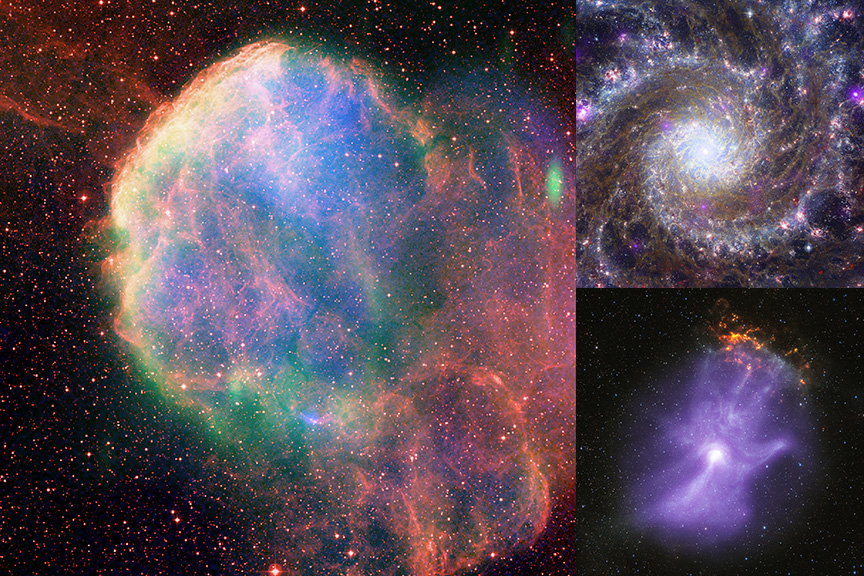
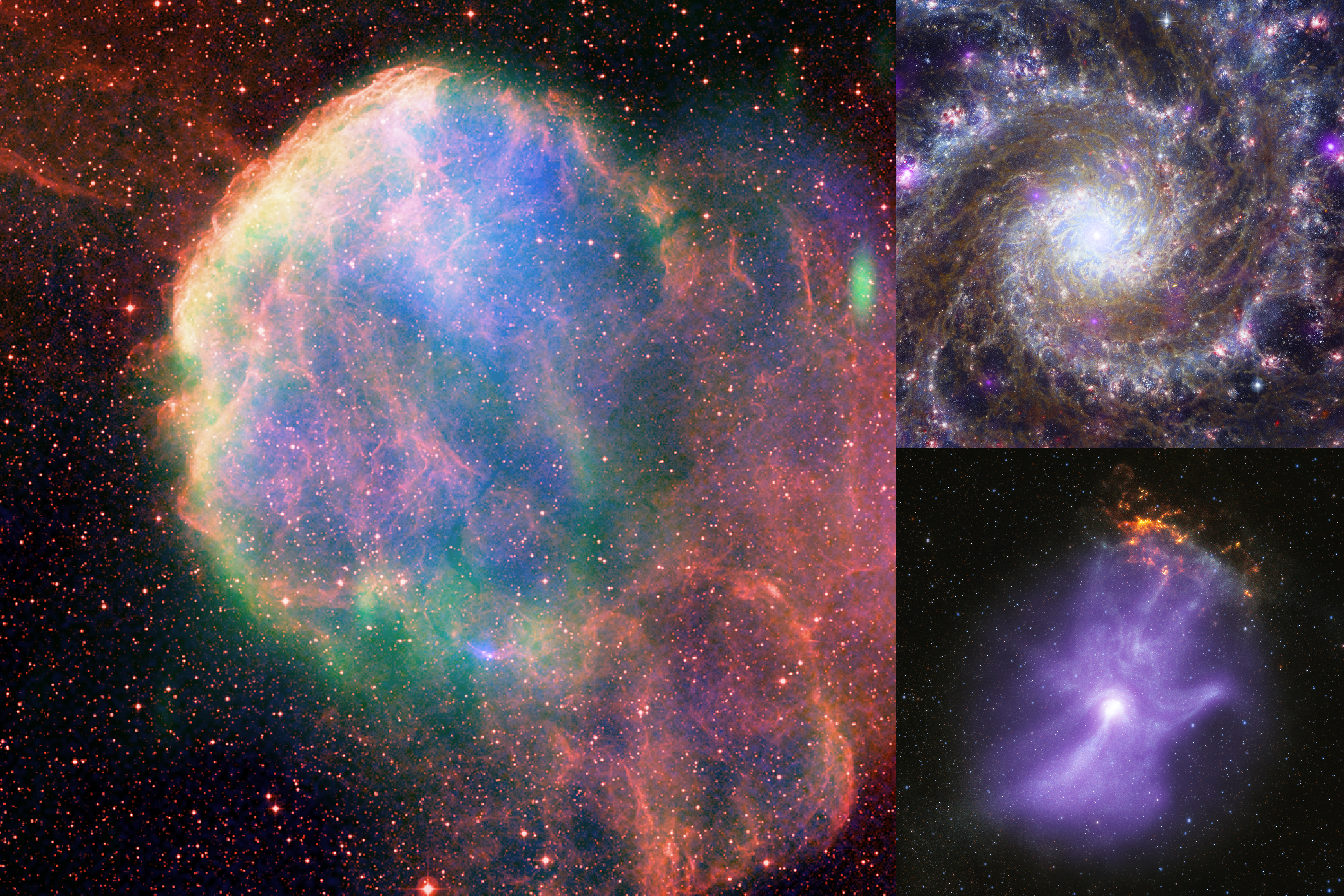
IC 443 (Jellyfish Nebula)/M74 (Phantom Galaxy)/MSH 15-52 / PSR B1509-58
Credit Chandra X-ray: NASA/CXC/B.Gaensler et al; ROSAT X-ray: NASA/ROSAT/Asaoka & Aschenbach; Radio Wide: NRC/DRAO/D.Leahy; Optical: DSS; Sonification: NASA/CXC/SAO/K.Arcand, SYSTEM Sounds (M. Russo, A. Santaguida)


Three new sonifications of images from NASA’s Chandra X-ray Observatory and other telescopes have been released. This work is also being featured in a new NASA+ documentary, "Listen to the Universe."

Sonification is the process of translating data into sounds. In the case of Chandra and other telescopes, scientific data are collected from space as digital signals that are commonly turned into visual imagery. The sonification project takes these data through another step of mapping the information into sound.


IC 443 (Jellyfish Nebula)
(above)

IC 443 is a supernova remnant, or the debris of an exploded star, which astronomers have nicknamed the Jellyfish Nebula. A visual composite image of IC 443 includes X-rays from NASA’s Chandra X-ray Observatory and German ROSAT X-ray telescope (blue) along with radio data from the NSF’s Very Large Array (green) and optical data from the Digitized Sky Survey (red). The sonification of IC 443 begins with a top-down scan as the brightness of the data is correlated to the volume of the sound. The sounds are mapped to colors in the image with red light being heard as lower pitches, the green as medium, and the blue light as the higher pitches. This creates notes that sweep up and down in pitch continuously. Several colors are isolated and control the volume of sustained tones with red controlling the lowest note and white controlling the highest note. The background stars in the optical image have been converted to water drop sounds in the sonification.


M74 (Phantom Galaxy):


SonificationMessier 74 is a spiral galaxy like our Milky Way, which is seen face-on from Earth’s vantage point some 32 million light-years away. X-rays from Chandra (purple) have been combined with an infrared view of M74 from NASA’s James Webb Space Telescope (green, yellow, red, and magenta) as well as optical data from NASA’s Hubble Space Telescope (orange, cyan, and blue). In sonifying these data, a clockwise-moving radar-like scan starts around 12 o’clock. The distance from the center controls the frequencies of sound with light farther from the center being higher pitched. The Chandra sources correspond to relatively high musical pitches of glassy ethereal and clear plucked sounds. In the Webb data, large, medium, and small features are represented by low, medium, and high frequency ranges of pitches respectively with the brightest stars being heard as percussive sounds. The Hubble data have been turned into breathy synthesizer sounds along with thin metallic plucked sounds for bright stars and clusters.


MSH 15-52 / PSR B1509-58:


The third new sonification is of MSH 15-52, a cloud of energized particles blown away from a dead, collapsed star. This image includes X-rays from the Imaging X-ray Polarimetry Explorer, or IXPE, (purple) as well as Chandra (orange, green, and blue). These data have been combined with infrared data from the Dark Energy Plane Survey 2 (red and blue). In sound, the scan goes from the bottom to the top. The brightness of the Chandra data of the cloud have been converted into rough string-like sounds, while the blast wave is represented by a range of pitches of firework-type noises. The IXPE data are heard as wind-like sounds. The infrared data are mapped to musical pitches of a synthesizer sound. The light curve, or brightness over time, from the dead star’s collapsed core is heard in pulses that occur almost 7 times every second as it does in the original data.

These sonifications were led by the Chandra X-ray Center (CXC) and included as part of NASA's Universe of Learning (UoL) program. The collaboration was driven by visualization scientist Kimberly Arcand (CXC), astrophysicist Matt Russo, and musician Andrew Santaguida, (both of the SYSTEM Sounds project), along with consultant Christine Malec.

NASA's Marshall Space Flight Center manages the Chandra program. The Smithsonian Astrophysical Observatory's Chandra X-ray Center controls science from Cambridge Massachusetts and flight operations from Burlington, Massachusetts. NASA's Universe of Learning materials are based upon work supported by NASA under cooperative agreement award number NNX16AC65A to the Space Telescope Science Institute, working in partnership with Caltech/IPAC, Center for Astrophysics | Harvard & Smithsonian, and the Jet Propulsion Laboratory.


Visual Description:

The first image in this release is the Jellyfish Nebula, also called IC 443. This supernova remnant is shaped like a huge, colorful bubble containing shades of pink, blue, red, and green. Cloud-like structures, both inside the bubble and stretching outside of the bubble to our right and upper left, are filamentary in nature, as if fingers pulled at the edges of a cotton ball. Stars, seen as red dots, are flecked across the entire image.

The second image is Messier 74, a spiral galaxy like our own Milky Way. Seen face-on from our vantage point on Earth, the galaxy's sparkling arms spiral out from a bright white core. The core appears vibrant and alive, and crackles with lightning-like, pale blue light. Glowing, high-energy stars in purple, white, and orange, dot the lengths of the spiraling arms. Webs of murky dust crisscross the space between the curving silver blue arms, also known as dust lanes.

The last image is MSH 15-52, a pulsar wind nebula, which strongly resembles a ghostly purple hand with sparkling fingertips. A pulsar is a highly magnetized collapsed star that rotates and creates jets of matter flowing away from its poles. These jets, along with intense winds of particles, form pulsar wind nebulae. Here, the pulsar wind nebula known as MSH 15-52 resembles a hazy purple cloud set against a black, starry backdrop.

The shape of this pulsar wind nebula strongly resembles a human hand, including five fingers, a palm and wrist. The bright white spot near the base of the palm is the pulsar itself. The three longest fingertips of the hand shape point toward our upper right, or 1:00 on a clock face. There, a small, mottled, orange and yellow cloud appears to sparkle or glow like embers. This orange cloud is part of the remains of the supernova explosion that created the pulsar. The backdrop of stars was captured in infrared light.


Fast Facts for IC 443 (Jellyfish Nebula):

Credit: Chandra X-ray: NASA/CXC/B.Gaensler et al; ROSAT X-ray: NASA/ROSAT/Asaoka & Aschenbach; Radio Wide: NRC/DRAO/D.Leahy; Optical: DSS; Sonification: NASA/CXC/SAO/K.Arcand, SYSTEM Sounds (M. Russo, A. Santaguida)

About the Sound

Top-down scan with brightness controlling volume
Colors appearing in the nebula are mapped to sound in two ways.
Redder light is mapped to lower pitches while bluer light is mapped to higher pitches. This creates notes that sweep up and down in pitch continuously.
Several colors are isolated and control the volume of sustained tones with red controlling the lowest note and white controlling the highest note.
Background stars are converted to water drop sounds. The brightness of each star is mapped to volume and pitch and reverb is controlled by the brightness of the nebula in front of them.

Scale: The image is about 46.5 arcmin across (66 light-years across)
Category: Neutron Stars/X-ray Binaries, Supernovas & Supernova Remnants
Coordinates (J2000): RA 06h 17m 05.20s | Dec +22° 21´ 26.70"
Constellation: Gemini
Observation Date: January 12, 2005
Observation Time: 11 hours
Obs. ID: 5531
Instrument: ACIS
References: B. Gaensler et al. 2006, arXiv: astro-ph/0601304v2
Color Code: X-ray: blue; Radio: green; Optical: red
Distance Estimate: About 5,000 light-years


Fast Facts for M74 (Phantom Galaxy):

Credit: X-ray: NASA/CXC/SAO; Optical: ESA/Hubble & NASA; IR: ESA/Webb, NASA & CSA, J. Lee and the PHANGS-JWST Team; Image Processing: N. Wolk and K. Arcand; Sonification: NASA/CXC/SAO/K.Arcand, SYSTEM Sounds (M. Russo, A. Santaguida)

About the Sound:

Radar-like scan, clockwise from 12:00.
Brightness is mapped to volume and the distance from the center is mapped to pitch is various ways (farther from the center is higher pitched).

Binaural panning moves the apparent position of the sound clockwise around the listener’s head.

Infrared (JWST)

Distance from the center controls the pitch with large, medium, and small scale features mapped to low, med, and high ranges of frequencies.
Bright stars appearing red are accompanied by a percussive sound.

Optical (HST)

The distance from the center is mapped to musical pitches of a breathy synth sound.
Bright stars and clusters are rendered as thin plucked sounds.

X-ray (Chandra)

The distance from the center is mapped to high musical pitches of a glassy ethereal sound.
Compact sources are rendered as high musical pitches of a clear plucked sound.

Scale: Image is about 3.4 arcmin (32,000 light-years) across
Category: Normal Galaxies & Starburst Galaxies
Coordinates (J2000): RA 1h 36m 42s | Dec +15° 47´ 01"
Constellation: Pisces
Observation Date: 13 observations from Jun 2001-Nov 2019
Observation Time: 81 hours 48 minutes (3 days 9 hours 48 minutes)
Obs. ID: 2057, 2058, 4753, 4854, 14801, 16000-16003, 16484, 16485, 20333, 21000
Instrument: ACIS
Color Code: X-ray: purple; Optical: orange, cyan, blue, IR: green, yellow, red, magenta
Distance Estimate: About 32 million light-years


Fast Facts for MSH 15-52 / PSR B1509-58:

Credit: X-ray: NASA/CXC/Stanford Univ./R. Romani et al. (Chandra); NASA/MSFC (IXPE); Infrared: NASA/JPL-Caltech/DECaPS; Image Processing: NASA/CXC/SAO/J. Schmidt; Sonification: NASA/CXC/SAO/K.Arcand, SYSTEM Sounds (M. Russo, A. Santaguida)

About the Sound

Bottom to top scan with brightness converted to audio frequency and volume using various techniques.
Horizontal position in the image is reflected in the stereo position of the sound.
Chandra (X-ray)

Brightness of pulsar nebula mapped to musical pitch on a rough string-like sound.
Brightness of blastwave emission mapped to pitch of affected fireworks sounds.

IXPE (X-ray)

Brightness mapped to continuous audio frequencies producing a wind-like sound.

DECAPS

The brightness of stars is mapped to musical pitches with a dreamy percussive synthesizer sound.

Pulsar Lightcurve

The composite includes a real-time sonification of the central pulsar’s X-ray emission (NuSTAR) which exhibits pulses 6.67 times every second. Its volume is loudest as the scanning line passes the pulsar itself.

Scale: Image is about 20 arcmin (93 light-years) across
Category: Supernovas & Supernova Remnants, Neutron Stars/X-ray Binaries
Coordinates (J2000): RA 15h 13m 55.52s | Dec -59° 08´ 08.8"
Constellation: Circinus
Observation Date: 10 pointings between 14 Aug 2000 and 19 June 2008
Observation Time: 93 hours 50 minutes (3 days 21 hours 50 minutes)
Obs. ID: 754, 3833, 3834, 4384, 5534, 5535, 5562, 6116, 6117, 9138
Instrument: ACIS
References: Romani, R. et al., ApJ, 2023; arXiv:2309.16067
Color Code: X-ray: orange, green, blue (Chandra), purple (IXPE); Infrared: red, blue
Distance Estimate: About 16,000 light-years


Saturday, March 02, 2024

Astronomers reveal a new link between water and planet formation

Astronomers have found water vapour in a disc around a young star exactly where planets may be forming. In this image, the new observations from the Atacama Large Millimeter/submillimeter Array (ALMA) show the water vapour in shades of blue. Near the centre of the disc, where the young star lives, the environment is hotter and the gas brighter. The red-hued rings are previous ALMA observations showing the distribution of dust around the star. Credit: ALMA (ESO/NAOJ/NRAO)/S. Facchini et al.

This is the sharpest image ever taken by ALMA — sharper than is routinely achieved in visible light with the NASA/ESA Hubble Space Telescope. It shows the protoplanetary disc surrounding the young star HL Tauri. These new ALMA observations reveal substructures within the disc that have never been seen before and even show the possible positions of planets forming in the dark patches within the system. Credit: ALMA (ESO/NAOJ/NRAO)

HL Tauri is a young star surrounded by a remarkable dusty disc. It is located in the famous constellation of Taurus (The Bull) shown in this image, close to the naked eye Pleiades and Hyades star clusters. This star is too faint to be seen with small telescopes. Credit: ESO, IAU and Sky & Telescope

This image shows the region in which HL Tauri is situated. HL Tauri is part of one of the closest star-forming regions to Earth and there are many young stars, as well as clouds of dust, in its vicinity. This picture was created from images forming part of the Digitized Sky Survey 2. Credit: ESO/Digitized Sky Survey 2


Researchers have used the Atacama Large Millimeter/submillimeter Array (ALMA) to find water vapor in the disc around a young star, precisely where planets may be forming. Water is a key ingredient for life on Earth and is also thought to play a significant role in planet formation. Yet, until now, we had never been able to map how water is distributed in a stable, cool disc — the type of disc that offers the most favorable conditions for planets to form around stars.

“I had never imagined that we could capture an image of oceans of water vapor in the same region where a planet is likely forming,” says Stefano Facchini, an astronomer at the University of Milan, Italy, who led the study published today in Nature Astronomy. The observations reveal at least three times as much water as in all of Earth’s oceans in the inner disc of the young Sun-like star HL Tauri, located 450 light-years away from Earth in the constellation Taurus.

“It is truly remarkable that we can not only detect but also capture detailed images and spatially resolve water vapor at a distance of 450 light-years from us,” adds co-author Leonardo Testi, an astronomer at the University of Bologna, Italy. The observations with ALMA allow astronomers to determine the distribution of water in different regions of the disc. “Taking part in such an important discovery in the iconic HL Tauri disc was beyond what I had ever expected for my first research experience in astronomy,” adds Mathieu Vander Donckt from the University of Liège, Belgium, who was a master’s student when he participated in the research.

A significant amount of water was found in the region where a known gap in the HL Tauri disc exists. Ring-shaped gaps are carved out in gas- and dust-rich discs by orbiting young planet-like bodies as they gather material and grow. “Our recent images reveal a substantial quantity of water vapor at a range of distances from the star that includes a gap where a planet could potentially be forming at the present time,” says Facchini. This suggests that this water vapor could affect the chemical composition of planets forming in those regions.

Observing water with a ground-based telescope is no mean feat, as the abundant water vapor in Earth’s atmosphere degrades the astronomical signals. ALMA is an antenna array in the Chilean Atacama Desert at about 5,000 meters elevation that was built in a high and dry environment specifically to minimize this degradation, providing exceptional observing conditions. “To date, ALMA is the only facility able to spatially resolve water in a cool planet-forming disc,” says co-author Wouter Vlemmings, a professor at the Chalmers University of Technology in Sweden1.

“It is truly exciting to directly witness, in a picture, water molecules being released from icy dust particles,” says Elizabeth Humphreys, an astronomer at ESO who also participated in the study. The dust grains that make up a disc are the seeds of planet formation, colliding and clumping into ever-larger bodies orbiting the star. Astronomers believe that where it is cold enough for water to freeze onto dust particles, things stick together more efficiently — an ideal spot for planet formation. “Our results show how the presence of water may influence the development of a planetary system, just like it did some 4.5 billion years ago in our own Solar System,” Facchini adds.

With upgrades happening at ALMA and ESO’s Extremely Large Telescope (ELT) coming online within the decade, planet formation and the role water plays in it will become clearer than ever. In particular, METIS, the Mid-infrared ELT Imager, and Spectrograph will give astronomers unrivaled views of the inner regions of planet-forming discs, where planets like Earth form.
  1. The new observations used the Band 5 and Band 7 receivers on ALMA. Band 5 expanded ALMA into a new frequency range specifically for detecting and imaging water in the local Universe. In this study, the team observed three spectral lines of water across the two receiver frequency ranges to map gas at different temperatures within the disc. ↩︎


Additional Information

This research was presented in a paper titled “Resolved ALMA observations of water in the inner astronomical units of the HL Tau disk” to appear in Nature Astronomy (doi:10.1038/s41550-024-02207-w).

The team is composed of S. Facchini (Dipartimento di Fisica, Università degli Studi di Milano, Italy), L. Testi (Dipartimento di Fisica e Astronomia “Augusto Righi”, Università di Bologna, Italy), E. Humphreys (European Southern Observatory, Germany, Joint ALMA Observatory, Chile; European Southern Observatory Vitacura, Chile), M. Vander Donckt (Space sciences, Technologies & Astrophysics Research (STAR) Institute, University of Liège, Belgium), A. Isella (Department of Physics and Astronomy, Rice University, USA [Rice]), R. Wrzosek (Rice), A. Baudry (Laboratoire d’Astrophysique de Bordeaux, Univ. de Bordeaux, CNRS, France), M. D. Gray (National Astronomical Research Institute of Thailand, Thailand), A. M. S. Richards (JBCA, University of Manchester, UK), W. Vlemmings (Department of Space, Earth and Environment, Chalmers University of Technology, Sweden).

The original press release was published by ESO, an ALMA partner on behalf of Europe.

The Atacama Large Millimeter/submillimeter Array (ALMA), an international astronomy facility, is a partnership of the European Organisation for Astronomical Research in the Southern Hemisphere (ESO), the U.S. National Science Foundation (NSF) and the National Institutes of Natural Sciences (NINS) of Japan in cooperation with the Republic of Chile. ALMA is funded by ESO on behalf of its Member States, by NSF in cooperation with the National Research Council of Canada (NRC) and the National Science and Technology Council (NSTC) in Taiwan and by NINS in cooperation with the Academia Sinica (AS) in Taiwan and the Korea Astronomy and Space Science Institute (KASI).

ALMA construction and operations are led by ESO on behalf of its Member States; by the National Radio Astronomy Observatory (NRAO), managed by Associated Universities, Inc. (AUI), on behalf of North America; and by the National Astronomical Observatory of Japan (NAOJ) on behalf of East Asia. The Joint ALMA Observatory (JAO) provides the unified leadership and management of the construction, commissioning and operation of ALMA.


Videos

This video takes you to the location of HL Tauri in the constellation of Taurus, 450 light-years away from Earth. The start of the sequence shows a wide view, including the Pleiades and Hyades naked-eye star clusters. It then zooms into a very detailed visible-light image from the NASA/ESA Hubble Space Telescope and ends with ALMA observations of water vapor in the HL Tauri disc. Credit: ALMA (ESO/NAOJ/NRAO)/NASA/ESA/N. Risinger (skysurvey.org). Music: Astral Electronic

Researchers have found water vapour in the disc around a young star exactly where planets may be forming. Water is a key ingredient for life on Earth, and is also thought to play a significant role in planet formation. Yet, until now, we had never been able to map how water is distributed in a stable, cool disc — the type of disc that offers the most favorable conditions for planets to form around stars. The new findings were made possible thanks to the Atacama Large Millimeter/submillimeter Array (ALMA), in which the European Southern Observatory (ESO) is a partner. This video summarises the discovery. Credit: ESO Directed by: Angelos Tsaousis and Martin Wallner. Editing: Angelos Tsaousis and Luis Calçada. Web and technical support: Gurvan Bazin and Raquel Yumi Shida. Written by: Pamela Freeman and Tom Howarth. Music: Stellardrone — The Earth is Blue. Footage and photos: ESO/L. Calçada, ALMA (ESO/NAOJ/NRAO)/S. Facchini et al., A. Tsaousis, C. Malin (christophmalin.com), B. Tafreshi, General Dynamics C4 Systems. Scientific consultant: Paola Amico, Mariya Lyubenova.


Contacts

Nicolás Lira
Education and Public Outreach Coordinator
oint ALMA Observatory, Santiago - Chile
Phone: +56 2 2467 6519
Cel:
+56 9 9445 7726
Email: nicolas.lira@alma.cl

Bárbara Ferreira
ESO Media Manager
Garching bei München, Germany
Phone:
+49 89 3200 6670
Email: press@eso.org

Naoko Inoue
EPO officer, ALMA Project
National Astronomical Observatory of Japan (NAOJ)
Email:
naoko.inoue@nao.ac.jp

Jill Malusky
Public Information Officer
NRAO
Phone:
+1 304-456-2236
Email: jmalusky@nrao.edu


Friday, March 01, 2024

‘Beyond what’s possible’: new JWST observations unearth mysterious ancient galaxies

Spectral analysis of its light with JWST revealed this red disk galaxy’s anomalous nature – it formed around 13 billion years ago even though it contains ~4x more mass in stars than our Milky Way does today. (This Webb image shows ZF-UDS-7329, a rare massive galaxy that formed very early in the Universe. Image credit: Glazebrook et al., doi: 10.1038/s41586-024-07191-9)

Associate Professo Lagos developed the theoretical modelling used in the study.

Our understanding of how galaxies form and the nature of dark matter could be completely upended, after new observations of a stellar population bigger than the Milky Way from more than 11 billion years ago that should not exist.

A paper published today in Nature details findings using new data from the James Webb Space Telescope (JWST). The results finds that a massive galaxy in the early universe – observed 11.5 billion years ago (a cosmic redshift of 3.2) – has an extremely old population of stars formed much earlier – 1.5 billion years earlier in time (a red shift of around 11). The observation upends current modelling, as not enough dark matter has built up in sufficient concentrations to seed their formation.

Swinburne University of Technology’s Distinguished Professor Karl Glazebrook led the study and the international team who used the JWST for spectroscopic observations of this massive quiescent galaxy.

“We’ve been chasing this particular galaxy for seven years and spent hours observing it with the two largest telescopes on earth to figure out how old it was. But it was too red and too faint, and we couldn’t measure it. In the end, we had to go off earth and use the JWST to confirm its nature.”

The formation of galaxies is a fundamental paradigm underpinning modern astrophysics and predicts a strong decline in the number of massive galaxies in early cosmic times. Extremely massive quiescent galaxies have now been observed as early as one to two billion years after the Big Bang which challenges previous theoretical models.

Distinguished Professor Glazebrook worked with leading researchers all over the world, including Dr Themiya Nanayakkara, Dr Lalitwadee Kawinwanichakij, Dr Colin Jacobs, Dr Harry Chittenden, Associate Professor Glenn G Kacprzak and Associate Professor Ivo Labbe from Swinburne’s Centre for Astrophysics and Supercomputing.

“This was very much a team effort, from the infrared sky surveys we started in 2010 that led to us identifying this galaxy as unusual, to our many hours on the Keck and Very Large Telescope where we tried, but failed to confirm it, until finally the last year where we spent enormous effort figuring out how to process the JWST data and analyse this spectrum.”

Dr Themiya Nanayakkara, who led the spectral analysis of the JWST data, says, “we are now going beyond what was possible to confirm the oldest massive quiescent monsters that exist deep in the Universe.”

“This pushes the boundaries of our current understanding of how galaxies form and evolve. The key question now is how they form so fast very early in the Universe and what mysterious mechanisms leads to stopping them forming stars abruptly when the rest of the Universe doing so.”

Associate Professor Claudia Lagos from the University of Western Australia node of the International Centre for Radio Astronomy Research (ICRAR) was crucial in developing the theoretical modelling of the evolution of dark matter concentrations for the study.

“Galaxy formation is in large part dictated by how dark matter concentrates,” she says. “Having these extremely massive galaxies so early in the Universe is posing significant challenges to our standard model of cosmology. This is because we don’t think such massive dark matter structures as to host these massive galaxies have had time yet to form. More observations are needed to understand how common these galaxies may be and to help us understand how truly massive these galaxies are.”

Distinguished Professor Glazebrook hopes this could be a new opening for our understanding of the physics of dark matter.

“JWST has been finding increasing evidence for massive galaxies forming early in time. This result sets a new record for this phenomenon. Although it is very striking, it is only one object. But we hope to find more; and if we do this will really upset our ideas of galaxy formation.”