Monday, January 13, 2020

Surprise! TESS Shows Ancient North Star Undergoes Eclipses

The star Alpha Draconis (circled), also known as Thuban, has long been known to be a binary system. Now data from NASA's TESS show its two stars undergo mutual eclipses. Credit: NASA/MIT/TESS

Astronomers using data from NASA’s Transiting Exoplanet Survey Satellite (TESS) have shown that Alpha Draconis, a well-studied star visible to the naked eye, and its fainter companion star regularly eclipse each other. While astronomers previously knew this was a binary system, the mutual eclipses came as a complete surprise.

“The first question that comes to mind is ‘how did we miss this?’” said Angela Kochoska, a postdoctoral researcher at Villanova University in Pennsylvania who presented the findings at the 235th meeting of the American Astronomical Society in Honolulu on Jan. 6. “The eclipses are brief, lasting only six hours, so ground-based observations can easily miss them. And because the star is so bright, it would have quickly saturated detectors on NASA’s Kepler observatory, which would also mask the eclipses.”


This animation illustrates a preliminary model of the Thuban system, now known to be an eclipsing binary thanks to data from NASA’s Transiting Exoplanet Survey Satellite (TESS). The stars orbit every 51.4 days at an average distance slightly greater than Mercury’s distance from the Sun. We view the system about three degrees above the stars’ orbital plane, so they undergo mutual eclipses, but neither is ever completely covered up by its partner. The primary star is 4.3 times bigger than the Sun and has a surface temperature around 17,500 degrees Fahrenheit (9,700 C), making it 70% hotter than our Sun. Its companion, which is five times fainter, is most likely half the primary’s size and 40% hotter than the Sun. Thuban, also called Alpha Draconis, is located about 270 light-years away in the northern constellation Draco. Credits: NASA’s Goddard Space Flight Center/Chris Smith (USRA). Download HD video from NASA Goddard's Scientific Visualization Studio

The system ranks among the brightest-known eclipsing binaries where the two stars are widely separated, or detached, and only interact gravitationally. Such systems are important because astronomers can measure the masses and sizes of both stars with unrivaled accuracy.

Alpha Draconis, also known as Thuban, lies about 270 light-years away in the northern constellation Draco. Despite its “alpha” designation, it shines as Draco’s fourth-brightest star. Thuban’s fame arises from a historical role it played some 4,700 years ago, back when the earliest pyramids were being built in Egypt.

At that time, it appeared as the North Star, the one closest to the northern pole of Earth’s spin axis, the point around which all of the other stars appear to turn in their nightly motion. Today, this role is played by Polaris, a brighter star in the constellation Ursa Minor. The change happened because Earth’s spin axis performs a cyclic 26,000-year wobble, called precession, that slowly alters the sky position of the rotational pole.

TESS monitors large swaths of the sky, called sectors, for 27 days at a time. This long stare allows the satellite to track changes in stellar brightness. While NASA’s newest planet hunter mainly seeks dimmings caused by planets crossing in front of their stars, TESS data can be used to study many other phenomena as well.

A 2004 report suggested that Thuban displayed small brightness changes that cycled over about an hour, suggesting the possibility that the system’s brightest star was pulsating.

To check this, Timothy Bedding, Daniel Hey, and Simon Murphy at the University of Sydney, Australia, and Aarhus University, Denmark, turned to TESS measurements. In October, they published a paper that described the discovery of eclipses by both stars and ruling out the existence of pulsations over periods less than eight hours.

Now Kochoska is working with Hey to understand the system in greater detail.

“I've been collaborating with Daniel to model the eclipses and advising on how to bring together more data to better constrain our model.” Kochoska explained. “The two of us took different approaches to modeling the system, and we hope our efforts will result in its full characterization.”

As known from earlier studies, the stars orbit every 51.4 days at an average distance of about 38 million miles (61 million kilometers), slightly more than Mercury’s distance from the Sun. The current preliminary model shows that we view the system about three degrees above the stars’ orbital plane, which means neither star completely covers the other during the eclipses. The primary star is 4.3 times bigger than the Sun and has a surface temperature around 17,500 degrees Fahrenheit (9,700 C), making it 70% hotter than our Sun. Its companion, which is five times fainter, is most likely half the primary’s size and 40% hotter than the Sun.

Kochoska says she is planning ground-based follow-up observations and anticipating additional eclipses in future TESS sectors.

“Discovering eclipses in a well-known, bright, historically important star highlights how TESS impacts the broader astronomical community,” said Padi Boyd, the TESS project scientist at NASA’s Goddard Space Flight Center in Greenbelt, Maryland. “In this case, the high precision, uninterrupted TESS data can be used to help constrain fundamental stellar parameters at a level we’ve never before achieved.”

TESS is a NASA Astrophysics Explorer mission led and operated by MIT in Cambridge, Massachusetts, and managed by NASA's Goddard Space Flight Center. Additional partners include Northrop Grumman, based in Falls Church, Virginia; NASA’s Ames Research Center in California’s Silicon Valley; the Harvard-Smithsonian Center for Astrophysics in Cambridge, Massachusetts; MIT’s Lincoln Laboratory; and the Space Telescope Science Institute in Baltimore. More than a dozen universities, research institutes and observatories worldwide are participants in the mission.


By Francis Reddy
NASA’s Goddard Space Flight Center, Greenbelt, Md.

Media contact

Claire Andreoli
NASA’s Goddard Space Flight Center, Greenbelt, Md.
(301) 286-1940


Editor: Francis Reddy
Source: NASA/TESS


Sunday, January 12, 2020

New Technique May Give NASA’s Webb Telescope a Way to Quickly Identify Planets with Oxygen

Conceptual image of water-bearing (left) and dry (right) exoplanets with oxygen-rich atmospheres. Crescents are other planets in the system, and the red sphere is the M-dwarf star around which the exoplanets orbit. The dry exoplanet is closer to the star, so the star appears larger. Credits: NASA/GSFC/Friedlander-Griswold

Researchers may have found a way that NASA's James Webb Space Telescope can quickly identify nearby planets that could be promising for our search for life, as well as worlds that are uninhabitable because their oceans have vaporized.

Since planets around other stars (exoplanets) are so far away, scientists cannot look for signs of life by visiting these distant worlds. Instead, they must use a cutting-edge telescope like Webb to see what's inside the atmospheres of exoplanets. One possible indication of life, or biosignature, is the presence of oxygen in an exoplanet’s atmosphere. Oxygen is generated by life on Earth when organisms such as plants, algae and cyanobacteria use photosynthesis to convert sunlight into chemical energy.

But what should Webb look for to determine if a planet has a lot of oxygen? In a new study, researchers identified a strong signal that oxygen molecules produce when they collide. Scientists say Webb has the potential to detect this signal in the atmospheres of exoplanets.

“Before our work, oxygen at similar levels as on Earth was thought to be undetectable with Webb, but we identify a promising way to detect it in nearby planetary systems,” said Thomas Fauchez of the Universities Space Research Association at NASA’s Goddard Space Flight Center in Greenbelt, Maryland. “This oxygen signal is known since the early 80’s from Earth’s atmospheric studies, but has never been studied for exoplanet research.” Fauchez is the lead author of the study, appearing in the journal Nature Astronomy January 6.

The researchers used a computer model to simulate this oxygen signature by modeling the atmospheric conditions of an exoplanet around an M dwarf, the most common type of star in the universe. M dwarf stars are much smaller, cooler, and fainter than our Sun, yet much more active, with explosive activity that generates intense ultraviolet light. The team modelled the impact of this enhanced radiation on atmospheric chemistry, and used this to simulate how the component colors of the star's light would change when the planet would pass in front of it.

As starlight passes through the exoplanet’s atmosphere, the oxygen absorbs certain colors (wavelengths) of light— in this case, infrared light with a wavelength of 6.4 micrometers. When oxygen molecules collide with each other or with other molecules in the exoplanet’s atmosphere, energy from the collision puts the oxygen molecule in a special state that temporarily allows it to absorb the infrared light. Infrared light is invisible to the human eye, but detectable using instruments attached to telescopes.

“Similar oxygen signals exist at 1.06 and 1.27 micrometers and have been discussed in previous studies but these are less strong and much more mitigated by the presence of clouds than the 6.4 micrometer signal,” said Geronimo Villanueva, a co-author of the paper at Goddard.

Intriguingly, oxygen can also make an exoplanet appear to host life when it does not, because it can accumulate in a planet’s atmosphere without any life activity at all. For example, if the exoplanet is too close to its host star or receives too much star light, the atmosphere becomes very warm and saturated with water vapor from evaporating oceans. This water could be then broken down by the strong ultraviolet radiation into atomic hydrogen and oxygen. Hydrogen, which is a light atom, escapes to space very easily, leaving the oxygen behind.

Over time, this process can cause entire oceans to be lost while building up a thick oxygen atmosphere. So, abundant oxygen in an exoplanet’s atmosphere does not necessarily mean abundant life, but may instead indicate a rich water history.

“Depending upon how easily Webb detects this 6.4 micrometer signal, we can get an idea about how likely it is that the planet is habitable,” said Ravi Kopparapu, a co-author of the paper at Goddard. “If Webb points to a planet and detects this 6.4 micrometer signal with relative ease, this would mean that the planet has a very dense oxygen atmosphere and may be uninhabitable.”

The oxygen signal is so strong that it also can tell astronomers whether M dwarf planets have atmospheres at all, using just a few Webb transit observations.

“This is important because M dwarf stars are highly active, and it has been postulated that stellar activity might ‘blow away’ entire planetary atmospheres,” said Fauchez. “Knowing simply whether a planet orbiting an M dwarf can have an atmosphere at all is important for understanding star-planet interactions around these abundant but active stars.”

Although the oxygen signal is strong, cosmic distances are vast and M dwarfs are dim, so these stars will have to be relatively nearby for Webb to detect the signal in exoplanet atmospheres within a reasonable amount of time. An exoplanet with a modern Earth-like atmosphere will have to be orbiting an M dwarf that is within approximately 16 light-years of Earth. For a desiccated exoplanet with an oxygen atmosphere 22 times the pressure of Earth’s, the signal could be detected up to about 82 light-years away. One light-year, the distance light travels in a year, is almost six trillion miles. For comparison, the closest stars to our Sun are found in the Alpha Centauri system a little over 4 light-years away, and our galaxy is about 100,000 light-years across.

The research was funded in part by Goddard’s Sellers Exoplanet Environments Collaboration (SEEC), which is funded in part by the NASA Planetary Science Division's Internal Scientist Funding Model. This project has also received funding from the European Union’s Horizon 2020 research and innovation program under the Marie Sklodowska-Curie Grant, the NASA Astrobiology Institute Alternative Earths team, and the NExSS Virtual Planetary Laboratory.

Webb will be the world's premier space science observatory, when it launches in 2021. It will solve mysteries in our solar system, look beyond to distant worlds around other stars, and probe the mysterious structures and origins of our universe and our place in it. Webb is an international project led by NASA with its partners, ESA (European Space Agency) and the Canadian Space Agency.

Bill Steigerwald / Nancy Jones

NASA Goddard Space Flight Center, Greenbelt, Maryland

301-286-8955 / 301-286-0039

william.a.steigerwald@nasa.gov / nancy.n.jones@nasa.gov

Editor: Bill Steigerwald


Saturday, January 11, 2020

NASA Planet Hunter Finds its 1st Earth-size Habitable-zone World

The three planets of the TOI 700 system orbit a small, cool M dwarf star. TOI 700 d is the first Earth-size habitable-zone world discovered by TESS. Credit: NASA's Goddard Space Flight Center.

NASA’s Transiting Exoplanet Survey Satellite (TESS) has discovered its first Earth-size planet in its star’s habitable zone, the range of distances where conditions may be just right to allow the presence of liquid water on the surface. Scientists confirmed the find, called TOI 700 d, using NASA’s Spitzer Space Telescope and have modeled the planet’s potential environments to help inform future observations.

TOI 700 d is one of only a few Earth-size planets discovered in a star's habitable zone so far. Others include several planets in the TRAPPIST-1 system and other worlds discovered by NASA’s Kepler Space Telescope.

“TESS was designed and launched specifically to find Earth-sized planets orbiting nearby stars,” said Paul Hertz, astrophysics division director at NASA Headquarters in Washington. “Planets around nearby stars are easiest to follow-up with larger telescopes in space and on Earth. Discovering TOI 700 d is a key science finding for TESS. Confirming the planet’s size and habitable zone status with Spitzer is another win for Spitzer as it approaches the end of science operations this January."


TESS monitors large swaths of the sky, called sectors, for 27 days at a time. This long stare allows the satellite to track changes in stellar brightness caused by an orbiting planet crossing in front of its star from our perspective, an event called a transit.

TOI 700 is a small, cool M dwarf star located just over 100 light-years away in the southern constellation Dorado. It’s roughly 40% of the Sun’s mass and size and about half its surface temperature. The star appears in 11 of the 13 sectors TESS observed during the mission’s first year, and scientists caught multiple transits by its three planets.

The star was originally misclassified in the TESS database as being more similar to our Sun, which meant the planets appeared larger and hotter than they really are. Several researchers, including Alton Spencer, a high school student working with members of the TESS team, identified the error.

“When we corrected the star’s parameters, the sizes of its planets dropped, and we realized the outermost one was about the size of Earth and in the habitable zone,” said Emily Gilbert, a graduate student at the University of Chicago. “Additionally, in 11 months of data we saw no flares from the star, which improves the chances TOI 700 d is habitable and makes it easier to model its atmospheric and surface conditions.”

Gilbert and other researchers presented the findings at the 235th meeting of the American Astronomical Society in Honolulu, and three papers — one of which Gilbert led — have been submitted to scientific journals.

The innermost planet, called TOI 700 b, is almost exactly Earth-size, is probably rocky and completes an orbit every 10 days. The middle planet, TOI 700 c, is 2.6 times larger than Earth — between the sizes of Earth and Neptune — orbits every 16 days and is likely a gas-dominated world. TOI 700 d, the outermost known planet in the system and the only one in the habitable zone, measures 20% larger than Earth, orbits every 37 days and receives from its star 86% of the energy that the Sun provides to Earth. All of the planets are thought to be tidally locked to their star, which means they rotate once per orbit so that one side is constantly bathed in daylight.

A team of scientists led by Joseph Rodriguez, an astronomer at the Center for Astrophysics | Harvard & Smithsonian in Cambridge, Massachusetts, requested follow-up observations with Spitzer to confirm TOI 700 d.

“Given the impact of this discovery — that it is TESS’s first habitable-zone Earth-size planet — we really wanted our understanding of this system to be as concrete as possible,” Rodriguez said. “Spitzer saw TOI 700 d transit exactly when we expected it to. It’s a great addition to the legacy of a mission that helped confirm two of the TRAPPIST-1 planets and identify five more.”

The Spitzer data increased scientists’ confidence that TOI 700 d is a real planet and sharpened their measurements of its orbital period by 56% and its size by 38%. It also ruled out other possible astrophysical  causes of the transit signal, such as the presence of a smaller, dimmer companion star in the system.

Rodriguez and his colleagues also used follow-up observations from a 1-meter ground-based telescope in the global Las Cumbres Observatory network to improve scientists’ confidence in the orbital period and size of TOI 700 c by 30% and 36%, respectively.

Because TOI 700 is bright, nearby, and shows no sign of stellar flares, the system is a prime candidate for precise mass measurements by current ground-based observatories. These measurements could confirm scientists’ estimates that the inner and outer planets are rocky and the middle planet is made of gas.

Future missions may be able to identify whether the planets have atmospheres and, if so, even determine their compositions.

While the exact conditions on TOI 700 d are unknown, scientists can use current information, like the planet’s size and the type of star it orbits, to generate computer models and make predictions. Researchers at NASA’s Goddard Space Flight Center in Greenbelt, Maryland, modeled 20 potential environments of TOI 700 d to gauge if any version would result in surface temperatures and pressures suitable for habitability.

Their 3D climate models examined a variety of surface types and atmospheric compositions typically associated with what scientists regard to be potentially habitable worlds. Because TOI 700 d is tidally locked to its star, the planet’s cloud formations and wind patterns may be strikingly different from Earth’s.

One simulation included an ocean-covered TOI 700 d with a dense, carbon-dioxide-dominated atmosphere similar to what scientists suspect surrounded Mars when it was young. The model atmosphere contains a deep layer of clouds on the star-facing side. Another model depicts TOI 700 d as a cloudless, all-land version of modern Earth, where winds flow away from the night side of the planet and converge on the point directly facing the star.

When starlight passes through a planet’s atmosphere, it interacts with molecules like carbon dioxide and nitrogen to produce distinct signals, called spectral lines. The modeling team, led by Gabrielle Engelmann-Suissa, a Universities Space Research Association visiting research assistant at Goddard, produced simulated spectra for the 20 modeled versions of TOI 700 d.

“Someday, when we have real spectra from TOI 700 d, we can backtrack, match them to the closest simulated spectrum, and then match that to a model,” Engelmann-Suissa said. “It’s exciting because no matter what we find out about the planet, it’s going to look completely different from what we have here on Earth.”

TESS is a NASA Astrophysics Explorer mission led and operated by MIT in Cambridge, Massachusetts, and managed by NASA's Goddard Space Flight Center. Additional partners include Northrop Grumman, based in Falls Church, Virginia; NASA’s Ames Research Center in California’s Silicon Valley; the Harvard-Smithsonian Center for Astrophysics in Cambridge, Massachusetts; MIT’s Lincoln Laboratory; and the Space Telescope Science Institute in Baltimore. More than a dozen universities, research institutes and observatories worldwide are participants in the mission.

The Jet Propulsion Laboratory in Pasadena, California, manages the Spitzer Space Telescope mission for NASA's Science Mission Directorate in Washington. Science operations are conducted at the Spitzer Science Center at Caltech in Pasadena. Space operations are based at Lockheed Martin Space in Littleton, Colorado. Data are archived at the Infrared Science Archive housed at IPAC at Caltech. Caltech manages JPL for NASA.

The modeling work was funded through the Sellers Exoplanet Environments Collaboration at Goddard, a multidisciplinary collaboration that brings together experts to build comprehensive and sophisticated computer models to better analyze current and future exoplanet observations.

By Jeanette Kazmierczak
NASA’s Goddard Space Flight Center, Greenbelt, Md.​

Editor: Rob Garner

Source: NASA/TESS


Friday, January 10, 2020

Hubble Detects Smallest Known Dark Matter Clumps

Quasars' Multiple Images Shed Light on Tiny Dark Matter Clumps
Credits: NASA, ESA, A. Nierenberg (JPL) and T. Treu (UCLA)

Illustration of Strong Gravitational Lensing
Credits: NASA, ESA, and D. Player (STScI) 
Release Images


Using NASA's Hubble Space Telescope and a new observing technique, astronomers have found that dark matter forms much smaller clumps than previously known. This result confirms one of the fundamental predictions of the widely accepted "cold dark matter" theory.

All galaxies, according to this theory, form and are embedded within clouds of dark matter. Dark matter itself consists of slow-moving, or “cold,” particles that come together to form structures ranging from hundreds of thousands of times the mass of the Milky Way galaxy to clumps no more massive than the heft of a commercial airplane. (In this context, "cold" refers to the particles' speed.)
The Hubble observation yields new insights into the nature of dark matter and how it behaves. "We made a very compelling observational test for the cold dark matter model and it passes with flying colors," said Tommaso Treu of the University of California, Los Angeles (UCLA), a member of the observing team.

Dark matter is an invisible form of matter that makes up the bulk of the universe's mass and creates the scaffolding upon which galaxies are built. Although astronomers cannot see dark matter, they can detect its presence indirectly by measuring how its gravity affects stars and galaxies. Detecting the smallest dark matter formations by looking for embedded stars can be difficult or impossible, because they contain very few stars.

While dark matter concentrations have been detected around large- and medium-sized galaxies, much smaller clumps of dark matter have not been found until now. In the absence of observational evidence for such small-scale clumps, some researchers have developed alternative theories, including "warm dark matter." This idea suggests that dark matter particles are fast moving, zipping along too quickly to merge and form smaller concentrations. The new observations do not support this scenario, finding that dark matter is "colder" than it would have to be in the warm dark matter alternative theory.

"Dark matter is colder than we knew at smaller scales," said Anna Nierenberg of NASA's Jet Propulsion Laboratory in Pasadena, California, leader of the Hubble survey. "Astronomers have carried out other observational tests of dark matter theories before, but ours provides the strongest evidence yet for the presence of small clumps of cold dark matter. By combining the latest theoretical predictions, statistical tools, and new Hubble observations, we now have a much more robust result than was previously possible."

Hunting for dark matter concentrations devoid of stars has proved challenging. The Hubble research team, however, used a technique in which they did not need to look for the gravitational influence of stars as tracers of dark matter. The team targeted eight powerful and distant cosmic "streetlights," called quasars (regions around active black holes that emit enormous amounts of light). The astronomers measured how the light emitted by oxygen and neon gas orbiting each of the quasars' black holes is warped by the gravity of a massive foreground galaxy, which is acting as a magnifying lens.

Using this method, the team uncovered dark matter clumps along the telescope's line of sight to the quasars, as well as in and around the intervening lensing galaxies. The dark matter concentrations detected by Hubble are 1/10,000th to 1/100,000th times the mass of the Milky Way's dark matter halo. Many of these tiny groupings most likely do not contain even small galaxies, and therefore would have been impossible to detect by the traditional method of looking for embedded stars.

The eight quasars and galaxies were aligned so precisely that the warping effect, called gravitational lensing, produced four distorted images of each quasar. The effect is like looking at a funhouse mirror. Such quadruple images of quasars are rare because of the nearly exact alignment needed between the foreground galaxy and background quasar. However, the researchers needed the multiple images to conduct a more detailed analysis.

The presence of the dark matter clumps alters the apparent brightness and position of each distorted quasar image. Astronomers compared these measurements with predictions of how the quasar images would look without the influence of the dark matter. The researchers used the measurements to calculate the masses of the tiny dark matter concentrations. To analyze the data, the researchers also developed elaborate computing programs and intensive reconstruction techniques.

"Imagine that each one of these eight galaxies is a giant magnifying glass," explained team member Daniel Gilman of UCLA. "Small dark matter clumps act as small cracks on the magnifying glass, altering the brightness and position of the four quasar images compared to what you would expect to see if the glass were smooth."

The researchers used Hubble’s Wide Field Camera 3 to capture the near-infrared light from each quasar and disperse it into its component colors for study with spectroscopy. Unique emissions from the background quasars are best seen in infrared light. "Hubble's observations from space allow us to make these measurements in galaxy systems that would not be accessible with the lower resolution of ground-based telescopes—and Earth's atmosphere is opaque to the infrared light we needed to observe," explained team member Simon Birrer of UCLA.

Treu added: "It's incredible that after nearly 30 years of operation, Hubble is enabling cutting-edge views into fundamental physics and the nature of the universe that we didn't even dream of when the telescope was launched."

The gravitational lenses were discovered by sifting through ground-based surveys such as the Sloan Digital Sky Survey and Dark Energy Survey, which provide the most detailed three-dimensional maps of the universe ever made. The quasars are located roughly 10 billion light-years from Earth; the foreground galaxies, about 2 billion light-years.

The number of small structures detected in the study offers more clues about dark matter's nature. "The particle properties of dark matter affect how many clumps form," Nierenberg explained. "That means you can learn about the particle physics of dark matter by counting the number of small clumps."

However, the type of particle that makes up dark matter is still a mystery. "At present, there's no direct evidence in the lab that dark matter particles exist," Birrer said. "Particle physicists would not even talk about dark matter if the cosmologists didn’t say it's there, based on observations of its effects. When we cosmologists talk about dark matter, we're asking 'how does it govern the appearance of the universe, and on what scales?'"

Astronomers will be able to conduct follow-up studies of dark matter using future NASA space telescopes such as the James Webb Space Telescope and the Wide Field Infrared Survey Telescope (WFIRST), both infrared observatories. Webb will be capable of efficiently obtaining these measurements for all known quadruply lensed quasars. WFIRST's sharpness and large field of view will help astronomers make observations of the entire region of space affected by the immense gravitational field of massive galaxies and galaxy clusters. This will help researchers uncover many more of these rare systems.

The team will present its results at the 235th meeting of the American Astronomical Society in Honolulu, Hawaii.

The Hubble Space Telescope is a project of international cooperation between NASA and ESA (European Space Agency). NASA's Goddard Space Flight Center in Greenbelt, Maryland, manages the telescope. The Space Telescope Science Institute (STScI) in Baltimore, Maryland, conducts Hubble science operations. STScI is operated for NASA by the Association of Universities for Research in Astronomy in Washington, D.C.


Contact:  

Donna Weaver / Ray Villard
Space Telescope Science Institute, Baltimore, Maryland
410-338-4493 / 410-338-4514

dweaver@stsci.edu / villard@stsci.edu

Anna Nierenberg
Jet Propulsion Laboratory, Pasadena, California
818-393-5095

anna.m.nierenberg@jpl.nasa.gov

Tommaso Treu / Daniel Gilman
University of California, Los Angeles, California
310-206-5617 (office) / 757-814-5869 (cell)
tt@astro.ucla.edu / gilmana@ucla.edu


Related Links:


Thursday, January 09, 2020

Goldilocks Stars Are Best Places to Look for Life

Comparison of G, K, and M Stars for Habitability
Credits: NASA, ESA, and Z. Levy (STScI) 
Science: NASA , ESA , and E. Guinan (Villanova University)


Orange Dwarf Stars Most Likely to Host Planets

To date astronomers have discovered over 4,000 planets orbiting other stars. Statistically, there should be over 100 billion planets in our Milky Way galaxy. They come in a wide range of sizes and characteristics, largely unimagined before exoplanets were first discovered in the mid-1990s. The biggest motivation for perusing these worlds is to find "Genesis II," a planet where life has arisen and evolved beyond microbes. The ultimate payoff would be finding intelligent life off the Earth.

A major step in searching for habitable planets is finding suitable stars that could foster the emergence of complex organisms. Because our Sun has nurtured life on Earth for nearly 4 billion years, conventional wisdom would suggest that stars like it would be prime candidates. But stars like our Sun represent only about 10% of the Milky Way population. What's more, they are comparatively short-lived. Our Sun is halfway through its estimated 10 billion-year lifetime.

Complex organisms arose on Earth only 500 million years ago. And, the modern form of humans has been here only for the blink of an eye on cosmological timescales: 200,000 years. The future of humanity is unknown. But what is for certain is that Earth will become uninhabitable for higher forms of life in a little over 1 billion years, as the Sun grows warmer and desiccates our planet.

Therefore, stars slightly cooler than our Sun — called orange dwarfs — are considered better hang-outs for advanced life. They can burn steadily for tens of billions of years. This opens up a vast timescape for biological evolution to pursue an infinity of experiments for yielding robust life forms. And, for every star like our Sun there are three times as many orange dwarfs in the Milky Way.

The only type of star that is more abundant are red dwarfs. But these are feisty little stars. They are so magnetically active they pump out 500 times as much radiation in the form of X-rays and ultraviolet light as our Sun does. Planets around these stars take a beating. They would be no place to call home for organisms like us.

An emerging idea, bolstered by stellar surveys performed by Hubble and other telescopes, is that the orange dwarfs are "Goldilocks stars" — not too hot, not too cool, and above all, not too violent to host life-friendly planets over a vast horizon of cosmic time.

In the search for life beyond Earth, astronomers look for planets in a star's "habitable zone" — sometimes nicknamed the "Goldilocks zone" — where temperatures are just right for liquid water to exist on a planet's surface to nurture life as we know it.

An emerging idea, bolstered by a three-decade-long set of stellar surveys, is that there are "Goldilocks stars" — not too hot, not too cool, and above all, not too violent to host life-friendly planets.

Because our Sun has nurtured life on Earth for nearly 4 billion years, conventional wisdom would suggest that stars like it would be prime candidates in the search for other potentially habitable worlds. In reality, stars slightly cooler and less luminous than our Sun, classified as K dwarfs, are the true "Goldilocks stars," said Edward Guinan of Villanova University, Villanova, Pennsylvania. "K-dwarf stars are in the 'sweet spot,' with properties intermediate between the rarer, more luminous, but shorter-lived solar-type stars (G stars) and the more numerous red dwarf stars (M stars). The K stars, especially the warmer ones, have the best of all worlds. If you are looking for planets with habitability, the abundance of K stars pump up your chances of finding life."

For starters, there are three times as many K dwarfs in our galaxy as stars like our Sun. Roughly 1,000 K stars lie within 100 light-years of our Sun as prime candidates for exploration. These so-called orange dwarfs live from 15 billion to 45 billion years. By contrast, our Sun, now already halfway through its lifetime, lasts for only 10 billion years. Its comparatively rapid rate of stellar evolution will leave the Earth largely uninhabitable in just another 1 or 2 billion years. "Solar-type stars limit how long a planet's atmosphere can remain stable," Guinan said. That's because a billion or so years from now, Earth will orbit inside the hotter (inner) edge of the Sun's habitable zone, which moves outward as the Sun grows warmer and brighter. As a result, the Earth will be desiccated as it loses its present atmosphere and oceans. By an age of 9 billion years the Sun will have swelled up to become a red giant that could engulf the Earth.

Despite their small size, the even more abundant red dwarf stars, also known as M dwarf stars, have even longer lifetimes and appear to be hostile to life as we know it. Planets that are located in a red dwarf's comparatively narrow habitable zone, which is very close to the star, are exposed to extreme levels of X-ray and ultraviolet (UV) radiation, which can be up to hundreds of thousands of times more intense than what Earth receives from the Sun. A relentless fireworks show of flares and coronal mass ejections bombard planets with a dragon's breath of seething plasma and showers of penetrating high-energy particles. Red dwarf habitable-zone planets can be baked bone dry and have their atmospheres stripped away very early in their lives. This could likely prohibit the planets from evolving to be more hospitable a few billion years after red dwarf outbursts have subsided. "We're not so optimistic anymore about the chances of finding advanced life around many M stars," Guinan said.

The K dwarfs do not have intensely active magnetic fields that power strong X-ray and UV emissions and energetic outbursts, and therefore they shoot off flares much less frequently, based on Guinan's research. Accompanying planets would get about 1/100th as much deadly X-ray radiation as those orbiting the close-in habitable zones of magnetically-active M stars.

In a program called the "GoldiloKs" Project, Guinan and his Villanova colleague Scott Engle, are working with undergraduate students to measure the age, rotation rate, and X-ray and far-ultraviolet radiation in a sampling of mostly cool G and K stars.They are using NASA's Hubble Space Telescope, Chandra X-ray Observatory, and the European Space Agency's XMM-Newton satellite for their observations. Hubble's sensitive ultraviolet-light observations of radiation from hydrogen were used to assess the radiation from a sample of about 20 orange dwarfs. "Hubble is the only telescope that can do this kind of observation," Guinan said.

Guinan and Engle found that the levels of radiation were much more benign to any accompanying planets than those found around red dwarfs. K stars also have longer lifetimes and therefore slower migration of the habitable zone. Therefore, K dwarfs seem like the ideal place to go looking for life, and these stars would allow time for highly evolved life to develop on planets. Over the Sun's entire lifetime — 10 billion years — K stars only increase their brightness by about 10-15%, giving biological evolution a much longer timespan to evolve advanced life forms than on Earth.

Guinan and Engle looked at some of the more interesting K stars hosting planets, including Kepler-442, Tau Ceti, and Epsilon Eridani. (The latter two were early targets of the late 1950s Project Ozma — the first attempt to detect radio transmissions from extraterrestrial civilizations.)

"Kepler-442 is noteworthy in that this star (spectral classification, K5) hosts what is considered one of the best Goldilocks planets, Kepler-442b, a rocky planet that is a little more than twice Earth's mass. So the Kepler-442 system is a Goldilocks planet hosted by a Goldilocks star!" said Guinan.

Over the last 30 years Guinan and Engle and their students have observed a variety of stellar types. Based on their studies, the researchers have determined relationships among stellar age, rotation rate, X-ray-UV emissions and flare activity. These data have been utilized to investigate the effects of high-energy radiation on planet atmospheres and possible life.

The results are being presented at the 235th meeting of the American Astronomical Society in Honolulu, Hawaii.

The Hubble Space Telescope is a project of international cooperation between NASA and ESA (European Space Agency). NASA's Goddard Space Flight Center in Greenbelt, Maryland, manages the telescope. The Space Telescope Science Institute (STScI) in Baltimore, Maryland, conducts Hubble science operations. STScI is operated for NASA by the Association of Universities for Research in Astronomy in Washington, D.C.


Contact:

Ray Villard
Space Telescope Science Institute, Baltimore, Maryland
410-338-4514
villard@stsci.edu

Edward Guinan
Villanova University, Villanova, Pennsylvania
edward.guinan@villanova.edu

Related Links: NASA's Hubble Portal


Famous Black Hole Has Jet Pushing Cosmic Speed Limit

M87
Credit: NASA/CXC/SAO/B. Snios et al.

A Tour of the M87 Jet - More Animations


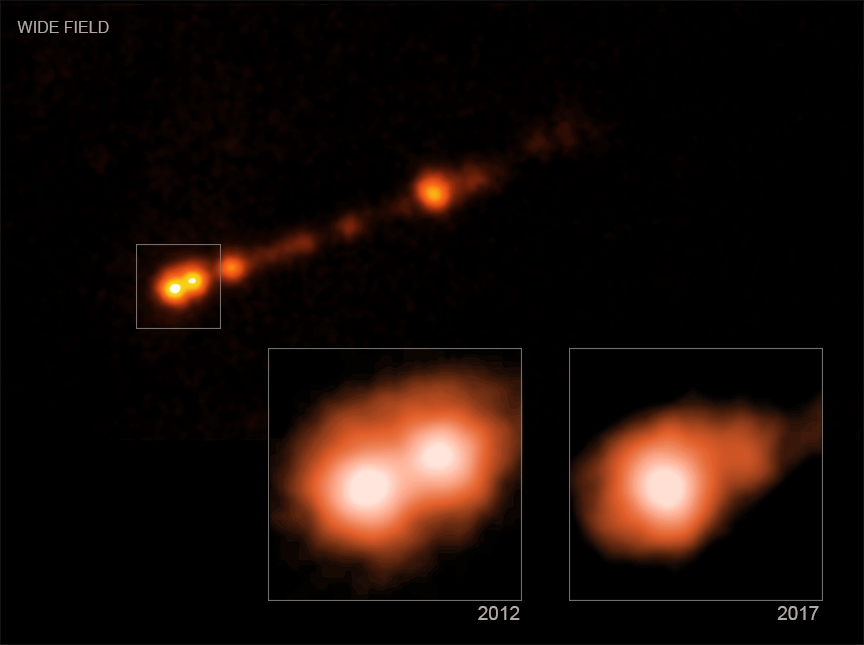
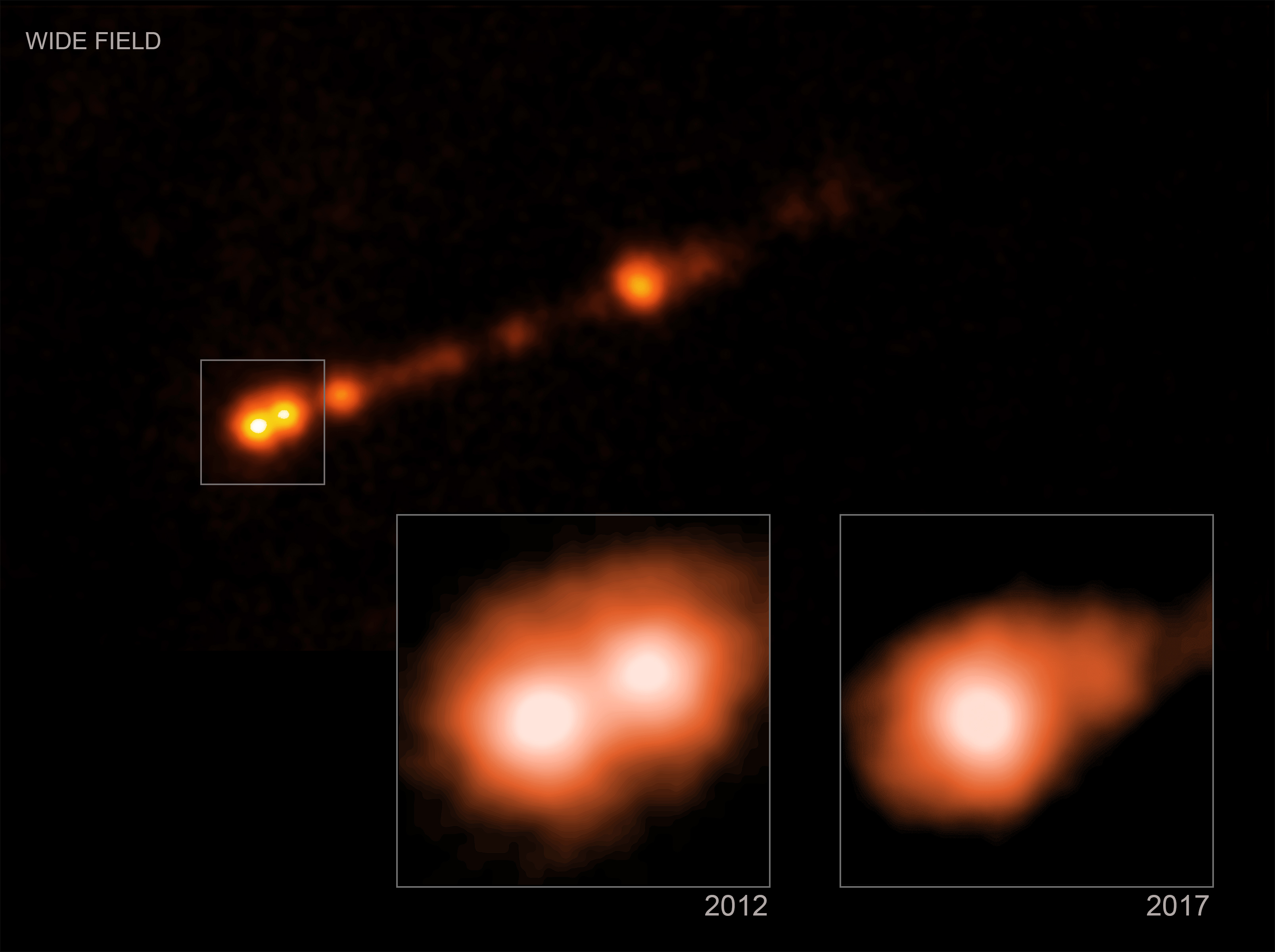
These images show evidence from NASA's Chandra X-ray Observatory that the black hole in the galaxy Messier 87 (M87) is blasting particles out at over 99% the speed of light, as described in our latest press release. While astronomers have observed features in the M87 jet blasting away from its black hole this quickly at radio and optical wavelengths for many years, this provides the strongest evidence yet that actual particles are travelling this fast. Astronomers required the sharp X-ray vision from Chandra in order to make these precise measurements.

The main panel of the graphic shows the entire length of M87's jet seen by Chandra, stretching for about 18,000 light years. "Knots" of X-ray emission seen here are created when material falls onto the M87 sporadically, creating bursts of X-ray light that travel along the jet and away from the black hole. The insets show Chandra observations taken in 2012 and 2017 of a small region near the base of the jet. The source in the lower left is X-ray emission from material around the black hole, and the other source is a knot in the jet about 900 light years from the black hole. This knot moves away from the black hole between 2012 and 2017 and also fades by 70%.

2012 & 2017 Labeled Insets 
Credit: NASA/CXC/SAO/B. Snios et al.

The researchers carefully studied this knot, and another one about 2,500 light years along the jet. By comparing how far these knots moved over the five-year interval, the team of astronomers was able to determine the closer knot has an apparent speed of 6.3 times the speed of light for the X-ray knot, while the other looks like it is moving at 2.4 times the speed of light.

Illustration of the Supermassive Black Hole at the Center of M87 
Credit: NASA/CXC/M.Weiss

This is an example of superluminal motion, which occurs when objects are traveling close to the speed of light along a direction that is close to Earth's line of sight. The jet travels almost as quickly towards us as the light it generates, giving the illusion that the jet's motion is much more rapid than the speed of light. In the case of M87, the jet is pointing close to our direction, resulting in these exotic apparent speeds.

Previously astronomers have not been able to definitively show that matter in the jet is moving at very close to the speed of light. For example, the moving features could be a wave or a shock, similar to a sonic boom from a supersonic plane, rather than tracing the motions of matter.

Chandra Wide-field View of M87; box shows the approximate location of the wide-field jet image above 
Credit: NASA/CXC

The black hole in M87 received a great deal of attention in April 2019 when the Event Horizon Telescope project released the first image of a black hole from this galaxy, which has been observed many times by Chandra over its two decades of operations. The black hole in M87 has a mass of about 6.5 billion times that of the sun and is located about 55 million light years from Earth. 

A paper describing these results, which were presented at the 235th meeting of the American Astronomical Society, was published in The Astrophysical Journal and is available online. The authors of the paper were Brad Snios (Center for Astrophysics | Harvard & Smithsonian, or CfA), Paul Nulsen (CfA), Ralph Kraft (CfA), Teddy Cheung (Naval Research Laboratory), Eileen Meyer (University of Maryland, Baltimore County), William Forman (CfA), Christine Forman (CfA), and Stephen Murray (CfA).

NASA's Marshall Space Flight Center manages the Chandra program. The Smithsonian Astrophysical Observatory's Chandra X-ray Center controls science and flight operations from Cambridge and Burlington, Massachusetts.


Fast Facts for M87:

Scale: Wide-field image is about 45 arcsec (12,000 light years) across. Insets are about 3 arcsec (790 light years) across.
Coordinates (J2000): RA 12h 30m 49s | Dec 12° 23´ 28"
Constellation: Virgo
Observation Date: April 14, 2012 and March 2, 2017
Observation Time: 40 hours 33 minutes (1 day 16 hours 33 minutes)
Obs. ID: 13515, 18612
Instrument: HRC
Also Known As: NGC 4486
References: Sinos, B. et al., 2019, ApJ, 879, 8; arXiv:1905.04330.
Color Code: Intensity (orange-white)
Distance Estimate: About 55 million light years


Wednesday, January 08, 2020

Astronomers Spot Distant Galaxy Group Driving Ancient Cosmic Makeover

EGS77 is the farthest galaxy group identified to date. It dates back to a time when the universe was only 680 million years old, or less than 5 percent of its current age of 13.8 billion years.  Credit: Nasa's Goddard Space Flight Center 

Maunakea, Hawaii – An international team of astronomers funded in part by NASA has found the farthest galaxy group identified to date. With the help of W. M. Keck Observatory on Maunakea, Hawaii, the team confirmed the trio of galaxies called EGS77 dates to a time when the universe was only 680 million years old, or less than 5% of its current age of 13.8 billion years. 

More significantly, observations show the galaxies are participants in a sweeping cosmic makeover called reionization. The era began when light from the first stars changed the nature of hydrogen throughout the universe in a manner akin to a frozen lake melting in the spring. This transformed the dark, light-quenching early cosmos into the one we see around us today.

“The young universe was filled with hydrogen atoms, which so attenuate ultraviolet light that they block our view of early galaxies,” said James Rhoads at NASA’s Goddard Space Flight Center in Greenbelt, Maryland, who presented the findings on Jan. 5 at the 235th meeting of the American Astronomical Society in Honolulu. “EGS77 is the first galaxy group caught in the act of clearing out this cosmic fog.” 

While more distant individual galaxies have been observed, EGS77 is the farthest galaxy group to date showing the specific wavelengths of far-ultraviolet light revealed by reionization. This emission, called Lyman alpha light, is prominent in all members of EGS77.

In its infancy, the universe was a hot, opaque plasma. After expanding and cooling for about 380,000 years, the universe formed the first atoms — more than 90% of them hydrogen. Hundreds of millions of years later, this gas formed the first stars and galaxies. But the very presence of this abundant gas poses challenges for spotting galaxies in the early universe.  

In its earliest phase, the universe was a glowing plasma of particles, including electrons, protons, atomic nuclei, and light. Atoms could not yet exist. The universe was in an ionized state, similar to the gas inside a lighted neon sign or fluorescent tube.

This illustration of the EGS77 galaxy group shows the galaxies surrounded by overlapping bubbles of hydrogen ionized by ultraviolet light from their stars. By transforming light-quenching hydrogen atoms to ionized gas, UV starlight is thought to have formed such bubbles throughout the early universe, gradually transitioning it from opaque to completely transparent. Credit: Nasa's Goddard Space Flight Center

After the universe expanded and cooled for about 380,000 years, electrons and protons combined into the first atoms — more than 90% of them hydrogen. Hundreds of millions of years later, this gas formed the first stars and galaxies. But the very presence of this abundant gas poses challenges for spotting galaxies in the early universe. 

Hydrogen atoms readily absorb and quickly re-emit far-ultraviolet light known as Lyman alpha emission, which has a wavelength of 121.6 nanometers. When the first stars formed, some of the light they produced matched this wavelength. Because Lyman alpha light easily interacted with hydrogen atoms, it couldn’t travel far before the gas scattered it in random directions.  

“Intense light from galaxies can ionize the surrounding hydrogen gas, forming bubbles that allow starlight to travel freely,” said team member Vithal Tilvi, a researcher at Arizona State University in Tempe. “EGS77 has formed a large bubble that allows its light to travel to Earth without much attenuation. Eventually, bubbles like these grew around all galaxies and filled intergalactic space, reionizing the universe and clearing the way for light to travel across the cosmos.”

EGS77 was discovered as part of the Cosmic Deep And Wide Narrowband (Cosmic DAWN) survey, for which Rhoads serves as principal investigator. The team imaged a small area in the constellation Boötes using a custom-built filter on the National Optical Astronomy Observatory’s Extremely Wide-Field InfraRed Imager (NEWFIRM), which was attached to the 4-meter Mayall telescope at Kitt Peak National Observatory near Tucson, Arizona.

This animation shows EGS77’s place in cosmic history, flies to the galaxies, and illustrates how ultraviolet light from their stars create bubbles of ionized hydrogen around them.  Credit: Nasa's Goddard Space Flight Center 

Because the universe is expanding, Lyman alpha light from EGS77 has been stretched out during its travels, so astronomers actually detect it at near-infrared wavelengths. We can’t see these galaxies in visible light now because that light started out at shorter wavelengths than Lyman alpha and was scattered by the fog of hydrogen atoms.

To help select distant candidates, the researchers compared their images with publicly available data of the same region taken by NASA’s Hubble and Spitzer space telescopes. Galaxies appearing brightly in near-infrared images were tagged as possibilities, while those appearing in visible light were rejected as being too close.  

The team confirmed the distances to EGS77’s galaxies by using the Multi-Object Spectrometer for Infra-Red Exploration (MOSFIRE) on the Keck I telescope at the W. M. Keck Observatory on Maunakea, Hawaii. The three galaxies all show Lyman alpha emission lines at slightly different wavelengths, reflecting slightly different distances. The separation between adjacent galaxies is about 2.3 million light-years, or slightly closer than the distance between the Andromeda galaxy and our own Milky Way. 

A paper describing the findings, led by Tilvi, has been submitted to The Astrophysical Journal.

“While this is the first galaxy group identified as being responsible for cosmic reionization, future NASA missions will tell us much more,” said co-author Sangeeta Malhotra at Goddard. “The upcoming James Webb Space Telescope is sensitive to Lyman alpha emission from even fainter galaxies at these distances, and may find more galaxies within EGS77.” 

Astronomers expect that similar reionization bubbles from this era will be rare and hard to find. NASA’s planned Wide Field Infrared Survey Telescope (WFIRST) may be able to uncover additional examples, further illuminating this important transition in cosmic history.


About MOSFIRE

MOSFIRE (Multi-Object Spectrograph for Infrared Exploration) is a highly-efficient instrument that can take images or up to 46 simultaneous spectra. Using a sensitive state-of-the-art detector and electronics system, MOSFIRE obtains observations fainter than any other near infrared spectrograph. MOSFIRE is an excellent tool for studying complex star or galaxy fields, including distant galaxies in the early Universe, as well as star clusters in our own Galaxy. MOSFIRE obtained first light in April 2012 and was made possible by funding provided by the National Science Foundation and astronomy benefactors Gordon and Betty Moore. It is currently the most in-demand instrument at the W. M. Keck Observatory.


About W. M. Keck Observatory

The W. M. Keck Observatory telescopes are among the most scientifically productive on Earth. The two, 10-meter optical/infrared telescopes on the summit of Maunakea on the Island of Hawaii feature a suite of advanced instruments including imagers, multi-object spectrographs, high-resolution spectrographs, integral-field spectrometers, and world-leading laser guide star adaptive optics systems.

Some of the data presented herein were obtained at Keck Observatory, which is a private 501(c) 3 non-profit organization operated as a scientific partnership among the California Institute of Technology, the University of California, and the National Aeronautics and Space Administration. 

The Observatory was made possible by the generous financial support of the W. M. Keck Foundation.
The authors wish to recognize and acknowledge the very significant cultural role and reverence that the summit of Maunakea has always had within the Native Hawaiian community.  We are most fortunate to have the opportunity to conduct observations from this mountain.


Tuesday, January 07, 2020

A Repeating Fast Radio Burst from a Spiral Galaxy

Image of the host galaxy of the Fast Radio Burst (FRB) 180916.J0158+65 as seen with the Gemini-North telescope. The position of the FRB is marked. The inset is a higher-contrast zoom-in of the star-forming region containing the FRB (marked by the red circle). © B. Marcote et al, Nature 2020

Localisation of a new, recurring source of radio flashes deepens the mystery of their origins

The Effelsberg 100-m radio telescope participated in the European VLBI Network (EVN) to observe a repeating Fast Radio Burst (FRB) and helped to pinpoint the FRB to a spiral galaxy similar to our own. Crucial to this work was the sensitivity of the Effelsberg telescope and its flexible pulsar instrument that aided the quick radio localisation. This FRB is the closest to Earth ever localised and was found in a radically different environment to previous studies. The discovery, once again, changes researchers’ assumptions on the origins of these mysterious extragalactic events.

The results are reported in the current issue of the journal Nature by an international team of scientists including Ramesh Karuppusamy from the Max Planck Institute for Radio Astronomy in Bonn, Germany.

One of the greatest mysteries in astronomy right now is the origin of short, dramatic bursts of radio light seen across the universe, known as Fast Radio Bursts or FRBs. Although they last for only a thousandth of a second, there are now hundreds of records of these enigmatic sources. However, from these records, the precise location is known for just four FRBs - they are said to be ‘localised’.

In 2016, one of these four sources was observed to repeat, with bursts originating from the same region in the sky in a non-predictable way. This resulted in researchers drawing distinctions between FRBs where only a single burst of light was observed (‘non-repeating’) and those where multiple bursts of light were observed (‘repeating’).

“The multiple flashes that we witnessed in the first repeating FRB arose from very particular and extreme conditions inside a very tiny (dwarf) galaxy”, says Benito Marcote, from the Joint Institute for VLBI ERIC, the lead author of the current study. “This discovery represented the first piece of the puzzle but it also raised more questions than it solved, such as whether there was a fundamental difference between repeating and non-repeating FRBs. Now, we have localised a second repeating FRB, which challenges our previous ideas on what the source of these bursts could be.”

On 19th June 2019, eight telescopes from the European VLBI Network (EVN) simultaneously observed a radio source known as FRB 180916.J0158+65. This source was originally discovered in 2018 by the CHIME telescope in Canada, which enabled the team to conduct a very high resolution observation with the EVN in the direction of FRB 180916.J0158+65. During five hours of observations the researchers detected four bursts, each lasting for less than two thousandths of a second. The resolution reached through the combination of the telescopes across the globe, using a technique known as Very Long Baseline Interferometry (VLBI), meant that the bursts could be precisely localised to a region of approximately only seven light years across. This localisation is comparable to an individual on Earth being able to distinguish a person on the Moon.

The Effelsberg 100-m radio telescope of the Max Planck institute for Radio Astronomy (MPIfR) played a crucial role in these observations in two ways. With the flexible instruments at this telescope one could record data amenable to rapid identification of radio bursts and a form of data suitable for high resolution radio imaging. Secondly the large collecting area of the telescope makes it an indispensable element in the coordinated interferometric observations of weak sources like this FRB.

With the precise position of the radio source the team was able to conduct observations with one of the world’s largest optical telescopes, the 8-m Gemini North on Mauna Kea in Hawaii. Examining the environment around the source revealed that the bursts originated from a spiral galaxy named SDSS J015800.28+654253.0, located half a billion light years from Earth. The bursts come from a region of that galaxy where star formation is prominent.

“The found location is radically different from the previously located repeating FRB, but also different from all previously studied FRBs”, explains Kenzie Nimmo, PhD student at the University of Amsterdam. “The differences between repeating and non-repeating fast radio bursts are thus less clear and we think that these events may not be linked to a particular type of galaxy or environment. It may be that FRBs are produced in a large zoo of locations across the Universe and just require some specific conditions to be visible.”

“With the characterisation of this source, the argument against against pulsar-like emission as origin for repeating FRBs is gaining strength”, says Ramesh Karuppusamy of the MPIfR, a co-author of the study. “We are at the verge of more such localisations brought about by the upcoming newer telescopes. These will finally allow us to establish the true nature of these sources”, he adds.

While the current study casts doubt on previous assumptions, this FRB is the closest to Earth ever localised, allowing astronomers to study these events in unparalleled detail.

“We hope that continued studies will unveil the conditions that result in the production of these mysterious flashes. Our aim is to precisely localize more FRBs and, ultimately, understand their origin”, concludes Jason Hessels, corresponding author on the study, from the Netherlands Institute for Radio Astronomy (ASTRON) and the University of Amsterdam.

Map of the European VLBI Network (EVN) telescopes used in the observation, showing the positions of the eight participating radio telescopes and also JIVE in The Netherlands. (visibleearth.nasa.gov).


Why Fast Radio Burst localisation is important


While Fast Radio Bursts (FRBs) are a mystery of their own, their study could bring astronomers closer to understanding the Universe itself. In modern cosmology a major question is how structures on all scales were formed. There are computationally expensive simulations to address these questions, but their results strongly depend on the assumed conditions in the early Universe. Results from such simulations need to be compared with actual observations to determine if the simulations provide accurate answers. This is problematic as the majority of matter distributed within galaxies is invisible.

FRBs, however, may offer an elegant solution to this problem in the future. The short pulses from FRBs are “dispersed”, so at longer wavelengths the pulse arrives to Earth slightly later than at shorter wavelengths. This time delay can be measured very accurately, and it is an indirect estimate of the amount of material between the source and the Earth. If thousands of FRBs are found, in all directions, it will be possible to map the distribution of matter across the universe. However, in order to get the true three-dimensional distribution of matter in space, astronomers need to know the distance of each FRB from Earth as well.

How to localise a Fast Radio Burst


In the majority of searches for FRBs a single radio telescope is used to identify the approximate region that the FRB is originating from. However, the use of very high resolution radio observations through Very Long Baseline Interferometry (VLBI) adopts a novel approach.

Currently, the European VLBI Network (EVN) is the only VLBI array that is sensitive enough to study FRBs. In doing so, astronomers are able to determine both the host galaxy and the immediate local environment of the FRB. By determining the host galaxy, astronomers can then use optical observations to analyze the light coming from the galaxy and this can be used to determine its distance from Earth. Studying the environments in which FRBs occur is the key to understanding how these bursts can be produced and which extragalactic objects are associated with them.

“As we continue to unravel the mystery of FRBs, astronomers need to be able to study these sources in incredible detail. The combined sensitivity of the telescopes in the EVN currently provides a unique opportunity to observe these events and we hope that continued observations will contribute to our understanding of these enigmatic sources.” says Francisco Colomer, Director of the Joint Institute for VLBI ERIC.

Institutes and telescopes involved


Institutes involved Observations were conducted with the European Very Long Baseline Interferometry Network (EVN). The EVN is the most sensitive Very Long Baseline Interferometry (VLBI) array in the world, which allows researchers to conduct unique, high-resolution, radio astronomical observations of cosmic radio sources. Data from the EVN is processed at the Joint Institute for VLBI ERIC (JIVE) - an international research infrastructure based in the Netherlands, which also provides support, conducts leading research and forwards technical development in the field of radio astronomy.

A total of eight antennas from the EVN were involved in this observation: 25x38-m Jodrell Bank Mark2, University of Manchester (UK), 25-m Westerbork single-dish, ASTRON (The Netherlands), 100-m Effelsberg, Max Planck Institute for Radio Astronomy (Germany), 32-m Medicina, National Institute for Astrophysics (Italy), 25-m Onsala, Onsala Space Observatory (Sweden), 32-m Toruń, Nicolaus Copernicus University (Poland), 32-m Irbene, Ventspils International Radio Astronomy Centre (Latvia), and 65-m Tianma, Chinese Academy of Sciences (China).

Follow up optical observations were conducted using 8.1-m Gemini North, National Science Foundation’s National Optical-Infrared Astronomy Research Laboratory and Association of Universities for Research in Astronomy (USA).

The authors of the current study comprise B. Marcote, K. Nimmo, J. W. T. Hessels, S. P. Tendulkar, C. G. Bassa, Z. Paragi, A. Keimpema, M. Bhardwaj, R. Karuppusamy, V. M. Kaspi, C. J. Law, D. Michilli, K. Aggarwal, B. Andersen, A. M. Archibald, K. Bandura, G. C. Bower, P. J. Boyle, C. Brar, S. Burke-Spolaor, B. J. Butler, T. Cassanelli, P. Chawla, P. Demorest, M. Dobbs, E. Fonseca, U. Giri, D. C. Good, K. Gourdji, A. Josephy, A. Yu. Kirichenko, F. Kirsten, T. L. Landecker, D. Lang, T. J. W. Lazio, D. Z. Li, H.-H. Lin, J. D. Linford, K. Masui, J. Mena-Parra, A. Naidu, C. Ng, C. Patel, U.-L. Pen, Z. Pleunis, M. Rafiei-Ravandi, M. Rahman, A. Renard, P. Scholz, S. R. Siegel, K. M. Smith, I. H. Stairs, K. Vanderlinde and A. V. Zwaniga with Ramesh Karuppusamy as co-author from MPIfR.


Contact

Dr. Ramesh Karuppusamy
Phone:+49 228 525-108
Email: ramesh@mpifr-bonn.mpg.de
Max-Planck-Institut für Radioastronomie, Bonn

Dr. Jason Hessels
Phone:+31 521 596-769
Email: hessels@astron.nl
ASTRON & The University of Amsterdam, The Netherlands

Dr. Norbert Junkes
Presse- und Öffentlichkeitsarbeit
Phone:+49 228 525-399
Email: njunkes@mpifr-bonn.mpg.de
Max-Planck-Institut für Radioastronomie, Bonn


Original Paper

A repeating fast radio burst source localized to a nearby spiral galaxy

B. Marcote et al., Nature, Online Publication January 06, 2020


Links

JIVE
Joint Institute for VLBI ERIC (JIVE)

Radio Telescope Effelsberg
Effelsberg Radio Telescope

EVN
European VLBI Network (EVN)

A repeating Fast Radio Burst from a Spiral Galaxy
Youtube Movie on FRB 180916.J0158+65.


Monday, January 06, 2020

NASA's Hubble Surveys Gigantic Galaxy

UGC 2885
Credits: NASA, ESA, and B. Holwerda (University of Louisville)

This majestic spiral galaxy might earn the nickname the "Godzilla Galaxy" because it may be the largest known in the local universe. The galaxy, UGC 2885, is 2.5 times wider than our Milky Way and contains 10 times as many stars.

But it is a "gentle giant," say researchers, because it looks like it has been sitting quietly over billions of years, possibly sipping hydrogen from the filamentary structure of intergalactic space. This fuels modest ongoing star birth at half the rate of our Milky Way. In fact, its supermassive central black hole is a sleeping giant, too; because the galaxy does not appear to be feeding on much smaller satellite galaxies, it is starved of infalling gas.

The galaxy has been nicknamed "Rubin’s galaxy," after astronomer Vera Rubin (1928 – 2016) by Benne Holwerda of the University of Louisville, Kentucky, who observed the galaxy with NASA's Hubble Space Telescope.

"My research was in a large part inspired by Vera Rubin's work in 1980 on the size of this galaxy." Rubin measured the galaxy's rotation, which provides evidence for dark matter, which makes up most of the galaxy's mass as measured by the rotation rate. "We consider this a commemorative image. This goal to cite Dr. Rubin in our observation was very much part of our original Hubble proposal."

In results being presented at the winter American Astronomical Society meeting in Honolulu, Hawaii , Holwerda is seeking to understand what led to the galaxy's monstrous size. "How it got so big is something we don't quite know yet," said Holwerda. "It's as big as you can make a disk galaxy without hitting anything else in space."

One clue is that the galaxy is fairly isolated in space and doesn't have any nearby galaxies to crash into and disrupt the shape of its disk.

Did the monster galaxy gobble up much smaller satellite galaxies over time? Or did it just slowly accrete gas for new stars? "It seems like it's been puttering along, slowly growing," Holwerda said. Using Hubble's exceptional resolution, his team is counting the number of globular star clusters in the galaxy's halo — a vast shell of faint stars surrounding the galaxy. An excess of clusters would yield evidence that they were captured from smaller infalling galaxies over many billions of years.

NASA's upcoming James Webb Space Telescope could be used to explore the center of this galaxy as well as the globular cluster population. NASA's planned Wide Field Infrared Survey Telescope (WFIRST) would give an even more complete census of this galaxy's cluster population, especially that of the whole halo. "The infrared capability of both space telescopes would give us a more unimpeded view of the underlying stellar populations," said Holwerda. This complements Hubble's visible-light ability to track wispy star formation throughout the galaxy.

A number of foreground stars in our Milky Way can be seen in the image, identified by their diffraction spikes. The brightest appears to sit on top of the galaxy's disk, though UGC 2885 is really 232 million light-years farther away. The giant galaxy is located in the northern constellation Perseus.

The Space Telescope Science Institute is expanding the frontiers of space astronomy by hosting the science operations center of the Hubble Space Telescope, the science and operations center for the James Webb Space Telescope, and the science operations center for the future Wide Field Infrared Survey Telescope (WFIRST). STScI also houses the Mikulski Archive for Space Telescopes (MAST) which is a NASA-funded project to support and provide to the astronomical community a variety of astronomical data archives, and is the data repository for the Hubble, Webb, Kepler, K2, TESS missions and more.

Source: HubbleSite


Contact:

Ray Villard
Space Telescope Science Institute, Baltimore, Maryland
410-338-4514
villard@stsci.edu

Benne Holwerda
University of Louisville, Louisville, Kentucky
502-852-0918
bwholw01@louisville.edu


Related Links: