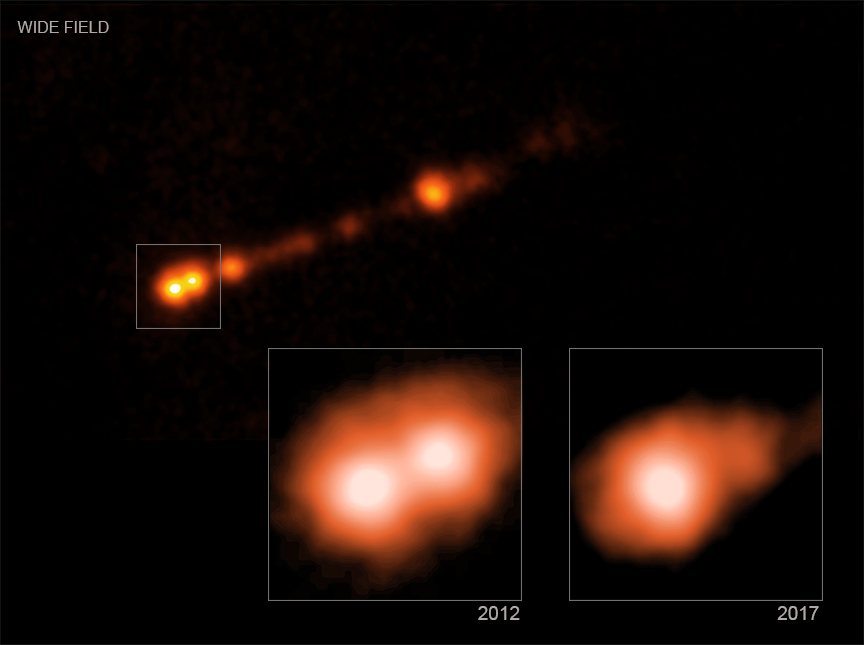
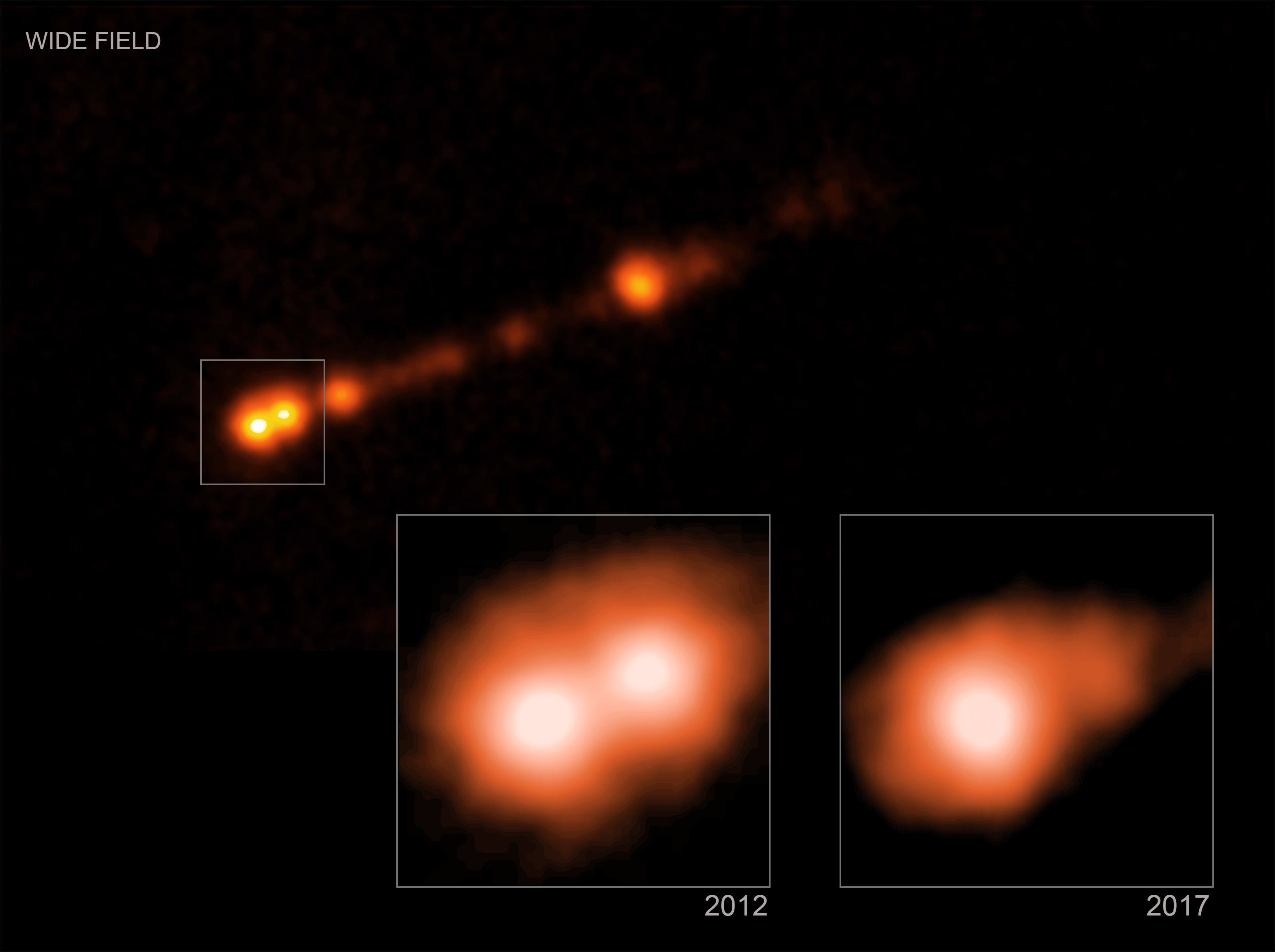
Fig. 1: Light curve of the gamma-ray flare (bottom) and collection of quasi-simultaneously observed images of the M87 jet (top) at various scales obtained in radio and X-ray during the 2018 campaign. The telescopes, the wavelength observation range and scale are shown at the top right of each image. © EHT Collaboration, Fermi-LAT Collaboration, H.E.S.S. Collaboration, MAGIC Collaboration, VERITAS Collaboration, EAVN Collaboratio
Multi-wavelength Campaign with Effelsberg and mm-VLBI Arrays Reveals a High-energy Gamma-ray Flare
The shadow of the black hole in Messier 87 has been imaged by with global radio array telescopes over the last years. Joint campaigns have been coordinated annually ever since. An international team of researchers has just released the results of a large campaign on M87 of Event Horizon Telescope and Global mm-VLBI Array observations in 2018, involving over twenty-five ground-based and space-based telescopes. The team, including a number of researchers from the Max Planck Institute for Radio Astronomy in Bonn, Germany, report a spectacular flare at multiple wavelengths from the powerful relativistic jet emanating from the very centre of the same galaxy. This study reveals the first observation in over a decade of a high-energy gamma-ray flare. Photons up to thousands of billions of times the energy of visible light from the supermassive black hole M87* were detected after obtaining nearly simultaneous spectra of that galaxy with the broadest wavelength coverage ever collected.
Millimetre VLBI facilities, represented by two arrays, the Event Horizon Telescope (EHT) and the Global mm-VLBI Array (GMVA), the latter coordinated by the Max Planck Institute for Radio Astronomy (MPIfR), are global networks of radio telescopes regularly interconnected to observe the innermost structures of galactic nuclei and to image the shadows of supermassive black holes.
“We were fortunate to detect a gamma-ray flare from M87 during the EHT's multi-wavelength campaign—the first such event in over a decade,” says Giacomo Principe, publication coordinator and researcher at the University of Trieste. “This rare event allowed us to pinpoint the region producing the gamma-ray emission. Recent and upcoming observations with a more sensitive EHT array will provide critical insights into the physics around M87’s supermassive black hole, exploring the disk-jet connection and the origins of gamma-ray photons.”
Messier 87, also known as Virgo A or NGC 4486, is the brightest object in the Virgo cluster of galaxies, the largest gravitationally bound type of structure in the universe. The relativistic jet examined by the researchers is surprising in its extent, reaching sizes that exceed the black hole’s event horizon by tens of millions of times (7 orders of magnitude) - akin to the difference between the size of a bacterium and the largest known blue whale.
The energetic flare, which lasted approximately three days and suggests an emission region of less than three light-days in size (~170 AU, where 1 Astronomical Unit is the distance from the Sun to Earth), revealed a bright burst of high-energy emission—well above the energies typically detected by radio telescopes from the black hole region.
“High-cadence very-high-energy gamma-ray observations during both a steady state and a rare short-term flare—the first in over a decade—were achieved through the collaboration of three imaging high-energy telescope arrays”, explains Alexander Hahn from the Max Planck Institute for Physics, a co-author of the study. “Combined with simultaneous multi-wavelength data at lower energies, these observations offer crucial insights into the extreme processes powering these cosmic events.”
During the campaign, the LAT instrument aboard the Fermi space observatory detected an increase in high-energy gamma-ray flux with energies up to billions of times greater than visible light. The satellites Chandra and NuSTAR then collected high-quality data in the X-ray band. Radio observations with VLBI arrays such as the GMVA, the Very Long Baseline Array (VLBA) and the East Asian VLBI Network (EAVN) show a relativistic jet and an apparent annual change in the jet's position angle within a few milliarcseconds of arc from the galaxy's core.
“The radio imaging provides a unique perspective, allowing astronomers to track the structural and temporal evolution of the jet at unprecedented angular resolutions”, says Thomas Krichbaum of the MPIfR. “In this campaign, radio data not only constrained the jet geometry but also served as a vital reference for correlating the gamma-ray emission with the relativistic jet dynamics.”
Observations show changes in the position of the ring's asymmetry (the black hole's event horizon) and the jet's position. This suggests a physical link between these structures on very different scales. “The first image from the 2017 observational campaign showed that the ring’s emission was uneven, with brighter areas indicating asymmetries. Subsequent 2018 observations confirmed these findings, showing that the position angle of the asymmetry had shifted”, says Daryl Haggard, professor at McGill University and co-coordinator of the EHT multi-wavelength working group.
This is a prime example of how radio observations of the most violent objects in the Universe are complemented by high-energy telescopes like those used in this major campaign. The MPIfR participates in this effort with observations performed with the GMVA and the EHT. These radio data were, among other, postprocessed at the MPIfR correlator facility in Bonn. MPIfR radio telescopes participating in these arrays are the 100-m telescope in Effelsberg and the 12-m APEX telescope in Chile. The 30-m IRAM telescope in Pico Veleta, Spain, recently complemented by the IRAM/NOEMA telescope array in the French Alps, added substantial sensitivity to these observations.
“This observing campaign produced the first image ever showing both the black hole shadow and the jet in M87, presented in April 2023, and now we see that new, exciting results are coming from the coordinated observations carried out around the second global EHT campaign”, recalls Eduardo Ros, astronomer at the MPIfR and European scheduler of the GMVA.
J. Anton Zensus, director at the MPIfR and founding chair of the EHT collaboration, concludes: "The contribution of cutting-edge technology in radio astronomy, in coordination with different facilities on Earth and beyond, shows here in a special way how multi-band studies of sources such as Messier 87 pave the way for stimulating future research and potential breakthroughs in understanding the Universe"

Fig. 2: The observatories and telescopes that participated in the 2018 multiband campaign to detect the high-energy gamma-ray flare from the M87* black hole. © EHT Collaboration, Fermi-LAT Collaboration, H.E.S.S. Collaboration, MAGIC Collaboration, VERITAS Collaboration, EAVN Collaboration.
Additional Information
The EHT collaboration involves more than 400 researchers from Africa, Asia, Europe, North and South America, with around 270 participating in this paper. The international collaboration aims to capture the most detailed images of black holes using a virtual Earth-sized telescope. Supported by considerable international efforts, the EHT links existing telescopes using novel techniques to create a fundamentally new instrument with the highest angular resolving power that has yet been achieved.
The EHT consortium consists of 13 stakeholder institutes; the Academia Sinica Institute of Astronomy and Astrophysics, the University of Arizona, the Center for Astrophysics | Harvard & Smithsonian, the University of Chicago, the East Asian Observatory, the Goethe University Frankfurt, the Institut de Radioastronomie Millimétrique, the Large Millimeter Telescope, the Max Planck Institute for Radio Astronomy, the MIT Haystack Observatory, the National Astronomical Observatory of Japan, the Perimeter Institute for Theoretical Physics, and the Radboud University.
The EHT array operating at 1.3 mm wavelength included ALMA, APEX, the IRAM 30-meter Telescope, the IRAM NOEMA Observatory, the James Clerk Maxwell Telescope (JCMT), the Large Millimeter Telescope (LMT), the Submillimeter Array (SMA), the Submillimeter Telescope (SMT), the South Pole Telescope (SPT), the Kitt Peak Telescope (KP), and the Greenland Telescope (GLT). The GMVA, observing at adjacent days at a wavelength of 3.5 mm included the 100-m radio telescope in Effelsberg. GMVA and EHT data were post-processed at the MPIfR correlator facility. The EHT data were also correlated at the MIT/Haystack Observatory in Westford, MA, USA. Further analysis was performed in the framework of the global EHT collaboration.
The second EHT and multi-wavelength campaign in 2018 leveraged more than two dozen high-profile observational facilities, including NASA’s Fermi-LAT, the Hubble Space Telescope, NuSTAR, Chandra, and Swift telescopes, together with the world’s three largest Imaging Atmospheric Cherenkov Telescope arrays (H.E.S.S., MAGIC and VERITAS). These observatories are sensitive to X-ray photons as well as high-energy and very-high-energy gamma-rays, respectively.
Researchers affiliated with the Max Planck Institut für Radioastronomie, listed as co-authors in the published research, are: Jae-Young Kim, Ru-sen Lu, and also Walter Alef, Rebecca Azulay, Uwe Bach, Anne-Kathrin Baczko, Silke Britzen, Gregory Desvignes, Sergio A. Dzib, Ralph Eatough, Christian M. Fromm, Michael Janssen, Joana A. Kramer, Michael Kramer, Thomas P. Krichbaum, Mikhail Lisakov, Jun Liu, Kuo Liu, Andrei P. Lobanov, Nicholas R. MacDonald, Nicola Marchili, Karl M. Menten, Cornelia Müller, Hendrik Müller, Gisela Ortiz-Leon, Georgios Filippos Paraschos, Felix Poetzl, Eduardo Ros, Helge Rottmann, Alan L. Roy, Tuomas Savolainen, Lijing Shao, Pablo Torne, Efthalia Traianou, Jan Wagner, Robert Wharton, Maciek Wielgus, Gunther Witzel, J. Anton Zensus, and Guang-Yao Zhao.
Contact:
Dr. Thomas Krichbaum
tel:+49 228 525-295
tkrichbaum@mpifr-bonn.mpg.de
Max Planck Institute for Radio Astronomy, Bonn
Prof. Dr. J. Anton Zensus
Director and Head of Research Division Radi Astronomy / VLBI
tel:+49 228 525-298
azensus@mpifr-bonn.mpg.de
Max Planck Institute for Radio Astronomy, Bonn
Prof. Dr. Eduardo Ros
tel:+49 228 525-125
ros@mpifr-bonn.mpg.de
Max-Planck-Institut für Radioastronomie, Bonn
Dr. Norbert Junkes
Press and Public Outreach
tel:+49 228 525-399
njunkes@mpifr-bonn.mpg.de Max Planck Institute for Radio Astronomy, Bonn
Original Paper
Broadband Multi-wavelength Properties of M87 during the 2018 EHT Campaign including a Very High Energy Flaring Episode
The Event Horizon Telescope- Multi-wavelength science working group, The Event Horizon Telescope Collaboration, The Fermi Large Area Telescope Collaboration, H.E.S.S. Collaboration, MAGIC Collaboration, VERITAS Collaboration, and EAVN Collaboration. In: A&A, 692, A140 (2024). DOI: 10.1051/0004-6361/202450497 .
The Event Horizon Telescope- Multi-wavelength science working group, The Event Horizon Telescope Collaboration, The Fermi Large Area Telescope Collaboration, H.E.S.S. Collaboration, MAGIC Collaboration, VERITAS Collaboration, and EAVN Collaboration (arXiv preprint).
Animation
Gamma-ray Flare
Very high energy gamma-ray flare observed by Cherenkov telescopes (H.E.S.S., MAGIC and VERITAS). Credits: EHT Collaboration, Fermi-LAT Collaboration, H.E.S.S. Collaboration, MAGIC Collaboration, VERITAS Collaboration, EAVN Collaboration).
Links
Radio Astronomy / VLBI
Research Department at MPIfR
Fundamental Physics in Radio Astronomy
Research Department at MPIfR
Millimeter and Submillimeter Astronomy
Research Department at MPIfR
Radio Telescope Effelsberg
Effelsberg 100-m Radio Telescope
EHT
Event Horizon Telescope (EHT)
GMVA
Global mm-VLBI Array (GMVA)
VLBA
Very Long Baseline Array (VLBA)
EAVN
East-Asian VLBI Network (EAVN)
Fermi LAT
The Fermi Large Area Telescope (LAT)
H.E.S.S.
The H.E.S.S. Collaboration
MAGIC
The MAGIC Telescopes
VERITAS
VERITAS (Very Energetic Radiation Imaging Telescope Array System)
Parallel Press Releases
CfA Astronomers Help Catch Rare Gamma-Ray Outburst from M87’s Powerful Jet
Harvard/CfA Press Release, December 13, 2024
Event Horizon Telescope: rare gamma-ray burst observed from M87, UniTS also involved
UniTS Press Release, December 13, 2024
The Event Horizon Telescope Collaboration Reports a Spectacular Flare from the Centre of the Messier 87 Galaxy
CITA Press Release, December 13, 2024
M87's powerful jet unleashes rare gamma-ray outburst
Press Release Nagoya City University/Eurekalert, December 13, 2024
Brillamento di luce gamma nel getto di M87
INAF Press Release, December 13, 2024
L’INATTESO BRILLAMENTO NEL GETTO DI M87 OSSERVATO DALLE ONDE RADIO AI RAGGI GAMMA
INFN Press Release, December 13, 2024
【プレスリリース】M87のジェットから強力なガンマ線フレアを検出〜EHTと多波長観測が捉えた巨大ブラックホールの活動期〜
Press Release ICRR/Univ. Tokyo, December 13, 2024
M87 のジェットから強力なガンマ線フレアを検出 〜EHT と多波長観測が捉えた巨大ブラックホールの活動期〜
Kogakuin University Press Release, December 13, 2024