Thursday, December 27, 2018

Outer Solar System Object has Astronomers Seeing Double

Gemini South DSSI image of star pair occulted by Orcus’ satellite Vanth. Image reveals bright primary star in the center of the image and a companion at upper right (approximately 2:00 position). The other “star” at lower left (8:00 position) is an artifact of processing. This image consists of 1000 seconds of data subtracted to remove atmospheric distortions to reveal the close binary pair responsible for the Vanth double occultation.

Extremely high-resolution speckle observations by Gemini South deliver critical details on a star (or stars) lying in the apparent path of remnants from the early formation of our Solar System.

In early March of 2017 the outer Solar System object Orcus, and its one known satellite Vanth, were on an apparent collision course with a star – at least that’s the way it appeared from our perspective on Earth. Original calculations showed that Orcus would pass in front of a relatively bright star and temporarily block the star’s light. However, later refinements to the calculations revealed that the shadow of Vanth would trace a path across the Earth’s surface.

These events, known as occultations, are only visible from a thin swath on Earth’s surface and calculations have small uncertainties due to observations of the orbits and estimates of the objects’ size. But even with these uncertainties, what happened surprised astronomers.

Because of these uncertainties observations were conducted by five telescopes distributed geographically to be sure to catch the event. While neither of the Gemini telescopes were scheduled to observe the occultation, Gemini was called into action when the coordinated observations detected two separate, non-simultaneous occultations by widely separated telescopes. The detections were made by the NASA Infrared Telescope Facility on Maunakea, and the Las Cumbres 1-meter telescope at the McDonald Observatory in Texas.

Based on the observations, and earlier Hubble Space Telescope observations, the team ruled out the possibility of another yet-undiscovered satellite. The separation of the events also precluded Vanth or Orcus from being responsible for both occultations.

Following the recommendation of an external reviewer of the submitted paper on the work, team member Amanda Bosh of the Massachusetts Institute of Technology asked for Fast Turnaround time on the Gemini South telescope in Chile. These observations would scrutinize the star in extremely high resolution and look for a yet unseen companion which could explain the double occultation. A visiting instrument, called the Differential Speckle Survey Instrument (DSSI), would be used due to its powerful ability to resolve stars in exquisite detail.

DSSI uses a technique called “speckle imaging,” which takes thousands of very quick exposures that can capture fine details, including artifacts due to atmospheric blurring. By averaging out the effects of the ever-changing atmospheric turbulence, what remains is an ultra-sharp image of the stars in the field. When this technique was applied to the target star for this occultation, the result was clear: the star was a double and separated by only 250 milliarcseconds from each other (comparable to separating two automobile headlamps from approximately 600 miles, or 1,000 kilometers, away). Furthermore, the alignment of the star pair fit the paths of the occultations, proving that Vanth was observed to occult the two different stars from the two different sites. Mystery solved!

“Without the high-resolution data provided by Gemini, we would not have been able to accurately determine which body occulted which star(s). Speckle imaging is a powerful technique, and it ensured correct interpretation of these stellar occultation data,” said Amanda Sickafoose, lead author on the published results.

Stellar occultations provide an extremely reliable way to determine the sizes of distant Solar System objects so these observations were critical in refining the size of Vanth. Amanda Sickafoose adds, “Occultations are extremely sensitive to atmospheres and our results place a limit of a few microbars for any possible global atmosphere on Vanth.” From other observations astronomers also estimate that Orcus has a diameter of about 900 kilometers and the new occultation measurements from this work show that Vanth’s diameter is about 450 kilometers which is almost double the previously estimated size. The pair are known as trans-Neptunian objects (TNOs) which are thought to be remnants from the formation of our Solar System. Orcus and Vanth orbit in the outer Solar System in resonance with Neptune and in an orbit similar to Pluto in distance from the Sun, but in a position about 180 degrees from Pluto relative to the Sun. “This is why the Orcus system is sometimes described as an ‘anti-Pluto’,” said Sickafoose.

DSSI has visited both Gemini telescopes several times, thanks to the instrument’s Principal Investigator (PI) Elliott Horch of Southern Connecticut State University. Based on the instrument’s success, two updated versions of DSSI are slated for Gemini, one on Gemini North (called ‘Alopeke, Hawaiian for fox, which is already in use), and at Gemini South (called Zorro, Spanish for fox, which is slated for installation in early 2019). Steve Howell of NASA’s Ames Research Center serves as PI for both of these new instruments.

The paper describing these observations was led by Amanda A. Sickafoose of the South African Astronomical Observatory and the Massachusetts Institute of Technology. The paper has been published in Icarus and the preprint is available at: https://arxiv.org/abs/1810.08977.


Monday, December 24, 2018

ALMA Gives Passing Comet Its Close-up

Side-by-side comparison shows an ALMA image of comet 46P/Wirtanen (left) and an optical image (right). The ALMA image has approximately 1000 times the resolution of the optical image and zooms in on the inner portion of the comet's diffuse coma. Credit: ALMA (ESO/NAOJ/NRAO), M. Cordiner, NASA/CUA; Derek Demeter, Emil Buehler Planetarium. Hi-Res File

ALMA image of comet 46P/Wirtanen taken on December 2 as the comet approached Earth. The ALMA image shows the concentration and distribution of hydrogen cyanide (HCN) molecules near the center of the comet's coma. Credit: ALMA (ESO/NAOJ/NRAO); M. Cordiner, NASA/CUA. Hi-Res File

An optical image of comet 46P/Wirtanen taken from Chiefland, Florida, on December 4, 2018. Camera details: Canon 6D camera, MN190mm astrograph telescope. Credit: Derek Demeter, Emil Buehler Planetarium. Hi-Res File


Animation of comet 46P/Wirtanen taken from Chiefland, Florida, on December 4, 2018. Camera details: Canon 6D camera, MN190mm astrograph telescope. Credit: Derek Demeter, Emil Buehler Planetarium.


As comet 46P/Wirtanen neared Earth on December 2, astronomers using the Atacama Large Millimeter/submillimeter Array (ALMA) took a remarkably close look the innermost regions of the comet’s coma, the gaseous envelope around its nucleus.

ALMA imaged the comet when it was approximately 16.5 million kilometers from Earth. At its closet on December 16, the comet – one of the brightest in years — was approximately 11.6 million kilometers from Earth, or about 30 times the distance from the Earth to the moon.

“This comet is causing a stir in the professional and amateur astronomy communities due to its combined brightness and proximity, which allows us to study it in unprecedented detail” said NASA’s Martin Cordiner, who led the team that made the ALMA observations. “As the comet drew nearer to the Sun, its icy body heated up, releasing water vapor and various other particles stored inside, forming the characteristic puffed-up coma and elongated tail.”

The ALMA image of comet 46P/Wirtanen zooms-in to very near its nucleus – the solid “dirty snowball” of the comet itself — to image the natural millimeter-wavelength “glow” emitted by molecules of hydrogen cyanide (HCN), a simple organic molecule that forms an ethereal atmosphere around the comet. ALMA, using its remarkable ability to see fine details, was able to detect and image the fine-scale distribution of this particular molecule.

The HCN image shows a compact region of gas and an extended, diffuse, and somewhat asymmetrical, pattern in the inner portion of the coma. Due to the extreme proximity of this comet, most of the extended coma is resolved out, so these observations are only sensitive to the innermost regions, in the immediate vicinity of the nucleus.

The astronomers also performed observations of more complex molecules on Dec 9, when the comet was 13.6 million kilometers from Earth.

Comet 46P/Wirtanen orbits the Sun once every five-and-a-half years, which is remarkably brisk compared to its more famous cousin Halley’s Comet, which has an orbital period of about 75 years. Other bright comets can have periods that are on the order of hundreds and even thousands of years. The comet may yet be visible to the naked eye.

For comparison, an optical view of the comet taken by an amateur astrophotographer is shown. Though they appear to be similar, the ALMA image spans an area of the sky only about 5 arcseconds – about 1000 times smaller than the optical image – meaning ALMA is looking at the very fine-scale features in the coma.

This and previous observations of comets with ALMA confirm that they are rich in organic molecules, and may therefore have seeded the early Earth with the chemical building blocks of life.

The National Radio Astronomy Observatory is a facility of the National Science Foundation, operated under cooperative agreement by Associated Universities, Inc.


Contact:

Charles Blue,
Public Information Officer
(434) 296-0314
 E-mail:  cblue@nrao.edu


The Atacama Large Millimeter/submillimeter Array (ALMA), an international astronomy facility, is a partnership of the European Southern Observatory (ESO), the U.S. National Science Foundation (NSF) and the National Institutes of Natural Sciences (NINS) of Japan in cooperation with the Republic of Chile. ALMA is funded by ESO on behalf of its Member States, by NSF in cooperation with the National Research Council of Canada (NRC) and the Ministry of Science and Technology (MOST) in Taiwan and by NINS in cooperation with the Academia Sinica (AS) in Taiwan and the Korea Astronomy and Space Science Institute (KASI).

ALMA construction and operations are led by ESO on behalf of its Member States; by the National Radio Astronomy Observatory (NRAO), managed by Associated Universities, Inc. (AUI), on behalf of North America; and by the National Astronomical Observatory of Japan (NAOJ) on behalf of East Asia. The Joint ALMA Observatory (JAO) provides the unified leadership and management of the construction, commissioning and operation of ALMA.


Sunday, December 23, 2018

Sapphires and Rubies in the Sky

Illustration of one of the exotic super-Earth candidates, 55 Cnc e, that are rich in sapphires and rubies and might shimmer in blue and red colors. Illustration: Thibaut Roger. Hi-res image

Researchers at the Universities of Zurich and Cambridge have discovered a new, exotic class of planets outside our solar system. These so-called super-Earths were formed at high temperatures close to their host star and contain high quantities of calcium, aluminium and their oxides – including sapphire and ruby.

21 light years away from us in the constellation Cassiopeia, a planet orbits its star with a year that is just three days long. Its name is HD219134 b. With a mass almost five times that of Earth it is a so-called “super-Earth”. Unlike the Earth however, it most likely does not have a massive core of iron, but is rich in calcium and aluminium. “Perhaps it shimmers red to blue like rubies and sapphires, because these gemstones are aluminium oxides which are common on the exoplanet,” says Caroline Dorn, astrophysicist at the Institute for Computational Science of the University of Zurich. HD219134 b is one of three candidates likely to belong to a new, exotic class of exoplanets, as Caroline Dorn and her colleagues at the Universities of Zurich and Cambridge now report in the British journal MNRAS. 

The researchers study the formation of planets using theoretical models and compare their results with data from observations. It is known that during their formation, stars such as the Sun were surrounded by a disc of gas and dust in which planets were born. Rocky planets like the Earth were formed out of the solid bodies leftover when the proto-planetary gas disc dispersed. These building blocks condensed out of the nebula gas as the disc cooled. “Normally, these building blocks are formed in regions where rock-forming elements such as iron, magnesium and silicon have condensed,” explains Dorn who is associated to the NCCR PlanetS. The resulting planets have an Earth-like composition with an iron core. Most of the super-Earths known so far have been formed in such regions.

The composition of super-Earths is more diverse than expected

But there are also regions close to the star where it is much hotter. “There, many elements are still in the gas phase and the planetary building blocks have a completely different composition,” says the astrophysicist. With their models, the research team calculated what a planet being formed in such a hot region should look like. Their result: calcium and aluminium are the main constituents alongside magnesium and silicon, and there is hardly any iron. “This is why such planets cannot, for example, have a magnetic field like the Earth,” says Dorn. And because the inner structure is so different, their cooling behavior and atmospheres will also differ from those of normal super-Earths. The team therefore speak of a new, exotic class of super-Earths formed from high-temperature condensates.

“What is exciting is that these objects are completely different from the majority of Earth-like planets,” says Dorn – “if they actually exist.” The probability is high, as the astrophysicists explain in their paper. “In our calculations we found that these planets have 10 to 20 percent lower densities than the Earth,” explains the first author. Other exoplanets with similarly low-densities were also analyzed by the team. “We looked at different scenarios to explain the observed densities,” says Dorn. For example, a thick atmosphere could lead to a lower overall density. But two of the exoplanets studied, 55 Cancri e and WASP-47 e, orbit their star so closely that their surface temperature is almost 3000 degrees and they would have lost this gas envelope long ago. “On HD219134 b it’s less hot and the situation is more complicated,” explains Dorn. At first glance, the lower density could also be explained by deep oceans. But a second planet orbiting the star a little further out makes this scenario unlikely. A comparison of the two objects showed that the inner planet cannot contain more water or gas than the outer one. It is still unclear whether magma oceans can contribute to the lower density.

“So, we have found three candidates that belong to a new class of super-Earths with this exotic composition” the astrophysicist summarizes. The researchers are also correcting an earlier image of super-Earth 55 Cancri e, which had made headlines in 2012 as the “diamond in the sky”. Researchers had previously assumed that the planet consisted largely of carbon, but had to abandon this theory on the basis of subsequent observations. “We are turning the supposed diamond planet into a sapphire planet,” laughs Dorn.


Reference:

Source: NCCR PlanetS


Saturday, December 22, 2018

Fossil from the Big Bang Discovered with W. M. Keck Observatory

Simulation of galaxies and gas in the universe. Within the gas in the (blue) filaments connecting the (orange) galaxies lurk rare pockets of pristine gas – vestiges of the Big Bang that have somehow been orphaned from the explosive, polluting deaths of stars, seen here as circular shock waves around some orange points. Credit: TNG Collaboration


Rare Relic is One of Only Three Fossil Clouds Known in the Universe


Maunakea, Hawaii – A relic cloud of gas, orphaned after the Big Bang, has been discovered in the distant universe by astronomers using the world’s most powerful optical telescope, the W. M. Keck Observatory on Maunakea, Hawaii.

The discovery of such a rare fossil, led by PhD student Fred Robert and Professor Michael Murphy at Swinburne University of Technology, offers new information about how the first galaxies in the universe formed.

“Everywhere we look, the gas in the universe is polluted by waste heavy elements from exploding stars,” says Robert. “But this particular cloud seems pristine, unpolluted by stars even 1.5 billion years after the Big Bang.”

“If it has any heavy elements at all, it must be less than 1/10,000th of the proportion we see in our Sun. This is extremely low; the most compelling explanation is that it’s a true relic of the Big Bang.”

The results will be published in the journal Monthly Notices of the Royal Astronomical Society. A preprint of the paper, “Exploring the origins of a new, apparently metal-free gas cloud at z = 4.4,” is available online at http://arxiv.org/abs/1812.05098.

Robert and his team used two of Keck Observatory’s instruments – the Echellette Spectrograph and Imager (ESI) and the High-Resolution Echelle Spectrometer (HIRES) – to observe the spectrum of a quasar behind the gas cloud.

The quasar, which emits a bright glow of material falling into a supermassive black hole, provides a light source against which the spectral shadows of the hydrogen in the gas cloud can be seen.

“We targeted quasars where previous researchers had only seen shadows from hydrogen and not from heavy elements in lower-quality spectra,” says Robert. “This allowed us to discover such a rare fossil quickly with the precious time on Keck Observatory’s twin telescopes.”

The only two other fossil clouds known were discovered in 2011 by Professor Michele Fumagalli of Durham University, John O’Meara, formerly a professor at St. Michael’s College and now the new Chief Scientist at Keck Observatory, and Professor J. Xavier Prochaska of the University of California, Santa Cruz; both Fumagalli and O’Meara are co-authors of this new research on the third fossil cloud.

“The first two were serendipitous discoveries, and we thought they were the tip of the iceberg. But no one has discovered anything similar – they are clearly very rare and difficult to see. It’s fantastic to finally discover one systematically,” says O’Meara.

“It’s now possible to survey for these fossil relics of the Big Bang,” says Murphy. “That will tell us exactly how rare they are and help us understand how some gas formed stars and galaxies in the early universe, and why some didn’t.”

This research was funded by an Australian Research Council Discovery Project grant and Professor Fumagalli’s contribution was partially funded by a European Research Council grant.


About ESI

The Echellette Spectrograph and Imager (ESI) is a medium-resolution visible-light spectrograph that records spectra from 0.39 to 1.1 microns in each exposure. Built at UCO/Lick Observatory by a team led by Prof. Joe Miller, ESI also has a low-resolution mode and can image in a 2 x 8 arc min field of view. An upgrade provided an integral field unit that can provide spectra everywhere across a small, 5.7 x4.0 arc sec field. Astronomers have found a number of uses for ESI, from observing the cosmological effects of weak gravitational lensing to searching for the most metal-poor stars in our galaxy.

About HIRES

The High-Resolution Echelle Spectrometer (HIRES) produces spectra of single objects at very high spectral resolution, yet covering a wide wavelength range. It does this by separating the light into many “stripes” of spectra stacked across a mosaic of three large CCD detectors. HIRES is famous for finding exoplanets. Astronomers also use HIRES to study important astrophysical phenomena like distant galaxies and quasars, and find cosmological clues about the structure of the early universe, just after the Big Bang.

About W. M. Keck Observatory

The W. M. Keck Observatory telescopes are the most scientifically productive on Earth. The two, 10-meter optical/infrared telescopes atop Maunakea on the Island of Hawaii feature a suite of advanced instruments including imagers, multi-object spectrographs, high-resolution spectrographs, integral-field spectrometers, and world-leading laser guide star adaptive optics systems. The data presented herein were obtained at Keck Observatory, which is a private 501(c) 3 non-profit organization operated as a scientific partnership among the California Institute of Technology, the University of California, and the National Aeronautics and Space Administration. The Observatory was made possible by the generous financial support of the W. M. Keck Foundation. The authors recognize and acknowledge the very significant cultural role and reverence that the summit of Maunakea has always had within the Native Hawaiian community. We are most fortunate to have the opportunity to conduct observations from this mountain.


Friday, December 21, 2018

Faint Glow Within Galaxy Clusters Illuminates Dark Matter

Galaxy Clusters Abell S1063 and MACS J0416.1-2403
Credits: NASA, ESA, and M. Montes (University of New South Wales)
Acknowledgment: J. Lotz (STScI) and the HFF team

Two massive galaxy clusters — Abell S1063 (left) and MACS J0416.1-2403 (right) — display a soft blue haze, called intracluster light, embedded among innumerable galaxies. The intracluster light is produced by orphan stars that no longer belong to any single galaxy, having been thrown loose during a violent galaxy interaction, and now drift freely throughout the cluster of galaxies. Astronomers have found that intracluster light closely matches with a map of mass distribution in the cluster's overall gravitational field. This makes the blue "ghost light" a good indicator of how invisible dark matter is distributed in the cluster. Dark matter is a key missing link in our understanding of the structure and evolution of the universe. Abell S1063 and MACS J0416.1-2403 were the strongest examples of intracluster light providing a much better match to the cluster's mass map than X-ray light, which has been used in the past to trace dark matter. Release Images

A new look at Hubble images of galaxies could be a step toward illuminating the elusive nature of dark matter, the unobservable material that makes up the majority of the universe, according to a study published online today in the Monthly Notices of the Royal Astronomical Society.

Utilizing Hubble's past observations of six massive galaxy clusters in the Frontier Fields program, astronomers demonstrated that intracluster light — the diffuse glow between galaxies in a cluster — traces the path of dark matter, illuminating its distribution more accurately than existing methods that observe X-ray light.

Intracluster light is the byproduct of interactions between galaxies that disrupt their structures; in the chaos, individual stars are thrown free of their gravitational moorings in their home galaxy to realign themselves with the gravity map of the overall cluster. This is also where the vast majority of dark matter resides. X-ray light indicates where groups of galaxies are colliding, but not the underlying structure of the cluster. This makes it a less precise tracer of dark matter.

"The reason that intracluster light is such an excellent tracer of dark matter in a galaxy cluster is that both the dark matter and these stars forming the intracluster light are free-floating on the gravitational potential of the cluster itself—so they are following exactly the same gravity," said Mireia Montes of the University of New South Wales in Sydney, Australia, who is co-author of the study. "We have found a new way to see the location where the dark matter should be, because you are tracing exactly the same gravitational potential. We can illuminate, with a very faint glow, the position of dark matter."

Montes also highlights that not only is the method accurate, but it is more efficient in that it utilizes only deep imaging, rather than the more complex, time-intensive techniques of spectroscopy. This means more clusters and objects in space can be studied in less time — meaning more potential evidence of what dark matter consists of and how it behaves.

"This method puts us in the position to characterize, in a statistical way, the ultimate nature of dark matter," Montes said.

"The idea for the study was sparked while looking at the pristine Hubble Frontier Field images," said study co-author Ignacio Trujillo of the Canary Islands Institute of Astronomy in Tenerife, Spain, who along with Montes had studied intracluster light for years. "The Hubble Frontier Fields showed intracluster light in unprecedented clarity. The images were inspiring," Trujillo said. "Still, I did not expect the results to be so precise. The implications for future space-based research are very exciting."

"The astronomers used the Modified Hausdorff Distance (MHD), a metric used in shape matching, to measure the similarities between the contours of the intracluster light and the contours of the different mass maps of the clusters, which are provided as part of the data from the Hubble Frontier Fields project, housed in the Mikulski Archive for Space Telescopes (MAST). The MHD is a measure of how far two subsets are from each other. The smaller the value of MHD, the more similar the two point sets are. This analysis showed that the intracluster light distribution seen in the Hubble Frontier Fields images matched the mass distribution of the six galaxy clusters better than did X-ray emission, as derived from archived observations from Chandra X-ray Observatory's Advanced CCD Imaging Spectrometer (ACIS).

Beyond this initial study, Montes and Trujillo see multiple opportunities to expand their research. To start, they would like to increase the radius of observation in the original six clusters, to see if the degree of tracing accuracy holds up. Another important test of their method will be observation and analysis of additional galaxy clusters by more research teams, to add to the data set and confirm their findings.

The astronomers also look forward to the application of the same techniques with future powerful space-based telescopes like the James Webb Space Telescope and WFIRST, which will have even more sensitive instruments for resolving faint intracluster light in the distant universe.

Trujillo would like to test scaling down the method from massive galaxy clusters to single galaxies. "It would be fantastic to do this at galactic scales, for example exploring the stellar halos. In principal the same idea should work; the stars that surround the galaxy as a result of the merging activity should also be following the gravitational potential of the galaxy, illuminating the location and distribution of dark matter."

The Hubble Frontier Fields program was a deep imaging initiative designed to utilize the natural magnifying glass of galaxy clusters' gravity to see the extremely distant galaxies beyond them, and thereby gain insight into the early (distant) universe and the evolution of galaxies since that time. In that study the diffuse intracluster light was an annoyance, partially obscuring the distant galaxies beyond. However, that faint glow could end up shedding significant light on one of astronomy's great mysteries: the nature of dark matter.

The Hubble Space Telescope is a project of international cooperation between NASA and ESA (European Space Agency). NASA's Goddard Space Flight Center in Greenbelt, Maryland, manages the telescope. The Space Telescope Science Institute (STScI) in Baltimore, Maryland, conducts Hubble science operations. STScI is operated for NASA by the Association of Universities for Research in Astronomy in Washington, D.C.


Related Links

This site is not responsible for content found on external links


Contacts

Leah Ramsay / Ray Villard
Space Telescope Science Institute, Baltimore, Maryland
667-218-6439 / 410-338-4514

lramsay@stsci.edu / villard@stsci.edu

Mireia Montes
University of New South Wales, Sydney, Australia

mireia.montes.quiles@gmail.com


Thursday, December 20, 2018

Young Star Caught in a Fit of Growth

This illustration shows a young star undergoing a growth spurt. Top panel: Material from the dusty and gas-rich disk (orange) plus hot gas (blue) mildly flows onto the star, creating a hot spot. Middle panel: The outburst begins—the inner disk is heated, more material flows to the star, and the disk creeps inward. Lower panel: The outburst is in full throttle, with the inner disk merging into the star and gas flowing outward (green).  Credit: Caltech/T. Pyle (IPAC) -   [Full-size image]

An illustration of a young star undergoing an outburst, in which material from a surrounding disk has drained onto the star itself, bulking up its mass. Gas is seen flowing outward in green. Credit: Caltech/T. Pyle (IPAC) - [Full-size Image]

The location of Gaia 17bpi, which lies in the Sagitta constellation, is indicated in the center of this image taken by NASA’s Spitzer Space Telescope. Credit: NASA/JPL-Caltech/M. Kuhn (Caltech) - [Full-size image]


New visible and infrared observations of young star reveal clues about how it bulks up

Researchers have discovered a young star in the midst of a rare growth spurt—a dramatic phase of stellar evolution when matter swirling around a star falls onto the star, bulking up its mass. The star belongs to a class of fitful stars known as FU Ori's, named after the original member of the group, FU Orionis (the capital letters represent a naming scheme for variable stars, and Orionis refers to its location in the Orion constellation). Typically, these stars, which are less than a few million years old, are hidden behind thick clouds of dust and hard to observe. This new object is only the 25th member of this class found to date and one of only about a dozen caught in the act of an outburst.

"These FU Ori events are extremely important in our current understanding of the process of star formation but have remained almost mythical because they have been so difficult to observe," says Lynne Hillenbrand, professor of astronomy at Caltech and lead author of a new report on the findings appearing in The Astrophysical Journal. "This is actually the first time we've ever seen one of these events as it happens in both optical and infrared light, and these data have let us map the movement of material through the disk and onto the star."

The newfound star, called Gaia 17bpi, was first spotted by the European Space Agency's Gaia satellite, which scans the sky continuously, making precise measurements of stars in visible light. When Gaia spots a change in a star's brightness, an alert goes out to the astronomy community. A graduate student at the University of Exeter and co-author of the new study, Sam Morrell, was the first to notice that the star had brightened. Other members of the team then followed up and discovered that the star's brightening had been serendipitously captured in infrared light by NASA's asteroid-hunting NEOWISE satellite at the same time that Gaia saw it, as well as one-and-a-half-years earlier.

"While NEOWISE's primary mission is detecting nearby solar system objects, it also images all of the background stars and galaxies as it sweeps around the sky every six months," says co-author Roc Cutri, lead scientist for the NEOWISE Data Center at IPAC, an astronomy and data center at Caltech. "NEOWISE has been surveying in this way for five years now, so it is very effective for detecting changes in the brightness of objects."

NASA's infrared-sensing Spitzer Space Telescope also happened to have witnessed the beginning of the star's brightening phase twice back in 2014, giving the researchers a bonanza of infrared data. 

The new findings shine light on some of the longstanding mysteries surrounding the evolution of young stars. One unanswered question is: How does a star acquire all of its mass? Stars form from collapsing balls of gas and dust. With time, a disk of material forms around the star, and the star continues to siphon material from this disk. But, according to previous observations, stars do not pull material onto themselves fast enough to reach their final masses.  

Theorists believe that FU Ori events—in which mass is dumped from the disk onto the star over a total period of about 100 years—may help solve the riddle. The scientists think that all stars undergo around 10 to 20 or so of these FU Ori events in their lifetimes but, because this stellar phase is often hidden behind dust, the data are limited. "Somebody sketched this scenario on the back of an envelope in the 1980s, and, after all this time, we still haven't done much better at determining the event rates," says Hillenbrand.

The new study shows, with the most detail yet, how material moves from the midrange of a disk, in a region located around 1 astronomical unit from the star, to the star itself. (An astronomical unit is the distance between Earth and the sun.) NEOWISE and Spitzer were the first to pick up signs of the buildup of material in the middle of the disk. As the material started to accumulate in the disk, it warmed up, giving off infrared light. Then, as this material fell onto the star, it heated up even more, giving off visible light, which is what Gaia detected. 

"The material in the middle of the disk builds up in density and becomes unstable," says Hillenbrand. "Then it drains onto the star, manifesting as an outburst." 

The researchers used the W. M. Keck Observatory and Caltech's Palomar Observatory to help confirm the FU Ori nature of the newfound star. Says Hillenbrand, "You can think of Gaia as discovering the initial crime scene, while Keck and Palomar pointed us to the smoking gun."

The study is titled, "Gaia 17bpi: An FU Ori Type Outburst." Other authors include: Carlos Contreras Peña and Tim Naylor of the University of Exeter; Michael Kuhn and Luisa Rebull of Caltech; Simon Hodgkin of Cambridge University; Dirk Froebrich of the University of Kent; and Amy Mainzer of JPL. 

Written by Whitney Clavin


Contact:

Whitney Clavin
(626) 395-1856
wclavin@caltech.edu

Source: Caltech


Wednesday, December 19, 2018

Fragmenting Disk Gives Birth to Binary Star ‘Odd Couple’

Artists impression of the disk of dust and gas surrounding the massive protostar MM 1a, with its companion MM 1b forming in the outer regions. Credit: J. D. Ilee / University of Leeds.

Observation of the dust emission (green) and the cool gas around MM1a (red is receding gas, blue is approaching gas), indicating that the outflow cavity rotates in the same sense as the central accretion disc. MM1b is seen orbiting in the lower left. Credit: ALMA (ESO/NAOJ/NRAO); J. D. Ilee / University of Leeds.

Observation of the dust emission (green) and hot gas rotating in the disc around MM 1a (red is receding gas, blue is approaching gas). MM 1b is seen the lower left. Credit: ALMA (ESO/NAOJ/NRAO); J. D. Ilee / University of Leeds.


Astronomers using the Atacama Large Millimeter/submillimeter Array (ALMA) have discovered that two young stars forming from the same swirling protoplanetary disk may be twins — in the sense that they came from the same parent cloud of star-forming material. Beyond that, however, they have shockingly little in common.

The main, central star of this system, which is located approximately 11,000 light-years from Earth, is truly colossal — a full 40 times more massive than the Sun. The other star, which ALMA recently discovered just beyond the central star’s disk, is a relatively puny one-eightieth (1/80) that mass.

Their striking difference in size suggests that they formed by following two very different paths. The more massive star took the more traditional route by collapsing under gravity out of a dense “core” of gas. The smaller one likely followed the road less traveled by – at least for stars – by accumulating mass from a portion of the disk that “fragmented” away as it matured, a process that may have more in common with the birth of gas-giant planets.

“Astronomers have known for a long time that most massive stars orbit one or more other stars as partners in a compact system, but how they got there has been a topic of conjecture,” said Crystal Brogan, an astronomer with the National Radio Astronomy Observatory (NRAO) in Charlottesville, Virginia, and a co-author on the study. “With ALMA, we now have evidence that the disk of gas and dust that encompasses and feeds a growing massive star also produces fragments at early stages that can form a secondary star.”

The main object, known as MM 1a, is a previously identified young massive star surrounded by a rotating disk of gas and dust. A faint protostellar companion to this object, MM 1b, was newly detected by ALMA just outside the MM 1a protoplanetary disk. The team believes this is one of the first examples of a fragmented disk to be detected around a massive young star.

“This ALMA observation opens new questions, such as ‘Does the secondary star also have a disk?’ and ‘How fast can the secondary star grow?’ The amazing thing about ALMA is that we have not yet used its full capabilities in this area, which will someday allow us to answer these new questions,” said co-author Todd Hunter, who is also with the NRAO in Charlottesville.

Stars form within large clouds of gas and dust in interstellar space. When these clouds collapse under gravity, they begin to rotate faster, forming a disk around them.

“In low-mass stars like our Sun, it is in these disks that planets can form,” said John Ilee, an astronomer at Leeds University in England and lead author on the study. “In this case, the star and disk we have observed are so massive that, rather than witnessing a planet forming in the disk, we are seeing another star being born.”

By observing the millimeter wavelength light naturally emitted by the dust, and subtle shifts in the frequency of light emitted by the gas, the researchers were able to calculate the mass of MM 1a and MM 1b.

Their work is published in the Astrophysical Journal Letters.

“Many older massive stars are found with nearby companions,” added Ilee. “But binary stars are often very equal in mass, and so likely formed together as siblings. Finding a young binary system with a mass ratio of 80-to-1 is very unusual and suggests an entirely different formation process for both objects.”

The favored formation process for MM 1b occurs in the outer regions of cold, massive disks. These “gravitationally unstable” disks are unable to hold themselves up against the pull of their own gravity, collapsing into one – or more – fragments.

The researchers note that newly discovered young star MM 1b could also be surrounded by its own circumstellar disk, which may have the potential to form planets of its own – but it will need to be quick.  “Stars as massive as MM 1a only live for around a million years before exploding as powerful supernovae, so while MM 1b may have the potential to form its own planetary system in the future, it won’t be around for long,” Ilee concluded.

Additional Information

This research was published in the Astrophysical Journal Letters in an article titled “G11.92–0.61 MM 1: A Fragmented Keplerian Disk Surrounding a Proto-O Star” by J. D. Ilee.

The Atacama Large Millimeter/submillimeter Array (ALMA), an international astronomy facility, is a partnership of the European Southern Observatory (ESO), the U.S. National Science Foundation (NSF) and the National Institutes of Natural Sciences (NINS) of Japan in cooperation with the Republic of Chile. ALMA is funded by ESO on behalf of its Member States, by NSF in cooperation with the National Research Council of Canada (NRC) and the Ministry of Science and Technology (MOST) in Taiwan and by NINS in cooperation with the Academia Sinica (AS) in Taiwan and the Korea Astronomy and Space Science Institute (KASI).

ALMA construction and operations are led by ESO on behalf of its Member States; by the National Radio Astronomy Observatory (NRAO), managed by Associated Universities, Inc. (AUI), on behalf of North America; and by the National Astronomical Observatory of Japan (NAOJ) on behalf of East Asia. The Joint ALMA Observatory (JAO) provides the unified leadership and management of the construction, commissioning and operation of ALMA.


Contacts

Nicolás Lira
Education and Public Outreach Coordinator
Joint ALMA Observatory, Santiago - Chile
Phone: +56 2 2467 6519
Cell phone: +56 9 9445 7726
Email: nicolas.lira@alma.cl

Charles E. Blue
Public Information Officer
National Radio Astronomy Observatory Charlottesville, Virginia - USA
Phone: +1 434 296 0314
Cell phone: +1 202 236 6324
Email: cblue@nrao.edu

Calum Turner
ESO Assistant Public Information Officer
Garching bei München, Germany
Phone: +49 89 3200 6670
Email: calum.turner@eso.org

Masaaki Hiramatsu
Education and Public Outreach Officer, NAOJ Chile
Observatory
, Tokyo - Japan
Phone: +81 422 34 3630


Tuesday, December 18, 2018

Chandra Serves up Cosmic Holiday Assortment

Chandra Archive Collection
Credit  NASA/CXC/SAO


Chandra Archive Collection:   


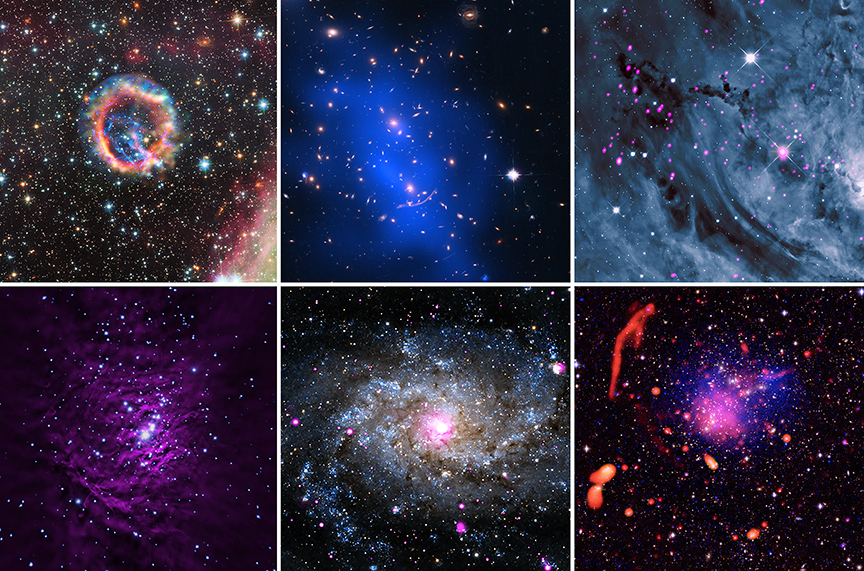
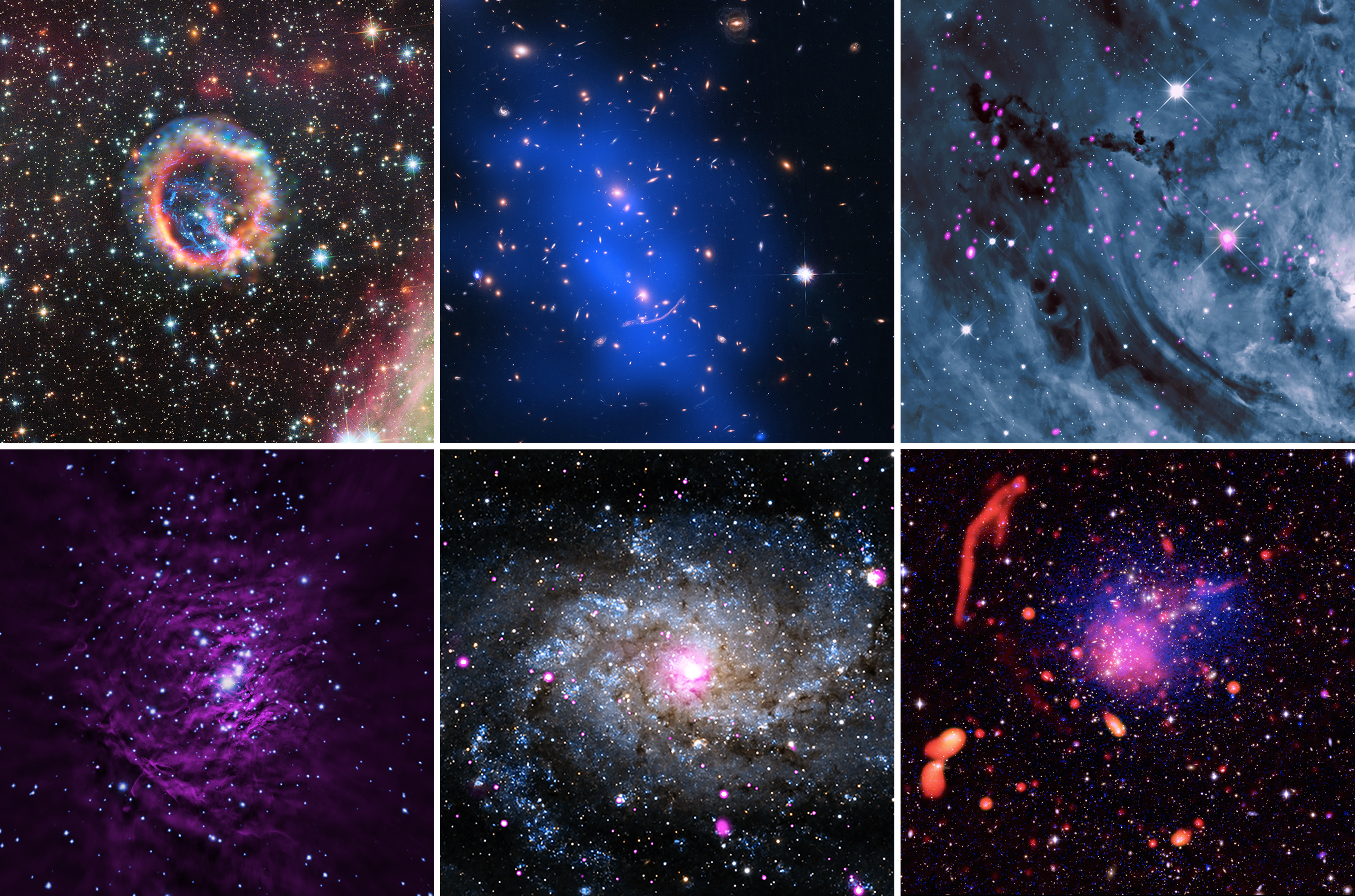
This is the season of celebrating, and the Chandra X-ray Center has prepared a platter of cosmic treats from NASA's Chandra X-ray Observatory to enjoy. This selection represents different types of objects — ranging from relatively nearby exploded stars to extremely distant and massive clusters of galaxies — that emit X-rays detected by Chandra. Each image in this collection blends Chandra data with other telescopes, creating a colorful medley of light from our Universe.


Top row (left to right):

E0102-72.3
This supernova remnant was produced by a massive star that exploded in a nearby galaxy called the Small Magellanic Cloud. X-rays from Chandra (blue and purple) have helped astronomers confirm that most of the oxygen in the universe is synthesized in massive stars. The amount of oxygen in the E0102-72.3 ring shown here is enough for thousands of solar systems. This image also contains optical data from NASA's Hubble Space Telescope and the Very Large Telescope in Chile (red and green).

Abell 370
Located about 4 billion light years from Earth, Abell 370 is a galaxy cluster containing several hundred galaxies. Galaxy clusters are the largest objects in the Universe held together by gravity. In addition to the individual galaxies, they contain vast amounts of multimillion-degree gas that emits X-rays, and dark matter that supplies most of the gravity of the cluster, yet does not produce any light. Chandra reveals the hot gas (diffuse blue regions) in a combined image with optical data from Hubble (red, green, and blue).

Messier 8 (M8)
Also known as NGC 6523 or the Lagoon Nebula, Messier 8 is a giant cloud of gas and dust where stars are currently forming. At a distance of about 4,000 light years from Earth, Messier 8 provides astronomers an excellent opportunity to study the properties of very young stars. Many infant stars give off copious amounts of high-energy light including X-rays, which are seen in the Chandra data (pink). The X-ray data have been combined with an optical image of Messier 8 from the Mt. Lemmon Sky Center in Arizona (blue and white).


Bottom row (left to right):

Orion Nebula
Look just below the middle of the three stars of belt in the constellation of Orion to find the Orion Nebula, which can be seen without a telescope. With a telescope like Chandra, however, the view is much different. In this image, X-rays from Chandra (blue) reveal individual young stars, which are hot and energetic. When combined with radio emission from the NSF's Very Large Array (purple), a vista of this stellar nursery is created that the unaided human eye could never capture.

Messier 33 (M33)
The Triangulum Galaxy, a.k.a., Messier 33, is a spiral galaxy about 3 million light years from Earth. It belongs to the Local Group of galaxies that includes the Milky Way and Andromeda galaxies. Chandra's X-ray data (pink) reveal a diverse range of objects including neutron stars and black holes that are pulling material from a companion star, and supernova remnants. An optical image from amateur astronomer Warren Keller (red, green, and blue) shows the majestic arms of this spiral galaxy that in many ways is a cousin to our own Milky Way.

Abell 2744
This composite image contains the aftermath of a giant collision involving four separate galaxy clusters at a distance of about 3.5 billion light years. Officially known as Abell 2744, this system is also referred to by astronomers as "Pandora's Cluster" because all of the different structures found within it. This view of Abell 2744 contains X-ray data from Chandra (blue) showing hot gas, optical data from Subaru and the VLT (red, green and blue), and radio data from the NSF's Karl G. Jansky Very Large Array (red).

NASA's Marshall Space Flight Center in Huntsville, Alabama, manages the Chandra program for NASA's Science Mission Directorate in Washington. The Smithsonian Astrophysical Observatory in Cambridge, Massachusetts, controls Chandra's science and flight operations.


Saturday, December 15, 2018

The Epoch of Planet Formation, Times Twenty


NGC 346 (Multiwavelength)  
Credits: NASA, JPL-Caltech, and D. Gouliermis (Max-Planck Institute)


Webb’s infrared vision will help researchers tally the population of young stars

Billions of years ago, the young universe blazed with the brilliant light of myriad stars bursting to life. The young stars arising from this stellar "baby boom" are too far away and too faint for even the most powerful telescopes to study in detail. Astronomers will use the upcoming NASA James Webb Space Telescope to study star birth in the nearby Small Magellanic Cloud galaxy, which contains some of the same conditions that existed in galaxies during the universe’s peak star-formation epoch. Webb’s sharp infrared vision will help researchers take a census of medium-mass stars like our Sun still wrapped in their dense, dusty cocoons in the giant stellar nursery NGC 346, located about 200,000 light-years away. This census could help astronomers develop a clearer picture of how the galaxies of long ago churned out stars so rapidly.

The dazzling glow of young stars dominates images of the giant stellar nursery NGC 346, in the neighboring dwarf galaxy called the Small Magellanic Cloud. But this photogenic beauty is more than just a "pretty face."

NGC 346 is a nearby proxy for the myriad star-forming regions that existed when the universe was ablaze with star formation just a few billion years after the big bang. Astronomers do not have telescopes powerful enough to study the details of star formation in these faraway "baby-boom" galaxies. The Hubble Space Telescope imaged NGC 346 to identify the optically bright stars. However, to understand the star-formation process astronomers must peer through the dusty stellar nurseries. Observers will use the sharp infrared vision of NASA’s James Webb Space Telescope to study NGC 346, which could help them develop a clearer picture of how the galaxies of long ago churned out stars at such a tremendous rate.

Webb will allow astronomers to carry out an unprecedented, detailed analysis of a star-forming region that is deficient in elements heavier than hydrogen and helium. In the very early universe only hydrogen and helium (cooked up in the big bang) were available raw materials for star formation. Subsequent generations of stars created heavier elements in their cores through nuclear fusion and through supernova explosions. These elements, such as carbon, nitrogen, and oxygen, are recycled through subsequent generations of stars, planets, and in the case of Earth, all forms of life.

Another link between NGC 346 and the star-forming heyday is the large amount of young, massive stars residing in these fertile areas. These stellar giants wreak havoc on their environment by unleashing searing ultraviolet radiation and powerful stellar winds (streams of charged particles). Energy from these "bullying" monster stars can destroy star-forming clouds of gas and dust and disrupt the disks encircling stars where planets can form.

"The Small Magellanic Cloud could be a local astrophysical laboratory to study processes that happened at the peak star-formation epoch, because those early galaxies contained lots of massive stars and were deficient in heavier elements," said lead researcher Margaret Meixner, of the Space Telescope Science Institute and the Johns Hopkins University, both in Baltimore, Maryland. "The questions are what is the process of star formation in galaxies lacking heavier elements and how is star formation there different than star formation in the Milky Way, which contains heavier elements? You need to get a census of all the forming stars to answer these questions."

A Census of Smaller-mass Stars

The Milky Way contains about 25 percent more heavier elements than the Small Magellanic Cloud. Numerous studies have been conducted on how stars form in the heavier-element-rich Milky Way. But Milky Way stars are nearby, while the stars in the Small Magellanic Cloud are too far away to study all of them in detail. "We’re really hoping to study the NGC 346 region on the scales that we’ve been able to study star formation in our Milky Way galaxy," added team member Isha Nayak of the Johns Hopkins University in Baltimore, Maryland. "It’s hard to resolve things even in nearby galaxies like the Small Magellanic Cloud in the same manner as we can do in our own neighborhood. One question we want answered is, do all of these stars develop in the same way?"

The Webb observations will continue the work started by astronomers using telescopes such as the Herschel Space Observatory and NASA’s Spitzer Space Telescope. Spitzer and Herschel observations provided a census of the massive stars forming in NGC 346, which are eight times our Sun’s mass or larger. But Webb’s Near-Infrared Camera (NIRCam) and Mid-Infrared Imager (MIRI) instruments have the sharpness to catch the smaller stars, from eight solar masses to less than a solar mass.

Astronomers will then have the complete mass distribution of stars in NGC 346. The Webb census may uncover as many as 10,000 young, dust-enshrouded fledgling stars, many of them less than a million years old.v Probing Dusty, Planet-forming Disksv Some of the fledgling stars in NGC 346 have protoplanetary disks encircling them, where planets may form. Researchers will use NIRCam and the MIRI imager to detect the near-infrared dust emission in these disks. "We will be able to determine if these disks are similar to the types of disks we see in our local solar neighborhood that are forming planetary systems," Meixner said. "And, we hope to answer whether planetary systems can form in areas deficient in heavier elements or in very extreme star-forming conditions."

It may be harder to make planets in environments largely lacking heavier elements. "When you have an environment deficient in heavier elements, the ultraviolet radiation from high-mass stars can penetrate much deeper into a molecular gas cloud where stars are forming, so it’s hard for low-mass stars, let alone planets, to form in such an environment," Nayak said.

Dust may be a nuisance for many people, but it is important for star formation. It helps to shield the dense, cold, gaseous cloud in which stars form from scorching radiation and harsh stellar winds that could tear the cloud apart. "Dust plays an important role with providing a safe haven for a stellar nursery," Meixner explained.

Webb’s spectrographs will pinpoint the densest, dustiest regions where star formation is happening and will probe the evolution of the protoplanetary disks. "The question is what do you need to form stars?" Meixner said. "Maybe we will find a relationship between star formation and its environment."

The observations described here will be taken as part of Webb’s Guaranteed Time Observation (GTO) program. The GTO program provides dedicated time to the scientists who have worked with NASA to craft the science and instrument capabilities of Webb throughout its development.

The James Webb Space Telescope will be the world's premier space science observatory when it launches in 2021. Webb will solve mysteries of our solar system, look beyond to distant worlds around other stars, and probe the mysterious structures and origins of our universe and our place in it. Webb is an international project led by NASA with its partners, the European Space Agency (ESA) and the Canadian Space Agency.


Friday, December 14, 2018

In Search of Missing Worlds, Hubble Finds a Fast Evaporating Exoplanet

This artist's illustration shows a giant cloud of hydrogen streaming off a warm, Neptune-sized planet just 97 light-years from Earth. The exoplanet is tiny compared to its star, a red dwarf named GJ 3470. The star's intense radiation is heating the hydrogen in the planet's upper atmosphere to a point where it escapes into space. The alien world is losing hydrogen at a rate 100 times faster than a previously observed warm Neptune whose atmosphere is also evaporating away. Credits: NASA, ESA, and D. Player (STScI)

This graphic plots exoplanets based on their size and distance from their star. Each dot represents an exoplanet. Planets the size of Jupiter (located at the top of the graphic) and planets the size of Earth and so-called super-Earths (at the bottom) are found both close to and far from their star. But planets the size of Neptune (in the middle of the plot) are scarce close to their star. This so-called desert of hot Neptunes shows that such alien worlds are rare, or, they were plentiful at one time, but have since disappeared. The detection that GJ 3470b, a warm Neptune at the border of the desert, is fast losing its atmosphere suggests that hotter Neptunes may have eroded down to smaller, rocky super-Earths. Credits: NASA, ESA, and A. Feild (STScI).  Science: NASA, ESA, and V. Bourrier (University of Geneva, Switzerland)


Fishermen would be puzzled if they netted only big and little fish, but few medium-sized fish. Astronomers likewise have been perplexed in conducting a census of star-hugging extrasolar planets. They have found hot Jupiter-sized planets and hot super-Earths (planets no more than 1.5 times Earth's diameter). These planets are scorching hot because they orbit very close to their star. But so-called "hot Neptunes," whose atmospheres are heated to more than 1,700 degrees Fahrenheit, have been much harder to find. In fact, only about a handful of hot Neptunes have been found so far.

In fact, most of the known Neptune-sized exoplanets are merely "warm," because they orbit farther away from their star than those in the region where astronomers would expect to find hot Neptunes. The mysterious hot-Neptune deficit suggests that such alien worlds are rare, or, they were plentiful at one time, but have since disappeared.

A few years ago astronomers using NASA's Hubble Space Telescope found that one of the warmest known Neptunes (GJ 436b) is losing its atmosphere. The planet isn't expected to evaporate away, but hotter Neptunes might not have been so lucky.

Now, astronomers have used Hubble to nab a second "very warm" Neptune (GJ 3470b) that is losing its atmosphere at a rate 100 times faster than that of GJ 436b. Both planets reside about 3.7 million miles from their star. That's one-tenth the distance between our solar system's innermost planet, Mercury, and the Sun.

"I think this is the first case where this is so dramatic in terms of planetary evolution," said lead researcher Vincent Bourrier of the University of Geneva in Sauverny, Switzerland. "It's one of the most extreme examples of a planet undergoing a major mass-loss over its lifetime. This sizable mass loss has major consequences for its evolution, and it impacts our understanding of the origin and fate of the population of exoplanets close to their stars."

As with the previously discovered evaporating planets, the star's intense radiation heats the atmosphere to a point where it escapes the planet's gravitational pull like an untethered hot air balloon. The escaping gas forms a giant cloud around the planet that dissipates into space. One reason why GJ 3470b may be evaporating faster than GJ 436b is that it is not as dense, so it is less able to gravitationally hang on to the heated atmosphere.

What's more, the star hosting GJ 3470b is only 2 billion years old, compared to the 4-billion- to 8-billion-year-old star that planet GJ 436b orbits. The younger star is more energetic, so it bombards the planet with more blistering radiation than GJ 436b receives. Both are red dwarf stars, which are smaller and longer-lived than our Sun.

Uncovering two evaporating warm Neptunes reinforces the idea that the hotter version of these distant worlds may be a class of transitory planet whose ultimate fate is to shrink down to the most common type of known exoplanet, mini-Neptunes — planets with heavy, hydrogen-dominated atmospheres that are larger than Earth but smaller than Neptune. Eventually, these planets may downsize even further to become super-Earths, more massive, rocky versions of Earth.

"The question has been, where have the hot Neptunes gone?" said Bourrier. "If we plot planetary size and distance from the star, there's a desert, a hole, in that distribution. That's been a puzzle. We don't really know how much the evaporation of the atmospheres played in forming this desert. But our Hubble observations, which show a large amount of mass loss from a warm Neptune at the edge of the desert, is a direct confirmation that atmospheric escape plays a major role in forming this desert."

The researchers used Hubble's Space Telescope Imaging Spectrograph to detect the ultraviolet-light signature of hydrogen in a huge cocoon surrounding the planet as it passed in front of its star. The intervening cocoon of hydrogen filters out some of the starlight. These results are interpreted as evidence of the planet's atmosphere bleeding off into space.

The team estimates that the planet has lost as much as 35 percent of its material over its lifetime, because it was probably losing mass at a faster rate when its red-dwarf star was younger and emitting even more radiation. If the planet continues to rapidly lose material, it will shrink down to a mini-Neptune in a few billion years.

Hydrogen probably isn't the only element evaporating away: it may be a tracer for other material streaming off into space. The researchers plan to use Hubble to hunt for elements heavier than hydrogen and helium that have hitched a ride with the hydrogen gas to escape the planet. "We think that the hydrogen gas could be dragging heavy elements such as carbon, which reside deeper in the atmosphere, upward and out into space," Bourrier said.

The observations are part of the Panchromatic Comparative Exoplanet Treasury (PanCET) survey, a Hubble program to look at 20 exoplanets, mostly hot Jupiters, in the first large-scale ultraviolet, visible, and infrared comparative study of distant worlds.

Observing the evaporation of these two warm Neptunes is encouraging, but team members know they need to study more of them to confirm predictions. Unfortunately, there may be no other planets of this class residing close enough to Earth to observe. The problem is that hydrogen gas cannot be detected in warm Neptunes farther away than 150 light-years from Earth because it is obscured by interstellar gas. GJ 3470b resides 97 light-years away.

However, helium is another tracer for material escaping a warm Neptune's atmosphere. Astronomers could use Hubble and the upcoming NASA James Webb Space Telescope to search in infrared light for helium, because it is not blocked by interstellar material in space.

"Looking for helium could expand our survey range," Bourrier said. "Webb will have incredible sensitivity, so we would be able to detect helium escaping from smaller planets, such as mini-Neptunes."

The researcher's paper will appear in the Dec. 13 issue of Astronomy and Astrophysics.

The Hubble Space Telescope is a project of international cooperation between NASA and ESA (European Space Agency). NASA's Goddard Space Flight Center in Greenbelt, Maryland, manages the telescope. The Space Telescope Science Institute (STScI) in Baltimore, Maryland, conducts Hubble science operations. STScI is operated for NASA by the Association of Universities for Research in Astronomy in Washington, D.C.


Related  Links

This site is not responsible for content found on external links


Contact

Donna Weaver / Ray Villard
Space Telescope Science Institute, Baltimore, Maryland
410-338-4493 / 410-338-4514

dweaver@stsci.edu / villard@stsci.edu

Vincent Bourrier
University of Geneva, Sauverny, Switzerland
011-41-22-379-2449

vincent.bourrier@unige.ch