Showing posts with label Abell 2744. Show all posts

Sunday, May 31, 2026

NASA’s Webb Reveals Black Hole That Formed Before Its Galaxy

An image from NIRCam on NASA’s James Webb Space Telescope shows Little Red Dot Abell2744-QSO1, magnified and triply imaged by galaxy cluster Abell 2744 (Pandora’s Cluster). Credit Image: NASA, ESA, CSA, Lukas Furtak (Ben-Gurion University); Image Processing: Alyssa Pagan (STScI)

An image detail from NIRCam (left) on NASA’s James Webb Space Telescope shows Little Red Dot Abell2744-QSO1. A map of gas velocity in QSO1 (right), made using the IFU on NIRSpec, shows evidence for a 50-million-solar-mass black hole at the center. Credit Image: NASA, ESA, CSA, Ignas Juodžbalis (Cambridge), Cosimo Marconcini (University of Florence), Roberto Maiolino (Cambridge), Francesco D'Eugenio (Cambridge), Hannah Übler (MPE); Image Processing: Alyssa Pagan (STScI)

Image of Abell 2744 and Little Red Dot Abell2744-QSO1, captured by Webb’s NIRCam, with compass arrows, scale bar, and color key for reference. Credit Image: NASA, ESA, CSA, Lukas Furtak (Ben-Gurion University); Image Processing: Alyssa Pagan (STScI)

A sonification is a translation of data into sound. In this sonification, the velocity of hydrogen gas moving around a black hole in the center of a Little Red Dot known as Abell2744-QSO1 (QSO1) is translated into sounds of varying pitch (or frequency). The faster the gas is moving toward the telescope, the higher the pitch. The faster it is moving away from the telescope, the lower the pitch. Credit Sonification: NASA, ESA, CSA, STScI, Christopher Britt (STScI), Ralf Crawford (STScI), Alyssa Pagan (STScI), Margaret Carruthers (STScI); Science: Ignas Juodžbalis (Cambridge), Cosimo Marconcini (University of Florence), Roberto Maiolino (Cambridge), Francesco D'Eugenio (Cambridge), Hannah Übler (MPE)


Which comes first, the galaxy or the black hole? We don’t know, but scientists have long thought it could be the galaxy: Large stars within an existing galaxy consume their fuel and collapse to form black holes, which can gobble up surrounding material and merge over time to form more massive entities.

But it’s hard to figure out how black holes millions to billions of times the mass of the Sun, thousands of which have now been detected in the early universe, could have grown so quickly from such small seeds.

Now, researchers using NASA’s James Webb Space Telescope have detected clear evidence that some supermassive black holes were enormous from the beginning, forming without a stellar collapse phase, and without a significantly more massive host galaxy to feed them.

“This is a remarkable finding,” said Roberto Maiolino of University of Cambridge in the United Kingdom, co-author of studies published in Nature and the Monthly Notices of the Royal Astronomical Society. “It’s a paradigm shift, a total revisiting of the classical scenarios of how black holes form and grow.”

Little Red Dot QSO1

The team’s conclusion is based on detailed observations of Abell2744-QSO1 (QSO1), a prototypical Little Red Dot that existed just 700 million years after the big bang.

Although QSO1 is only 1,300 light-years across, and its light has been traveling for more than 13 billion years, it is easier to study than most other Little Red Dots because it is gravitationally lensed by galaxy cluster Abell 2744 (Pandora’s Cluster). QSO1 is both magnified and triply imaged, appearing in three different locations in the sky.

Initial studies of QSO1 revealed compelling evidence that it may be little more than a cloud of glowing hydrogen and helium gas circling a supermassive black hole estimated at 40 million times the mass of the Sun. But as with other early black holes discovered by Webb, there was uncertainty about whether it really was that massive. “Before now, all of the mass measurements of black holes in the early universe have been indirect, based on assumptions from what we know about them in the local universe. We didn’t know if those assumptions really apply to the distant universe,” said co-author Francesco D’Eugenio, also of the University of Cambridge.

Mapping gas composition, velocity

The team recognized that if QSO1’s black hole is as massive as it looks, they should be able to use the integral field unit (IFU) on Webb’s NIRSpec (Near Infrared Spectrograph) to trace the effects of its gravity on the gas swirling around it, while also mapping the distribution of various elements in the gas.

Cambridge graduate student Ignas Juodžbalis and Cosimo Marconcini of the University of Florence, lead authors on one of the studies, used the IFU observations to map motions of hydrogen gas surrounding the black hole. When they plotted the rotation velocity as a function of distance from the center, they found that the gas has Keplerian motion: It orbits a central point in the same way that planets in our solar system orbit the Sun.

“This is important because it tells us that most of the mass of QSO1 is concentrated in the black hole at the center,” said Juodžbalis. “If the mass were more distributed, as it would be if there were a lot of stars, the gas would not have this perfect Keplerian rotation.”

Since Keplerian motion is governed by simple laws of gravity, the team was able to use the gas velocity measurements to calculate the black hole mass directly, a feat that had not previously been possible.

They found that not only is the black hole immense — roughly 50 million solar masses — it makes up, at minimum, an astonishing two-thirds of QSO1’s total mass. This proportion is thousands of times greater than in nearby galaxies, where supermassive black holes make up only a tiny fraction of the host galaxy’s total mass.

The IFU composition maps supported these results, showing that the gas throughout QSO1 is almost entirely hydrogen and helium, with very little of the heavier elements like oxygen that would be expected in a galaxy rich with stars and stellar debris. With a metallicity less than 0.5% of the Sun, QSO1 is one of the most pristine galactic environments ever measured.

“This is a phenomenal result,” said Maiolino. “It is the first direct measurement of a black hole mass within the first billion years after the big bang, and it is consistent with the previous measurements.” The team thinks this is a good sign that the assumptions used for indirect mass measurements are valid and the masses of other black holes in the early universe have not been overestimated.

Supermassive black hole origins

The team recognized that if QSO1’s black hole is as massive as it looks, they should be able to use the integral The outsized mass of QSO1 relative to its host galaxy suggests that it can’t have formed gradually from much smaller, stellar-mass black holes merging and feeding. “It seems that we have found a black hole that does not have a substantial host galaxy and that has predated stellar processes,” said Juodžbalis. “This is very exciting because it is evidence for primordial black holes or direct collapse black holes, which have been theorized but not confirmed.”

Whether QSO1’s black hole evolved from a “heavy seed” that formed within the first second of the big bang or somewhat later from the collapse of a giant cloud of gas, it was almost certainly born big, and may be in the early stages of building a galaxy around it.

The team thinks that Little Red Dots like QSO1 cannot have been rare in the early universe, and is in the process of analyzing similar objects to find out whether supermassive black holes actually do predate the galaxies where they currently reside.

The James Webb Space Telescope is the world’s premier space science observatory. Webb is solving mysteries in our solar system, looking beyond to distant worlds around other stars, and probing the mysterious structures and origins of our universe and our place in it. Webb is an international program led by NASA with its partners, ESA (European Space Agency) and CSA (Canadian Space Agency).


Related Links

Watch: NASA Black Hole Visualization Takes Viewers Beyond the Brink

Explore more: ViewSpace | Black Holes: Searching for the unseen

Read more: Dissecting Supermassive Black Holes

Watch: What Webb Learns from Light

Explore more: NASA's Universe of Learning: Black Hole Resources

More Webb News

More Webb Images

Webb Science Themes

Webb Mission Page


Wednesday, February 15, 2023

NASA’s Webb Uncovers New Details in Pandora’s Cluster

Pandora's Cluster (NIRCam Image)
Credits: Science: NASA, ESA, CSA, Ivo Labbe (Swinburne), Rachel Bezanson (University of Pittsburgh)
Image Processing: Alyssa Pagan (STScI)

Release Images |  Release Videos


Astronomers have revealed the latest deep field image from NASA’s James Webb Space Telescope, featuring never-before-seen details in a region of space known as Pandora’s Cluster (Abell 2744). Webb’s view displays three clusters of galaxies – already massive – coming together to form a megacluster. The combined mass of the galaxy clusters creates a powerful gravitational lens, a natural magnification effect of gravity, allowing much more distant galaxies in the early universe to be observed by using the cluster like a magnifying glass.

Only Pandora’s central core has previously been studied in detail by NASA’s Hubble Space Telescope . By combining Webb’s powerful infrared instruments with a broad mosaic view of the region’s multiple areas of lensing, astronomers aimed to achieve a balance of breadth and depth that will open up a new frontier in the study of cosmology and galaxy evolution.

“The ancient myth of Pandora is about human curiosity and discoveries that delineate the past from the future, which I think is a fitting connection to the new realms of the universe Webb is opening up, including this deep-field image of Pandora’s Cluster,” said astronomer Rachel Bezanson of the University of Pittsburgh in Pennsylvania, co-principal investigator on the Ultradeep NIRSpec and NIRCam ObserVations before the Epoch of Reionization (UNCOVER) program to study the region.

“When the images of Pandora’s Cluster first came in from Webb, we were honestly a little star struck,” said Bezanson. “There was so much detail in the foreground cluster and so many distant lensed galaxies, I found myself getting lost in the image. Webb exceeded our expectations.” The new view of Pandora’s Cluster stitches four Webb snapshots together into one panoramic image, displaying roughly 50,000 sources of near-infrared light.

In addition to magnification, gravitational lensing distorts the appearance of distant galaxies, so they look very different than those in the foreground. The galaxy cluster “lens” is so massive that it warps the fabric of space itself, enough for light from distant galaxies that passes through that warped space to also take on a warped appearance.

Astronomer Ivo Labbe of the Swinburne University of Technology in Melbourne, Australia, co-principal investigator on the UNCOVER program, said that in the lensing core to the lower right in the Webb image, which has never been imaged by Hubble, Webb revealed hundreds of distant lensed galaxies that appear like faint arced lines in the image. Zooming in on the region reveals more and more of them.

“Pandora’s Cluster, as imaged by Webb, shows us a stronger, wider, deeper, better lens than we have ever seen before,” Labbe said. “My first reaction to the image was that it was so beautiful, it looked like a galaxy formation simulation. We had to remind ourselves that this was real data, and we are working in a new era of astronomy now.”

The UNCOVER team used Webb’s Near-Infrared Camera (NIRCam) to capture the cluster with exposures lasting 4-6 hours, for a total of about 30 hours of observing time. The next step is to meticulously go through the imaging data and select galaxies for follow-up observation with the Near-Infrared Spectrograph (NIRSpec), which will provide precise distance measurements, along with other detailed information about the lensed galaxies’ compositions, providing new insights into the early era of galaxy assembly and evolution. The UNCOVER team expects to make these NIRSpec observations in the summer of 2023.

In the meantime, all of the NIRCam photometric data has been publicly released so that other astronomers can become familiar with it and plan their own scientific studies with Webb’s rich datasets. “We are committed to helping the astronomy community make the best use of the fantastic resource we have in Webb,” said UNCOVER co-investigator Gabriel Brammer of the Niels Bohr Institute’s Cosmic Dawn Center at the University of Copenhagen. “This is just the beginning of all the amazing Webb science to come.”

The imaging mosaics and catalog of sources on Pandora’s Cluster (Abell 2744) provided by the UNCOVER team combine publicly available Hubble data with Webb photometry from three early observation programs: JWST-GO-2561 , JWST-DD-ERS-1324 , and JWST-DD-2756 .

The James Webb Space Telescope is the world's premier space science observatory. Webb will solve mysteries in our solar system, look beyond to distant worlds around other stars, and probe the mysterious structures and origins of our universe and our place in it. Webb is an international program led by NASA with its partners, ESA (European Space Agency) and the Canadian Space Agency.


About This Release

Credits:

Media Contact:

Leah Ramsay
Space Telescope Science Institute, Baltimore, Maryland

Christine Pulliam

Space Telescope Science Institute, Baltimore, Maryland

Permissions: Content Use Policy

Contact Us: Direct inquiries to the News Team.

Related Links and Documents:


Monday, February 13, 2023

Footprints of Galactic Immigration Uncovered in Andromeda Galaxy

PR Video noirlab2304a
Galactic Immigration in the Andromeda Galaxy

PR Video noirlab2304b
Excerpt of the DESI measurements of the Andromeda Galaxy


Videos

Cosmoview Episode 62: Footprints of Galactic Immigration Uncovered in Andromeda Galaxy
Cosmoview Episode 62: Footprints of Galactic Immigration Uncovered in Andromeda Galaxy 
 
Cosmoview Episodio 62: Descubren las huellas de inmigración galáctica en la galaxia de Adrómeda


The Dark Energy Spectroscopic Instrument reveals compelling evidence of a mass migration of stars into a galaxy other than the Milky Way

A team of researchers led by astronomers at NSF’s NOIRLab has uncovered striking new evidence for a mass migration of stars into the Andromeda Galaxy. Intricate patterns in the motions of stars reveal an immigration history very similar to that of the Milky Way. The new results were obtained with the DOE’s Dark Energy Spectroscopic Instrument on the Nicholas U. Mayall 4-meter Telescope at Kitt Peak National Observatory, a Program of NSF’s NOIRLab.

Over the course of billions of years, galaxies grow and evolve by forging new stars and merging with other galaxies through aptly named “galactic immigration” events. Astronomers try to uncover the histories of these immigration events by studying the motions of individual stars throughout a galaxy and its extended halo of stars and dark matter. Such cosmic archaeology, however, has only been possible in our own galaxy, the Milky Way, until now.

An international team of researchers has uncovered striking new evidence of a large galactic immigration event in the Andromeda Galaxy, the Milky Way’s nearest large galactic neighbor. The new results were made with the DOE’s Dark Energy Spectroscopic Instrument (DESI) on the Nicholas U. Mayall 4-meter Telescope at Kitt Peak National Observatory, a Program of NSF’s NOIRLab.

By measuring the motions of nearly 7500 stars in the inner halo of the Andromeda Galaxy, also known as Messier 31 (M31), the team discovered telltale patterns in the positions and motions of stars that revealed how these stars began their lives as part of another galaxy that merged with M31 about 2 billion years ago. While such patterns have long been predicted by theory, they have never been seen with such clarity in any galaxy.

“Our new observations of the Milky Way’s nearest large galactic neighbor, the Andromeda Galaxy, reveal evidence of a galactic immigration event in exquisite detail,” explained Arjun Dey, astronomer at NSF’s NOIRLab and the lead author of the paper presenting this research. “Although the night sky may seem unchanging, the Universe is a dynamic place. Galaxies like M31 and our Milky Way are constructed from the building blocks of many smaller galaxies over cosmic history. ”

“We have never before seen this so clearly in the motions of stars, nor had we seen some of the structures that result from this merger,” said Sergey Koposov, an astrophysicist at the University of Edinburgh and coauthor of the paper. “Our emerging picture is that the history of the Andromeda Galaxy is similar to that of our own Galaxy, the Milky Way. The inner halos of both galaxies are dominated by a single immigration event.”

This research sheds light on not only the history of our galactic neighbors but also the history of our own galaxy. Most of the stars in the Milky Way’s halo were formed in another galaxy and later migrated into our own in a galactic merger 8–10 billion years ago. Studying the relics of a similar, but more recent, galaxy merger in M31 gives astronomers a window onto one of the major events in the Milky Way’s past.

To trace the history of migration in M31, the team turned to DESI. DESI was constructed to map tens of millions of galaxies and quasars in the nearby Universe in order to measure the effect of dark energy on the expansion of the Universe. It is the most powerful multi-object survey spectrograph in the world, and is capable of measuring the spectra of more than 100,000 galaxies a night. DESI’s world-class capabilities can also be put to use closer to home, however, and the instrument was crucial to the team’s survey of M31.

“This science could not have been done at any other facility in the world. DESI’s amazing efficiency, throughput, and field of view make it the best system in the world to carry out a survey of the stars in the Andromeda Galaxy,” said Dey. “In only a few hours of observing time, DESI was able to surpass more than a decade of spectroscopy with much larger telescopes.”

Even though the Mayall Telescope was completed 50 years ago (it achieved first light in 1973), it remains a world-class astronomical facility thanks to continued upgrades and state-of-the-art instrumentation. “Fifty years sounds like a long time, and naïvely one might think that’s the natural lifetime of a facility,” said co-author Joan R. Najita, also at NOIRLab. “But with renewal and reuse, a venerable telescope like the Mayall can continue to make amazing discoveries despite being relatively small by today’s standards.”

The research was carried out in collaboration with two Harvard University undergraduates, Gabriel Maxemin and Joshua Josephy-Zack, who connected with the project through the Radcliffe Institute for Advanced Study. Najita was a Radcliffe Fellow from 2021 to 2022.

The team now plans to use the unparalleled capabilities of DESI and the Mayall Telescope to explore more of M31’s outlying stars, with the aim of revealing its structure and immigration history in unprecedented detail.

“It’s amazing that we can look out at the sky and read billions of years of another galaxy’s history as written in the motions of its stars — each star tells part of the story,” concluded Najita. “Our initial observations exceeded our wildest expectations and we are now hoping to conduct a survey of the entire M31 halo with DESI. Who knows what new discoveries await!”


More Information:

The Dark Energy Spectroscopic Instrument reveals compelling evidence of a mass migration of stars into a galaxy other than the Milky Way

A Dey, A. et al., (2023) “DESI Observations of the Andromeda Galaxy: Revealing the Immigration History of our Nearest Neighbor” to appear in The Astrophysical Journal.

NSF’s NOIRLab (National Optical-Infrared Astronomy Research Laboratory), the US center for ground-based optical-infrared astronomy, operates the international Gemini Observatory (a facility of NSF, NRC–Canada, ANID–Chile, MCTIC–Brazil, MINCyT–Argentina, and KASI–Republic of Korea), Kitt Peak National Observatory (KPNO), Cerro Tololo Inter-American Observatory (CTIO), the Community Science and Data Center (CSDC), and Vera C. Rubin Observatory (operated in cooperation with the Department of Energy’s SLAC National Accelerator Laboratory). It is managed by the Association of Universities for Research in Astronomy (AURA) under a cooperative agreement with NSF and is headquartered in Tucson, Arizona. The astronomical community is honored to have the opportunity to conduct astronomical research on Iolkam Du’ag (Kitt Peak) in Arizona, on Maunakea in Hawai‘i, and on Cerro Tololo and Cerro Pachón in Chile. We recognize and acknowledge the very significant cultural role and reverence that these sites have to the Tohono O’odham Nation, to the Native Hawaiian community, and to the local communities in Chile, respectively.


Links


Contacts:

Arjun Dey
Astronomer
NSF’s NOIRLab
Email:
arjun.dey@noirlab.edu

Joan R. Najita
Astronomer
NSF’s NOIRLab
Email:
joan.najita@noirlab.edu

Charles Blue
Public Information Officer
NSF’s NOIRLab
Tel: +1 202-236-6324
Email:
charles.blue@noirlab.edu


Monday, November 21, 2022

NASA's Webb Draws Back Curtain on Universe's Early Galaxies

Abell 2744 GLASS (NIRCam Image)
Credits: Science: NASA, ESA, CSA, Tommaso Treu (UCLA)
Image Processing: Zolt G. Levay (STScI)

 Release images | Release videos


A few days after officially starting science operations, NASA's James Webb Space Telescope propelled astronomers into a realm of early galaxies, previously hidden beyond the grasp of all other telescopes until now.

“Everything we see is new. Webb is showing us that there's a very rich universe beyond what we imagined," said Tommaso Treu of the University of California at Los Angeles, principal investigator on one of the Webb programs. "Once again the universe has surprised us. These early galaxies are very unusual in many ways."

Two research papers, led by Marco Castellano of the National Institute for Astrophysics in Rome, Italy, and Rohan Naidu of the Harvard-Smithsonian Center for Astrophysics and the Massachusetts Institute of Technology in Cambridge, Massachusetts, have been published in the Astrophysical Journal Letters.

These initial findings are from a broader Webb research initiative involving two Early Release Science (ERS) programs: the Grism Lens-Amplified Survey from Space (GLASS), and the Cosmic Evolution Early Release Science Survey (CEERS).

With just four days of analysis, researchers found two exceptionally bright galaxies in the GLASS-JWST images. These galaxies existed approximately 450 and 350 million years after the big bang (with a redshift of approximately 10.5 and 12.5, respectively), though future spectroscopic measurements with Webb will help confirm.

"With Webb, we were amazed to find the most distant starlight that anyone had ever seen, just days after Webb released its first data," said Naidu of the more distant GLASS galaxy, referred to as GLASS-z12, which is believed to date back to 350 million years after big bang. The previous record holder is galaxy GN-z11, which existed 400 million years after the big bang (redshift 11.1), and was identified in 2016 by Hubble and Keck Observatory in deep-sky programs.

"Based on all the predictions, we thought we had to search a much bigger volume of space to find such galaxies," said Castellano.

"These observations just make your head explode. This is a whole new chapter in astronomy. It's like an archaeological dig, and suddenly you find a lost city or something you didn’t know about. It’s just staggering," added Paola Santini, fourth author of the Castellano et al. GLASS-JWST paper.

"While the distances of these early sources still need to be confirmed with spectroscopy, their extreme brightnesses are a real puzzle, challenging our understanding of galaxy formation," noted Pascal Oesch at the University of Geneva in Switzerland, second author of the Naidu et al. paper.

The Webb observations nudge astronomers toward a consensus that an unusual number of galaxies in the early universe were so much brighter than expected. This will make it easier for Webb to find even more early galaxies in subsequent deep sky surveys, say researchers.

"We've nailed something that is incredibly fascinating. These galaxies would have had to have started coming together maybe just 100 million years after the big bang. Nobody expected that the dark ages would have ended so early," said Garth Illingworth of the University of California at Santa Cruz, a member of the Naidu/Oesch team. "The primal universe would have been just one hundredth its current age. It's a sliver of time in the 13.8 billion-year-old evolving cosmos."

Erica Nelson of the University of Colorado in Boulder, a member of the Naidu/Oesch team, noted that "our team was struck by being able to measure the shapes of these first galaxies; their calm, orderly disks question our understanding of how the first galaxies formed in the crowded, chaotic early universe." This remarkable discovery of compact disks at such early times was only possible because of Webb’s much sharper images, in infrared light, compared to Hubble.

"These galaxies are very different than the Milky Way or other big galaxies we see around us today," said Treu.

Illingworth emphasized the two bright galaxies found by these teams have a lot of light. He said one option is that they could have been very massive, with lots of low-mass stars, like later galaxies. Alternatively, they could be much less massive, consisting of far fewer extraordinarily bright stars, known as Population III stars. Long theorized, they would be the first stars ever born, blazing at blistering temperatures and made up only of primordial hydrogen and helium – before stars could later cook up heavier elements in their nuclear fusion furnaces. No such extremely hot, primordial stars are seen in the local universe.

"Indeed, the farthest source is very compact, and its colors seem to indicate that its stellar population is particularly devoid of heavy elements and could even contain some Population III stars. Only Webb spectra will tell," said Adriano Fontana, second author of the Castellano et al. paper and a member of the GLASS-JWST team.

Present Webb distance estimates to these two galaxies are based on measuring their infrared colors. Eventually, follow-up spectroscopy measurements showing how light has been stretched in the expanding universe will provide independent verification of these cosmic yardstick measurements.

The James Webb Space Telescope is the world’s premier space science observatory. Webb will solve mysteries in our solar system, look beyond to distant worlds around other stars, and probe the mysterious structures and origins of our universe and our place in it. Webb is an international program led by NASA with its partners, ESA (European Space Agency) and CSA (Canadian Space Agency).


About This Release: Credits:

Release: NASA, ESA, CSA, STScI

Media Contact:


Ray Villard
Space Telescope Science Institute, Baltimore, Maryland

Christine Pulliam
 Space Telescope Science Institute, Baltimore, Maryland

Permissions:
Content Use Policy

Contact us: Direct inquiries to the News Team.

Related Links and Documents:


Monday, March 25, 2019

NASA’s Webb to Explore Galaxies from Cosmic Dawn to Present Day

Abell 2744, nicknamed Pandora's Cluster, is a giant pile-up of four smaller galaxy clusters. The cluster is so massive that its powerful gravity bends the light from galaxies far behind it, making the background objects appear larger and brighter in a phenomenon called gravitational lensing. Shown in this Hubble image, the mammoth Abell 2744 cluster is located about 3.5 billion light-years away. Credits: NASA, ESA, and J. Lotz, M. Mountain, A. Koekemoer, and the HFF Team (STScI). Hi-res images

How did the first galaxies in the universe form, and did they make the universe transparent to light? How did later galaxies produce and disperse into the universe the heavier elements that are the building blocks of stars, planets, and even humans? These are questions astronomers will address in some of the first observations made by NASA’s James Webb Space Telescope, slated to launch in March 2021. Astronomers hope the answers will lead to a better understanding of the origins and evolution of the universe. 

Through the combined power of NASA’s James Webb Space Telescope and gravity creating “natural telescopes” in space, astronomers hope to answer two science questions that are fundamental to understanding the origins and evolution of the universe:

- How did the first galaxies in the universe form, and did they make the universe transparent to light?

- How did later galaxies produce and disperse into the universe the heavier elements that are the building blocks of stars, planets, and even humans?

These questions will be addressed in some of the first observations made by the Webb telescope, slated to launch in March 2021. These observations will be part of the Director’s Discretionary-Early Release Science program, which provides time to selected projects early in the telescope’s mission. This program allows the astronomical community to quickly learn how best to use Webb’s capabilities, while also yielding robust science.

An international team led by Tommaso Treu of the University of California, Los Angeles, has been investigating how Webb can tackle these two key questions about the universe in the Early Release Science program.

Treu and his team will study the earliest, most distant galaxies to investigate their origins. After the big bang, the universe cooled down. As it cooled, protons and electrons combined to form neutral hydrogen atoms, until the universe became filled with hydrogen and opaque to light. Then at some point, the first galaxies formed, and scientists think these first galaxies emitted enough ultraviolet light to destroy the neutral hydrogen atoms and make the universe transparent to light. This is called the end of the “dark ages.”

“We’re not exactly sure when this happens, and we think it’s galaxies making the universe transparent, but we are not totally sure,” Treu said. “One of the things our proposal will try to do is establish whether indeed galaxies are the ones that are making the universe transparent — ending the cosmic dark ages — and what kind of galaxies they are, what are their properties, and when this happens.”

Using Gravity as a “Natural Telescope”

To see the faintest, farthest galaxies, the team will combine the power of Webb with the magnification of a “natural telescope” in space. The phenomenon, called gravitational lensing, occurs when a huge amount of matter, such as a cluster of galaxies, creates a gravitational field that distorts and magnifies the light from distant galaxies that are behind it, but in the same line of sight. The effect allows researchers to study the details of early galaxies too far away to be seen with current technology and telescopes.

One gravitational lens is Abell 2744, an enormous cluster of four smaller galaxy clusters. Also known as Pandora’s Cluster, this giant collection of galaxies has been well studied, including by NASA’s Hubble Space Telescope. Abell 2744 is one of many clusters that scientists can use in combination with Webb to peer back into the universe’s distant past.

“It’s a cluster that we know very well,” Treu said. “The fact that we know it so well means that we can calculate very precisely the properties of the lens. Using our models, we can compute very accurately how the background images have been distorted. Then we can invert that to figure out the intrinsic properties of the objects as they would look without the lens in front."

Simultaneously, the team will take deep images in the near and medium infrared of two fields offset from the cluster. “We will use those to count galaxies in the very early universe and figure out how many there are,” explained Treu. “Those are the sources that are suspected to eventually produce the ionizing photons that end the dark ages.”

Forming the Universe’s Heavier Elements

The big bang only formed hydrogen, helium, and traces of other light elements. Heavier elements like iron, oxygen, and carbon, which are made in stars, eventually ended up in the universe — but scientists don’t know exactly how this process happened.

“In astronomy, we think of hydrogen and helium as the light elements, and everything else we call a ‘metal,’” explained team member Alaina Henry of the Space Telescope Science Institute in Baltimore, Maryland. “We want to measure the metals that are produced by the first stars in the first supernovae. This tells us how the stars evolve, and how many end their lives as supernovae, where the heaviest elements — such as iron — are made.”

Identifying the “Fingerprints” of Elements in the Light

Answering both questions requires the unique spectroscopic capabilities of the Webb telescope. Spectroscopy separates an object’s light into its component colors, allowing scientists to see the “fingerprints” of different elements. By analyzing these spectral fingerprints, astronomers can determine the physical properties of that object, including its temperature, mass, luminosity, and composition.

Treu and his team will use two different spectrographs on Webb, each with different strengths and functions. Comparing and contrasting these capabilities is an important technical goal of their program.

Webb’s Near Infrared Imager and Slitless Spectrograph (NIRISS) gives observers spatial information, so they can determine how a spectrum changes across the sky. However, it has relatively low spectral resolution, meaning it is harder to differentiate between very similar colors.

The telescope’s Near Infrared Spectrograph (NIRSpec) has a quarter of a million tiny microshutters, each as wide as a human hair. These shutters can be opened or closed individually to isolate the light from a particular object. “In exchange for that, you lose spatial information,” said Treu, “but you get much higher spectral information. You can see the motion of the gas, both within galaxies and flowing in and out of them.”

“Webb will effectively be a much more capable spectrograph than we have ever had in space,” Treu added. “It will have multiple instruments to disperse the light. We need to understand the strengths of each one and how they complement each other.”

Expectations

Looking deep into the cosmos, Treu and his team expect to get a very good idea of the opacity of the universe, and also learn how ionizing photons — particles of light — escaped from the very early galaxies. They will also observe nearer galaxies at later times, when the galaxies are forming stars very vigorously. “We will get the best view ever of this process of gas flowing in, forming stars, and then being blown out by super-winds,” Treu said.

“It would be really fun if we found spectral features that we hadn’t seen very often, or maybe not at all before,” added Henry.

The James Webb Space Telescope will be the world’s premier space science observatory when it launches in 2021. Webb will solve mysteries of our solar system, look beyond to distant worlds around other stars, and probe the mysterious structures and origins of our universe and our place in it. Webb is an international project led by NASA with its partners, ESA (European Space Agency) and the Canadian Space Agency.


Tuesday, December 18, 2018

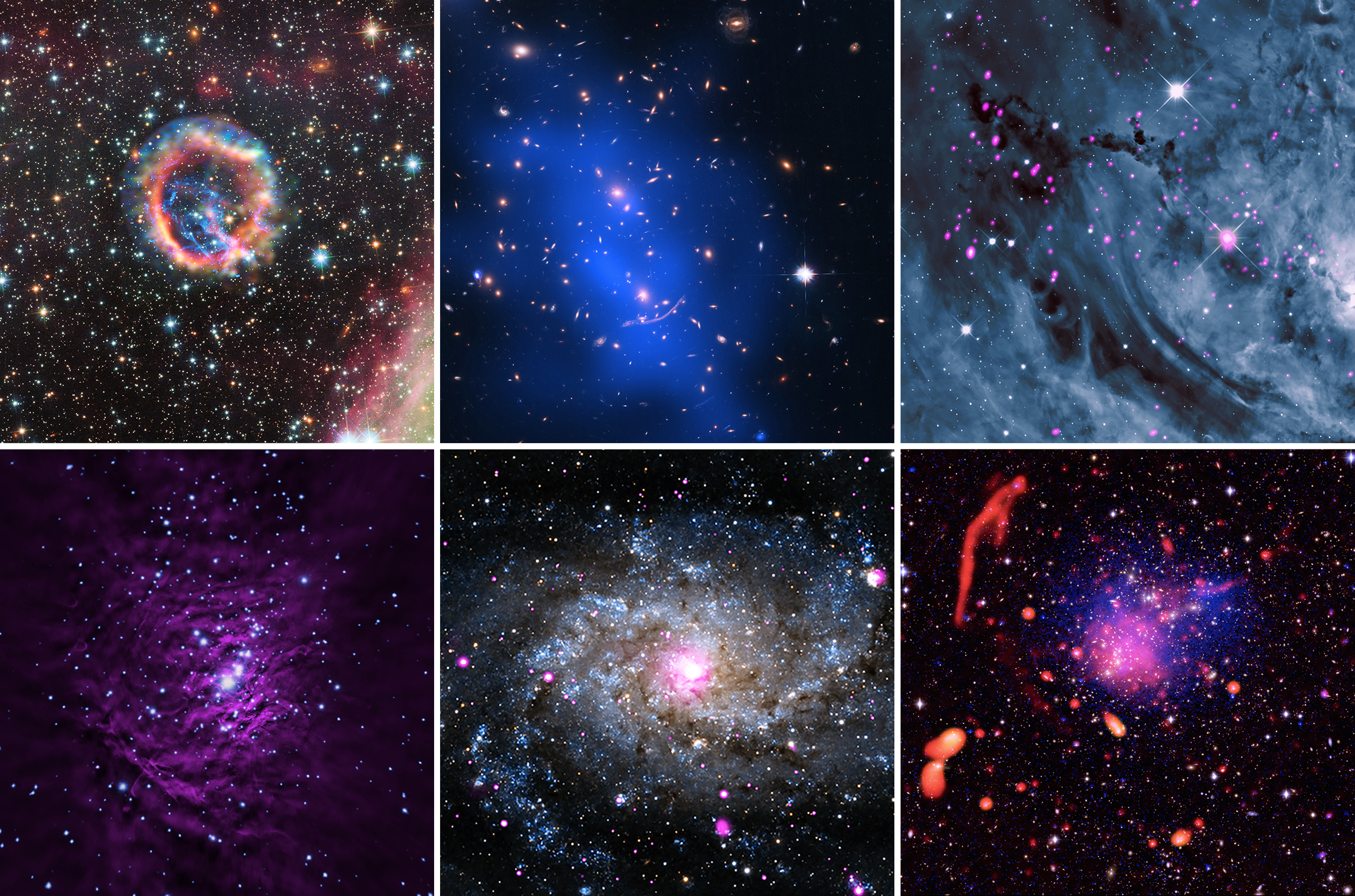
Chandra Serves up Cosmic Holiday Assortment

Chandra Archive Collection
Credit  NASA/CXC/SAO


Chandra Archive Collection:   


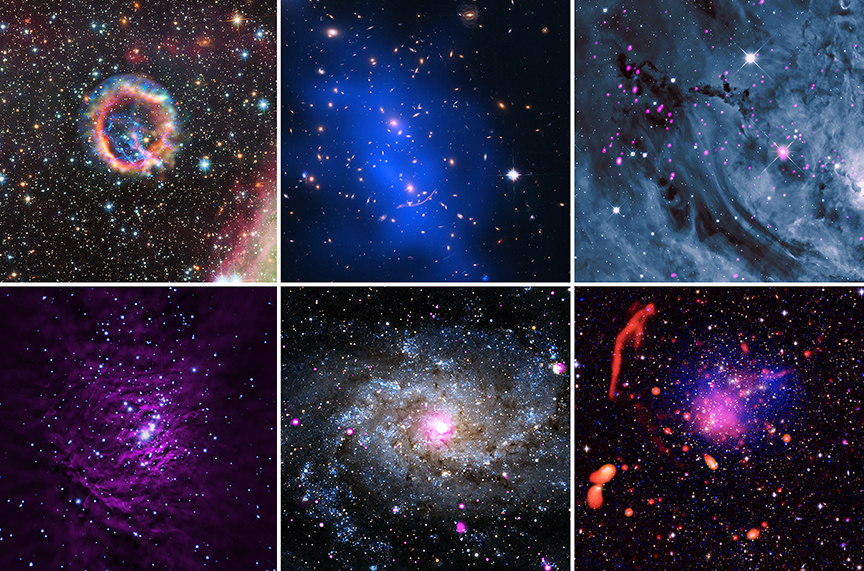
This is the season of celebrating, and the Chandra X-ray Center has prepared a platter of cosmic treats from NASA's Chandra X-ray Observatory to enjoy. This selection represents different types of objects — ranging from relatively nearby exploded stars to extremely distant and massive clusters of galaxies — that emit X-rays detected by Chandra. Each image in this collection blends Chandra data with other telescopes, creating a colorful medley of light from our Universe.


Top row (left to right):

E0102-72.3
This supernova remnant was produced by a massive star that exploded in a nearby galaxy called the Small Magellanic Cloud. X-rays from Chandra (blue and purple) have helped astronomers confirm that most of the oxygen in the universe is synthesized in massive stars. The amount of oxygen in the E0102-72.3 ring shown here is enough for thousands of solar systems. This image also contains optical data from NASA's Hubble Space Telescope and the Very Large Telescope in Chile (red and green).

Abell 370
Located about 4 billion light years from Earth, Abell 370 is a galaxy cluster containing several hundred galaxies. Galaxy clusters are the largest objects in the Universe held together by gravity. In addition to the individual galaxies, they contain vast amounts of multimillion-degree gas that emits X-rays, and dark matter that supplies most of the gravity of the cluster, yet does not produce any light. Chandra reveals the hot gas (diffuse blue regions) in a combined image with optical data from Hubble (red, green, and blue).

Messier 8 (M8)
Also known as NGC 6523 or the Lagoon Nebula, Messier 8 is a giant cloud of gas and dust where stars are currently forming. At a distance of about 4,000 light years from Earth, Messier 8 provides astronomers an excellent opportunity to study the properties of very young stars. Many infant stars give off copious amounts of high-energy light including X-rays, which are seen in the Chandra data (pink). The X-ray data have been combined with an optical image of Messier 8 from the Mt. Lemmon Sky Center in Arizona (blue and white).


Bottom row (left to right):

Orion Nebula
Look just below the middle of the three stars of belt in the constellation of Orion to find the Orion Nebula, which can be seen without a telescope. With a telescope like Chandra, however, the view is much different. In this image, X-rays from Chandra (blue) reveal individual young stars, which are hot and energetic. When combined with radio emission from the NSF's Very Large Array (purple), a vista of this stellar nursery is created that the unaided human eye could never capture.

Messier 33 (M33)
The Triangulum Galaxy, a.k.a., Messier 33, is a spiral galaxy about 3 million light years from Earth. It belongs to the Local Group of galaxies that includes the Milky Way and Andromeda galaxies. Chandra's X-ray data (pink) reveal a diverse range of objects including neutron stars and black holes that are pulling material from a companion star, and supernova remnants. An optical image from amateur astronomer Warren Keller (red, green, and blue) shows the majestic arms of this spiral galaxy that in many ways is a cousin to our own Milky Way.

Abell 2744
This composite image contains the aftermath of a giant collision involving four separate galaxy clusters at a distance of about 3.5 billion light years. Officially known as Abell 2744, this system is also referred to by astronomers as "Pandora's Cluster" because all of the different structures found within it. This view of Abell 2744 contains X-ray data from Chandra (blue) showing hot gas, optical data from Subaru and the VLT (red, green and blue), and radio data from the NSF's Karl G. Jansky Very Large Array (red).

NASA's Marshall Space Flight Center in Huntsville, Alabama, manages the Chandra program for NASA's Science Mission Directorate in Washington. The Smithsonian Astrophysical Observatory in Cambridge, Massachusetts, controls Chandra's science and flight operations.


Wednesday, April 25, 2018

NASA’s James Webb Space Telescope Could Potentially Detect the First Stars and Black Holes

Galaxy clusters like Abell 2744 can act as a natural cosmic lens, magnifying light from more distant, background objects through gravity. NASA’s James Webb Space Telescope may be able to detect light from the first stars in the universe if they are gravitationally lensed by such clusters.Credits: NASA, ESA, and J. Lotz, M. Mountain, A. Koekemoer, and the HFF Team (STScI). Hi-res image

This diagram illustrates how rays of light from a distant galaxy or star can be bent by the gravity of an intervening galaxy cluster. As a result, an observer on Earth sees the distant object appear brighter than it would look if it weren’t gravitationally lensed.Credits: NASA, ESA, and A. Feild and F. Summers (STScI). Hi-res image


The first stars in the universe blazed to life about 200 to 400 million years after the big bang. Observing those very first individual stars across such vast distances of space normally would be a feat beyond any space science telescope. However, new theoretical work suggests that under the right circumstances, and with a little luck, NASA’s upcoming James Webb Space Telescope will be able to capture light from single stars within that first generation of stars.

“Looking for the first stars and black holes has long been a goal of astronomy. They will tell us about the actual properties of the very early universe, things we’ve only modeled on our computers until now,” said Rogier Windhorst of Arizona State University, Tempe. Windhorst is lead author of the paper that appeared in the Astrophysical Journal Supplement.

“We want to answer questions about the early universe such as, were binary stars common or were most stars single? How many heavy chemical elements were produced, cooked up by the very first stars, and how did those first stars effect star formation?” added co-author Frank Timmes of Arizona State University.

The key will be to look for a star that has been gravitationally lensed, its light bent and magnified by the gravity of an intervening galaxy cluster. But not just any gravitational lensing will do. Typical gravitational lensing can magnify light by a factor of 10 to 20 times, not enough to make a first-generation star visible to Webb.

But if the distant star and closer galaxy cluster line up just right, the star’s light can be amplified 10,000 times or more, bringing it within the realm of detectability. This could be done via so-called cluster caustic transits, where the light from a first star candidate could be enormously magnified for a few months due to the motion of the galaxy cluster across the sky.

The chances of such a precise alignment are small, but not zero. Astronomers recently announced that Hubble spotted a super-magnified star known as “Icarus.” Although it was the farthest single star ever seen, it was much closer than the stars Webb might locate. With Webb, the team hopes to find a lensed example of a star that formed from the primordial mix of hydrogen and helium that suffused the early universe, which astronomers call Population III stars.

In addition to the first stars, Windhorst and his colleagues investigated the possibility of seeing accretion disks surrounding the first black holes. Such a black hole, formed by the cataclysmic death of a massive star, could shine brightly if it pulled gas from a companion star.

The longer an object shines, the more likely it will drift into alignment with a gravitational lens. First-generation stars are expected to have been both massive and short-lived, lasting for just a few million years before exploding as supernovae. In contrast, a black hole stripping a companion star could shine for 10 times longer, feeding from a steady stream of gas. As a result, Webb might detect more black hole accretion disks than early stars.

The team calculates that an observing program that targets several galaxy clusters a couple of times a year for the lifetime of Webb could succeed in finding a lensed first star or black hole accretion disk. They have already selected some of the best target clusters, including the Hubble Frontier Fields clusters and the cluster known as “El Gordo."


“We just have to get lucky and observe these clusters long enough,” said Windhorst. “The astronomical community would need to continue to monitor these clusters during Webb’s lifetime.”

The James Webb Space Telescope will be the world's premier space science observatory. Webb will solve mysteries of our solar system, look beyond to distant worlds around other stars, and probe the mysterious structures and origins of our universe and our place in it. Webb is an international project led by NASA with its partners, the European Space Agency (ESA) and the Canadian Space Agency (CSA).


Related Links:


Contacts:


Christine Pulliam
Space Telescope Science Institute, Baltimore, Maryland
410-338-4366
cpulliam@stsci.edu

Rogier Windhorst
Arizona State University, Tempe, Arizona
480-540-0816
rogier.windhorst@asu.edu


Thursday, November 09, 2017

Shocking Results of Galaxy-Cluster Collisions

Composite image of Abell 2744 region, with radio, X-Ray, and optical (visible light) data combined. Credit: Pearce et al.; Bill Saxton, NRAO/AUI/NSF; Chandra, Subaru; ESO. Hi-res image

Radio-only image of Abell 2744 region, showing radio-emitting features caused by subatomic particles accelerated to high speeds by the collisions of giant clusters of galaxies.  Credit: Pearce et al., NRAO/AUI/NS. Hi-res image

Animated GIF cycles through the individual images (radio, X-ray, optical) of Abell 2744. 
Credit: Pearce et al.; Bill Saxton, NRAO/AUI/NSF; Chandra; Subaru; ESO. Hi-res image


A giant collision of several galaxy clusters, each containing hundreds of galaxies, has produced this spectacular panorama of shocks and energy. The collisions generated shock waves that set off a celestial fireworks display of bright radio emission, seen as red and orange. In the center of the image, the purple indicates X-rays caused by extreme heating.

The region is collectively known as Abell 2744, some 4 billion light-years from Earth. The radio portion of the image comes from new observations made with the National Science Foundation’s Karl G. Jansky Very Large Array (VLA), and is combined with earlier data from NASA’s Chandra X-ray observatory. Both are overlaid on an image at visible-light wavelengths made with data from the Subaru telescope and the Very Large Telescope (VLT). The new VLA observations revealed previously undetected regions where shocks accelerated subatomic particles, causing radio emission.

Astronomers are studying the combined image in an attempt to decipher the sequence of galaxy-cluster collisions. Currently, they said, evidence indicates a North-South (top-bottom in the image) collision of subclusters and an East-West (left-right in the image) collision. There is a possible third collision, and the astronomers continue to analyze their data to uncover more details about the region’s complex history of collisions and their aftermath.

The scientists reported their findings in a paper in the Astrophysical Journal by Connor Pearce, of the Harvard-Smithsonian Center for Astrophysics and the University of Southampton in the UK, and an international team of colleagues.

The National Radio Astronomy Obser vatory is a facility of the National Science Foundation, operated under cooperative agreement by Associated Universities, Inc.

 
Media Contact:

Dave Finley, Public Information Officer
(575) 835-7302

dfinley@nrao.edu


Wednesday, July 26, 2017

Mapping Dark Matter

Abell 2744, a cluster of galaxies whose dark matter halo has imaged more distant galaxies as seen in this Hubble Space Telescope image. Astronomers have compared the image to simulations of dark matter lensing and found excellent agreement, indicating that that current models of dark matter behavior on the large scale are quite good.  Credit: NASA/ESA/Hubble


About eighty-five percent of the matter in the universe is in the form of dark matter, whose nature remains a mystery. The rest of the matter in the universe is of the kind found in atoms. Astronomers studying the evolution of galaxies in the universe find that dark matter exhibits gravity and, because it is so abundant, it dominates the formation of large-scale structures in the universe like clusters of galaxies. Dark matter is hard to observe directly, needless to say, and it shows no evidence of interacting with itself or other matter other than via gravity, but fortunately it can be traced by modeling sensitive observations of the distributions of galaxies across a range of scales.

Galaxies generally reside at the centers of vast clumps of dark matter called haloes because they surround the clusters of galaxies. Gravitational lensing of more distant galaxies by dark matter haloes offers a particularly unique and powerful probe of the detailed distribution of dark matter. So-called strong gravitational lensing creates highly distorted, magnified and occasionally multiple images of a single source; so-called weak lensing results in modestly yet systematically deformed shapes of background galaxies that can also provide robust constraints on the distribution of dark matter within the clusters.

CfA astronomers Annalisa Pillepich and Lars Hernquist and their colleagues compared gravitationally distorted Hubble images of the galaxy cluster Abell 2744 and two other clusters with the results of computer simulations of dark matter haloes. They found, in agreement with key predictions in the conventional dark matter picture, that the detailed galaxy substructures depend on the dark matter halo distribution, and that the total mass and the light trace each other. They also found a few discrepancies: the radial distribution of the dark matter is different from that predicted by the simulations, and the effects of tidal stripping and friction in galaxies are smaller than expected, but they suggest these issues might be resolved with more precise simulations. Overall, however, the standard model of dark matter does an excellent and reassuring job of describing galaxy clustering.
Reference(s): 
"Mapping Substructure in the HST Frontier Fields Cluster Lenses and in Cosmological Simulations," Priyamvada Natarajan, Urmila Chadayammuri, Mathilde Jauzac, Johan Richard, Jean-Paul Kneib, Harald Ebeling, Fangzhou Jiang, Frank van den Bosch, Marceau Limousin, Eric Jullo, Hakim Atek, Annalisa Pillepich,Cristina Popa, Federico Marinacci, Lars Hernquist, Massimo Meneghetti, and Mark Vogelsberger, MNRAS 468, 1962, 2017.


Thursday, March 09, 2017

Ancient Stardust Sheds Light on the First Stars

Artist’s impression of the remote dusty galaxy A2744_YD4

PR Image eso1708b
ALMA and Hubble Space Telescope views of the distant dusty galaxy A2744_YD4


Videos

ESOcast 99 Light: ALMA Sheds Light on the First Stars (4K UHD)

Artist’s impression of dust formation by supernovae in A2744_YD4

Zooming in on the young dusty galaxy A2744_YD4


Most distant object ever observed by ALMA

Astronomers have used ALMA to detect a huge mass of glowing stardust in a galaxy seen when the Universe was only four percent of its present age. This galaxy was observed shortly after its formation and is the most distant galaxy in which dust has been detected. This observation is also the most distant detection of oxygen in the Universe. These new results provide brand-new insights into the birth and explosive deaths of the very first stars.

An international team of astronomers, led by Nicolas Laporte of University College London, have used the Atacama Large Millimeter/submillimeter Array (ALMA) to observe A2744_YD4, the youngest and most remote galaxy ever seen by ALMA. They were surprised to find that this youthful galaxy contained an abundance of interstellar dust — dust formed by the deaths of an earlier generation of stars.

Follow-up observations using the X-shooter instrument on ESO’s Very Large Telescope confirmed the enormous distance to A2744_YD4. The galaxy appears to us as it was when the Universe was only 600 million years old, during the period when the first stars and galaxies were forming [1].

“Not only is A2744_YD4 the most distant galaxy yet observed by ALMA,” comments Nicolas Laporte, “but the detection of so much dust indicates early supernovae must have already polluted this galaxy.”

Cosmic dust is mainly composed of silicon, carbon and aluminium, in grains as small as a millionth of a centimetre across. The chemical elements in these grains are forged inside stars and are scattered across the cosmos when the stars die, most spectacularly in supernova explosions, the final fate of short-lived, massive stars. Today, this dust is plentiful and is a key building block in the formation of stars, planets and complex molecules; but in the early Universe — before the first generations of stars died out — it was scarce.

The observations of the dusty galaxy A2744_YD4 were made possible because this galaxy lies behind a massive galaxy cluster called Abell 2744 [2]. Because of a phenomenon called gravitational lensing, the cluster acted like a giant cosmic “telescope” to magnify the more distant A2744_YD4 by about 1.8 times, allowing the team to peer far back into the early Universe.

The ALMA observations also detected the glowing emission of ionised oxygen from A2744_YD4. This is the most distant, and hence earliest, detection of oxygen in the Universe, surpassing another ALMA result from 2016.

The detection of dust in the early Universe provides new information on when the first supernovae exploded and hence the time when the first hot stars bathed the Universe in light. Determining the timing of this “cosmic dawn” is one of the holy grails of modern astronomy, and it can be indirectly probed through the study of early interstellar dust.

The team estimates that A2744_YD4 contained an amount of dust equivalent to 6 million times the mass of our Sun, while the galaxy’s total stellar mass — the mass of all its stars — was 2 billion times the mass of our Sun. The team also measured the rate of star formation in A2744_YD4 and found that stars are forming at a rate of 20 solar masses per year — compared to just one solar mass per year in the Milky Way [3].

“This rate is not unusual for such a distant galaxy, but it does shed light on how quickly the dust in A2744_YD4 formed,” explains Richard Ellis (ESO and University College London), a co-author of the study. “Remarkably, the required time is only about 200 million years — so we are witnessing this galaxy shortly after its formation.”

This means that significant star formation began approximately 200 million years before the epoch at which the galaxy is being observed. This provides a great opportunity for ALMA to help study the era when the first stars and galaxies “switched on” — the earliest epoch yet probed. Our Sun, our planet and our existence are the products — 13 billion years later — of this first generation of stars. By studying their formation, lives and deaths, we are exploring our origins.

“With ALMA, the prospects for performing deeper and more extensive observations of similar galaxies at these early times are very promising,” says Ellis.

And Laporte concludes: “Further measurements of this kind offer the exciting prospect of tracing early star formation and the creation of the heavier chemical elements even further back into the early Universe.”


Notes

[1] This time corresponds to a redshift of z=8.38, during the epoch of reionisation.

[2] Abell 2744 is a massive object, lying 3.5 billion light-years away (redshift 0.308), that is thought to be the result of four smaller galaxy clusters colliding. It has been nicknamed Pandora’s Cluster because of the many strange and different phenomena that were unleashed by the huge collision that occurred over a period of about 350 million years. The galaxies only make up five percent of the cluster’s mass, while dark matter makes up seventy-five percent, providing the massive gravitational influence necessary to bend and magnify the light of background galaxies. The remaining twenty percent of the total mass is thought to be in the form of hot gas.

[3] This rate means that the total mass of the stars formed every year is equivalent to 20 times the mass of the Sun.


More information

This research was presented in a paper entitled “Dust in the Reionization Era: ALMA Observations of a z =8.38 Gravitationally-Lensed Galaxy” by Laporte et al., to appear in The Astrophysical Journal Letters.

The team is composed of N. Laporte (University College London, UK), R. S. Ellis (University College London, UK; ESO, Garching, Germany), F. Boone (Institut de Recherche en Astrophysique et Planétologie (IRAP), Toulouse, France), F. E. Bauer (Pontificia Universidad Católica de Chile, Instituto de Astrofísica, Santiago, Chile), D. Quénard (Queen Mary University of London, London, UK), G. Roberts-Borsani (University College London, UK), R. Pelló (Institut de Recherche en Astrophysique et Planétologie (IRAP), Toulouse, France), I. Pérez-Fournon (Instituto de Astrofísica de Canarias, Tenerife, Spain; Universidad de La Laguna, Tenerife, Spain), and A. Streblyanska (Instituto de Astrofísica de Canarias, Tenerife, Spain; Universidad de La Laguna, Tenerife, Spain).

The Atacama Large Millimeter/submillimeter Array (ALMA), an international astronomy facility, is a partnership of ESO, the U.S. National Science Foundation (NSF) and the National Institutes of Natural Sciences (NINS) of Japan in cooperation with the Republic of Chile. ALMA is funded by ESO on behalf of its Member States, by NSF in cooperation with the National Research Council of Canada (NRC) and the National Science Council of Taiwan (NSC) and by NINS in cooperation with the Academia Sinica (AS) in Taiwan and the Korea Astronomy and Space Science Institute (KASI).
ALMA construction and operations are led by ESO on behalf of its Member States; by the National Radio Astronomy Observatory (NRAO), managed by Associated Universities, Inc. (AUI), on behalf of North America; and by the National Astronomical Observatory of Japan (NAOJ) on behalf of East Asia. The Joint ALMA Observatory (JAO) provides the unified leadership and management of the construction, commissioning and operation of ALMA.

ESO is the foremost intergovernmental astronomy organisation in Europe and the world’s most productive ground-based astronomical observatory by far. It is supported by 16 countries: Austria, Belgium, Brazil, the Czech Republic, Denmark, France, Finland, Germany, Italy, the Netherlands, Poland, Portugal, Spain, Sweden, Switzerland and the United Kingdom, along with the host state of Chile. ESO carries out an ambitious programme focused on the design, construction and operation of powerful ground-based observing facilities enabling astronomers to make important scientific discoveries. ESO also plays a leading role in promoting and organising cooperation in astronomical research. ESO operates three unique world-class observing sites in Chile: La Silla, Paranal and Chajnantor. At Paranal, ESO operates the Very Large Telescope, the world’s most advanced visible-light astronomical observatory and two survey telescopes. VISTA works in the infrared and is the world’s largest survey telescope and the VLT Survey Telescope is the largest telescope designed to exclusively survey the skies in visible light. ESO is a major partner in ALMA, the largest astronomical project in existence. And on Cerro Armazones, close to Paranal, ESO is building the 39-metre European Extremely Large Telescope, the E-ELT, which will become “the world’s biggest eye on the sky”.


Links
 .


Contacts

Nicolas Laporte
University College London
United Kingdom
Tel: +44 2 035 495 802
Cell: +44 7452 807 591

Richard Ellis
ESO
Garching bei München, Germany
Tel: +44 7885 403334
Cell: +49 151 629 56829

Richard Hook
ESO Public Information Officer
Garching bei München, Germany
Tel: +49 89 3200 6655
Cell: +49 151 1537 3591

Source: ESO