Thursday, November 12, 2015

Illumination of the Early Universe by Quasars: Korea's 1st Result as Limited Gemini Partner

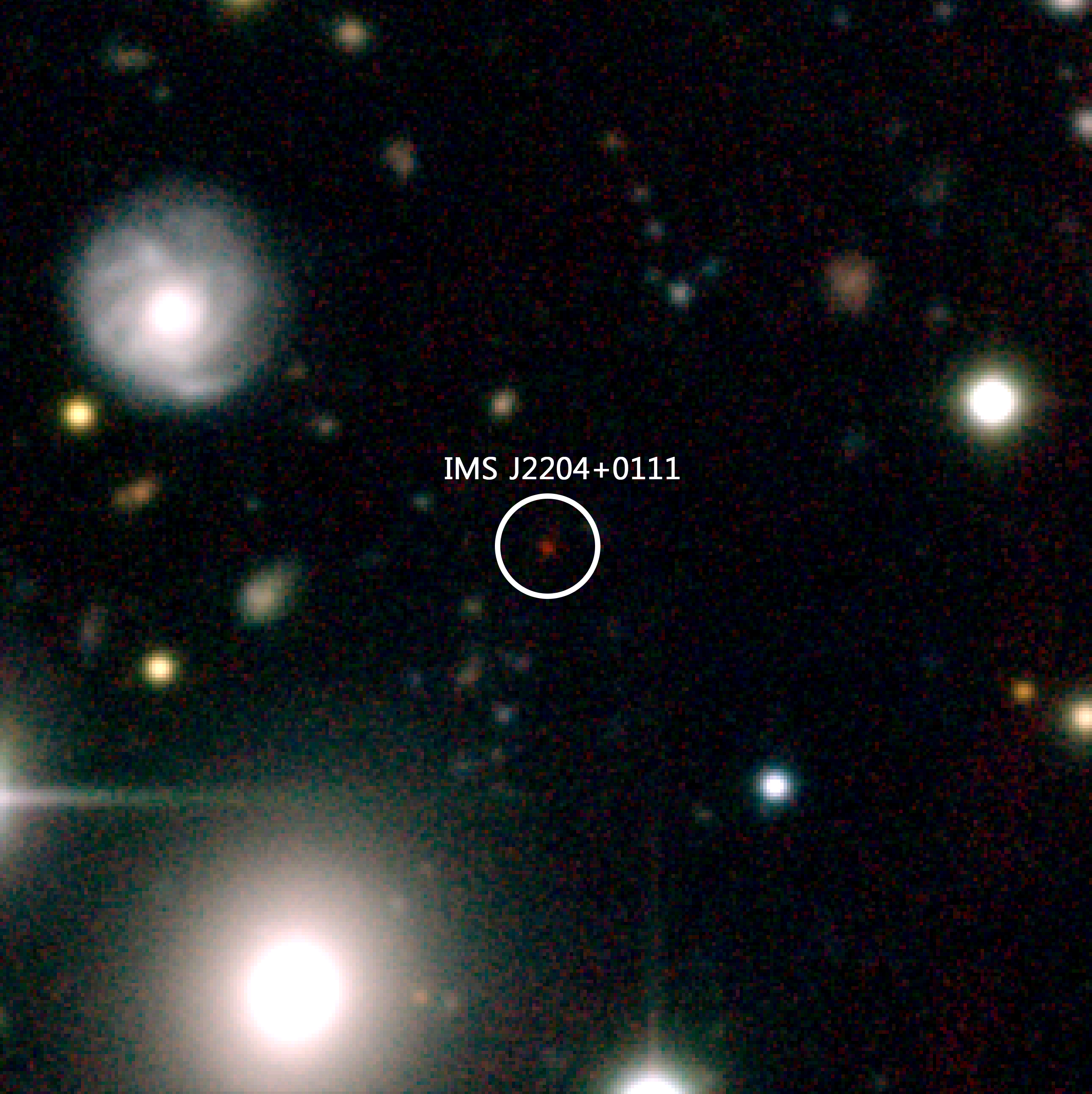
Figure 1. Color composite-image of IMS J2204+0111 at z=6 (about 1 billion years after the Big Bang). IMS J2204+0111 is the red object at the center and its distance from us is 12.8 billion light years. Because of the expansion of the universe, distant objects like IMS J2204+0111 move away from us almost at the speed of the light, making their light to shift into near-infrared wavelength (phenomenon, called “redshift”). This makes them look very red in comparison to other objects, and this special color feature enabled the team to identify distant quasar candidates.  Full resolution JPEG

Figure 2: GMOS spectrum of IMS J2204+0111. A prominent break in the spectrum is visible at the wavelength of about 8500 Å. The feature corresponds to the Hydrogen Lyman-α line which has a wavelength of 1216 Å at rest. It is now shifted to 8500 Å, suggesting that this object is moving away from us at the redshift of 5.944. The sharp break is caused because neutral hydrogen around the quasar absorbed the light at the wavelength below the Lyman-α line.


A team of Korean astronomers discovered a faint quasar in the early Universe which sheds light on the main sources of illumination about 1 billion years after the Big Bang. The team used the Gemini South telescope in Chile, and several telescopes on Maunakea in Hawai‘i, to make the discovery. This is the first published scientific result from the Korean astronomical community since the Korea Astronomy and Space Science Institute (KASI) joined in a limited partnership with Gemini at the beginning of 2015.

The history of objects we see today in the Universe started when the first stars formed a few hundred million years after the Big Bang. However, it has been unclear what types of objects illuminated the intergalactic medium in order to ionize neutral atoms (called the re-ionization of the universe). Quasars, because they are so bright, have been suggested as one of the main “culprits” for the source of re-ionizing energy. Quasars shine when supermassive black holes at the centers of galaxies vigorously accrete gas and stars – they can blaze at up to 100 times the total brightness of their host galaxies. Knowing the number of quasars in the early Universe with moderate luminosity (from about a few to 10 times more luminous than our Milky Way galaxy) can provide an important clue to solving this puzzle, since moderate luminosity quasars dominate the available illumination provided by quasars.

However, moderate luminosity quasars are faint (because they are so distant), and rare, so it is challenging to find them. So far, only two or three such objects have been identified. In order to find moderate luminosity quasars at a redshift of 6 (or about one billion years after the Big Bang), the team performed a moderately wide and deep imaging survey, called the Infrared Medium-deep Survey (IMS) using the data taken with telescopes on Maunakea, including the United Kingdom Infrared Telescope, and the Canada-France-Hawai‘i Telescope. In a subset of these data, the team identified 7 faint quasar candidates. Subsequently, the spectrum of one of these quasars, obtained with the Gemini Multi-Object Spectrograph (GMOS) at the Gemini South telescope in July 2015, revealed that the object is indeed a much sought-after moderate luminosity quasar in the early Universe.

The newly discovered quasar, named as IMS J220417.92+011144.8, is expected to harbor a black hole of about 10 million to 100 million solar masses. Its distance is about 12.8 billion light-years from us. The discovery of IMS J2204+0111 and the statistical results of the survey suggest that quasars can only contribute up to about 10% of the re-ionizing flux in the early Universe. This value is lower than expected and doesn’t provide enough energy to fully account for the re-ionization of the Universe. Additionally, the redshifts of the other quasar candidates are still unknown; if they turn out not to be quasars, this number would be reduced even further. Therefore, it is unlikely that quasars are the dominant sources of illumination in the early Universe: 90% or more of the light must originate from other objects.

The discovery was made possible thanks to the GMOS’s high sensitivity to infrared light where most of the light of such high-redshift quasars is concentrated. This work was carried out by Yongjung Kim (lead author), Myungshin Im (Principal Investigator), and Yiseul Jeon of Seoul National University, Minjin Kim at Korea Astronomy and Space Science Institute, and 14 other collaborators. The result was published in the November 10 issue of The Astrophysical Journal Letters, and the paper is available on the astro-ph.


Wednesday, November 11, 2015

The Glowing Halo of a Zombie Star

Artist’s impression of the glowing disc of material around the white dwarf SDSS J1228+1040
 
Artist’s impression comparing the disc of material around SDSS J1228+1040 and Saturn
 

 PR Image eso1544c
The motions of the material around the white dwarf SDSS J1228+1040 


Videos

Artist’s impression of the glowing disc of material around the white dwarf SDSS J1228+1040
PR Video eso1544a 
Artist’s impression of the glowing disc of material around the white dwarf SDSS J1228+1040


VLT maps out remains of white dwarf’s meal


The remains of a fatal interaction between a dead star and its asteroid supper have been studied in detail for the first time by an international team of astronomers using the Very Large Telescope at ESO’s Paranal Observatory in Chile. This gives a glimpse of the far-future fate of the Solar System.

Led by Christopher Manser, a PhD student at the University of Warwick in the United Kingdom, the team used data from ESO’s Very Large Telescope (VLT) and other observatories to study the shattered remains of an asteroid around a stellar remnant — a white dwarf called SDSS J1228+1040 [1].

Using several instruments, including the Ultraviolet and Visual Echelle Spectrograph (UVES) and X-shooter, both attached to the VLT, the team obtained detailed observations of the light coming from the white dwarf and its surrounding material over an unprecedented period of twelve years between 2003 and 2015. Observations over periods of years were needed to probe the system from multiple viewpoints [2].

“The image we get from the processed data shows us that these systems are truly disc-like, and reveals many structures that we cannot detect in a single snapshot,” explained lead author Christopher Manser.

The team used a technique called Doppler tomography — similar in principle to medical tomographic scans of the human body — which allowed them to map out in detail the structure of the glowing gaseous remains of the dead star’s meal orbiting J1228+1040 for the first time.

While large stars — those more massive than around ten times the mass of the Sun — suffer a spectacularly violent climax as a supernova explosion at the ends of their lives, smaller stars are spared such dramatic fates. When stars like the Sun come to the ends of their lives they exhaust their fuel, expand as red giants and later expel their outer layers into space. The hot and very dense core of the former star — a white dwarf — is all that remains.

But would the planets, asteroids and other bodies in such a system survive this trial by fire? What would be left? The new observations help to answer these questions.

It is rare for white dwarfs to be surrounded by orbiting discs of gaseous material — only seven have ever been found. The team concluded that an asteroid had strayed dangerously close to the dead star and been ripped apart by the immense tidal forces it experienced to form the disc of material that is now visible.

The orbiting disc was formed in similar ways to the photogenic rings seen around planets closer to home, such as Saturn. However, while J1228+1040 is more than seven times smaller in diameter than the ringed planet, it has a mass over 2500 times greater. The team learned that the distance between the white dwarf and its disc is also quite different — Saturn and its rings could comfortably sit in the gap between them [3].

The new long-term study with the VLT has now allowed the team to watch the disc precess under the influence of the very strong gravitational field of the white dwarf. They also find that the disc is somewhat lopsided and has not yet become circular.

“When we discovered this debris disc orbiting the white dwarf back in 2006, we could not have imagined the exquisite details that are now visible in this image, constructed from twelve years of data — it was definitely worth the wait,” added Boris Gänsicke, a co-author of the study.

Remnants such as J1228+1040 can provide key clues to understanding the environments that exist as stars reach the ends of their lives. This can help astronomers to understand the processes that occur in exoplanetary systems and even forecast the fate of the Solar System when the Sun meets its demise in about seven billion years.


Notes

[1] The white dwarf’s full designation is SDSS J122859.93+104032.9.

[2] The team identified the unmistakable trident-like spectral signature from ionised calcium, called the calcium (Ca II) triplet. The difference between the observed and known wavelengths of these three lines can determine the velocity of the gas with considerable precision.

[3] Although the disc around this white dwarf is much bigger than Saturn’s ring system in the Solar System, it is tiny compared to the debris discs that form planets around young stars.


More information

This research was presented in a paper entitled “Doppler-imaging of the planetary debris disc at the white dwarf SDSS J122859.93+104032.9”, by C. Manser et al., to appear in the Monthly Notices of the Royal Astronomical Society.

The team is composed of Christopher Manser (University of Warwick, UK), Boris Gaensicke (University of Warwick), Tom Marsh (University of Warwick), Dimitri Veras (University of Warwick, UK), Detlev Koester (University of Kiel, Germany), Elmé Breedt (University of Warwick), Anna Pala (University of Warwick), Steven Parsons (Universidad de Valparaiso, Chile) and John Southworth (Keele University, UK).

ESO is the foremost intergovernmental astronomy organisation in Europe and the world’s most productive ground-based astronomical observatory by far. It is supported by 16 countries: Austria, Belgium, Brazil, the Czech Republic, Denmark, France, Finland, Germany, Italy, the Netherlands, Poland, Portugal, Spain, Sweden, Switzerland and the United Kingdom, along with the host state of Chile. ESO carries out an ambitious programme focused on the design, construction and operation of powerful ground-based observing facilities enabling astronomers to make important scientific discoveries. ESO also plays a leading role in promoting and organising cooperation in astronomical research. ESO operates three unique world-class observing sites in Chile: La Silla, Paranal and Chajnantor. At Paranal, ESO operates the Very Large Telescope, the world’s most advanced visible-light astronomical observatory and two survey telescopes. VISTA works in the infrared and is the world’s largest survey telescope and the VLT Survey Telescope is the largest telescope designed to exclusively survey the skies in visible light. ESO is a major partner in ALMA, the largest astronomical project in existence. And on Cerro Armazones, close to Paranal, ESO is building the 39-metre European Extremely Large Telescope, the E-ELT, which will become “the world’s biggest eye on the sky”.


Links

Contacts

Christopher Manser
University of Warwick
United Kingdom
Email: C.Manser@warwick.ac.uk

Boris Gänsicke
University of Warwick
United Kingdom
Tel: +44 (0)2476574741
Email: Boris.Gaensicke@warwick.ac.uk

Tom Frew
International Press Officer, University of Warwick
United Kingdom
Tel: +44 (0)24 7657 5910
Cell: +44 (0)7785 433 155
Email: a.t.frew@warwick.ac.uk

Richard Hook
ESO Public Information Officer
Garching bei München, Germany
Tel: +49 89 3200 6655
Cell: +49 151 1537 3591
Email: rhook@eso.org

Source: ESO

Time Delay in Lensed Quasar: First Fast Turnaround Result

30"x30" color composite g+r+i image using data from both Gemini and the NOT, highlighting the three brighter lensed quasar images for which time delays have now been measured. Image C leads all other images of the quasar by several years, and hence predicts the future behaviour. Lensing of quasars is achromatic, but the NOT data (r,i) and Gemini data (g) were taken at different times, and hence image C appears in this composite to be a different color than images A and B. 


A team of Norwegian and US astronomers, using data from Gemini North and the Nordic Optical Telescope (NOT), have measured the time delay in images of a quasar lensed by a foreground cluster of galaxies. The Gemini observations are the first published result obtained with the innovative Fast Turnaround (FT) mode of observing.

A distant quasar may have its light split into multiple images by a foreground galaxy cluster that acts as a gravitational lens. The light travels along different paths of differing lengths to form each of these images. Quasars themselves are intrinsically variable, so the observed fading and brightening of each image happens at different observed times. Measuring these “time delays” yields tight constraints on the mass distribution in the lensing cluster, as well as the lensing geometry, and hence cosmology.

The team monitored the redshift z=2.82 quasar SDSS J2222+2745 over the course of three years, using the NOT and Gemini+GMOS-N. They found a time delay of 48 and 722 days for two pairs of the quasar’s lensed images. The Gemini data were instrumental in refining the time delay measurements for the quasar image that leads the other image by ~ 2 years and hence predicts the behavior of other images of the quasar; continuing monitoring of the system will now allow further observations that take advantage of that 2 year peek into the future.

Under Gemini’s FT mode, users can submit proposals every month and (if accepted) receive data 1-4 months after their initial proposal idea. The mode can be used for any kind of scientifically valuable project that needs just a few hours of observing time. Since the program’s launch in January, it has been used to follow up discoveries of new solar system objects, obtain data sets needed to complete projects, and also for short, self-contained programs. For more information, see the FT web pages: http://www.gemini.edu/sciops/observing-gemini/observing-modes/fast-turnaround.

This work is available on Astro-ph at: http://arxiv.org/abs/1505.06187.

Paper Abstract:

We report first results from an ongoing monitoring campaign to measure time delays between the six images of the quasar SDSS J2222+2745, gravitationally lensed by a galaxy cluster. The time delay between A and B, the two most highly magnified images, is measured to be τAB=47.7±6.0 days (95% confidence interval), consistent with previous model predictions for this lens system. The strong intrinsic variability of the quasar also allows us to derive a time delay value of τCA=722±24 days between image C and A, in spite of modest overlap between their light curves in the current data set. Image C, which is predicted to lead all the other lensed quasar images, has undergone a sharp, monotonic flux increase of 60-75% during 2014. A corresponding brightening is firmly predicted to occur in images A and B during 2016. The amplitude of this rise indicates that time delays involving all six known images in this system, including those of the demagnified central images D-F, will be obtainable from further ground-based monitoring of this system during the next few years.


Tuesday, November 10, 2015

GMRT discovers giant radio galaxy 9 billion light-years away

This is an optical image of J021659-044920 with radio lobes (in yellow-red) supimposed. The supermassive black hole in the red galaxy at the centre (zoomed-in inset) has led to the formation of the giant radio lobes. Image credit: Prathamesh Tamhane/Yogesh Wadadekar.


A team of astronomers working at the National Centre for Radio Astrophysics (NCRA, TIFR), Pune have discovered, using the Giant Metrewave Radio Telescope (GMRT), an extremely rare galaxy of gigantic size. This galaxy — located about 9 billion light-years away towards the constellation Cetus — emits powerful radio waves and has an end-to-end extent of a whopping 4 million light-years. 

Such galaxies with extremely large ‘radio size’ are appropriately called giant radio galaxies.

How do galaxies with an optical size of a hundred thousand light-years produce radio emission several million light-years in extent? It is argued that the presence of a supermassive black hole at the centre of the galaxy drives large scale jets of hot plasma in diametrically opposite directions which eventually give rise to large radio lobes (see the image above). While radio galaxies with size less than a million light-years are common, giant radio galaxies are extremely rare, even more so, at large cosmic distances where only a handful have been discovered so far. This newly discovered galaxy known by its scientific name ‘J021659-044920’ is the newest member of this elite group.


Under some special circumstances, the central black hole may stop producing the radio jet, and then the bright radio lobes fade away, within a few million years, due to lack of replenishment. What makes J021659-044920 special is that it has been caught in this dying phase, where the radio jet appears to have switched off and the radio lobes have started fading. The fading of the lobes is caused by their losing energy in two ways: one, by emitting radio waves which show up as the gigantic radio lobes and two, by transferring energy to photons from the cosmic microwave background via a process known as inverse Compton scattering. This latter mechanism leads to faint X-ray emission, which is seen to emanate from the radio lobes of this galaxy. Such dying radio objects are best studied using a low frequency radio telescope such as the GMRT. The GMRT, the world’s largest radio telescope facility operating at low radio frequencies, is an array of 30 fully steerable, 45-metre diameter antennas, spread out over a 30 kilometre region around Khodad, near Narayangaon town of Pune district in western India. The GMRT was built and is operated by National Centre for Radio Astrophysics of the Tata Institute of Fundamental Research and has been in operation since 2002.

For their analysis, the team combined their GMRT observations with previous observations made with a slew of international ground and space based telescope facilities — XMM-Newton Space Telescope in X-ray, the Japanese Subaru Telescope in optical, UK’s Infrared Telescope in near-infrared, NASA’s Spitzer Space Telescope in mid-infrared and the Jansky Very Large Array (USA) in high frequency radio bands. By using data from multiple telescopes spanning across the electromagnetic spectrum, they were able to carry out a comprehensive and incredibly detailed analysis of the physical conditions around this distant galaxy. The properties of the magnetic field in the region between galaxies in the distant universe can be understood with these observations.

Source: Astronomy Now

Monday, November 09, 2015

Protostar Growth Spurts

Astronomers using ALMA have imaged the episodic outflow of a young protostar known as CARMA-7. The twin jets -- each nearly 2.46 trillion kilometers long -- have distinct gaps, revealing that the star is growing by fits-and-starts. Credit: B. Saxton (NRAO/AUI/NSF); A. Plunkett et al.; ALMA (NRAO/ESO/NAOJ)


Astronomers using the Atacama Large Millimeter/submillimeter Array (ALMA) have discovered an adolescent protostar that is undergoing a rapid-fire succession of growth spurts. Evidence for this fitful youth is seen in a pair of intermittent jets streaming away from the star’s poles.

Known as CARMA-7, the protostar is one of dozens of similar objects in the Serpens South star cluster, which is located approximately 1,400 light-years from Earth. This clutch of nascent stellar objects was first detected by and named for the Combined Array for Research in Millimeter-wave Astronomy (CARMA) telescope.

"This young protostar is undergoing periods of rapid growth separated by periods of relative calm,” said Adele Plunkett, previously a National Science Foundation (NSF) graduate research fellow at Yale University and now a fellow at the European Southern Observatory (ESO) in Chile. "This punctuated stellar formation provides important insights into the chaotic interplay within this tightly packed cluster of young stars.”

All stars form in dense clouds of dust and gas. As material condenses and a star begins to evolve, surrounding material forms a flattened, rotating disk that flows onto its surface. Because of the rotational energy of the material in the disk and with the help of the star’s magnetic field, a portion of that material gets ejected from the star’s poles, forming a pair of jets that can be seen with radio telescopes like ALMA.

In a recent survey of several protostars in the Serpens South region, astronomers were surprised to find one with brilliantly defined jets that seem to turn on-and-off with startling regularity, alternating from one to the other in possibly as little as 100 years. The protostar and its jets are oriented in such a way that the upper jet is mostly moving away from us and the lower jet is mostly moving toward us.

These prominent jets offer an otherwise hidden insight into the environment of the accretion disk surrounding the protostar. Since the accretion process is obscured by the surrounding dust and gas, the outflow is an important observational proxy. However, since many stars are forming in close proximity, astronomers needed powerful ALMA observations to disentangle the chaotic outflow activity.

The ALMA data reveal that there were 22 distinct ejection events associated with the CARMA-7 protostar. These outflows, which travel up to 2.46 trillion kilometers from the protostar, also are impacting the surrounding cluster and intermingling with other jets.

Previous observations were unable to distinguish the outflow from CARMA-7 from the surrounding outflows driven by neighboring protostars. “These sources are so young and embedded and neither optical nor near-infrared light could give a complete picture of the protostar and its outflow,” said Plunkett. “This shows how valuable ALMA is for observing a region like this.”

A paper describing these results is published in the journal Nature.

The National Radio Astronomy Observatory is a facility of the National Science Foundation, operated under cooperative agreement by Associated Universities, Inc.

*  *  *

The Atacama Large Millimeter/submillimeter Array (ALMA), an international astronomy facility, is a partnership of the European Organisation for Astronomical Research in the Southern Hemisphere (ESO), the U.S. National Science Foundation (NSF) and the National Institutes of Natural Sciences (NINS) of Japan in cooperation with the Republic of Chile. ALMA is funded by ESO on behalf of its Member States, by NSF in cooperation with the National Research Council of Canada (NRC) and the National Science Council of Taiwan (NSC) and by NINS in cooperation with the Academia Sinica (AS) in Taiwan and the Korea Astronomy and Space Science Institute (KASI).

ALMA construction and operations are led by ESO on behalf of its Member States; by the National Radio Astronomy Observatory (NRAO), managed by Associated Universities, Inc. (AUI), on behalf of North America; and by the National Astronomical Observatory of Japan (NAOJ) on behalf of East Asia. The Joint ALMA Observatory (JAO) provides the unified leadership and management of the construction, commissioning and operation of ALMA.


Contact: 

Charles Blue
(434) 296-0314
Email: cblue@nrao.edu


Saturday, November 07, 2015

Hubble Uncovers Fading Cinders of Some of Our Galaxy's Earliest Homesteaders

 
White Dwarf Stars in the Milky Way Bulge
Credit for Hubble Images: NASA, ESA, A. Calamida and K. Sahu (STScI), 
and the SWEEPS Science Team. Credit for Ground-based Image: A. Fujii
Object Name: SWEEPS Field


About this image: NASA's Hubble Space Telescope has detected for the first time a population of white dwarfs embedded in the hub of our Milky Way galaxy. The Hubble images are the deepest, most detailed study of the galaxy's central bulge of stars. The smoldering remnants of once-vibrant stars can yield clues to our galaxy's early construction stages that happened long before Earth and our sun formed.

[Left] — This is a ground-based view of the Milky Way’s central bulge, seen in the direction of the constellation Sagittarius. Giant dust clouds block most of the starlight coming from the galactic center. Hubble, however, peered through a region (marked by the arrow) called the Sagittarius Window, which offers a keyhole view into the galaxy's hub.

[Upper right] — This is a small section of Hubble's view of the dense collection of stars crammed together in the galactic bulge. The region surveyed is part of the Sagittarius Window Eclipsing Extrasolar Planet Search (SWEEPS) field and is located 26,000 light-years away.

[Lower right] — Hubble uncovered extremely faint and hot white dwarfs. This is a sample of 4 out of the 70 brightest white dwarfs spied by Hubble in the Milky Way's bulge. Astronomers picked them out based on their faintness, blue-white color, and motion relative to our sun. The numbers in the inset images correspond to the white dwarfs' location in the larger Hubble view.

Hubble's Advanced Camera for Surveys made the observations in 2004 and 2011-2013.


Using NASA's Hubble Space Telescope to conduct a "cosmic archaeological dig" at the very heart of our Milky Way galaxy, astronomers have uncovered the blueprints of our galaxy's early construction phase.

Peering deep into the Milky Way's crowded central hub of stars, Hubble researchers have uncovered for the first time a population of ancient white dwarfs — smoldering remnants of once-vibrant stars that inhabited the core. Finding these relics at last can yield clues to how our galaxy was built, long before Earth and our sun formed.

The observations are the deepest, most detailed study of the galaxy's foundational city structure — its vast central bulge that lies in the middle of a pancake-shaped disk of stars, where our solar system dwells.

As with any archaeological relic, the white dwarfs contain the history of a bygone era. They contain information about the stars that existed about 12 billion years ago that burned out to form the white dwarfs. As these dying embers of once-radiant stars cool, they serve as multi-billion-year-old time pieces that tell astronomers about the Milky Way's groundbreaking years.

An analysis of the Hubble data supports the idea that the Milky Way's bulge formed first and that its stellar inhabitants were born very quickly — in less than roughly 2 billion years. The rest of the galaxy's sprawling disk of second- and third-generation stars grew more slowly in the suburbs, encircling the central bulge like the brim of a giant sombrero.

"It is important to observe the Milky Way's bulge because it is the only bulge we can study in detail," explained Annalisa Calamida of the Space Telescope Science Institute (STScI) in Baltimore, Maryland, the science paper's lead author. "You can see bulges in distant galaxies, but you cannot resolve the very faint stars, such as the white dwarfs. The Milky Way's bulge includes almost a quarter of the galaxy's stellar mass. Characterizing the properties of the bulge stars can then provide important information to understanding the formation of the entire Milky Way galaxy and that of similar, more distant galaxies."

The Hubble survey also found slightly more low-mass stars in the bulge, compared to those in the galaxy's disk population. "This result suggests that the environment in the bulge may have been different than the one in the disk, resulting in a different star-formation mechanism," Calamida said.
The observations were so sensitive that the astronomers also used the data to pick out the feeble glow of white dwarfs. The team based its results on an analysis of 70 of the hottest white dwarfs detectable by Hubble in a small region of the bulge among tens of thousands of stars.

These stellar relics are small and extremely dense. They are about the size of Earth but 200,000 times denser. A teaspoon of white dwarf material would weigh about 15 tons. Their tiny stature makes them so dim that it would be as challenging as looking for the glow of a pocket flashlight located on the moon. Astronomers used the sharp Hubble images to separate the bulge stars from the myriad stars in the foreground of our galaxy's disk by tracking their movements over time. The team accomplished this task by analyzing Hubble images of the same field of 240,000 stars, taken 10 years apart. The long timespan allowed the astronomers to make very precise measurements of the stars' motion and pick out 70,000 bulge stars. The bulge's stellar inhabitants move at a different rate than stars in the disk, allowing the astronomers to identify them.

The region surveyed is part of the Sagittarius Window Eclipsing Extrasolar Planet Search (SWEEPS) field and is located 26,000 light-years away. The unusually dust-free location on the sky offers a keyhole view into the "downtown" bulge. Hubble's Advanced Camera for Surveys made the observations in 2004 and 2011-2013.

"Comparing the positions of the stars from now and 10 years ago we were able to measure accurate motions of the stars," said Kailash Sahu of STScI, the study's leader. "The motions allowed us to tell if they were disk stars, bulge stars, or halo stars."

The astronomers identified the white dwarfs by analyzing the colors of the bulge stars and comparing them with theoretical models. The extremely hot white dwarfs appear bluer relative to sun-like stars. As white dwarfs age, they become cooler and fainter, becoming difficult even for sharp-eyed Hubble to detect.

"These 70 white dwarfs represent the peak of the iceberg," Sahu said. "We estimate that the total number of white dwarfs is about 100,000 in this tiny Hubble view of the bulge. Future telescopes such as NASA's James Webb Space Telescope will allow us to count almost all of the stars in the bulge down to the faintest ones, which today's telescopes, even Hubble, cannot see."

The team next plans to increase their sample of white dwarfs by analyzing other portions of the SWEEPS field. This should ultimately lead to a more precise estimate of the age of the galactic bulge. They might also determine if star formation processes in the bulge billions of years ago were different from what's seen in the younger disk of our galaxy.

The team's results appeared in the Sept. 1, 2015, issue of The Astrophysical Journal. A companion paper appeared in The Astrophysical Journal in 2014.


CONTACT 

Donna Weaver / Ray Villard
Space Telescope Science Institute, Baltimore, Maryland
410-338-4493 / 410-338-4514
dweaver@stsci.edu / villard@stsci.edu

Annalisa Calamida / Kailash Sahu
Space Telescope Science Institute, Baltimore, Maryland
410-338-4341 / 410-338-4930
calamida@stsci.edu / ksahu@stsci.edu


Source: Hubble Site

Friday, November 06, 2015

At the centre of the tuning fork

Credit: ESA/Hubble & NASA and N. Gorin (STScI)
Acknowledgement: Judy Schmidt (http://www.geckzilla.com/)


This galaxy is known as Mrk 820 and is classified as a lenticular galaxy — type S0 on the Hubble Tuning Fork. The Hubble Tuning Fork is used to classify galaxies according to their morphology. Elliptical galaxies look like smooth blobs in the sky and lie on the handle of the fork. They are arranged along the handle based on how elliptical they are, with the more spherical galaxies furthest from the tines of the fork, and the more egg-shaped ones closest to the end of the handle where it divides. The two prongs of the tuning fork represent types of unbarred and barred spiral galaxies.

Lenticular galaxies like Mrk 820 are in the transition zone between ellipticals and spirals and lie right where the fork divides. A closer look at the appearance of Mrk 820 reveals hints of a spiral structure embedded in a circular halo of stars.

Surrounding Mrk 820 in this image is good sampling of other galaxy types, covering almost every type found on the Hubble Tuning Fork, both elliptical and spiral. Most of the smears and specks are distant galaxies, but the prominent bright object at the bottom is a foreground star called TYC 4386-787-1.

A version of this image was entered into the Hubble's Hidden Treasures image processing competition by contestant Judy Schmidt.


NASA's Swift Spots its Thousandth Gamma-ray Burst

GRB 151027B, Swift's 1,000th burst (center), is shown in this composite X-ray, ultraviolet and optical image. X-rays were captured by Swift's X-Ray Telescope, which began observing the field 3.4 minutes after the Burst Alert Telescope detected the blast. Swift's Ultraviolet/Optical Telescope (UVOT) began observations seven seconds later and faintly detected the burst in visible light. The image includes X-rays with energies from 300 to 6,000 electron volts, primarily from the burst, and lower-energy light seen through the UVOT's visible, blue and ultraviolet filters (shown, respectively, in red, green and blue). The image has a cumulative exposure of 10.4 hours. Credits: NASA/Swift/Phil Evans, Univ. of Leicester


NASA's Swift spacecraft has detected its 1,000th gamma-ray burst (GRB). GRBs are the most powerful explosions in the universe, typically associated with the collapse of a massive star and the birth of a black hole.

"Detecting GRBs is Swift's bread and butter, and we're now at 1,000 and counting," said Neil Gehrels, the Swift principal investigator at NASA's Goddard Space Flight Center in Greenbelt, Maryland. "The spacecraft remains in great shape after nearly 11 years in space, and we expect to see many more GRBs to come."

A GRB is a fleeting blast of high-energy light, often lasting a minute or less, occurring somewhere in the sky every couple of days. Scientists are looking for exceptional bursts that offer the deepest insights into the extreme physical processes at work.

This illustration shows the ingredients of the most common type of gamma-ray burst. The core of a massive star (left) has collapsed, forming a black hole that sends a jet moving through the collapsing star and out into space at near the speed of light. Radiation across the spectrum arises from hot ionized gas in the vicinity of the newborn black hole, collisions among shells of fast-moving gas within the jet, and from the leading edge of the jet as it sweeps up and interacts with its surroundings. Credits: NASA's Goddard Space Flight Center.


Shortly before 6:41 p.m. EDT on Oct. 27, Swift's Burst Alert Telescope detected the 1,000th GRB as a sudden pulse of gamma rays arising from a location toward the constellation Eridanus. Astronomers dubbed the event GRB 151027B, after the detection date and the fact that it was the second burst of the day. Swift automatically determined its location, broadcast the position to astronomers around the world, and turned to investigate the source with its own sensitive X-ray, ultraviolet and optical telescopes.

Astronomers classify GRBs by their duration. Like GRB 151027B, roughly 90 percent of bursts are of the "long" variety, where the gamma-ray pulse lasts more than two seconds. They are believed to occur in a massive star whose core has run out of fuel and collapsed into a black hole. As matter falls toward the newly formed black hole, it launches jets of subatomic particles that move out through the star's outer layers at nearly the speed of light. When the particle jets reach the stellar surface, they emit gamma rays, the most energetic form of light. In many cases, the star is later seen to explode as a supernova.

"Short" bursts last less than two seconds -- and sometimes just thousandths of a second. Swift observations provide strong evidence these events are caused by mergers of orbiting neutron stars or black holes.

Once a GRB is identified, the race is on to observe its fading light with as many instruments as possible. Based on alerts from Swift, robotic observatories and human-operated telescopes turn to the blast site to measure its rapidly fading afterglow, which emits X-rays, ultraviolet, visible and infrared light, and radio waves. While optical afterglows are generally faint, they can briefly become bright enough to be seen with the unaided eye.

"Over the years, astronomers have constantly refined their techniques to get their telescopes onto the burst site in the shortest possible time," said John Nousek, Swift’s director of mission operations and a professor of astronomy and astrophysics at Penn State University in University Park, Pennsylvania. "In fact, the process to follow up Swift GRB alerts is as productive as ever."

GRB 151027B provides a perfect example. Five hours after the Swift alert, the burst location first became visible from the European Southern Observatory (ESO) in Paranal, Chile. There a team led by Dong Xu of the Chinese National Astronomical Observatories in Beijing captured the afterglow's visible light using the Very Large Telescope's X-shooter spectrograph. The ESO observations show that light from the burst had been traveling to us for more than 12 billion years, placing it in the most distant few percent of GRBs Swift has recorded.

Astronomers now have distance measurements for about 30 percent of Swift GRBs, which makes it possible to investigate how these powerful events are distributed across space and time. The distance record is held by GRB 090429B, which exploded at the dawn of star formation in the universe. Its light took more than 13 billion years to reach Earth.   

This illustration shows the positions of 1,000 Swift GRBs on an all-sky map oriented so that the plane of our galaxy, the Milky Way, runs across the center. Bursts are color coded by year, and the location of GRB 151027B is shown at lower right. An annual tally of the number of bursts Swift has detected appears below the label for each year. Background: An infrared view from the Two Micron All-Sky Survey. Credits: NASA's Goddard Space Flight Center and 2MASS/J. Carpenter, T. H. Jarrett, and R. Hurt


In addition to its GRB studies, Swift conducts multiwavelength observations of a wide array of astrophysical phenomena, from nearby comets and asteroids to faraway quasars and blazars, galaxies where supermassive black holes produce unpredictable high-energy flares.  

"Swift is an amazingly versatile observatory, with gamma-ray burst detections every week, target-of-opportunity observations every day, and with a vast users' community covering all fields of astronomy," said Patrizia Caraveo, director of research at the Italian National Institute for Astrophysics in Milan and a co-investigator on Swift.

"Swift has been a fabulous discovery machine, finding previously unknown types of outbursts from stars, galaxies and from gamma-ray bursts themselves," said Julian Osborne, who leads the U.K. Swift team at the University of Leicester. "It's great to see our national contributions to the mission's X-ray and UV/optical telescopes having such a big impact."

With new types of astronomical observatories ramping up, Swift is poised to take on a new role. Ghostly particles called neutrinos have been detected from outside the solar system, and soon astronomers expect that gravitational wave observatories will detect the first ripples in space-time, a phenomenon predicted by Einstein's relativity theory. Swift scientists plan to use the satellite's capabilities to search for high-energy light associated with neutrino and gravitational wave sources.

Swift was launched on Nov. 20, 2004. Managed by NASA Goddard, the mission is operated in collaboration with Penn State, the Los Alamos National Laboratory in New Mexico, and Orbital Sciences Corporation in Dulles, Virginia. Other partners include the University of Leicester and Mullard Space Science Laboratory in the United Kingdom, Brera Observatory and the Italian Space Agency in Italy, with additional contributions from Germany and Japan.

Francis Reddy
NASA's Goddard Space Flight Center, Greenbelt, Maryland


Source: NASA/Swift

Thursday, November 05, 2015

Whopping Galaxy Cluster Spotted with Help of NASA Telescopes

The galaxy cluster called MOO J1142+1527 can be seen here as it existed when light left it 8.5 billion years ago. The red galaxies at the center of the image make up the heart of the galaxy cluster. Image credit: NASA/JPL-Caltech/Gemini/CARMA.  › Full image and caption


Astronomers have discovered a giant gathering of galaxies in a very remote part of the universe, thanks to NASA's Spitzer Space Telescope and Wide-field Infrared Survey Explorer (WISE). The galaxy cluster, located 8.5 billion light-years away, is the most massive structure yet found at such great distances.

Galaxy clusters are gravitationally bound groups of thousands of galaxies, which themselves each contain hundreds of billions of stars. The clusters grow bigger and bigger over time as they acquire new members.

How did these clusters evolve over time? What did they look like billions of years ago? To answer these questions, astronomers look back in time to our youthful universe. Because light takes time to reach us, we can see very distant objects as they were in the past. For example, we are seeing the newfound galaxy cluster -- called Massive Overdense Object (MOO) J1142+1527 -- as it existed 8.5 billion years ago, long before Earth formed.

As light from remote galaxies makes its way to us, it becomes stretched to longer, infrared wavelengths by the expansion of space. That's where WISE and Spitzer help out.

For infrared space telescopes, picking out distant galaxies is like plucking ripe cherries from a cherry tree. In the infrared images produced by Spitzer, these distant galaxies stand out as red dots, while closer galaxies look white. Astronomers first combed through the WISE catalog to find candidates for clusters of distant galaxies. WISE catalogued hundreds of millions of objects in images taken over the entire sky from 2010 to 2011.

They then used Spitzer to narrow in on 200 of the most interesting objects, in a project named the "Massive and Distant Clusters of WISE Survey," or MaDCoWS. Spitzer doesn't observe the whole sky like WISE, but can see more detail.

"It's the combination of Spitzer and WISE that lets us go from a quarter billion objects down to the most massive galaxy clusters in the sky," said Anthony Gonzalez of the University of Florida in Gainesville, lead author of a new study published in the Oct. 20 issue of the Astrophysical Journal Letters.

From these observations, MOO J1142+1527 jumped out as one of the most extreme.

The W.M. Keck Observatories and Gemini Observatory on Mauna Kea in Hawaii were used to measure the distance to the cluster at 8.5 billion light-years. Using data from the Combined Array for Research in Millimeter-wave Astronomy (CARMA) telescopes near Owens Valley in California, the scientists were then able to determine that the cluster's mass is a quadrillion times that of our sun -- making it the most massive known cluster that far back in space and time.
MOO J1142+1527 may be one of only a handful of clusters of this heft in the early universe, according to the scientists' estimates.

"Based on our understanding of how galaxy clusters grow from the very beginning of our universe, this cluster should be one of the five most massive in existence at that time," said co-author Peter Eisenhardt, the project scientist for WISE at NASA's Jet Propulsion Laboratory in Pasadena, California.

In the coming year, the team plans to sift through more than 1,700 additional galaxy cluster candidates with Spitzer, looking for biggest of the bunch.

"Once we find the most massive clusters, we can start to investigate how galaxies evolved in these extreme environments," said Gonzalez.

JPL managed and operated WISE for NASA's Science Mission Directorate in Washington. In September 2013, WISE was reactivated, renamed NEOWISE and assigned a new mission to assist NASA's efforts to identify potentially hazardous near-Earth objects. JPL manages the Spitzer Space Telescope mission for NASA's Science Mission Directorate, Washington. Science operations and data processing for Spitzer and NEOWISE take place at the Infrared Processing and Analysis Center at the California Institute of Technology in Pasadena. Caltech manages JPL for NASA.


More information about WISE is online at:  http://www.nasa.gov/wise

More information about Spitzer is online at:  http://www.nasa.gov/spitzer - http://spitzer.caltech.edu


Media Contact

Whitney Clavin
Jet Propulsion Laboratory, Pasadena, California
818-354-4673

whitney.clavin@jpl.nasa.gov

Source: JPl-Caltech

Wednesday, November 04, 2015

Disk Gaps Don't Always Signal Planets

This artist's concept illustrates a solar system that is a much younger version of our own. Dusty disks, like the one shown here circling the star, are the breeding grounds of planets. When visible or near-infrared observations show a gap in a disk like this, it is often interpreted as evidence for an unseen planet. However, new research shows that a gap could be a sort of cosmic illusion and not the sign of a hidden planet after all.
NASA/JPL-Caltech/T. Pyle (SSC). High Resolution (jpg) - Low Resolution (jpg)


Cambridge, MA - When astronomers study protoplanetary disks of gas and dust that surround young stars, they sometimes spot a dark gap like the Cassini division in Saturn's rings. It has been suggested that any gap must be caused by an unseen planet that formed in the disk and carved out material from its surroundings. However, new research shows that a gap could be a sort of cosmic illusion and not the sign of a hidden planet after all.

"If we don't see light scattered from the disk, it doesn't necessarily mean that nothing is there," says lead author Til Birnstiel (Max Planck Institute for Astronomy), who conducted the research while at the Harvard-Smithsonian Center for Astrophysics (CfA).

The researchers studied disks that shine in visible or near-infrared wavelengths due to scattered, or reflected, light. (In contrast, radio or millimeter telescopes pick up emission directly from the disk itself.)

Scattered light comes from starlight that bounces off tiny particles about the size of cigarette smoke. Those particles initially suffuse the protoplanetary disk, but undergo changes over time.

Small particles can clump together to form larger and larger objects, eventually growing into full-fledged planets. However, when particles collide they sometimes break apart instead of sticking together. Particles can also move closer to or farther from the star in a process called migration. The team modeled these processes using the Smithsonian's Hydra supercomputer cluster.

"Growth, migration and destruction can have tangible, observable effects," explains co-author Sean Andrews of the CfA. "Specifically, these processes can create an apparent gap in the disk when the small particles that scatter light are cleared away, even though larger particles still remain."

Birnstiel offers the analogy, "Throwing a stone in the air doesn't obstruct my view, but throwing a handful of dust in the air does. Similarly, as small particles grow bigger in some areas of the disk, they don't obstruct our view any more and those regions appear empty."v So how can astronomers tell if a gap in a protoplanetary disk is real, or simply an area where pebbles reign and dust is gone? The key is to make observations at longer wavelengths of light that can pick up the pebbles.

To that end, the team will conduct observations of a well-known example of a disk with a gap, TW Hydrae, with the Atacama Large Millimeter/submillimeter Array (ALMA). If they find large grains within the apparent gap, that will suggest there is no planet. However, if the gap appears empty in these observations as well, then the evidence will be stronger for the existence of an unseen planet.

This work has been published in the Astrophysical Journal Letters.

Headquartered in Cambridge, Mass., the Harvard-Smithsonian Center for Astrophysics (CfA) is a joint collaboration between the Smithsonian Astrophysical Observatory and the Harvard College Observatory. CfA scientists, organized into six research divisions, study the origin, evolution and ultimate fate of the universe.

For more information, contact:

Christine Pulliam
Media Relations Manager
Harvard-Smithsonian Center for Astrophysics
617-495-7463
cpulliam@cfa.harvard.edu


Tuesday, November 03, 2015

The Distribution of Atomic Hydrogen in Simulated Galaxies

In simulated galaxies of the hydrodynamical cosmological “EAGLE” simulation the distribution of atomic hydrogen agrees with observations in unprecedented detail. This success means that EAGLE can aid astrophysicists to better understand the processes shaping real galaxies, such as the origin of their atomic hydrogen. EAGLE is not quite perfect, however: the study also found that some simulated galaxies contain unphysically large holes in their atomic hydrogen discs, meaning further work for simulators to improve the models underlying the treatment of supernova explosions and the interstellar matter.


Atomic hydrogen (abbreviated as “H I”) is an important component of galaxies, it is believed to feed the dense ‘interstellar matter’ from which stars can form. Although invisible to optical telescopes, astronomers have been able to make ever more accurate observations of this gas component using radio telescopes: this has revealed, for instance, that galaxies with the same stellar mass can differ in their H I content by more than an order of magnitude. By combining several radio antennas into one `supertelescope’ with the aid of interferometry it has also become possible to create high resolution maps showing the distribution of atomic hydrogen within individual galaxies (for an example, see Fig. 1).

But despite this wealth of observational data, astronomers are still puzzled by the question of why some galaxies contain so much more H I than others, and especially why `normal’ and `H I-rich’ galaxies still appear to follow common relations, as shown recently by the MPA-led “Bluedisk” project (see monthly highlights May 2013 and March 2014). A fundamental problem is that galaxies only evolve over periods of many millions of years, so that it is impossible to directly observe how the H I reservoir is built up. Instead, astronomers have to try and answer this question with the aid of models and simulations.


Fig. 2:  Gas in the large EAGLE simulation. Blue represents “cold” gas (T greater then 30,000 K), green warm, and red the hottest gas with T > 300,000 K. The small insets zoom in towards a single galaxy, highlighting the huge dynamic range of the simulation. © Richard Bower / James Trayford, ICC Durham


An international collaboration has recently completed the “EAGLE” simulation of galaxies which matches observed galaxies in several properties such as their stellar mass and size with unprecedented accuracy (see Fig. 2). A research team led by MPA scientist Yannick Bahe has now studied how well these simulated galaxies agree with real ones in terms of their atomic hydrogen content: an important test for the simulation model, which also determines whether EAGLE can give trustworthy clues on the evolution of H I in real galaxies.

To make this comparison, the scientists first had to post-process the simulation and calculate how much of the hydrogen in each simulation particle is actually atomic, i.e. not ionised or molecular. Once this was done, the total mass of H I in over 2000 simulated galaxies could be computed and compared to observational data from the “GASS” project. The resulting match between simulation and data is extremely good: it represents a significant improvement compared to previous simulations and indicates that the models used in EAGLE provide a reasonable description of the physical processes involved in forming galaxies.

Fig. 3:  The surface density of atomic hydrogen, plotted against distance from the galaxy centre. Yellow and blue bands show data from the “Bluedisk” project, comparing galaxies with normal (yellow) and exceptionally high (blue) total atomic hydrogen content. Red and green circles show simulated galaxies from EAGLE in the same categories. © MPA

 
Motivated by this initial success, the scientists tested the EAGLE simulations in more detail by comparing not just the total mass of H I, but also its distribution within galaxies to observations. The above-mentioned “Bluedisk” project has shown that this distribution is surprisingly independent of the total mass of H I as long as the galaxies’ H I discs are scaled to a common size (so called “self-similarity”). For an accurate comparison, the team now ‘observed’ the EAGLE galaxies in the same way as was done in Bluedisk. As can be seen in Fig. 3, both agree surprisingly well: EAGLE reproduces both the self-similarity between ‘normal’ and ‘H I-rich’ galaxies (red and green symbols in Fig. 3) and the detailed shape of the surface density profile – at least in the outer parts of the simulated galaxies.

In the central regions, however, EAGLE galaxies typically contain not enough atomic hydrogen. To test this discrepancy further, the scientists inspected more than 2000 images of the simulated galaxies, which finally gave the crucial clue: many simulated galaxies contain ‘holes’ in their hydrogen discs that are much larger than what is seen in observations. Once all simulated galaxies showing these large holes were excluded, the density profiles matched observations almost perfectly even in the centre.

Fig. 4:  Synthetic image showing atomic hydrogen in a simulated galaxy, in analogy to Fig. 1. 
Clearly visible are a number of large holes in the hydrogen disc. © MPA


Why, now, do some EAGLE galaxies contain these large holes? The scientists have not yet found a definitive answer, but it is likely that the way in which supernova explosions are modelled in the simulation plays a major role. This critical part of galaxy formation is still causing headaches for simulators: to include them in galaxy simulations in a fully self-consistent fashion, the resolution of the simulations would need to go up by many orders of magnitude. This will be, regrettably, impossible for a long time to come – even the biggest supercomputers today are just not big enough (see also highlight August 2015). As a result, EAGLE has to resort to using a highly simplified model for the effects of such supernovae. Another simplified model has to be employed for the dense interstellar matter, because a resolution level that would allow a fully self-consistent treatment can also not yet be achieved in simulations of a representative portion of the Universe. Although these simplified models produce galaxies which are realistic in many ways – such as their size – they do leave a noticeable artefact in some of the simulated hydrogen discs: the large holes discovered by the researchers.

It is therefore an important challenge for astrophysicists to optimise both the simulation codes and the models in such a way that – in conjunction with continually more powerful supercomputers – a self-consistent treatment of the dense interstellar medium can be achieved. Combined with improved supernova models, these future simulations will, hopefully, produce galaxies that match the real Universe even better than EAGLE does. However, the current study also demonstrates that EAGLE can already give valuable insight into the evolution of atomic hydrogen in galaxies. In a follow-up project, the researchers will examine the formation of the simulated galaxies to find out how and why some of them got so much more hydrogen than others.

 
Bahe, Yannick
Author: Bahe, Yannick


Monday, November 02, 2015

Worlds within Worlds: Hubble Peels Back the Layers of a Warm Neptune

Take Neptune for example. For many years, especially since 1989 when Voyager 2 flew past Neptune and measured its gravity field, astronomers have known that the blue giant harbors a secret world inside. Hidden deep below the azure cloud tops lies a rocky core not much larger than Earth. Uranus has one, too! These “worlds within worlds” could have exotic properties including scorching hot oceans and diamond rain.

If only researchers could peel back the clouds for a closer look….

Astronomers using NASA’s Hubble Space Telescope have discovered an immense cloud of hydrogen evaporating from a Neptune-sized planet named GJ 436b. The planet’s atmosphere is evaporating because of extreme irradiation from its parent star. Sciencecast Video


About 30 light years away, a Neptune-sized planetis having some of its layers peeled back.

Astronomers using NASA’s Hubble Space Telescope have discovered an immense cloud of hydrogen evaporating from a Neptune-sized planet named GJ 436b.

“This cloud is spectacular,” says the study’s leader, David Ehrenreich of the Observatory of the University of Geneva in Switzerland. “The research team has nicknamed it ‘The Behemoth.’”

The planet’s atmosphere is evaporating because of extreme irradiation from its parent star—a process that might have been even more intense in the past.

“The parent star, which is a faint red dwarf, was once more active,” says Ehrenreich. “This means that the planet’s atmosphere evaporated faster during its first billion years of existence. Overall, we estimate that the planet may have lost up to 10 percent of its atmosphere.”

GJ 436b is considered to be a “Warm Neptune” because of its size and because it is much closer to its parent star than Neptune is to our own sun. Orbiting at a distance of less than 3 million miles, It whips around the central red dwarf in just 2.6 Earth days. For comparison, the Earth is 93 million miles from the sun and orbits it every 365.24 days.

Systems like GJ 436b could explain the existence of so-called “Hot Super-Earths.”

“Hot Super-Earths” are larger, hotter versions of our own planet. Space telescopes such as NASA’s Kepler and the French led CoRoT have discovered hundredsof them orbiting distant stars. The existence of The Behemoth suggests that Hot Super-Earths could be the remnants of Warm Neptunes that completely lost their gaseous atmospheres to evaporation.

Finding a cloud around GJ 436b required Hubble’s ultraviolet vision. Earth’s atmosphere blocks most ultraviolet light so only a space telescope like Hubble could make the crucial observations.

“You would not see The Behemoth in visible wavelengths because it is optically transparent,” says Ehrenreich. On the other hand, it is opaque to UV rays. “So when you turn the ultraviolet eye of Hubble onto the system, it’s really kind of a transformation because the planet turns into a monstrous thing.”

The ultraviolet technique could be a game-changer in exoplanet studies, he adds. Ehrenreich expects that astronomers will find thousands of Warm Neptunes and Super-Earths in the years ahead. 

Astronomers will want to examine them for evidence of evaporation. Moreover, the ultraviolet technique might be able to spot the signature of oceans evaporating on Earth-like planets, shedding new light on worlds akin to our own.

Maybe you can’t judge a book by its cover, but you can judge a planet by its Behemoth.


Sunday, November 01, 2015

The Minimum Mass of a Proto-Solar System Disk

 
An image of the young star forming region IC348 in Perseus (about 2-3 million years old) as seen by the infrared cameras onboard the Spitzer Space Telescope. Astronomers studying the birth of solar systems have found thirteen stars in this complex with detectable disks, none of which is as massive as the early Solar system's disk.  Credit:NASA, ESA, J. Muzerolle (STScI), E. Furlan (NOAO and Caltech), K. Flaherty (Univ. of Arizona/Steward Observatory), Z. Balog (Max Planck Institute for Astronomy), and R. Gutermuth (Univ. of Massachusetts, Amherst)


Astronomers estimate that at the time the Solar system formed, its proto-planetary disk contained the equivalent of about twenty Jupiter-masses of gas and dust. This so-called "minimum mass solar nebula (MMSN)" is derived from the current masses of the rocky planets and calculations of how they formed; a minimum mass is used in case the planet formation mechanism is somehow less efficient than expected. (Some earlier estimates had MMSN values up to about 100 Jupiter-masses.) As a nebula ages and its planets develop, its disk mass naturally decreases; current models estimate that a planetary system can form in under five million years.

CfA astronomer Sean Andrews and his colleagues have been studying the early stages of planet-forming nebulae around other stars using the fact that such disks are cool and emit radiation primarily in the infrared and submillimeter regimes. The team used the submillimeter camera on the James Clerk Maxwell Telescope in Hawaii to map the emitting dust in a cluster of young stars known as IC348 located in the Perseus molecular cloud about a thousand light-years away from us. The cluster is estimated to be about two to three million years old, and its planetary systems should therefore be partially developed.

The scientists found thirteen submillimeter point sources in the cloud indicative of disks, in a total population of about three hundred and seventy known objects. From its emitted luminosity the scientists can estimate the mass of a disk, and they find these disks range in size between 1.5 and 16 Jupiter-masses -- smaller than a MMSN. Their results imply that disks as massive as the early solar system's are, at least by this age, very rare. Furthermore, expecting that the undetected sources all have smaller and fainter disks, the team combined the observations of all the sources to estimate what the average disk mass was: one-half a Jupiter-mass. The astronomers conclude that fewer than about 1% of stars have a MMSN disk. If most disks start off with the solar minimum mass value, therefore, they must have evolved very rapidly in order to have depleted most of the mass after a few millions years.


Reference(s):


"A SCUBA-2 850-μm Survey of Protoplanetary Discs in the IC 348 Cluster," L. Cieza, J. Williams, E. Kourkchi, S. Andrews, S. Casassus, S. Graves, and M. R. Schreiber, MNRAS 454, 1909, 2015.